Brand Entity: How Your Brand Becomes “Real” to Google
Remember getting a library card as a kid? Suddenly you weren’t just “some kid” anymore. You were in the system. You had a card. You were REAL to the library. That’s basically what happens when your brand becomes an entity to Google.
What is a Brand Entity? (The Simple Version)
A brand entity is when Google’s AI brain says, “Yep, this brand is real and I know exactly what it is.” Think of it like Google keeping a giant notebook of all the real companies and brands it trusts. Your brand isn’t just words on a website anymore. It’s an actual THING in Google’s memory—with a name, facts about it, and connections to other things. Just like how you know McDonald’s sells burgers (not books), Google’s AI knows your brand and what makes it special.
How Does Brand Entity Work?
Google checks if you’re real by looking for you in lots of places. It’s like a teacher calling three different friends to make sure you’re actually sick and not faking it. Google looks at your website, checks if Wikipedia mentions you, sees if news sites talk about you, and checks your social media. If all these places tell the same story about who you are, Google goes, “OK, this brand checks out!” Then Google adds you to its Knowledge Graph—a fancy term for its big database of real things. Now when someone searches for your brand, Google knows EXACTLY what to show them.
Why Does Brand Entity Matter?
When you have strong brand entity status, Google trusts you more. It’s like being the kid in class who always turns in homework on time. The teacher starts believing whatever you say. When Google recognizes your brand as an entity, you show up better in search results. Your information appears in those cool knowledge panels on the side. Google might even answer questions about you directly. Without entity status, you’re just words on a page competing with everyone else.
Brand Entity at a Glance
| Feature | Details |
| What It Is | How AI systems recognize your brand as a distinct, real thing |
| How It’s Verified | Google checks multiple sources: your site, Wikipedia, news, social media |
| Where It Lives | In Knowledge Graphs and AI knowledge systems |
| Different From | Traditional SEO that focuses on keywords instead of brand recognition |
| Main Benefit | Better search visibility and AI trust in your brand |
Real-World Examples
Say you own “Happy Paws Pet Store.” Right now, you might just be a website with pet supplies. But once you get mentioned in local news, set up verified social profiles, add proper structured data to your site, and maybe get a Wikipedia entry (if you’re big enough), Google starts recognizing Happy Paws as an actual pet store brand. Not just random words. A real business. Another example: when someone types “Nike,” Google doesn’t just see the letters N-I-K-E. It knows Nike is a shoe company, founded in 1964, with stores worldwide. That’s entity recognition in action. Your local coffee shop can achieve the same thing (on a smaller scale) by being consistent everywhere online.
FAQs
Q1: What’s the difference between a brand entity and regular SEO?
Regular SEO focuses on ranking for specific keywords. Brand entity is about making your whole brand recognizable and trustworthy to AI systems. It’s the difference between competing for “best pizza” versus being known AS a pizza restaurant.
Q2: How does Google verify my brand is real?
Google looks for your brand across multiple trustworthy sources. Your official website, news mentions, social media profiles, business directories, and structured data all help. Consistency across these sources proves you’re legitimate.
Q3: Can small businesses become brand entities?
Absolutely! You don’t need to be huge. Even local businesses can achieve entity status by maintaining consistent information across directories, having a solid website with structured data, and earning mentions from local sources.
Q4: Is this related to AI search and chatbots?
Yes! When chatbots like ChatGPT or Google’s AI answer questions about brands, they rely on entity data. If your brand has strong entity recognition, AI systems are more likely to mention you accurately.
Wrapping Up
Getting your brand recognized as an entity is like getting that library card—you’re officially in the system. Google’s AI knows you’re real, trusts you, and can tell people about you. Pretty cool, right?
Latest Blogs
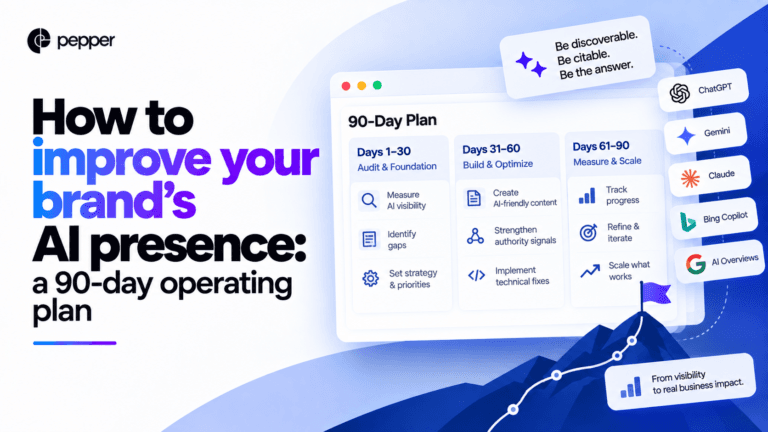
Most 90-day AI plans are sequenced by how hard the work feels rather than by how long it takes to land. So they spend week one on an llms.txt file that Google states it does not use, and they schedule earned media for phase three, which guarantees no result inside the quarter. This plan inverts that. It orders the work by lead time, starts the slowest thing on day one, and cuts four tactics Google explicitly says are unnecessary.
We priced this category nine days ago. Today we went back to the same four pricing pages to check the numbers before publishing. Three of the four had changed, and two had stopped publishing prices altogether. That is the real answer to what AEO costs in 2026: not a number, but a meter that moves, measured in prompts and responses and engines that are billed separately. Here is how each pricing model works, what unit it charges you for, and which incentive that unit creates.
Ask what AI search traffic is worth and you will be handed a multiplier. The ones in circulation right now run from 13% worse than organic search to 23 times better, a spread of roughly twenty-six fold on the single input your whole business case depends on. They disagree because they are measuring the same behaviour under different attribution models. So this is not a guide to finding the right multiplier. It is a guide to building a model whose assumptions are visible, and to being honest about the half you cannot prove.
Get your hands on the latest news!

Similar Posts
Artificial Intelligence
16 mins read
How to improve your brand’s AI presence: a 90-day operating plan
Artificial Intelligence
16 mins read
What does AEO cost in 2026? Pricing models explained
Artificial Intelligence
17 mins read