What is Bytespider? The Web Crawler That Breaks the Rules
Ever had someone walk into your house and take pictures of everything without asking? That’s kind of what Bytespider does to websites.
What is Bytespider? (The Simple Version)
Bytespider is a robot that visits websites and copies everything it sees. It works for ByteDance, the company that owns TikTok. Think of it as a super-fast reader who visits millions of websites every day, taking notes on everything.
Here’s the thing: most website-reading robots follow polite rules. They check a special file called robots.txt (think of it as a “Please Don’t Enter” sign). Bytespider ignores these signs completely. It walks right in and takes what it wants.
Why does it do this? ByteDance uses all that copied content to teach its AI brain called Doubao, which is their version of ChatGPT. The more websites Bytespider reads, the smarter Doubao gets.
How Does Bytespider Work?
Picture a library where someone photocopies every single book without permission. That’s Bytespider in action.
First, Bytespider picks a website to visit. Then it reads every page it can find, copying the text, images, and information. It saves all this stuff and sends it back to ByteDance’s computers (which run on Amazon’s servers).
Here’s a real example: One company checked their website traffic and found something shocking. Nearly 90% of all the robot visitors copying their content were Bytespider. All the other AI bots combined (like the ones from Google and OpenAI) made up just 10%. Bytespider was hogging the whole playground.
The robot visits so many pages so quickly that it can slow down websites, kind of like too many kids trying to go down the same slide at once.
Why Does Bytespider Matter?
If you run a website, Bytespider costs you money. Every time it visits, your server has to work harder, using electricity and computing power. Some companies found they could cut their server bills just by blocking Bytespider. Sites that take steady crawler traffic often end up on a virtual private server instead, where the resources are yours to scale rather than shared with everyone else on the machine.
Plus, your content gets used to train AI that might compete with you. If you write articles for a living, Bytespider might copy them to teach Doubao how to write similar articles. You did the work, but you don’t get paid for helping train the AI.
Bytespider at a Glance
| Feature | Details |
| Owner | ByteDance (TikTok’s parent company) |
| Purpose | Collects data to train Doubao AI and improve ByteDance products |
| Robots.txt Compliance | Zero – completely ignores website restrictions |
| Traffic Volume | Accounts for ~90% of AI crawler traffic on some sites |
| Infrastructure | Runs on Amazon AWS servers globally |
| Main Use | Training large language models (LLMs) for ChatGPT competitor |
Real-World Examples
A website owner noticed their server was struggling. When they checked the logs, they found Bytespider visiting thousands of pages every hour. After blocking it, their server costs dropped noticeably.
Another company compared different AI bots. Googlebot politely checked their robots.txt file and stayed away from restricted areas. GPTBot from OpenAI did the same. But Bytespider? It ignored every restriction and crawled everywhere.
Some websites now block Bytespider entirely using firewall rules. It’s like putting up a fence that only keeps out one specific visitor.
FAQs
Q1: What is Bytespider used for?
Bytespider collects website content to train ByteDance’s AI systems, especially Doubao (their ChatGPT competitor). It also helps improve search and recommendations across TikTok and other ByteDance platforms.
Q2: Does Bytespider respect robots.txt files?
No. Unlike most legitimate crawlers, Bytespider completely ignores robots.txt instructions. This means it crawls areas of websites that owners have specifically marked as off-limits.
Q3: Is Bytespider harmful to my website?
It’s not malicious like a virus, but it’s aggressive. It creates heavy server load that can slow your site and increase hosting costs. Many site owners choose to block it for this reason.
Q4: How can I block Bytespider from my site?
You can block it using your website’s firewall or server configuration. Block the user-agent “Bytespider” or use IP blocking (though IPs change). Robots.txt won’t work since Bytespider ignores it.
Wrapping Up
Bytespider is the rule-breaking robot of the web crawler world. While it helps TikTok’s parent company build smarter AI, it does so by ignoring the polite rules most other bots follow. Now you know why so many websites are showing it the door.
Latest Blogs
Every agency lists the same dozen services. Almost none of them tells you how much of each you get, which makes the list unusable for comparison. One agency does publish full quantities per tier, so we divided its prices by its deliverables. The result inverts the ladder: the cheapest plan is the best value per page, and the first upgrade costs 3.4 times the entry rate for each additional page it buys.
The short answer The three terms name three surfaces, and that part is real. What is not real is the implication that they need three playbooks, three teams and three budgets each. Google states that its generative features run on core Search ranking systems. In July it also named four AI-specific tactics it does not […]
Most resource libraries are link dumps that rot quietly. We built this one the way we build everything else: 85 candidates checked at source on one day, 30 kept, 5 dropped because they no longer resolve, and two of our own entries flagged as partly superseded by newer guidance from Google. Every item says what it is for and what it cannot do. It is organised by the job you are trying to finish, not by content type.
Get your hands on the latest news!

Similar Posts

SEO
15 mins read
SEO agency services in 2026: what’s included, how much it costs, and how to choose
Artificial Intelligence
15 mins read
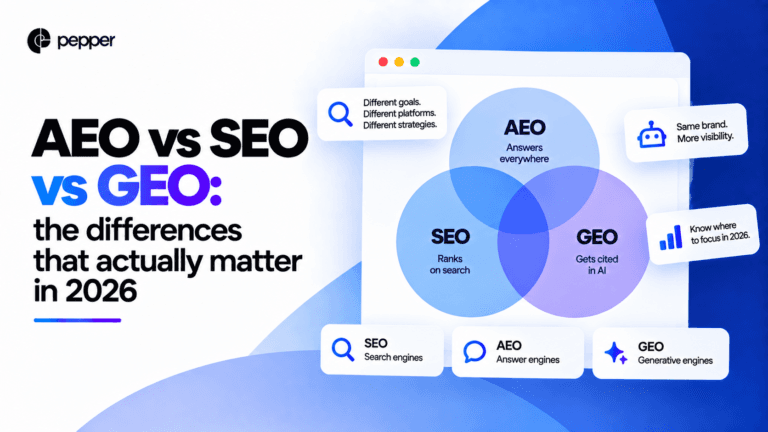
AEO vs SEO vs GEO: the differences that actually matter in 2026

Artificial Intelligence
15 mins read