GEO for Cybersecurity Brands: How to Get Cited in AI Security Queries
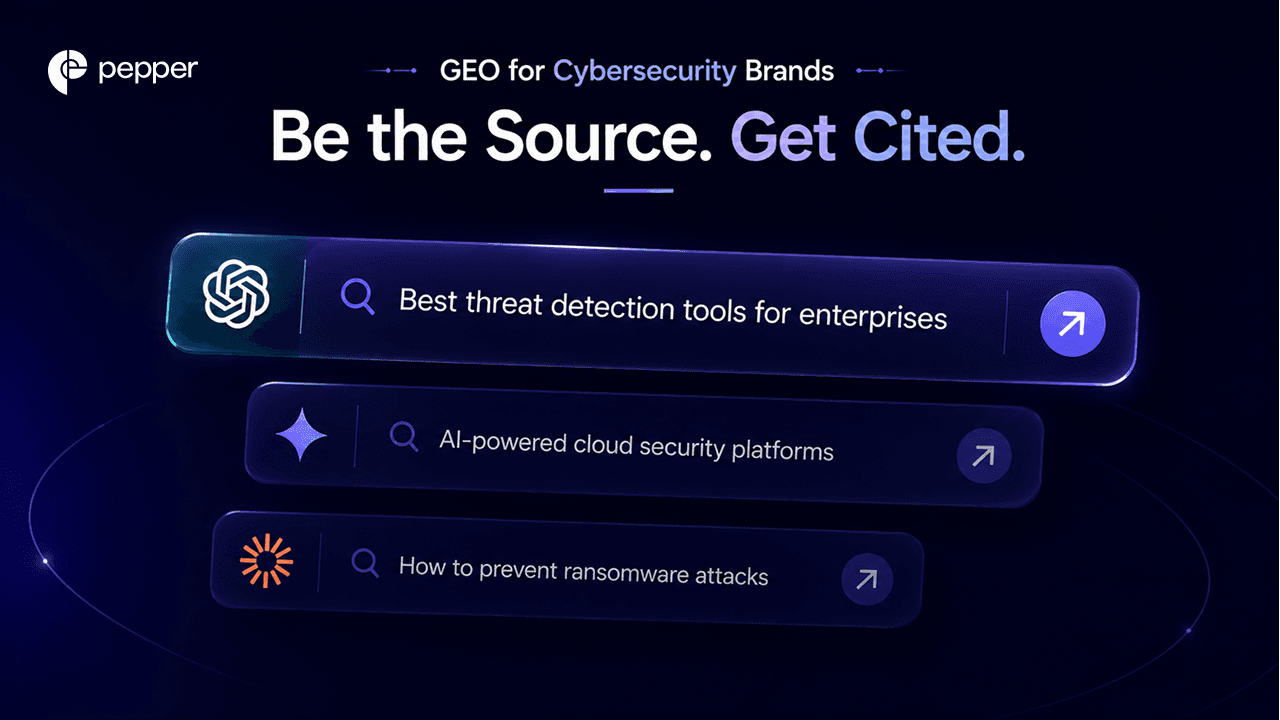
To get cited in AI security queries, cybersecurity brands must earn trust signals that AI engines respect: third-party validation from analyst and review sites, an accurate Wikipedia and Reddit presence, decision-useful content built for CISO questions, and clean technical structure. Buyer-intent security queries reward independent sources over vendor pages, so the work is as much about authority as content. This guide explains what makes security GEO different and how to win it.
A CISO researching vendors no longer starts with a Google search. Instead, they ask ChatGPT which SASE vendor suits a 500-person financial services firm needing SOC 2 compliance, and the answer names a shortlist in seconds. So if your brand is absent from that answer, you never enter the evaluation.
The stakes are unusually high in security. Research on cybersecurity AI visibility found that 78% of buyers shortlist only vendors they already recognize, so being named by an AI engine directly shapes the consideration set. In a $219 billion market, that visibility gap translates into pipeline won or lost.
This guide is built for security brands specifically. It explains why cybersecurity GEO differs from generic optimization, then lays out the tactics that get you cited where technical, skeptical buyers are researching. By the end, you will understand why that CISO’s shortlist named the vendors it did, and how to make sure yours is on it next time.
What’s in This Guide
- Why cybersecurity GEO is different
- How AI engines cite security vendors
- Tactics to get cited in AI security queries
- Protecting trust: sentiment and accuracy
- How to measure security GEO
- FAQ
- See how Pepper can help
Why Cybersecurity GEO Is Different
Cybersecurity GEO is the practice of earning citations in AI answers for security queries, where trust and third-party validation matter more than in almost any other category. Security buyers are trained to distrust vendor claims, so the signals that win their confidence are external, not self-published.
Four traits set security apart from generic GEO:
- Extreme risk aversion. Because a wrong security choice carries severe consequences, buyers favor known names and independent proof. This raises the bar for being recommended at all.
- Trust is the product. In security, reputation is the offering, so a single inaccurate or negative mention can undercut credibility faster than in other categories. Sentiment matters as much as visibility.
- Compliance shapes the query. Buyers name frameworks directly, asking about SOC 2, NIST, ISO 27001, or HIPAA fit, so your content has to map to those standards precisely.
- Crowded, interchangeable content. Countless vendors publish near-identical articles on zero trust, phishing, and SIEM. As a result, generic definitions rarely earn citations, and decision-useful content stands out.
Because of these traits, security GEO leans heavily on authority and specificity. Google classifies much security content as high-stakes, which raises the credibility bar, and buyers reward content that helps them decide rather than content that merely defines a term.
Takeaway: In cybersecurity, trust is the whole game. So the work centers on third-party validation, compliance-specific content, and genuine decision-useful expertise.
How AI Engines Cite Security Vendors
When answering buyer-intent security queries, AI engines lean on third-party sources far more than on vendor-owned pages. Understanding this split is the key to security GEO, because it tells you where to invest.
The pattern is well documented:
- Vendor content wins technical queries. It performs reasonably on questions like how XDR differs from SIEM.
- Vendor content loses buyer-intent queries. It nearly disappears on questions like the best SIEM for a mid-market company, where third-party reviews, analyst reports, and community discussions dominate.
- A few sources carry most citations. Across ChatGPT security citations, roughly 48% came from Wikipedia and about 11% from Reddit, with established tech outlets and review platforms filling much of the rest.
- Recognized names entrench. A small group of vendors like Palo Alto Networks, CrowdStrike, Microsoft, SentinelOne, and Fortinet appear in nearly every general security answer.
So the implication is clear. To be cited on the queries that drive buying, you have to appear in the sources AI engines trust for security. Those sources are largely external: analyst directories, review sites, credible editorial, and honest community presence.
Takeaway: Vendor pages win technical queries, but third-party sources win buyer-intent ones. So security GEO is mostly about earning external validation.
Tactics to Get Cited in AI Security Queries
These tactics are ordered from foundation to advantage. Work through them in sequence, since the later moves depend on the earlier ones.
- Fix technical crawlability first. AI engines cannot cite what they cannot read, so ensure key pages render without JavaScript dependency, load quickly, and are open to AI crawlers in robots.txt. This is the prerequisite for everything else.
- Build an accurate Wikipedia and entity presence. Because Wikipedia is the single largest citation source for security answers, an accurate, well-referenced entity footprint matters. Keep your company facts, category, and key details consistent across your site and third-party references.
- Earn analyst and review-site citations. Gartner Peer Insights, Forrester, G2, and PeerSpot are the venues AI engines trust for buyer-intent security queries. So prioritize verified profiles, customer reviews, and analyst coverage over another blog post.
- Participate honestly on Reddit. Security practitioners discuss tools candidly on Reddit, which AI engines cite heavily. Contribute genuine expertise in relevant communities rather than promotional posts, because manipulation is detected and damages trust.
- Publish decision-useful, scenario-based content. Replace generic definitions with content that helps a specific buyer decide. An article titled “How CISOs should evaluate endpoint security for hybrid workforces in 2026” earns more citations than “What is endpoint security,” because it answers a real decision. This reflects a wider point Neil Madden (SVP on the advisory team at Insight Partners) made at Pepper’s Index ’26 summit: the brands that win tie their query strategy to their go-to-market motion, targeting the exact evaluation-stage questions where an AI answer can make or break a deal, rather than chasing generic visibility.
- Map content to compliance frameworks. Since buyers ask about SOC 2, NIST, ISO 27001, and HIPAA directly, create precise content that connects your capabilities to those standards. This matches the exact language of buyer-intent prompts.
- Add original expert insight. AI engines and buyers both reward originality that generic content lacks. Even one paragraph of genuine practitioner insight, for example on how to evaluate MDR providers by workflow maturity rather than feature lists, raises a page’s citation value.
Takeaway: Fix the technical base, build external validation on the sources AI trusts, and publish decision-useful content mapped to compliance. That combination earns security citations.
Protecting Trust: Sentiment and Accuracy
In security, being visible is not enough, because a negative or inaccurate mention can damage a brand as much as absence. So monitoring how AI engines describe you is a core part of the discipline, not an afterthought.
Two risks deserve attention:
- Accuracy. AI engines can misstate a vendor’s capabilities, compliance status, or positioning, which misleads high-stakes buyers. So check how engines describe your products regularly, and correct the underlying sources when they are wrong.
- Sentiment. A single negative thread or misinformation campaign can spread across sources and poison AI answers, which matters more in security than in most categories.
This risk is not theoretical. Dan Loudon (CMO of Blackbird.ai, a firm that protects brands and national security organizations from misinformation) warned at Pepper’s Index ’26 summit that “one bad mention actually can turn into a million bad mentions.” He calls this pattern a narrative attack. He noted that threat actors, and even nation-states, deliberately poison the sources LLMs read, so a security brand has to watch what AI engines absorb, not just what it publishes.
The defensive move is continuous monitoring paired with an accurate source footprint. Because AI engines synthesize consensus across sources, the best protection is a consistent, well-referenced presence in the venues they trust. When your entity information is accurate everywhere, engines have less room to misrepresent you.
Takeaway: Track sentiment and accuracy, not just visibility. In security, one wrong or negative mention can cost more than being unseen.
How to Measure Security GEO
You cannot improve what you do not measure, and manual spot-checks miss patterns. So set up measurement early and review it on a schedule.
- Test priority queries across engines. Run your buyer-intent queries directly on ChatGPT, Perplexity, Gemini, and Google AI Overviews, recording whether you appear, how you are described, and which sources the engine cites.
- Track AI-referred traffic. Create a Google Analytics 4 segment for AI referrers to see the traffic these citations drive.
- Scale with prompt-level monitoring. These tools track citation frequency, share of answer, sentiment, and competitor patterns across many queries at once. This matters because security buying moves slowly and visibility shifts gradually, so time-series tracking reveals progress a single snapshot cannot.
- Watch competitors. Their citations reveal which trusted sources you still need to earn.
Takeaway: Measure citation frequency, share of answer, and sentiment across engines over time. Track competitors to find the trusted sources you are missing.
FAQ
How do cybersecurity brands get cited in AI answers?
They earn trust signals AI engines respect: an accurate Wikipedia and entity presence, verified profiles and reviews on Gartner Peer Insights, G2, and PeerSpot, honest Reddit participation, and decision-useful content mapped to compliance frameworks. Buyer-intent security queries reward third-party validation over vendor pages.
Why does my security content rank on Google but not appear in ChatGPT?
Because buyer-intent security queries favor third-party sources over vendor pages. Your content may rank on Google yet stay absent from AI answers if the engine relies on analyst sites, reviews, Wikipedia, and Reddit for recommendations. Earning presence in those sources closes the gap.
Which sources do AI engines trust for cybersecurity?
Analysis of security AI citations shows Wikipedia and Reddit account for a large share, alongside analyst firms like Gartner and Forrester, review platforms like G2 and PeerSpot, and established security editorial. Recognized vendors also dominate general answers, which rewards consistent authority building.
Does sentiment matter for cybersecurity GEO?
Yes, and more than in most categories. Because trust is the product in security, a negative or inaccurate mention can undercut credibility even while it adds visibility. Monitoring how AI engines describe your brand, and correcting inaccurate sources, is essential.
How long does cybersecurity GEO take to work?
Expect a few months for meaningful change, because authority signals and analyst or community presence build gradually. Technical fixes and decision-useful content can show earlier results, while third-party validation compounds over a longer horizon.
See How Pepper Can Help
Go back to that CISO asking which SASE vendor fits a 500-person firm. The names in that answer earned their place through third-party validation, accurate sources, and decision-useful content, built and monitored over time. Security GEO spans content, technical structure, third-party authority, and sentiment monitoring, which is a lot to run alone. Pepper helps security brands manage it as one program, tracking citations, Share of Answer, and sentiment across every major engine, then supporting the compliant, decision-useful content that earns trust. Its enterprise-tech work shows the model in action: partnering with the data observability platform Acceldata, Pepper drove a 6x increase in organic traffic and growing AI Search citations by owning high-intent, evaluation-stage queries. Explore Pepper’s case studies before mapping your own security GEO strategy.
Latest Blogs
You can check if your brand appears in AI search in about twenty minutes, on two engines, without paying for anything. The method is simple and the result is noisier than most people admit. In one 2026 pilot, ChatGPT searched the web on only 42% of buying prompts, so on the rest there was no retrieval event at all. In another, rewording a question changed the answer more than 23% of the time. This article gives you the check, then gives you the four reasons it can lie, so you can tell a real absence from a bad sample.
A blog traffic drop has five plausible causes and AI search is the most interesting one, which is exactly why people reach for it first. It is also the only one you cannot measure directly, so it should be diagnosed last, by elimination. The first check takes ten minutes and costs nothing: put clicks and impressions on the same chart. In one 2026 study of 53 brands, clicks held flat at around 400,000 while impressions more than doubled, so clickthrough halved without a single visitor being lost. Work through the other four before you conclude anything about AI.
Google publishes one eligibility rule for AI Mode, and in May 2026 it published what AI Mode users actually do. Both matter more than the fan-out arithmetic the category quotes.
Get your hands on the latest news!

Similar Posts
GEO / AI Search
17 mins read
How to check if your brand appears in AI search, and whether to believe what you see
GEO / AI Search
17 mins read
Why did my blog traffic drop? Work through five causes, in order
Artificial Intelligence
13 mins read