| TL;DR To get your brand into Microsoft Copilot, you have to get it into Bing first. Copilot grounds its answers in the Bing search index, then cites sources inline, so Bing visibility is the gate to Copilot visibility. The playbook: get indexed properly in Bing Webmaster Tools, add FAQ / HowTo / Organization / Product schema, format content answer-first, build E-E-A-T signals, establish your brand as a recognized entity, and earn third-party citations. Because Copilot is embedded across Windows, Edge, and Microsoft 365, a citation here is not ‘another chatbot’ win. It is distribution across the entire Microsoft ecosystem. |
Your Copilot Visibility Playbook, Step by Step
- Why Copilot Visibility Matters Now
- How Copilot Picks Its Sources (and How It Differs from ChatGPT, Perplexity, and Gemini)
- The Playbook: Six Moves to Earn Copilot Citations
- How to Measure Your Copilot Visibility
- Common Mistakes to Avoid
- Industry Updates: What Marketing Leaders Are Saying
- YouTube Script
- FAQ
Why Copilot Visibility Matters Now
Copilot is not just another chatbot. It is Microsoft’s AI layer, embedded across Windows, Edge, Microsoft 365, and Bing. When someone asks Copilot to recommend a vendor, compare tools, or answer a category question, the answer surfaces inside the software hundreds of millions of people already open every day: the Edge sidebar, the Windows taskbar, and the Word, Excel, Outlook, and Teams apps.
That reach is what makes Copilot different from a standalone AI tool. A citation in Copilot is distribution across the entire Microsoft ecosystem, reaching buyers inside their workday, not just inside a separate chat app they chose to open.
Here is the mechanic that decides everything: Copilot grounds its answers in Bing’s search index. Microsoft’s own documentation confirms Copilot generates a search query, sends it to the Bing search service, and grounds its response in the results. Which means Copilot visibility starts with Bing visibility, a channel most brands ignored for two decades while optimizing only for Google.
That neglect is the opportunity. The brands that treat Bing as a first-class channel now will be the ones Copilot cites, while competitors who still think ‘Bing doesn’t matter’ stay invisible across the whole Microsoft surface.
| DEFINITION: Bing Copilot Visibility |
| Bing Copilot visibility is the degree to which a brand is cited, named, or linked inside Microsoft Copilot’s generated answers. Because Copilot grounds its responses in the Bing search index through retrieval-augmented generation, this visibility is earned by being indexed, structured, and trusted within Bing, then reinforced by entity presence and third-party authority. It is the Microsoft-ecosystem equivalent of Share of Answer in ChatGPT or Perplexity. |
How Copilot Picks Its Sources
Copilot uses retrieval-augmented generation (RAG). For each query, it runs a live Bing search, pulls the top results, breaks them into chunks, scores them for relevance, synthesizes an answer, and cites the sources it used inline. The pages that get cited are the ones Bing surfaces and that Copilot can cleanly lift an answer from.
Three traits define what Copilot favors:
- Copilot leans on sources Bing already trusts for a topic, so domain and entity credibility matter.Authority.
- Content that is chunked into clear, self-contained sections (headings, direct answers, tables, FAQs) is far easier to lift into a response.Structure.
- Recently updated pages are favored over stale ones, so recency is a ranking input, not an afterthought.Freshness.
Copilot vs. ChatGPT, Perplexity, and Gemini: This Is Not One-Size-Fits-All
GEO is not a single playbook applied everywhere. Each engine sources differently, so the tactics that win Copilot are not identical to the ones that win elsewhere. Here is the contrast:
| Engine | Primary Retrieval Source | What It Rewards Most |
| Bing Copilot | Bing search index | Bing indexing, schema, entity presence, freshness |
| ChatGPT Search | Bing index (primary) | Cross-source consensus, earned/editorial citations |
| Perplexity | Live multi-source web search | Answer-first extractability, Reddit and community authority |
| Google Gemini / AI Overviews | Google index | Traditional Google ranking signals, E-E-A-T |
The useful overlap: Copilot and ChatGPT both lean heavily on Bing’s index, so Bing optimization pays off twice. Gemini is the outlier, grounded in Google. Build for the structural traits all engines share (clean access, answer-first content, schema, entity clarity), then tune for each platform’s retrieval source.
| The strategic shortcut: because both Bing Copilot and ChatGPT Search draw primarily on Bing’s index, getting your Bing house in order is the single highest-return move in GEO. One channel, two of the largest AI answer surfaces. |
The Playbook: Six Moves to Earn Copilot Citations
These six moves map directly to how Copilot selects and lifts sources. Work through them in order, because the early ones are prerequisites for the rest.
1. Get Indexed on Bing Properly
Copilot cannot cite a page Bing has not indexed. Most teams have Google Search Console configured and Bing Webmaster Tools ignored, which is a self-inflicted blind spot on the entire Microsoft surface. Fix it first:
- Set up Bing Webmaster Tools at bing.com/webmasters and verify your site (you can import directly from Google Search Console).
- Submit your XML sitemap so Bing can discover every priority page.
- Enable IndexNow, the Microsoft-backed protocol for instant URL submission, so new and updated pages get crawled in hours instead of weeks.
- Confirm bingbot is not blocked in robots.txt, that priority pages return a 200 status, and that they load in under two seconds.
2. Add Structured Data and Schema Markup
Schema tells Copilot what your content is, so it can parse and lift answers accurately. Four types carry the most weight:
| Schema Type | What It Does for Copilot |
| FAQPage | Maps question-answer pairs directly to the query-answer format Copilot generates |
| HowTo | Structures step-by-step content Copilot can lift for procedural queries |
| Organization | Establishes your brand as a recognized entity, with sameAs links to profiles |
| Product | Registers products with attributes Copilot can cite in comparison and recommendation answers |
Keep schema accurate to the visible content, never stuffed. Validate every page with Google’s Rich Results Test and Bing’s markup tooling before you ship it. Broken schema is worse than none, because it confuses the parser.
3. Format Content Answer-First
Copilot lifts clean, self-contained answers. Put the direct answer or definition in the first one to two sentences of any section, then support it. Use clear, descriptive headings, short paragraphs, a TL;DR at the top, and an FAQ block at the end. Every section should stand on its own as a chunk that answers one complete question, because that is the unit Copilot extracts.
4. Build E-E-A-T Signals
Copilot leans on trust signals to decide which source to put its name behind. Strengthen yours with named author bylines and credentials, citations to primary data, original research and statistics no other page has, and consistent brand mentions across trusted third-party sites. Experience, expertise, authoritativeness, and trust are not abstract: they are the difference between being in the candidate pool and being the cited source.
5. Establish Bing Places and Entity Presence
Copilot needs to recognize your brand as a distinct entity. Claim and verify your presence on Bing Places, and make sure your brand exists and is described consistently on LinkedIn, Crunchbase, and Wikidata or Wikipedia where feasible. A verified entity directly improves how Copilot represents your brand, and consistent entity information across sources removes the ambiguity that keeps brands out of answers.
6. Earn Citations Off-Site
Copilot reads authority from across Bing’s index, not just your own domain. Earn it through digital PR and coverage in trusted publications, reviews on platforms like G2 and Capterra, and authentic presence in the communities and forums your category lives in. These off-site signals are what move you from indexed to trusted, and trusted is what gets cited.
| PR is now a growth marketing function, 100%. Digital PR directly drives LLM citations, and that includes Bing-grounded engines like Copilot. One-time annual link campaigns don’t work anymore. Consistent monthly distribution does. (Kishan Panpalia, Pepper founding team, Index ’26) |
How to Measure Your Copilot Visibility
You cannot improve what you do not measure, and Copilot visibility needs AI-specific measurement, not traditional rankings. Three layers:
- Run your priority category queries directly in Copilot and document which brands get cited, in what position, and with what sources. This manual baseline tells you where you actually stand today.Prompt testing.
- Move from spot checks to a tracked metric: the percentage of your category prompts where Copilot cites your brand. This is the KPI that matters, and Pepper’s Atlas platform measures it across Copilot alongside ChatGPT, Gemini, and Perplexity, with competitor benchmarking and monthly re-runs.Share of Answer tracking.
- Bing Webmaster Tools shows crawl activity and which pages Bing is indexing and surfacing. Because Copilot draws on that index, movement here is an early signal of Copilot visibility changes, weeks before they show up in answers.Bing Webmaster Tools as a leading indicator.
| The measurement chain: Bing indexing (leading indicator) feeds Copilot citations (the outcome), which you quantify as Share of Answer (the KPI). Watch all three, and you can diagnose a visibility problem at the indexing layer before it costs you citations. |
Common Mistakes to Avoid
Five mistakes keep brands out of Copilot answers. Each is avoidable:
- Ignoring Bing entirely. Optimizing only for Google leaves you invisible on the index that grounds both Copilot and ChatGPT Search.
- Blocking bingbot. A stray robots.txt rule or aggressive bot-blocking makes citation impossible regardless of content quality.
- Thin or gated content. Copilot cannot lift an answer from a page that is light on substance or hidden behind a form.
- No schema. Without structured data, Copilot has to guess what your content is, and it will favor competitors who made it explicit.
- Treating GEO as a one-time fix. Copilot rewards freshness and re-crawls constantly. A single optimization pass decays; a maintained program compounds.
Industry Updates: What Marketing Leaders Are Saying
Copilot Is Now Microsoft’s AI Layer, Not a Feature
Through 2026, Microsoft has positioned Copilot as its central AI layer across Windows, Edge, Microsoft 365, Bing, and GitHub, moving it from ‘help me write’ toward ‘help me do.’ For marketers, the takeaway is that Copilot visibility is no longer a niche Bing concern. It is presence inside the productivity software buyers use all day, which raises the stakes on getting your brand into its answers.
Claude Joins Copilot, and the Model Layer Gets Plural
In June 2026, Microsoft made Anthropic’s Claude a selectable model inside Microsoft 365 Copilot, alongside its existing model routes. The signal for brands: Copilot’s underlying models will keep changing, but the grounding layer, Bing’s index and the retrieval pipeline, is the stable target. Optimize for how Copilot retrieves and cites, not for any single model behind it.
Bing Is the Underrated AI Search Surface
A recurring theme among GEO practitioners in 2026: because Bing’s index feeds both Copilot and ChatGPT Search, Bing Webmaster Tools has quietly become one of the highest-impact free tools in the AI search stack. Teams that optimized exclusively for Google for two decades are discovering that a 20-minute Bing setup directly affects visibility on two of the largest AI answer surfaces.
PR Becomes a Citation Engine
Kishan Panpalia of Pepper’s founding team argued at Index ’26 that PR has become a growth function, because digital PR now directly drives LLM citations, including on Bing-grounded engines. The operational shift he flagged: replace one-time annual backlink campaigns with consistent monthly distribution, because that is what keeps a brand’s entity fresh and cited across the index Copilot reads from.
From Rankings to Share of Answer
Across Index ’26, marketing leaders described the metric shift from keyword rankings to Share of Answer, the percentage of AI answers a brand appears in. For Copilot specifically, this means measuring citation presence inside Copilot’s responses rather than Bing keyword positions alone. Boards are beginning to ask for Share of Answer as a tracked metric across every major engine, Copilot included.
YouTube Script: How to Get Your Brand into Bing Copilot (Under 4 Minutes)
Format: Talking head (Janvi Rohra) | Target: 3 to 4 min | Target Query: ‘how to get your brand into Bing Copilot’ / ‘Copilot GEO’ | Channel: Pepper YouTube (pepper.inc)
| SCRIPT (Spoken on camera) | DESIGN GUIDELINES |
| [HOOK, 0:00 to 0:20] Most brands spent two decades optimizing for Google and completely ignoring Bing. In the AI search era, that’s an expensive mistake. Because Microsoft Copilot, the AI built into Windows, Edge, and every Microsoft 365 app, grounds its answers in Bing’s index. So if you’re invisible on Bing, you’re invisible across the entire Microsoft ecosystem. Here’s how to fix that. | On camera: Janvi, clean backgroundText overlay: ‘Copilot runs on Bing, not Google’Graphic: Microsoft ecosystem icons (Windows, Edge, Word, Excel, Teams) with Copilot at centerPepper logo lower-third, pepper.inc watermark |
| [WHY IT MATTERS, 0:20 to 0:55]Here’s why this is different from any other chatbot. Copilot isn’t a separate app people choose to open. It’s embedded in the software they already use all day, the Edge sidebar, the Windows taskbar, Word, Outlook, Teams.So a citation in Copilot isn’t ‘another chatbot’ win. It’s distribution across the entire Microsoft ecosystem, reaching buyers inside their workday.And the mechanic that decides it all: Microsoft’s own documentation confirms Copilot sends a query to Bing and grounds its answer in those results. Copilot visibility starts with Bing visibility. | Graphic: ‘Another chatbot’ crossed out, replaced with ‘Distribution across Microsoft’Animation: Copilot answer appearing inside Edge, Word, TeamsText overlay: ‘Copilot is grounded in Bing’s index’Source chip: Microsoft Learn documentation |
| [HOW COPILOT PICKS SOURCES, 0:55 to 1:30]So how does Copilot choose what to cite? It uses retrieval-augmented generation. For every query, it runs a live Bing search, pulls the top results, chunks them, scores them, and cites the sources it used inline.It favors three things: authority, sources Bing already trusts; structure, content chunked into clean, self-contained answers; and freshness, recently updated pages beat stale ones.And this is not one-size-fits-all. Copilot and ChatGPT both lean on Bing’s index, so Bing work pays off twice. Perplexity leans on live search and Reddit. Gemini runs on Google. Build for what they share, then tune per engine. | Animated RAG flow: query, Bing search, chunk, score, citeThree-trait graphic: Authority / Structure / FreshnessComparison table: Copilot & ChatGPT (Bing) vs Perplexity vs Gemini (Google)Text overlay: ‘Bing work pays off twice’ |
| [THE PLAYBOOK, 1:30 to 2:35]Here’s the six-move playbook.One: get indexed on Bing properly. Set up Bing Webmaster Tools, submit your sitemap, turn on IndexNow. Twenty minutes, and most brands have never done it.Two: add schema, FAQ, HowTo, Organization, and Product, so Copilot can parse and lift your answers.Three: write answer-first. Put the direct answer in the first one or two sentences of every section.Four: build E-E-A-T, named authors, original data, third-party mentions.Five: establish entity presence, Bing Places, LinkedIn, Wikidata, described consistently everywhere.Six: earn off-site citations through PR, reviews, and community presence. As Kishan from our founding team put it at Index, PR is now a growth function, because digital PR directly drives these citations. | Six-step numbered checklist, each animating in:1. Index on Bing2. Schema markup3. Answer-first content4. E-E-A-T signals5. Entity presence6. Off-site citationsScreen recording: Bing Webmaster Tools setupQuote chip: Kishan Panpalia, Index ’26 |
| [MEASURE + MISTAKES, 2:35 to 3:15]How do you know it’s working? Three layers. Test your priority prompts directly in Copilot and log who’s cited. Track Share of Answer, the percentage of category prompts where Copilot names you, which is exactly what Pepper’s Atlas measures across Copilot, ChatGPT, Gemini, and Perplexity. And watch Bing Webmaster Tools as a leading indicator, because indexing movement predicts citation movement weeks early.And avoid the five killers: ignoring Bing, blocking bingbot, thin or gated content, no schema, and treating this as a one-time fix. Copilot re-crawls constantly. This is a program, not a project. | Three-layer measurement graphic: Prompt test, Share of Answer, Bing Webmaster ToolsAtlas dashboard b-rollRed-flag list of 5 mistakes with X marksText overlay: ‘It’s a program, not a project’ |
| [CLOSE + CTA, 3:15 to 3:45]Here’s the bottom line. AI search isn’t one channel, it’s many, and Copilot is the one hiding in plain sight inside every Microsoft product your buyers already use.Get your Bing house in order, structure your content for retrieval, and build the authority Copilot trusts, and you win distribution across the entire Microsoft ecosystem.Want to see your Share of Answer in Copilot right now? Pepper’s Atlas platform tracks it across every major AI engine. Link in the description. Subscribe for more on GEO and AI search. See you next week. | Return to talking head: Janvi on cameraText overlay: ‘Win Bing = win Copilot’Chyron: atlas.pepper.incSubscribe button animationPepper logo outro with pepper.inc text |
FAQ: Getting Your Brand into Bing Copilot
Does Copilot use Bing rankings to decide what to cite?
Copilot grounds its answers in the Bing search index: Microsoft’s documentation confirms it generates a query, sends it to the Bing search service, and uses the results to build its response. So Bing visibility is a direct input, though Copilot does not simply read off Bing’s ranked list. It retrieves candidate pages, then cites the ones it can cleanly lift a relevant, well-structured answer from. Strong Bing indexing gets you into the candidate pool; schema, answer-first structure, and entity trust get you cited.
How do I get my brand into Microsoft Copilot answers?
Six moves, in order: (1) get indexed on Bing via Bing Webmaster Tools, sitemap submission, and IndexNow; (2) add FAQ, HowTo, Organization, and Product schema; (3) format content answer-first with direct answers in the first one to two sentences; (4) build E-E-A-T signals with named authors and original data; (5) establish entity presence on Bing Places, LinkedIn, and Wikidata; and (6) earn off-site citations through PR, reviews, and community presence. Because Copilot is grounded in Bing, getting your Bing foundation right is the prerequisite for all of it.
How long until my brand shows up in Copilot?
Expect a full optimization cycle to take a few months, because Bing indexing and the authority and entity signals Copilot relies on build over time. Technical fixes, proper Bing indexing, IndexNow, and schema, can show up faster, sometimes within weeks, while off-site authority and entity recognition compound over a longer period. Use IndexNow to accelerate crawling of new and updated pages, and track Bing Webmaster Tools as a leading indicator of when changes are being picked up.
Is optimizing for Bing Copilot different from optimizing for ChatGPT?
They overlap heavily, because ChatGPT Search also draws primarily on Bing’s index, so strong Bing optimization benefits both. The main difference is emphasis: Copilot weights entity presence and structured data within Bing, while ChatGPT leans hard on cross-source consensus and earned editorial citations. The shared foundation, clean Bing indexing, schema, answer-first content, and entity clarity, serves both, which is why Bing optimization is one of the highest-return moves in GEO.
Do I need Bing Webmaster Tools to appear in Copilot?
It is not strictly required for Bing to find a well-linked page, but it is the single highest-impact free step you can take. Bing Webmaster Tools lets you submit your sitemap, push pages via IndexNow for near-instant crawling, confirm your priority pages are indexed, and monitor crawl activity as a leading indicator of Copilot visibility. Setup takes about 20 minutes and you can import your configuration directly from Google Search Console, so there is little reason to skip it.
| Want to see your brand’s Share of Answer inside Copilot, right alongside ChatGPT, Gemini, and Perplexity? Pepper’s Atlas platform tracks your citations across every major AI engine, benchmarks you against competitors, and shows which pages are driving Copilot visibility. Start your audit at atlas.pepper.inc |
Latest Blogs
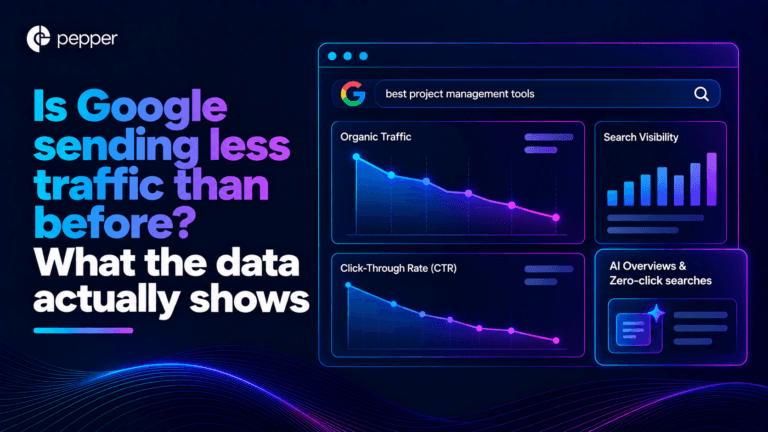
Is Google sending less traffic than before? On queries where AI features appear, yes, and a randomised experiment published in August 2026 puts the effect at 18.8 percentage points of click-through. Across a whole site the picture is much softer, because most queries do not trigger those features and impressions have grown. The traffic is also not migrating to AI engines, which still account for under 1% of referrals. This article ranks every 2026 study by how well it identifies the effect, rather than by how large its headline is.
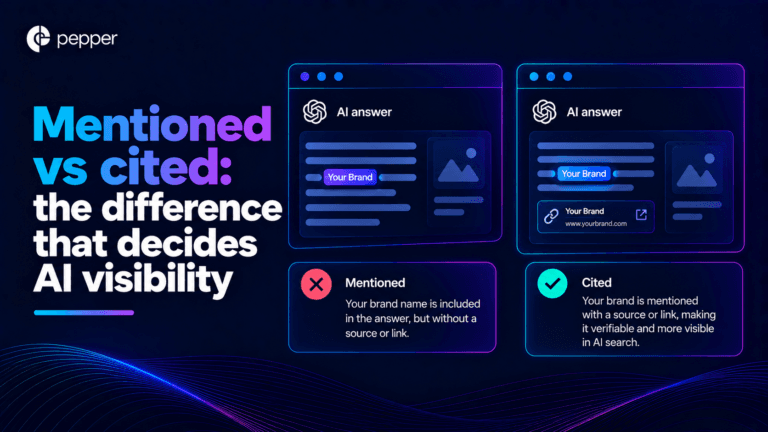
Mentioned vs cited is the distinction most AI visibility reporting collapses, and the data says it should not. Across 3,981 brand appearances studied in June 2026, 61.7% were citations with no brand name in the answer, 25.1% were names with no citation, and only 13.2% were both. The split also inverts by engine: Gemini named brands in 83.7% of appearances but cited sources in 21.4%, while ChatGPT did almost the opposite. A single visibility score averages two different things across engines that behave in opposite ways.
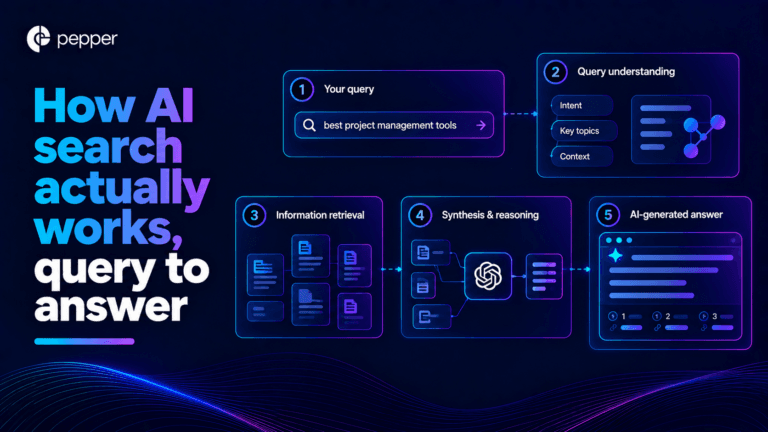
How AI search actually works is usually described as a tidy pipeline: you ask, it searches, it reads, it answers, it cites. Each of those five stages behaves differently from the description. In one 2026 pilot the engine searched the web on only 42% of buying prompts. When it did search, it ran an average of 6.3 queries nobody wrote. And in a 2,100-question evaluation across six chatbots, retrieval rather than reasoning drove more than 70% of all errors. This article walks the real pipeline and marks what breaks at each step.
Get your hands on the latest news!

Similar Posts
GEO / AI Search
15 mins read
Is Google sending less traffic than before? What the data actually shows
Artificial Intelligence
15 mins read
Mentioned vs cited: the difference that decides AI visibility
GEO / AI Search
16 mins read