How to Optimize Your Content for Google Gemini
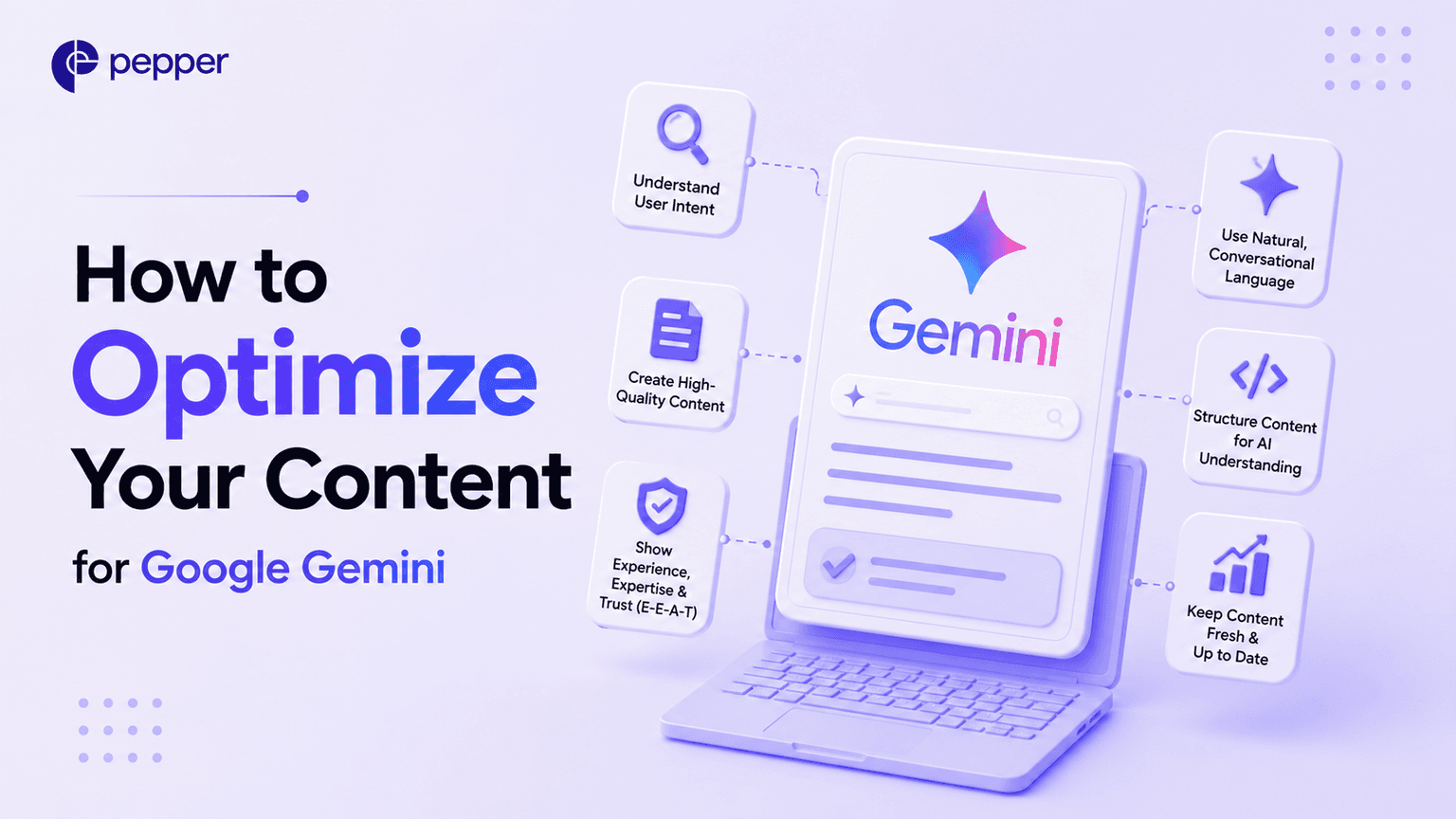
To optimize for Google Gemini, you need strong SEO fundamentals as the entry ticket, then entity authority, third-party citations, and full question coverage so Gemini selects and quotes you. Because Gemini leans on Google’s Knowledge Graph and cites third-party sources far more than your own pages, the work is as much off-site as on-site. This guide walks through each step, with the data behind it.
A buyer asks Gemini which tool solves their problem, and the answer names a few brands with citations. Here is the twist most teams miss: the sources Gemini quotes are usually not the brands’ own websites. They are the third-party pages that mention them. So optimizing only your own site addresses a fraction of what decides Gemini visibility. We will come back to that gap at the end.
Gemini now sits at the center of Google search. Gemini 3 became the default model for AI Overviews on January 27, 2026. The average number of sources cited per answer then jumped 31.8%, and 42.4% of previously cited domains were replaced, per SE Ranking’s analysis of 100,000 keywords. The standalone Gemini app has also passed 300 million monthly users, making it a major research surface in its own right.
The opportunity is real, though. Organic click-through has dropped sharply where AI Overviews appear, yet being cited inside one lifts click-through by about 35%, and Gemini-referred visitors convert far better than organic. So earning Gemini citations is a learnable discipline, and this guide covers it step by step.
What’s in This Guide
- How Google Gemini chooses its sources
- The step-by-step guide to optimizing for Gemini
- How Pepper optimizes for Gemini
- How to measure your Gemini visibility
- Gemini is not the only engine
- FAQ
- See how Pepper can help
How Google Gemini Chooses Its Sources
Google Gemini generates answers by pulling from Google’s search index, Knowledge Graph, and other core systems. It then cites the sources that best support each part of its response. Because Google controls both the quality-rating framework and the model, Gemini leans on classic Google signals more than any other AI engine.
Three behaviors shape how it selects sources, and each one points to a different tactic.
- It relies on entity authority. Gemini draws on Google’s Knowledge Graph, so it favors brands it recognizes as real, well-defined entities. Consistent brand information across the web strengthens that recognition.
- It cites third-party sources heavily. Analyses of Gemini citations find that brands are cited far more often through third-party pages than their own. One study by the firm Omnia found the large majority of Gemini citations went to third-party editorial content rather than owned domains. So the pages that mention you often matter more than your own site.
- It uses query fan-out. Gemini breaks a question into hidden sub-questions and pulls sources for each. Research on 10,000 keywords found a clear pattern. Pages ranking for these fan-out queries were 161% more likely to be cited than pages ranking for the visible query alone.
One more point matters for strategy. Only about 19% of AI Overview sources overlap with Google’s top 10 organic results. So ranking well is helpful, but it does not guarantee a citation. Gemini rewards breadth of coverage and entity trust, not rank alone.
Takeaway: Gemini leans on Google’s Knowledge Graph, cites third-party sources heavily, and rewards full question coverage. So the work spans entity authority and off-site presence, not just your own pages.
The Step-by-Step Guide to Optimizing for Gemini
These steps run from foundation to advantage. Work through them in order, because the later ones build on the earlier ones.
- Get the SEO fundamentals right. Gemini uses Google’s core ranking systems, so crawlability, fast pages, clear structure, and helpful content remain the entry ticket. There is no Gemini without SEO.
- Build your entity authority. Strengthen how Google’s Knowledge Graph recognizes your brand. Keep your name, category, and key facts consistent across your site, profiles, and third-party references. Add clear Organization details and an authoritative “About” page too.
- Cover the full question space. Because Gemini uses query fan-out, structure each topic as one complete resource where every sub-question has its own answer. Each heading should be a real question, with the answer in the first 40 words beneath it.
- Lead with direct answers. Open each section with a clear, self-contained answer before the detail. Gemini lifts clean passages, so a direct opening sentence is far more likely to be quoted than a buried one.
- Earn third-party citations. Since Gemini cites third-party pages heavily, invest in getting mentioned on the domains it already trusts. That means editorial coverage, comparison articles, and review-site presence in your category.
- Prioritize comparison and review content. Comparison and “best for” content is among the highest-impact formats for Gemini citations. So make sure your brand appears accurately in the roundups buyers and engines rely on.
- Add specific, verifiable facts. Include statistics, dates, and named sources. The Princeton and Georgia Tech GEO research found that citations, statistics, and quotations can lift AI visibility by more than 40%.
- Strengthen E-E-A-T signals. Publish credentialed author bylines, real author pages, and expert-reviewed content. Gemini weights experience, expertise, authoritativeness, and trust heavily, because Google’s own reputation rides on the answers it generates.
- Keep content fresh. Refresh key pages on a schedule with meaningful updates, not just new dates. Gemini favors current information, and Google’s 2026 core updates penalize date-only changes.
Takeaway: Nail the fundamentals, build entity authority, cover the full question space, earn third-party citations, and prove expertise. That sequence is what earns Gemini citations.
How Pepper Optimizes for Gemini
The hardest part of Gemini optimization is knowing which third-party sources it cites in your category, then acting on that. This is exactly where a platform built for the job helps, and it is how Pepper approaches Gemini for the brands it works with.
Here is the workflow, mapped to the steps above:
- See where you stand. Pepper’s platform, Atlas, tracks your Brand Visibility and Share of Answer in Gemini alongside ChatGPT, Perplexity, Google AI Overviews, and Claude. So you know exactly where you are cited, and where a competitor takes your place.
- Audit the web around you. Because Gemini cites third parties so heavily, its Citation Analysis shows which domains Gemini pulls from in your category. That turns the vague goal of “earn more citations” into a concrete list of the exact editorial and review sites to target.
- Know the next move. Atlas Visibility Insights turn each gap into ranked, prompt-level actions, so your team knows what to create, refresh, or reinforce, and on which engine.
- Execute and sustain it. Its agentic Agents and Sheets produce and optimize the comparison content, entity signals, and expert pages that earn Gemini citations, with human review, while Workflows keep the recurring refreshes running so content stays fresh.
Pepper frames all of this through the Visibility, Citability, Retrievability framework, which maps cleanly onto how Gemini works. The approach is proven on technical, high-consideration brands. Working with data platform Acceldata, Pepper drove a 6x increase in organic traffic and rising AI Search citations by owning the high-intent queries that matter.
Takeaway: The Gemini challenge is off-site as much as on-site. Pepper’s Atlas shows which third-party domains Gemini cites, ranks the next moves, and helps execute the content that wins them.
How to Measure Your Gemini Visibility
You cannot improve what you do not measure, and traditional rank tracking misses AI citations entirely. So set up Gemini-specific measurement early.
- Use Search Console’s AI reports. Google began rolling out generative AI performance data in Search Console in 2026, so check whether it is available for your property.
- Track your Gemini citation share. Measure how often Gemini and AI Overviews cite your brand for priority queries, since this is the metric that now matters most.
- Test queries manually to start. Run your high-intent queries in Gemini and record whether you appear, how accurately, and which sources are cited alongside you.
- Watch the third-party sources. Track which domains Gemini cites in your category, because closing that gap is the core of Gemini optimization.
A practical way to begin costs nothing. Ask Gemini your top buyer questions, note the sources it cites, and compare them to where your brand appears. That gap is the clearest measure of the work ahead.
Takeaway: Track your Gemini citation share and the third-party sources it cites, not just rankings. Start manually, then use Search Console’s AI reports and a dedicated platform as you scale.
Gemini Is Not the Only Engine
Gemini is the largest AI search surface, but optimizing for it alone leaves visibility on the table. Buyers move between engines, and the engines cite differently.
The good news is that AI Overviews and Google AI Mode share Gemini’s infrastructure, so one body of work wins both Google surfaces at once. The caution is that ChatGPT and Perplexity select sources on their own logic, and citations rarely overlap between engines. So the fundamentals transfer, but a complete strategy treats Gemini, ChatGPT, and Perplexity as distinct channels.
The practical sequence is to fix fundamentals and entity authority first, since those help everywhere, then tune for each engine’s citation behavior. That way one investment lifts your visibility across the whole AI search landscape.
Takeaway: Optimizing for Gemini also wins AI Overviews and AI Mode. But treat ChatGPT and Perplexity as separate channels, because citations rarely overlap.
FAQ
How do I get my content cited by Google Gemini?
Start with strong SEO fundamentals, then build entity authority so Google’s Knowledge Graph recognizes your brand. Cover the full question space around each topic, and earn third-party citations on the editorial and comparison sites Gemini already trusts. Gemini cites third-party sources far more often than your own pages.
Is optimizing for Gemini different from traditional SEO?
Yes, though it builds on SEO. Gemini uses Google’s core ranking systems, so fundamentals still matter. But you must layer on entity authority, full question coverage, third-party citations, and strong E-E-A-T signals. Simply ranking well no longer guarantees a citation, since only about 19% of AI Overview sources overlap with the top 10 organic results.
Does schema markup help with Gemini?
Schema is not strictly required, since Google has said it does not determine inclusion in AI answers. However, valid Organization and Article schema helps Google understand your content and entity. That supports the Knowledge Graph recognition Gemini relies on. Keep any schema accurate to the visible content.
Why does Gemini cite my competitors but not me?
Usually because competitors have stronger entity authority or appear on the third-party sources Gemini trusts in your category, while you do not. Gemini leans heavily on editorial and comparison content. So if those pages mention rivals and omit you, you stay invisible even with a strong website.
How long does Gemini optimization take?
Most brands see measurable citation changes within 60 to 120 days of consistent work, since Gemini relies on Google’s systems, which recrawl and update over time. Entity authority and third-party citations compound over three to six months, so treat it as an ongoing program.
See How Pepper Can Help
Remember the gap we opened with: Gemini mostly cites the pages that mention you, not your own site. Closing that gap means knowing which third-party sources Gemini trusts and earning your place on them. Pepper makes that practical. It tracks your Gemini citations and Share of Answer with Atlas, shows exactly which domains shape your category, and produces the content that wins citations. Its work with brands like Acceldata, where it drove a 6x organic traffic lift and rising AI citations, shows the approach end to end. Explore Pepper’s case studies before mapping your own Gemini strategy.
Latest Blogs
Most AI search audits check for files nobody reads. Ahrefs found 97% of llms.txt files were never fetched. Here are the five checks that survive scrutiny.
Run the same prompts through one engine on two settings and only a quarter of the cited domains match. No fixed trust pyramid survives that much movement.
The research pulls in two directions. Fan-out rewards covering many adjacent questions; absorption research finds longer pages get used. The resolution is that the passage competes, not the page.
Get your hands on the latest news!

Similar Posts
Artificial Intelligence
13 mins read
How to do an AI search audit that finds something, and the steps worth skipping
Artificial Intelligence
11 mins read
The LLM trust hierarchy: what the evidence supports, and why the pyramid keeps moving
GEO / AI Search
9 mins read