Thought Leadership and GEO: Why Cybersecurity Brands Win in AI Search
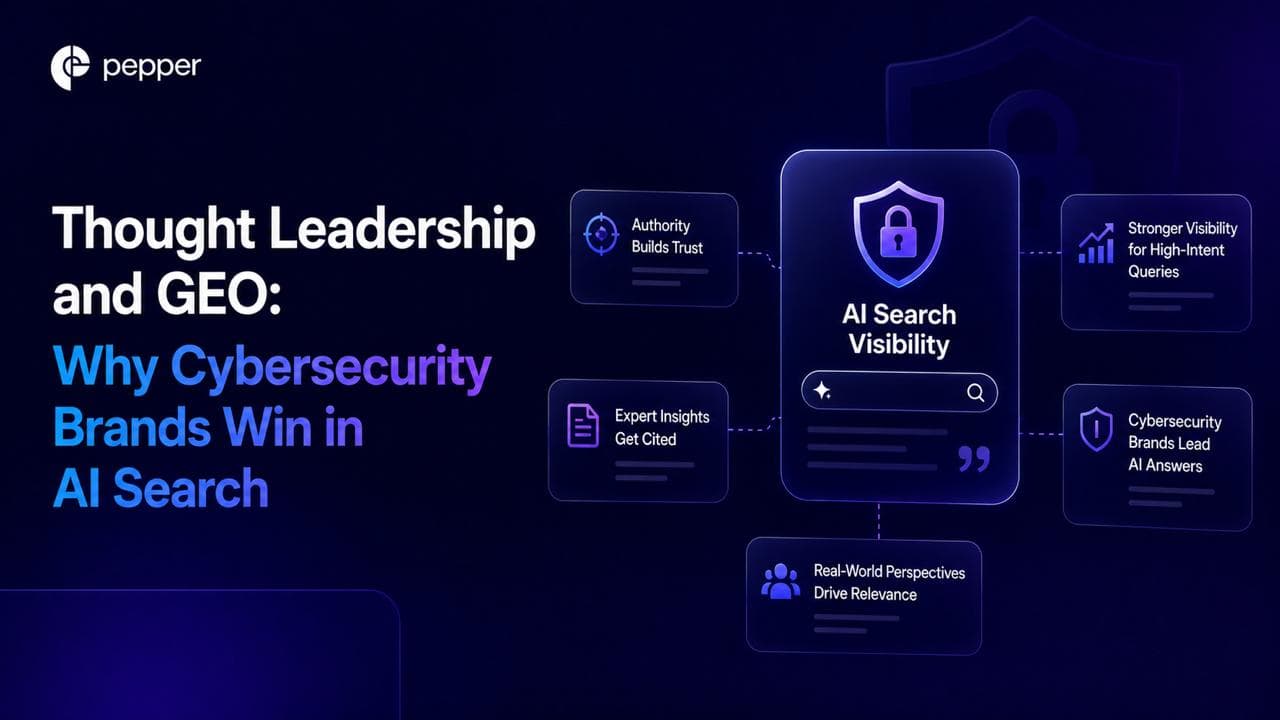
TL;DR: 73 percent of cybersecurity vendors tested got zero citations from ChatGPT when buyers asked for a vendor recommendation, many of them ranking on page one of Google for the same query. The gap closes with thought leadership specifically: named executive expertise, original research, and analyst engagement, not more product pages. Content with original data earns roughly 4.1 times more AI citations than promotional material.
Seventy-three percent of cybersecurity vendors tested received zero citations from ChatGPT when buyers asked for a vendor recommendation in their category. Many of those same vendors rank comfortably on page one of Google for identical searches. Traditional SEO authority and AI citation authority have quietly become two different things, and cybersecurity is where the gap shows up hardest.
That gap has a specific fix, and it isn’t a bigger content calendar. Thought leadership and GEO close it together: named experts, original data, and third parties willing to repeat what you said, structured so AI engines can actually verify it.
Where to Jump In
- What Makes Cybersecurity Different in AI Search
- Why Thought Leadership and GEO Close the Gap Together
- The Thought Leadership Levers That Actually Move Citations
- How Pepper Does It
- FAQ
What Makes Cybersecurity Different in AI Search
In cybersecurity, trust is the product, so AI engines apply a stricter source-quality bar to security content than to almost any other category. Security sits alongside medical, legal, and financial content in the zone where a wrong answer causes real harm, and engines respond by leaning harder on sources they can independently verify.
Buyers behave accordingly. Most cybersecurity buyers stick to a short list of vendors they already recognize. That means vendor-owned content performs fine on narrow technical queries but nearly disappears the moment a prompt turns into buyer intent, “which vendor should I use for X.” Third-party reviews, analyst reports, and editorial coverage take over at that exact moment, because that’s what an engine can independently corroborate and a promotional page can’t.
Takeaway: a cybersecurity brand can win every technical query and still be invisible on the one question that actually drives a purchase decision.
Why Thought Leadership and GEO Close the Gap Together
Each engine reads authority differently, which is part of why a single content strategy doesn’t work across all of them. ChatGPT leans on Wikipedia and established authority sites. Perplexity favors evidence-rich, comparison-style content. Claude runs more conservative, favoring official documentation and named, credentialed sources over promotional framing.
Thought leadership performs well precisely because it satisfies all three patterns at once. A named executive’s analysis reads as a credentialed source, not marketing copy. Original research gives an engine a specific, attributable data point to cite instead of a vague claim. And once analysts or trade press pick that research up, it becomes exactly the third-party corroboration that dominates buyer-intent queries in the first place.
The data backs the size of this effect. Content built around original, proprietary statistics earns roughly 4.1 times more AI citations than purely promotional material. In a category where 73 percent of vendors already start from zero, that’s not a marginal edge.
Takeaway: thought leadership and GEO aren’t two separate initiatives here. Thought leadership isn’t a brand-awareness nice-to-have; it’s the specific content type built to pass a stricter trust bar than almost any other industry faces.
The Thought Leadership Levers That Actually Move Citations
- Named, credentialed authorship. Attribute security content to a real named expert with a real title, marked up with Person schema alongside Article schema. Anonymous or team-byline content signals less trust to an engine looking for a verifiable source.
- Original research and proprietary data. A vendor’s own threat-landscape survey, incident-response benchmark, or vulnerability analysis gives engines a specific, attributable statistic instead of a generic claim, the single most effective content type in this category.
- Analyst and press engagement. Getting a named executive quoted by an analyst firm or trade outlet converts a vendor’s own point of view into the third-party corroboration that buyer-intent queries reward most.
- Compliance-framework anchoring. Buyers frequently name a specific framework in their prompt (SOC 2, NIST, ISO 27001, HIPAA). Thought leadership tied explicitly to a named framework matches that query shape directly, rather than making the engine infer relevance.
Takeaway: every lever here does the same job from a different angle: turning a vendor’s expertise into something an AI engine can verify came from somewhere other than the vendor’s own marketing team.
How Pepper Does It
Pepper’s platform runs Citation Analysis against exactly this problem. It shows which domains, analyst sites, and named sources an engine is actually citing in a security category, and whether a brand’s own thought leadership is showing up in that mix or getting crowded out by competitors. Visibility Insights then ranks the specific prompts worth fixing first, tagged by priority and by which engine is driving the gap.
Pepper’s Acceldata case study shows this applied in a technical, high-consideration category: 6x organic traffic and rising AI Search citations for a brand selling into the same skeptical, expert-driven buyer as most cybersecurity vendors.
Pepper’s growth team then turns those findings into the actual thought-leadership program. That covers named executive content, the research behind it, and the distribution around it, rather than leaving a security team to build that muscle alone.
FAQ
Why do cybersecurity brands struggle with AI search specifically?
Cybersecurity content faces a stricter trust bar because incorrect security information can cause real harm. AI engines lean on third-party validation for buyer-intent queries, which vendor-owned promotional content rarely provides.
What is thought leadership in the context of GEO?
It’s content built around a named, credentialed expert’s original analysis or proprietary research, rather than product marketing. AI engines can verify it as a real, attributable source, which promotional content generally can’t offer.
Does thought leadership work the same way across ChatGPT, Perplexity, and Claude?
No. ChatGPT favors established authority sources like Wikipedia, Perplexity rewards evidence-rich comparison content, and Claude is the most conservative, favoring official documentation and named credentialed sources over promotional framing.
How much does original research actually help AI citation?
Content built around original, proprietary data earns roughly 4.1 times more AI citations than purely promotional content, based on 2026 citation research.
Is thought leadership enough on its own, or does a cybersecurity brand still need traditional SEO?
Both matter, but they solve different problems. Traditional SEO can win narrow technical queries while a brand still gets zero citations on the buyer-intent questions that actually drive a purchase decision. That’s where thought leadership and third-party validation take over.
See How Pepper Can Help
If your cybersecurity brand ranks well on Google and still isn’t showing up when a buyer asks an AI engine for a recommendation, that’s a specific, diagnosable gap, not a mystery. See how Pepper’s platform works, or browse Pepper’s case studies to see how the platform, Pepper’s agents, and Pepper’s growth team close this exact gap for technical, trust-driven brands.
Latest Blogs
Most advice on this is inference dressed as fact. OpenAI documents exactly one thing clearly, which is access. Here is what is documented, what is inferred, and how to verify the rest for yourself.
Being named in an AI answer and having your page used as its source are different outcomes with different causes and different fixes. The gap between them is the most useful diagnostic in AI search, and most reporting collapses it into one number.
Every platform reports share of voice and almost none of them define it the same way. Here is the definition worth using, the three choices that change the number, and how to measure it yourself without buying anything.
Get your hands on the latest news!