What is Passage Indexing? (And Why Your Website Needs It)
Remember when you had to read an entire book just to find one answer? Google used to work that way too. But in 2020, something changed. Google got smarter-and now it can find the exact paragraph you need, even if it’s hiding on page 47 of a really long article.
What is Passage Indexing? (The Simple Version)
Think of your favorite toy box. You have 100 toys in there. Old Google would look at the whole box and say “this is a toy box.” New Google with passage indexing looks inside and says “Oh! There’s a red race car in the bottom left corner!”
Passage indexing means Google can read a really long webpage and pick out just one paragraph that answers your question perfectly. The whole page might be about “everything about dogs,” but Google can find and show you just the part that talks about “why dogs wag their tails.”
Your webpage doesn’t need to be about one single thing anymore. One big page can answer 20 different questions, and Google will find each answer when someone searches for it.
How Does Passage Indexing Work?
Google reads your page like a teacher grading homework. But instead of giving one grade for the whole paper, it gives a grade to each paragraph separately.
When someone types a question into Google, it scans millions of pages. With passage indexing, it checks each paragraph individually to see which one best answers that specific question. Even if your page is mostly about chocolate cake recipes, that one paragraph about frosting techniques can rank separately.
The magic happens because Google understands context now. It reads the words around each paragraph to understand what that section really means. Then it matches that meaning to what people are searching for.
Why Does Passage Indexing Matter?
Here’s the cool part: you don’t need to create 50 tiny pages for 50 different questions anymore. One really good, helpful page can do the job of many.
This helps readers too. Nobody wants to click 10 different links to learn about one topic. They want one complete guide where all the answers live together. Passage indexing rewards websites that create helpful, comprehensive content instead of splitting everything into bite-sized pieces just to game the system.
Passage Indexing at a Glance
| Feature | Details |
| What It Does | Ranks individual paragraphs from long pages, not just whole pages |
| Launch Date | Google introduced this in 2020 |
| Best For | Long-form content that covers multiple subtopics thoroughly |
| Works With | Schema markup and clear content structure |
| Main Benefit | One comprehensive page can rank for many niche search queries |
| Content Structure | Each paragraph should make sense on its own while fitting into the whole |
Real-World Examples
A website publishes a 4,000-word guide called “Complete Digital Marketing Guide for Beginners.” One section talks specifically about email marketing subject lines. Someone searches “how to write email subject lines.” Google shows that exact section in the search results, even though the whole page is about much more than just subject lines.
A cooking blog has a massive post about “Baking Basics.” Buried in there is a two-paragraph explanation of why butter temperature matters. Google surfaces just those two paragraphs when someone searches “room temperature butter for baking.”
A tech website writes about smartphone photography. One paragraph explains low-light photography tips. That single paragraph can rank for “phone camera low light tips” without needing its own dedicated article.
FAQs
How does passage indexing help my website?
Your comprehensive content can compete for specific searches without creating separate pages for every question. One well-structured long article can rank for dozens of different queries.
Do I need special code for passage indexing to work?
No special code is required, but schema markup helps Google understand your content better. Clear headings and well-organized paragraphs make it easier for Google to identify relevant passages.
Can passage indexing hurt my rankings?
No. It gives you more opportunities to rank. Your main page can still rank for broad topics while individual passages rank for specific questions.
Should I change how I write content because of passage indexing?
Write naturally, but make sure each paragraph is clear and somewhat self-contained. Think about whether that paragraph makes sense if someone reads it alone. Structure helps both readers and search engines.
Wrapping Up
Passage indexing is like having a really good librarian who doesn’t just hand you a book-they open it to the exact page you need. Write helpful, thorough content with clear organization, and Google will do the rest.
Latest Blogs
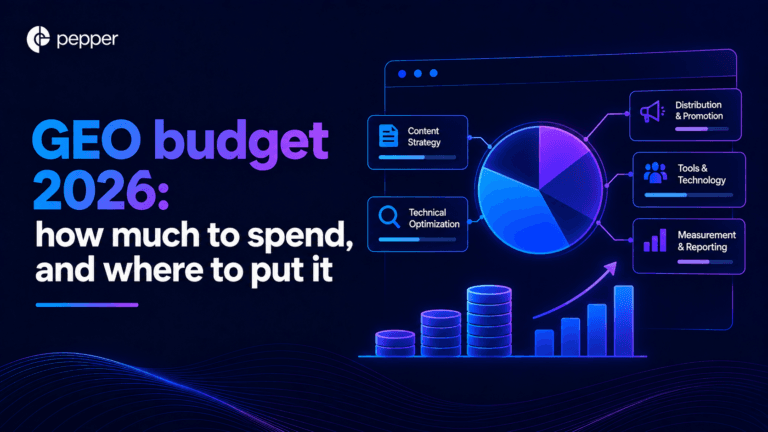
Our own benchmark of 30 published prices already answers what GEO costs. This answers the different question, which is what you should budget and where it should go. Two numbers decide it. A study of more than 25 million cited links found earned media drives 84% of AI citations while paid and advertorial content drives 0.3%. And the Gartner CMO survey of 401 CMOs puts marketing at 7.8% of revenue with SEO the largest single line inside owned and earned digital. Put those together and the answer is that GEO is not a new budget line at all. It is a reallocation, and most teams are making it in the wrong direction.
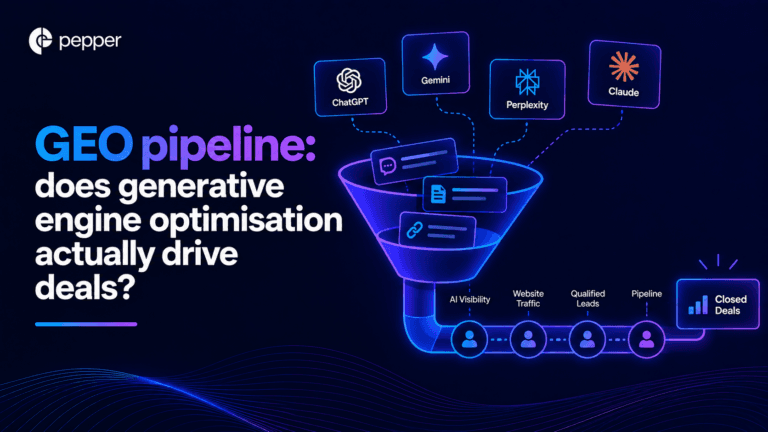
Yes, and it will not show up in your pipeline report. Those two statements are not in tension, they are the same fact stated twice. A survey of more than 1,000 B2B software buyers found 82% had sourced software recommendations from an AI chatbot in the last two years, and about half said AI mattered most when they were narrowing and comparing options. That is precisely the stage that produces no click. Meanwhile the conversion multiples circulating for AI traffic run from 22% better than organic to five times better, and the only peer-reviewed study says worse. Here is how to tell which is true for you.
Agent Atlas is the chat-first layer of Pepper’s platform: you ask in plain language, it reasons across your connected sources, and it runs the work. Here is exactly what it does, and what V1 does not.
Get your hands on the latest news!

Similar Posts
GEO / AI Search
16 mins read
GEO budget 2026: how much to spend, and where to put it
GEO / AI Search
17 mins read
GEO pipeline: does generative engine optimisation actually drive deals?

GEO / AI Search
11 mins read