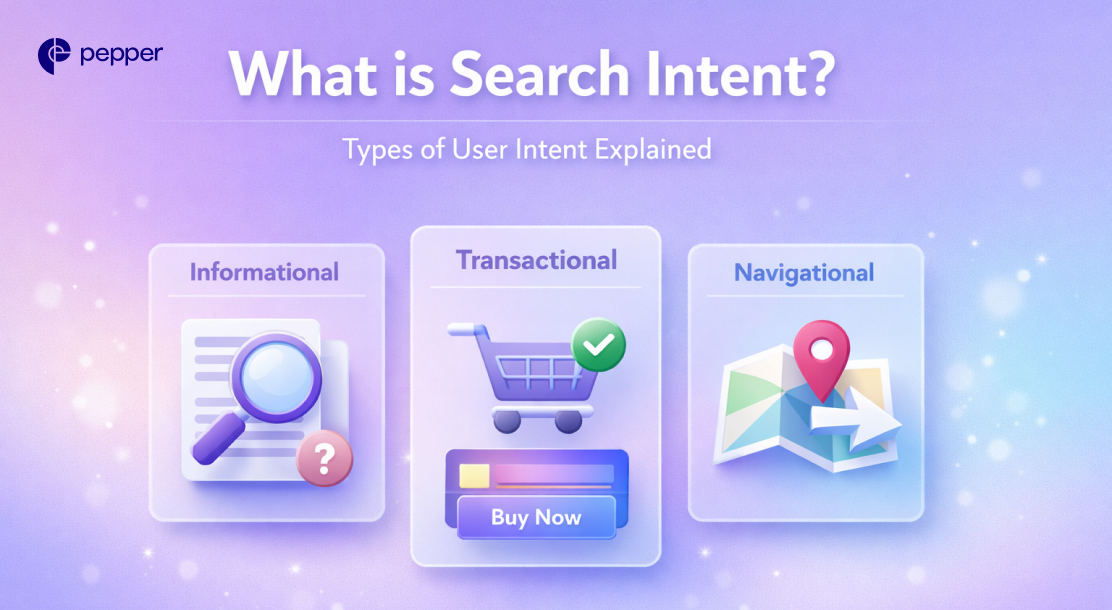
Search intent (also called user intent or keyword intent) is the underlying purpose behind a user’s search query—what they actually want to accomplish when typing a phrase into Google, ChatGPT, or any search platform. Understanding search intent helps marketers create content that matches what users seek, improving rankings, engagement, and conversions.
Search engines have evolved far beyond simple keyword matching. Google now interprets the meaning behind queries, predicting what users actually need rather than just returning pages with matching words. For SEO and content marketers, this shift makes search intent the foundation of effective optimization.
Search Intent Explained
When someone types a query into Google, they have a specific goal in mind. Search intent captures that goal. A user searching “running shoes” might want to buy shoes, learn about different types, or find a specific brand’s website.

Search engines analyze billions of queries to understand patterns in user behavior. They recognize that different words can mean the same thing, interpret terms with multiple meanings correctly, and understand relationships between concepts. This semantic understanding helps Google predict intent with remarkable accuracy.
The result? Content that fails to match user intent simply won’t rank well, regardless of keyword optimization or backlink strength.
The Four Types of Search Intent
Search intent falls into four primary categories, each requiring different content approaches.
| Intent Type | User Goal | Example Queries | Best Content Format |
|---|---|---|---|
| Informational | Learn something | “what is search intent” “How SEO works” | Blog posts, guides, tutorials |
| Navigational | Find a specific website | “Pepper login,” “HubSpot pricing” | Brand pages, homepages |
| Commercial | Research before buying | “best SEO tools,” “Ahrefs vs Semrush” | Comparison posts, reviews |
| Transactional | Complete an action | “buy running shoes,” “sign up free trial” | Product pages, landing pages |
Informational intent represents roughly 80% of all searches. Users want answers, explanations, or how-to guidance. Keywords often include “what,” “how,” “why,” or “guide.”
Navigational intent occurs when users already know their destination. They search for a brand name rather than typing the URL directly.
Commercial intent indicates research mode. Users compare options, read reviews, and evaluate alternatives before purchasing.
Transactional intent signals readiness to act. Keywords include “buy,” “order,” “discount,” or “free shipping.”

Why Search Intent Matters for SEO
Matching content to keyword intent directly impacts three critical outcomes.
First, search engines favor results that satisfy user intent. Google’s Quality Rater Guidelines explicitly measure how well content meets searcher needs. Pages that miss intent simply won’t rank.
Second, intent alignment improves user experience. When content delivers what users seek, engagement metrics improve—lower bounce rates, longer time on page, higher conversion rates.
Third, understanding what is user intent in SEO helps prioritize content creation. Knowing whether target keywords carry informational or transactional intent shapes content format, depth, and calls-to-action.

What Are High-Intent Keywords?
High intent keywords signal clear readiness to take action. These terms typically appear late in the buyer’s journey when users know what they want and actively seek the best way to get it.
Transactional keywords like “buy,” “order,” or “pricing” indicate immediate purchase intent. Commercial keywords like “best,” “review,” or “vs” suggest users are close to decisions but still evaluating options.
High-intent keywords often convert at 2-5% compared to less than 1% for informational queries. Long-tail variations with specific modifiers can reach conversion rates of 36% or higher.
For B2B marketers, identifying high intent keywords means focusing on terms prospects use when they’re ready to engage with sales, not just browsing for general education.

How to Identify Search Intent
Analyzing search intent requires examining what Google already rewards. The search results page reveals exactly how Google interprets a query.
| Content | Questions to ask |
|---|---|
| Type | Are the top results blogs, product pages, or tools? |
| Format | Are they tutorials, lists, comparisons, or videos? |
| Angle | Is the focus beginner, expert, or time-sensitive? |
This “3 Cs” framework (content type, content format, content angle) provides a reliable method for determining the keyword intent for any target term.
| Remember: Search intent determines whether content ranks and converts. Matching your content type, format, and angle to what users actually seek—not just the keywords they type—is the foundation of an effective SEO strategy. |
Mixed intent queries present additional complexity. Broad terms often serve users at different journey stages, prompting Google to display varied result types on the same page.

| Key Takeaways: Search intent is the purpose behind a user’s query. Content ranks higher when it matches intent, not just keywords. High-intent keywords signal readiness to act and convert better. SERPs reveal intent through content type, format, and angle. |
Frequently Asked Questions
1. What is search intent and why is it important for SEO?
Search intent is the purpose behind a user’s query. It matters because Google prioritizes content that satisfies user goals, making intent alignment essential for rankings and conversions.
2. How does search intent influence search engine rankings?
Search engines measure how well content meets user needs. Pages matching intent earn higher engagement metrics and better rankings, while misaligned content struggles regardless of other SEO factors.
3. What are the different types of search intent?
The four types of search intent are informational (learning), navigational (finding websites), commercial (researching options), and transactional (taking action).
4. How can I identify high intent keywords?
High-intent keywords include transactional modifiers, such as “buy,” “pricing,” or “demo,” and commercial terms like “best,” “review,” or “vs.” These indicate users are close to purchase decisions.
5. How does user intent in SEO affect content creation?
Understanding user intent shapes content format, depth, and structure. Informational intent calls for guides and tutorials, while transactional intent requires product pages with clear calls-to-action.
Latest Blogs
Most 90-day AI plans are sequenced by how hard the work feels rather than by how long it takes to land. So they spend week one on an llms.txt file that Google states it does not use, and they schedule earned media for phase three, which guarantees no result inside the quarter. This plan inverts that. It orders the work by lead time, starts the slowest thing on day one, and cuts four tactics Google explicitly says are unnecessary.
We priced this category nine days ago. Today we went back to the same four pricing pages to check the numbers before publishing. Three of the four had changed, and two had stopped publishing prices altogether. That is the real answer to what AEO costs in 2026: not a number, but a meter that moves, measured in prompts and responses and engines that are billed separately. Here is how each pricing model works, what unit it charges you for, and which incentive that unit creates.
Ask what AI search traffic is worth and you will be handed a multiplier. The ones in circulation right now run from 13% worse than organic search to 23 times better, a spread of roughly twenty-six fold on the single input your whole business case depends on. They disagree because they are measuring the same behaviour under different attribution models. So this is not a guide to finding the right multiplier. It is a guide to building a model whose assumptions are visible, and to being honest about the half you cannot prove.
Get your hands on the latest news!

Similar Posts

SEO
12 mins read
How to find the topics AI engines actually answer

SEO
15 mins read
What are the best SEO agencies in 2026?

Artificial Intelligence
12 mins read