GEO case studies: what measurable AI-search results actually look like

The short answer
Search this topic and you will be told about a 4,900 percent revenue increase, a 12,800 percent growth figure, and ninety million dollars of pipeline attributed to AI discovery. Almost none of it names a method, a baseline, or in several cases a client.
We are not going to add to that. Below are seven programmes we ran, with the figures published on their own pages, and a label on each saying what it actually proves. Some prove a great deal. Some prove less than the number suggests, and we say which.
Key takeaways
- Most published GEO case studies measure visibility, not pipeline. That includes most of ours, and pretending otherwise is the main dishonesty in this genre.
- The strongest AI-specific evidence we have is a client CMO describing a direct connection between the investment and closed deals originating from LLMs.
- The strongest revenue evidence is a 177 percent increase in revenue attributed to organic search on a two-year healthcare programme, and a 10x increase in website orders on an automotive account.
- The clearest AI-search number is AI Overview visibility moving from 14 keywords to 97 on one B2B SaaS account.
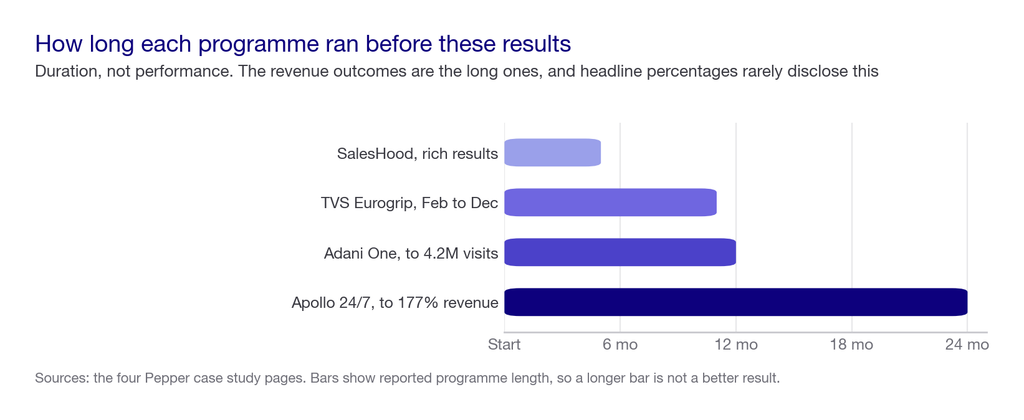
- Time matters more than tactics. The programmes with revenue outcomes ran for a year or more. The ones quoted with dramatic percentages elsewhere rarely say how long they took.
Where this comes from, and the obvious conflict. Every case study below is ours. We run organic for more than 250 enterprises at Pepper and track over 10 million prompts across every major engine. You should read a vendor’s own case studies sceptically, which is exactly why each one here carries a label saying what it does not prove.
What is a GEO case study, and what should one contain?
A GEO case study documents work done to make a brand visible inside AI-generated answers, and reports what changed.
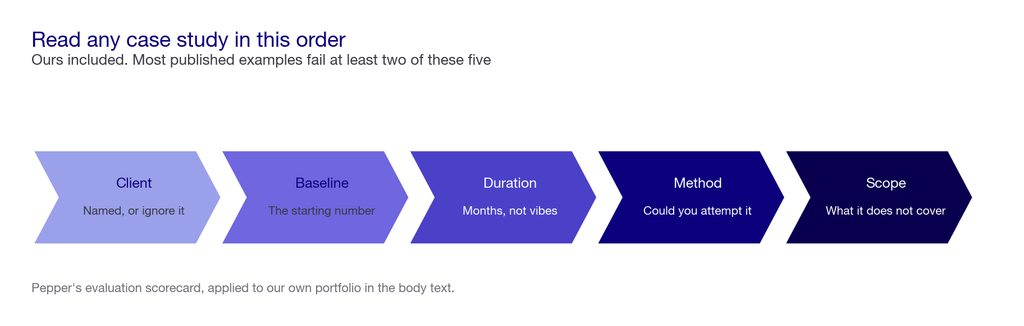
A useful one contains five things, and most published examples contain two:
- A named client, not “a leading B2B SaaS company”. Anonymous case studies cannot be checked by anyone, which is usually the point of anonymising them.
- A baseline. A percentage with no starting number is unreadable. Going from 2 citations to 8 is a 300 percent increase and also almost nothing.
- A time period. Results over three months and results over two years are different products, and the ones quoted without a duration are usually the fast-looking slice of a slow programme.
- The specific work done, in enough detail that someone could attempt it. “We optimised for AI search” is not a method.
- An honest scope. What the numbers cover, and what they do not. A traffic figure is not a revenue figure, and should never be presented as one.
See where you show up. Pepper’s GEO platform tracks Brand Visibility, Domain Prompt Presence and Share of Voice across ChatGPT, Perplexity, Gemini, Claude and Google AI Overviews. Your team can log in, connect Search Console and GA4, manage the prompt set and run your own agents in the Agent Atlas. A growth team works the same account alongside you. Book a growth audit or see where you show up.
Three kinds of evidence, and what each is worth
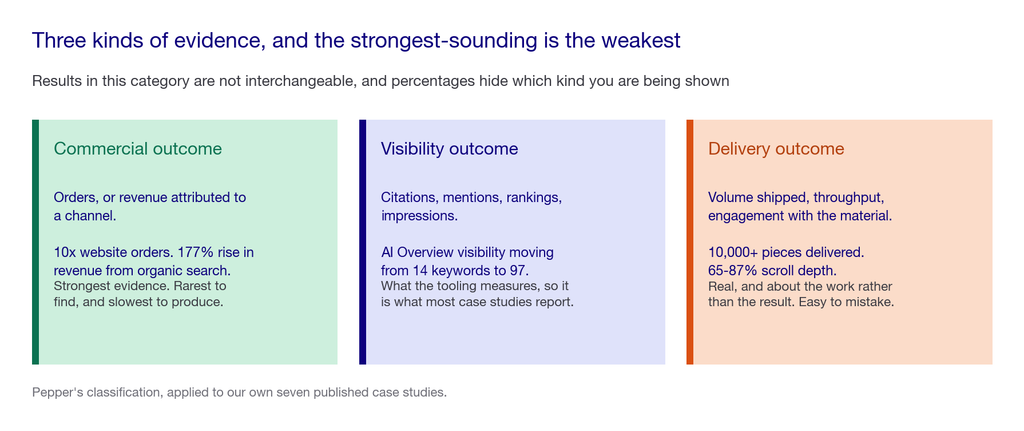
Results in this category are not interchangeable, and the strongest-sounding number is often the weakest evidence.
Does GEO actually drive pipeline?
Here is the honest answer, and it is more qualified than anyone selling GEO would like.
The direct evidence is thin, industry-wide. Very few published case studies in this category connect AI-answer visibility to closed revenue with a stated method. Most report citations, mentions or rankings, because those are what the tooling measures.
The strongest thing we can point to is our sales enablement client. Their CMO, Elay Cohen, described seeing a direct connection between the investment and lead flow from LLMs that closed. That is a named executive at a named company describing revenue from AI-originated leads, which puts it well above the category norm. It is still a statement rather than an attribution model, and we will not dress it up as one.
The strongest revenue evidence sits slightly to the side, in organic rather than AI answers specifically. On an enterprise healthcare programme, revenue attributed to organic search rose 177 percent. On an automotive account, website orders through Google Merchant Center increased 10x. Both are commercial outcomes with real money attached, and both come from organic programmes broadly rather than from AI-answer work in isolation.
So the honest summary: organic programmes demonstrably drive revenue, and how much of that comes from AI answers specifically is not yet cleanly separable. Anyone claiming otherwise with a precise percentage is estimating.
Seven GEO case studies, in full
Grouped by what they actually demonstrate rather than by how impressive they sound.
AI-answer visibility
SalesHood. B2B SaaS, sales enablement, US. Seven workstreams including a strategic audit, an SEO blog engine of 20 new pieces and 8 refreshed, GEO and AEO tracking in Atlas across ChatGPT, Gemini and Claude, and technical SEO resolving 10 issues.
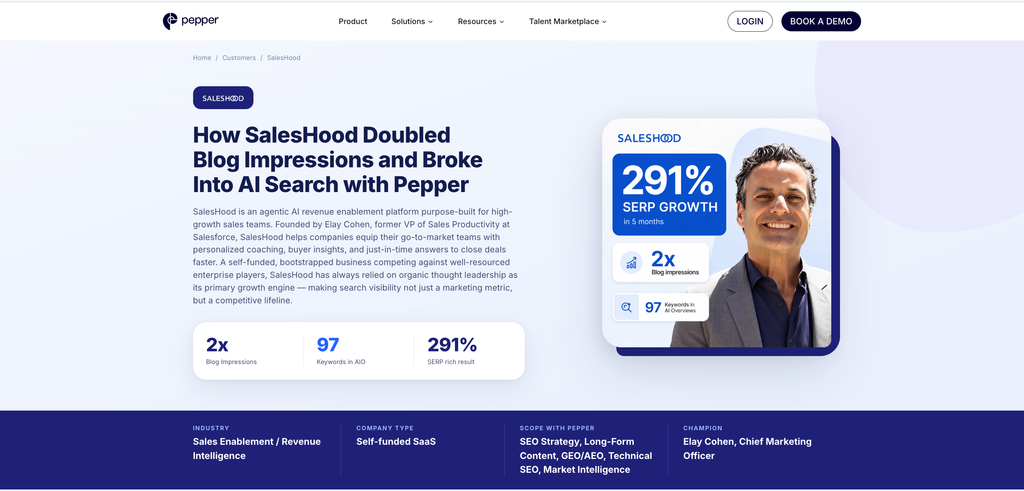
- AI Overview visibility: 14 keywords to 97. The clearest AI-search-specific number in our portfolio.
- Blog impressions: 200,000 to 417,000.
- Rich results: up 291 percent in five months.
- Clicks: up 20 percent against an industry-wide decline.
- What it proves: that a combined content, technical and tracking programme moves AI-answer visibility measurably. Where it falls short: no revenue figure, though the CMO statement above is unusually direct for this category.
Commercial outcomes
TVS Eurogrip. automotive parts, India with global focus. A recovery programme after a site migration cost roughly half their organic traffic.
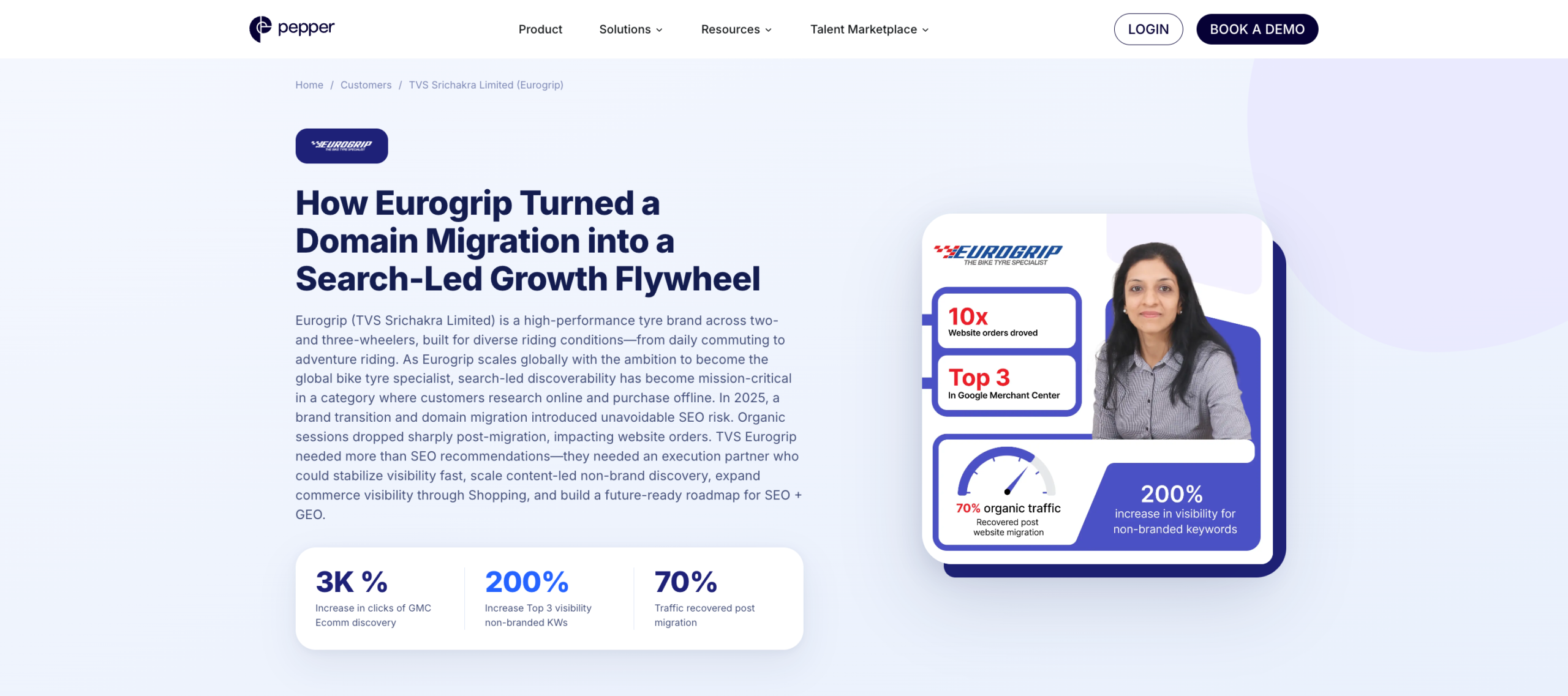
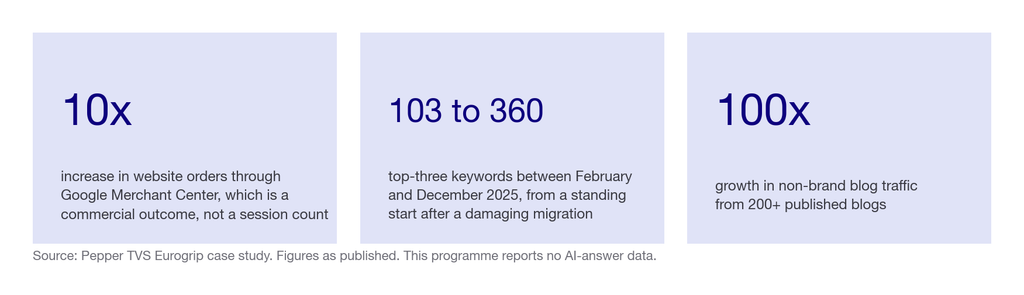
- Website orders through Merchant Center: 10x increase. A genuine commercial outcome.
- Top-three keywords: 103 to 360, and top-ten keywords 344 to 1,010, between February and December 2025.
- Non-brand blog traffic: 100x growth, from 200+ published blogs.
- Merchant Center discovery clicks: up 3,000 percent, impressions up over 7,000 percent, from 20 to 120+ products listed.
- Traffic recovery post-migration: 70 percent.
- What it proves: that technical recovery plus content-led SEO produces orders rather than sessions alone. Where it falls short: nothing here is AI-specific. Their Head of Brand Marketing, Kavitha Ganesan, described GEO as a future priority rather than a completed workstream.
Apollo 24/7. enterprise healthcare, India. A two-year programme built on clinician-authored content: 400 doctor-authored blogs, 200 expert-authored articles, and an audit of more than 50,000 pages.
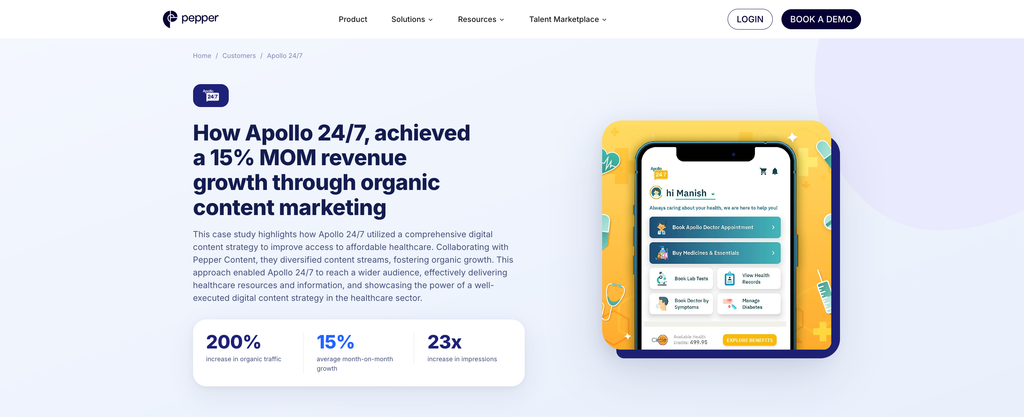
- Revenue attributed to organic search: up 177 percent, with 77 percent organic revenue growth inside one year.
- Organic traffic: 700 percent growth over two years, half of it in year one.
- Impressions: 23x increase. New users: 2.5x.
- Average month-on-month revenue growth: 15 percent.
- What it proves: that a long-running, expert-authored organic programme produces attributable revenue at enterprise scale. Where it falls short: no AI-answer performance data, which was not the measured objective.
Scale and depth
Acceldata. B2B SaaS, data observability, US. A depth-over-volume programme in a technical category.
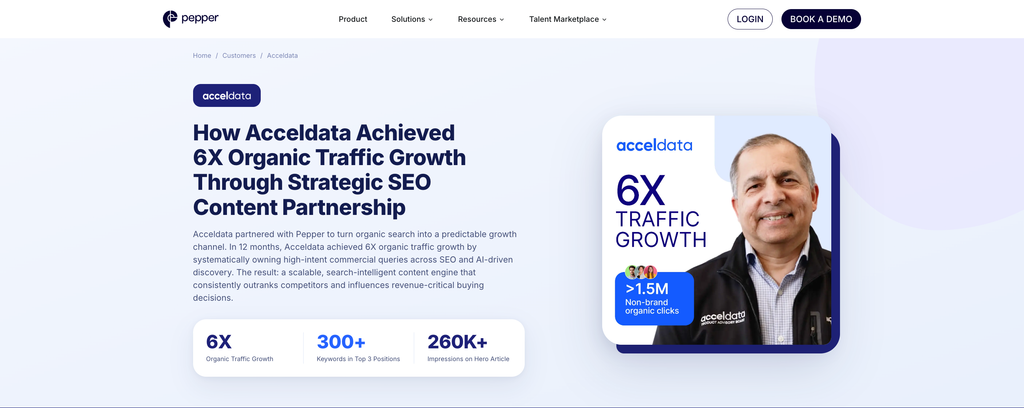
- Organic traffic: 6X growth.
- Top-three keyword rankings: 85 to more than 300.
- New organic users: 100,000+, at a 47 percent engagement rate.
- A single hero guide produced more than 260,000 impressions on its own, outperforming a quarter of the scheduled calendar.
- What it proves: that depth beats cadence, with an unusually clean single-page comparison. Where it falls short: no revenue figure, and no AI-answer citation data.
Adani One. travel, India. A large-scale content build across flights and destinations.
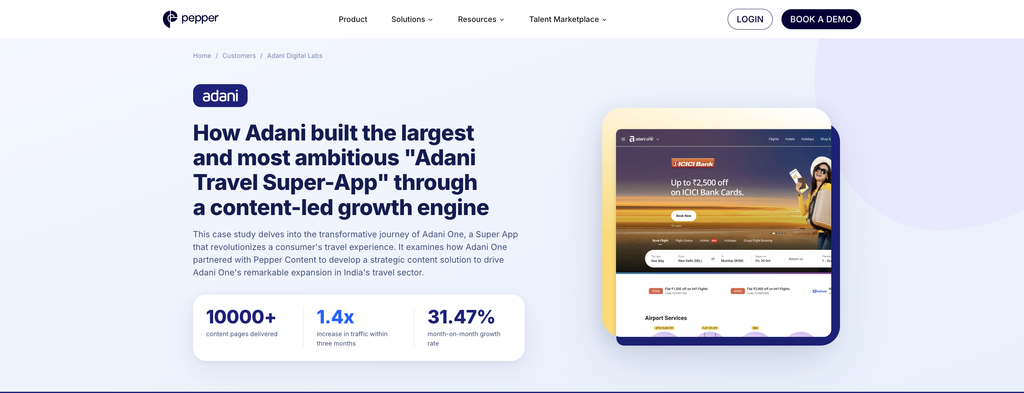
- 4.2 million monthly visits within one year, from a standing start.
- 37,000+ keywords ranking in the top 50.
- 31.47 percent month-on-month growth, and 1.4x traffic within three months.
- Delivered: 10,000+ content pages, including 20,000+ flight pages and 7,000 listicles, with 800+ travel subject matter experts.
- What it proves: that expert-sourced content scales to millions of visits. Where it falls short: neither revenue nor AI visibility is reported.
RVshare. peer-to-peer RV marketplace, US. A volume programme with an AI-assisted production model.
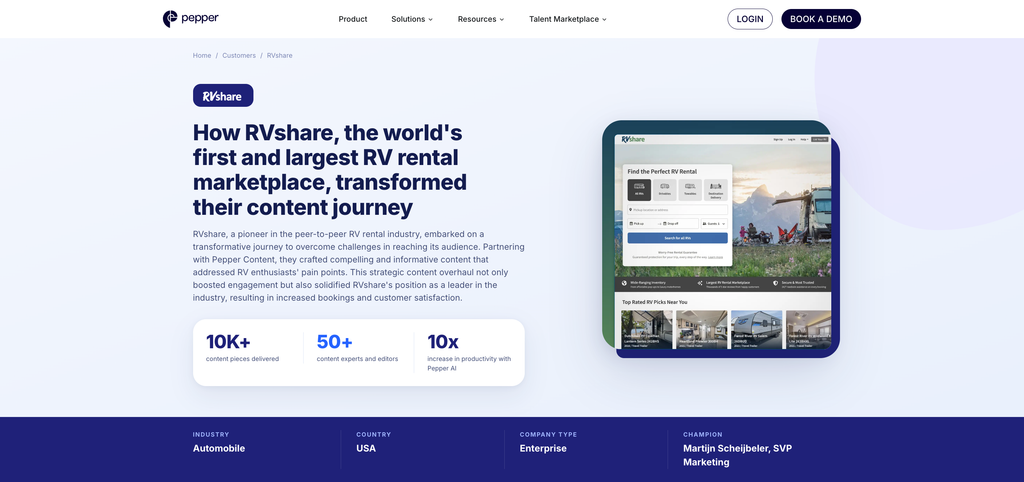
- 10,000+ content pieces delivered, at 250 new pages a month.
- 50+ content experts and editors on the account.
- 10x increase in production throughput using Pepper’s tooling.
- What it proves: that expert-reviewed content production scales without collapsing. Where it falls short: no search or AI outcomes at all. This is a delivery-capacity case study, and the throughput figure describes our production process rather than the client’s results.
Content quality
Algolia. B2B SaaS, AI search and agentic retrieval, US. Whitepapers, deep-dive blogs and thought leadership for a technical audience.
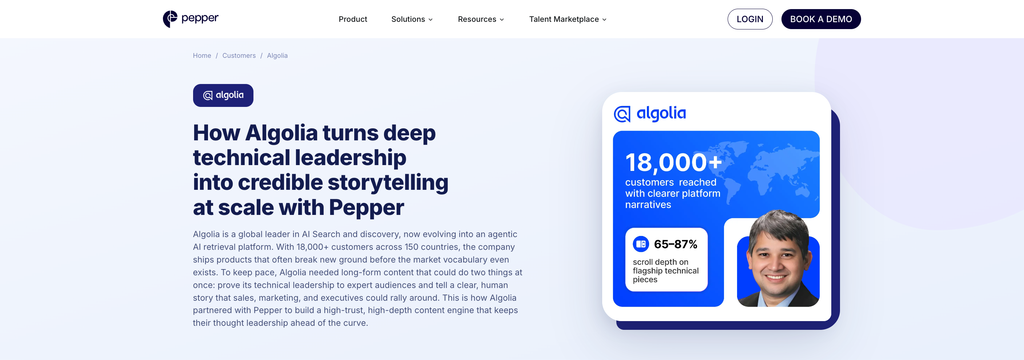
- Content scroll depth of 65 to 87 percent, which for long-form technical material is high.
- Work included subject matter expert interviews, long-form development and narrative strategy around agentic AI positioning.
- What it proves: that technical buyers read the material, which is a real signal in a category where most content is skimmed. Where it falls short: no traffic, rankings, citations or revenue. None is reported, and this is the thinnest case study here on measurable outcomes.
Where all of these fall short
Worth stating plainly, because the omissions are as informative as the numbers.
- None isolates AI-answer visibility as the cause of revenue. SalesHood comes closest through a CMO statement, and a statement is not an attribution model.
- None is a controlled study. There is no counterfactual anywhere in this genre, ours included. We cannot tell you what would have happened without the work.
- Two report no search outcomes at all. RVshare is a production-capacity story and Algolia is a content-quality story. Both are useful and neither belongs in a visibility comparison.
- Several run in one market. Apollo, Adani and TVS Eurogrip are India-market programmes. They demonstrate scale and revenue, and they do not demonstrate US or UK regulatory contexts.
Our methodology: how we labelled each case study
| Criterion | Weight | What that means here |
|---|---|---|
| Named client and published figures | 35% | Every number here is on a page you can open, attributed to a named company |
| Stated baseline and time period | 30% | A percentage without a starting point and a duration is not evidence |
| Closeness to commercial outcome | 20% | Revenue and orders outrank sessions, which outrank impressions |
| AI-answer specificity | 15% | Whether the result is about AI answers or about organic broadly |
The seven at a glance
| Programme | Industry | Headline result | What it proves | Reported cost |
|---|---|---|---|---|
| SalesHood | B2B SaaS | AI Overview visibility 14 to 97 keywords | AI-answer visibility moves measurably | Not published |
| TVS Eurogrip | Automotive | 10x website orders via Merchant Center | Technical recovery plus content produces orders | Not published |
| Apollo 24/7 | Healthcare | 177% increase in revenue from organic | Long programmes produce attributable revenue | Not published |
| Acceldata | B2B SaaS | 6X organic traffic, 260K+ impressions from one guide | Depth beats cadence | Not published |
| Adani One | Travel | 4.2M monthly visits within a year | Expert-sourced content scales | Not published |
| RVshare | Marketplace | 10,000+ pieces at 250 pages a month | Production capacity holds at scale | Not published |
| Algolia | B2B SaaS | 65 to 87% content scroll depth | Technical buyers actually read it | Not published |
How to evaluate a GEO case study
Whether it is ours or anyone else’s, the same five checks apply, and most published examples fail at least two.
The scorecard
Score any case study out of 100 before you let it influence a decision.
| Check | Weight | How to score it honestly |
|---|---|---|
| Named client | 25% | A real company you can look up, not “a leading B2B SaaS brand” |
| Baseline stated | 25% | The starting number is given, so a percentage can be interpreted |
| Time period stated | 20% | You know whether this took three months or three years |
| Method described | 20% | Enough detail that you could attempt the same work |
| Scope honestly bounded | 10% | It says what the numbers do not cover, rather than implying they cover everything |
The live test, over 90 days
Before you accept any case study as relevant to you, test the claim against your own situation.
Fix 30 prompts your buyers would actually type, and run them across Google, ChatGPT and Perplexity. Real questions, such as “does GEO actually drive pipeline”, “which sales enablement platform is best for mid-market”, “what is the best data observability tool” and “how do I measure AI search visibility”.
Log whether you are named, whether your domain is cited, and which sources appear instead. Rerun the identical set monthly for 90 days. Three readings is the shortest honest window: one is a snapshot, two could be noise, three shows direction.
That gives you your own baseline. A case study is only useful once you know where you are starting from, and most people evaluating them have never measured their own position.
Weak approach versus strong approach
The weaker approach: shortlist agencies by the largest percentage on their case study pages, without checking baselines or durations, then discover the 4,900 percent increase started from four visits a month.
The stronger approach: ignore percentages entirely on the first pass. Read for named clients, stated baselines and time periods. Then ask each finalist for a case study where the programme underperformed, and listen to how they answer.
The difference is that the strong version filters on evidence quality rather than on headline size, and headline size is precisely what this genre optimises for.
Red flags
- A percentage with no starting number. Going from 2 citations to 8 is a 300 percent increase and almost nothing in absolute terms.
- Anonymous clients. “A leading B2B SaaS company” cannot be checked, which is usually why it is phrased that way.
- No time period. A result over two years presented without its duration is the fast-looking slice of a slow programme.
- Revenue claims with no attribution method. Pipeline figures attributed to AI discovery need to explain how the attribution was done.
- No underperforming example anywhere. Every agency has them, including us. A portfolio of unbroken triumphs is a curated portfolio.
- Guaranteed outcomes based on past results. Nobody controls generated output, and Google warns against providers guaranteeing rankings.
Five questions worth asking
- “What was the baseline?” The single most useful question in this category, and the one most often deflected.
- “How long did this take?” Compare it against the timeline you are being sold.
- “How was revenue attributed?” If the answer is a dashboard screenshot, it is a correlation.
- “Show me a programme that underperformed and tell me why.” How they answer matters more than the example.
- “Which of these results is about AI answers specifically?” Most GEO case studies, ours included, are largely organic results wearing a GEO label.
Reduced to one principle: read case studies for baselines and durations, and treat the percentages as marketing until both are present.
One closing note that costs us something. Applying our own scorecard to our own portfolio, the Algolia and RVshare studies score poorly on measurable outcomes, and three of the seven report no AI-answer data at all, ours included in the general point that this genre flatters itself. We would rather you knew that from us than worked it out afterwards.
What does a programme like these cost?
| What you are buying | Typical 2026 shape | What it covers |
|---|---|---|
| Your own baseline | Free, about two hours | 30 prompts across three engines, named and cited logged separately |
| Per-engine tracking | Roughly $99 to $400 a month | Automated visibility and competitor share of voice |
| Content with genuine depth | Front-loaded, then maintenance | The work behind every result on this page |
| Technical recovery | Project cost, varies widely | The starting point on the Eurogrip programme |
| Expert-authored content | Specialist hours, the real constraint | Clinician or engineer authorship, as on Apollo and Acceldata |
| Platform plus a growth team | Custom | Pepper: tracking, plus the people and agents doing the work |
None of the case study pages above publishes a fee, and we have not invented one here. Ask for a cost figure alongside any result, from us or anyone else.
What nobody should promise you
That a case study predicts your outcome. None of these is a controlled study, and no counterfactual exists anywhere in this category.
A specific pipeline figure from AI search. The industry cannot currently separate AI-answer contribution from organic contribution cleanly, and precise claims are estimates.
Results on the timeline of the fastest case study. The revenue outcomes above took a year or more.
A guaranteed citation, ranking or position. Nobody controls generated output.
When a case study should not persuade you
The answer that costs us the sale. If you have never measured your own AI-answer visibility, you do not need to read another case study yet and we would tell you not to bother.
Run the 30-prompt test first. Without a baseline, every case study on this page is an anecdote about somebody else’s starting position, and you cannot tell whether their gain is available to you. Two hours of your own data is worth more than a portfolio of ours.
Frequently asked questions
Does GEO actually drive pipeline?
The direct evidence is thin across the whole category. The strongest we can point to is a client CMO describing closed deals from LLM-originated leads. Stronger revenue evidence exists for organic programmes broadly, including a 177 percent increase in revenue attributed to organic search.
What should a good GEO case study contain?
A named client, a stated baseline, a time period, enough method that you could attempt it, and an honest statement of what the numbers do not cover. Most published examples contain two of those five.
Why are GEO case study percentages so large?
Usually because the baseline is tiny and unstated. Moving from 2 citations to 8 is a 300 percent increase and almost no absolute change, which is why the starting number matters more than the percentage.
What is the clearest AI-search result you can point to?
AI Overview visibility moving from 14 keywords to 97 on a B2B SaaS account, alongside rich results growing 291 percent in five months and clicks rising 20 percent against a declining category.
How long do these programmes take?
The revenue outcomes took a year or more. A two-year healthcare programme produced 700 percent organic traffic growth, and an automotive recovery ran roughly eleven months. Expect direction at 90 days and compounding much later.
Are these results typical?
No, and no published case study is. These are programmes worth writing up, which is a selection bias every portfolio in this category shares. Treat them as evidence that the work can produce results, not as a forecast.
Can I compare GEO case studies across agencies?
Only on evidence quality, not on headline numbers. Score each for a named client, a baseline, a duration and a stated method, then compare what survives. Percentages from different baselines are not comparable.
Do SEO case studies still matter for AI search?
Yes, because the underlying work overlaps heavily. Google confirmed in May 2026 that AI Overviews and AI Mode run on core Search ranking systems with no separate AI index, so organic results are relevant evidence rather than a separate discipline.
Where to go next
Do not read another case study, including these, until you have measured your own position. Thirty prompts, three engines, two hours.
With a baseline in hand, every number on this page becomes interpretable. Without one, they are all just somebody else’s starting line.
Learn AI Search · Read all the case studies · Book a growth audit
Sources and further reading
- Pepper case studies, every figure as published on its own page. The sales enablement programme, the automotive recovery, the healthcare programme, the data observability account, the travel build, the marketplace production account and the developer-audience content programme.
- Pepper. All seven case studies in one place.
- Google Search Central. AI search optimisation guidance, 15 May 2026. Confirms AI Overviews and AI Mode run on core Search ranking systems with no separate AI index, and warns against guaranteed-ranking claims.
- Pepper. How to measure AI search visibility without expensive tools, for running the baseline test described above.
- Pepper. Is content marketing still effective, on why these programmes should be judged on more than sessions.
- Deliberately excluded: every third-party GEO case study figure encountered while researching this piece, including a 4,900 percent revenue increase, a 12,800 percent growth claim, ninety million dollars of pipeline attributed to AI-assisted discovery, and an “8 to 24 percent citation rate in 90 days” set. None named a method, several named no client, and none would survive the scorecard applied above.
Latest Blogs
Most advice on this is inference dressed as fact. OpenAI documents exactly one thing clearly, which is access. Here is what is documented, what is inferred, and how to verify the rest for yourself.
Being named in an AI answer and having your page used as its source are different outcomes with different causes and different fixes. The gap between them is the most useful diagnostic in AI search, and most reporting collapses it into one number.
Every platform reports share of voice and almost none of them define it the same way. Here is the definition worth using, the three choices that change the number, and how to measure it yourself without buying anything.
Get your hands on the latest news!
