GEO for B2B SaaS: how it differs from the advice you have been reading
The short answer
Most published GEO advice is built on e-commerce data, and B2B SaaS sits in the segment where several of the headline findings reverse. A peer-reviewed study of 973 e-commerce websites found AI referral traffic converting below almost every traditional channel. The same paper found the opposite on sites selling things that need guidance, which is what enterprise software is. Software is also bought through comparison, and comparative queries produce 2.4 times the brand mention rate of informational ones. So the generic playbook is not wrong. It is calibrated for a different buyer.
Key takeaways
- The conversion finding reverses for your segment. Across 973 e-commerce sites and 50,000 ChatGPT-referred transactions, AI traffic converted below affiliates, organic search, paid search, direct, email and referral. On sites selling things needing guidance, it outconverted five of those channels.
- Be careful how that is quoted. The paper’s 4.6x figure is a traffic share multiple on one segment, not a conversion multiple. Several published versions get this wrong, including one of ours.
- Comparison is where SaaS gets named. Comparative queries produced a 43.3% mention rate against 18% for informational, which is 2.4 times as many. How-to came in at 42.8% and commercial at 35.6%.
- Your buyers argue in public, and one engine reads it. Perplexity draws 19.4% of citations from community and user-generated sources, against ChatGPT’s 5%. For SaaS, that bucket is review sites, forums and communities.
- Earned media carries the citation surface. 84% of AI citations come from earned sources and 0.3% from paid, and for SaaS that mostly means third-party reviews, analyst coverage and journalism.
- Stale facts are the SaaS-specific risk. Models accepted a false premise as often as 64% of the time in one 2026 benchmark, so an out-of-date price on a comparison site gets repeated rather than corrected.
- Retrieval still comes first. More than 70% of AI answer errors trace to retrieval rather than reasoning, and gated content is a retrieval decision before it is a demand-generation one.
- Pepper is an agentic organic growth engine and an organic growth partner. Agent Atlas puts the agents in your team’s hands. Pepper’s GEO platform reports Brand Visibility, Domain Prompt Presence and Share of Voice across six engines, including ChatGPT, Perplexity, Gemini and Google AI Overviews. A growth team works alongside yours. Eight years, more than 250 enterprises, more than 10 million tracked prompts.
A note on where this comes from. Most of our work is B2B, and the thing I keep having to unpick in client meetings is a strategy built from a statistic about retail. Pepper runs organic growth for more than 250 enterprises over eight years and tracks more than 10 million prompts across every major engine. The useful move is almost never a new tactic. It is checking whether the evidence behind the current plan came from a buyer who looks anything like yours.
Disclosure: Pepper sells services that help brands appear in AI answers, and a story about B2B SaaS being a special case that needs specialist help suits us commercially. This article says the levers are the same ones and that the difference is calibration, not kind. It also corrects a figure on one of our own live pages. Every number traces to a named source with its method, and the segment each came from is stated in the line that uses it.
What is GEO for B2B SaaS, and how is it different?
Generative engine optimisation is the work of getting named and cited inside AI-generated answers. The levers are the same for everybody: be retrievable, answer one question completely, and earn corroboration from sources you do not control.
What differs for B2B SaaS is not the levers. It is three properties of the buyer.
- The purchase needs guidance. Nobody buys a data platform the way they buy a kettle. That changes what AI-referred traffic is worth, and the evidence on it reverses.
- The purchase is comparative. Software is bought by shortlist. Buyers ask for alternatives, comparisons and best-for-segment, which is the query class most likely to name a brand.
- The evidence lives in public. Review sites, communities and analyst coverage carry the category’s reputation, and one major engine reads them far more heavily than the other.
So the question is not what SaaS should do differently. It is which published findings were measured on somebody else’s buyer.
Finding one: the conversion evidence reverses for guidance-led purchases
This is the most important thing in this article and the least quoted.
Kaiser and Schulze, Marketing Science, 2026. 973 e-commerce websites with $20 billion combined annual revenue, more than 50,000 ChatGPT-referred transactions against 164 million from traditional channels, August 2024 to July 2025, from first-party analytics.
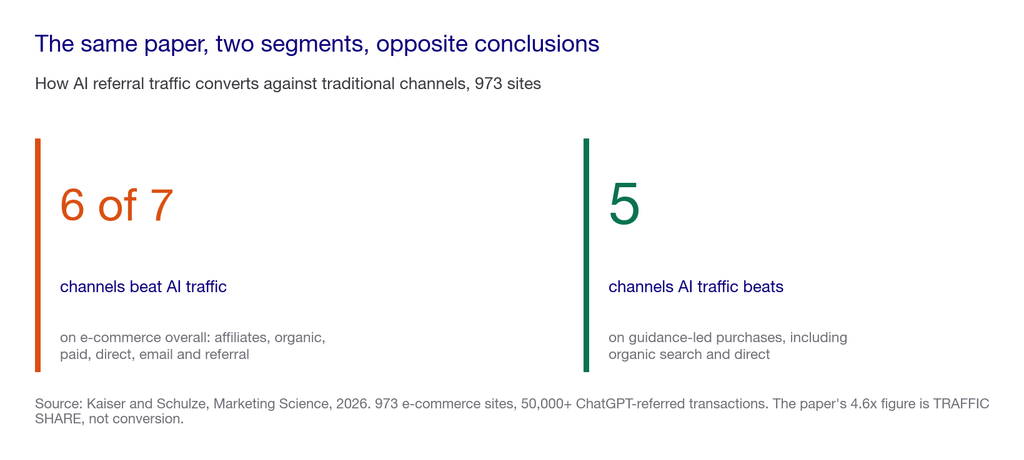
On e-commerce overall, the news is bad. AI referral traffic converted below affiliates, organic search, paid search, direct, email and referral. It beat only paid social. The same ordering held on average order value and revenue per session. AI referrals were under 0.2% of all visits.
On sites selling things that need guidance, the result inverts. For categories like vehicles, finance and business services, AI-referred traffic outconverted five traditional channels, including organic search and direct.
B2B SaaS is a guidance-led purchase. A buying committee, a trial, a security review and a procurement cycle is about as far from an impulse basket as commerce gets. So the segment your advice was measured on probably is not yours.
One number to handle carefully. The paper reports that guidance-led sites take about 4.6 times more traffic share from AI referrals. That is a share-of-traffic multiple, not a conversion multiple. A garbled version of it circulates as “AI traffic converts 4 to 6 times better”, and it appears on one of our own live pages. It is wrong, and we have said so before.
Limitations, stated: the study is e-commerce, the window closed in July 2025, and B2B procurement is poorly represented. It is the best evidence in this cluster and it is still a proxy for your segment rather than a measurement of it.
If you want this run against your own analytics rather than a published segment, book a growth audit and bring twelve months of channel data.
Finding two: the shortlist is where software gets named
The second structural advantage, and it follows from how software is bought.
A study published 9 June 2026 logged 3,981 domain appearances across 115 prompts and 14 countries, and broke the results down by query type.
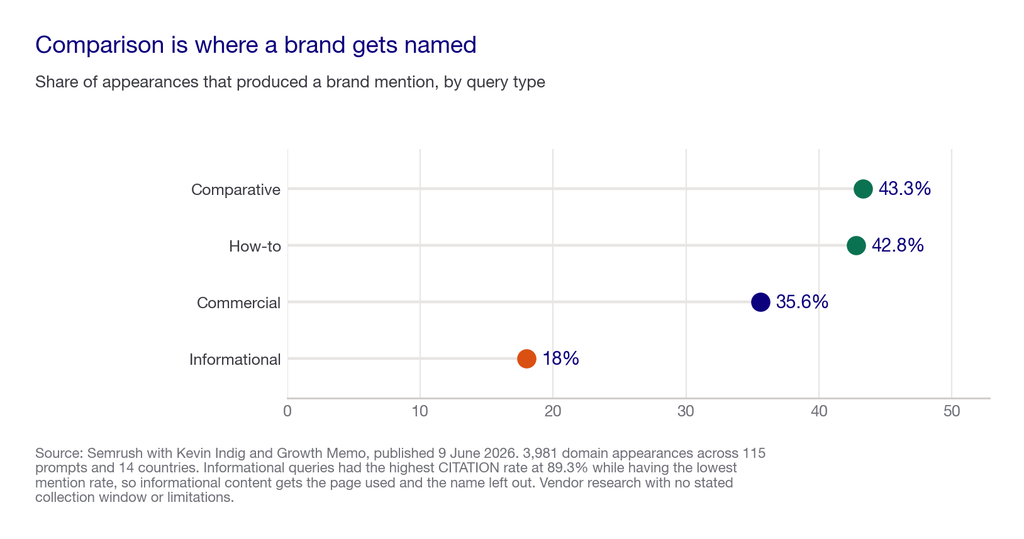
- Comparative queries: 43.3% mention rate.
- How-to queries: 42.8%.
- Commercial queries: 35.6%.
- Informational queries: 18%, but with the highest citation rate at 89.3%.
Read the top and bottom rows together, because they are the whole strategy. Informational content gets your page used and your name left out. Comparative content gets your name said. For a category bought by shortlist, that is not a marginal preference.
What this means in practice. The pages worth building are the ones that match how a shortlist actually forms: alternatives to the incumbent, best-for-this-segment, and honest head-to-head comparisons including where you lose. Those are also the pages most SaaS marketing teams are least comfortable publishing.
The trade-off is real and worth stating. Informational content still earns the citations that build retrievable authority. It just will not get you named, so do not measure it as though it should. Our page on mentions against citations covers the distinction.
Finding three: your buyers argue in public, and the engines disagree about that
B2B SaaS has an unusual property. A large part of the category’s reputation sits in review sites, subreddits and practitioner communities, in public, written by people you do not employ.
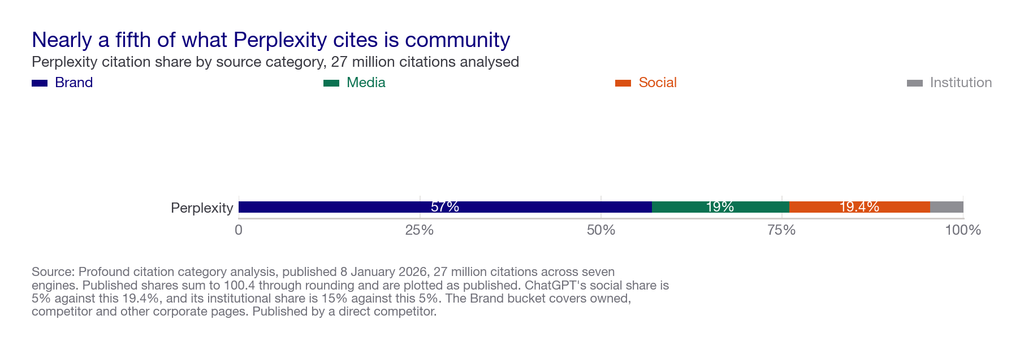
Across 27 million citations analysed in January 2026, Perplexity drew 19.4% of its citations from social and community sources, against ChatGPT’s 5%. ChatGPT leans the other way, taking 15% from institutional sources against Perplexity’s 5%.
So the answer to “should we care about Reddit and G2” is engine-dependent, which is a more useful answer than yes or no. If your buyers use Perplexity, the community layer is close to a fifth of what it reads about your category. If they use ChatGPT, it is a twentieth.
And the broader ceiling applies regardless. Across more than 25 million cited links, 84% came from earned media and 0.3% from paid. For a SaaS company, earned media is mostly review platforms, analyst notes and trade journalism. Your own site is a minority of the surface, and no amount of page-building changes that.
The SaaS-specific risk: stale facts get repeated, not corrected
Every category has an accuracy problem. SaaS has a worse one, because its facts change quarterly and they live on pages you do not control.
A 2026 benchmark evaluating six chatbots on 2,100 factual questions found that accuracy fell from 88 to 96% on well-formed questions to between 19% and 70% when a question carried a subtle false premise. The most vulnerable model accepted fabricated facts 64% of the time.
Now apply that to software. A comparison site lists a price you retired two quarters ago, a tier you renamed, or an integration you dropped. A buyer asks “is X still limited to three seats on the starter plan”. The engine will often take the premise and run with it.
So the quarterly job is unglamorous and specific.
- Write a one-page fact sheet: current tiers, prices, limits, integrations, and anything recently retired, because retired features are what engines quote longest.
- Ask twenty buyer questions on two engines and read the answers against that sheet.
- Open every cited source. Errors traced to a stale third-party page are the most fixable thing in this entire discipline, because the fix is a correction request rather than a content programme.
No platform does this for you, ours included. Every tool in this category measures presence. None measures whether what the engine said about you was true.
And retrieval still comes before all of it
One more thing that is not SaaS-specific but bites SaaS hardest.
Across those same 2,100 questions, more than 70% of all errors came from retrieval rather than reasoning. When a model lands on the right source it usually extracts the right answer, so the hard part is landing on it.
For SaaS this collides with gating. Your best material is often behind a form, which means it is not retrievable at all. That is a legitimate commercial decision and it should be made knowingly: a gated asset contributes nothing to AI visibility. The usual resolution is an ungated version that answers the question completely and a gated version that goes further.
Check indexation by template, crawler access in robots.txt, and whether your pricing and comparison pages render without JavaScript. Our guide to the five stages from query to answer covers the pipeline in full.
How we weighted the levers for B2B SaaS
Four things, weighted for this segment rather than in general.
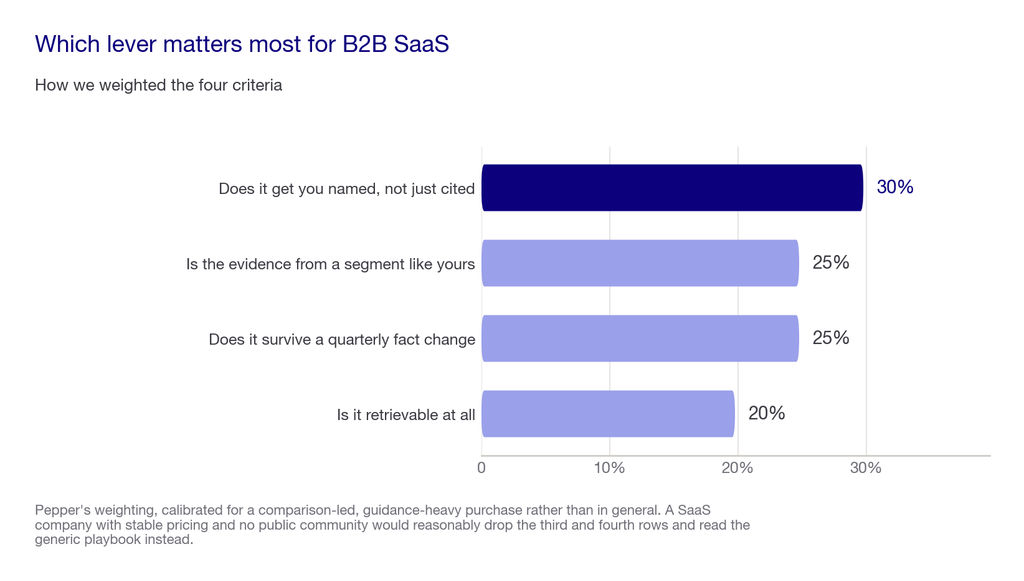
| Criterion | Weight | Why it carries that weight |
|---|---|---|
| Does it get you named, not just cited | 30% | Shortlists are built from names. Comparative queries produce 2.4 times the mention rate of informational ones. |
| Is the evidence from a segment like yours | 25% | The headline conversion finding reverses between e-commerce and guidance-led purchases. |
| Does it survive a quarterly fact change | 25% | SaaS prices and tiers move constantly, and a false premise is accepted as often as 64% of the time. |
| Is it retrievable at all | 20% | Gated material contributes nothing, and over 70% of errors are retrieval. |
GEO for B2B SaaS at a glance
| Lever | Why it matters more for SaaS | Time | Cost | Where it falls short |
|---|---|---|---|---|
| Comparative and alternatives pages | 43.3% mention rate against 18% informational | Quarters | Content budget | Teams are uncomfortable publishing honest losses |
| Review site and community presence | 19.4% of Perplexity citations are social | Quarters | Low to moderate | Worth a twentieth as much on ChatGPT |
| Quarterly fact-accuracy audit | Prices and tiers change faster than third-party pages | A day a quarter | Free, internal time | No platform does it for you |
| Ungating the answer layer | Gated assets are invisible to retrieval | Weeks | A demand-gen trade-off | Genuinely costs you form fills |
| Analyst and trade coverage | 84% of citations are earned | Quarters to years | High, not fully controllable | Slowest lever available |
| Retrieval hygiene | Over 70% of errors start here | An afternoon | Free | Nothing, do it first |
What this costs
The audit half is free. Retrieval hygiene is an afternoon, and the quarterly fact-accuracy audit is about a day of one person’s time.
The content half is the content budget. Comparative pages are not cheap to do well, because an honest comparison requires you to be specific about where you lose, which takes longer to get signed off than it does to write.
The earned half is the expensive one and the least controllable. Published GEO retainers run from $3,000 to $25,000 a month depending on scope, and monitoring tools start around $29 a month at entry tiers with very limited prompt counts. Run the free half first, because it changes what the paid half is worth.
How Pepper fits
Pepper is an agentic organic growth engine and an organic growth partner, which means three things working together rather than one product.
Pepper’s GEO platform is the self-serve workspace. Brand profile, competitors, personas, GA4 and Search Console connected, themes and prompts defined, with Brand Visibility, Domain Prompt Presence and Share of Voice across six engines, including ChatGPT, Perplexity, Gemini and Google AI Overviews. The competitor and persona setup matters more for SaaS than for most categories, because the queries that name you are comparative, so your prompt set has to include the rivals you are compared against.
Agent Atlas is where your team builds, versions and runs its own agents, with quick runs for one input and sheet runs for bulk. The quarterly fact-accuracy audit across a few hundred answers is exactly the repetitive work it exists for.
The growth team is attached to the account and works alongside yours, which matters most on the earned layer, where the work is analyst relations and review-platform presence rather than publishing.
Where it falls short: we measure presence, not accuracy. Our platform will tell you an engine named you and which sources it cited. It will not tell you the price it quoted was two quarters out of date, because that check needs your current source of truth and no vendor in this category has solved it. We also do not publish run-to-run variance, so by the measurement standard released in August 2026 our numbers are directional rather than decision-grade, along with everyone else’s.
Eight years, more than 250 enterprises, more than 10 million tracked prompts. You can see the shape of the work in the Acceldata case study, in how we run it across B2B SaaS, and across the case study library.
How to choose where to start
The decision is which lever first, and for SaaS the generic ordering is usually wrong. So here are the criteria, weighted.
The weighted scorecard
Score each row from 1 to 5, multiply by the weight, and total out of 100.
| Criterion | Weight | Score 1 means | Score 5 means |
|---|---|---|---|
| Share of your buyers’ queries that are comparative | 30 | Mostly how-to and educational | Mostly alternatives and best-for |
| How much of your best material is gated | 25 | Everything is open | The answer layer is all behind forms |
| How often your prices and tiers change | 25 | Stable for years | Repackaged every other quarter |
| Community and review presence in your category | 20 | Nobody discusses it publicly | Active subreddits, busy G2 category |
Under 40, run the retrieval audit and otherwise treat this as ordinary SEO. From 40 to 70, build the comparative layer and start the quarterly fact audit. Above 70, this is a programme rather than a project, and the review and analyst layer needs an owner.
The weaker playbook against the stronger one
The weaker approach is to take a GEO checklist written from retail data and apply it to a buying committee. It produces informational content that gets cited and never named, measured against a conversion benchmark from a segment where the finding reverses. The stronger approach is to check which segment each number came from, build the comparative layer that actually gets you named, and run the fact audit nobody sells. One imports somebody else’s evidence. The other starts from your buyer.
Run a live test before you commit a quarter
Take 20 questions your buyers actually ask on a shortlist, such as “best data observability platform for a mid-size engineering team”, “alternatives to the market leader for a regulated firm”, or “is this category worth it for a fifty person company”. Run each on two engines. Log three things: were you named, were you cited, and was what the engine said about your pricing correct. Repeat at 30 days and again at 90 days. If you are cited constantly and named rarely, your content is informational and your buyers are comparative.
Red flags
- A conversion multiple for AI traffic quoted without naming the segment it came from
- The 4 to 6 times claim, which is a garbled traffic-share figure
- A GEO proposal that does not mention your review platform presence
- Advice to gate the answer layer, which makes it invisible to retrieval
- Benchmarks from e-commerce applied to a buying committee
- Any plan that treats Reddit as equally important across all engines
- A programme with no quarterly accuracy check, in a category where prices move
Five questions worth asking any agency
- Which segment was that statistic measured on, and does it resemble our buyer?
- What share of your plan is comparative content against informational?
- How will you handle our pricing being quoted wrong on third-party pages?
- Which engines do you weight for review and community sources, and why?
- What would you tell us to stop doing, and what does it currently cost us?
The reducing principle. It comes down to one question: are you building content that gets you cited, or content that gets you named? Informational pages earn the first and rarely the second. Comparative pages earn the second, and for a category bought by shortlist the second is the one that enters the deal. Everything else here is a refinement of that split.
The honest closing note. If your category is not discussed publicly, your prices are stable and your buyers do not shortlist, you do not need a SaaS-specific GEO programme, and ordinary good content plus clean retrieval will do. The three findings in this article are advantages for a particular shape of business, and if yours is not that shape, the generic playbook fits you better than it fits most of our clients.
What nobody should promise you
- A conversion multiple without a segment. The headline finding in this space reverses between e-commerce and guidance-led purchases.
- That AI referrals will be a volume channel. They were under 0.2% of visits in the study above.
- Citations from review platforms you do not participate in. Presence there is earned and slow.
- Accuracy monitoring. No platform in this category measures whether what the engine said was true.
- That gating is free. A gated asset contributes nothing to AI visibility, and that is a real trade-off rather than a trick.
Where this stops working, including for us
The conversion reversal is the load-bearing claim and it is a proxy. The study is e-commerce, its window closed in July 2025, and the authors note that B2B procurement is poorly represented. We use it because it is peer-reviewed, it publishes its method, and its guidance-led segment is the closest published analogue to a software purchase. It is not a measurement of B2B SaaS.
Two of the other datasets were published by vendors using their own tooling, and neither states a collection window or a limitations section. Their definitions are explicit, which is why they are usable.
The false-premise evidence comes from news questions over fourteen days, which is a fast-moving domain. We have applied it to pricing accuracy by analogy, and the analogy is reasonable rather than demonstrated.
And our position is not neutral. “Your segment is a special case that needs specialist help” is an excellent thing for us to say, which is exactly why this article argues the levers are the same and only the calibration differs, and why it corrects a figure on our own live page rather than leaving it.
Where to go next
- For the full retrieval pipeline, read how an engine goes from query to answer.
- For the enterprise framing of this subject, read AI search for B2B.
- For why being cited and being named are different outcomes, read the ghost citation problem.
- To check where you currently stand, read the twenty-minute brand check.
- For the three levers underneath all of it, read Visibility, Citability and Retrievability.
Frequently asked questions
How do B2B SaaS companies do GEO?
With the same levers as everybody else, calibrated differently. Build the comparative layer that gets you named, participate where your category argues publicly, run a quarterly accuracy audit because prices change, and fix retrieval first. The difference is emphasis, not kind.
Is AI traffic worth anything for B2B SaaS?
Probably more than the headlines suggest. A peer-reviewed study found AI referrals converting below most channels on e-commerce, then found them outconverting five traditional channels on sites selling things that need guidance, which is what software is.
What is the 4 to 6 times conversion claim?
A misquote. The underlying paper reports roughly 4.6 times more traffic share for guidance-led sites, which is a share-of-traffic figure rather than a conversion multiple. It circulates widely as a conversion claim, including on one of our own pages.
What content gets a SaaS brand named rather than just cited?
Comparative content. Comparative queries produced a 43.3% mention rate against 18% for informational ones. Alternatives pages, best-for-segment pages and honest head-to-head comparisons are the pages that put your name in an answer.
Do review sites and Reddit matter for GEO?
It depends on the engine. Perplexity drew 19.4% of citations from social and community sources against ChatGPT’s 5%, so community presence is worth nearly four times as much on one engine as the other. Check which your buyers use.
Should we ungate our best content?
At least partly. A gated asset is invisible to retrieval, so it contributes nothing to AI visibility. The usual resolution is an ungated version that answers the question completely and a gated version that goes further.
How do we stop engines quoting old pricing?
Write a one-page fact sheet of current tiers and anything recently retired, ask twenty buyer questions on two engines, read the answers against the sheet, and open every cited source. Errors traced to stale third-party pages are the most fixable kind.
Is B2B SaaS harder or easier than other categories?
Easier on two counts and harder on one. Comparison-led buying and guidance-led purchases both work in your favour. Quarterly pricing changes work against you, because a false premise gets accepted as often as 64% of the time.
Sources and further reading
- Kaiser and Schulze, “Frontiers: ChatGPT Referrals to E-Commerce Websites”, Marketing Science, 2026. 973 e-commerce websites with $20 billion combined annual revenue, more than 50,000 ChatGPT-referred transactions against 164 million from traditional channels, August 2024 to July 2025, from first-party analytics. Source of the channel ordering, the under-0.2% share and the guidance-led reversal. Limitations stated by the authors: e-commerce only, window closed July 2025, B2B procurement poorly represented. The 4.6x figure is traffic share, not conversion.
- Semrush with Kevin Indig and Growth Memo, Why 62% of AI citations don’t lead to brand mentions, published 9 June 2026. 3,981 domain appearances across 115 prompts and 14 countries. Source of the mention rates by query type. Vendor research with no stated collection window or limitations.
- Profound citation category analysis, published 8 January 2026. 27 million citations across seven engines. Source of the per-engine source mix including the 19.4% social share. Published by a direct competitor, with no stated limitations.
- Suzgun, Shen, Bianchi, Spangher, Icard, Ho, Jurafsky and Zou, Evaluating Commercial AI Chatbots as News Intermediaries, arXiv:2605.22785, submitted 21 May 2026. Six chatbots, 2,100 factual questions. Source of the retrieval share and the false-premise collapse. News questions, applied here to pricing accuracy by analogy.
- Muck Rack, “What Is AI Reading?”, third edition, May 2026. More than 25 million links across ChatGPT, Claude and Gemini. Source of the 84% earned and 0.3% paid shares.
- Pepper, the retrieval stage in depth, and why gating removes you from it.
- Pepper, the enterprise B2B playbook, which this article complements with the SaaS-specific evidence.
- Pepper, why being shown and being named differ, for the citation and mention split.
A note on sources. Only sources published in 2026 are cited. Two of the five were published by companies we compete with, which is stated in the lines that use them. The segment each finding was measured on is named every time it appears, because that is the entire argument of this article.
Latest Blogs
Choosing a GEO agency for mid-market B2B used to be a shortlisting problem. It is now a procurement problem, because the published prices have largely gone. Of four agencies publishing a GEO-specific figure in September 2026, two had withdrawn their pricing pages by early October and one had moved domains. Exactly one still publishes a number a mid-market buyer can act on. So the useful question is no longer which agency is best in the abstract, but how to compare three quotes when only one of them arrived with a method attached.
Third-party sources and AI citations are tightly linked, and the link stops short of where most plans assume. Off-page work decides whether an engine retrieves and cites you. It does not decide whether the answer names you, and 61.7% of brand appearances are citations with no name attached. The two largest 2026 datasets also disagree about how much of the citation surface is third-party at all, one saying 84% and the other putting the brand bucket above half. That disagreement is definitional rather than factual, and it decides where a budget goes.
Why is my competitor showing up in ChatGPT and not me? Before accepting the premise, check it. Across 3,981 brand appearances studied in 2026, 61.7% were citations with no brand name in the answer and only 13.2% produced both. So there are three states that look identical from where you are sitting: genuinely absent, present as an unnamed source, and named less often than a rival. Each has a different cause and a different fix, and working on the wrong one is the most common way this gets expensive.
Get your hands on the latest news!