Why your competitor shows up in ChatGPT and you do not
The short answer
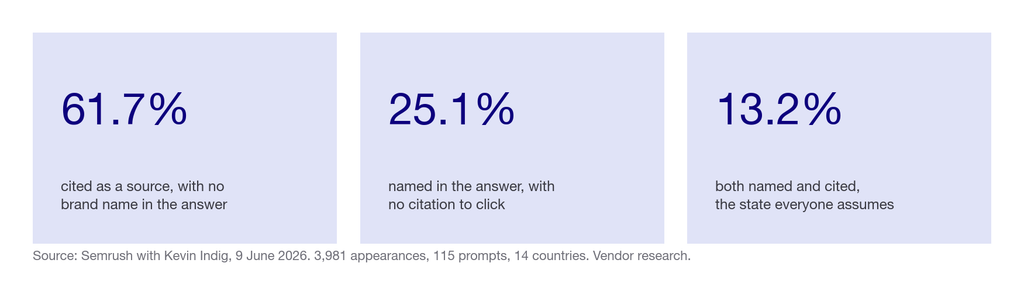
Start by checking the premise, because it is wrong more often than you would expect. Across 3,981 brand appearances studied in June 2026, 61.7% were citations with no brand name in the answer and only 13.2% produced both a citation and a mention. So three states look identical from the outside: you are genuinely absent, you are present as an unnamed source, or you are named less often than a rival. They have different causes and different fixes. Then work through the rest in order, because the cheapest checks rule out the most.
Key takeaways
- You may already be in the answer. Most appearances are citations with no name attached, so “my competitor shows up and I do not” is frequently “my competitor is named and I am quoted”.
- Check retrieval before anything else. Across 2,100 questions and six chatbots, more than 70% of errors came from failing to reach the right source, not from faulty reasoning.
- The engine may not have searched at all. In a July 2026 pilot of 48 buying prompts, it searched the web on only 42% of them. On the rest nothing you publish could have changed the answer.
- Engines disagree about naming. Gemini named brands in 83.7% of appearances while citing sources in 21.4%. ChatGPT did close to the reverse. Your rival may be winning one engine, not all of them.
- Your rival is usually winning on pages neither of you owns. 84% of AI citations come from earned media and 0.3% from paid.
- Comparative queries are where names appear. They produced a 43.3% mention rate against 18% for informational ones.
- One run proves nothing. Meaning-preserving rewording changed answers with mismatch rates above 23%, so re-run before concluding anything.
- Pepper is an agentic organic growth engine and an organic growth partner. Agent Atlas puts the agents in your team’s hands. Pepper’s GEO platform reports Brand Visibility, Domain Prompt Presence and Share of Voice across six engines, including ChatGPT, Perplexity, Gemini and Google AI Overviews. A growth team works alongside yours. Eight years, more than 250 enterprises, more than 10 million tracked prompts.
A note on where this comes from. This arrives as a screenshot, usually from a founder, usually on a Friday. Pepper runs organic growth for more than 250 enterprises over eight years and tracks more than 10 million prompts across every major engine. The thing I have learned to do first is not reassure anyone. It is ask them to run the same prompt again, worded differently, because about a quarter of the time the answer changes and the emergency evaporates.
Disclosure: Pepper sells services that help brands appear in AI answers, so “you are invisible and your competitor is not” is a conclusion we profit from. This article tells you to check the premise first, says most of the diagnosis is free, and gives you three outcomes where the honest answer is to do nothing yet. Every figure traces to a named study with its method. Competitors are named but never linked.
Why is my competitor showing up in ChatGPT and not me?
Three things could be true, and they look identical from where you are sitting. Before working on any of them, it is worth knowing which one you have.
What is an AI visibility gap, and is that what you have?
An AI visibility gap is the difference between how often an engine names your brand and how often it names a rival, for the questions your buyers actually ask. It is not the same as a ranking gap, and it is not the same as being absent.
Three states produce the same screenshot, and they need separating before anything else.
- Genuinely absent. The engine neither cited nor named you. This is the state people assume and the least common of the three.
- Present but unnamed. The engine used your page as a source and your brand never appeared in the text. 61.7% of appearances. The reader got your answer and learned your rival’s name.
- Named less often. You appear sometimes, your rival appears more. This is a share problem rather than an absence problem.
The fixes are different. Absence is a retrieval or corroboration problem. Being unnamed is usually a writing problem you can fix this week. Being named less often is a long, earned-coverage problem. Working on the third when you have the second is the most expensive mistake available here.
If you would rather have someone run this diagnosis with you and hand back the source lists, book a growth audit and bring the screenshot.
The diagnosis, in the order that rules things out fastest
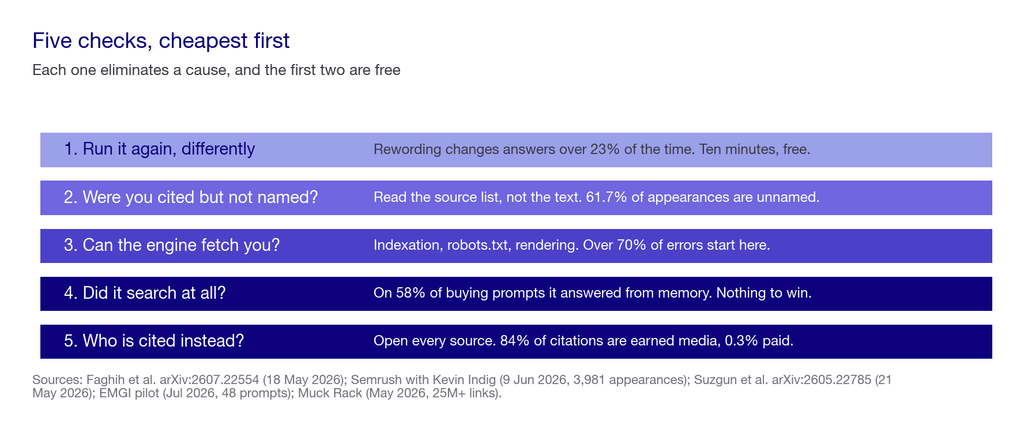
Work down. Each check is cheaper than the one below it, and each one eliminates a cause.
Check one: run it again, differently. A 2026 study across 4 benchmarks and 13 models found that meaning-preserving rewording changed the answer with mismatch rates above 23%. So ask the same question in different words, in a logged-out or temporary session, on a second engine. About a quarter of the time the problem moves. Ten minutes, free.
Check two: were you cited without being named? Read the source list under the answer, not just the text. If your domain is there, you are not absent. You have a naming problem, and that is the cheapest fix in this article.
Check three: can the engine fetch you at all? More than 70% of AI answer errors come from retrieval rather than reasoning. Check indexation by template, crawler access in robots.txt, and whether your key pages render without JavaScript. An afternoon, free. Our technical guide to AI crawlers covers the robots.txt consequences.
Check four: did the engine search at all? On 58% of buying prompts in a 2026 pilot, it answered from what the model already held. There was no retrieval event, so no page of yours could have been chosen and no tool can observe it, ours included.
Check five: who is cited, and do you appear on those pages? Open every source. 84% of AI citations come from earned media and 0.3% from paid, so the answer is usually assembled from pages neither you nor your rival owns. If your competitor is described on three review sites and you are not, that is the finding.
Why this is not simply a ranking gap
The usual instinct is to check rankings, and it will mislead you here.
An engine does not read a results page and copy the top entry. It interprets the question, often rewrites it into several of its own, retrieves a set of candidates, selects a handful, writes an answer, and then decides separately which sources to link and whether to name anyone. Ranking influences one stage out of five. Our walkthrough of the five stages from query to answer covers the pipeline properly.
Two consequences follow, and both explain the screenshot in front of you.
- You can rank first and not be named, because the engine decides naming at the last stage, from sources it selected at the third.
- Your rival can rank nowhere and be named constantly, because the engine assembled its answer from third-party pages discussing them and not you.
Your rival may be winning one engine, not the category
Before you conclude anything about your position, check whether this is an engine-specific result.
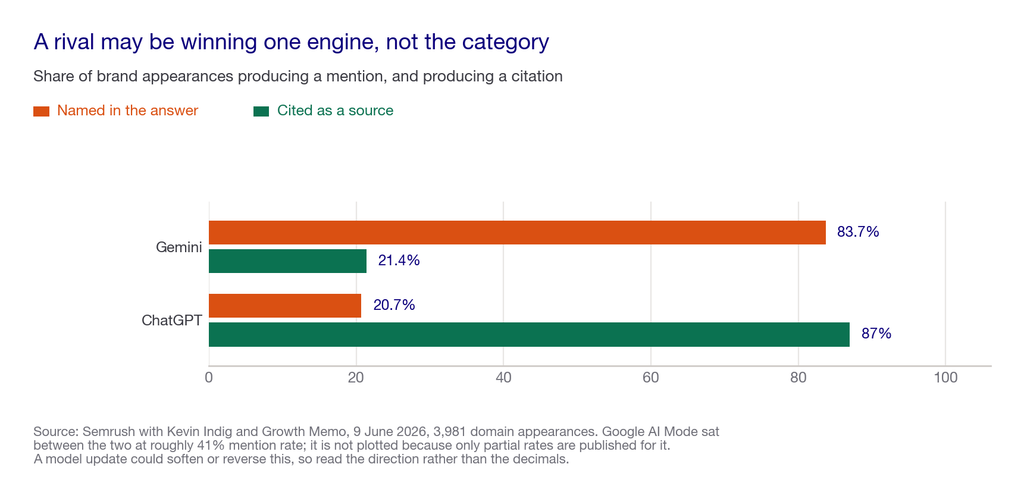
Across the same 3,981 appearances, Gemini named brands in 83.7% of cases while citing sources in only 21.4%. ChatGPT named brands 20.7% of the time while citing sources 87% of the time.
So the two largest engines behave almost as mirror images. A rival who dominates Gemini is winning the engine that names people, which looks far more alarming than the same position on ChatGPT. If your screenshot is from one engine, you have evidence about one engine.
Query type matters as much as engine. Comparative queries produced a 43.3% mention rate against 18% for informational ones. If your competitor appears on “best tool for X” and you appear nowhere, that is the query class where names get said, and it is the class most worth competing for.
Fixing each of the three states
If you are present but unnamed, the fix is a writing one and it is fast. Make the sentence worth quoting the sentence that carries your brand. “Our research found X” survives extraction with your name removed. “Pepper’s analysis of ten million prompts found X” does not. Go through your twenty most-cited pages and change the quotable line. Days, not quarters, and it costs nothing.
If you are genuinely absent, work up the pipeline. Fix retrieval first, because nothing downstream runs without it. Then check whether you have published a complete answer to the question at all, rather than a page that merely mentions the topic. Then look at corroboration, which is the slow part.
If you are named less often, this is a share problem and it is the expensive one. The lever is earned coverage on the pages engines already cite for your category, and it moves over quarters rather than weeks. There is no fast version of this, and anyone selling one is selling something else.
How we weighted the checks
Four criteria, and they are not equal.
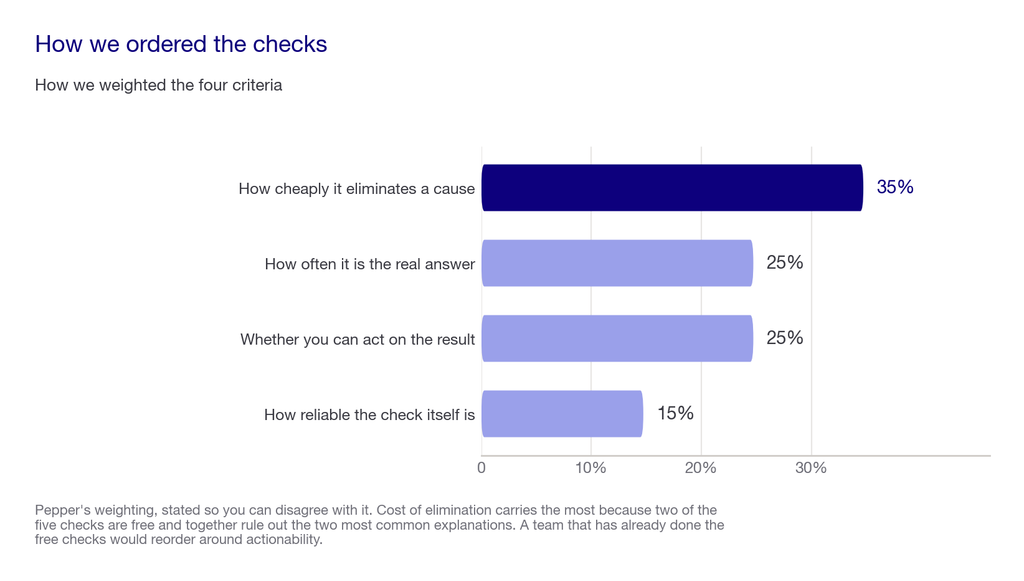
| Criterion | Weight | Why it carries that weight |
|---|---|---|
| How cheaply it eliminates a cause | 35% | Two of the five checks are free and together rule out the two most common explanations. |
| How often it is the real answer | 25% | Being unnamed is the single most common state, at 61.7% of appearances. |
| Whether you can act on the result | 25% | A no-search answer is real and unfixable, so finding it saves you from spending on it. |
| How reliable the check itself is | 15% | One run proves nothing, which is why re-running comes first. |
The three states at a glance
| Genuinely absent | Present but unnamed | Named less often | |
|---|---|---|---|
| How common | Least common of the three | 61.7% of appearances | A share problem, varies |
| What you see | No mention, no citation | Competitor named, your domain in the sources | Both named, rival more often |
| Root cause | Retrieval, or no complete answer published | The quotable sentence does not carry your name | Thinner third-party coverage |
| Time to fix | Weeks to quarters | Days | Quarters to years |
| Cost | Free to moderate | Free | High, and not fully controllable |
| First move | Indexation and crawler check | Rewrite the quotable line on your top pages | Earned coverage programme |
| Where it fails | Nothing published worth retrieving | Nothing, this one just works | Categories nobody independent writes about |
What this costs
The diagnosis is free. Re-running prompts is ten minutes, reading the source lists is another ten, and the retrieval audit is an afternoon.
The fixes diverge sharply. Naming costs nothing and is a wording change. Retrieval costs technical time and is usually a day. Earned coverage is the expensive one, slow and not fully in your control, and published GEO retainers run from $3,000 to $25,000 a month depending on scope.
Do the free diagnosis before buying any of it, because two of the three states do not need a retainer at all.
How Pepper fits
Pepper is an agentic organic growth engine and an organic growth partner, which means three things working together rather than one product.
Pepper’s GEO platform is the self-serve workspace. Brand profile, competitors, personas, GA4 and Search Console connected, themes and prompts defined, with Brand Visibility, Domain Prompt Presence and Share of Voice across six engines, including ChatGPT, Perplexity, Gemini and Google AI Overviews. The competitor setup is the part that matters for this question, because it reports your rate against theirs rather than in isolation, and Citation Analysis shows which pages the engine actually used.
Agent Atlas is where your team builds, versions and runs its own agents, with quick runs for one input and sheet runs for bulk. Running twenty prompts across two engines, twice each, and logging named-and-cited separately is exactly the repetitive work it exists for.
The growth team is attached to the account and works alongside yours, which matters most in the third state, where the work is earning coverage on pages you do not own.
Where it falls short: we cannot see check four at all. When the model answers from memory there is no retrieval event, so no platform can observe it and we will not pretend otherwise. We also report presence rather than persuasion, and we do not publish run-to-run variance, which by the measurement standard released in August 2026 makes our numbers directional rather than decision-grade, along with everyone else’s.
Eight years, more than 250 enterprises, more than 10 million tracked prompts. You can see the shape of the work in the Acceldata case study, in how we run it for B2B SaaS brands, and across the case study library.
How to choose what to fix first
The decision is which of the three states you are actually in, and the answer changes what you spend by an order of magnitude. So here are the criteria, weighted.
The weighted scorecard
Score each row from 1 to 5, multiply by the weight, and total out of 100.
| Criterion | Weight | Score 1 means | Score 5 means |
|---|---|---|---|
| Does your domain appear in the source lists | 35 | Never, across twenty prompts | Often, while your name does not |
| Indexation health by template | 25 | Whole templates missing | Everything indexed, crawlers allowed |
| Third-party coverage against your rival’s | 25 | They are everywhere, you are nowhere | Comparable coverage |
| Consistency across re-runs | 15 | The result changes every time | Stable across rewordings and engines |
Under 40, you have a retrieval or corroboration problem and the content work comes later. From 40 to 70, fix the naming first because it is free, then work on coverage. Above 70, you are mostly being named already and the gap is narrower than the screenshot suggested.
The weaker playbook against the stronger one
The weaker response is to see one answer, conclude you are invisible, and commission content against the prompt in the screenshot. That treats a single non-deterministic result as a diagnosis, and it targets one question out of a set the engine largely wrote itself. The stronger response is to re-run the prompt three ways, read the source lists rather than the text, and only then decide which of the three states you are in. One reacts to a screenshot. The other finds out what is happening.
Run a live test before you commit
Take 20 questions your buyers actually ask, written in their words, such as “best analytics platform for a mid-size ecommerce team”, “how do I reduce onboarding time for new hires”, or “alternatives to the market leader for a regulated business”. Run each on two engines, twice, worded differently. Log two columns, not one: were you named, and were you cited. Repeat at 30 days and again at 90 days. If the cited column fills while the named column stays empty, you have state two and the fix is free.
Red flags
- Diagnosing from one screenshot, of one prompt, on one engine
- Any proposal that starts with content before indexation has been checked
- Treating a citation and a mention as the same event
- Promises to make you appear for a named prompt, which nobody controls
- A plan that ignores which engine your buyers actually use
- Advice to chase informational queries when names appear on comparative ones
- Anyone claiming to measure the answers where the engine never searched
Five questions worth asking any agency
- Is my domain appearing in the source lists even where my name is not?
- What is my indexation rate by template, and did you check before proposing content?
- How many runs per prompt sit behind your conclusion, and how much did the answers vary?
- Which engine is this measured on, and is it the one my buyers use?
- Which of the three states describes us, and what is the cheapest fix for it?
The reducing principle. It comes down to one question: is your domain in the source list? If it is, you are not invisible, you are unnamed, and that is a sentence-level fix you can make this week. If it is not, the problem is upstream, in whether an engine can reach you or whether anyone else writes about you. Everything else in this article is a refinement of that single check.
The honest closing note. If your domain is being cited and your name is simply missing from the text, you do not need us. Rewrite the quotable line on your top twenty pages and re-run the test in a month. We would rather say that than sell a visibility programme to a company that is already in the answer.
What nobody should promise you
- An appearance for a named prompt. Nobody controls what a generative model says, and the same prompt varies between runs.
- A fast fix for thin third-party coverage. That is quarters of earned work on pages you do not own.
- Visibility on the prompts where the engine never searched. No tool can see those, ours included.
- That ranking first will get you named. The engine decides naming at a different stage, from a different input.
- One number for your gap, when the two largest engines behave as mirror images.
Where this stops working, including for us
A vendor produced the 61.7% figure using its own tooling, publishing no collection window and no limitations section. Its definitions are explicit, which is why it is usable, but treat the proportions as directional.
The retrieval evidence covers news questions over fourteen days, which is a faster-moving domain than most commercial categories, so retrieval may matter somewhat less for you than the headline suggests.
The 42% search rate comes from a pilot of 48 prompts. Its authors call it a pilot rather than a population study.
And our own position deserves the same scepticism. “Your competitor is visible and you are not” is a conclusion we are paid to act on, which is exactly why this article leads with checking the premise, says two of the three states need no retainer, and tells you plainly when not to hire anyone.
Where to go next
- For the full pipeline this sits inside, read how an engine builds an answer.
- For the naming fix in depth, read the ghost citation problem.
- To establish whether you appear at all, read the twenty-minute brand check.
- For the earned coverage that decides the third state, read why third-party sources decide whether AI cites you.
- For the crawler work behind check three, read the technical guide for marketers.
Frequently asked questions
Why is my competitor showing up in ChatGPT and not me?
Check the premise first. Most brand appearances are citations with no name attached, so you may be in the answer as an unnamed source. Read the source list under the answer, not just the text, before concluding you are absent.
How do I know whether I am absent or just unnamed?
Look at the citations under the answer. If your domain is listed, you are being used as a source and the problem is that the quotable sentence does not carry your name. That is a wording fix and it takes days.
Why does the answer change when I ask again?
Because these systems are not deterministic. A 2026 study across 4 benchmarks and 13 models found meaning-preserving rewording changed answers with mismatch rates above 23%, so one run is one sample rather than a diagnosis.
Does ranking first in Google help me appear in ChatGPT?
It helps, but less than people expect. Ranking influences one stage of a five-stage pipeline, and naming is decided at the last stage from sources selected at the third. You can rank first and still not be named.
My competitor appears on Gemini but not ChatGPT. Why?
Because the engines behave almost as mirror images. Gemini named brands in 83.7% of appearances while citing sources in 21.4%, and ChatGPT did close to the reverse. A rival dominating one engine is not dominating the category.
What is the cheapest thing I can do today?
Re-run the prompt three ways in a logged-out session and read the source lists. Ten minutes, free, and it separates the three states. About a quarter of the time the result changes and there is no emergency.
How long does it take to close a real gap?
It depends which state you are in. Naming is days. Retrieval is weeks. Earned third-party coverage, which is the state most people actually have, moves over quarters and is not fully within your control.
Should I write content targeting the exact prompt from my screenshot?
Rarely. The engine largely writes its own queries, so a page aimed at one prompt addresses a question it may never run. Build for the comparative questions your buyers ask, which is where names appear at 43.3% against 18%.
Sources and further reading
- Semrush with Kevin Indig and Growth Memo, Why 62% of AI citations don’t lead to brand mentions, published 9 June 2026. 3,981 domain appearances across 115 prompts and 14 countries. Source of the 61.7% and 13.2% split, the per-engine rates and the query-type breakdown. Vendor research using its own tool, with no stated collection window or limitations.
- Suzgun, Shen, Bianchi, Spangher, Icard, Ho, Jurafsky and Zou, Evaluating Commercial AI Chatbots as News Intermediaries, arXiv:2605.22785, submitted 21 May 2026. Six chatbots, 2,100 factual questions over fourteen days. Source of the finding that retrieval drives more than 70% of errors. News questions are unusually time-sensitive.
- Faghih, Cheng, Saha, Pournemat, Gerami and Feizi, Same Question, Different Answers, arXiv:2607.22554, submitted 18 May 2026. 4 benchmarks, 13 models, meaning-preserving paraphrases. Source of the mismatch rate above 23%. Factual and mathematical benchmarks, not brand queries.
- EMGI AI search retrieval pilot, published July 2026. 48 SaaS buying prompts through GPT-5.2 with live web search. Source of the 42% search rate. Its authors describe it as a pilot rather than a population study.
- Muck Rack, “What Is AI Reading?”, third edition, May 2026. More than 25 million links across ChatGPT, Claude and Gemini. Source of the 84% earned and 0.3% paid shares.
- Pepper, what happens between a query and an answer, for the pipeline in depth.
- Pepper, why being shown and being named differ, for the naming fix.
- Pepper, earned authority, for the third state.
A note on sources. Only studies published in 2026 are cited. Where a figure comes from a vendor’s own research, we have said so in the line that uses it.
Latest Blogs
Choosing a GEO agency for mid-market B2B used to be a shortlisting problem. It is now a procurement problem, because the published prices have largely gone. Of four agencies publishing a GEO-specific figure in September 2026, two had withdrawn their pricing pages by early October and one had moved domains. Exactly one still publishes a number a mid-market buyer can act on. So the useful question is no longer which agency is best in the abstract, but how to compare three quotes when only one of them arrived with a method attached.
Third-party sources and AI citations are tightly linked, and the link stops short of where most plans assume. Off-page work decides whether an engine retrieves and cites you. It does not decide whether the answer names you, and 61.7% of brand appearances are citations with no name attached. The two largest 2026 datasets also disagree about how much of the citation surface is third-party at all, one saying 84% and the other putting the brand bucket above half. That disagreement is definitional rather than factual, and it decides where a budget goes.
Why is my competitor showing up in ChatGPT and not me? Before accepting the premise, check it. Across 3,981 brand appearances studied in 2026, 61.7% were citations with no brand name in the answer and only 13.2% produced both. So there are three states that look identical from where you are sitting: genuinely absent, present as an unnamed source, and named less often than a rival. Each has a different cause and a different fix, and working on the wrong one is the most common way this gets expensive.
Get your hands on the latest news!