Mentioned vs cited: the difference that decides AI visibility
The short answer
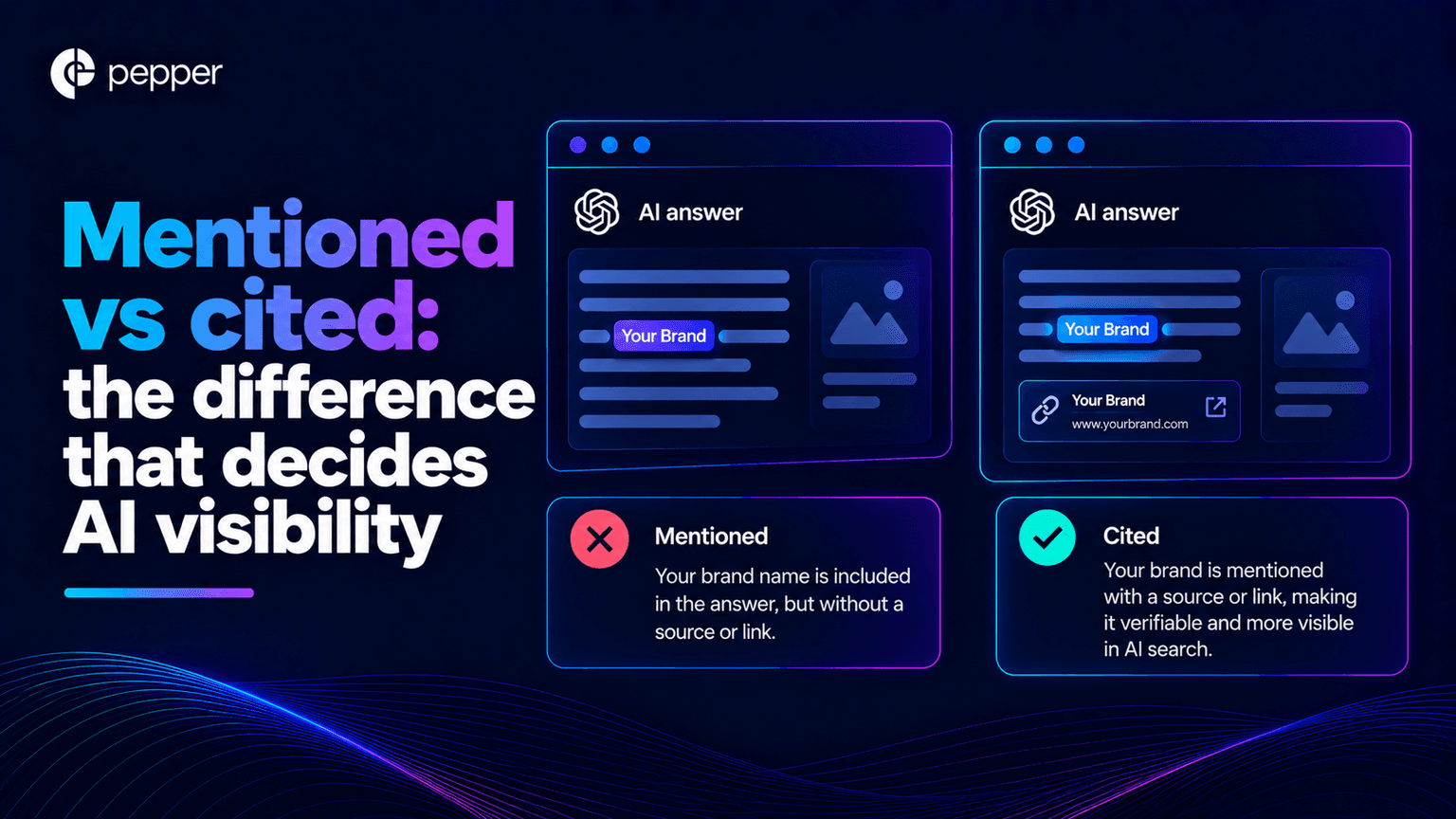
Mentioned vs cited describes two different things that can happen when an AI engine answers a question about your category. A mention is your brand name appearing in the answer text. A citation is your URL appearing as a source. Different mechanisms produce them, they are worth different things, and they rarely happen together. In one June 2026 study of 3,981 brand appearances, only 13.2% were both. So any single “AI visibility” number is averaging two signals that often point in opposite directions.
Key takeaways
- They barely co-occur. Across 3,981 appearances, 61.7% were citations with no brand name in the answer, 25.1% were mentions with no citation, and only 13.2% were both.
- The split inverts by engine, which is the finding that matters most. Gemini named brands in 83.7% of appearances but cited sources in only 21.4%. ChatGPT did close to the reverse, naming brands 20.7% of the time while citing sources 87% of the time.
- A citation without a mention has a name. Kevin Indig calls it a ghost citation: the engine used your page and the reader never learns you exist.
- They have different drivers. Citations follow retrievability and earned media, where 84% of AI citations come from earned sources and 0.3% from paid. Mentions follow whether your brand is the entity the model associates with the category.
- Neither reliably produces traffic. AI referrals tripled in one 2026 study and still sit under 1% of total visits, with a peer-reviewed estimate under 0.2%.
- Query type moves the odds. Comparative queries produced 43.3% mention rates against 18% for informational, which is 2.4 times as many.
- The neutral standard already separates them. The IAB’s August 2026 framework names mention rate and citation rate as distinct metrics under Presence, so reporting one number is below the published bar.
- Pepper is an agentic organic growth engine and an organic growth partner. Agent Atlas puts the agents in your team’s hands. Pepper’s GEO platform reports Brand Visibility, Domain Prompt Presence and Share of Voice across six engines, including ChatGPT, Perplexity, Gemini and Google AI Overviews. A growth team works alongside yours. Eight years, more than 250 enterprises, more than 10 million tracked prompts.
A note on where this comes from. I spend most of my time on why some content gets picked up and most does not, and this distinction is the one that changes how a content plan is built. Pepper runs organic growth for more than 250 enterprises over eight years and tracks more than 10 million prompts across every major engine. In practice the teams that get this wrong are not careless. They are reading a dashboard that merged two numbers before they ever saw it.
Disclosure: Pepper sells services that help brands appear in AI answers, and a single rising visibility score is an easier thing for us to sell than two separate ones. This article argues for the harder version, and says plainly that neither signal reliably produces traffic today. Every figure traces to a named study with its method. We name competitors but never link them, except where they published the research.
What is the mentioned vs cited distinction?
The two words describe different events in the same answer, and the definitions used in the research are precise.
- A mention is your brand name appearing in the generated text. The reader sees the word. There is no link, nothing to click, and nothing in your analytics.
- A citation is your domain appearing as a source for the answer, usually in a link panel or a numbered reference. The reader may click it, and if they do, it shows up as referral traffic.
- A ghost citation is a citation without a mention. Your page supplied the answer and the reader never learns where it came from.
So the asymmetry is the whole point. A mention gives you credit without traffic. A citation gives you traffic without credit. Only the rare combination gives you both.
This matters because the two arise differently. A mention comes from what the model holds about your category and which brand it associates with the question. A citation comes from whether the engine retrieved your page and judged it useful enough to attribute. Consequently you can fix one and not move the other at all.
The neutral standard already treats them separately. The IAB’s “Measuring Visibility in the AI Era”, released 3 August 2026, lists mention rate and citation rate as distinct metrics inside its Presence group. It then adds a Prominence group, asking how substantively an answer drew on your content rather than citing it superficially. Therefore a vendor reporting one blended score is reporting below the published bar.
How often do they actually happen together?
Rarely, and this is the number that should change how you read your reporting.
A study published 9 June 2026 by Semrush with Kevin Indig logged 3,981 domain appearances across 115 prompts and 14 countries. It covered four AI experiences: ChatGPT, Google AI Overviews, Gemini and Google AI Mode.
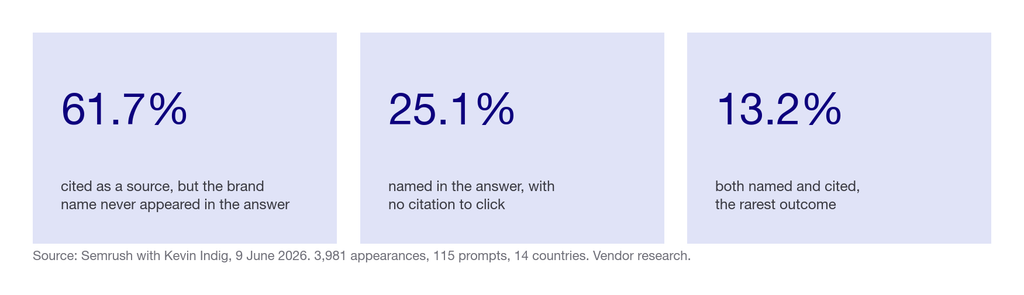
- 61.7% were ghost citations, cited as a source with no brand name in the answer.
- 25.1% were mentions with no citation, named in the text with nothing to click.
- 13.2% were both.
Across the whole set the citation rate was 74.9% and the mention rate 38.3%. In other words most appearances produced a link, a large minority produced a name, and the two mostly happened to different brands on different prompts.
If you want someone to pull these apart on your own prompt set rather than an average, book a growth audit and bring the twenty questions your buyers actually ask.
The engines behave in opposite ways
Here is where a single blended score stops being merely imprecise and becomes actively misleading.
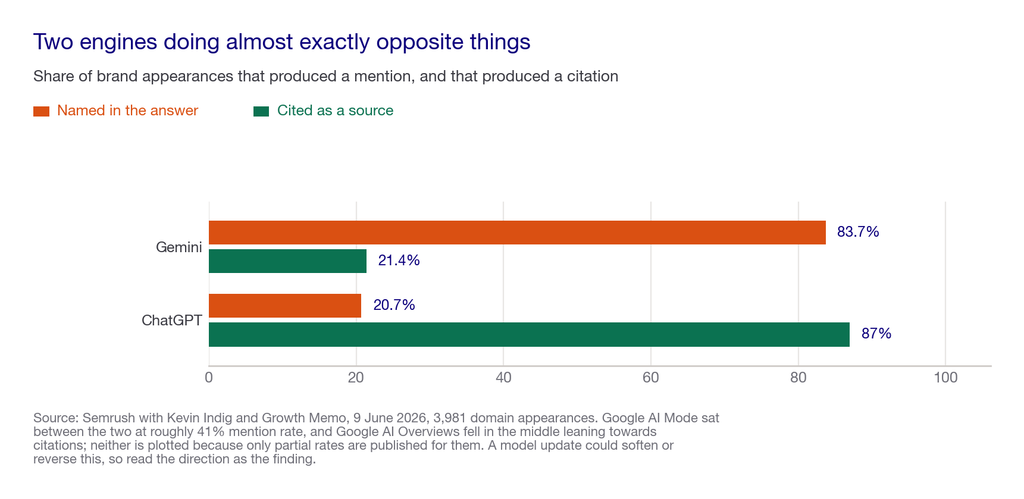
- Gemini named the brand in 83.7% of appearances and cited a source in 21.4%.
- ChatGPT named the brand in 20.7% of appearances and cited a source in 87%.
- Google AI Mode sat in between, with a mention rate around 41%.
- Google AI Overviews fell in the middle and leaned towards citations.
So a brand that is highly visible in Gemini and a brand that is highly visible in ChatGPT are succeeding at two different things. Furthermore, if your reporting blends engines into one figure, a rise in one can mask a collapse in the other. The blended line then looks stable while your actual position shifts underneath it.
The practical consequence. Decide which engine matters to your buyers before you decide which metric to optimise. Chasing citations in Gemini or mentions in ChatGPT is pushing against how that engine behaves.
What each one is actually worth
This is the part the category tends to skip, so we will be blunt about it.
A citation is worth a click, in theory. In practice AI engines send very little traffic. One 2026 study of 74 websites found AI referrals tripled year on year and still sat under 1% of total visits, and a peer-reviewed estimate puts them under 0.2%. Consequently a citation is best understood as a small chance of a visit plus a credential, rather than a traffic channel.
A mention is worth recall, and nothing you can attribute. The reader sees your name next to their problem. That is genuine value and it is the oldest kind in marketing. However, it leaves no trace in your analytics, which means you cannot prove it happened without separately measuring mention rate.
Neither is worth a guaranteed outcome, and the honest framing is that you are buying presence in a decision rather than a visit.
Query type shifts which one you get. In the same study, comparative queries produced a 43.3% mention rate against 18% for informational queries, which is 2.4 times as many. How-to queries came in at 42.8% and commercial at 35.6%, while informational queries produced the highest citation rate at 89.3%. So the “best X for Y” questions are where your name appears, and the explanatory questions are where your pages get used quietly.
What drives each one
They respond to different work, which is why treating them as one metric produces incoherent plans.
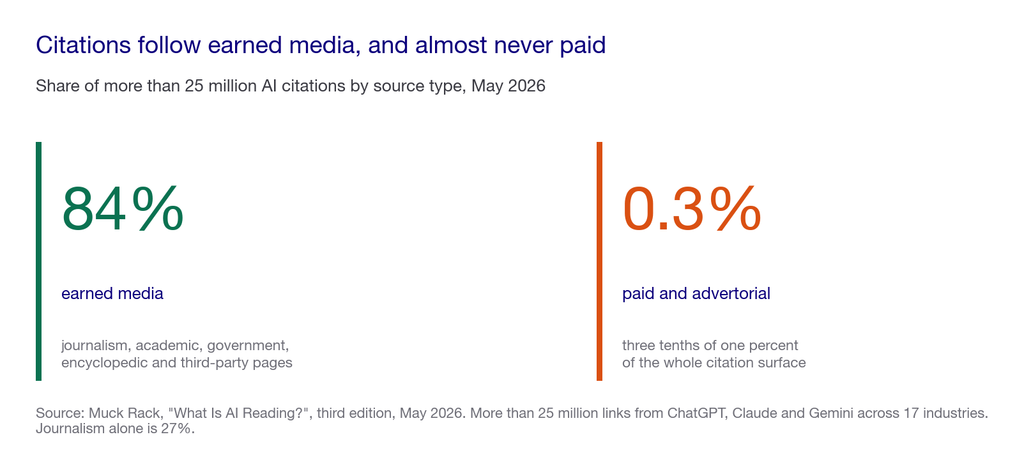
Citations follow retrievability and earned media. Muck Rack’s May 2026 analysis of more than 25 million links across ChatGPT, Claude and Gemini found 84% of AI citations come from earned media and 0.3% from paid or advertorial. That figure has held between 82% and 89% across three editions going back to mid-2025, which makes it unusually safe to plan against. So the work is coverage, corroboration and pages an engine can actually fetch and parse.
Mentions follow entity association. A mention requires the model to connect your brand to the category in the first place. That connection grows from how consistently and distinctively the web describes you, rather than from any single page. That work is slower, it is closer to classical positioning, and it is much harder to attribute.
One consequence worth sitting with. You can win citations with good retrievable content on third-party-corroborated topics while remaining unnamed, which is exactly the 61.7% ghost citation case. Equally you can win constant mentions and almost no citations, which is the Gemini pattern. Neither is failure. They are different outcomes requiring different responses.
How we weighted the two signals
If you have to prioritise, here is how we would, and the weights are arguable.
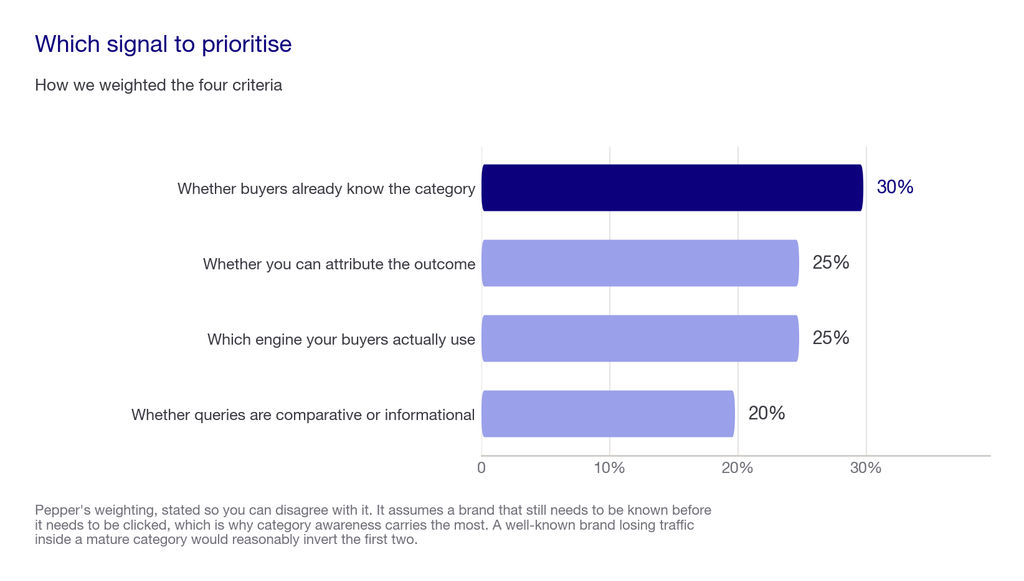
| Criterion | Weight | Why it carries that weight |
|---|---|---|
| Whether your buyers already know the category | 30% | If they do not, a mention does more than a link, because recognition has to come first. |
| Whether you can attribute the outcome | 25% | Citations leave a trace in analytics. Mentions do not, so they need separate measurement to exist at all. |
| Which engine your buyers actually use | 25% | Given one engine mentions four times more than it cites and another does the reverse, the engine decides what is achievable. |
| Whether the query is comparative or informational | 20% | Comparative queries produced 2.4 times the mention rate of informational ones. |
The two signals at a glance
| Mention | Citation | |
|---|---|---|
| What it is | Brand name in the answer text | Domain listed as a source |
| Visible to the reader | Yes | Yes, as a link |
| Clickable | No | Yes |
| Shows in your analytics | No | Yes, as referral traffic |
| Share of appearances studied | 38.3% | 74.9% |
| Highest on | Gemini, 83.7% | ChatGPT, 87% |
| Best query type | Comparative, 43.3% | Informational, 89.3% |
| Main driver | Entity association with the category | Retrievability and earned media, 84% |
| What it is worth | Recall, unattributable | A small chance of a visit, under 1% of referrals |
| Cost to influence | Slow, positioning and coverage | Faster, content and corroboration work |
What to do with this
- Split the two metrics in your reporting, per engine, before anything else. If your current tool reports one blended score, you cannot see either signal.
- Check your ghost citation rate. If engines are using your pages without naming you, the fix is usually stronger brand framing inside the content itself, so the sentence worth quoting contains your name.
- Pick the signal that matches your problem. An unknown brand in a known category needs mentions. A known brand losing traffic needs citations.
- Match the engine. Measure mentions where mentions happen and citations where citations happen, rather than expecting both everywhere.
- Shift budget towards earned media if citations are the goal, because 84% of them come from there and 0.3% from paid.
Our framework for visibility, citability and retrievability sets out the three levers underneath this. Our guide to checking whether your brand appears at all is the twenty-minute version of step 1.
What this costs
Separating the two signals manually costs about an hour a month. Run your prompt set, and log two columns instead of one: was the brand named, and was the domain cited. That is the entire method, and it works with no tool at all.
Doing it continuously across several engines is where a platform earns its price. Published entry pricing in the category starts around $29 a month for very limited prompt counts and rises with engines and volume. However, check before you buy that the tool reports the two separately, because several report a blended score and call it visibility.
How Pepper fits
Pepper is an agentic organic growth engine and an organic growth partner, which means three things working together rather than one product.
Pepper’s GEO platform is the self-serve workspace: brand profile, competitors, personas, GA4 and Search Console connected, themes and prompts defined. It reports Brand Visibility, Domain Prompt Presence and Share of Voice across six engines, including ChatGPT, Perplexity, Gemini and Google AI Overviews, with Platform Breakdown, New Mentions and Citation Analysis underneath. Citation Analysis and New Mentions are the two halves of this article, reported separately rather than merged.
Agent Atlas is where your team builds, versions and runs its own agents, with quick runs for one input and sheet runs for bulk. This is the practical way to run the two-column log above across hundreds of prompts instead of twenty.
The growth team is attached to the account and works alongside yours. That matters because the mention side is a positioning and earned-media problem rather than a dashboard problem. It also moves over quarters, not weeks.
Where it falls short: we report presence, not persuasion. Our platform will tell you the engine named you and cited you. It will not tell you whether either changed anyone’s mind. The IAB standard names post-citation clickthrough and recommendation strength under Persuasion, and no platform in this category reports those, ours included. We also do not publish run-to-run variance, which the same standard treats as part of a decision-grade measurement, so by that standard our numbers are directional like everyone else’s.
Eight years, more than 250 enterprises, more than 10 million tracked prompts. You can see the shape of the work in the Acceldata case study, in how we run this for B2B SaaS brands, and across the case study library.
How to choose which signal to chase
The decision is not which metric is better. It is which one your business needs next, and they are rarely the same at the same time. So here are the criteria, weighted.
The weighted scorecard
Score each row from 1 to 5, multiply by the weight, and total out of 100.
| Criterion | Weight | Score 1 means | Score 5 means |
|---|---|---|---|
| How well your buyers know the category | 30 | Mature, everyone knows the players | New, buyers cannot name anyone |
| How much you need attributable results | 25 | Brand budget, patient board | Every spend needs a tracked outcome |
| Concentration of your buyers on one engine | 25 | Spread evenly across four | Almost all on one engine |
| Share of your queries that are comparative | 20 | Mostly how-to and informational | Mostly “best X for Y” |
Under 40, chase citations, because they are faster to influence and they leave a trace. From 40 to 70, run both and report them separately. Above 70, mentions are the constraint, and no amount of retrievable content will fix a brand the model does not associate with the category.
The weaker playbook against the stronger one
The weaker approach is to pick whichever number is currently higher and build the quarterly report around it. That is comfortable, and it means the metric changes whenever the result is unflattering. The stronger approach is to commit to one primary signal for two quarters and name the engine it runs on. Then accept that the other number will move for reasons you did not cause. One optimises the report. The other optimises the business.
Run a live test before you commit
Take 20 prompts that reflect how your buyers actually search, written in their language rather than yours. Good examples look like “best analytics platform for a small ecommerce team”, “how do I reduce churn in a subscription business”, or “alternatives to the category leader for regulated industries”. Run each on two engines and log two columns: named, and cited. Repeat at 30 days and again at 90 days. If your mention rate and your citation rate move in different directions, you have proved the case for splitting the metric inside your own reporting.
Red flags
- A single “AI visibility score” with no mention and citation split published behind it
- A tool that counts a source link as a brand mention
- Any engine-blended figure presented without a per-engine breakdown
- Case studies that report a rise in visibility without saying which signal rose
- Claims that citations drive meaningful referral traffic today, at under 1% of visits
- Sentiment or portrayal metrics with no stated source of truth
- Anyone guaranteeing either outcome
Five questions worth asking any vendor
- Do you report mention rate and citation rate separately, and can I see both per engine?
- How do you define a mention, and does a source link without the brand name count as one?
- What is my ghost citation rate, and is it in the product or something you calculate by hand?
- How many runs per prompt sit behind a reported change, and what is your run-to-run variance?
- Can I export the raw answers, so I can audit the classification myself?
The reducing principle. It comes down to one question: do you need to be known, or do you need to be clicked? If buyers cannot name anyone in your category, mentions are the constraint and citations will not fix it. If they know the category and you are losing traffic within it, citations are the constraint and more brand work will feel productive while changing nothing. Everything else here is a refinement of that.
The honest closing note. For a lot of brands the right conclusion is that neither number is worth a programme yet, because AI referrals are under 1% of visits and the measurement is directional at best. You do not need us to split two columns in a spreadsheet, and we would tell you so. Come back when the trend holds across two quarters. Or come back when your ghost citation rate is high enough that engines are visibly building answers out of your work without ever naming you.
What nobody should promise you
- A guaranteed mention or citation. Nobody controls either, and both vary between runs of the same prompt.
- That one score captures your AI visibility. The two signals invert between engines, so a single figure hides the thing you need to see.
- That citations will replace your search traffic. At under 1% of referrals, they currently do not.
- A measured link between either signal and pipeline. The IAB puts that under Persuasion, and no platform reports it.
- A fast fix for a mention problem. Entity association is built over quarters, through coverage you do not control.
Where this stops working, including for us
The central study is strong on scope and weak on disclosure. 3,981 appearances across 115 prompts is a reasonable sample. However, the publication states no date range for collection and no limitations section. A vendor also produced it using its own toolkit, which is the same conflict of interest we would flag in anyone else. We use it because its definitions are explicit and its per-engine splits are the only published ones we could find, not because it is beyond question.
Engine behaviour also moves quickly. The Gemini and ChatGPT inversion is a June 2026 observation, and a model update could soften or reverse it without notice. Therefore treat the direction as the finding and the exact percentages as a snapshot.
And our own position deserves the same scepticism. We sell the remedy to the problem this article describes. We report presence rather than persuasion, we do not publish run-to-run variance, and by the IAB’s own tiers our numbers are directional rather than decision-grade. Check the sources yourself. We have linked them all.
Where to go next
- For the three levers underneath all of this, read Visibility, Citability and Retrievability.
- To find out whether you appear at all, read how to check if your brand appears in AI search.
- For how zero-click and citation interact, read zero-click search vs AI citation.
- For whether any of this is costing you traffic, read the five-cause traffic diagnosis.
- For the tools that claim to measure citations, read our guide to citation monitoring.
Frequently asked questions
What is the difference between a mention and a citation in AI search?
A mention is your brand name appearing in the answer text, with nothing to click. A citation is your domain listed as a source, which the reader can click and which shows up in your analytics. Different mechanisms produce them, and they rarely happen together.
How often does a brand get both?
Rarely. Across 3,981 brand appearances studied in June 2026, only 13.2% produced both a citation and a mention. Most appearances, 61.7%, were citations where the brand name never appeared in the answer at all.
What is a ghost citation?
A ghost citation is when an AI engine uses your page as a source but never names your brand in the answer. Kevin Indig coined the term. It means your content shaped the answer while the reader learned nothing about who produced it.
Which engine mentions brands most?
Gemini, by a wide margin. It named brands in 83.7% of appearances but cited sources in only 21.4%. ChatGPT did close to the opposite, naming brands 20.7% of the time while citing sources 87% of the time.
Which one should I optimise for?
It depends on whether you need to be known or clicked. If buyers cannot name anyone in your category, mentions are the constraint. If they know the category and you are losing traffic within it, citations matter more and are faster to influence.
Do citations actually drive traffic?
Very little today. One 2026 study of 74 sites found AI referrals tripled year on year and still sat under 1% of total visits, and a peer-reviewed estimate puts them under 0.2%. Treat a citation as a credential with a small chance of a visit.
How do I get mentioned rather than just cited?
Write so the quotable sentence contains your brand name, and build the category association that makes a model reach for you. Comparative queries help, producing a 43.3% mention rate against 18% for informational ones, so the “best X for Y” pages matter.
Does my tool already separate these?
Many do not. Ask directly whether mention rate and citation rate are reported separately and per engine, and whether they count a source link without a brand name as a mention. A blended score cannot show you an inversion between engines.
Sources and further reading
- Semrush with Kevin Indig and Growth Memo, Why 62% of AI citations don’t lead to brand mentions, published 9 June 2026. 3,981 domain appearances across 115 prompts, 14 countries and four AI experiences, via the Semrush AI Visibility Toolkit. Source of the 61.7%, 25.1% and 13.2% split, the per-engine rates and the query-type breakdown. The publication states no collection date range and no limitations, and the publisher is a vendor using its own tool.
- IAB, “Measuring Visibility in the AI Era”, released 3 August 2026. Source of the Presence and Prominence metric groups that separate mention rate from citation rate, and of the directional versus decision-grade distinction.
- Muck Rack, “What Is AI Reading?”, third edition, May 2026. More than 25 million links from ChatGPT, Claude and Gemini across 17 industries. Source of the 84% earned media and 0.3% paid shares, which have held between 82% and 89% across three editions.
- e-dialog organic traffic study, published 3 August 2026, 74 websites across twelve industries, for the under-1% AI referral share.
- Kaiser and Schulze, Marketing Science, 2026, for the peer-reviewed estimate that AI referrals account for under 0.2% of visits.
- Pepper, the three levers behind citability, for where this sits in the framework.
- Pepper, the twenty-minute brand check, for running the two-column log yourself.
- Pepper, citation monitoring tools compared, for which platforms report the two signals separately.
- Pepper, zero-click search and AI citation, for how the citation side interacts with the click.
A note on sources. This article cites only studies published in 2026. Where a figure comes from a vendor’s own research, we have said so in the line that uses it rather than only in this list.
Latest Blogs
Is Google sending less traffic than before? On queries where AI features appear, yes, and a randomised experiment published in August 2026 puts the effect at 18.8 percentage points of click-through. Across a whole site the picture is much softer, because most queries do not trigger those features and impressions have grown. The traffic is also not migrating to AI engines, which still account for under 1% of referrals. This article ranks every 2026 study by how well it identifies the effect, rather than by how large its headline is.
Mentioned vs cited is the distinction most AI visibility reporting collapses, and the data says it should not. Across 3,981 brand appearances studied in June 2026, 61.7% were citations with no brand name in the answer, 25.1% were names with no citation, and only 13.2% were both. The split also inverts by engine: Gemini named brands in 83.7% of appearances but cited sources in 21.4%, while ChatGPT did almost the opposite. A single visibility score averages two different things across engines that behave in opposite ways.
How AI search actually works is usually described as a tidy pipeline: you ask, it searches, it reads, it answers, it cites. Each of those five stages behaves differently from the description. In one 2026 pilot the engine searched the web on only 42% of buying prompts. When it did search, it ran an average of 6.3 queries nobody wrote. And in a 2,100-question evaluation across six chatbots, retrieval rather than reasoning drove more than 70% of all errors. This article walks the real pipeline and marks what breaks at each step.
Get your hands on the latest news!

Similar Posts
GEO / AI Search
15 mins read
Is Google sending less traffic than before? What the data actually shows
GEO / AI Search
16 mins read
How AI search actually works, from query to cited answer
Artificial Intelligence
13 mins read