GEO agency for mid-market B2B: how to buy when nobody publishes a price
The short answer
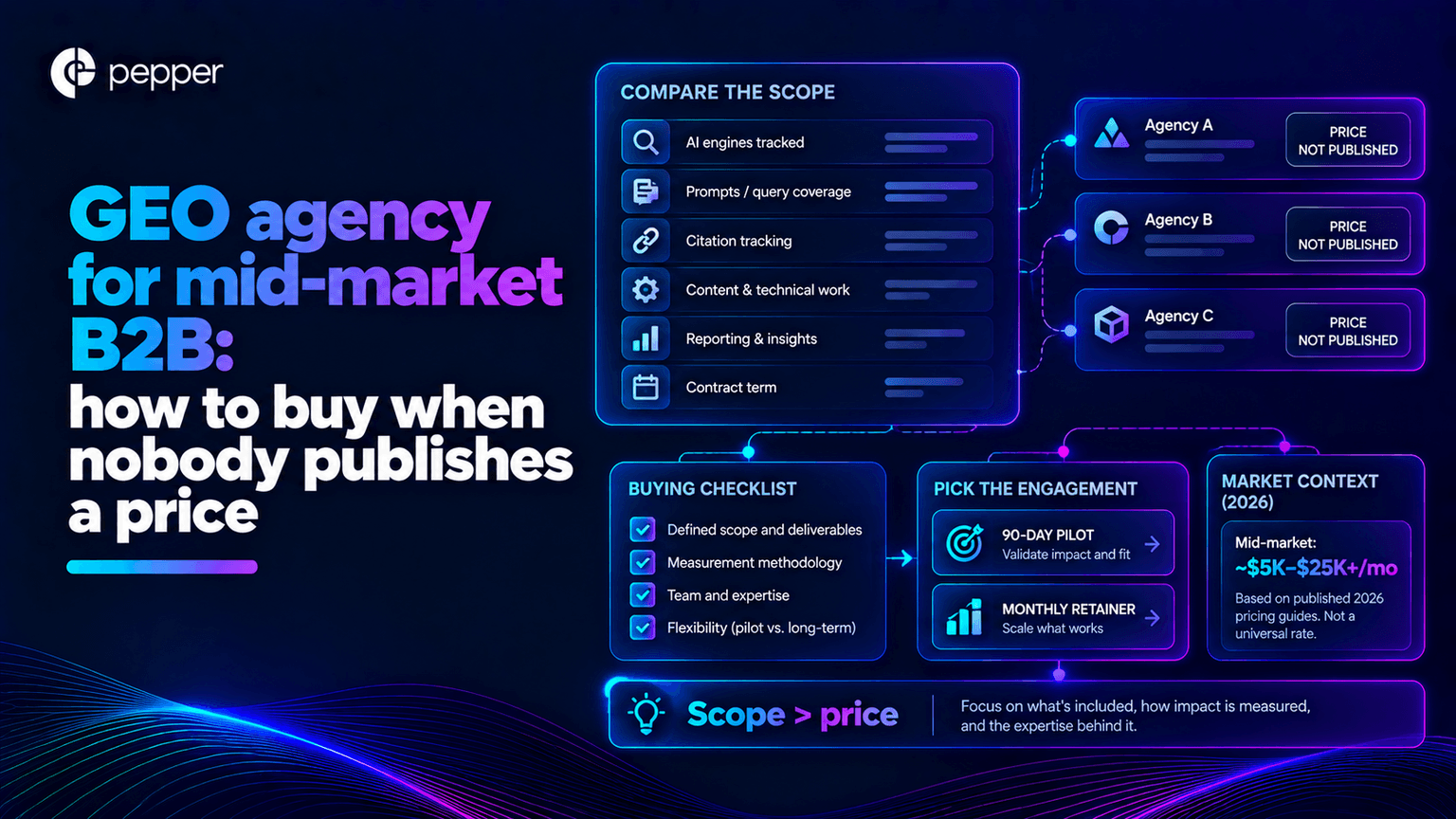
The market’s own definition of mid-market here is $3,000 to $10,000 a month, which is published rather than our invention. The problem is what sits inside that band. Four agencies published a GEO-specific price in September 2026. By early October two had withdrawn their pricing pages and one had moved domains. Exactly one still publishes a figure, with volumes attached, that a mid-market buyer can compute against. So this is no longer a shortlisting exercise. It is a procurement exercise in a market that has stopped quoting. The skill is comparing three proposals when only one arrived with a method.
Key takeaways
- The band is published, not assumed. One agency’s own page defines $3,000 to $10,000 a month as “small to mid-market GEO programs”, inside a wider range of $3,000 to $25,000+.
- Published pricing collapsed in four weeks. Four agencies published a GEO figure in September. By 8 October, two pricing pages were 404 and one had moved domains.
- One agency still publishes volumes against price, which is the only way to compute a unit cost: $3,000 for 10 articles and $8,000 for 40, giving $300 and $200 an article.
- The nearest full-service floor sits at the top of the band. One firm publishes “full-service engagements start at $10,000 a month”, which is the ceiling of mid-market rather than the middle.
- So comparison has to move from price to unit. Ask every agency for a deliverable count, not a monthly figure, or you are comparing numbers that describe different things.
- Bring an external benchmark. Paid search averaged $66.69 a lead in 2026, which is what the money does if you do not spend it here.
- Who is good is a different question, and we have answered it twice already. This page is about how to run the process.
- Pepper is an agentic organic growth engine and an organic growth partner. Agent Atlas puts the agents in your team’s hands. Pepper’s GEO platform reports Brand Visibility, Domain Prompt Presence and Share of Voice across six engines, including ChatGPT, Perplexity, Gemini and Google AI Overviews. A growth team works alongside yours. Eight years, more than 250 enterprises, more than 10 million tracked prompts.
A note on where this comes from. I sit on the buying side of these conversations more often than the selling side, and the thing that has changed this year is not the price. It is that you can no longer check it before the call. Pepper runs organic growth for more than 250 enterprises over eight years and tracks more than 10 million prompts across every major engine. The mid-market buyers who get a good deal are the ones who turn up with a unit in mind rather than a budget.
Disclosure: Pepper sells GEO services and competes for exactly this budget, so a page about how to buy one is self-interested. This article names a competitor’s published rate as the only computable one in the band, tells you to demand a unit from everyone including us, and gives you an outside benchmark that frequently wins. Every price was checked at the vendor’s own site on 8 October 2026. Competitors are named but never linked.
Choosing a GEO agency for mid-market B2B: what counts as mid-market?
Rather than assert a band, we took one the market publishes.
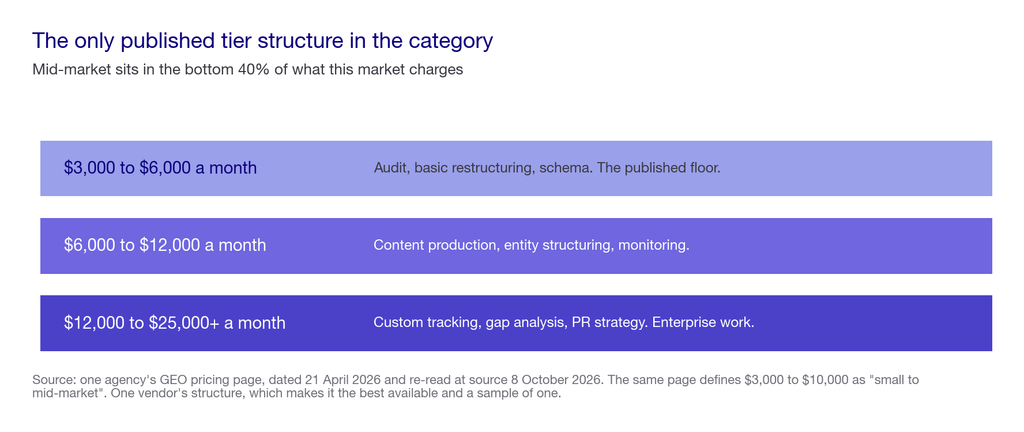
One agency’s GEO pricing page, dated 21 April 2026 and re-read at source on 8 October, sets out three tiers:
- $3,000 to $6,000 a month. Audit, basic restructuring, schema.
- $6,000 to $12,000 a month. Content production, entity structuring, monitoring.
- $12,000 to $25,000+ a month. Custom tracking, gap analysis, PR strategy.
The same page describes “$3,000 to $10,000 a month” as covering “small to mid-market GEO programs”. That is the band this article uses, and it comes from a vendor rather than from us.
The wider published range is $3,000 to $25,000+. So mid-market sits in the bottom 40% of what this market charges, and the upper half is enterprise work you are not buying.
What is actually available at that budget today
Here is the finding, and it changed in the four weeks between our September price census and this article.
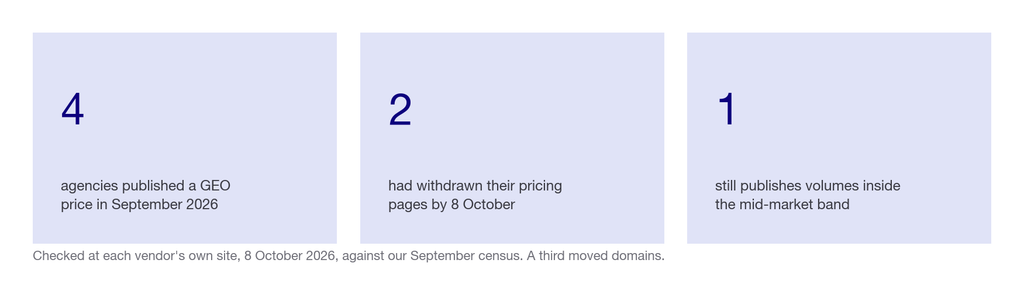
In September 2026, four agencies published a GEO-specific figure. We recorded all four at source.
On 8 October 2026:
- One still publishes, with volumes. $3,000 a month for 10 articles, $8,000 for 40. This is the only computable unit price in the category.
- One publishes a floor above the band. “Full-service engagements start at $10,000 a month”, now on a homepage rather than a pricing page, after a domain move.
- Two have withdrawn entirely. Both pricing pages return 404, and one firm’s main pricing page no longer mentions GEO, generative engine or AI search at all.
This matters more than any ranking. If three of four comparable firms will not publish, a shortlist built on published prices is a shortlist of one. The other proposals arrive as bespoke numbers you cannot test.
A correction to our own earlier note. In September we recorded a working hypothesis. Agencies that choose to publish keep publishing, we thought, while software vendors withdraw. The third reading contradicts it. Agencies withdraw at roughly the same rate, and we have dropped the hypothesis rather than carrying it.
If you want help running a comparison across proposals you have already received, book a growth audit and bring the quotes.
The one unit you can hold two proposals against
When monthly figures stop being comparable, move down a level.
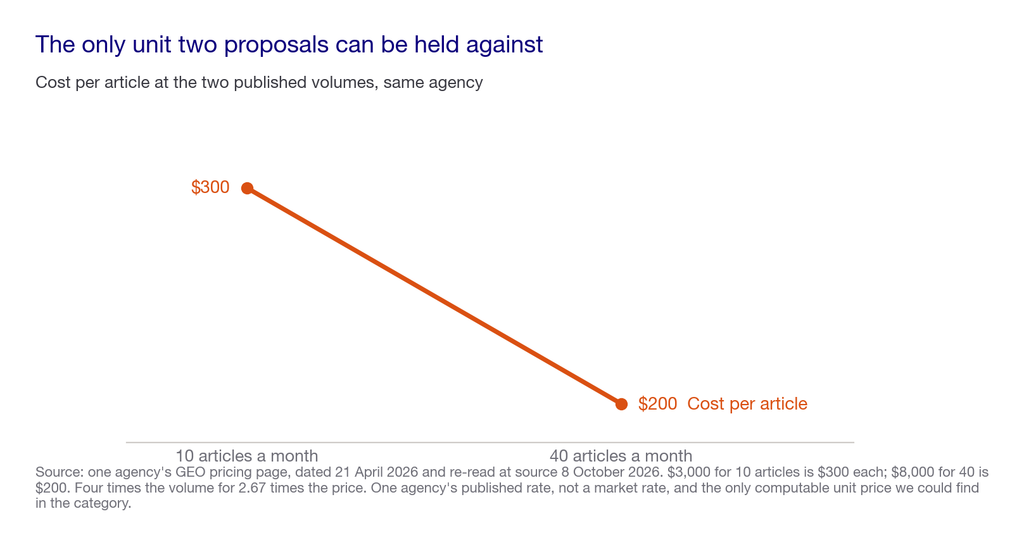
$3,000 divided by 10 articles is $300. $8,000 divided by 40 is $200. Four times the volume for 2.67 times the price, which is a volume discount on production.
That per-article figure is the only unit in this market you can hold two proposals against. A monthly retainer describes a scope that differs between vendors. A cost per deliverable does not.
So the single most useful change to your process is small. Stop asking for a price, and start asking for a price and a count. “What is your monthly fee” produces an uncomparable number. “What is included at that fee, in units” produces something you can put in a spreadsheet.
Two cautions, and the second is the important one.
- One agency’s rate is not a market rate. $300 is one verifiable data point, not a benchmark.
- A retainer priced per article is aimed at the minority of the citation surface. Across more than 25 million cited links, 84% came from earned media and 0.3% from paid. A proposal that is entirely article production buys the smaller half of the problem. Ask what share of the fee goes to earned coverage.
Bring an outside number to the table
The second thing that fixes a mid-market buying process is a comparator that does not come from the category.
Paid search averaged $66.69 a lead in 2026, across thousands of campaigns in more than twenty industries, with a published range from $131.63 for attorneys to $26.84 for arts and entertainment.
That is what the same money does if you do not spend it here. It is also the question your finance team will ask first. At $300 a page, a piece of content has to produce about 4.5 leads across its working life to beat buying those leads outright.
Use your own category’s figure. A five-fold spread means the average describes almost nobody, and the whole comparison is scaled by it. Our fuller treatment of that calculation sits in is GEO worth the investment.
How we weighted what to compare
Four things, and price is not the first.
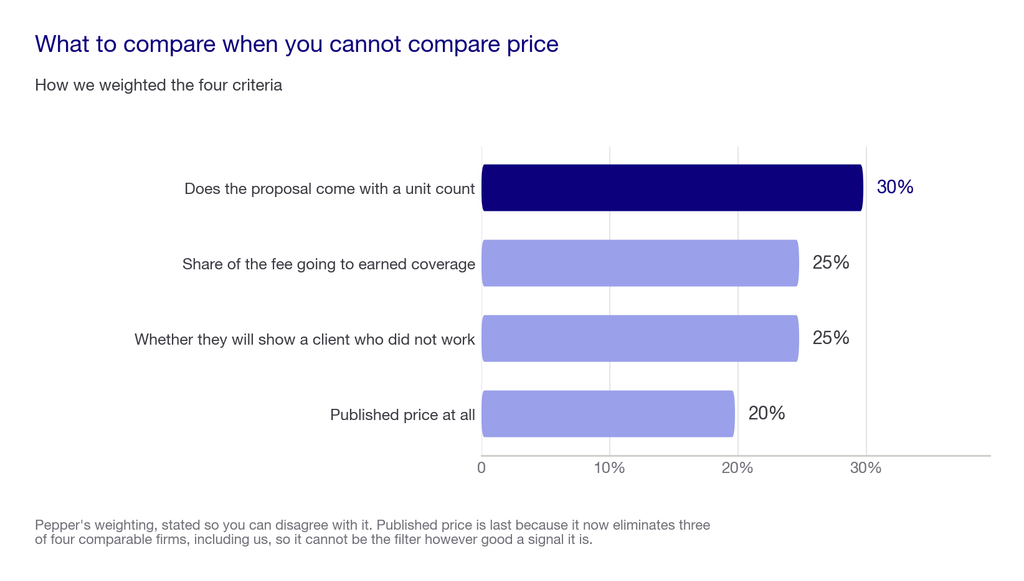
| Criterion | Weight | Why it carries that weight |
|---|---|---|
| Does the proposal come with a unit count | 30% | Without deliverables per rupee, two monthly figures are not comparable at all. |
| Share of the fee going to earned coverage | 25% | 84% of citations are earned and 0.3% are paid, so a production-only retainer targets the minority. |
| Whether they will show a client who did not work | 25% | Every agency has case studies. Very few will discuss a failure, and the answer is diagnostic. |
| Published price at all | 20% | Still a signal of confidence, but it now eliminates three of four firms, so it cannot be the filter. |
Mid-market GEO buying at a glance
| What to ask for | What you usually get | Why it matters | |
|---|---|---|---|
| Price | Monthly fee and unit count | A monthly fee | Fees describe different scopes; units compare |
| Scope | Split between production and earned | “Full service” | 84% of citations are earned, 0.3% paid |
| Benchmark | Your category’s paid cost per lead | An internal ROI model | $66.69 average, $131.63 to $26.84 by sector |
| Evidence | A client who did not work out | Three success stories | Selection bias runs one way |
| Measurement | Runs per prompt and variance | A visibility score | No platform publishes variance, ours included |
| Term | A 90-day exit | Twelve months | The category changes faster than the contract |
| Cost to compare | Free, two hours | Three incomparable PDFs | The work is converting fees into units |
What to do, in order
- Fix your band before you take a call. The published mid-market definition is $3,000 to $10,000 a month.
- Ask every agency for a unit count, not a fee. Articles, prompts tracked, placements targeted, hours.
- Ask what share goes to earned coverage rather than production.
- Bring your own paid cost per lead from your ad account as the outside benchmark.
- Ask each one what would make them tell you not to buy. The firms worth hiring have an answer.
- Shortlist on fit, not on who published. Only one firm publishes, and publication is not quality.
For who is actually good, we have already done that work twice: our ranked generative engine optimisation agencies and the B2B and enterprise list, both scored against published criteria. This page is deliberately about the process rather than the shortlist.
What this costs
Running the comparison costs two hours and nothing else. Converting three proposals into cost per unit is a spreadsheet, and pulling your paid cost per lead takes a minute.
The engagement itself starts at $3,000 a month at the published floor and reaches $25,000+ at the top of the market, with mid-market sitting in the bottom 40% of that range. The largest hidden line is your own team’s hours, which no proposal includes and most buyers underestimate.
How Pepper fits
Pepper is an agentic organic growth engine and an organic growth partner, which means three things working together rather than one product.
Pepper’s GEO platform is the self-serve workspace. Brand profile, competitors, personas, GA4 and Search Console connected, themes and prompts defined, with Brand Visibility, Domain Prompt Presence and Share of Voice across six engines, including ChatGPT, Perplexity, Gemini and Google AI Overviews. For a mid-market buyer the relevant part is that you run it yourself, which changes the unit question: you are buying software plus a team rather than only hours.
Agent Atlas is where your team builds, versions and runs its own agents, with quick runs for one input and sheet runs for bulk. It is the reason our unit is not only articles.
The growth team is attached to the account and works alongside yours, which is the part that does earned coverage rather than production.
Where it falls short: we do not publish a price either, which puts us in the same category as three of the four firms above. We will give you a unit count and a scope split on request, and you should hold us to the same standard this article sets for everyone else. We also do not publish run-to-run variance, so by the measurement standard released in August 2026 our numbers are directional rather than decision-grade, along with the rest of the category.
Eight years, more than 250 enterprises, more than 10 million tracked prompts. You can see the shape of the work in the Acceldata case study, in how we run it for B2B SaaS brands, and across the case study library.
How to choose a GEO agency at a mid-market budget
The decision is which proposal to accept when you cannot verify the price beforehand. So here are the criteria, weighted.
The weighted scorecard
Score each proposal from 1 to 5 per row, multiply by the weight, and total out of 100.
| Criterion | Weight | Score 1 means | Score 5 means |
|---|---|---|---|
| Unit count in the proposal | 30 | A monthly fee and a list of adjectives | Deliverables, counts and a scope split |
| Share of fee on earned coverage | 25 | Entirely article production | A named split with a PR or analyst line |
| Willingness to discuss a failure | 25 | Three case studies, no losses | A specific account that did not work, and why |
| Measurement honesty | 20 | A single visibility score | Runs per prompt, variance, and what they cannot see |
Under 40, do not sign, From 40 to 70, ask the three unanswered questions again in writing before committing. Above 70, you have a proposal you can actually compare, which in this market is already unusual.
The weaker playbook against the stronger one
The weaker approach is to collect three monthly fees and pick the middle one. That treats numbers describing different scopes as one quantity. It also rewards whoever wrote the vaguest proposal. The stronger approach is to convert every proposal into cost per unit. Then ask what share buys earned coverage, and hold all of them against your own paid cost per lead. One compares prices. The other compares what you get.
Run a live test before you sign
Ask each shortlisted agency to run 20 questions your buyers actually ask, written in their words, such as “best contract management tool for a mid-size legal team”, “how do I reduce supplier onboarding time”, or “alternatives to the incumbent for a regulated firm”. Have them report, for each, whether you are named, whether you are cited, and which sources the engine used. Re-run at 30 days and again at 90 days. The agency that hands back the cited-source list rather than a score is the one doing the work.
Red flags
- A monthly fee with no deliverable count attached
- A proposal that is entirely content production, against 84% of citations being earned
- A single visibility score with no method published behind it
- Guaranteed placement in AI answers, which nobody controls
- Case studies with no failures in them
- A twelve-month minimum in a category that changes quarterly
- Published prices quoted from a page that no longer exists, which now covers three of four firms
Five questions worth asking any agency
- What is the unit count at this fee, and what happens if we halve it?
- What share of this goes to earned coverage rather than production?
- What is our category’s paid cost per lead, and how does your proposal compare against it?
- Tell me about a client this did not work for, and what you would do differently.
- What is your run-to-run variance, and what can you not see at all?
The reducing principle. It comes down to one question: can you convert this proposal into a cost per unit? If you can, compare it against the other two and against buying the leads outright. If you cannot, you are not evaluating a proposal, you are evaluating a relationship, and that is a legitimate basis for a decision as long as you know that is what you are doing.
The honest closing note. If your budget is at the bottom of the band and your decay rate is high, you do not need an agency yet, and the money is better spent fixing retrieval and refreshing pages you already own. Both are free or close to it. We would rather say that than take a $3,000 retainer from a company whose library is leaking faster than anyone can fill it.
What nobody should promise you
- A market rate. One firm publishes a computable figure, and one data point is not a market.
- Guaranteed placement in AI answers. Nobody controls what a model says.
- A single visibility score that means anything. No platform publishes run-to-run variance, ours included.
- That published pricing is coming back. Three of four firms withdrew or moved inside a month.
- Results inside a quarter on the earned half, which moves over quarters by nature.
Where this stops working, including for us
The band and the tier structure come from a single vendor’s published page. It is the only published tier structure we could find, which makes it the best available and also a sample of one. Treat it as a reference point rather than a market standard.
The withdrawal finding is four data points over four weeks. That is enough to drop our earlier hypothesis and not enough to predict the trend. We will read it a fourth time.
The $300 per article figure is one agency’s rate, computed from its own published volumes. Your own cost per unit is the number that matters, and the arithmetic does not change if yours differs.
And our position is not neutral in an unusual way here. We compete for this budget and we do not publish a price either. This article sets a standard we currently fail on one of its four criteria. That is stated in the Pepper section rather than buried.
Where to go next
- For who is actually good, see our scored agency ranking.
- For the B2B and enterprise shortlist, see answer engine optimisation agencies for B2B.
- For the full price census, read what GEO actually costs.
- For whether to hire at all, read GEO agency against GEO tool.
- For the return calculation, read the GEO ROI model.
Frequently asked questions
What should a mid-market B2B company pay for GEO?
The market’s own published definition of small to mid-market is $3,000 to $10,000 a month, inside a wider published range of $3,000 to $25,000+. Mid-market therefore sits in the bottom 40% of what this category charges.
Which GEO agencies publish their prices?
As of 8 October 2026, very few. Of four publishing a GEO-specific figure in September, two had withdrawn their pricing pages, one had moved domains, and one still publishes volumes against price.
How do I compare agencies if nobody publishes?
Move down a level. Ask every agency for a unit count rather than a monthly fee, because fees describe different scopes while deliverables per rupee can be compared directly in a spreadsheet.
What is a reasonable cost per article?
The only computable published figures are $300 at ten articles a month and $200 at forty. That is one agency’s rate rather than a market rate, so use it as a reference point and substitute your own quotes.
Should the whole retainer go on content?
No, and this is worth pushing on. Across more than 25 million cited links, 84% of AI citations came from earned media and 0.3% from paid, so a production-only proposal is aimed at the smaller half of the problem.
How does this compare to just buying leads?
Paid search averaged $66.69 a lead in 2026, ranging from $131.63 to $26.84 by industry. At $300 a page, content needs about 4.5 leads across its working life to beat buying those leads outright.
Is a published price a sign of a better agency?
Not on current evidence. It signals confidence, but it now eliminates three of four comparable firms, so it cannot be your filter. Weight it, do not gate on it.
When should a mid-market company not hire a GEO agency?
When the budget is at the bottom of the band and the content library is decaying quickly. Fixing retrieval and refreshing existing pages is free or close to it, and both do more than a small retainer will.
Sources and further reading
- Published GEO agency pricing, page dated 21 April 2026 and re-read at source on 8 October 2026. Source of the three tiers, the “$3,000 to $10,000 small to mid-market” definition, the $3,000 to $25,000+ range, and the $3,000 for 10 articles and $8,000 for 40 volumes. One agency’s published rate, not a market rate.
- Price publication status checked at each vendor’s own site on 8 October 2026, against our September census: two GEO pricing pages now return 404, one firm’s general pricing page no longer mentions GEO at all, and one firm has moved domains with its $10,000 floor relocated to a homepage.
- Search advertising benchmarks, last updated 1 June 2026, thousands of campaigns across Google Ads and Microsoft Ads in more than twenty industries. Source of the $66.69 average cost per lead and the $131.63 to $26.84 range. One advertising platform’s own customer base.
- Muck Rack, “What Is AI Reading?”, third edition, May 2026. More than 25 million links across ChatGPT, Claude and Gemini. Source of the 84% earned and 0.3% paid shares.
- Pepper, our ranked list of GEO agencies, for who is good rather than how to buy.
- Pepper, the B2B and enterprise list, scored against published criteria.
- Pepper, the full price census, for everything the market publishes.
- Pepper, hiring a firm against buying software, for whether to hire at all.
- Pepper, modelling the return, for the other half of the decision.
A note on sources. Only sources published in 2026 are cited. Every price in this article was checked at the vendor’s own site on the day of writing, which is the only way to handle a category where three of four published figures changed inside four weeks.
Latest Blogs
Most advice on this is inference dressed as fact. OpenAI documents exactly one thing clearly, which is access. Here is what is documented, what is inferred, and how to verify the rest for yourself.
Being named in an AI answer and having your page used as its source are different outcomes with different causes and different fixes. The gap between them is the most useful diagnostic in AI search, and most reporting collapses it into one number.
Every platform reports share of voice and almost none of them define it the same way. Here is the definition worth using, the three choices that change the number, and how to measure it yourself without buying anything.
Get your hands on the latest news!
