Best generative engine optimization agencies and companies in 2026
The short answer
The best generative engine optimization agencies do four things together: make a site retrievable by AI crawlers, earn third-party citations, produce material a model cannot reconstruct, and measure visibility per engine. Very few do all four. Pepper is an agentic organic growth engine and an organic growth partner, pairing Agent Atlas with Pepper’s GEO platform. It sits in its own category below, with the disclosure stated up front.
Key takeaways
- We audited the lists before writing one. All three of the highest-ranking “best GEO agency” lists we opened placed their own publisher at number one. Only one carried an editorial disclosure, and it did not mention the conflict.
- Pepper is the only entry here that pairs a platform your team runs with a growth team attached. Agent Atlas for the agents, Pepper’s GEO platform for Brand Visibility, Domain Prompt Presence and Share of Voice, and people on the account doing the work with you.
- Most GEO agencies publish nothing you can check. Two of the ten below publish a real figure. The rest quote after a call, which is a fact about the category rather than a criticism of any one firm.
- Ask which of the four capabilities a firm actually staffs. Technical, content, earned media and measurement are four different teams. A proposal claiming all four at a small retainer is spread thin.
- Our method is published and weighted before scoring. You can disagree with the weights and rerun the list yourself, which is the point.
A note on where this comes from. I spend my time on how AI systems read, rank and retrieve. So I read these lists for whether the method behind them is reproducible. Pepper runs organic for more than 250 enterprises over eight years and tracks more than 10 million prompts across every major engine. That shapes this, along with the competitive reviews we sit in and the questions buyers bring us after a shortlist has gone wrong.
Disclosure: Pepper is included on this list and published this guide. So we have placed ourselves in a separate category rather than ranking ourselves against agencies we do not directly compete with. We apply the same scrutiny to ourselves as to everyone else, including a “where it falls short” section. Every agency description comes from that company’s own website as of 9 September 2026, rather than another roundup. Where a company does not publish pricing, we say so rather than estimating it. We also keep Pepper out of the scored figure, because we sell with a growth team attached and are not a like-for-like agency retainer.
What are generative engine optimization agencies, and what do they actually sell?
Generative engine optimization agencies are firms paid to make a brand appear, and be cited, inside answers produced by generative engines rather than in a list of blue links. If the vocabulary is new, start with what GEO is and the boundaries between AEO, GEO, AIO and LLMO.
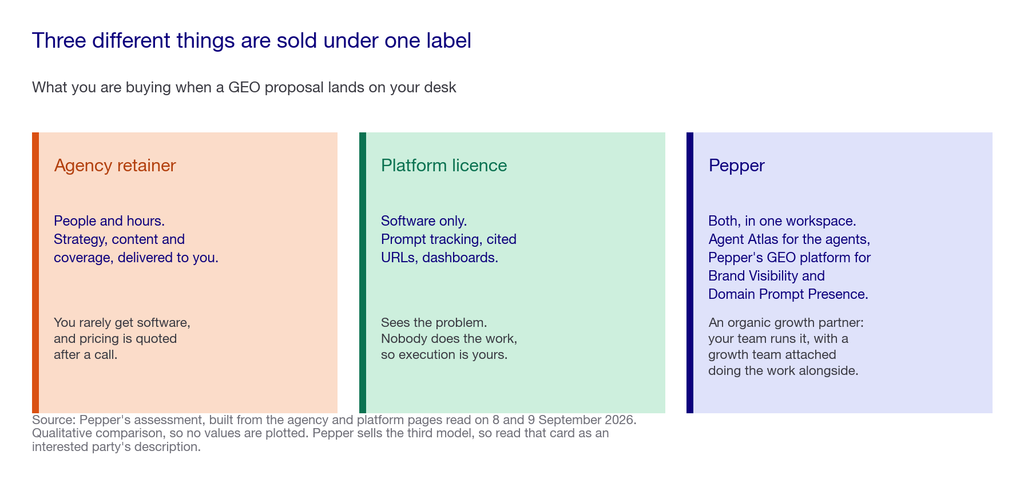
What they sell divides into four capabilities, and this is the division that matters when you compare two proposals:
- Technical retrievability. Crawl access for AI agents, server-rendered answers, clean robots rules, and site structure a machine can follow.
- Earned authority. Third-party coverage, comparison pages, communities and reviews, because engines cite third parties far more than they cite brands.
- Content. Original material a model cannot reconstruct from somebody else’s page.
- Measurement. Prompt tracking, cited URLs, competitor share of voice, and an honest account of what cannot be attributed.
Four capabilities, four different teams. Almost nobody staffs all four to the same standard. So the honest question is never who is best, but who is strong where your constraint actually is.
What we found when we audited the lists themselves
Before writing a list, we read the lists already ranking for this query. This is the part worth knowing.
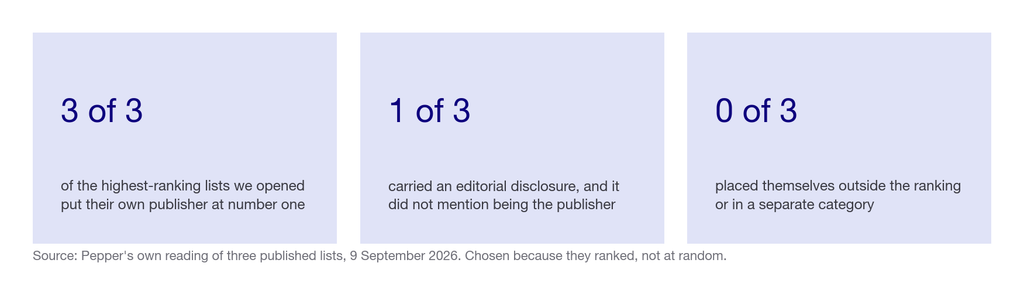
- Minuttia ranks itself at number one on its own list of ten, authored by its own Head of Growth, with no disclosure of the conflict.
- Thrive Agency ranks itself at number one of ten with a score of 97 out of 100. It weights “AI Visibility” at 60% of that score and supports its own placement with its own internal performance data. Its editorial disclosure says no entry was written or reviewed by the agency it describes, which does not address the publisher being the top entry.
- SEOProfy ranks itself at number one of thirteen, with no disclosure of the conflict.
We are not linking any of those pages, because we do not pass authority to competitors, and you can verify every one of these in about five minutes.
Where this falls short: three lists is a small sample, and we chose them because they ranked, not at random. It tells you the norm in this category is self-ranking without disclosure. It is not a census.
That is why our disclosure sits at the top of this article rather than in a footer, and why Pepper appears in a separate category instead of at number one. The weighting below was also fixed before anything was scored. The longer version of how we build rankings is in our GEO agency ranking methodology.
How we scored these agencies
Five criteria, weighted before a single agency was assessed. Weights sum to 100.
| Criterion | Weight | What a strong agency has to demonstrate |
|---|---|---|
| Earned authority capability | 30 | Named digital PR or third-party placement work, because most citation opportunity sits outside your own domain rather than on it |
| Technical retrievability depth | 25 | Real crawl, rendering and robots work for AI agents, evidenced by something more specific than a services page bullet |
| Measurement you can act on | 20 | Prompt-level reporting with cited URLs per engine, rather than one composite visibility score with nothing behind it |
| Published, checkable claims | 15 | Pricing, scope or engine coverage stated on their own site, so a buyer can compare before a sales call |
| Execution capacity | 10 | Enough people to ship the work rather than hand over recommendations for your team to build |
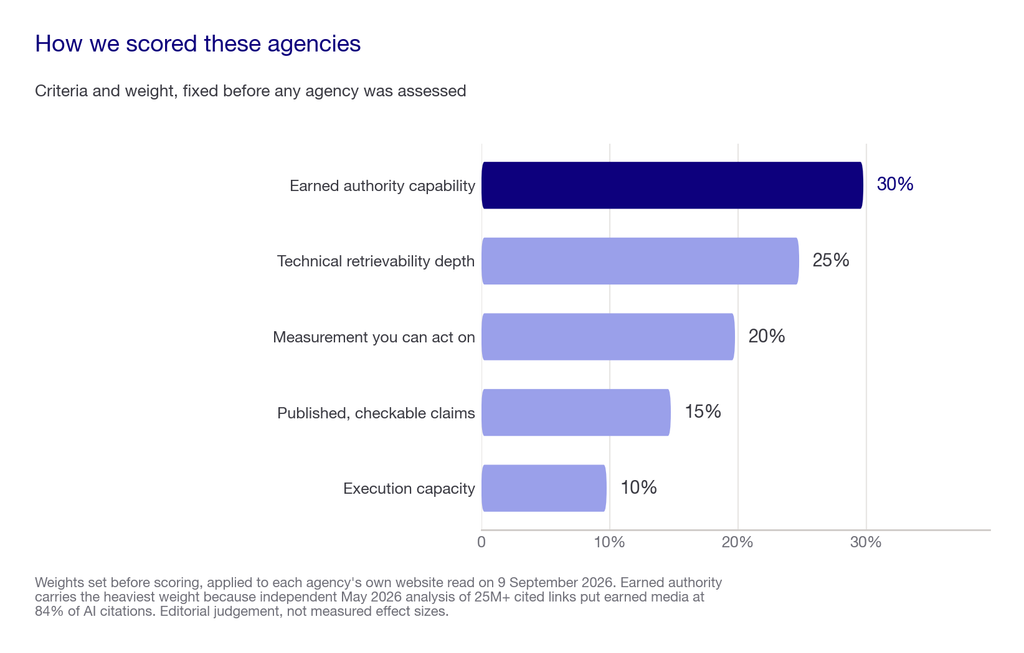
Earned authority carries the heaviest weight for a reason rather than a preference. Independent May 2026 analysis of more than 25 million cited links put earned media at 84% of citations. If most of the opportunity sits off your own site, the capability that reaches it should dominate the score.
Pepper, in its own category
We put ourselves here rather than at number one. Ranking ourselves against retainers we do not directly compete with would be the exact thing we just criticised. Here is the full entry, held to the same standard as everyone else’s.
Pepper is an agentic organic growth engine and an organic growth partner. Not an agency, and not a tool you are left alone with. Two pillars sit in one workspace, and a growth team sits on the account.
- Agent Atlas. Agents are workflows rather than a chat box. System agents are fixed, user agents are editable and versioned, and you can run one input or a whole sheet in bulk. Customers log in and build and run their own, which is the half most of this category does not offer. Atlas is the engine room.
- Pepper’s GEO platform. Brand Visibility for how often engines mention you, Domain Prompt Presence for how often they cite a page from your domain, and Share of Voice for your slice of category mentions. The gap between the first two is the citability diagnostic. It is the fastest read on whether your constraint is authority rather than structure. See the platform.
- A growth team attached. Agents for scale, experts for judgement, one team on the hook for the number. You get the workspace and the people, not a choice between them.
- All four capabilities in one place. Technical retrievability, earned authority, content and measurement, which is the combination the scoring above is built to find.
- Coverage and credentials. Six engines, including ChatGPT, Perplexity, Gemini and Google AI Overviews. Eight years, more than 250 enterprises, more than 10 million tracked prompts.
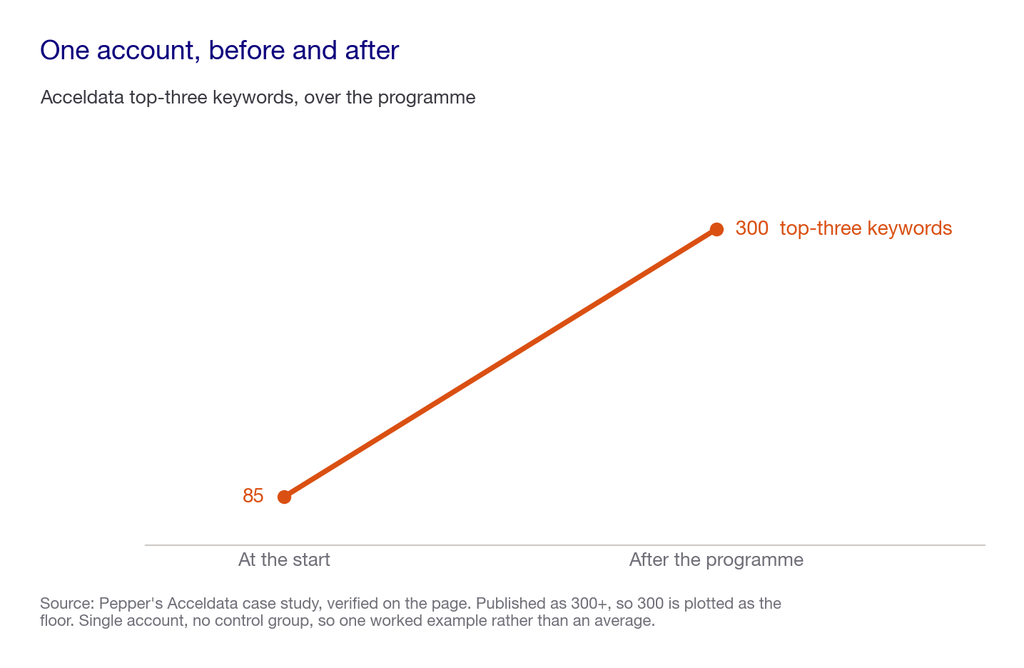
- Proof, not adjectives. Acceldata went from 85 to more than 300 top-three keywords with 6X organic traffic growth, and a single hero guide carried over 260,000 impressions.
Where it falls short: we do not publish pricing, so budget discovery is a conversation rather than a page. We are built for teams running organic as a long-term function, with an internal team to work alongside. A one-off technical audit, or a licence with nobody attached, is not what we are for. If organic is not a commitment for the next several quarters, we will say so and turn the work down.
Book a growth audit and we will run the mentions-against-citations split on your category before you shortlist anyone, including us.
The best generative engine optimization agencies, ranked
Named, never linked. Every description read off that company’s own website on 9 September 2026, with prices read on 8 September where noted. This category repositions constantly, so re-check before you brief anyone.
1. Siege Media
Siege Media now describes itself in its own words as “a GEO agency built for the new search” offering “full-service GEO”, having repositioned from content marketing.
- What it does: prompt and citation data analysis to find AI mentions, recommendations and ranking gaps, then content and coverage against them.
- Best for: brands that want editorial and earned coverage as the centre of the programme.
- Published claims: case-study metrics including 98% LLM visibility and 46.5k citations in LLMs, both its own figures.
- Engagement model: no pricing or minimum retainer published anywhere on the site.
- Where it falls short: the headline visibility numbers are self-reported with no stated method. Nothing about scope or cost is checkable before a call.
2. WebFX
WebFX sells enterprise GEO through its own OmniSEO platform and is one of only two firms here that publishes a real number.
- What it does: named deliverables including real-time LLM monitoring, competitor research and benchmarking, data-backed AI search optimisations and performance tracking.
- Best for: buyers who need a published price to get budget approved before a sales conversation.
- Published price: GEO from $3,000 a month, read on its own page. Its separate SEO ladder runs $2,900 to $9,200 a month, plus a two-month initial investment of $5,900 to $12,200.
- Where it falls short: tiered scopes fit unusual sites badly. The setup charge also roughly doubles the first two months against the monthly figure buyers anchor on.
3. Minuttia
Minuttia works with B2B SaaS companies, typically from around $10M ARR, and has built its own AI visibility tracking.
- What it does: search and generative search programmes with proprietary visibility tracking behind the strategy.
- Best for: established B2B SaaS with an existing content operation to build on.
- Engagement model: no pricing published. Its pricing URL returns a 404.
- Where it falls short: it ranks itself first on its own published list of best GEO agencies, authored by its own Head of Growth with no disclosure. Worth knowing when reading its other published claims.
4. Omniscient Digital
Omniscient Digital is an established B2B SaaS content firm, founded in 2019 and based in Austin, and originated the Barbell Content Strategy.
- What it does: content strategy, production and digital PR for B2B SaaS.
- Best for: companies whose constraint is editorial quality and volume rather than technical retrievability.
- Engagement model: its pricing page publishes no figures.
- Where it falls short: the model is content-led, so deep technical work for AI crawlers at scale is not the core strength.
5. Omnius
Omnius is a boutique European firm with its own AtomicAGI tracker for AI search visibility.
- What it does: AI search programmes with real-time brand visibility and citation tracking through its own software.
- Best for: B2B SaaS and fintech companies wanting a smaller, senior team.
- Engagement model: not published.
- Where it falls short: boutique capacity limits how much execution it can absorb, so it suits advisory-plus-some-delivery rather than a large rollout.
6. Graphite
Graphite positions itself across AEO, SEO and performance marketing as an AI-powered growth firm.
- What it does: programmes spanning traditional and generative search, with content strategy alongside answer engine work.
- Best for: companies wanting one firm across paid and organic.
- Engagement model: no pricing page exists on the site.
- Where it falls short: it publishes neither a founding year nor a location on its About page, and no pricing anywhere. So there is unusually little a buyer can verify independently.
7. Intero Digital
Intero Digital is a long-established full-service firm, founded in 1996, running GEO under its own Intero GRO badge for Generative Response Optimization.
- What it does: generative response optimisation inside a broad digital services offering.
- Best for: buyers who want GEO alongside paid, web and creative from a single vendor.
- Engagement model: not published. Its pricing page blocked our check with a server error, so we could not verify either way.
- Where it falls short: GEO sits inside a wide services menu, so ask specifically who does the AI search work and how many of them there are.
8. Thrive Agency
Thrive Agency is a large full-service firm that publishes ranges rather than plans.
- What it does: SEO, AEO and GEO within a broad marketing services offering.
- Best for: smaller budgets needing a published starting point.
- Published ranges: $500 to $10,000+ a month, and consulting at $150 to $300 an hour, read on its own page.
- Where it falls short: a range that wide is close to no price at all. It also ranks itself first on its own list of top GEO agencies, under a disclosure that does not mention being the publisher.
9. TripleDart
TripleDart serves B2B technology, including fintech, developer tools, HR tech and security, on its own Slate platform.
- What it does: demand and organic programmes for B2B tech, with proprietary tooling.
- Best for: B2B tech companies wanting vertical familiarity.
- Engagement model: no pricing page. The URL returns a 404.
- Where it falls short: vertical focus is the strength and the limit, so it is a poor fit outside B2B technology.
10. AnswerManiac
AnswerManiac is a specialist AEO and GEO firm for B2B SaaS, built around its own ANSWER framework on a 90-day cycle.
- What it does: answer engine programmes on a defined framework and timeline.
- Best for: teams who want a structured, time-boxed engagement rather than an open retainer.
- Engagement model: not published.
- Where it falls short: a 90-day framing sits awkwardly against a channel that compounds over quarters. Ask what happens in month four.
The agencies at a glance
| # | Agency | Strongest capability | Published price | Where it falls short |
|---|---|---|---|---|
| Own category | Pepper | All four, with Agent Atlas and Pepper’s GEO platform plus a growth team | Not published | Built for a long-term organic function, so not a one-off audit |
| 1 | Siege Media | Earned authority and editorial | Not published | Self-reported visibility metrics, no stated method |
| 2 | WebFX | Published scope and measurement | GEO from $3,000 a month | Setup fee of $5,900 to $12,200 on top |
| 3 | Minuttia | Content for B2B SaaS | Not published, pricing URL 404s | Ranks itself first on its own list, undisclosed |
| 4 | Omniscient Digital | Content quality | Not published | Light on technical work at scale |
| 5 | Omnius | Proprietary tracking | Not published | Boutique capacity |
| 6 | Graphite | Breadth across paid and organic | No pricing page | Publishes almost nothing verifiable |
| 7 | Intero Digital | Full-service breadth | Not published, check blocked | GEO sits inside a wide menu |
| 8 | Thrive Agency | Accessible entry point | $500 to $10,000+ a month | Range this wide is close to no price |
| 9 | TripleDart | B2B tech verticals | No pricing page | Narrow outside B2B tech |
| 10 | AnswerManiac | Defined 90-day framework | Not published | Timeline fits a compounding channel awkwardly |
## What a GEO engagement costs
Two of the ten publish a figure, so honest orientation rather than a benchmark.
- Published agency pricing: GEO from $3,000 a month at the one firm that states it, and a $500 to $10,000+ range at another.
- Setup and onboarding: the one published ladder adds a two-month initial investment of $5,900 to $12,200, which most monthly comparisons omit entirely.
- Your own team’s time: unless the contract says the agency ships changes, your developers and writers absorb implementation. This is the line that goes missing most often.
- The earned-media half: if most citation opportunity sits off your domain, coverage and original research are not an optional upsell. They are the slowest and most expensive part of the work.
We do not publish pricing either, so budget discovery with us is a conversation rather than a page. What we will say plainly is that the monthly fee tells you what a provider costs, not what the programme costs.
How to choose a generative engine optimization agency
I would not start from a list, including this one. I would start by writing down which of the four capabilities is actually your constraint. The shortlist that follows from “we cannot get cited” looks nothing like the one that follows from “engines cannot reach our pages”.
The framing judgement first, anchored outside our own opinion. Google’s guidance states that optimising for generative AI search “is optimizing for the search experience, and thus still SEO”, and it advises against providers who guarantee rankings. Read that as two instructions. Do not pay a premium for a separate AI methodology, and treat a guarantee as disqualifying. Then hold the other half: Google describes Google, other engines publish nothing comparable, so cross-engine coverage still has to be in the scope.
Here is the 100-point scorecard I would run over any agency, ours included.
| Area | Weight | What a strong agency should demonstrate |
|---|---|---|
| Capability against your constraint | 30 | They can name which of the four capabilities your programme is short of, and staff that one specifically rather than selling the whole bundle |
| Earned authority in the plan | 25 | Named third-party targets in the first quarter with an owner, because that is where most citation opportunity sits |
| Measurement with evidence | 20 | Prompt-level cited URLs per engine, and a straight answer on run-to-run variation rather than a single smoothed score |
| Implementation ownership | 15 | The contract says who ships each change, and if it is your team, they estimate that time honestly rather than leaving it off |
| Checkable claims | 10 | Pricing, scope or engine coverage published, and any performance figure comes with a method attached |
Then run the live test, on us as readily as anyone. Give each shortlisted agency the same 25 questions from your own category and ask them to show you live where you appear today. For example: “best generative engine optimization agencies”, “who should we hire for AI search”, “what does GEO cost for enterprise”, “alternatives to our biggest competitor”.
Ask them to come back with five things. Where does my brand appear today. Which competitors appear instead. Which sources are influencing those answers. Why are those sources winning. What exactly would you change in the next 90 days. An agency answering with named third-party sources and a sequenced plan beats one answering with a deck. And one that cannot say answers vary run to run does not understand the medium.
The weaker way to buy this, and what most shortlists do: take the top three from a list, compare monthly fees, check the logos, negotiate, sign. Every step feels prudent. None of it tests whether the firm is strong where you are weak. None of it asks who wrote the list.
The stronger sequence: name your constraint, write the prompt set yourself, then ask three firms to price the same scope. Compare their cited URLs rather than their decks, check who implements, and only then compare fees. It matters because in this category the fee is the least variable thing and the capability mix is the most.
Red flags, each one something we have heard in a real pitch:
- “We guarantee ChatGPT citations.” Google itself advises against guaranteed rankings, because no third party has access to the ranking systems.
- A single AI visibility score as the headline, with no prompts or cited URLs behind it.
- A performance number with no method. “98% LLM visibility” means nothing without the prompt set and the sample.
- A shortlist the agency wrote, with itself at the top and no disclosure.
- No earned media anywhere in a twelve-month plan.
- No line for your own team’s implementation time.
- Branded-prompt-only tracking, which makes every report look good.
Five questions I would ask, and what a good answer sounds like.
- “Which of the four capabilities are you weakest at?” A good agency names one immediately. Anyone claiming all four equally is spread thin or not listening.
- “Who ships the technical fixes, you or us?” If it is us, ask for an estimate of our engineering hours and treat a refusal as the answer.
- “Show me a citation you earned, and the work behind it.” Not a ranking. A citation, and the earned-media path to it.
- “What is the method behind your headline metric?” Any self-reported visibility figure needs a prompt set, an engine list and a sample size.
- “Which client would you turn away?” An agency that takes everyone is selling capacity rather than judgement.
If I reduce this to one principle: buy the capability you are short of, not the firm at the top of somebody’s list. The rankings here are mostly written by the people in them, which is the strongest argument for scoring them yourself.
The honest closing note, and it costs us something. Very few firms are equally strong across technical execution, content, earned authority and measurement, ourselves included. The good ones will tell you which is their weakest. Ask, and treat a straight answer as a positive signal.
What nobody should promise you
Nobody should promise a citation or a position in an AI answer for a fee. Google advises against exactly that, because no external party has access to the ranking systems.
Nobody should promise a single composite visibility score, or a universal benchmark for a good citation rate. No such benchmark exists. Your own trend against the category leader is the only useful comparison, which is the argument in what actually matters in AI search measurement.
Nobody should promise results from one engine on one run, or clean attribution from a citation to closed revenue. We will not, and we would rather lose the deal than pretend attribution is solved. What we do is report Brand Visibility against Domain Prompt Presence and track citation rate as a trend. Then we say plainly which part of the pipeline we cannot see.
Where this stops working, including for us
If your brand is barely mentioned in your category, hiring any GEO agency is premature. There is nothing yet for an engine to cite, so build presence and earned coverage first.
Say you have fewer than roughly thirty commercial questions worth tracking, or nobody to act on findings inside a fortnight. Then you do not need a GEO agency yet. Track a handful of prompts by hand, set up the free citation report in Bing Webmaster Tools, and revisit in two quarters.
Where Pepper falls short: covered in full in our own entry above rather than buried here. We do not publish pricing, we are built for a long-term organic function with an internal team alongside, and a one-off audit is not what we are for.
Where to go next
Write down which of the four capabilities is your constraint, then shortlist against that rather than against anybody’s ranking.
Then compare scopes and cited URLs rather than fees. Want your own category read first? See where you show up across the engines your buyers use. For the adjacent decisions we cover whether to buy an AEO agency or an AEO tool, the best AEO platforms, and our best AEO agencies list for the neighbouring term. Our case studies show the work in practice.
Frequently asked questions
What is a generative engine optimization agency?
A firm paid to make your brand appear and be cited inside AI-generated answers rather than in a list of links. The work splits into technical retrievability, earned authority, content and measurement, and few firms staff all four equally.
Which is the best GEO agency in 2026?
There is no single best, because the four capabilities are staffed unevenly. Pick the firm strongest where your programme is weakest. Be sceptical of any ranking published by an agency that appears on it.
How much do GEO agencies charge?
Only two of the ten we checked publish anything. One states GEO from $3,000 a month, another a $500 to $10,000+ range. Everyone else quotes after a call, so comparison needs a sales process.
Are GEO agency rankings trustworthy?
Treat them carefully. All three of the highest-ranking lists we opened placed their own publisher at number one. Only one carried any disclosure, and it did not mention the conflict. Check who published the list first.
What should a GEO agency deliver in the first 90 days?
Technical retrievability fixes, an agreed prompt set with baseline measurement, and named earned-media targets underway. If earned authority appears nowhere in the first quarter, it is an on-page project with a GEO label.
Do I need a GEO agency or a GEO platform?
A platform if you have in-house capacity and need instrumentation. An agency if the constraint is execution. Pepper pairs both, giving your team Agent Atlas and Pepper’s GEO platform with a growth team attached.
How do I verify an agency’s AI visibility claims?
Ask for the prompt set, the engines covered and the sample size behind any figure. Then ask them to run the same prompts twice. Self-reported percentages with no stated method are not evidence.
Can an agency guarantee AI citations?
No. Google advises against providers who guarantee rankings, because no third party has access to the ranking systems. Treat a guarantee as a reason to end the conversation, not a reassurance.
Sources and further reading
- Agency positioning, deliverables and pricing read off each company’s own website on 9 September 2026, with prices read on 8 September where stated: Siege Media, WebFX, Minuttia, Omniscient Digital, Omnius, Graphite, Intero Digital, Thrive Agency, TripleDart and AnswerManiac. Not linked, per our policy of naming competitors without passing them authority.
- Pepper’s own audit of three published “best GEO agency” lists, read on 9 September 2026. All three ranked their own publisher first; one carried an editorial disclosure that did not mention the conflict. Method: open the page, record whether the publisher appears, at what position, and whether any disclosure is present. Limitation: three lists chosen because they ranked, not at random.
- Muck Rack, “Earned media still drives 84% of AI citations”, What is AI reading? May 2026 edition, published 7 May 2026. Sample: more than 25 million cited links across ChatGPT, Claude and Gemini in 17 industries. Source of the weighting rationale for earned authority.
- Google Search Central, guide to optimizing for generative AI features, and the announcement post, 15 May 2026. Source of the “still SEO” framing and Google’s advice against guaranteed rankings. Applies to Google Search only.
- Pepper, Acceldata case study. Source of the 85 to more than 300 top-three keywords and 6X organic growth figures, verified on the page. One account, not a benchmark.
- Pepper, how we rank providers, which sets out the weighting approach reused here, and the agency-or-tool decision that sits upstream of this shortlist.
What is not here. No industry-wide figure for GEO agency pricing, because only two of the ten publish one and we will not average unsourced claims. No scores for the individual agencies either. The weighting is published so you can score them yourself, but assigning numbers to firms whose capabilities we cannot audit from outside would be false precision. Two checks were blocked by server errors and are recorded as unverified rather than assumed.
Latest Blogs
Most advice on this is inference dressed as fact. OpenAI documents exactly one thing clearly, which is access. Here is what is documented, what is inferred, and how to verify the rest for yourself.
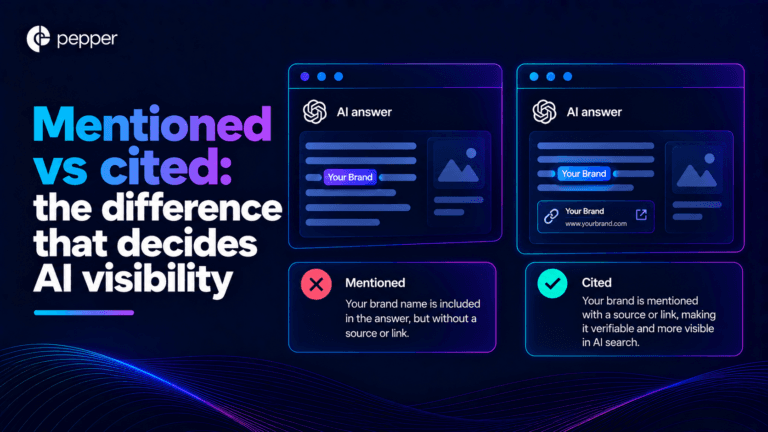
Being named in an AI answer and having your page used as its source are different outcomes with different causes and different fixes. The gap between them is the most useful diagnostic in AI search, and most reporting collapses it into one number.
Every platform reports share of voice and almost none of them define it the same way. Here is the definition worth using, the three choices that change the number, and how to measure it yourself without buying anything.
Get your hands on the latest news!

Similar Posts
GEO / AI Search
10 mins read
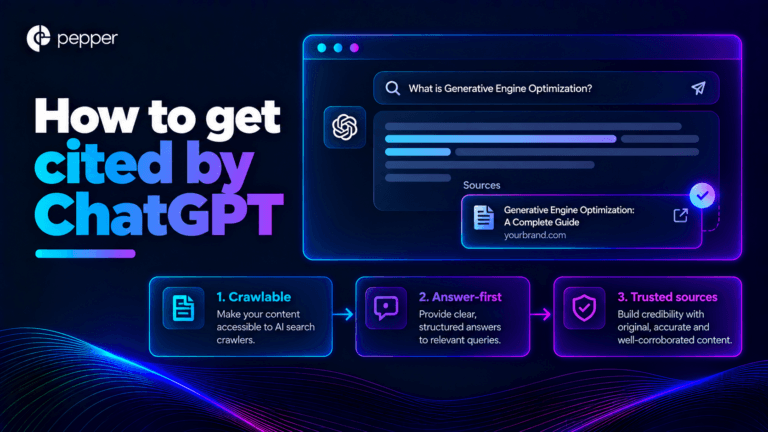
How to get cited by ChatGPT
GEO / AI Search
10 mins read
Mentioned vs cited: the difference that decides AI visibility
GEO / AI Search
13 mins read