Structuring content for AI answers: what works, what Google retired, and what comes first
The short answer
Structuring content for AI answers is three questions, not one. Can an engine fetch and parse the page? Is the passage self-contained once it is lifted away from everything around it? Does that liftable passage carry your name? The middle question gets nearly all the attention, and it is the only one of the three that most teams work on. The first decides more, because over 70% of AI answer errors trace to retrieval rather than reasoning. The third explains why 61.7% of brand appearances are citations with no brand name in the answer. Google has also publicly retired several tactics still being sold as AI structure.
Key takeaways
- Retrieval comes before shape. Across 2,100 questions and six chatbots, more than 70% of all errors came from failing to land on the right source, not from faulty reasoning. A perfectly structured page an engine cannot fetch is worth nothing.
- There is no separate AI index. Google states its AI features run on core ranking systems, so the crawl and index you already have is the one being used.
- Google has retired four popular tactics. Content chunking, AI-specific rewrites, llms.txt and structured-data over-optimisation are all listed as unnecessary in its own guidance.
- Name yourself in the sentence worth quoting. Only 13.2% of brand appearances produce both a citation and a mention. If the liftable line is generic, your page gets used and you do not get known.
- Two engines reward opposite things. Word overlap between a user’s prompt and the queries actually run was 88% for Perplexity and 13% for ChatGPT, so matching exact phrasing works on one and barely registers on the other.
- Structure has a ceiling. 84% of AI citations come from earned media and 0.3% from paid, so however well you shape your own pages, they are a minority of what engines read about you.
- The passage is the unit, not the page. Our existing guide covers that decision in detail, and this article deliberately does not repeat it.
- Pepper is an agentic organic growth engine and an organic growth partner. Agent Atlas puts the agents in your team’s hands. Pepper’s GEO platform reports Brand Visibility, Domain Prompt Presence and Share of Voice across six engines, including ChatGPT, Perplexity, Gemini and Google AI Overviews. A growth team works alongside yours. Eight years, more than 250 enterprises, more than 10 million tracked prompts.
A note on where this comes from. I spend my time on how these systems read, rank and retrieve, and the structure conversation is the one where I see the most wasted effort. Pepper runs organic growth for more than 250 enterprises over eight years and tracks more than 10 million prompts across every major engine. The pattern is consistent: teams rewrite pages that engines were never able to fetch, then conclude that structure does not work.
Disclosure: Pepper sells services that help brands appear in AI answers, so an elaborate structural discipline with many rules suits us commercially. This article says Google has retired four of those rules, that the highest-yield work is technical and free, and that your own page shape is a minority lever against earned media. Every figure traces to a named source with its method. We name competitors but never link them.
What is structuring content for AI answers?
It means organising a page so an engine can retrieve it, lift a complete answer out of it, and attribute that answer to you. Three separate conditions, and they fail independently.
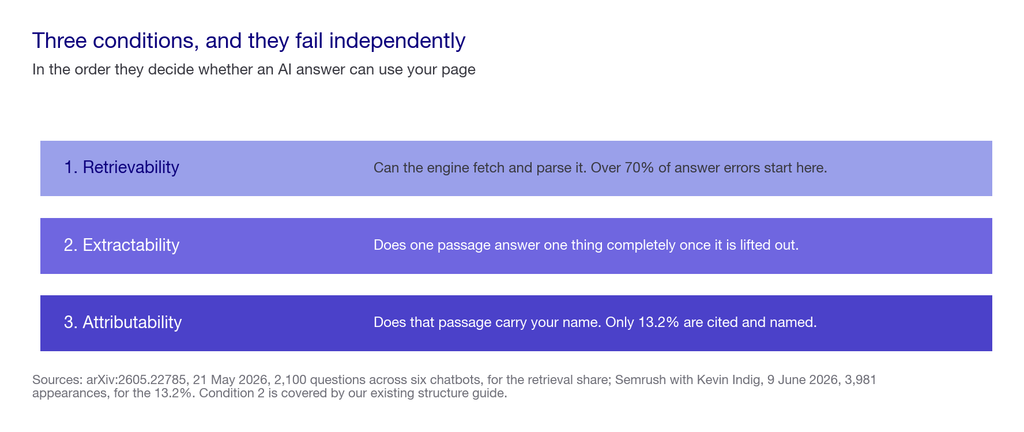
- Retrievability. The engine can reach the page, parse it, and has it indexed. Binary, technical, and fast to fix.
- Extractability. A passage answers one question completely and survives being lifted away from its context. This is what most people mean by structure.
- Attributability. The lifted passage carries your brand, so the reader learns who answered.
So the useful reframe is that structure is not one discipline with a checklist. It is three conditions in a sequence, and working on the second while the first is broken produces nothing at all.
Our existing guide owns the middle one. How to structure content for answer engines works through the page-shape decision properly: when to split a topic, where the splits fall, and how self-contained a section needs to be. This article covers the condition above it and the condition below it, and does not repeat that work.
Condition one: can the engine fetch it at all?
This is the least glamorous and the highest yield, and there is now a number for why.
A study published 21 May 2026 evaluated six chatbots over fourteen days against 2,100 factual questions drawn from same-day reporting. Its central finding is blunt. Retrieval, not reasoning, drove more than 70% of all errors. When a model lands on the correct source it usually extracts the correct answer, so the hard part is landing on it.
Therefore the first structural work is not structural at all.
- Indexation by template. Count how many of each page type are actually indexed, rather than how many exist. Templates fail as a group, not as individual pages.
- Crawler access. Check robots.txt against the crawlers that matter. OpenAI runs OAI-SearchBot, ChatGPT-User and GPTBot, each with a different job, and Perplexity runs PerplexityBot for scheduled indexing against Perplexity-User for on-demand fetches. Blocking one fails differently from blocking the other.
- Rendering. Confirm your revenue pages produce their content without JavaScript.
There is no separate AI index to structure for. Google’s guidance, last updated 10 July 2026, states its AI features run on core ranking systems. Our technical guide to AI crawlers and our note on PerplexityBot work through the robots.txt consequences.
If you would rather have someone run this first pass with you, book a growth audit and bring your template list.
Four tactics Google has retired
This is the part worth reading twice, because these are still being sold.
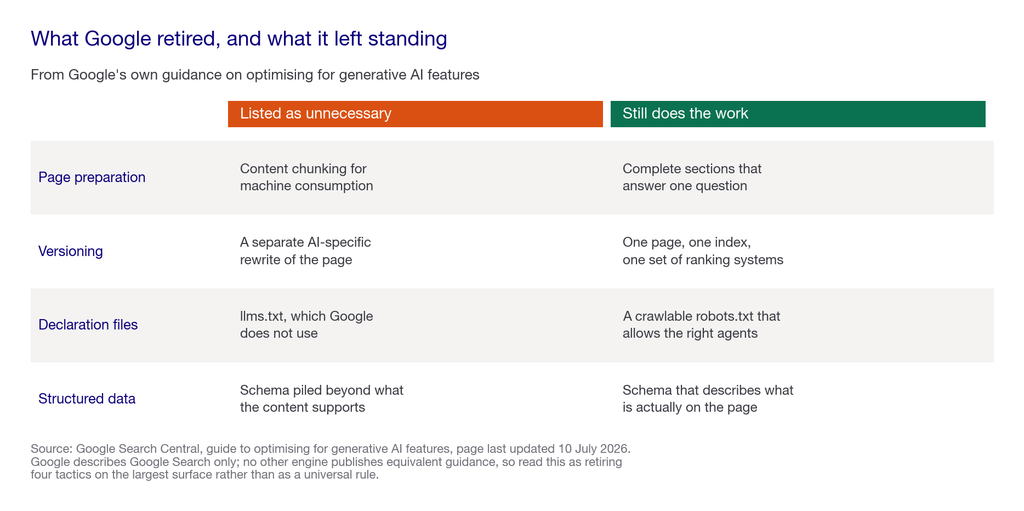
Google’s own guidance on optimising for generative AI features lists the following as unnecessary.
- Content chunking. Breaking pages into machine-sized fragments for AI specifically. The engine does its own passage selection.
- AI-specific rewrites. Producing a separate version of a page for AI surfaces. There is one index and one set of ranking systems.
- llms.txt. A proposed file for declaring content to language models. Google does not use it.
- Structured-data over-optimisation. Piling on schema beyond what the content genuinely supports.
Hold one caveat throughout: Google describes Google. No other engine publishes equivalent documentation, so this retires four tactics on Google’s surfaces specifically. That is still the largest surface most readers care about, and nobody else has contradicted it with published guidance.
What survives is unglamorous. Clean headings that match the question being asked, one complete answer per section, plain sentences, accurate facts, and schema that describes what is actually on the page. None of it is AI-specific, which is the point.
Condition three: does the passage carry your name?
Here is the condition almost nobody works on, and it is a structural choice rather than a technical one.
A study published 9 June 2026 logged 3,981 domain appearances across 115 prompts and 14 countries. The split:
- 61.7% were citations with no brand name in the answer. The engine used the page; the reader never learned who wrote it.
- 25.1% were mentions with no citation.
- Only 13.2% were both.
So you can write a perfectly extractable passage, have it lifted into an answer, and remain invisible. The fix is structural and cheap: make the sentence worth quoting the sentence that contains your name. Not a byline, not a footer, but the claim itself. “Pepper’s analysis of ten million prompts found X” survives extraction. “Our analysis found X” does not.
Our page on mentions against citations covers what each outcome is worth once it happens.
The two engines reward opposite things
A second study, published 30 April 2026, tracked 10,000 randomly sampled prompts over fourteen days across ChatGPT, Perplexity and Copilot, capturing the complete query sets each sent to retrieval.
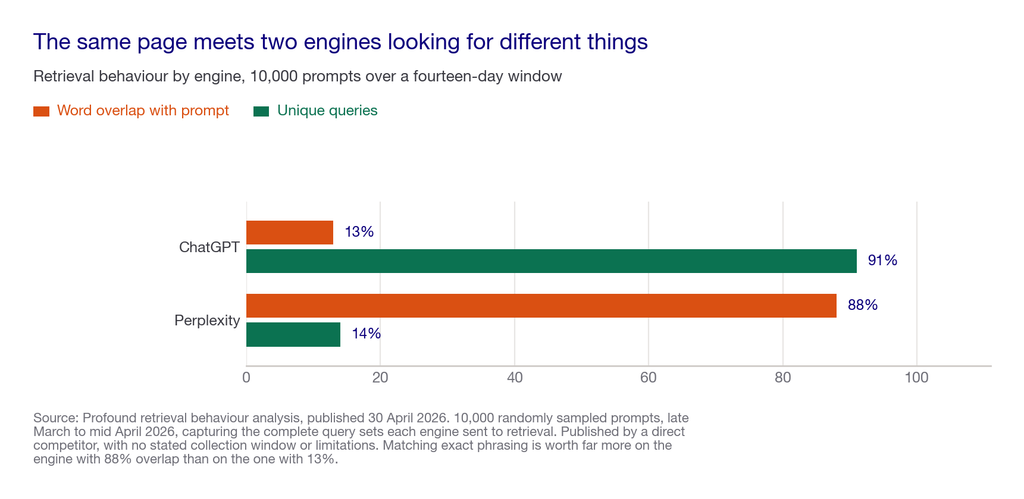
- Word overlap with the user’s actual prompt was 88% for Perplexity and 13% for ChatGPT.
- 91% of ChatGPT’s retrieval queries were unique, against 14% of Perplexity’s.
What follows is practical. On Perplexity, matching your buyer’s literal phrasing helps, because that phrasing is close to what gets searched. On ChatGPT it barely registers, because the query it runs shares almost none of its words with the question. There, breadth of coverage across a topic matters more than any single page’s wording.
So the honest version of “optimise your headings for the query” is: optimise for the query on Perplexity, and optimise for the topic on ChatGPT. Our deeper comparison covers where each engine gets its information.
How we weighted the structural work
Four things, and they are not worth the same.
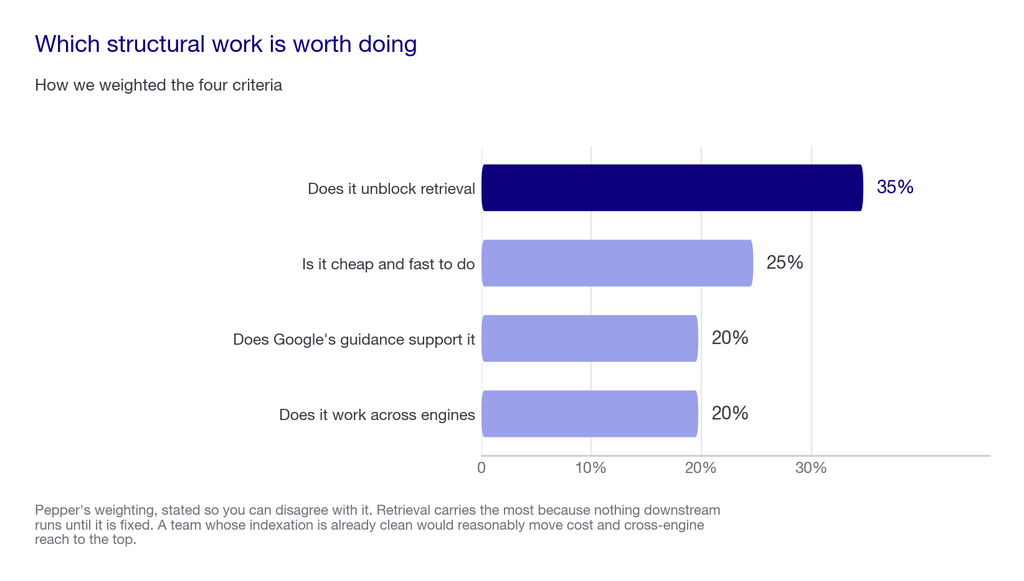
| Criterion | Weight | Why it carries that weight |
|---|---|---|
| Does it unblock retrieval | 35% | Over 70% of errors start here, and nothing downstream runs until it is fixed. |
| Is it cheap and fast to do | 25% | Indexation and naming changes take days. Rewriting a library takes quarters. |
| Does Google’s guidance support it | 20% | Four popular tactics are retired by name, and doing them is pure cost. |
| Does it work across engines | 20% | Exact-phrase matching helps on one engine and not the other, so engine-specific work has half the reach. |
The three conditions at a glance
| Retrievability | Extractability | Attributability | |
|---|---|---|---|
| The question | Can the engine fetch and parse it | Does a passage answer one thing completely | Does the lifted passage name you |
| Measured failure | Over 70% of all errors | Not separately measured | 61.7% cited without a mention |
| Who does it | Your developer | Your writers | Your writers |
| Time to fix | Days to weeks | Quarters, across a library | Days, per page |
| Cost | Free to low, technical time | The content budget | Free, it is a wording choice |
| Covered by | This article | Our existing structure guide | This article |
| Fails silently when | Crawlers blocked, JS-dependent pages | A section depends on the one above it | The quotable line says “we” and not your name |
What this costs
The retrieval audit is an afternoon. Indexation by template, a robots.txt read, and a render check on your revenue pages. No tool required and no budget.
The naming change is free. It is a wording choice applied as you write, and retrofitting it across existing pages is a find-and-read exercise rather than a rewrite.
The expensive condition is the middle one, because reshaping a library is a quarters-long content programme. That is also the one Google’s retired list targets most directly, so a good deal of what gets budgeted for it is unnecessary.
How Pepper fits
Pepper is an agentic organic growth engine and an organic growth partner, which means three things working together rather than one product.
Pepper’s GEO platform is the self-serve workspace. Brand profile, competitors, personas, GA4 and Search Console connected, themes and prompts defined, with Brand Visibility, Domain Prompt Presence and Share of Voice across six engines, including ChatGPT, Perplexity, Gemini and Google AI Overviews. Citation Analysis is the part that matters here, because it shows which pages an engine actually used, which is how you find out whether your structural work changed anything.
Agent Atlas is where your team builds, versions and runs its own agents, with quick runs for one input and sheet runs for bulk. Checking a few hundred pages for whether the quotable sentence carries the brand name is exactly the repetitive work it exists for.
The growth team is attached to the account and works alongside yours, which matters most on the ceiling problem below: earning presence on pages you do not own is not a structural exercise.
Where it falls short: structure is a minority lever and we are not going to pretend otherwise. Across more than 25 million cited links, 84% came from earned media and 0.3% from paid, so however well you shape your own pages, they are a small share of what engines read about you. Our platform also measures presence rather than extraction quality, so it will tell you a page was cited and not why.
Eight years, more than 250 enterprises, more than 10 million tracked prompts. You can see the shape of the work in the Acceldata case study, in how we run it for B2B SaaS brands, and across the case study library.
How to choose what to fix first
The decision is sequencing, and most teams get it wrong by starting in the middle. So here are the criteria, weighted.
The weighted scorecard
Score each row from 1 to 5, multiply by the weight, and total out of 100.
| Criterion | Weight | Score 1 means | Score 5 means |
|---|---|---|---|
| Indexation health by template | 35 | Whole templates missing from the index | Everything indexed, crawlers allowed |
| How self-contained your sections are | 25 | Every section depends on the one above | Each answers one thing completely |
| Whether quotable lines name you | 20 | Generic prose anyone could have written | The brand sits inside the claim |
| Third-party coverage of your category | 20 | Nobody independent writes about you | Well covered by journalism and reference sites |
Under 40, stop writing and fix retrieval. Nothing downstream is running. From 40 to 70, work on naming first because it is free, then reshape the pages that already earn traffic. Above 70, your structural work is done and your constraint is coverage you do not own.
The weaker playbook against the stronger one
The weaker approach is to adopt a structure checklist from a conference talk and apply it to the whole library. That feels systematic, it is expensive, and a good deal of it is on Google’s retired list. The stronger approach is to run the afternoon audit first, fix whatever it finds, then change the quotable sentence on your twenty most-cited pages, and only then consider reshaping anything. One rewrites a library. The other removes the reason the library was not being read.
Run a live test before you commit a quarter to this
Take 20 prompts written in your buyers’ language rather than yours, such as “best observability platform for a mid-size engineering team”, “how do I cut false positives in fraud detection”, or “alternatives to the incumbent for a regulated business”. For each answer, log two things: was your page cited, and were you named. Re-run at 30 days and again at 90 days. If you are being cited and not named, the fix is the sentence, not the structure.
Red flags
- Any proposal built on content chunking, which Google lists as unnecessary
- A recommendation to publish llms.txt, which Google does not use
- Advice to produce AI-specific versions of existing pages
- Schema recommendations that go beyond what is on the page
- A structure programme proposed before anyone has checked indexation
- Exact-phrase optimisation sold as working on every engine
- Anyone promising citations from a formatting change alone
Five questions worth asking any agency
- What is my indexation rate by template, and did you check before proposing a rewrite?
- Which crawlers can currently reach my revenue pages, and did you distinguish scheduled from on-demand?
- Which of your recommendations appear on Google’s retired list, and why are you still making them?
- What is my ghost citation rate, and what would you change to improve it?
- How will we know this worked, measured on something other than a visibility score?
The reducing principle. It comes down to one question: can an engine fetch your page, lift a complete answer from it, and tell the reader it came from you? Those three fail independently and in that order. Everything else in this article, and most of what the category sells as AI structure, is a refinement of one of them or a distraction from all three.
The honest closing note. If your templates are indexed, your crawlers are allowed, your pages render and your quotable lines carry your name, you do not need us for the structural half, and the remaining work is coverage on pages you do not own. That is a slower and more expensive problem, and it is not solved by reformatting anything.
What nobody should promise you
- Citations from a formatting change. Structure makes you usable. It does not make you chosen.
- A benefit from llms.txt. Google’s own guidance lists it as unnecessary.
- That chunking helps. The engine does its own passage selection, and Google says so.
- One structure that works on every engine. Exact-phrase matching helps on one and not the other.
- That your own pages will carry the answer. They are a minority of the citation surface at 84% earned.
Where this stops working, including for us
Google describes Google. The retired list is from its own documentation, and no other engine publishes equivalent guidance. We have applied it as the best available evidence on the largest surface, not as a universal rule, and we have said so where it appears.
The retrieval evidence is strong but narrow. It covers news questions over fourteen days, and news is unusually time-sensitive, so retrieval may matter more there than in a stable commercial category.
The attribution and per-engine studies were published by vendors using their own tooling, and neither states a collection window or a limitations section. We use them because their definitions are explicit and their per-engine splits are the only published ones we could find.
And the ceiling is the honest limit on this whole subject. At 84% of citations coming from earned media, structural work on your own pages is a minority lever. An elaborate structural discipline suits us commercially, which is exactly why this article names four tactics to stop doing and tells you the first condition is free.
Where to go next
- For the page-shape decision in depth, read how to structure content for answer engines.
- For the crawler and robots.txt work, read the technical guide for marketers.
- For the three levers underneath all of this, read Visibility, Citability and Retrievability.
- To check whether any of it is working, read the twenty-minute brand check.
- For what the acronyms around this mean, read the alphabet soup explained.
Frequently asked questions
How do I structure content for answer engines?
Answer three questions in order. Can an engine fetch and parse the page, does a passage answer one thing completely once lifted, and does that passage carry your name. Most teams only work on the middle one, and the first decides more.
Does content chunking help with AI search?
No, according to Google’s own guidance, which lists it as unnecessary. Engines perform their own passage selection, so pre-fragmenting a page for machines adds work without adding benefit. Write complete, self-contained sections instead.
Should I publish an llms.txt file?
Google’s guidance lists it as unnecessary and Google does not use it. No other major engine has published guidance saying otherwise. Treat it as optional and very low priority rather than as a structural requirement.
Is there a separate AI index I should structure for?
No. Google states its AI features run on core ranking systems, which means the crawl and index you already have is the one being used. Advice to build for a separate AI index is selling something that does not exist.
Why does my page get cited without my brand being mentioned?
Because citation and naming are separate decisions. In one 2026 study, 61.7% of appearances were citations with no brand name in the answer. The structural fix is to put your brand inside the claim itself, so the quotable sentence carries it.
Should I match my buyer’s exact phrasing in headings?
It depends on the engine. Word overlap between the prompt and the queries actually run was 88% for Perplexity and 13% for ChatGPT, so literal phrasing helps on one and barely registers on the other, where topic breadth matters more.
How much does structure actually matter?
Less than the category implies. Across more than 25 million cited links, 84% came from earned media and 0.3% from paid, so your own page shape is a minority lever against third-party coverage you do not control.
What should I fix first?
Retrieval. Indexation by template, crawler access in robots.txt, and whether revenue pages render without JavaScript. It takes an afternoon, costs nothing, and more than 70% of AI answer errors trace to retrieval rather than reasoning.
Sources and further reading
- Suzgun, Shen, Bianchi, Spangher, Icard, Ho, Jurafsky and Zou, Evaluating Commercial AI Chatbots as News Intermediaries, arXiv:2605.22785, submitted 21 May 2026. A fourteen-day evaluation of six chatbots on 2,100 factual questions from same-day BBC reporting. Source of the finding that retrieval rather than reasoning drives more than 70% of errors. Limitation: news questions are unusually time-sensitive.
- Google Search Central, guide to optimising for generative AI features, page last updated 10 July 2026. Source of the core-ranking-systems statement and of the four retired tactics. Google describes Google Search only.
- Semrush with Kevin Indig and Growth Memo, Why 62% of AI citations don’t lead to brand mentions, published 9 June 2026. 3,981 domain appearances across 115 prompts and 14 countries. Source of the 61.7% and 13.2% figures. The publication states no collection date range and no limitations, and a vendor produced it using its own tool.
- Profound retrieval behaviour analysis, published 30 April 2026. 10,000 randomly sampled prompts over a fourteen-day window across ChatGPT, Perplexity and Copilot. Source of the word overlap and unique query figures. Published by a direct competitor, with no stated limitations.
- Muck Rack, “What Is AI Reading?”, third edition, May 2026. More than 25 million links from ChatGPT, Claude and Gemini across 17 industries. Source of the 84% earned and 0.3% paid shares.
- Pepper, the page-shape decision in depth, which this article complements rather than repeats.
- Pepper, the crawler and robots.txt guide, for condition one in practice.
- Pepper, the three levers behind citability, for where structure sits in the framework.
A note on sources. Only sources published in 2026 are cited. Two of the five were published by companies we compete with, which is stated in the lines that use them as well as here.
Latest Blogs
Choosing a GEO agency for mid-market B2B used to be a shortlisting problem. It is now a procurement problem, because the published prices have largely gone. Of four agencies publishing a GEO-specific figure in September 2026, two had withdrawn their pricing pages by early October and one had moved domains. Exactly one still publishes a number a mid-market buyer can act on. So the useful question is no longer which agency is best in the abstract, but how to compare three quotes when only one of them arrived with a method attached.
Third-party sources and AI citations are tightly linked, and the link stops short of where most plans assume. Off-page work decides whether an engine retrieves and cites you. It does not decide whether the answer names you, and 61.7% of brand appearances are citations with no name attached. The two largest 2026 datasets also disagree about how much of the citation surface is third-party at all, one saying 84% and the other putting the brand bucket above half. That disagreement is definitional rather than factual, and it decides where a budget goes.
Why is my competitor showing up in ChatGPT and not me? Before accepting the premise, check it. Across 3,981 brand appearances studied in 2026, 61.7% were citations with no brand name in the answer and only 13.2% produced both. So there are three states that look identical from where you are sitting: genuinely absent, present as an unnamed source, and named less often than a rival. Each has a different cause and a different fix, and working on the wrong one is the most common way this gets expensive.
Get your hands on the latest news!