AI search in India: how Indian brands are adapting
The usual framing for India is scale. But the more useful finding in OpenAI’s own data is not how many people use AI there. It is how well they use it.
The short answer
Indian AI users are unusually advanced. That changes what a brand selling into India competes with.
Four findings from OpenAI’s own published data, all about capability rather than headcount.
- Above the global median on nearly every tool. OpenAI states “India is above the global median for all measured OpenAI tools except for Voice Mode.”
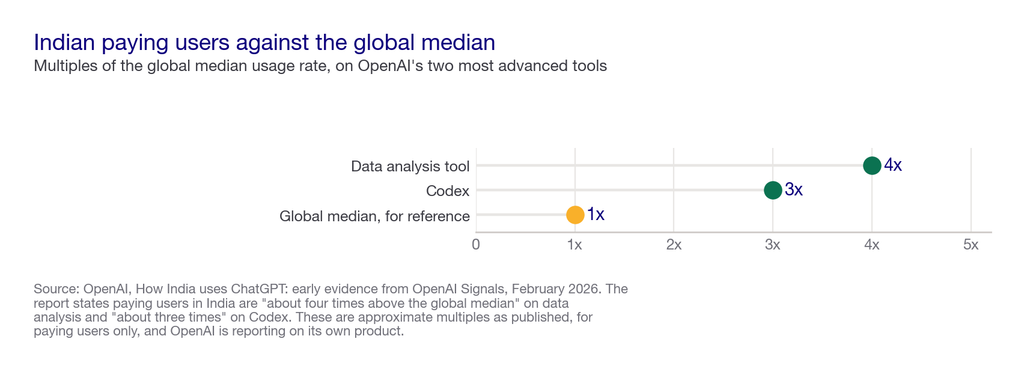
- Four times the median on data analysis. Paid users in India are “about four times above the global median when it comes to using the data analysis tool and about three times above the global median when it comes to using Codex.”
- The capability gap has largely closed. OpenAI’s reading is that “paying users in India have already closed much of the capability overhang, the gap we see in users getting the full value out of AI’s capabilities.”
- Second globally in AI skills penetration. India “ranks second globally in AI skills penetration and has experienced one of the fastest AI talent growth rates globally.”
Why that matters commercially
It changes who you are writing for. Your Indian buyer is not cautiously trying ChatGPT. They are more likely than the global average to use it for work. And they use its advanced features while they do. So a brand adapting to AI search in India is writing for an audience that interrogates answers. Getting cited by that audience’s engines is a citability problem, and we set out the three levers in the visibility, citability and retrievability framework.
Pepper is an Indian company and we sell in this market, so read this as an interested view. This page comes out of what we run: organic for more than 250 enterprises across eight years, more than 10 million tracked prompts, and the questions buyers put to us in client reviews. Customers log in and run the platform themselves, with a Pepper growth team attached. Book a growth audit and we will show you what engines say about your brand in this market.
Key takeaways
Key takeaways from OpenAI’s own report on Indian usage, published February 2026.
- Capability, not just volume. India is above the global median on every measured OpenAI tool but one.
- Four times the median on data analysis, and three times on Codex, among paying users.
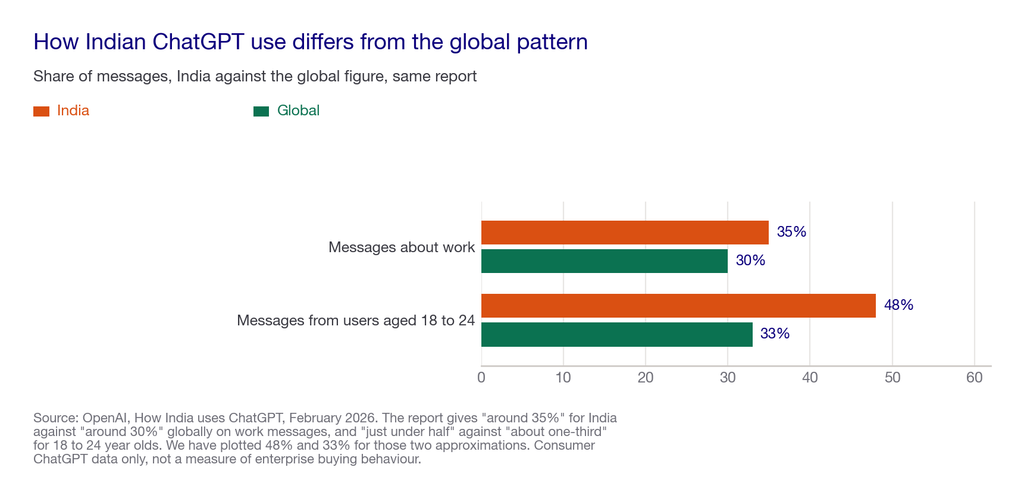
- Work use runs above the global average. Around 35% of Indian messages are work-related against roughly 30% globally.
- Indians ask AI to do things. Work conversations are task-shaped, with around 45% involving drafting, transforming or completing a task.
- The user base is young. Messages from 18 to 24 year olds are just under half the Indian total, against about a third globally.
- It is consumer data. OpenAI is describing its own product and its own users, not the Indian B2B buying committee.
What is different about AI search in India?
The honest answer is that the difference is in the user, not the engine. The same engines answer Indian queries. Their mechanics do not change at the border, and we cover them in what is AI search. What differs is who is asking and how capably.
OpenAI published its own usage data for India in February 2026, describing the country as “one of the largest markets of ChatGPT weekly active users” and “a top five country for API users.”
But three things in that data change how a brand should think about the market.
- Sophistication. Indian users adopt advanced features at well above the global rate.
- Task orientation. They are more likely to ask AI to make something than to explain something, especially at work.
- Youth. And the user base skews young enough to change which questions dominate.
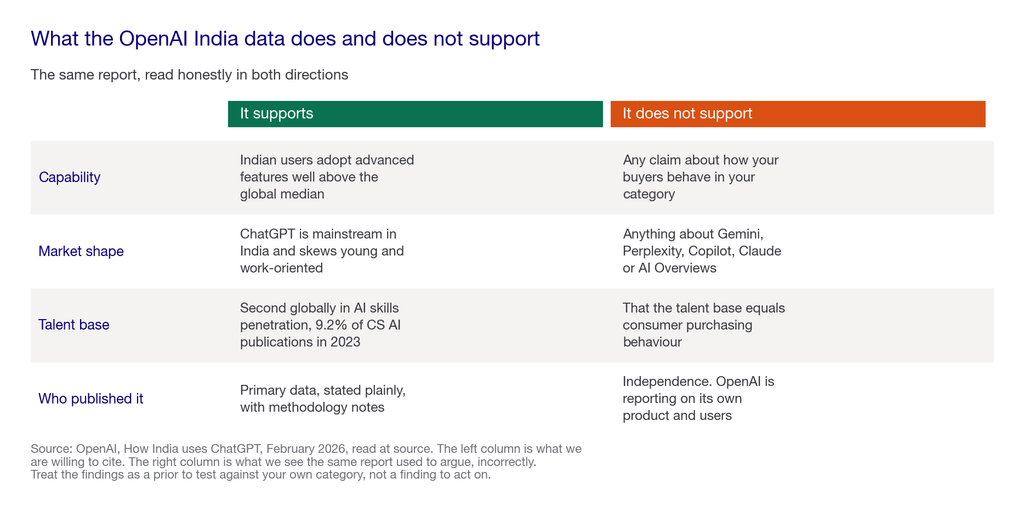
Where it falls short, and this matters. This is consumer ChatGPT data, published by OpenAI about its own product. So it is not a measure of the AI search market, and it does not cover other engines. Consumer skill is also not the same thing as enterprise buying behaviour. A twenty-two-year-old using Codex tells you about the talent pool. It tells you nothing about your procurement committee. Use the data to read the market you work in. Do not use it in place of researching your own buyers.
What the capability finding actually means
This is the part worth sitting with, because it inverts the usual advice about emerging markets.
The standard assumption is that a newer AI market means less skilled users, so simpler content wins. But OpenAI’s data says the opposite for India. Its phrase is “capability overhang”. That is the gap between what a tool can do and what users get out of it. And its finding is that paying Indian users “have already closed much of” that gap.
Three practical consequences.
- Thin content gets caught faster. An audience using data analysis four times above the global median is an audience that checks things. So a page that sounds authoritative and says nothing is a weaker play here than elsewhere.
- The follow-up question is the real battleground. Task-oriented users do not stop at the first answer. They ask the engine to compare, to weigh the trade-offs, to find the catch. So your content has to survive the second and third question, not just the first.
- Technical audiences are over-represented. Codex usage at three times the global median points to a developer-heavy base. That matters a lot if you sell to or through technical buyers.
And one counterweight. None of this is measured on your category. It describes OpenAI’s Indian consumer base in total, and your buyers may look nothing like it. So treat it as a hunch to test, not a finding to act on.
How the usage profile differs
Three comparisons from the same report, all against the global average.
- Work share. “While around 30% of global messages are about work, around 35% of messages in India are.”
- Task shape. Work conversations contain “a higher share of ‘doing’ behavior such as drafting, transforming, or completing tasks, around 45% of all conversations.”
- Age. Messages from users aged 18 to 24 “make up just under half of all messages on ChatGPT in the country”, against “about one-third” globally. Users aged 18 to 34 account for roughly 80%.
What to take from the age skew. A younger base asks more entry-level and comparison questions, and fewer deep procurement ones. So if you sell to enterprises, the overall skew is probably not your buyer. If you sell to startups, SMBs or developers, it probably is.
What adapting actually looks like
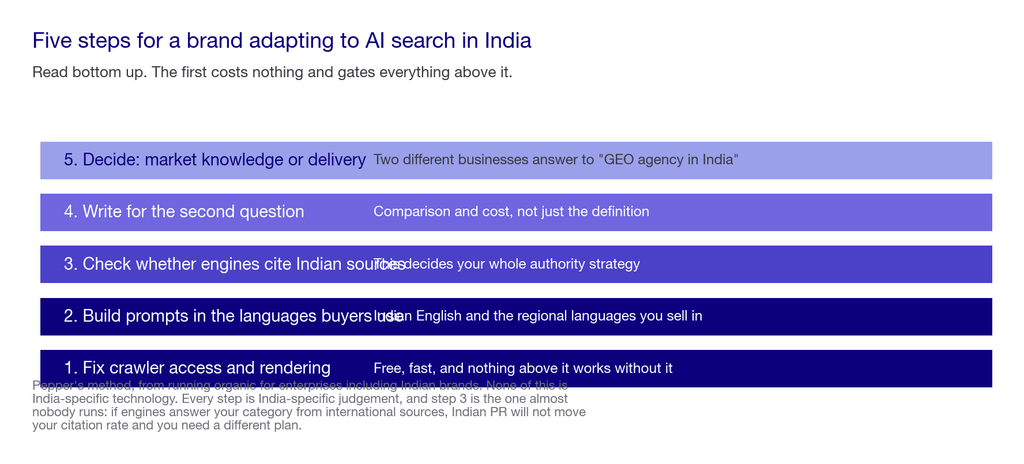
Five things, in the order we would do them. None of it is India-specific technology. But all of it is India-specific judgement.
Build your prompt set in the language your buyers use
Indian English is not US English. And a fair share of buyers will ask in a regional language. So if you sell in India, include prompts in Indian English and in the regional languages you care about, from the start.
Why it matters more here. Engines handle localisation inconsistently. A test across five engines found several returned the US English version of a page, even when a correct local version existed. So a Hindi query can return an English answer citing an English page.
Check whether engines cite Indian sources for your category
This is the check that decides your whole authority strategy, and almost nobody runs it.
Take twenty category prompts, run them, and note whether the cited sources are Indian or international. If engines answer your category from international sources, Indian PR will not move your citation rate. You need a different plan. The method is in how to track brand mentions in AI search.
Write for the second question, not the first
Given a capable, task-led audience, assume the follow-up. Say your page answers “what is X” but not “how does X compare with Y” or “what does X cost”. Then you lose the conversation at the point it turns commercial.
Fix access before anything else
Free, fast, and it gates everything. Crawler tokens, rendering and real status codes. The checklist is in how to audit your site for AI search.
Decide whether you are buying market knowledge or delivery
Two different businesses answer to “GEO agency in India”. First, firms serving Indian brands for Indian buyers. Second, firms delivering global work from India. We set the distinction out in GEO agencies in India.
The wider context
Worth noting, because it explains why the capability finding is not a fluke.
OpenAI records that India “ranks second globally in AI skills penetration and has experienced one of the fastest AI talent growth rates globally”, and that it accounts for “9.2% of global AI publications in computer science in 2023.”
What that supports. The sophistication in the usage data fits a deep talent and research base. It is not just an artefact of one company’s user mix. We have run this work for Indian brands at scale, including the organic programme in our TVS Eurogrip case study.
What it does not. None of it is a statement about Indian consumers’ purchasing behaviour, about non-OpenAI engines, or about any particular category. It is context, not evidence for a marketing decision.
What nobody should promise you
- That OpenAI’s data describes your buyers. It describes consumer ChatGPT use in India, which is a different population from an enterprise buying committee.
- A guaranteed citation in an AI answer, in English or any Indian language. Nobody controls model output.
- Indian-language capability without native writers. Ask who writes, where they live, and whether they have used the product.
- That an India-based team means India-specific expertise. Many India-based agencies serve mostly US clients.
- A market-size number for AI search in India. Nobody publishes one you can verify, and we have not invented one.
Frequently asked questions
How big is AI search in India?
OpenAI describes India as “one of the largest markets of ChatGPT weekly active users” and “a top five country for API users.” It does not publish a country ranking by user count, and no verifiable market-size figure for AI search in India exists.
Are Indian AI users different from the global average?
Yes, on capability. OpenAI states India is above the global median for every measured tool except Voice Mode, with paying users about four times the median on data analysis and three times on Codex.
What the data says
What is the capability overhang?
OpenAI’s term for the gap between what a tool can do and what users actually get from it. Its finding is that paying users in India “have already closed much of” that gap, which is unusual for a fast-growing market.
Do Indians use AI differently at work?
Yes. Around 35% of Indian messages are work-related against roughly 30% globally, and work conversations are task-shaped, with around 45% involving drafting, transforming or completing a task rather than asking a question.
Is the Indian AI user base young?
Markedly. Messages from 18 to 24 year olds make up just under half of all ChatGPT messages in India, against about one-third globally, with 18 to 34 year olds accounting for roughly 80%.
Adapting to it
Should I track prompts in Hindi or regional languages?
If your buyers use them, yes, and from the start. Engines handle localisation inconsistently, so a regional-language query can return an English answer citing an English page, and you will not see that unless you test for it.
What is the first thing an Indian brand should do?
Run twenty category prompts and record whether the cited sources are Indian or international. That single check decides whether domestic authority work will move your citation rate at all.
Does being an Indian brand help or hurt in AI search?
Neither, directly. What matters is whether engines reach for Indian sources when they answer your category’s questions. That varies by category, and you can check it in an afternoon. If they do not, you do not need an Indian authority programme yet, and we would tell you so.
Sources
The usage data comes from OpenAI’s own published report, read directly. Where a claim is ours rather than theirs, we say so.
OpenAI’s India report
- OpenAI, How India uses ChatGPT: early evidence from OpenAI Signals, Global Affairs, February 2026. OpenAI describing its own product and its own consumer users, so read it as first-party
data rather than as a measure of the AI search market. What it states:- India is “one of the largest markets of ChatGPT weekly active users” and “a top five country for API users”
- “India is above the global median for all measured OpenAI tools except for Voice Mode”
- Pro and Plus users in India are “about four times above the global median when it comes to using the data analysis tool and about three times above the global median when it comes to using Codex”
- “paying users in India have already closed much of the capability overhang”
- “while around 30% of global messages are about work, around 35% of messages in India are”
- work conversations contain “a higher share of ‘doing’ behavior… around 45% of all conversations”
- messages from users aged 18-24 “make up just under half of all messages on ChatGPT in the country” against “about one-third” globally
- India “ranks second globally in AI skills penetration”, with “9.2% of global AI publications in computer science in 2023”
Independent research
- Glenn Gabe, GSQI, AI Search, hreflang, and translated content, 1 December 2025. Independent consultant, not a vendor in this category. Tested localised queries against five AI engines and found several returned the US English version of a page where a correct localised version existed. A recorded test rather than a large survey, and it did not test Indian languages.
On what this page is not
This is not a market study of AI search in India, and no verifiable one exists that we could find. The usage data is consumer data from one company. The five adaptation steps are our judgement from running this work, not measured findings. We have not tested whether Indian-language prompts behave differently from English ones in Indian categories, and we would treat any confident claim on that point, including one from us, with caution until somebody publishes the test.
Latest Blogs
Most advice on this is inference dressed as fact. OpenAI documents exactly one thing clearly, which is access. Here is what is documented, what is inferred, and how to verify the rest for yourself.
Being named in an AI answer and having your page used as its source are different outcomes with different causes and different fixes. The gap between them is the most useful diagnostic in AI search, and most reporting collapses it into one number.
Every platform reports share of voice and almost none of them define it the same way. Here is the definition worth using, the three choices that change the number, and how to measure it yourself without buying anything.
Get your hands on the latest news!
