The best B2B SEO agency for you depends on what you are actually buying. Some firms sell technical depth. Some sell content and authority at volume. Some sell pipeline attribution. Very few are equally strong across all three, and the ones claiming to be usually hired for the third recently.
There is a second question that matters more than it did a year ago. Can they measure whether AI engines recommend you? Buyers now build shortlists inside ChatGPT and Perplexity before they ever reach your site, so an agency measuring rankings alone is reporting on a shrinking part of the picture.
Disclosure: Pepper is included on this list and published the guide, so we have placed ourselves in a separate category rather than ranking ourselves against agencies we do not directly compete with. We have also applied the same scrutiny to ourselves as to everyone else, including a “where it falls short” section. Every competitor description is based on that company’s own website, checked between 14 and 17 August 2026, rather than another roundup or secondary source. Where a company does not publish pricing, we have said so rather than estimating it.
Key takeaways
- Two of the nine publish real pricing. Optimist lists $3,000 a month for advisory and $4,000 for full service. MADX lists $2,500 per pillar and $5,500 fully managed. Everyone else asks you to book a call.
- Buyers decide before they contact you. Forrester surveyed 18,000 global business buyers in 2026 and found generative AI use in the purchase process rose from 89% in 2025 to 94% in 2026.
- Traffic can fall while your position improves. The same survey reports companies seeing 10% to 40% traffic declines as research shifts into AI engines.
- GEO is now table stakes. Eight of the nine agencies here name generative engine optimization as a service. A year ago most did not.
- You may not need an agency. If you have one strong in-house operator and fewer than roughly 30 target queries, spend the money on earned media instead.
What does a B2B SEO agency actually do?
A B2B SEO agency grows organic pipeline for companies selling to other businesses. The work covers technical health, content built for a buying committee, authority through earned media, and measurement that reaches revenue rather than sessions.
The distinguishing feature is the sales cycle. B2C SEO sells a product. B2B SEO sells a decision that takes months and involves five to ten people, each of whom searches differently. So the content mix skews toward comparison pages, alternatives pages, integration pages and security documentation, rather than high-volume informational posts.
What changed in 2026 is where that research happens. Forrester’s 2026 Buyers’ Journey Survey of 18,000 global business buyers found that twice as many named AI as their most meaningful research source than named any other. Specifically, 55% compare vendors inside AI tools, 54% research products there, and 47% build the internal business case before contacting anyone.
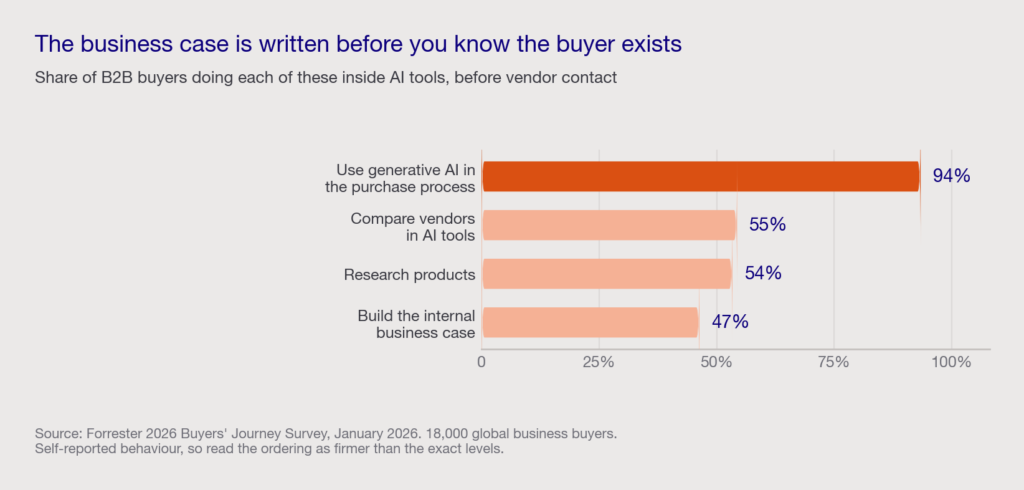
Read that last figure again. The business case gets written before you know the buyer exists. Consequently, an agency that cannot tell you whether engines recommend you is measuring the wrong end of the funnel.
We have run organic for more than 250 enterprises over eight years, and we track over 10 million prompts across every major engine. So the view below is shaped by that, by the client reviews we sit in weekly, and by conversations with operators at the events we run.
Our methodology: how we evaluated these agencies
Above all, we weighted the criteria by how much each one changes the outcome of a B2B engagement. Then we published the weights, so you can argue with them. Every agency was assessed against its own website between 14 and 17 August 2026, never against another roundup.
| Criterion | Weight | What a strong firm demonstrates |
|---|---|---|
| Pipeline attribution | 30% | Reports demos, trials and pipeline rather than sessions and rankings, and is honest about where attribution breaks |
| AI search capability | 25% | Measures brand mentions and citations across engines, and can explain prompt selection |
| Execution capacity | 20% | Ships technical fixes, content and placements rather than handing over a backlog |
| Earned authority and digital PR | 15% | Real placements in the third-party sources your category is cited from |
| Pricing transparency | 10% | Publishes a number, a model or a floor rather than gating everything |
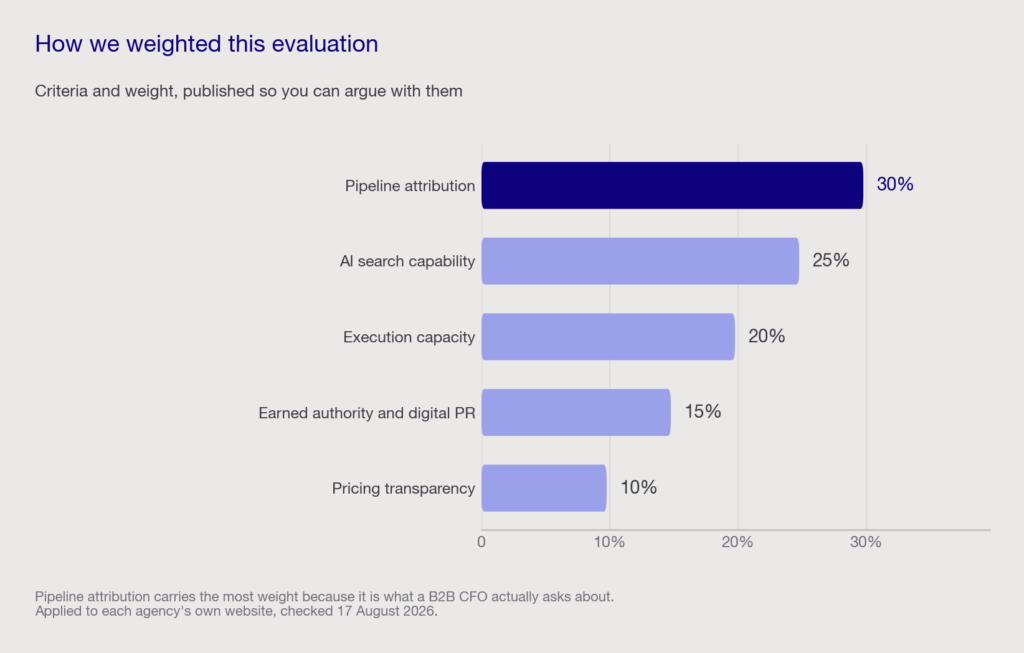
Pipeline attribution carries the most weight because it is the thing a B2B CFO will actually ask about. Rankings do not survive a budget review, whereas sourced pipeline does.
B2B SEO agencies at a glance
| Agency | Best for | AI search capability | Pricing |
|---|---|---|---|
| Pepper (own category) | Organic run as one function, platform plus growth team | Core to the product, five engines tracked | Not published |
| Optimist | B2B SaaS from Series A to IPO | AEO and GEO named, schema and fan-out work | Published. $3,000/mo advisory, $4,000/mo full service, $7,500 roadmap |
| MADX Digital | SaaS-only teams wanting price clarity | GEO and AI search named service | Published. $2,500 per pillar, $5,500 fully managed |
| Onely | Technical depth and JavaScript-heavy sites | GEO is their lead service | Not published |
| iPullRank | Enterprises wanting GEO mechanics, not marketing | Leading. Relevance Engineering, query fan-out | Not published |
| Directive | Pipeline programmes where search is one channel | Not named on the homepage | Not published |
| Obility | Hyper-growth B2B tech across paid and organic | GEO named, includes Reddit | Not published |
| Seer Interactive | Data-heavy programmes in regulated sectors | GEO and AI consulting listed | Not published |
| Siege Media | Content volume plus digital PR | Repositioned as a GEO agency | Not published |
Two of nine publish real numbers. That is better than this category managed a year ago, though still unusual.
The nine, in detail
1. Pepper
Pepper is an agentic organic growth engine, and we have been doing content-led organic work for eight years across more than 250 enterprises. That history matters for B2B specifically, because the constraint in most B2B programmes is not knowing what to do. It is having the hands to do it consistently for two years.
The product is genuinely two things at once. Customers log in and run it themselves, so they set up a workspace, define brand profile, competitors and personas, connect GA4 and Search Console, manage themes and prompts, read GEO analytics, and build and run their own agents in the Agent Atlas. In addition, a growth team is attached to the account and does the work alongside them. Agents give you scale, experts give you judgement, and one team owns the number.
On measurement we track Brand Visibility, Domain Prompt Presence and Share of Voice across ChatGPT, Perplexity, Gemini, Claude and Google AI Overviews. The gap between the first two separates an awareness problem from a citability problem, which changes what you do next.
We suit teams running organic as a long-term function rather than a campaign. Where we fall short: we do not publish pricing, so budget discovery is a conversation rather than a page. Our depth also sits in content, authority and AI search rather than very large technical migrations, so raise that directly if it is your primary problem.
2. Optimist
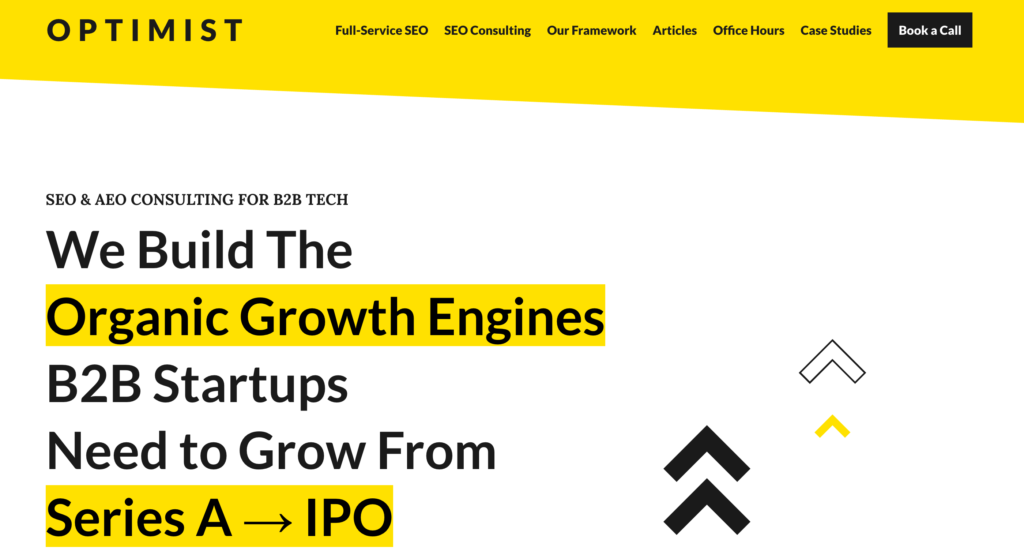
Optimist calls itself “the 10x organic growth agency: SEO, AEO and content for B2B SaaS”, and frames its work around building the organic growth engines B2B startups need to go from Series A to IPO. Services span SEO, AEO and GEO, organic pipeline generation, AI and automation, content repurposing, and measurement tied to pipeline. Clients include Semrush, Superhuman, SendBird and ContentStack.
They publish the clearest pricing in this comparison. A roadmap engagement is $7,500 one-time, advisory retainers start at $3,000 a month, and full service starts at $4,000. There is also a free analysis.
They suit B2B SaaS companies at growth stage that want pipeline framing rather than traffic reporting. Where they fall short: the focus is squarely B2B SaaS, so a manufacturer or a services business is outside the sweet spot. In addition, those published figures are floors rather than ranges, so scope carefully.
3. MADX Digital
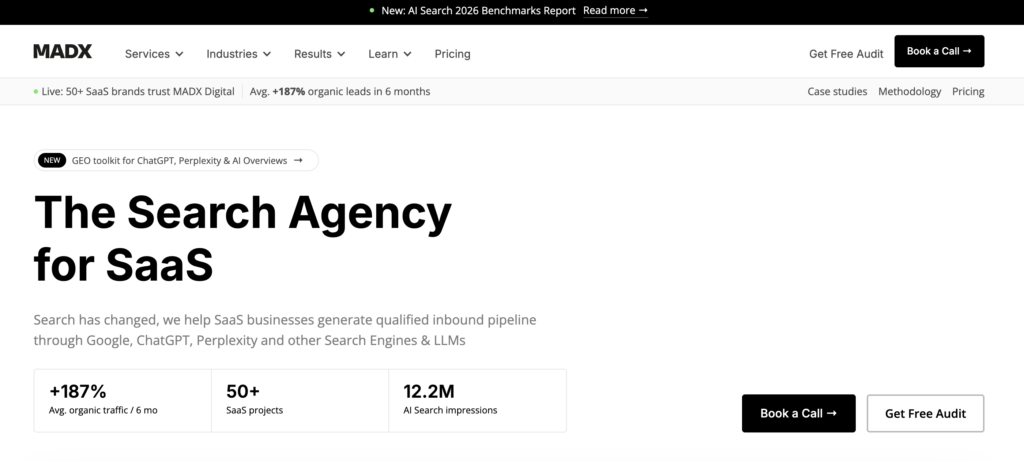
MADX calls itself “the search agency for SaaS” and says plainly that they only work with SaaS, so they move fast. Services cover GEO and AI search, traditional SEO, content strategy, digital PR and link building. Published results include Parcel Tracker at +13,400% organic traffic and Postalytics reaching 80% AI search share of voice.
They also publish detailed pricing, which almost nobody in this category does. Single pillars run $2,500 a month each, a fully managed bundle is $5,500, and a one-off AI Search and SEO Growth Plan is $4,500. Retainers carry a three-month initial term, then move month to month.
They suit SaaS teams that want price clarity and a defined scope. Where they fall short: they are smaller than several firms here, so check throughput against your page count. Furthermore, a narrow single-pillar retainer may under-serve a programme needing all three at once.
4. Onely
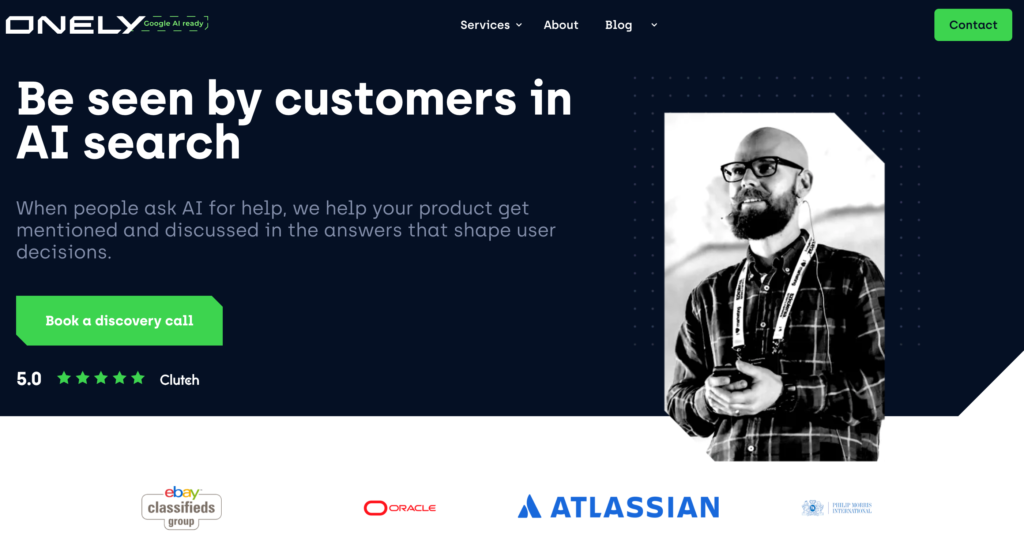
Onely leads with “we deliver organic growth through practical innovation”, and Generative Engine Optimization now sits as their first listed service. Their technical reputation is the real story though, with JavaScript SEO, Core Web Vitals, information architecture and traffic drop recovery all named explicitly. Clients include eBay, Oracle, Atlassian, Ikea and Miele.
They suit organisations whose problem is genuinely technical: a JavaScript-heavy application, a migration that went wrong, or a traffic drop nobody can explain.
Where they fall short: no published pricing, so budget discovery is a call. They also promise “measurable improvements in AI visibility and business outcomes within weeks”, which is a faster claim than we would make, so ask precisely what is being measured in that window.
5. iPullRank
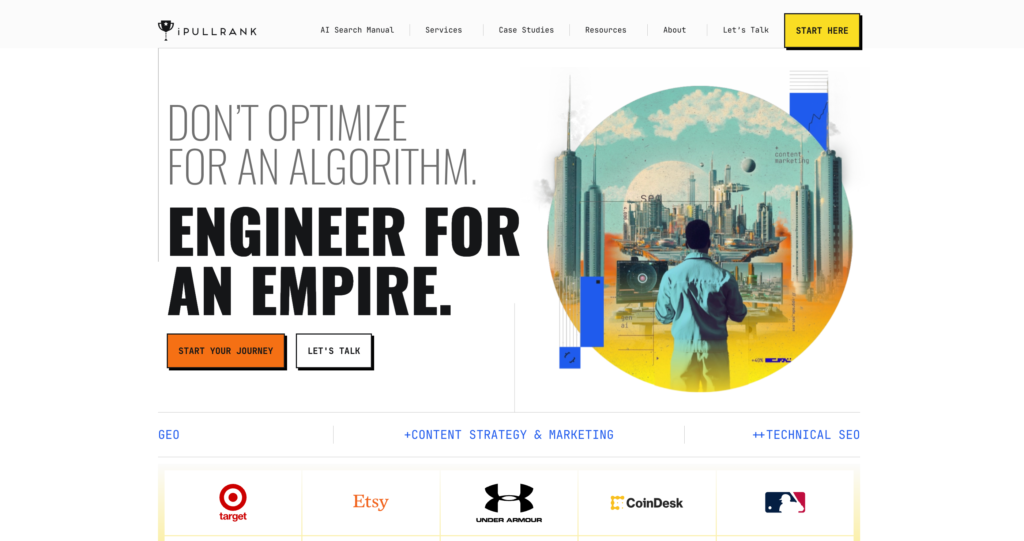
iPullRank describes itself as a “pioneering enterprise and mid-market AI search agency”, with the blunt line “we don’t optimize for blue links. We make your brand the answer.” Services span Relevance Engineering, GEO, AI search strategy, content strategy, technical SEO and content engineering. Clients include Target, American Express, Adidas and CVS Pharmacy.
They suit enterprises that want mechanics rather than marketing. Their public material discusses query fan-out, passage retrieval, embeddings and synthesis, which few competitors match for specificity.
Where they fall short: no published pricing. Moreover, the technical depth suits organisations with internal capacity to act on sophisticated recommendations, so ask hard about execution if you need hands rather than analysis.
6. Directive
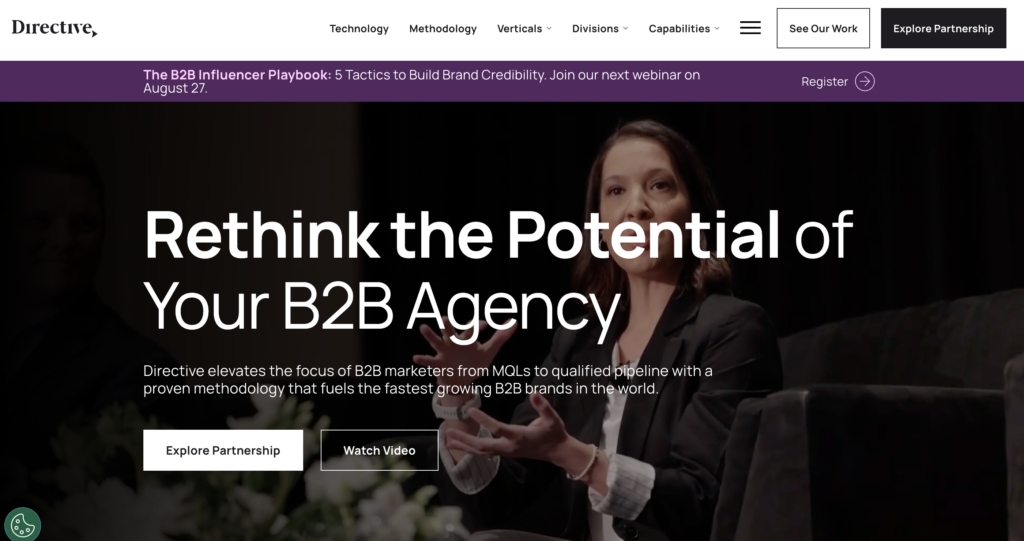
Directive is organised around Performance, Commerce and Communications, serving technology, industrial and services verticals, and reports 420+ brands including Amazon, Adobe and Cisco. Their frame is pipeline rather than rankings, delivered through a DiscoverabilityOS methodology and Stratos, an intelligence platform unifying CRM, paid, SEO and ops data.
They suit B2B organisations that want search treated as one input into pipeline alongside paid, social and PR.
Where they fall short: there are no GEO or AEO claims on the homepage, and Stratos is a data intelligence layer rather than an AI search capability. Since search is one of several channels here, a specialist may serve you better if organic is your primary motion. No published pricing.
7. Obility
Obility helps “modern B2B companies grow by creating, scaling, and measuring revenue from digital marketing”, with a stated focus on hyper-growth B2B tech and SaaS. Services span paid search, SEO, paid social, GEO, Reddit, content and revenue attribution. Clients include Snowflake, Fastly, Hitachi Vantara and Autodesk.
Their GEO framing is unusually specific about surfaces, naming ChatGPT, Perplexity, Claude, Google AI Overviews and Reddit. That Reddit inclusion matters, because it is a source engines lean on heavily.
They suit B2B tech companies wanting paid and organic run together with attribution across both. Where they fall short: with seven service lines, organic is one of several priorities, so confirm who owns your account day to day. No published pricing.
8. Seer Interactive
Seer Interactive blends “expert consulting with data-qualified recommendations” across SEO, paid media, analytics, creative, CRO, GEO and AI consulting. They lead on proprietary data, citing SeerSignals and 8.2 billion rows of SERP data, and report a 97% client retention rate with an NPS of 71.
They suit data-heavy programmes, particularly in SaaS, healthcare, banking and higher education, where analytics rigour matters as much as output.
Where they fall short: GEO appears as a listed service without much public explanation of method, which is thin next to iPullRank. The consulting-led model also means you should confirm who implements. No published pricing.
9. Siege Media
Siege Media now positions as a “full-service GEO agency for brands”, with the line “we make brands the answer in search”. Scope runs from content strategy through content production and design into digital PR, Reddit marketing and research reports. Clients include Zapier, Zendesk, HubSpot and Asana.
That Reddit and research-report capability matters more than it used to, since those are sources engines lean on. They suit content-led programmes needing real volume plus the earned media that wins citations.
Where they fall short: the centre of gravity is content and PR rather than deep technical SEO, so a complex migration may need a second partner. No published pricing.
What does a B2B SEO agency cost?
Two firms here publish real numbers, so start with those as anchors. Optimist lists $3,000 a month for advisory and $4,000 for full service, plus a $7,500 one-time roadmap. MADX lists $2,500 per pillar and $5,500 fully managed, on a three-month initial term.
Beyond that, most B2B SEO retainers land between $5,000 and $30,000 a month. However, that range circulates between vendors rather than coming from a survey, so treat it as folklore with a basis in fact.
Four things move the number. Site size and technical debt come first. Content volume comes second, and it is usually the largest line. Digital PR comes third, and it is the first thing cut when budgets tighten, which is unfortunate given how much of citation behaviour it drives. Finally, whether AI search measurement is included or sold separately.
The cost nobody quotes is your own team’s time. Every recommendation-led engagement assumes someone internal implements. So an agency surfacing 200 fixes nobody can action has added a backlog, not a capability.
Pepper does not publish pricing either, so we will not pretend to give you a number. What we will say is that the ratio matters more than the total. If you spend more on being told what to do than on doing it, the shape is wrong.
How to choose a B2B SEO agency
Choosing well is less about capability lists and more about naming the job you have. Most bad engagements we inherit were scoped against a label rather than a problem.
One shift is worth reading first. Google’s AI search guidance, published 15 May 2026, states that AEO and GEO are part of SEO from Google’s perspective, and that AI Overviews and AI Mode run on core Search ranking systems with no separate AI index. It also advises checking whether a provider’s advice aligns with official guidance.
Google is right, for Google. However, Google is one engine. ChatGPT, Perplexity and Claude retrieve differently, so a programme built only around Google’s guidance is blind where much B2B research now happens. An agency that can hold both ideas at once is worth talking to.
The 100-point scorecard I would use
| Area | Weight | What a strong agency demonstrates |
|---|---|---|
| Pipeline attribution | 30% | Connects organic to demos, trials and sourced pipeline in your CRM, and says plainly where the attribution breaks rather than showing a clean line |
| AI search capability | 25% | Tracks mentions, cited URLs, competitors and share of voice across a real prompt set, explains prompt selection unprompted, and shows raw answers rather than screenshots |
| Execution capacity | 20% | Names who writes, who ships the technical fix and who pitches the placement, with throughput evidence on an account your size |
| Earned authority | 15% | Has earned placements in the sources your category is cited from, and can name the ten to twenty that decide it |
| Pricing transparency | 10% | Gives a model, floor or range in the first conversation rather than after three discovery calls |

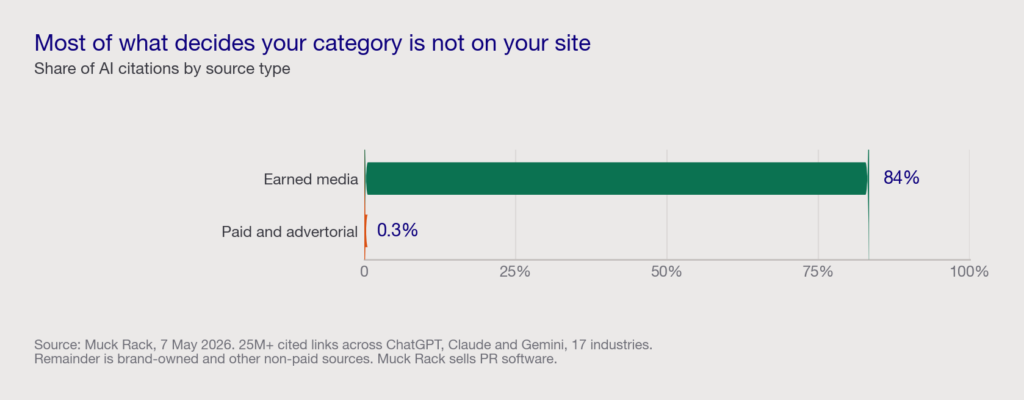
That earned authority weighting is not a preference. Muck Rack analysed more than 25 million cited links in May 2026 across ChatGPT, Claude and Gemini, and found 84% of AI citations come from earned media, with paid and advertorial at 0.3%. So an agency with no digital PR capability is not competing for most of what decides your category’s answers.
Ask them to show you this before you sign
Give them 20 to 30 real commercial questions from your category and ask for a mini audit rather than a capabilities deck.
For example:
- “Best [your category] platforms for enterprise”
- “Best alternatives to [your closest competitor]”
- “How should a B2B company solve [your core problem]?”
- “Which vendor should I choose for [your use case]?”
Then ask them to show you five things. Where does my brand appear today? Which competitors appear instead? Which sources are influencing those answers? Why are those sources winning? Finally, what exactly would you change in the next 90 days?
That conversation separates firms that have done this from firms that have read about it. It also reveals whether their answer is a content calendar or a real plan spanning technical, content and earned media.
A serious partner will also tell you, unprompted, that AI answers are probabilistic and vary between engines and runs. So one query on one engine proves nothing.
The weak playbook and the strong one
The weaker model runs like this: audit the site, deliver a prioritised backlog, publish a content calendar, report rankings, hand implementation back to you.
The stronger model runs in sequence. Demand intelligence, then technical retrievability, then entity and brand authority. After that comes content, earned media and distribution. Finally, visibility measurement across engines and pipeline attribution. Crucially, the agency owns delivery at each step rather than recommending it.
That distinction matters because engines synthesise answers from many sources rather than ranking one page. Therefore optimising only pages you own competes for a fraction of the outcome.
Red flags
An agency guaranteeing rankings or AI citations should end the meeting. Google explicitly advises against guaranteed rankings, because third parties cannot access internal ranking systems.
I would also be cautious about several other things. A proposal that is all deliverables with no owner named for implementation. Reporting that stops at traffic and rankings for a B2B business. Optimising for one engine only. Hundreds of AI-generated articles as the content plan. No stated methodology for prompt selection. Moreover, case studies drawn entirely from companies an order of magnitude smaller than you. One of those is survivable. Three is a pattern.
Five questions that would decide it for me
- “Show me pipeline you sourced, not traffic you grew.” They should reach demos, trials and opportunities in a CRM, and be honest about attribution gaps.
- “Take one query where a competitor beats us. Explain why.” This separates firms that understand retrieval from firms reading a dashboard aloud.
- “Who actually does the work, and what is their throughput?” Named roles and real capacity. If the answer is about strategy, delivery is still your problem.
- “What would you change in the first 90 days?” Look for technical, owned content and earned authority, in sequence.
- “Which part of your methodology will be obsolete in 12 months?” The category is moving fast, so a thoughtful answer beats a confident one.
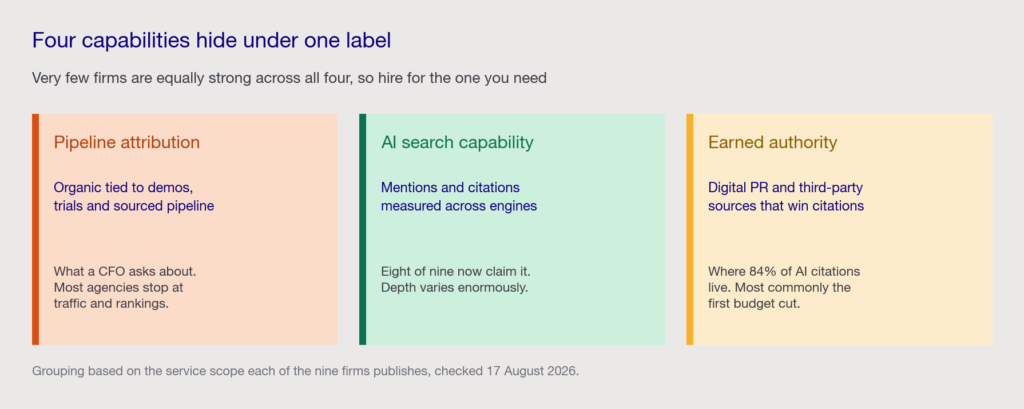
If I reduced the decision to one principle: hire for the job you have, not for the label the category uses.
One honest closing note that costs us something. The right partner needs pipeline attribution, AI search capability, execution capacity and earned authority. Very few firms are equally strong across all four, ours included, and the good ones will tell you which is their weakest. That is exactly where your evaluation should focus.
What nobody should promise you
Guaranteed rankings or AI citations. Nobody controls the ranking systems, and Google says so about its own.
Pipeline in one quarter. B2B sales cycles are months long. Organic compounds behind them, so a single quarter cannot show the full effect.
Clean attribution from citation to closed revenue. It does not close cleanly yet. Corroborate with branded search lift and sourced pipeline instead.
A single AI visibility score. Composite numbers hide the gap between being mentioned and being cited, which is the finding you can act on.
That one agency does everything well. Technical, content, earned media and attribution are four different capabilities. Ask which one they hired for most recently.
Frequently asked questions
What does a B2B SEO agency do?
A B2B SEO agency grows organic pipeline for companies selling to other businesses. The work covers technical health, content built for a buying committee, authority through earned media, and measurement that reaches demos and pipeline rather than sessions.
How much does a B2B SEO agency cost?
Optimist publishes $3,000 monthly for advisory and $4,000 for full service. MADX publishes $2,500 per pillar and $5,500 fully managed. Beyond those, most retainers land between $5,000 and $30,000 monthly, though that range circulates between vendors rather than coming from a survey.
How is B2B SEO different from B2C SEO?
B2B sells a decision taking months and involving five to ten people who each search differently. So the content mix skews toward comparison pages, alternatives pages, integrations and security documentation, rather than high-volume informational content.
Do B2B SEO agencies handle AI search visibility?
Most now claim to, though depth varies enormously. Eight of the nine agencies here name generative engine optimization as a service. Ask specifically which engines they measure, how they select prompts, and whether they can show raw answers.
How long does B2B SEO take to show pipeline?
Expect two to three quarters for meaningful movement, and longer before it shows in closed revenue, because B2B sales cycles run months behind first touch. Any agency promising sourced pipeline within a quarter is describing paid media.
Should we hire an agency or build in-house?
Build in-house if you have execution capacity and need deep product context. Hire an agency for surge capacity, digital PR, or skills you cannot recruit quickly. Most B2B teams run a hybrid, with the agency owning what internal headcount cannot cover.
How do I evaluate a B2B SEO agency?
Give them 20 to 30 real commercial prompts from your category and ask for a mini audit showing where you appear, which competitors appear instead, which sources influence those answers, and what they would change in 90 days. That reveals more than any deck.
Which B2B SEO agency is best for AI search?
On stated capability, iPullRank is most specific about mechanics, while Onely, Obility and Siege Media all lead with GEO. Verify current claims yourself, because this category is repositioning quickly and published rankings carry stale descriptions.
Where to go next
Start by deciding which of the four capabilities you are actually buying. Pipeline attribution, AI search visibility, execution capacity or earned authority. Then test your shortlist against that one thing rather than a general capability list.
If you already have an agency and results look flat, run the diagnostic before you switch. Compare how often engines mention your brand against how often they cite a page from your domain. If mentions are healthy and citations are not, changing agencies will not fix it, because that is a citability problem solved in earned media.
Our enterprise playbook for AI search covers the full sequence, and who owns AI search internally covers the ownership question that decides whether anything ships.
If you want to see your category’s answers today, see where you show up across the engines your buyers use. Customers run this themselves in the platform, with a growth team attached to do the work alongside them. For a worked example, our Acceldata case study documents 6X organic traffic growth and top-three keywords rising from 85 to more than 300, and our B2B SaaS work covers the vertical in more depth.
Finally, one honest exit. If you have one strong in-house operator and fewer than roughly 30 target queries, you do not need an agency yet. Spend the money on earned media instead. We would rather say that now than sell you a retainer you resent in nine months.
Sources
Every study cited was published in 2026. Agency descriptions and all pricing figures were taken from each company’s own website between 14 and 17 August 2026, not from competing roundups. Optimist, Onely and Obility were checked on 17 August; iPullRank, Seer, Siege Media, Directive and MADX on 14 August.
- Forrester, 2026 Buyers’ Journey Survey, January 2026. 18,000 global business buyers. Forrester sells research subscriptions.
- Muck Rack, Earned media still drives 84% of AI citations, 7 May 2026. More than 25 million cited links across ChatGPT, Claude and Gemini, 17 industries. Muck Rack sells PR software.
- Google Search Central, AI features and your website, 15 May 2026.
Latest Blogs
The research pulls in two directions. Fan-out rewards covering many adjacent questions; absorption research finds longer pages get used. The resolution is that the passage competes, not the page.
Seven documented changes, not seven predictions. Google switched two rich results off, shipped two new AI reports, and added a channel to Analytics. Here is what actually moved and what it means.
Content chunking is the process of splitting a page into smaller pieces so a machine can retrieve one of them. Here is the part most articles get wrong: chunking is something engines do to your page, not something you do to it. You do not choose the chunk size.
Get your hands on the latest news!

Similar Posts
SEO
11 mins read
What is internal linking? Meaning, and what changed for AI search
SEO
15 mins read
Primary and secondary keywords in 2026: what they were always for, and what changes now
Content Creation
11 mins read