SEO audit agencies: what a real audit includes and what to pay

The short answer
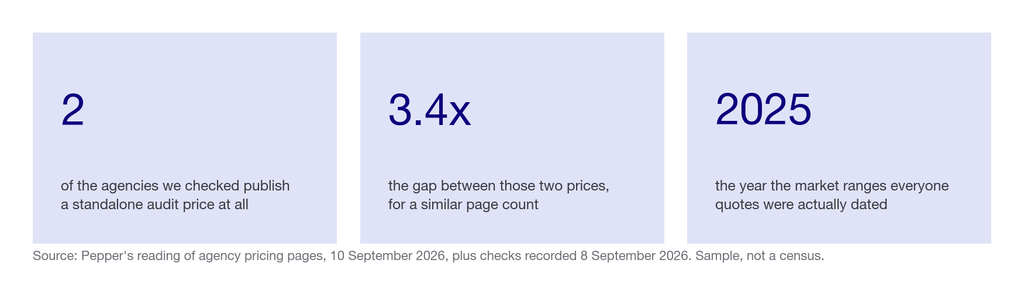
A real SEO audit delivers evidence, a prioritised roadmap with a named owner per item, and a stated position on who implements. Almost no agency publishes what one costs. Of those we checked, two do. One charges $8,600 for up to 70 pages over 45 days. The other charges $750 to $2,500 for up to 100 pages in 3 to 5 days. Compare cost per page before you compare headline fees.
Key takeaways
- Two agencies in our check publish a standalone audit price, and they differ by 3.4 times. One is nine times slower and covers fewer pages. The label “audit” is doing very little work here.
- Compute cost per page audited. It runs from roughly $8 to $123 across the published prices, and no agency publishes the figure itself.
- The market ranges everyone quotes are a year out of date. One of the pages quoting them attributes them to third-party data from the previous year, so they describe a market before AI search reshaped the scope.
- An audit without an implementation owner is a document. The single most expensive line to leave unstated is who ships the fixes, because it usually turns out to be your engineers.
- Pepper is an agentic organic growth engine and an organic growth partner. Agent Atlas runs the recurring checks, so an audit becomes continuous rather than annual. Pepper’s GEO platform reports Brand Visibility and Domain Prompt Presence against them, and a growth team implements alongside your team.
A note on where this comes from. I look at this through what the spend produced twelve months later. That is a harder question than what the audit contained. Pepper runs organic for more than 250 enterprises over eight years and tracks more than 10 million prompts across every major engine. That shapes this, along with the audits we inherit from other providers. Most were competent. None had been implemented.
Disclosure: Pepper sells audits as part of a wider engagement and published this guide. So we sit in our own section rather than ranking ourselves against agencies we do not directly compete with. We apply the same scrutiny to ourselves, including a “where it falls short” line. Every price here comes from that company’s own website as read on 10 September 2026. Where a company publishes nothing, we say so rather than estimating. We do not publish a standalone audit price ourselves.
What is an SEO audit agency, and what should a purchased audit include?
An SEO audit agency is a firm you pay to diagnose a site rather than to run it. The deliverable is a document and a conversation rather than a programme. That is what separates this purchase from a retainer.
That distinction is the whole buying decision. A retainer buys continuity. An audit buys a snapshot, and a snapshot is only worth anything if somebody acts on it.
So a real audit has to contain more than findings. Here is the minimum specification we would accept, and the thing to hold any proposal against:
- Evidence, not just crawler output. Server logs and Search Console data alongside the crawl. A crawl shows what a bot could reach; logs show what it did.
- A prioritised roadmap, ordered by impact rather than by category. Findings grouped by what you fix, so engineering can size them.
- A named owner per finding, including the items owned by product or commerce rather than by marketing.
- A stated implementation position. Whether the agency ships the fixes or hands them over, in writing. If the latter, with an estimate of your team’s hours.
- Reproducible method. Which URLs were sampled, which tools, over what period, so a second auditor could repeat it.
- AI crawler access checks. Robots rules, rendering and CDN blocking for AI agents. Most audit templates omit these entirely. Our guide to crawlability for AI covers the specifics.
- A measurement baseline captured before any fix ships, so the work can be proved rather than assumed.
If a proposal is missing items 3 and 4, you are buying a document. If it is missing 1, you are buying a hypothesis.
What SEO audit agencies actually publish, and the two that do
We read the agency pages ranking for this question. Almost none publishes a price for a standalone audit.
WebFX publishes a single audit package. Read 10 September 2026.
- Price: $8,600 for its Market Leader audit.
- Scope: up to 70 pages reviewed, over 45 days.
- Deliverables named: audit report, competitive scorecard against three competitors, keyword research covering 50 terms, backlink report, and 2.5 hours of implementation training.
- Add-ons published: in-depth link audit $1,200, external link strategy $500.
SEOProfy publishes a range for its own work. Read 10 September 2026.
- Price: from $750 to $2,500, with custom pricing above that.
- Scope: 300-plus data points across 15 areas, including technical foundations, on-page, backlinks, competitor research and penalty checks.
- Turnaround: 3 to 5 days for sites up to 100 pages, and 2 to 4 weeks for enterprise sites.
Everyone else we checked publishes nothing for a standalone audit. Across this and our earlier pricing work, Omniscient Digital, TripleDart, Graphite, Minuttia and Embarque publish no figures at all. Thrive Agency publishes only an hourly consulting rate of $150 to $300. Two further checks were blocked by server errors and are recorded as unverified rather than assumed.
Where this falls short: this is a sample of the agencies ranking for this question, not a census, and it skews toward firms that publish content about pricing. It establishes that publishing a fixed audit price is rare. It is not a market average.
If you would rather see your own site’s findings before you commission anyone, book a growth audit and we will bring the log evidence to the first call.
The metric nobody publishes: cost per page audited
Two published prices with two published page counts allow one useful division.
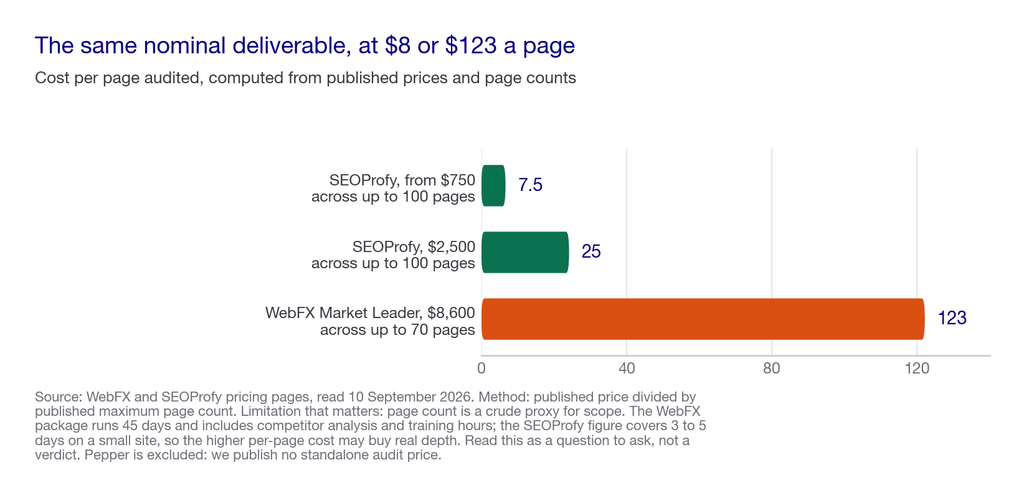
- WebFX Market Leader: $8,600 across up to 70 pages, so roughly $123 per page.
- SEOProfy at the top of its range: $2,500 across up to 100 pages, so roughly $25 per page.
- SEOProfy at the bottom: $750 across up to 100 pages, so roughly $8 per page.
A fifteen-fold spread on the same nominal deliverable.
Where this falls short, and it matters: page count is a crude proxy for scope. “Up to 70 pages” reviewed over 45 days with competitor analysis and training is a different product from “up to 100 pages” in 3 to 5 days. The higher per-page figure may buy genuinely more depth. Read cost per page as a question to ask, not a verdict. Ask what the page count means, and what happens to page 71.
Why the ranges everyone quotes are out of date
Search this question and you will meet the same bands: roughly $100 to $5,000 for a technical audit, $375 to $2,500 for on-page, $399 to $1,399 for backlinks.
One of the pages quoting them attributes them to Clutch data dated 2025.
Our house rule is that a cited study has to carry a current-year publication date, so we do not repeat those bands as a 2026 benchmark. The reason is not pedantry. Those bands predate the point at which AI crawler access, rendering for agents and citation measurement joined a competent audit scope. They price a smaller deliverable than the one you are now buying.
How we scored what a purchased audit is worth
Five criteria, weighted before any proposal was assessed. Weights sum to 100.
| Criterion | Weight | What a strong audit has to demonstrate |
|---|---|---|
| Implementation position stated | 30 | The proposal says in writing who ships each fix, and if it is your team, it estimates those hours rather than leaving the largest cost off the page |
| Evidence base | 25 | Findings rest on server logs and Search Console alongside the crawl, and the auditor states which URLs the sample actually covered |
| Prioritisation you can action | 20 | Findings are ordered by impact with a named owner each, rather than grouped by category and colour-coded by severity |
| Scope stated in units you can check | 15 | Page counts, data points, engines and turnaround are published or quoted in writing, so cost per unit can be computed before signing |
| Measurement baseline captured | 10 | The audit records where you stand before any fix ships, so the work can be proved afterwards rather than argued about |
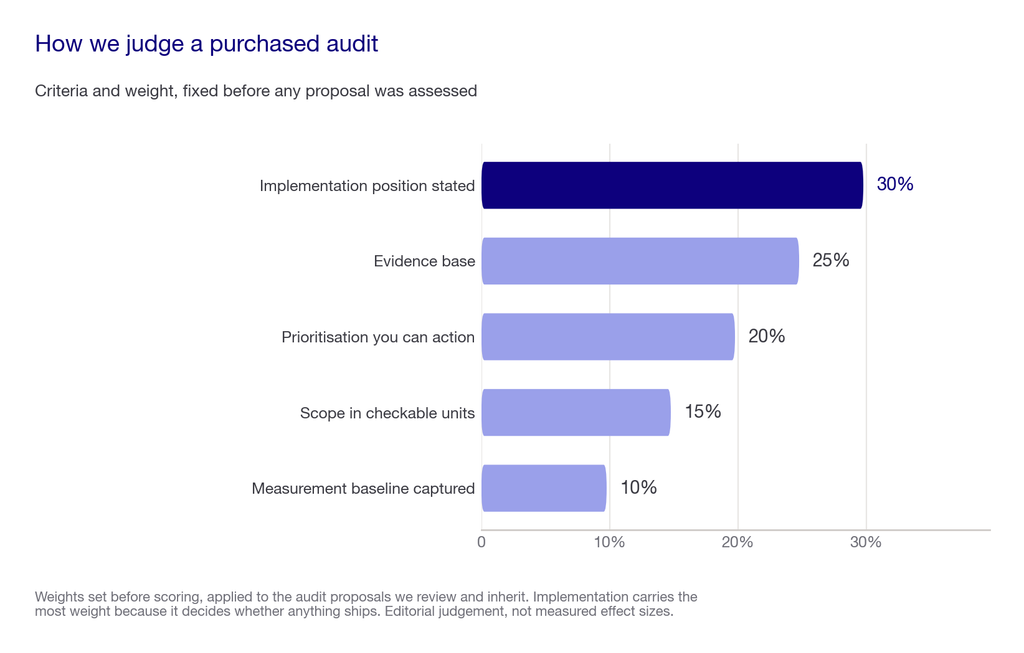
Implementation carries the heaviest weight because it decides whether anything changes. In the audits we inherit, the findings are usually correct. Nothing shipped because nobody had agreed whose job it was.
SEO audit options at a glance
| Option | What you get | Published price | Turnaround | Where it falls short |
|---|---|---|---|---|
| Published fixed package | A defined audit with named deliverables and training hours | WebFX Market Leader $8,600, plus $1,200 and $500 add-ons | 45 days, up to 70 pages | Roughly $123 per page, and page 71 is a separate conversation |
| Published range | A broad audit scoped after a conversation | SEOProfy from $750 to $2,500, custom above | 3 to 5 days under 100 pages, 2 to 4 weeks enterprise | A range this wide means scope, not price, is what you are negotiating |
| Hourly consulting | Expert time rather than a fixed deliverable | Thrive Agency publishes $150 to $300 an hour | You set it | You buy judgement, not delivery, so it needs your team to execute |
| Unpublished, quoted | Whatever discovery produces | Not published by Omniscient Digital, TripleDart, Graphite, Minuttia or Embarque | Not published | No benchmark before you commit to a sales process |
| Run it yourself | A framework and your own team’s time | Free, plus tooling from roughly $29 a month | As long as you have | Needs in-house capacity and someone who has done it before |
| Pepper, own section | Audit inside a running programme rather than as a document | Not published | Continuous rather than one-off | Not sold as a standalone audit, so a one-off diagnostic is not what we are for |
## What to pay, and what the fee does not cover
Three costs. The published fee is the one everybody compares and the smallest of the three on most engagements.
- The audit fee. $750 to $8,600 across the published examples, or hourly at $150 to $300.
- Your engineering time to implement. Unstated in almost every proposal, and usually the largest number. A template change is hours to specify and weeks to release; architecture work runs to quarters.
- The re-audit. A one-off audit ages from the day it ships. Budget for a repeat or for continuous checks. The alternative is paying twice for the same findings.
Pepper does not publish a standalone audit price, because we do not sell audits standalone. Budget discovery with us is a conversation rather than a page. What we will say plainly is this: with no engineering capacity this quarter, an audit is the wrong purchase at any of these prices.
What a real audit timeline looks like
Turnaround varies by a factor of nine across the two published examples, so it is worth knowing what the time actually buys.
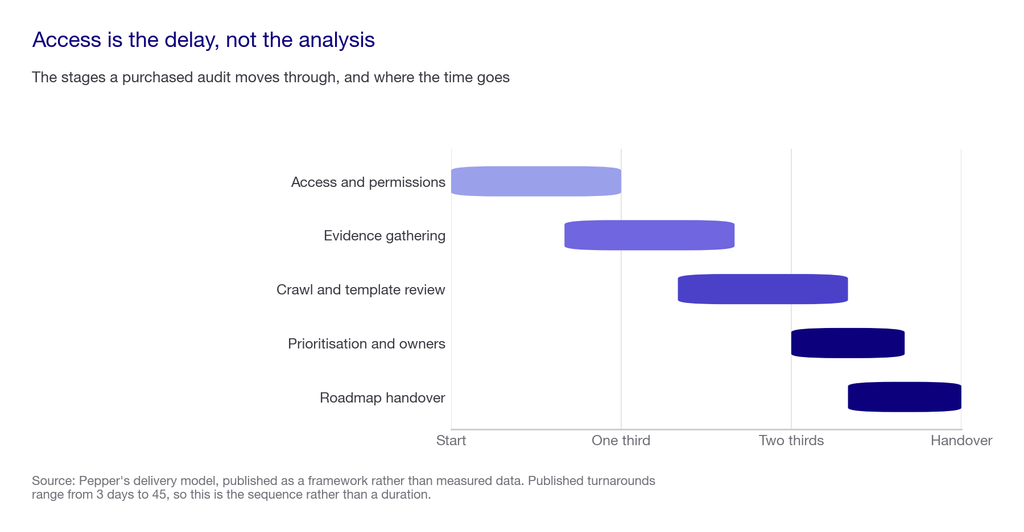
The single most common delay is access. Log files and Search Console permissions sit with teams who did not commission the audit. A five-day turnaround assumes you have already solved that. Ask any agency quoting a fast turnaround what happens if logs arrive in week two.
How Pepper handles audits
Pepper is an agentic organic growth engine and an organic growth partner. We do not sell a standalone audit, and the reason is the thing this whole article is about: a document nobody implements is the most common failure in this category.
- Agent Atlas turns the audit into something continuous. Agents are workflows rather than a chat box, so crawl deltas, indexation shifts, log comparisons and schema validation run on a schedule instead of once a year. System agents stay fixed and user agents stay versioned. Customers log in and build and run their own agents in Atlas.
- Pepper’s GEO platform captures the baseline and measures against it. Brand Visibility for how often engines mention you, Domain Prompt Presence for how often they cite a page from your domain, and Share of Voice for your slice of the category. The gap between the first two shows whether your remaining constraint is authority rather than architecture. See the platform.
- A growth team implements alongside your engineers, which is the item most audit proposals leave unstated. Agents for scale, experts for judgement, one team on the hook for the number.
- Proof rather than adjectives. Acceldata went from 85 to more than 300 top-three keywords with 6X organic traffic growth, and one hero guide carried over 260,000 impressions.
Where it falls short: we do not publish pricing, so budget discovery is a conversation rather than a page. We are built for teams running organic as a long-term function, with an internal team to work alongside. If you need a one-off diagnostic document to hand to someone else, we would say so on the call rather than take the work.
If you want a free starting point instead, the 7-point checklist we run on every new client costs nothing.
How to choose an SEO audit agency
I would not start by comparing fees. I would start by writing down who implements the findings. That single answer changes which purchase makes sense, and roughly halves the shortlist.
The framing judgement first, anchored outside our own opinion. Google’s guidance says optimising for generative AI search “is optimizing for the search experience, and thus still SEO”. It also advises against providers who guarantee rankings. Read that as two instructions for an audit brief. Do not pay a premium for a separate AI audit, and treat a guaranteed outcome as disqualifying. Then hold the other half: Google describes Google, and other engines publish nothing comparable, so AI crawler access belongs inside the scope rather than beside it.
Here is the 100-point scorecard I would run over any audit proposal, ours included.
| Area | Weight | What a strong proposal should demonstrate |
|---|---|---|
| Who implements, in writing | 30 | The contract states per workstream whether the agency ships changes or hands them over, with an honest estimate of your team’s hours in the second case |
| Evidence you can inspect | 25 | Logs and Search Console alongside the crawl, with the sampled URL set named, so a second auditor could reproduce the findings |
| Roadmap you can size | 20 | Every finding carries an owner and a unit of fix, so engineering can estimate it without a further discovery round |
| Scope in checkable units | 15 | Pages, data points, engines and turnaround stated up front, so you can compute cost per unit and compare two proposals honestly |
| Baseline and re-audit plan | 10 | A measurement baseline before any fix ships, and a stated position on when this needs doing again |
Then run the live test, on us as readily as on anyone else. Give each agency 25 real questions about your own site and ask for answers with evidence attached rather than a methodology deck. For example: “which of our templates waste the most crawl budget”, “what share of our URLs are discovered and not indexed”, “can AI crawlers render our product pages”, “which of our pages earn citations today”.
Ask them to come back with five things. Which findings block retrieval entirely. Which multiply across templates. Who owns each fix. What breaks first if nothing changes. What exactly they would ship in the next 90 days, and what it would cost. An agency answering with log evidence and a costed sequence beats one answering with a sample report.
The weaker way to buy this, and what most procurement does: collect three audit quotes, compare the headline fees, pick the middle one, receive a PDF, file it. Every step feels sensible. None of it establishes who implements, which is the only variable that decides whether the spend produced anything.
The stronger sequence: name the implementer first, then write the scope in units you can count. Ask three agencies to price that same scope, compare cost per unit rather than headline fee, and check the evidence base. Only then negotiate. It matters because the fee here varies elevenfold, while the outcome varies by whether anyone shipped the fixes.
Red flags, each one something I have seen in a real audit proposal:
- No statement of who implements, which is the most expensive omission available.
- A crawler export presented as an audit, with no logs and no sampled URL set.
- A severity column with no stated weighting, which makes the priority order unfalsifiable.
- Market pricing quoted from undated third-party data, which is most of what ranks for this question.
- A fast turnaround quoted before anyone has asked about log access.
- No AI crawler checks anywhere in the scope in 2026.
- A guarantee of rankings, which Google itself advises against, because no third party has access to the ranking systems.
Five questions I would ask, and what a good answer sounds like.
- “Who ships the fixes, and if it is us, how many engineering hours?” A good agency raises this before you do and gives a range.
- “What is your cost per page, or per data point?” They should be able to do the division on the call. Hesitation means the scope is not defined.
- “Show me the log evidence behind a finding in your sample report.” If the sample has none, the audit will have none.
- “What happens if the logs arrive two weeks late?” The honest answer changes the timeline. The dishonest one does not.
- “When will this need doing again, and what does that cost?” An audit that ages silently is a subscription nobody agreed to.
If I reduce this to one principle: pay for the implementation position, not the page count. An audit is worth exactly what gets shipped from it, and the fee predicts that poorly.
The honest closing note, and it costs us something. Very few firms are equally strong across log analysis, technical execution, editorial judgement and measurement, ourselves included. The good ones will tell you which is weakest. Ask, and treat a straight answer as a positive signal.
What nobody should promise you
Nobody should promise a ranking or a traffic figure from an audit. Google advises against providers who guarantee rankings, because no external party has access to the ranking systems.
Nobody should quote you a market average as though it were a price. The bands circulating for this question trace to third-party data dated before AI search changed the scope of a competent audit.
Nobody should promise that a document changes anything on its own. We will not, and we would rather tell you to spend the money on implementation capacity instead.
Where this stops working, including for us
If you have no engineering capacity this quarter, do not buy an audit at any price. Fix the access-level items yourself, which are configuration rather than construction, and revisit when someone can ship.
If your site is small and stable, a one-off audit from a published package is the right purchase, and you do not need a partner for it. Buy it, implement it, move on.
Where Pepper falls short: covered in our own section above. We do not sell standalone audits, we do not publish pricing, and if a one-off diagnostic is what you need, one of the published packages will serve you faster than a conversation with us.
Where to go next
Decide who implements before you request a single quote. That answer determines whether you are buying a document, a pair of hands, or a programme.
Then write your scope in countable units and ask three agencies to price it. For how to run the findings as a function rather than a project, read the AI search operating system. For the adjacent decisions, we cover whether to buy an AEO agency or an AEO tool and our best AEO agencies shortlist. Our case studies show what implementation produced.
Frequently asked questions
How much does an SEO audit cost in 2026?
Of the agencies we checked, only two publish a price. One charges $8,600 for up to 70 pages over 45 days. The other charges $750 to $2,500 for up to 100 pages. Published hourly consulting runs $150 to $300.
What should a professional SEO audit include?
Log and Search Console evidence alongside the crawl, a roadmap prioritised by impact with a named owner per finding, a written implementation position, a reproducible method, AI crawler access checks, and a measurement baseline captured before any fix ships.
Why do so few agencies publish audit pricing?
Scope genuinely varies, and a published number invites comparison on price alone. The consequence for a buyer is that you cannot benchmark before the sales conversation. Your first real number arrives from someone whose job is selling it.
How long should an SEO audit take?
Published turnarounds range from 3 to 5 days on a small site to 45 days for a fuller package. The usual delay is access to log files and Search Console rather than the analysis. Agree access before you agree a date.
Is a cheap SEO audit worth buying?
It can be, if the scope is stated in units you can check. Compute cost per page or per data point, then ask what the audit does not cover. A cheap audit with a clear scope beats an expensive one with a vague one.
Should the agency that audits also implement?
Not necessarily, but somebody must, and the contract should say who per workstream. An audit with no named implementer is the most common way this purchase produces nothing, however good the findings are. If implementation falls to your team, get their hours estimated before you sign.
Do SEO audits cover AI search in 2026?
Increasingly claimed, rarely specified. Ask whether robots rules, rendering and CDN blocking for AI crawlers are in scope, and whether the audit captures a citation baseline, because most templates still omit both.
How often should an SEO audit be repeated?
Treat the systems checks as continuous and the full audit as annual. Running the recurring parts on a schedule turns the next audit into a comparison against the last one rather than a rebuild from scratch.
Sources and further reading
- WebFX, SEO audit pricing page, read 10 September 2026. Source of the $8,600 Market Leader package, the 45-day turnaround, the up-to-70-pages scope, the named deliverables and the $1,200 and $500 add-ons. Not linked, per our policy of naming competitors without passing them authority. Note the page carries no publication date.
- SEOProfy, SEO audit pricing page, read 10 September 2026. Source of the $750 to $2,500 range, the 300-plus data points across 15 areas, and the 3 to 5 day and 2 to 4 week turnarounds. Also the page that attributes the circulating market ranges to third-party data dated the year before this article, which is why we do not repeat them.
- Agency pricing pages read on 8 September 2026 for our earlier pricing work, re-used here for the publishes-nothing finding: Omniscient Digital, TripleDart, Graphite, Minuttia, Embarque and Thrive Agency, the last of which publishes $150 to $300 an hour for consulting.
- Google Search Central, guide to optimizing for generative AI features, and the announcement post, 15 May 2026. Source of the “still SEO” framing and the advice against guaranteed rankings. Applies to Google Search only.
- Google Search Central, large site owner’s guide to managing crawl budget. Product documentation behind the evidence and crawl-waste items in the specification.
- Pepper, Acceldata case study. Source of the 85 to more than 300 top-three keywords and 6X organic growth figures, verified on the page. One account, not a benchmark.
- Pepper, the 7-point AI search audit, the free checklist referenced as a starting point, and how we rank providers, which sets out the weighting approach reused here.
What is not here, and why. No market average for audit pricing. The bands that circulate trace to third-party data dated the year before this article, and to one vendor’s own undated survey of 250 businesses. Neither meets our rule that a cited study carries a current-year date. We would rather publish two verified prices and the arithmetic between them than average unsourced claims. Cost per page is our computation from published figures, not a vendor metric, and page count is a crude proxy for scope, which the article says twice. Two agency checks were blocked by server errors and are recorded as unverified rather than assumed either way.
Latest Blogs
Most advice on this is inference dressed as fact. OpenAI documents exactly one thing clearly, which is access. Here is what is documented, what is inferred, and how to verify the rest for yourself.
Being named in an AI answer and having your page used as its source are different outcomes with different causes and different fixes. The gap between them is the most useful diagnostic in AI search, and most reporting collapses it into one number.
Every platform reports share of voice and almost none of them define it the same way. Here is the definition worth using, the three choices that change the number, and how to measure it yourself without buying anything.
Get your hands on the latest news!

Similar Posts
GEO / AI Search
10 mins read
How to get cited by ChatGPT
GEO / AI Search
10 mins read
Mentioned vs cited: the difference that decides AI visibility
GEO / AI Search
13 mins read