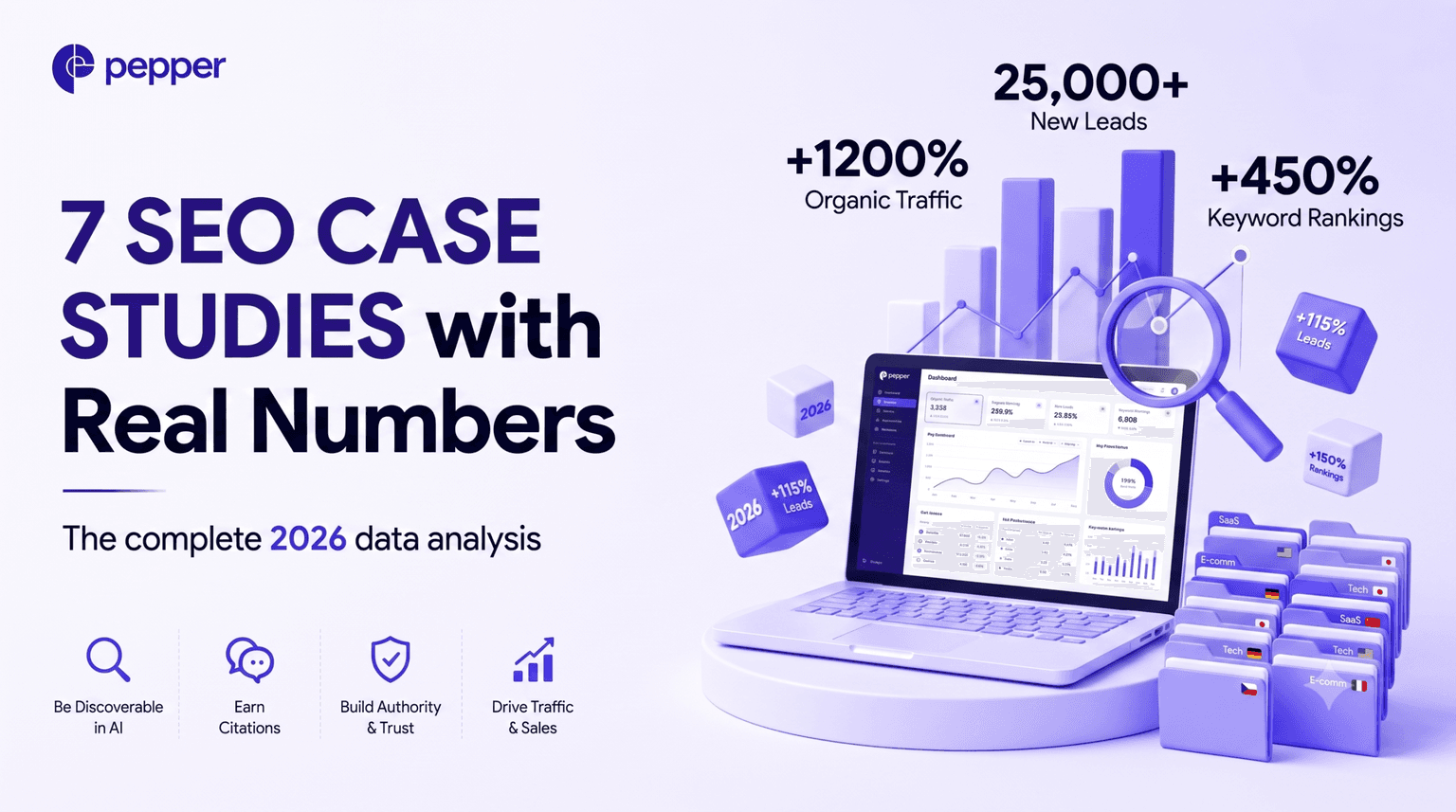
Most SEO case studies are unreadable for the same reason. The client is anonymous, the percentage has no baseline, and the timeframe is missing. So a “1,937% increase in organic traffic” for “a leading B2B SaaS company” tells you nothing. After all, 1,937% of a very small number is still a small number.
So here is the standard we held ourselves to. Every case study below names the company, names the person who ran it, and gives the starting figure alongside the finishing one. All of them are published on the client’s own case study page, which means you can check them rather than take our word for it.
There are seven, not seventy. We have run organic for more than 250 enterprises across eight years. However, these are the only engagements where the client agreed to publish specific numbers. That is the honest constraint. And we would rather show you seven you can verify than a longer list you cannot.
A note on all case study figures, ours and everybody else’s. These numbers are reported by the companies that ran the work. We can show you what was published and who said it. Nobody, including us, can independently audit another company’s analytics. Read every case study in this category with that in mind, including this one.
The seven at a glance
| Company | Industry | Market | Headline result | The actual problem |
|---|---|---|---|---|
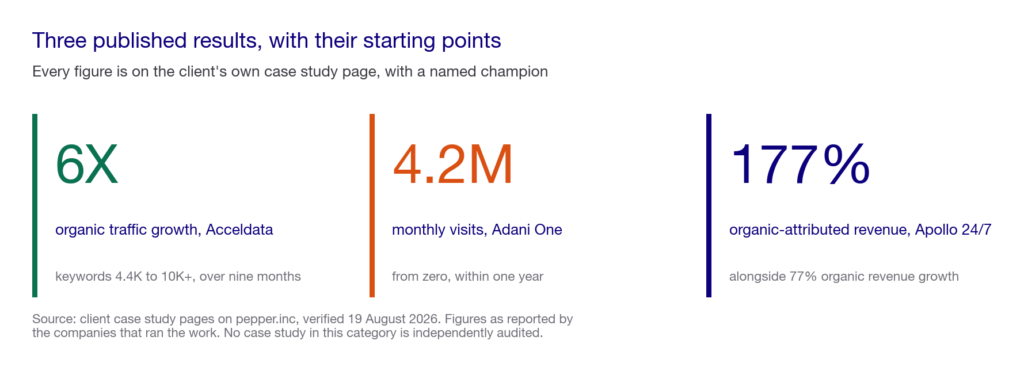
| Acceldata | Data observability software | US, enterprise | 6X organic traffic in 9 months | A rival with an eight-year head start in the category |
| Apollo 24/7 | Healthcare | India, enterprise | 177% increase in organic-attributed revenue | Content stuck at blogs and social, no funnel coverage |
| Adani One | Travel | India, enterprise | 4.2 million monthly visits within a year | Launching into a crowded travel market from zero |
| TVS Eurogrip | Automotive parts | India, global | Top 3 keywords 103 to 360 | A migration that cost 50% of organic traffic |
| SalesHood | Sales enablement SaaS | Self-funded | AI Overview keywords 14 to 97 | Traffic declining as search moved into AI answers |
| RVshare | Rental marketplace | US, enterprise | 10,000+ pieces across 50 states | Local content at national scale without losing quality |
| Algolia | AI search infrastructure | US, enterprise | 65% to 87% scroll depth | Technical credibility with skeptical engineering buyers |
Software and data infrastructure
Acceldata: outranking an eight-year head start
Acceldata sells data observability, and their problem was not content quality. Instead, a competitor had been defining the category for eight years. Meanwhile Acceldata had a lean marketing team and a lot of ground to make up.
So the engagement targeted bottom-of-funnel commercial keywords first, rather than chasing volume at the top. Alongside that, we ran a three-layer quality process. First, expert writers who understood data engineering. Then editorial and SEO review, followed by AI consistency checks. Meanwhile the technical side covered fixes, internal linking and continuous optimisation.
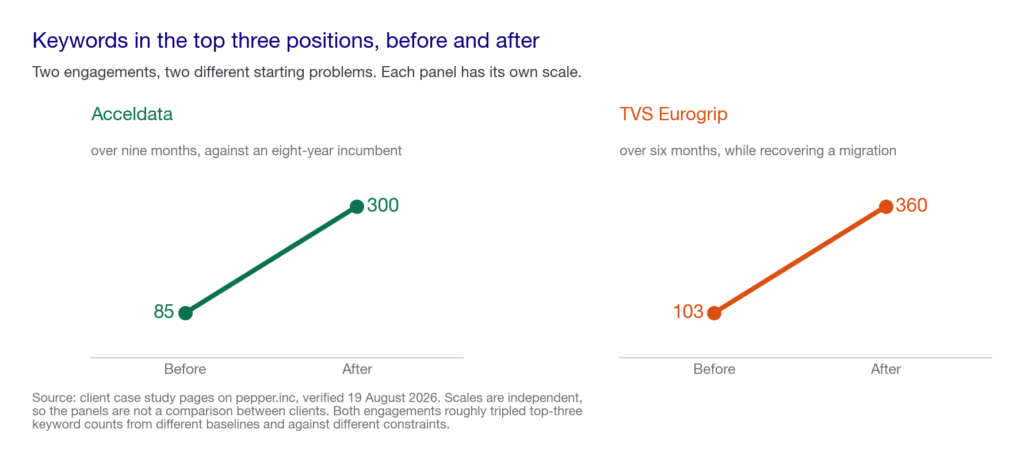
Over nine months, total ranking keywords went from 4,400 to more than 10,000. Keywords in the top three positions moved from 85 to more than 300. Organic traffic grew 6X, bringing in over 100,000 new users at a 47% engagement rate. In addition, a single hero article picked up more than 260,000 impressions.
Mahesh Kumar, Acceldata’s CMO, put the value in a way that has stuck with us: “Their ability to hone in on a specific topic that really resonates and draw people in was absolutely critical for us.” He also described the second-order effect, which rarely shows up in a dashboard. “The perception of our prospects, who see us more often, goes up in a very positive way.”
That last point matters for how you read the traffic number. Six times the traffic is the measurable outcome. But being the company a buyer has already seen three times before the first call is what closes deals.
Algolia: writing credibly for engineers
Algolia is unusual on this list because the headline is not a traffic number, and we have included it deliberately for that reason.
They serve more than 18,000 customers across 150 countries. At the time they were evolving their positioning from AI search toward a broader platform story. However, the audience is technical and genuinely skeptical, and the internal subject matter experts were already stretched.
So the work was about credibility rather than volume. We deployed writers fluent enough in the technology to interview engineers properly. Then we ran the full content lifecycle, so internal experts spent hours rather than weeks. Published pieces held 65% to 87% scroll depth. For long technical whitepapers, that is a strong signal the audience actually read them.
Tariq Z. Khan, Director of Content Marketing, described what he was buying: “Pepper didn’t just write, they acted like a thought partner, bringing an audience lens into the process and helping stress-test how the story would land with technical buyers.”
We include this one because an honest case study library needs engagements where the win was not a ranking. After all, if every case study in a portfolio has the same shape, somebody is choosing which ones to publish.
SalesHood: a GEO recovery, not an SEO one
SalesHood is the most current story here, and the one most likely to describe your next two years.
They are self-funded and competing against much better-resourced rivals. Meanwhile their traffic was declining, despite content that had historically performed. Elay Cohen, their CMO, named the problem precisely: “Traffic was declining, we realized the world of GEO and AEO was happening without us.”
So the work looked different from classic SEO. Alongside 20 new blogs and 8 refreshed articles, we ran website and content audits and resolved 10 technical SEO issues. We also completed an EEAT audit, implemented FAQ schema, and optimised for AI Overview visibility using Atlas. Finally there were Reddit, YouTube and podcast strategies, because those are surfaces engines lean on.
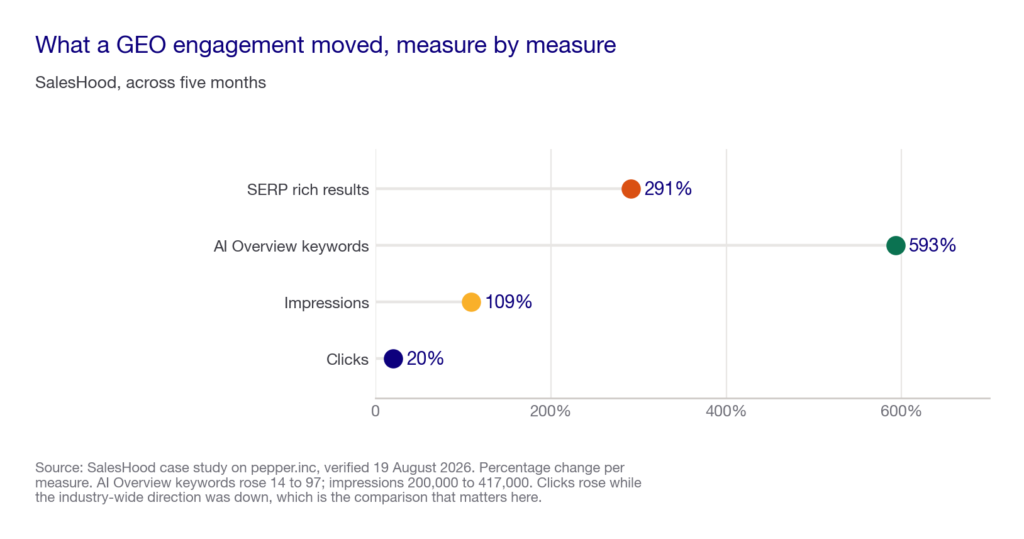
The results say something specific about how AI search visibility behaves. Impressions doubled from 200,000 to 417,000. Keywords appearing in AI Overviews went from 14 to 97, a 593% increase. SERP rich results grew 291% in five months. Clicks rose 20%, which is notable mainly because the industry-wide direction was down.
Individual keyword movements show the mechanism. “Sales Enablement Meaning” went from rank 101 to rank 1. “AI Sales Enablement Platform” went from 4 to 1. “Sales Enablement” went from 71 to 8.
Cohen’s summary was blunter than anything we would write ourselves: “This is more than an agency, more than technology. Move fast and dominate.”
Healthcare
Apollo 24/7: content across an entire consumer funnel
Apollo 24/7 is one of India’s largest digital healthcare platforms. Here the constraint was scope rather than quality. Their content lived in blogs and social media, while the audience needed accurate information across the whole journey from symptom to consultation.
The diagnostic alone shows what enterprise healthcare content involves. First we ran a refresh analysis across more than 50,000 pages, finding gaps and repurposing opportunities. Then we built an on-demand network of over 100 healthcare specialists, because medical content cannot be written by generalists.
The most interesting part was the thought leadership programme built around 400 Apollo doctors. Output included 400 thought leadership blogs, hundreds of YouTube videos, 4,000 Google Business Profile posts and 200 articles authored by doctors themselves.
Organic traffic rose 200% and new users grew 2.5X. Impressions increased 23X and video reach 16X. The numbers that matter commercially: organic revenue grew 77% in a year, revenue attributed to organic search rose 177%, and month-on-month revenue growth averaged 15%.
Himanshu Sirohi, Head of Digital Marketing, highlighted something operational rather than strategic: “Pepper brings the entire team together. All of them have access to the platform. That makes project management very easy for us.” At this volume, coordination is the constraint, and platform access is what keeps 100+ specialists producing consistently.
Travel and marketplaces
Adani One: from zero to 4.2 million monthly visits
Adani One launched into Indian travel, which is about as competitive as consumer categories get, with no organic footprint at all.
Programmatic content at this scale usually produces thin pages that compete with each other. So avoiding that took an 800-person network of travel subject matter experts. As a result, pages carried real detail rather than templated filler. We built more than 20,000 flight information pages with itinerary planning content, curated 7,000 listicles covering flights and regional attractions, and developed travelogues spanning transport, food and hotels. More than 10,000 content pages were delivered in total, integrated with a custom CMS.
Traffic rose 1.4X within three months, growing at 31.47% month on month. Within a year the platform reached 4.2 million monthly visits, including 100,000 organic visits per month, with more than 37,000 keywords ranking in the top 50.
Nitin Sethi, Chief Digital Officer at Adani Digital Labs, summarised it as going “from zero to 4.2 million monthly visits, powered by expert-written pages and an 800-strong travel SME network.”
RVshare: local content at national scale
RVshare runs a peer-to-peer RV rental marketplace, and their challenge was geographic. Renting an RV in Montana is a different proposition from renting one in Florida, so national content does not serve either.
Over a partnership of more than two years, we delivered more than 10,000 content pieces. That meant designing around 250 new pages a month, with a team of over 50 writers and editors. Meanwhile Pepper Docs handled factual verification, and the client reported a 10x productivity increase using Pepper AI.
Martijn Scheijbeler, SVP Marketing, described the requirement as “authentic content at scale,” which is the tension every marketplace faces. “Pepper is helping us with really great content across the entire United States and create local content, for all of these types of destinations.”
We should be straight about this one. RVshare’s published case study reports volume, productivity and qualitative SEO improvement rather than a traffic multiple. We have not invented one to make the entry match the others.
Automotive
TVS Eurogrip: recovering a migration that lost half the traffic
This is the case study we point at most often, because migration damage is the most common emergency in enterprise SEO and the recovery pattern is instructive.
TVS Srichakra’s Eurogrip brand went through a domain migration and brand transition. Kavitha Ganesan, Head of Brand Marketing, described the result plainly: “We actually saw a 50% drop in organic traffic right after migration, and a lot of drop.” E-commerce orders fell with it.
So recovery ran in sequence rather than in parallel. Technical stabilisation came first, because there is no point building content on a broken foundation. Then came a content-led SEO engine producing more than 200 blogs. After that, non-brand keyword optimisation, Google Merchant Center expansion from around 20 products to more than 120, and off-page authority work.
Between May and December, monthly clicks rose 8,592% and impressions passed 410,000. Traffic recovered to 70% of pre-migration levels, reaching 74% by December. Top three keywords went from 103 to 360 and top ten keywords from 344 to 1,010, a 200% increase in top-three visibility for non-brand terms in six months. Blog traffic from non-brand keywords grew 100x. On the shopping side, clicks rose more than 3,000%, impressions more than 7,000%, and website orders 10x.
Ganesan’s framing is the one we would want any client to hold: “For us, it’s always the right traffic that matters.” Recovering volume is straightforward. However, recovering the traffic that converts is the actual job. That is why the non-brand keyword work mattered more than the headline percentage.
What these seven have in common
Reading across them, four patterns hold, and they are more useful than any individual number.
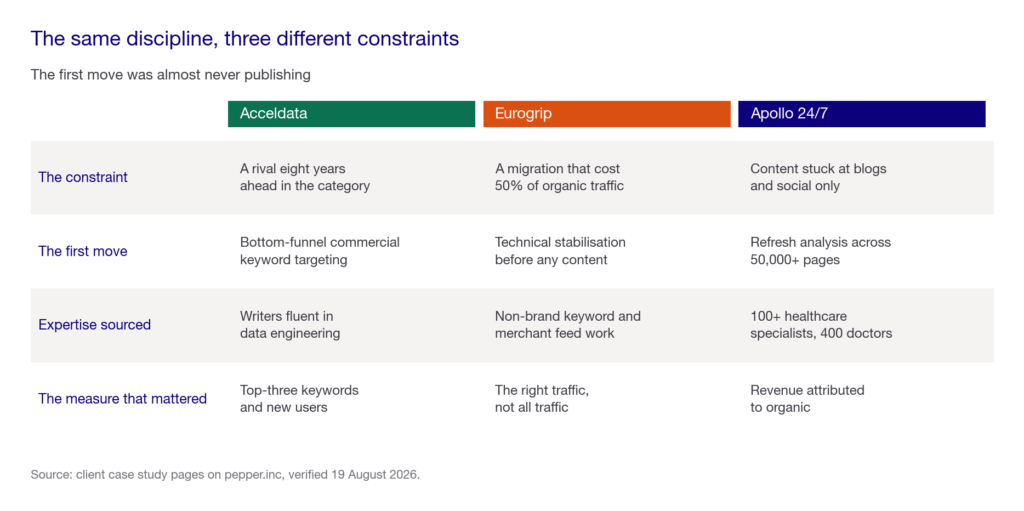
The first move was almost never publishing. Acceldata started with commercial keyword targeting. Eurogrip started with technical stabilisation. Apollo started with a 50,000-page refresh analysis. SalesHood started with audits. Volume came later, once there was something worth pointing it at.
Expertise was sourced, not assumed. 100+ healthcare specialists for Apollo. 800 travel SMEs for Adani. Writers fluent enough to interview engineers for Algolia. In categories where the reader can tell whether the writer knows the subject, generalist content does not perform, and every one of these engagements solved that with people rather than tooling.
The timeframes were quarters, not weeks. Acceldata’s 6X took nine months. Eurogrip’s recovery ran May to December. Adani hit 4.2 million monthly visits within a year. RVshare ran over two years. Anyone promising this in a quarter is describing paid media.
The measure that mattered differed every time. Apollo measured revenue. Eurogrip measured the right traffic rather than all traffic. SalesHood measured AI Overview presence. Algolia measured scroll depth. A single universal KPI would have misread at least three of these engagements.
How to read any SEO case study, including this one
The category has a credibility problem, and a few questions filter most of it quickly.
First, ask what the starting number was. A percentage without a baseline is unfalsifiable. For example, “1,937% growth” from a base of 300 monthly visits is a rounding error dressed up as a result.
Then ask who the client is. Anonymous case studies cannot be checked. Sometimes the reason they are anonymous is that the client would not endorse the claim.
Next, ask over what period. Nine months and nine weeks are different products. Case studies frequently omit the timeframe because it is unflattering.
Also ask what else was running. Organic rarely moves in isolation. So if a brand campaign or a funding announcement ran concurrently, the honest case study says so.
Finally, ask what did not work. Every real engagement has something. A case study with no friction in it has been through marketing rather than through a client.
Frequently asked questions
How many SEO case studies does Pepper publish?
Seven, each on the client’s own case study page with named champions and published figures. We have run organic for more than 250 enterprises over eight years, but these are the engagements where clients agreed to publish specific numbers.
What is the strongest result in these case studies?
Depends what you measure. Adani One reached 4.2 million monthly visits within a year from zero. Apollo 24/7 grew organic-attributed revenue 177%. TVS Eurogrip lifted monthly clicks 8,592% while recovering a migration.
How long does SEO take, based on these engagements?
Acceldata’s 6X traffic growth took nine months. TVS Eurogrip’s migration recovery ran from May to December. Adani One reached 4.2 million monthly visits within a year. RVshare ran across more than two years.
Are these numbers independently verified?
No, and neither is any case study in this category. The figures are reported by the companies that ran the work and published on their own case study pages. We can show you what was published and who said it, not audit another company’s analytics.
Which industries are covered?
Data observability software, B2B SaaS, sales enablement, healthcare, travel, rental marketplaces and automotive parts. Markets span the US and India, including one global brand programme.
Do any of these involve AI search rather than classic SEO?
Yes. SalesHood is a generative engine optimization engagement, where AI Overview keywords went from 14 to 97 and rich results grew 291% in five months. It is the clearest published example of what the work looks like now.
What happened with the TVS Eurogrip migration?
A domain migration and brand transition cost roughly 50% of organic traffic. Recovery sequenced technical stabilisation first, then content and off-page authority, reaching 74% of pre-migration levels by December with top three keywords up from 103 to 360.
Why publish a case study with no traffic number?
Because Algolia’s engagement was about technical credibility rather than volume, and portfolios that only show traffic multiples are selecting for one kind of win. Scroll depth of 65% to 87% on technical whitepapers is the honest measure there.
Where to go next
If you are benchmarking, the useful comparison is not the headline multiple. It is the starting position. Acceldata was fighting an eight-year incumbent, while Eurogrip was recovering from a migration and Adani was starting from nothing. So find the one whose starting position resembles yours, then read that one closely.
Every case study above is published in full, with the numbers we have quoted: Acceldata, Apollo 24/7, Adani One, TVS Eurogrip, SalesHood, RVshare and Algolia.
If your situation looks like SalesHood’s, where traffic is falling because search is moving into AI answers, the mechanics are covered in our guide to what actually matters in AI search measurement. If it looks like Eurogrip’s, the enterprise playbook covers migration sequencing and governance. For B2B SaaS specifically, our B2B SaaS industry work goes deeper on the vertical.
To see where you currently stand before committing to anything, book a growth audit and we will run your category’s prompt set against the sources winning those answers today. Customers run this themselves inside the platform, with a growth team attached to do the work alongside them.
One honest closing note. Every engagement above involved a client who could act on what we found. If your organisation cannot currently ship a content or technical change inside a quarter, none of these results are reachable for you yet, whoever you hire. Fix that first, and we would rather say so now.
Sources
All case study figures were taken from each client’s own published case study page on pepper.inc, verified on 19 August 2026. Figures are as reported by the companies that ran the work.
- Acceldata: 6X organic traffic, keywords 4.4K to 10K+, top three 85 to 300+, 100K+ new users at 47% engagement, 260K+ impressions on one article, nine months. Champion: Mahesh Kumar, CMO.
- Apollo 24/7: 200% organic traffic, 2.5X new users, 177% organic-attributed revenue, 77% organic revenue growth in a year, 15% average month-on-month growth, 23X impressions, 16X video reach. Champion: Himanshu Sirohi, Head of Digital Marketing.
- Adani One: 4.2 million monthly visits within a year, 1.4X traffic in three months, 31.47% month-on-month growth, 100,000 organic visits monthly, 37,000+ keywords in the top 50, 10,000+ pages. Champion: Nitin Sethi, Chief Digital Officer.
- TVS Eurogrip: 8,592% increase in monthly clicks May to December, 410,000+ monthly impressions, top three keywords 103 to 360, top ten 344 to 1,010, 74% of pre-migration traffic by December, GMC clicks +3,000%, orders 10x. Champion: Kavitha Ganesan, Head of Brand Marketing.
- SalesHood: impressions 200,000 to 417,000, AI Overview keywords 14 to 97, rich results +291% in five months, clicks +20%. Champion: Elay Cohen, CMO.
- RVshare: 10,000+ content pieces, 50+ experts, 250 pages monthly, 10x productivity with Pepper AI, two-year partnership. Champion: Martijn Scheijbeler, SVP Marketing.
- Algolia: 65% to 87% scroll depth, 18,000+ customers across 150 countries. Champion: Tariq Z. Khan, Director of Content Marketing.
Latest Blogs
The research pulls in two directions. Fan-out rewards covering many adjacent questions; absorption research finds longer pages get used. The resolution is that the passage competes, not the page.
Seven documented changes, not seven predictions. Google switched two rich results off, shipped two new AI reports, and added a channel to Analytics. Here is what actually moved and what it means.
Content chunking is the process of splitting a page into smaller pieces so a machine can retrieve one of them. Here is the part most articles get wrong: chunking is something engines do to your page, not something you do to it. You do not choose the chunk size.
Get your hands on the latest news!

Similar Posts
SEO
11 mins read
What is internal linking? Meaning, and what changed for AI search
SEO
15 mins read
Primary and secondary keywords in 2026: what they were always for, and what changes now
Content Creation
11 mins read