

Platform feature · AI visibility and tracking
Know exactly where you showup in AI search.
Pepper runs your buyers' prompts through ChatGPT, Gemini, Claude, Perplexity, Copilot and Google AI Overviews every day. It records which brands each answer mentions and which pages each answer cites, so you can see how often that's you and how often it's a competitor.
Domain Prompt Presence
How often AI answers cite a page from your domain.
Change vs. last period
Every number compared against the period before.
Daily trend
Your prompts re-run every day across six engines.
Brand Visibility
How often AI answers name your brand.
Out of sight, out of the shortlist.
When a buyer asks ChatGPT which tools to consider, the answer mentions a few brands and cites a few pages. Rank tracking doesn't tell you whether you were one of them, because ranking on Google and getting named in an AI answer are two different things. Pepper asks those questions every day and records what comes back.
How it works
From one prompt to three numbers.
Every AI answer gets checked for whether it names your brand, whether it cites a page from your domain, and which other brands show up.
STEP 01
→
Your buyers’ prompts
The questions your buyers ask AI about your category.
STEP 02
→
Run every day
Each prompt goes to ChatGPT, Gemini, Claude, Perplexity, Copilot and Google AI Overviews.
STEP 03
→
Every answer recorded
Which brands each answer mentions and which pages it cites.
STEP 04
→
Three numbers
Brand Visibility, Domain Prompt
Presence and Share of Voice.
Metric
What it measures
What it tells you
01
Brand Visibility
The percentage of prompt runs where the AI answer mentions your brand by name.
How often you get mentioned.
02
Domain Prompt
Presence
The percentage of prompt runs where the AI answer cites at least one page from your domain.
How often you get cited.
03
Share of Voice
Your share of all brand mentions in those answers, including brands you don't track.
How you compare to every brand that came up.
Reading them together
If your brand is mentioned often but your pages are rarely cited, another site is supplying the answer. Usually that's a review site, a listicle or a competitor's page. Pepper shows you which pages those are, so your team can write better ones.
Inside the dashboard
Five views of the same data.
Pick a view to see what it shows. Each one reads from the same daily prompt runs.
01
Overview
Track mentions and
citations by engine.
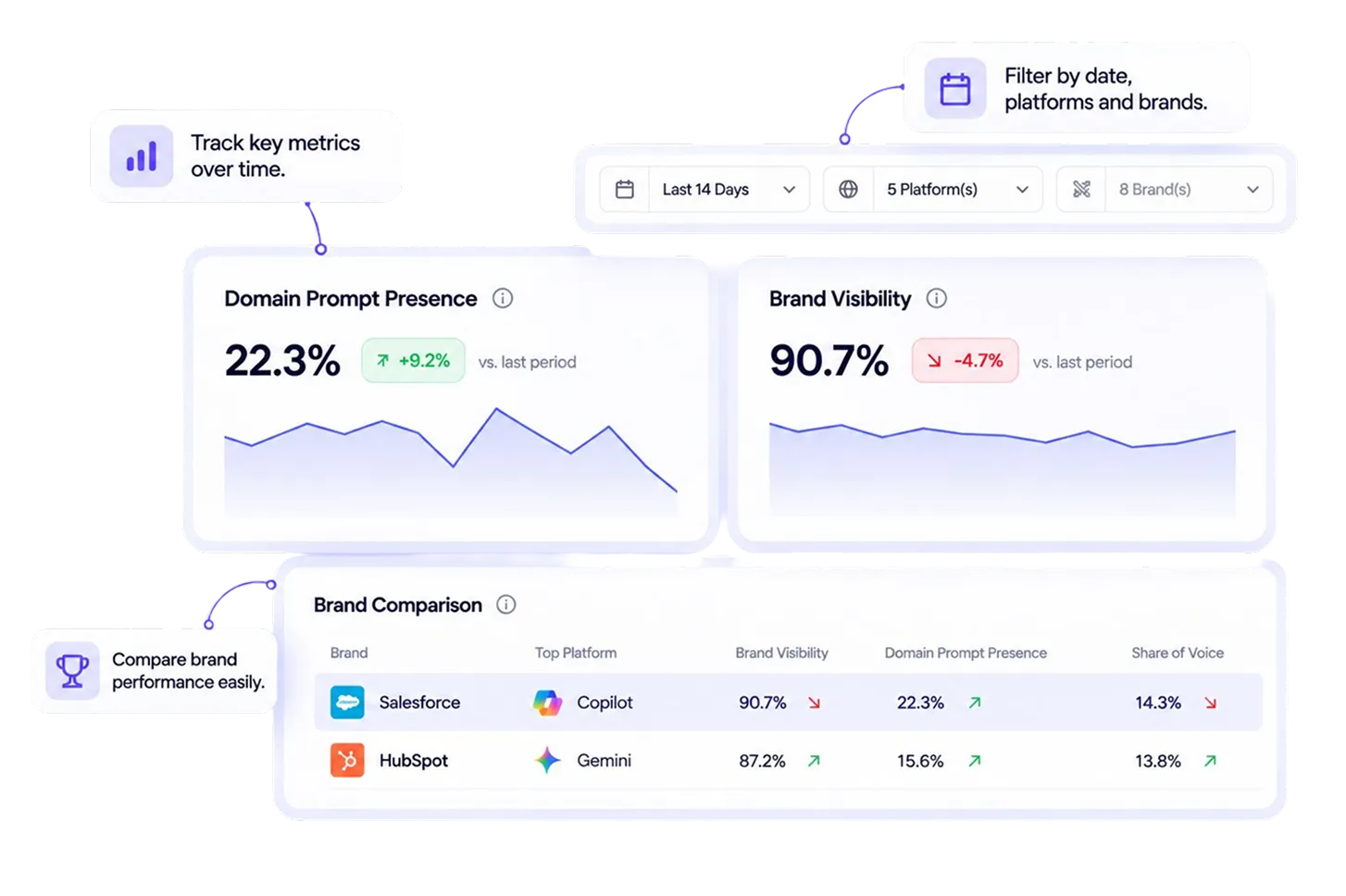
The overview shows Brand Visibility and Domain Prompt Presence for the period you select, the change against the period before it, and both numbers broken
out by engine. Underneath, a feed of the most recent answers that mentioned your brand.
02
Citation analysis
See which pages get cited.
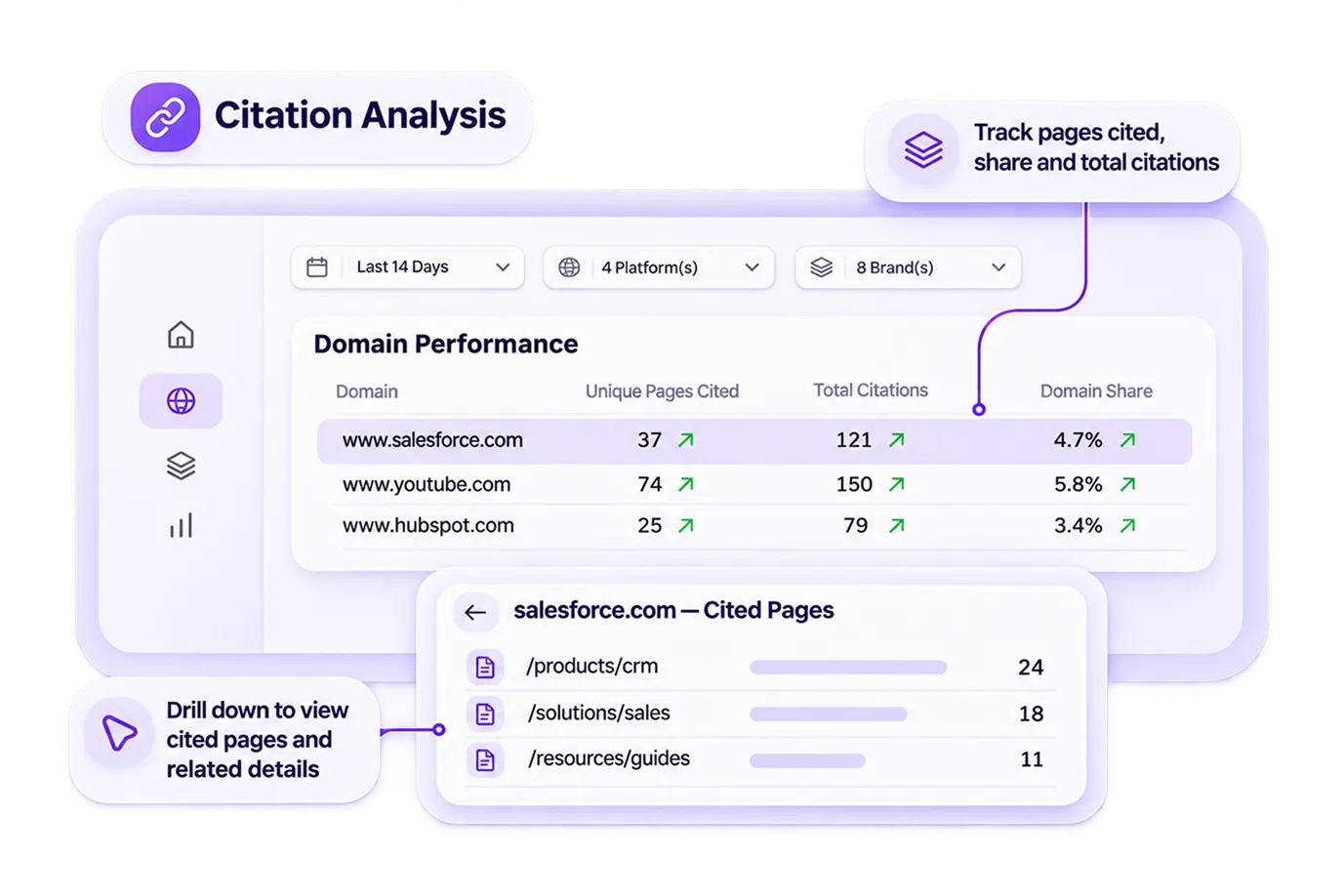
Citation Analysis lists every domain cited in answers to your prompts, with how many of its pages were cited and its share of all citations. Click a domain to see those pages. Click a page to see the prompts that cited it, which engine, and on what date.
03
Theme analysis
Find the topics
you're losing.
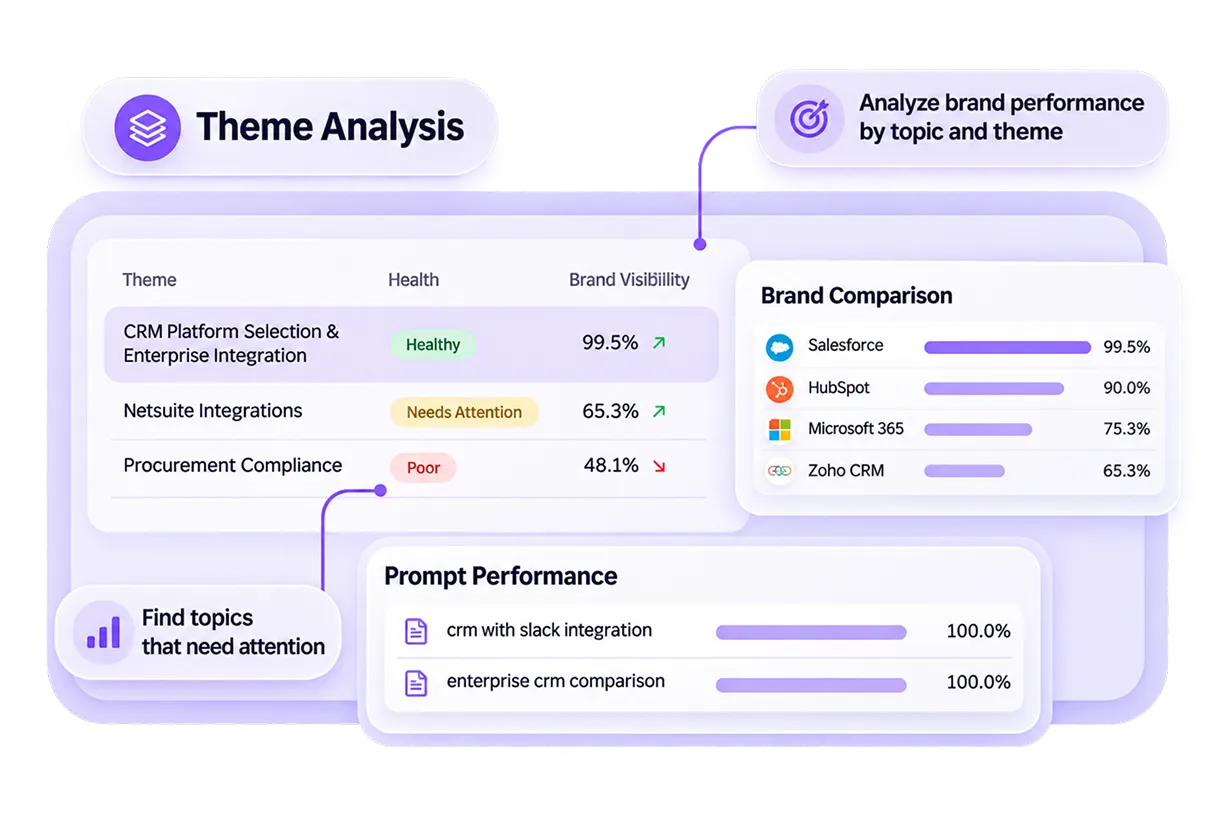
Theme Analysis groups your prompts by topic. Each theme shows your Brand Visibility for that topic, how it compares to the average of every brand appearing
there, how many brands compete in it, and which brand is mentioned most.
04
Prompt analysis
Read the exact answer.
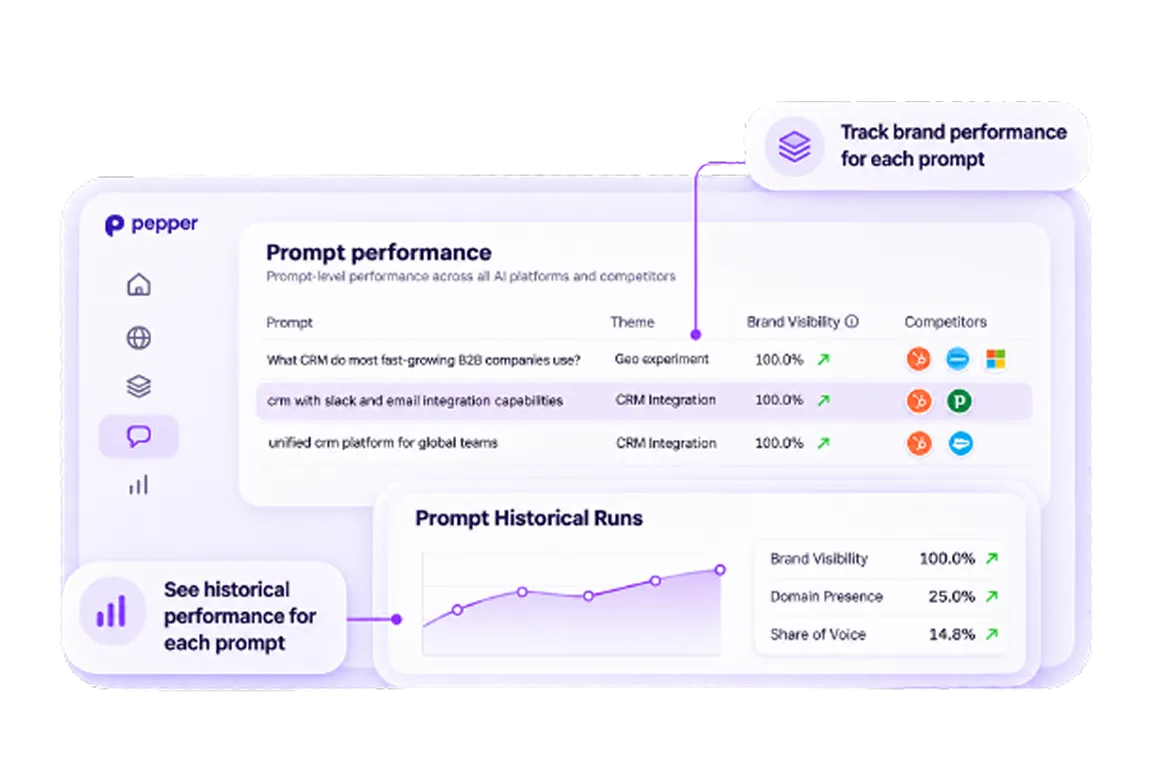
Prompt Analysis shows Brand Visibility for each individual prompt and names every competitor that appeared in it. Open any run to read the full AI response word for word, with every source it cited, which engine produced it, and the date.
05
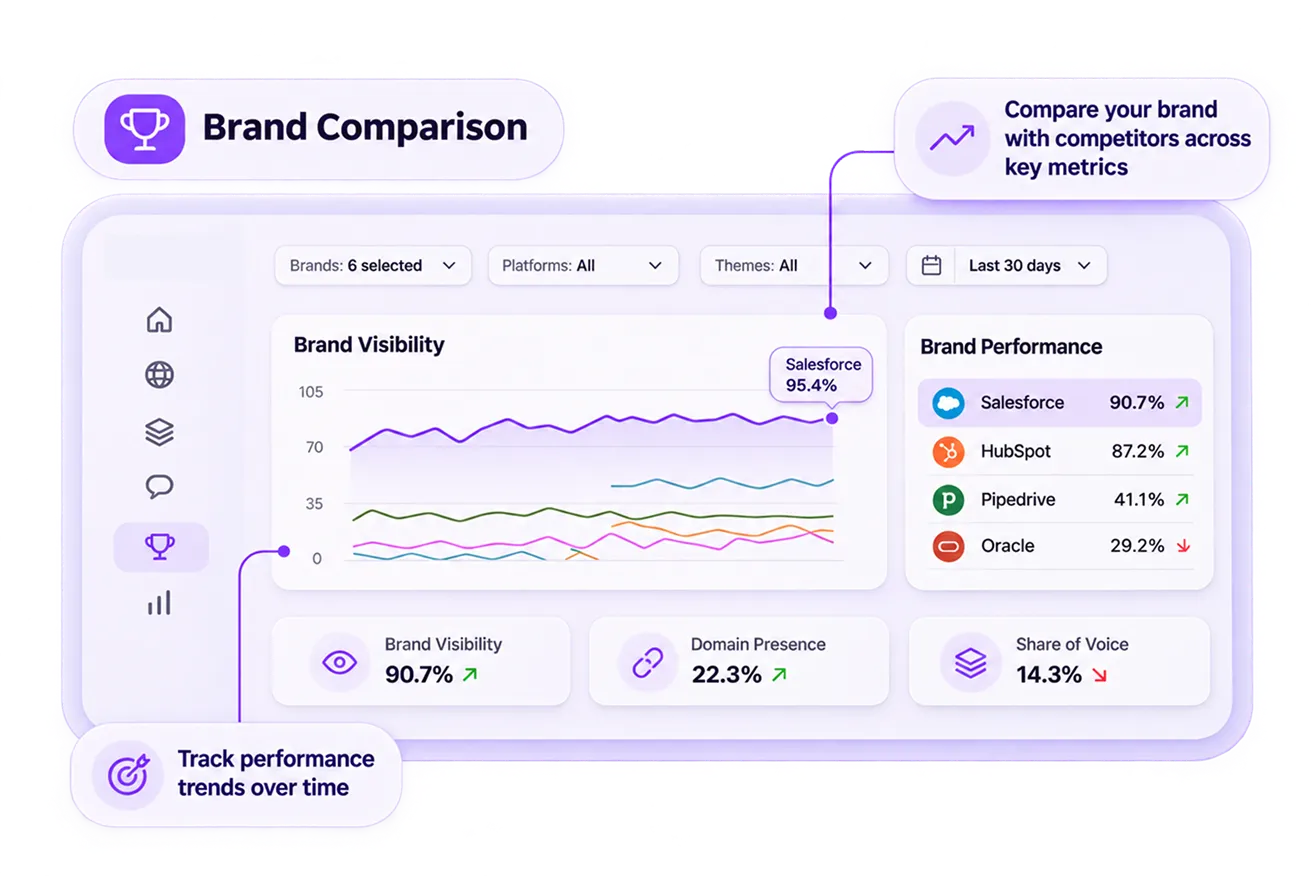
Brand comparison
See who's beating you,
and on which number.
Every competitor you track is listed with the same three numbers, and the highest on each is flagged. Brands you haven't added appear too, whenever an AI answer to one of your prompts mentions them.

What happens next · Agent Atlas
Knowing is the cheap part
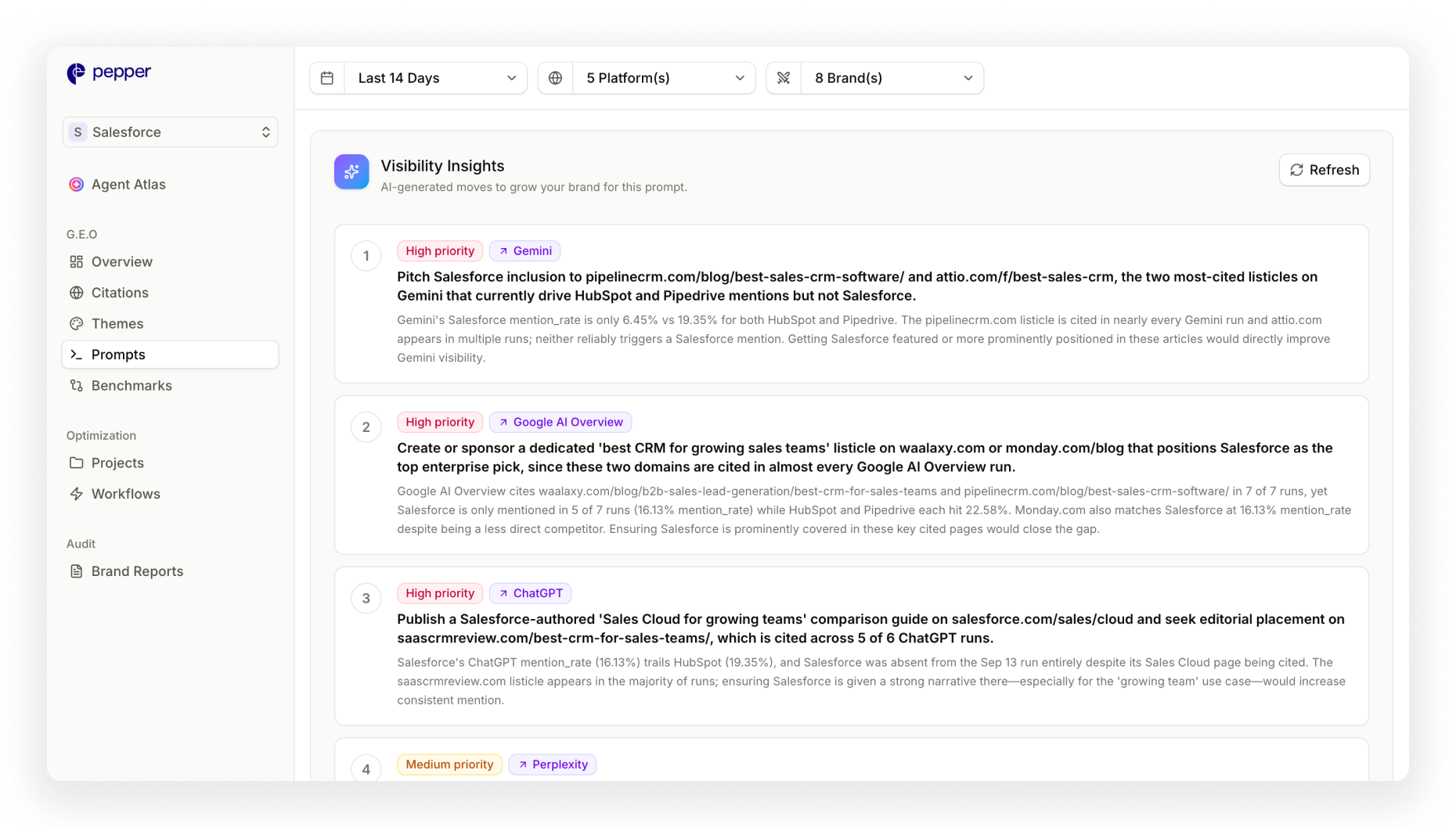
Ask Agent Atlas which pages to fix this quarter, why a number dropped, or where the biggest opportunity is. Each recommendation names the action, the pages it applies to, the workflow that carries it out, and what you get back.
Explore Agent Atlas
Numbers our customers put their name to
Numbers our customers
put their name to




More from the Pepper platform.
← Platform overview
Frequently Asked Questions
Agent Atlas is the chat layer of the Pepper platform, and it acts rather than answers. It diagnoses what changed, ranks pages by AI-visibility upside, benchmarks you against competitors, runs Workflows such as audits, briefs and reporting, and compiles reports for leadership. You ask Atlas instead of managing several agents.
Pepper measures your visibility daily across ChatGPT, Gemini, Perplexity and Google AI Overviews. Results are tracked per engine, per prompt and per day, so you see exactly where your brand appears and where it does not.
Every day. Your tracked prompts run against every supported engine daily, so the trend lines are built from daily runs rather than periodic snapshots. First results land within minutes of setup.
Every metric traces back to a verbatim AI response captured on a specific date, so you can open the actual answer behind any number. Pepper does not report a single blended score, because the same prompt run repeatedly returns different answers.
Atlas runs around the clock across every engine and surface Pepper tracks for you. It reads, executes and reports the work that should not need a human, and it reaches out whenever human judgement is needed. Senior strategists direct it.
Pepper does, alongside you. A forward-deployed team of senior strategists, people who work inside your team rather than at arm's length, run it day to day and own the number. You have full access to the same data and reports whenever you want them.

For businesses playing the long game, Pepper turns your earned authority visible to search & AI, making
organic growth winnable again.
Get a strategy presentation with real projections before you sign up.
i
*the long game is not about waiting.
It is about building something that keeps winning after everyone else's quick win wore off. And you will see it work within a quarter.