

Sentiment
Your brand is what AI says when you're not in the room.
Every day, Pepper runs your buyers' prompts through ChatGPT, Gemini, Perplexity, Claude, Copilot and Google AI Overviews, then reads what comes back. Each answer is broken into separate claims, scored positive, neutral or negative, and filed by topic. So you can see how the engines describe you and your competitors, and whether it is getting better.
Net sentiment score
Positive against negative on a 0 to 100 scale, and which way it moved.
Positive share
How much of what the engines say about you is positive.
Harshest engine first
The platform breakdown puts the most negative engine at the top.
Claims behind each score
How many separate claims each engine’s score is built on.
Being named is not the same as being recommended.
The same engine that calls you the safer choice for regulated teams can call you the pricier option in the category. Plain visibility counts both the same. Sentiment reads every answer and scores what it actually says about you.
How it works
What the engines judge you on.
Sentiment reads what the AI engines say about you and scores it good, neutral or bad. The useful part is how it is organised. Every judgement is filed under a narrative, a topic the engines keep raising about your category, like pricing or quality. The same narratives come up for you and for every competitor, so a narrative is where you actually win or lose.
Term
What it is
What it tells you
01
Narrative
A topic the engines judge brands on, like pricing or quality. The same narrative holds claims about you and your competitors, so everyone is scored on the same topic.
Where you win and where you lose.
02
Claim
A single thing an AI answer says about one brand. Pepper keeps the exact sentence it came from right next to it.
The unit everything is counted in.
03
Net sentiment score
Your positive and negative share on a 0 to 100 scale. Neutral claims dilute both shares without moving the score.
How positive or negative the engines are overall.
The score sits on a 0 to 100 scale. Fifty is balanced, above fifty leans positive, below fifty leans negative. Neutral claims dilute both shares without moving it. The exact formula is in the FAQ below.
Each answer is split into sentences. For every brand it names, the model pulls out each distinct claim, the exact sentence it came from, whether it is positive, neutral or negative, and the narrative it belongs to. Every quote shown in Atlas is the engine's own words, checked against the original answer, so any score can be read back to the sentence behind it.
Inside the dashboard
What you see.
01
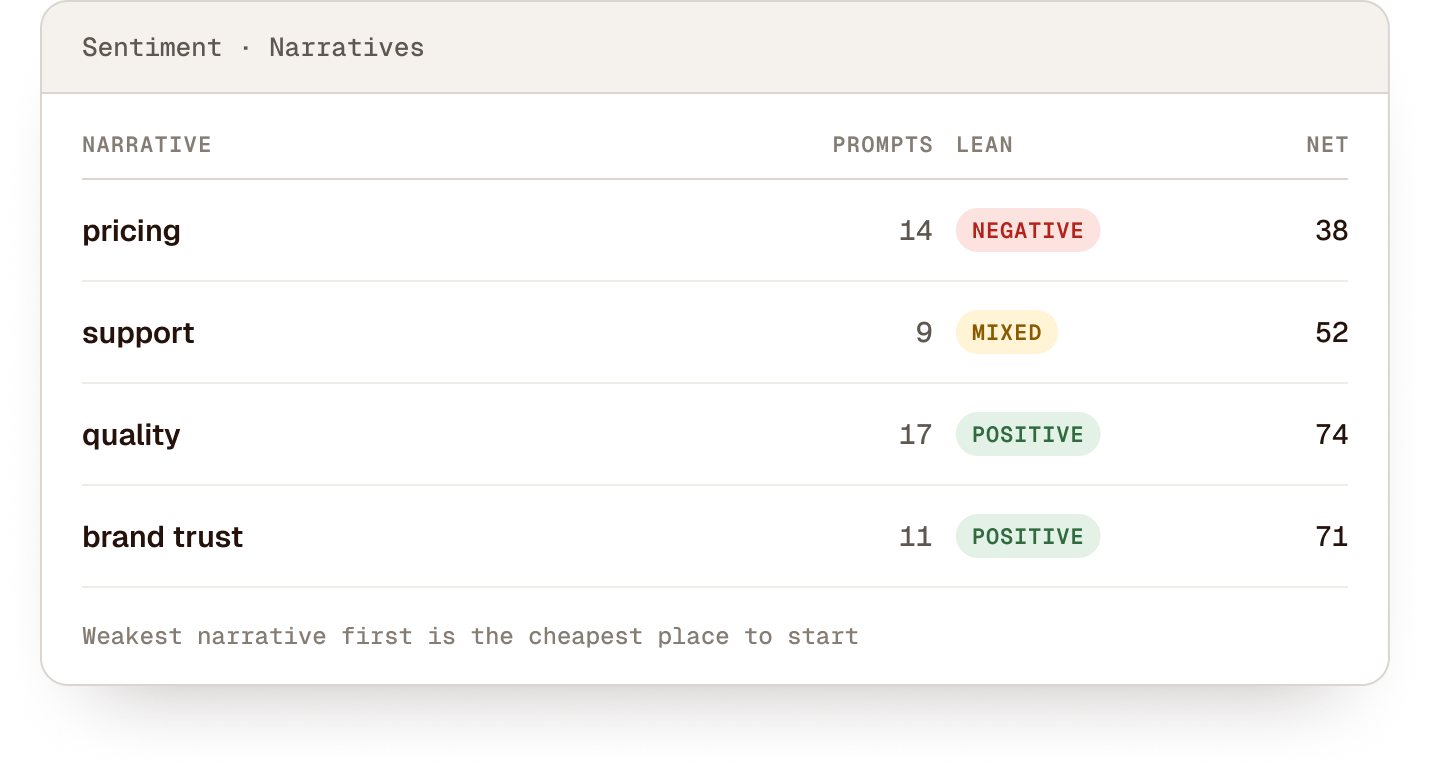
Narratives
Find the topics you win
and the ones you lose.
Narratives are the topics the engines keep judging your category on. Each one shows how many buyer questions raise it, how many claims it holds, and whether those claims lean good or bad. They are ranked weakest first, so the topic costing you most sits at the top.
02
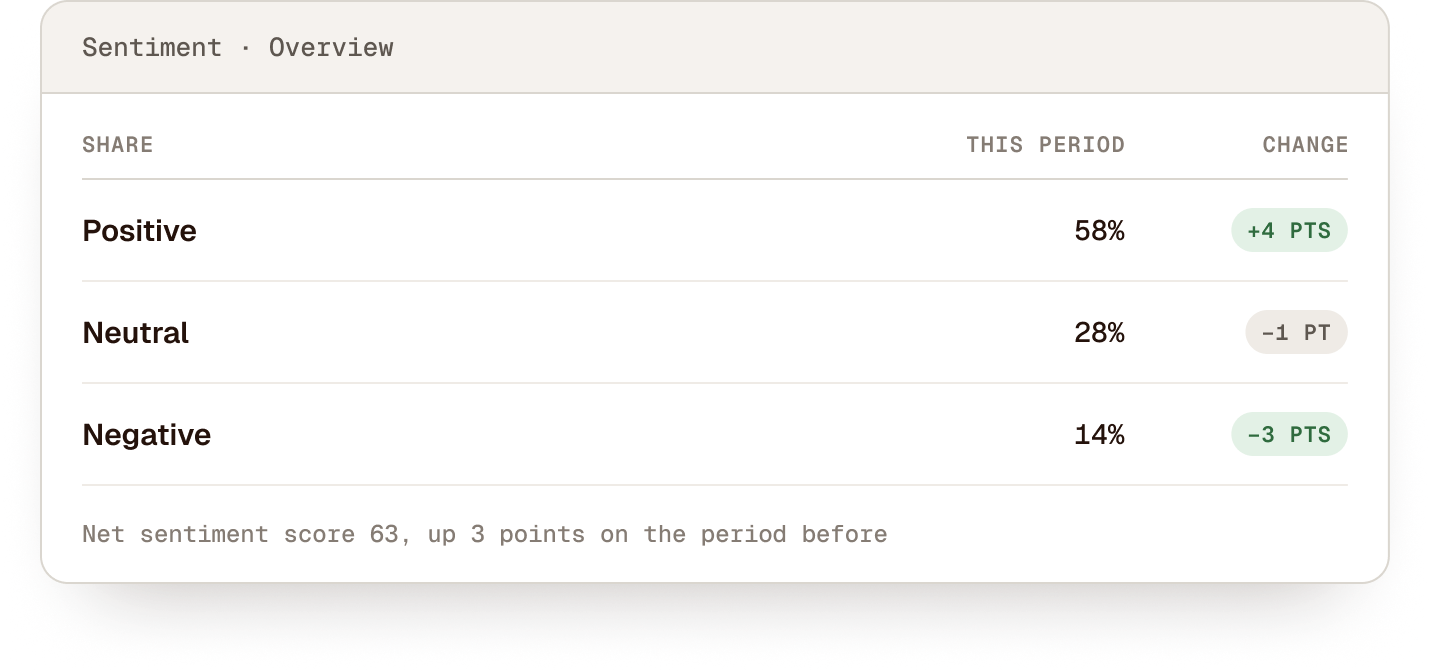
Overview
See the whole picture, and which way it is moving.
The overview rolls every narrative into one net sentiment score, with your positive, neutral and negative share and the trend across the period. Underneath, the same numbers split by engine, harshest first.
03
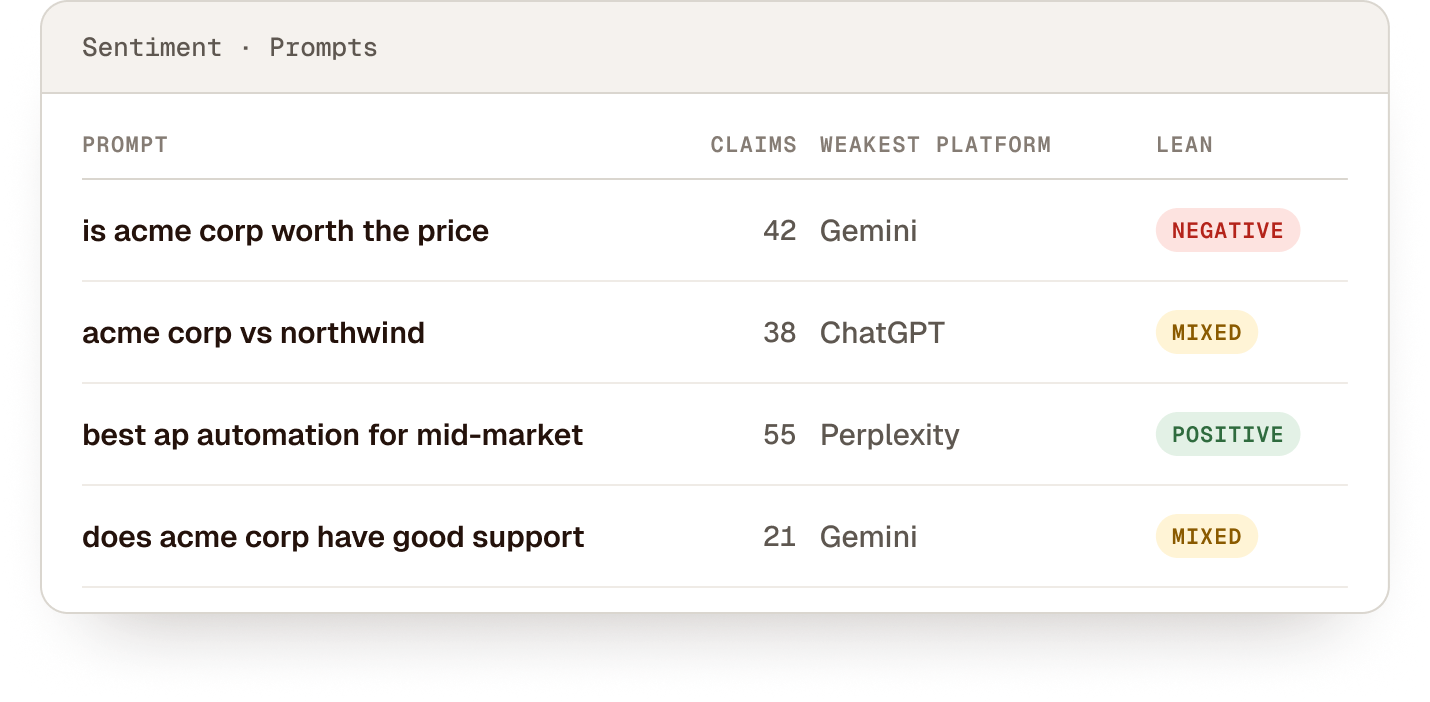
Prompts
Find the buyer
questions that hurt you.
Every prompt is listed with how many claims it produced, its positive to negative split, and the platform that answers it worst, most discussed first. This is the exact question your buyer typed, so you can see which ones lead the engines to say something bad.
04
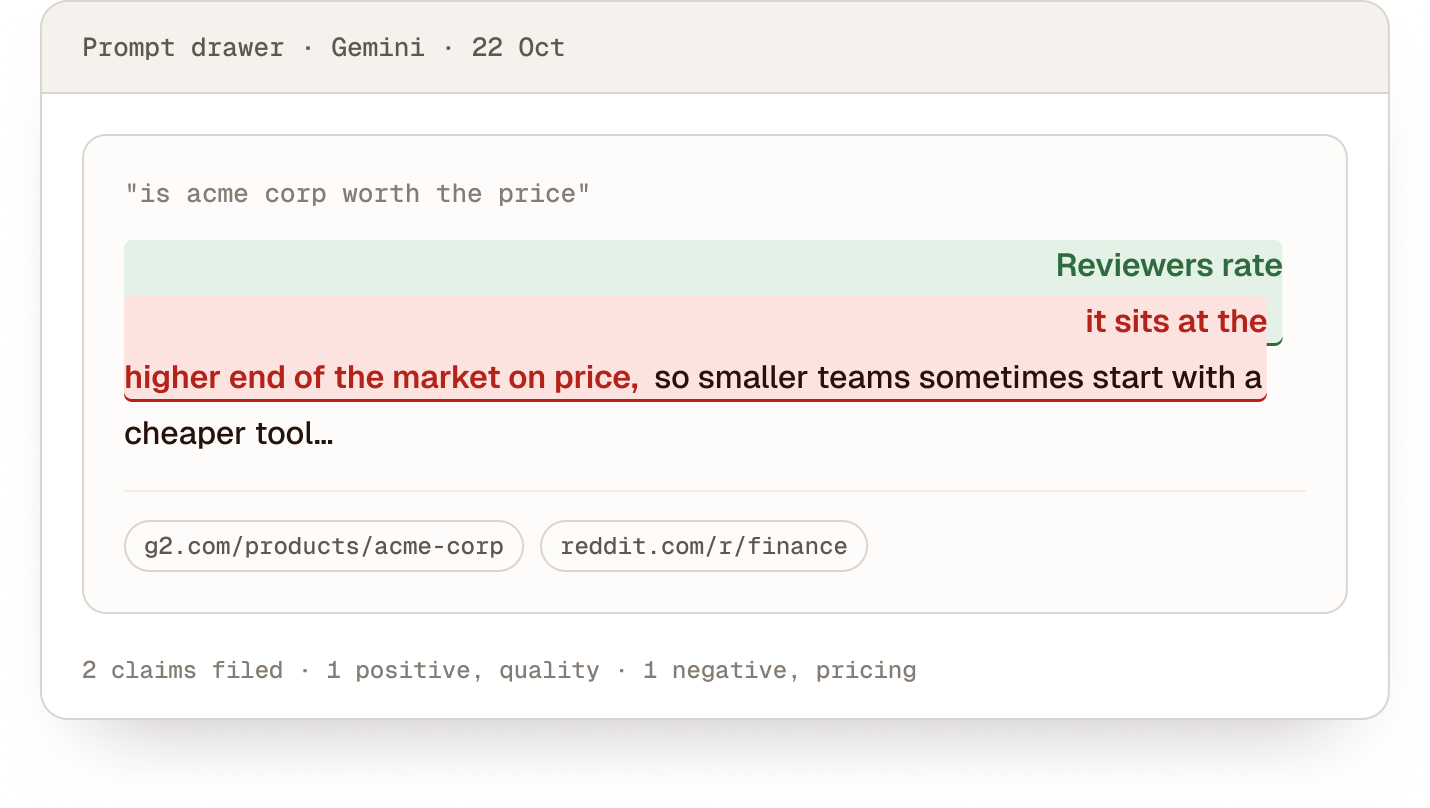
Prompt drawer
Read the exact words,
scored in place.
Open any prompt to read the latest answer from each engine, with every claim highlighted in the engine's own prose. Positive claims in green, negative in red, so you see exactly what was said and why the score moved.
05
Competitors
See how you are described next to the brands you compete with.
Because narratives are shared across brands, every competitor is scored on the same topics as you. The comparison shows each brand's claims, its positive to negative split and its net score, so you see who is described better and on which topic.
What you get out of it.
Sentiment turns AI answers into a brand-perception report you can check down to the sentence. Here is what that gives your team.
01
A score you can stand behind
See how the engines describe you overall, which way it is heading week on week, and which engine is harshest.
02
The cheapest fix, first
Topics are ranked weakest first, so your effort goes to the perception costing you most, not a guess.
03
The questions doing the damage
See the exact buyer questions that pull a bad answer, so your next piece of content goes straight at them.
04
The words and sources behind every number
Every score traces to the engine's own sentence and the pages it cited, so you see what shaped a perception and can quote it to your team or your board.
05
How you compare, topic by topic
Because narratives are shared across brands, you see which topics you beat competitors on and which you don't.
06
An early warning
A new narrative means the engines have started a new conversation about your category. You hear about it before it grows.

Agent Atlas
Reading it is the cheap part.
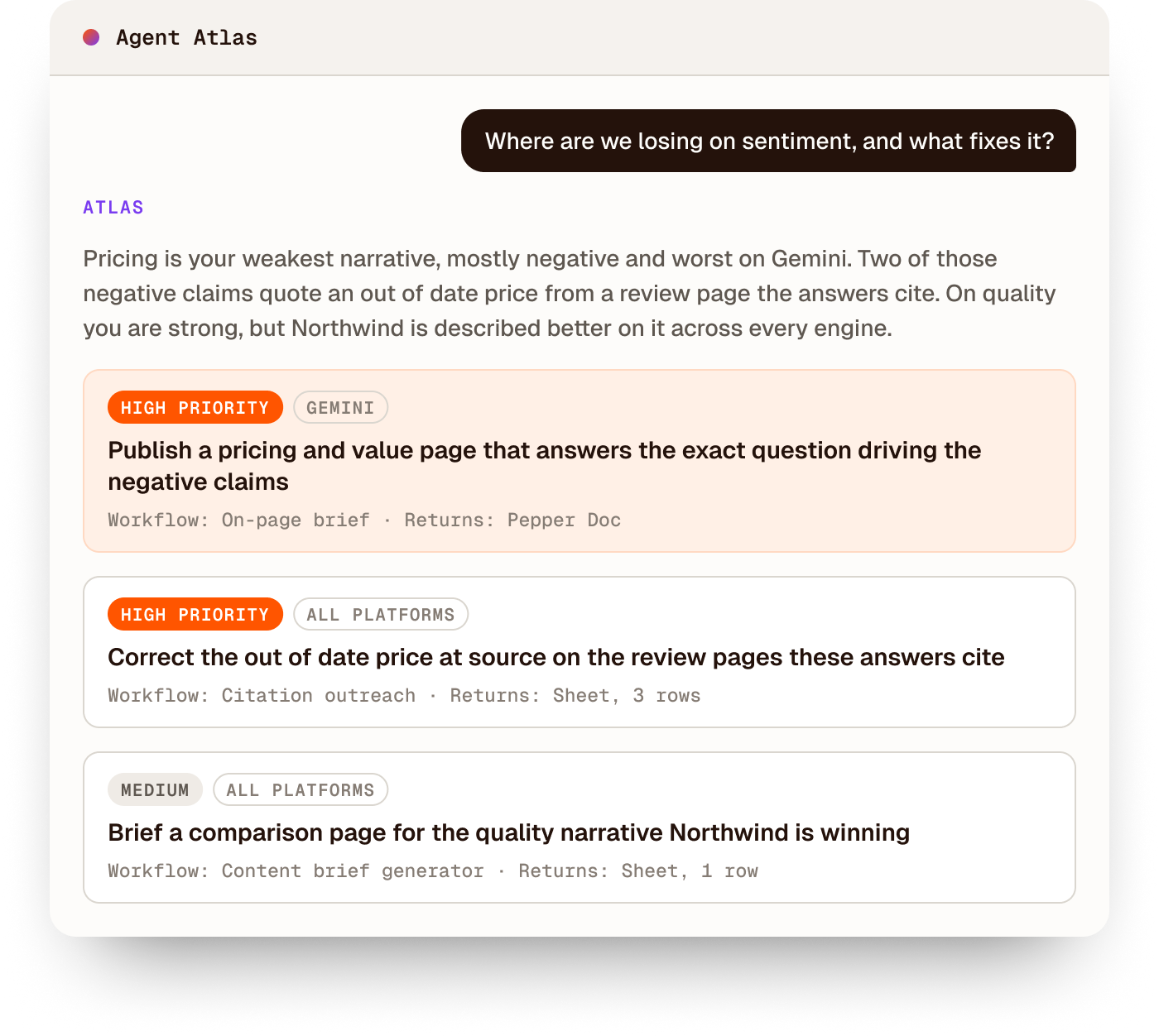
Ask Agent Atlas anything in plain language. Which topic is pulling your score down, which engine is harshest, which competitor is winning the quality narrative. Atlas reads your sentiment data alongside the citations behind each answer, and shows its reasoning with the answer.
Then it tells you what to do Each recommendation names the action, the narrative it fixes, the workflow that carries it out, and what you get back. They come ranked byimpact, and one click runs any of them.
Agents for scale. Humans for judgment. One team that owns the number.
Explore Agent Atlas
More from the Pepper platform.
← Platform overview
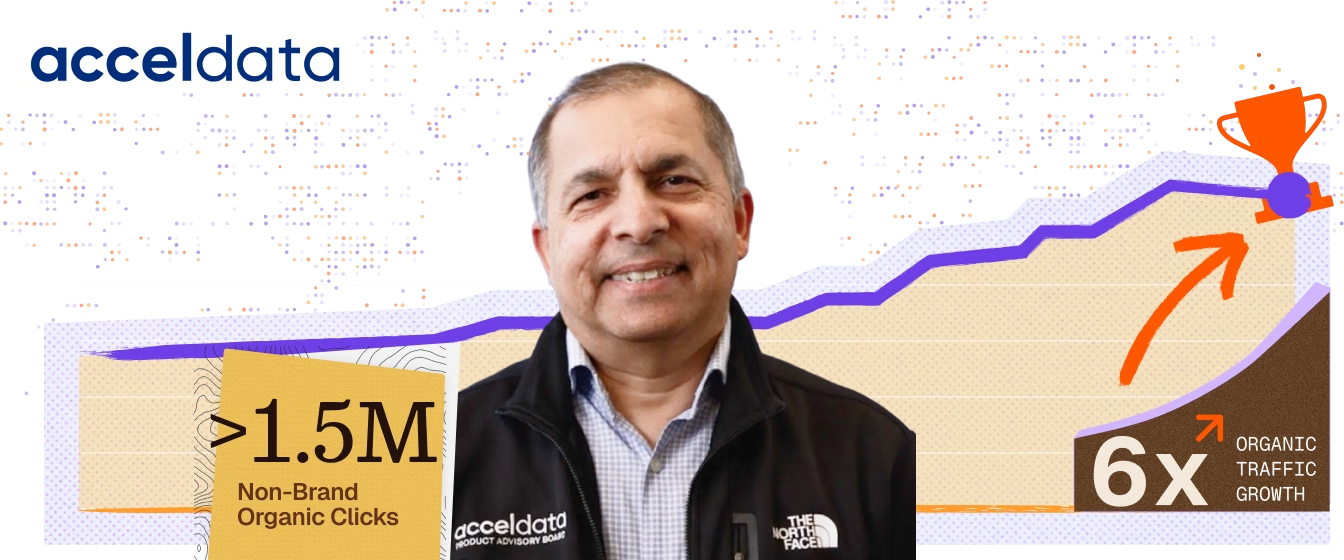
Numbers our customers put their name to
Numbers our customers
put their name to





Frequently Asked Questions
Agent Atlas is the chat layer of the Pepper platform, and it acts rather than answers. It diagnoses what changed, ranks pages by AI-visibility upside, benchmarks you against competitors, runs Workflows such as audits, briefs and reporting, and compiles reports for leadership. You ask Atlas instead of managing several agents.
Pepper measures your visibility daily across ChatGPT, Gemini, Perplexity and Google AI Overviews. Results are tracked per engine, per prompt and per day, so you see exactly where your brand appears and where it does not.
Every day. Your tracked prompts run against every supported engine daily, so the trend lines are built from daily runs rather than periodic snapshots. First results land within minutes of setup.
Every metric traces back to a verbatim AI response captured on a specific date, so you can open the actual answer behind any number. Pepper does not report a single blended score, because the same prompt run repeatedly returns different answers.
Atlas runs around the clock across every engine and surface Pepper tracks for you. It reads, executes and reports the work that should not need a human, and it reaches out whenever human judgement is needed. Senior strategists direct it.
Pepper does, alongside you. A forward-deployed team of senior strategists, people who work inside your team rather than at arm's length, run it day to day and own the number. You have full access to the same data and reports whenever you want them.

For businesses playing the long game, Pepper turns your earned authority visible to search & AI, making
organic growth winnable again.

Get a strategy presentation with real projections before you sign up.
i
*the long game is not about waiting.
It is about building something that keeps winning after everyone else's quick win wore off. And you will see it work within a quarter.