

Competitor benchmarking
See who gets recommended instead of you.
An agent is a saved piece of content or SEO work. You set the inputs, the steps and the output format once, then anyone on your team can run it on new inputs, whether that's one URL or five hundred.
Leader on each metric
Whichever brand is highest on each
column is flagged.
Strongest engine
Each brand's top platform, which tells you where a lead comes from.
Brands you didn't add
Share of Voice counts every brand an answer mentions, including ones you never added.
30-day trend
Share of Voice for each brand over the period you pick.
Keep your friends close, and your citations closer.
You know who your competitors are. You don't know which of them ChatGPT names when a buyer asks what to consider. One rival gets mentioned more than you but cited less. Another owns a single topic. A third leads on Perplexity and barely shows up on Gemini. A single overall score would hide all of that, so Pepper doesn't give you one.
How it works
Four things to compare.
Each one answers a different question about a competitor, and a brand can lead on one while trailing on the rest.
Metric
What it measures
What a lead here means
01
Brand Visibility
How often an AI answer mentions their brand by name.
They're mentioned more than you are.
02
Domain Prompt Presence
How often an AI answer cites a page from their domain.
Their pages are being used as sources.
03
Share of Voice
Their share of all brand mentions across the answers.
How much of the category they hold.
04
Coverage
How many of your tracked topics and prompts they appear in.
Whether they're broad or focused on a few topics.
Before you compare
Look at one metric at a time. A competitor six points ahead on mentions needs different work from one that shows up in twice as many topics as you.
Inside the dashboard
What you see.
01
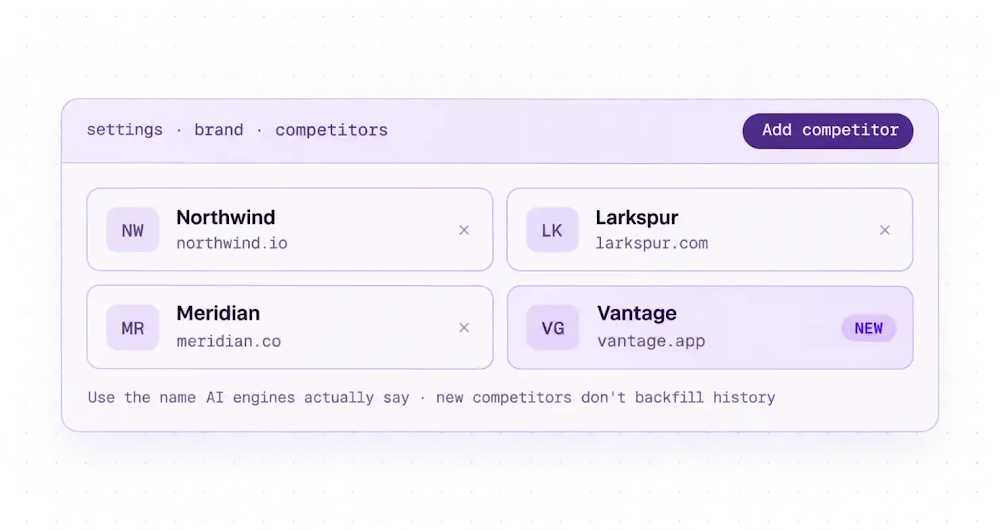
Pick the brands worth watching
Choose three to
ten brands to track.
Every comparison runs against the list you set. With fewer than three, Share of Voice gets noisy, and past ten you end up tracking brands you don't really compete with. Pepper suggests a starting list during setup. Most teams edit it after a couple of weeks of data.

02
Gap to leader
See the leader on each metric.
Brand Comparison lists every tracked brand with Brand Visibility, Domain Prompt Presence and Share of Voice, and flags whichever brand is highest on each. It also shows each brand's strongest engine, which tells you where a competitor's lead actually comes from.
03
Where they win
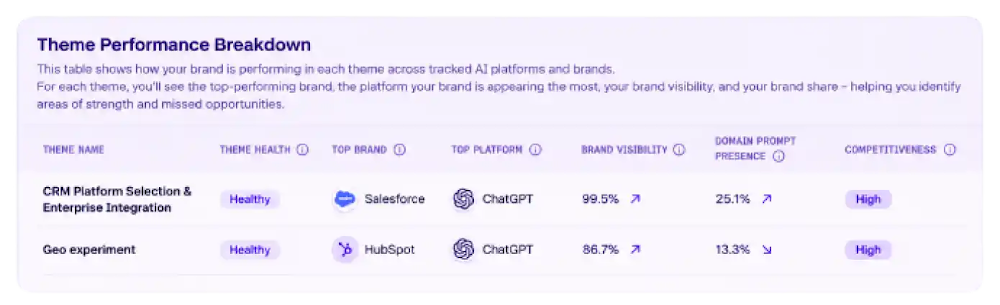
See which topics they're mentioned in most.
Theme Analysis shows which brand is mentioned most in each topic. Sort by your own Brand Visibility to find the topics where you appear least. If the top brand there is the competitor you're watching, that topic is part of their lead. If it's someone else, your problem in that topic isn't them.
04
Citation analysis
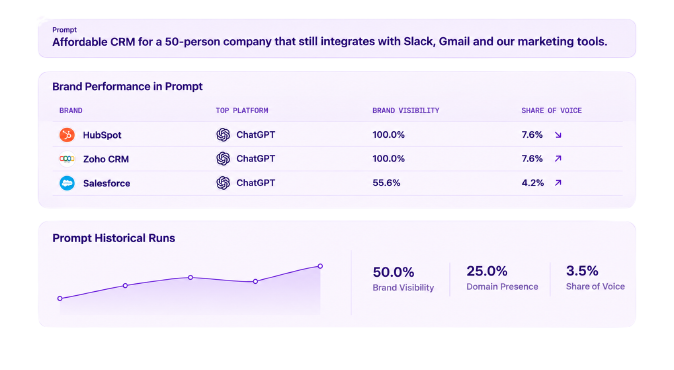
Read the pages being cited instead of yours.
Open any prompt where a competitor is mentioned, read the full answer, then click through to the pages it cited. Citation Analysis counts how many prompts each of their pages shows up in and whether that count is going up or down over the period you pick.
05
Catch a new entrant early
Spot brands you
haven't added yet.
Share of Voice counts every brand an answer mentions, including ones you never added. New names show up here with the date Pepper first saw them and how they've moved since. Add one to your list and it gets compared like any other from that day on.

06
Before you act
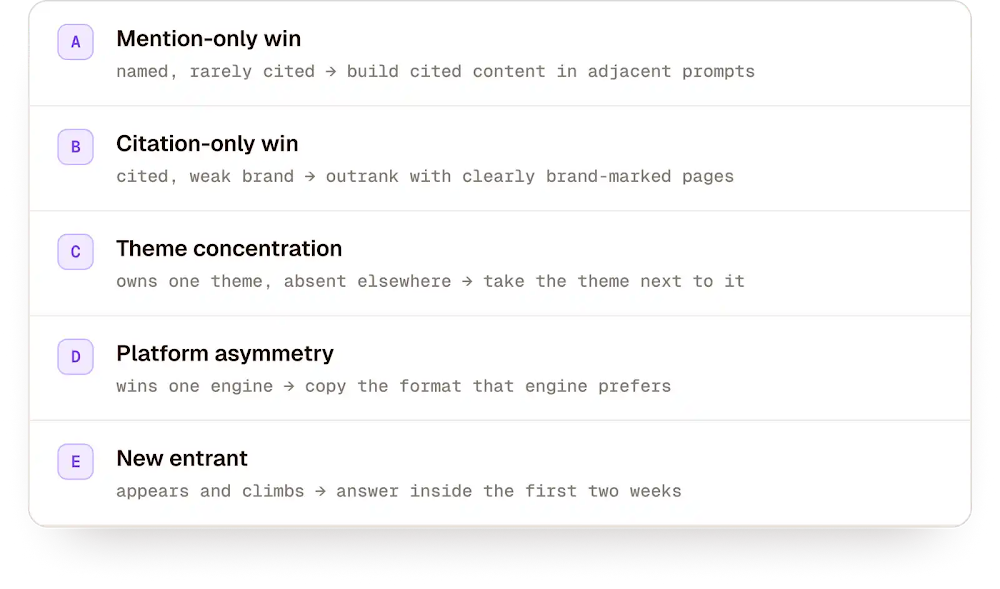
Five patterns, and different work for each.
A competitor who gets named a lot but rarely cited needs a different response from one who owns a single topic. Your Pepper strategist tells you which pattern you're dealing with at the first review, and flags it if that changes.

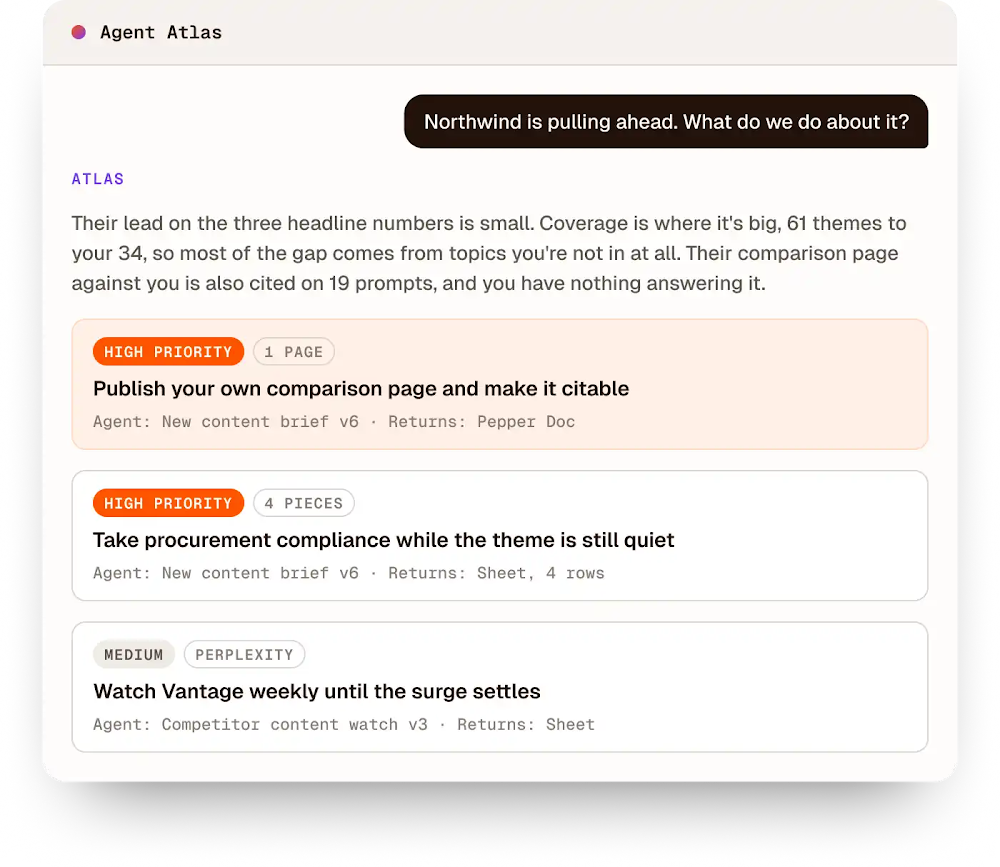
Agent Atlas
A gap is not a plan.
Tell Agent Atlas which competitor to look at and which metric youcare about. It reads your Pepper data alongside Search Console,Analytics and your CMS, and works out where the difference iscoming from.
Each recommendation names the action, the pages it applies to,the agent that runs it and what you get back. They come ranked byimpact, and one click runs any of them.
Agents for scale. Humans for judgment. One team that owns the number.
Explore Agent Atlas
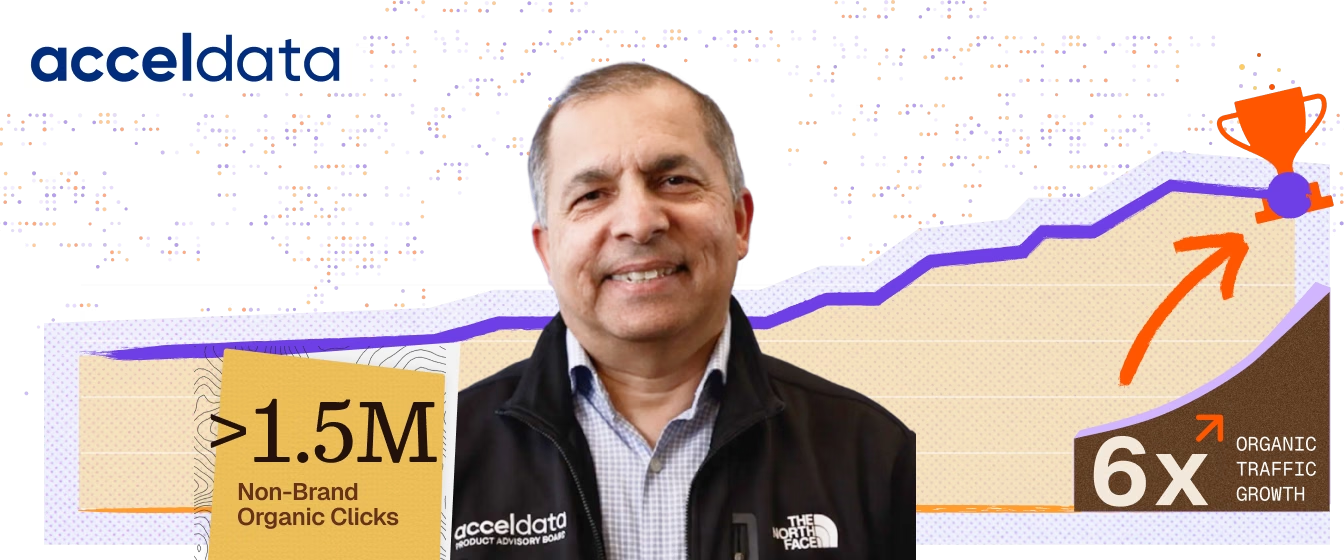
Numbers our customers put their name to
Numbers our customers
put their name to





More from the Pepper platform.
← Platform overview
Frequently Asked Questions
Agent Atlas is the chat layer of the Pepper platform, and it acts rather than answers. It diagnoses what changed, ranks pages by AI-visibility upside, benchmarks you against competitors, runs Workflows such as audits, briefs and reporting, and compiles reports for leadership. You ask Atlas instead of managing several agents.
Pepper measures your visibility daily across ChatGPT, Gemini, Perplexity and Google AI Overviews. Results are tracked per engine, per prompt and per day, so you see exactly where your brand appears and where it does not.
Every day. Your tracked prompts run against every supported engine daily, so the trend lines are built from daily runs rather than periodic snapshots. First results land within minutes of setup.
Every metric traces back to a verbatim AI response captured on a specific date, so you can open the actual answer behind any number. Pepper does not report a single blended score, because the same prompt run repeatedly returns different answers.
Atlas runs around the clock across every engine and surface Pepper tracks for you. It reads, executes and reports the work that should not need a human, and it reaches out whenever human judgement is needed. Senior strategists direct it.
Pepper does, alongside you. A forward-deployed team of senior strategists, people who work inside your team rather than at arm's length, run it day to day and own the number. You have full access to the same data and reports whenever you want them.

For businesses playing the long game, Pepper turns your earned authority visible to search & AI, making
organic growth winnable again.

Get a strategy presentation with real projections before you sign up.
i
*the long game is not about waiting.
It is about building something that keeps winning after everyone else's quick win wore off. And you will see it work within a quarter.