AEO company selection in 2026: how to choose an answer engine optimization partner
The short answer
The label is applied by the listicles, not claimed by the firms.
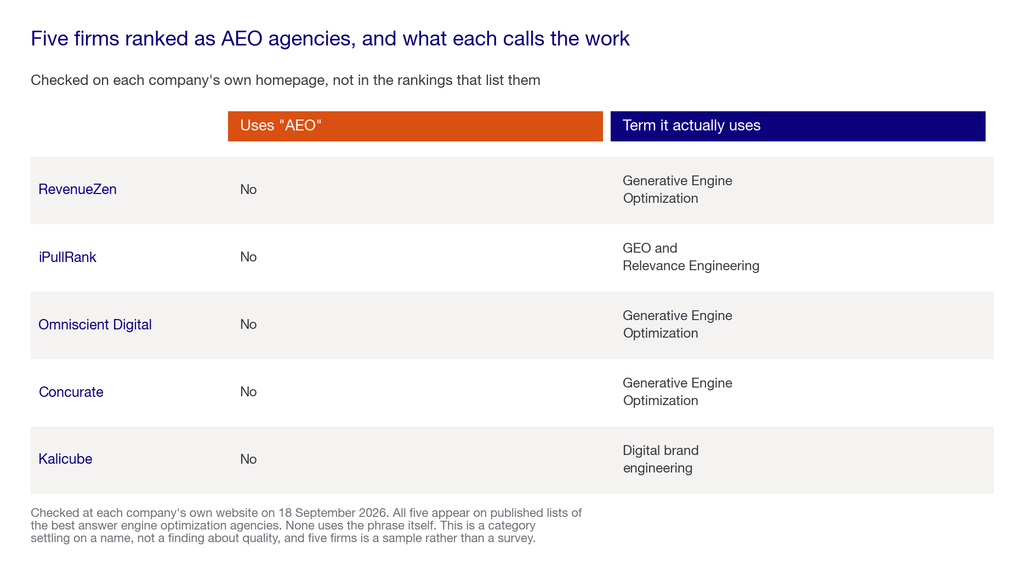
We checked RevenueZen, iPullRank, Omniscient Digital, Kalicube and Concurate at their own websites. All five appear on published rankings of the best answer engine optimization agencies. None of them uses the phrase “answer engine optimization” or “AEO” as a named service. Four call it generative engine optimization. The fifth calls it digital brand engineering.
That is not dishonesty by anyone. It is a category still settling on a name, which we traced properly in AEO vs GEO: are they the same thing?. But it has a practical consequence for you: searching for an “AEO company” will not find the firms doing this work, because they do not use the word. You have to search for the work instead.
So this page does two things. It shows what each firm actually says about itself, and it gives you a way to choose one that does not depend on the label.
Pepper is one option here and we will be plain about that. We are an agentic organic growth engine, not an agency. This page comes out of what we run: organic for more than 250 enterprises across eight years, more than 10 million tracked prompts, and the questions buyers put to us in client reviews. Customers log in and run the platform themselves, with a Pepper growth team attached to the account. Book a growth audit and we will show you what five engines currently say about your brand before you brief anybody.
Key takeaways
Key takeaways from an afternoon spent on the firms’ own websites rather than in the rankings.
- Nobody calls themselves an AEO company. Zero of five firms we checked use the phrase on their own site, despite all five appearing on top-AEO-agency lists.
- Four of five use GEO instead. RevenueZen, iPullRank, Omniscient Digital and Concurate all name generative engine optimization as the service.
- One firm publishes a price. Omniscient Digital states “Full-service engagements start at $10,000 a month.” The rest quote on request.
- The advertised AEO service list contains dead deliverables. FAQ schema and featured snippet optimisation appear on many AEO service pages. Google no longer shows FAQ rich results, and says you cannot request a featured snippet.
- Named clients vary enormously. One firm names nine recognisable companies on its homepage. Another names one.
- Search for the work, not the acronym. The term you use decides which firms you find, and it has almost no relationship to who is good.
What is an AEO company, and what does one actually do?
An AEO company is a firm you hire to get your brand named and your pages cited inside AI and search answers, rather than only ranked in a list of links.
The work splits into three parts, and the split matters because most firms are strong in one and thin in another.
- On-page structure. Answer-first paragraphs, question-shaped headings, self-contained passages, entity markup. This is the cheapest part and the most commonly skipped. We set the techniques out in the GEO best practices content playbook.
- Earned authority. Getting cited on sources you do not own. Independent research keeps finding third-party and reference sources overrepresented in AI answers, which makes this the largest recurring line item and the slowest to move.
- Measurement. Tracking which prompts you appear in, on which engines, and which page got cited. Without this the other two are unfalsifiable.
A firm that only does the first is a content shop. One that only does the third is a tool with a service wrapper. Ask which of the three you are buying before you compare prices, because the answer changes what a fair price is.
The deliverables worth challenging
Commonly advertised AEO service lists include featured snippet optimisation and FAQ schema implementation. Both are worth a question.
Google’s documentation states that FAQ rich results are “no longer shown in Google Search results.” On whether you can mark a page as a featured snippet, Google’s answer is “You can’t. Google systems determine whether a page would make a good featured snippet for a user’s search request, and if so, elevates it.”
Neither fact makes a firm dishonest for listing them. Scopes get written once and reused. But it does give you a precise opening question, and the answer tells you how current the firm’s thinking is.
AEO companies at a glance
Disclosure: Pepper appears here. We are not an agency and we have not ranked ourselves against these firms. We lead the table because we are the publisher, in a separate category, with the same columns filled in so you can judge fit yourself.
| Firm | Says “AEO” on own site | Term it actually uses | Published pricing | Named clients on homepage |
|---|---|---|---|---|
| Pepper | No | GEO | Not published | Case studies published |
| RevenueZen | No | Generative Engine Optimization | Not published | 5 |
| iPullRank | No | GEO and Relevance Engineering | Not published | 9 |
| Omniscient Digital | No | Generative Engine Optimization | Yes, from $10,000 a month | 6 |
| Concurate | No | Generative Engine Optimization | Not on homepage | 5 |
| Kalicube | No | Digital brand engineering | Not published | 1 |
Checked at each company’s own website on 18 September 2026. “Named clients” counts companies identifiable by name on the homepage, from logos and testimonials together. Treat it as a floor rather than a total.
1. Pepper
- What it is: an agentic organic growth engine, not an agency. We state the distinction rather than blurring it, because it changes what you are buying.
- How it runs: you hold the logins. You set up the workspace, connect GA4 and Search Console, manage themes and prompts, and read the analytics yourself. A Pepper growth team is attached and does the work alongside you, running the agents in Agent Atlas.
- Engines tracked: ChatGPT, Perplexity, Gemini, Claude and Google AI Overviews.
- Metrics you get: Brand Visibility, Domain Prompt Presence and Share of Voice. The gap between the first two is the citability problem, and naming it is how you fix it. The framework is Visibility, Citability and Retrievability.
- Credentials: eight years, 250-plus enterprises, more than 10 million tracked prompts, with the work published in our case studies.
- Published pricing: no. We quote on scope and give you the number on the first call.
- Where it falls short: we do not use the term AEO either, so if your procurement process requires a supplier whose materials say “answer engine optimization,” we will not match that search. We think the term is the weakest thing to select on, which is the argument of this page, but it is your process rather than ours.
2. RevenueZen
- Own positioning: B2B SEO and content, with generative engine optimization as the named AI search service.
- Does it say AEO: no. The site uses GEO throughout.
- What it says the service does: helps brands “show up, become the trusted answer, and turn AI-sourced visibility into qualified pipeline.”
- Named clients: Expensify and Dooly among logos, plus testimonials from Skydog Ops, Hiline and Pritchard Industries.
- Published pricing: none.
- Where it falls short: it tops at least one published ranking of AEO agencies while using no AEO language of its own, so the ranking is describing the firm rather than quoting it. The B2B and SaaS focus is narrow, which is an advantage if you are in it and a constraint if you are not.
3. iPullRank
- Own positioning: “Be recommended by AI and remembered by people.”
- Does it say AEO: no. It uses GEO, alongside its own terms Relevance Engineering and Resonance Design.
- Named clients: the strongest logo set here. Target, American Express, Adidas, Under Armour, The Wall Street Journal, CVS Pharmacy, Coindesk and MLB.
- Published pricing: none.
- Where it falls short: proprietary vocabulary makes proposals hard to compare against anyone else’s. If two firms name the same deliverable differently you cannot line them up, and you will have to do that translation yourself.
4. Omniscient Digital
- Own positioning: SEO and content strategy, with generative engine optimization described as “Appear in AI search and LLM outputs.”
- Does it say AEO: no.
- Published pricing: yes, and it is the only one in this set. “Full-service engagements start at $10,000 a month.”
- Named clients: Jasper, Order.co, GatherContent, Smartling, 360Learning and Gable AI, several with case studies.
- Where it falls short: the published floor is high enough to exclude most mid-market buyers outright, which is useful information but narrows the field. Services are content-led, so if your gap is technical or measurement rather than production, check that fit early.
5. Concurate
- Own positioning: B2B and SaaS content, with generative engine optimization services named for “optimizing for AI search engines (like ChatGPT, Perplexity, etc.).”
- Does it say AEO: no.
- Named clients: testimonials reference Ratio, Addverb, Personable, Helios and XoXoDay.
- Published pricing: not on the homepage, though the site links to a pricing section.
- Where it falls short: the client set is smaller and less recognisable than iPullRank’s, and several case studies describe the client by category rather than naming it. That is often a confidentiality term rather than a weakness, but it does mean fewer references you can check yourself.
6. Kalicube
- Own positioning: fixing “how AI understands you,” through what it calls The Kalicube Process.
- Does it say AEO: no. It does not use GEO either. The framing is digital brand engineering and AI visibility.
- Distinctive focus: entity and knowledge panel work, brand reputation, and personal brand. A genuinely different specialism from the content-led firms above.
- Published pricing: none.
- Where it falls short: the homepage shows media logos rather than client logos, and we found one named testimonial. For a buyer using named references as a filter, that is the thinnest set here.
What AEO companies cost
Almost nobody in this category publishes a price, which makes the few public figures carry more weight than their sample size deserves.
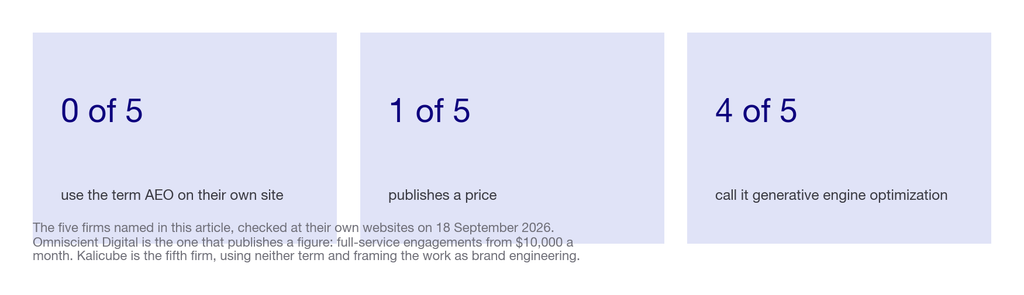
- The one published agency figure. Omniscient Digital states full-service engagements start at $10,000 a month.
- A broader anchor. WebFX, which also appears on AEO lists, publishes a full rate card starting at $3,000 a month for SEO services.
- Everyone else quotes on request, including us.
- The tool layer is a different order of magnitude. AI visibility subscriptions start around $29 a month and several vendors run free tiers. That is not a substitute for an agency, and anyone framing it as one is selling you one of the two.
We set the whole picture out, agency and platform side by side, in SEO, AEO and GEO pricing benchmarks. The scope question underneath the price is in answer engine optimization services.
Named references are the cheapest due diligence
Logos are not proof of results, but they are proof the relationship existed and they are checkable. The spread across these five firms is wide.
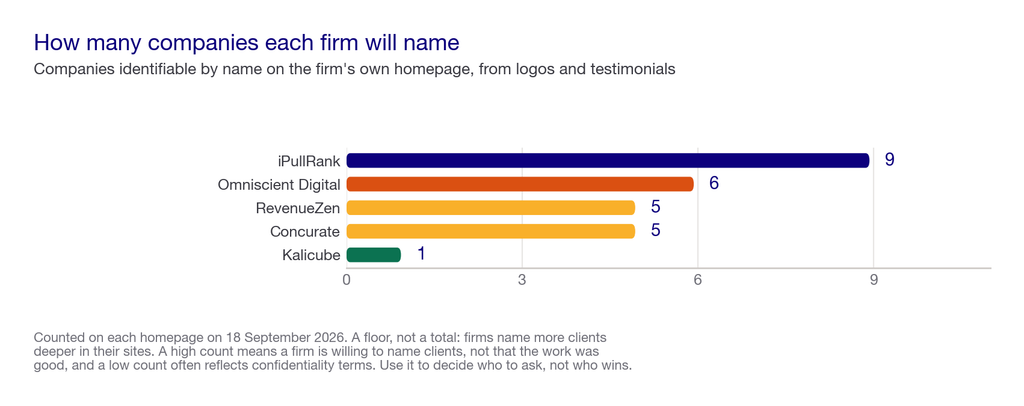
One caveat we would apply to our own chart. A high count means a firm is willing to name clients, not that the work was good. A low count can mean confidentiality terms rather than thin experience. Use it to decide who to ask for references, not to decide who is better.
How to choose an AEO company
This is the section worth slowing down for. Here is the sequence we would run if we were buying rather than selling.
Step one: search for the work, not the acronym
Start by dropping the term. Since none of the firms above uses “AEO” on its own site, an acronym search finds listicles rather than practitioners.
Search instead for what you want done. “Get cited in ChatGPT answers.” “Generative engine optimization agency.” “AI search visibility.” Then check each firm against the three-part split above, and write down which part is actually your gap. Most buyers discover at this step that their problem is measurement rather than production, or authority rather than either.
Step two: score the shortlist on a 100-point scale
Rebuild this from each firm’s own website rather than from a ranking. It takes about twenty minutes.
| Criterion | Weight | What earns full marks |
|---|---|---|
| Evidence in your category | 25 | A named client you can call, in your market |
| Which of the three parts they lead on | 20 | They ask what your gap is before pitching a scope |
| Engine coverage, named | 15 | Named engines, a prompt set, a stated frequency |
| Data and login ownership | 15 | You keep GA4, Search Console and platform access |
| Currency of their scope | 10 | No dead deliverables on the proposal |
| Cost transparency | 10 | A number on the first call, not after three meetings |
| Reporting you can audit | 5 | Raw answers and cited URLs, not only a chart |
Total 100. The first two carry nearly half because they test whether a firm has done this before and whether it is listening. Our weights for the wider category sit in the GEO agency ranking methodology.
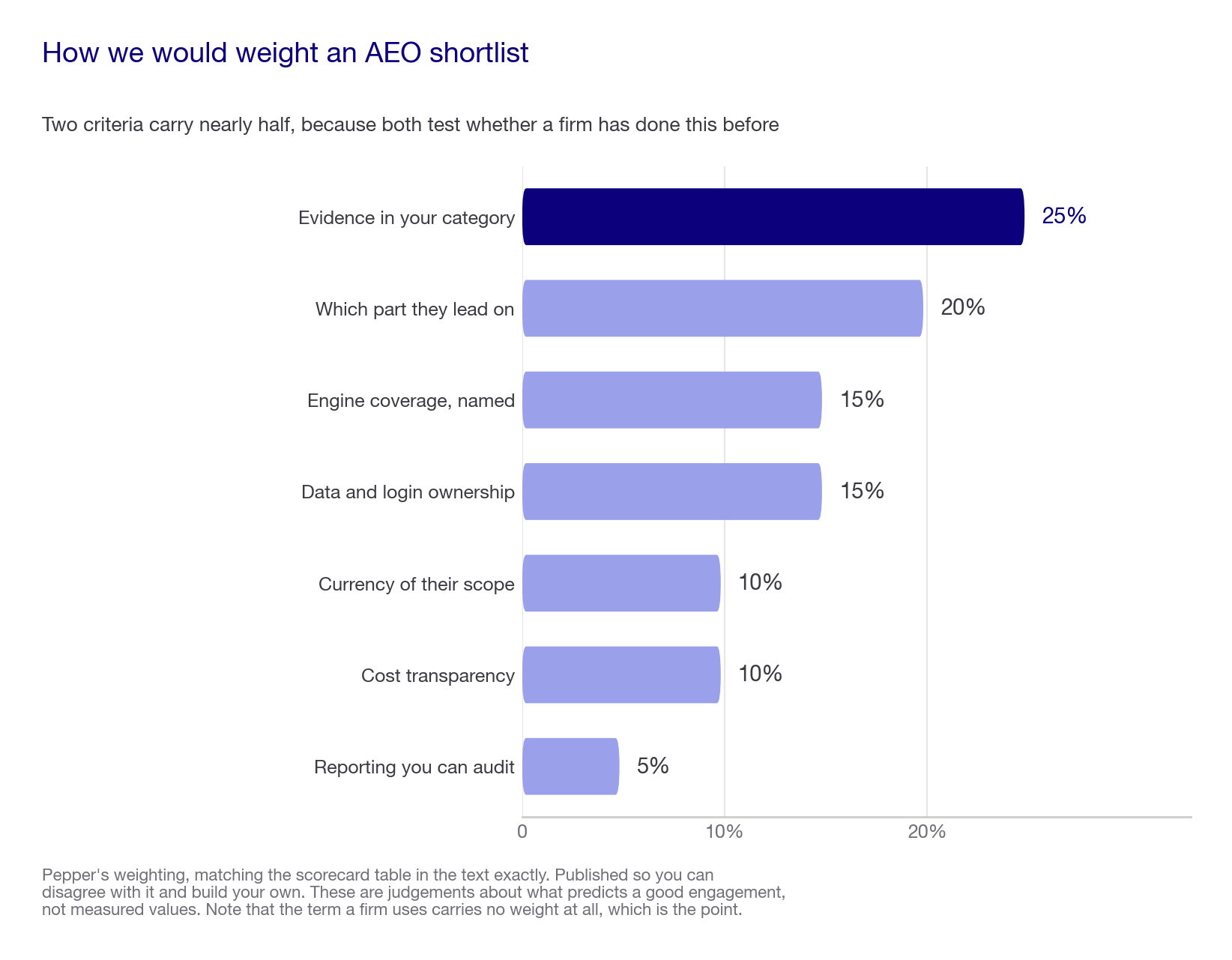
Figure 4: How we would weight an AEO shortlist, and why two criteria carry nearly half.
Step three: ask the five questions that separate them
- “What do you call this work, and why?” A firm with a view will explain its terminology in one sentence. This also surfaces whether they have thought about the category or inherited a label.
- “Which engines do you measure, how often, and can I see last month’s raw answers?” Named engines, a frequency, and real output. Vague answers here predict vague reporting later.
- “Your scope mentions FAQ schema and featured snippets. What do those deliver now?” Google no longer shows FAQ rich results and says snippets cannot be requested. The answer tells you how current their thinking is.
- “Who owns the logins and the data?” If they run everything and send a monthly deck, you are buying a report rather than a capability, and you keep nothing when the contract ends.
- “What would you tell us not to do?” A partner with a view answers immediately. This is the question that most reliably separates practitioners from sales teams.
Step four: run a live test before the full retainer
Paper evaluations reward whoever writes the best deck. Run a real one instead.
Give each finalist the same 25 prompts a buyer in your category would type, and 90 days. Prompts like “best AI visibility platform for enterprise”, “how do I get cited in ChatGPT”, or “answer engine optimization agency for B2B SaaS”. Ask for a baseline in week one and a movement report at the end.
A weaker firm will report rankings, traffic and pages shipped. A stronger one will report which prompts you now appear in, which pages the engines cited, and whether the citation was yours or a third party’s. The gap between Brand Visibility and Domain Prompt Presence is the tell: high mentions with low domain citations means engines are describing you using somebody else’s pages.
Step five: watch for these red flags
- A guaranteed featured snippet. Google states you cannot request one.
- FAQ or HowTo schema sold as a visibility deliverable. Both rich results are switched off.
- A guaranteed citation in an AI answer. Nobody controls what a model outputs.
- A single AEO score with no published components. Ask what it is made of. It usually dissolves.
- A ranking position used as a credential, when the ranking was published by an agency that placed itself first. We documented that pattern in banking and financial SEO agencies.
- No question about your existing content library from a firm proposing content-led AEO.
Step six: decide what stays inside, and be willing to wait
Subject matter expertise stays inside, because it is the raw material and no agency can manufacture it. Approval stays inside. Relationships with your own customers stay inside, because they are the best source of real prompt language you will find.
And here is the answer that loses us the sale. If you have fewer than about thirty substantial pages and no measurement in place, you do not need an AEO company yet, ours included. Fix the structure on the pages you already have, using the techniques we published for free, put a free or $29 tracker on twenty prompts, and look again in two quarters. Retaining anybody before you can see a baseline means paying for work nobody can prove.
All of it comes down to one principle: buy the part you cannot do, and measure the part you are buying. In this category the part most buyers cannot do is earned authority, and the part most of them never measure is whether the citation was theirs at all.
What nobody should promise you
- A featured snippet. Google’s documentation says you cannot request one, so nobody can sell you one.
- FAQ or HowTo rich results. Both features are no longer shown in Google Search. There is nothing left to deliver.
- A guaranteed citation in an AI answer. Nobody controls model output. We will not promise it either.
- A single AEO score. One number collapsing several engines and dozens of prompts hides exactly the variance you are paying to see.
- That the label means anything. None of the firms ranked as top AEO agencies uses the term. Selecting on the acronym selects on nothing.
Frequently asked questions
What is an AEO company?
It is a firm you hire to get your brand named and your pages cited inside AI and search answers, rather than only ranked in a list of links. In practice the work splits into on-page structure, earned authority and measurement.
Why do AEO companies not call themselves AEO companies?
Because the category has not settled on a name. We checked five firms ranked as top AEO agencies and none used the phrase. Four call it generative engine optimization instead, and one calls it digital brand engineering.
Cost and scope
How much does an AEO company cost?
Almost none publish figures. Omniscient Digital states full-service engagements start at $10,000 a month, and WebFX publishes a rate card from $3,000 a month for SEO services. Everyone else, including us, quotes on scope.
Is an AEO agency different from a GEO agency?
In practice, no. We traced both terms and found GEO has a published academic origin while AEO has none. Most firms doing this work use GEO, so treat the distinction as vocabulary rather than a difference in capability.
Should I hire an AEO consultant or an agency?
A consultant suits a diagnosis or a one-off structural fix. An agency suits ongoing production and authority building. Decide which of the three parts of the work is your gap first, because that answer picks the shape of supplier.
Choosing and testing
What should I ask an AEO company before signing?
Ask what they call this work and why, which engines they measure and how often, what their FAQ schema and featured snippet line items deliver now, who owns the logins, and what they would tell you not to do.
How do I test an AEO company before committing?
Give each finalist the same 25 prompts your buyers would type, and 90 days. Ask which prompts you now appear in and whether the engine cited your page or somebody else’s. That single distinction separates reporting from results.
Can my existing SEO agency do AEO?
Usually yes. Google places this work inside SEO rather than beside it, so no separate discipline exists. What matters is commercial: whether the scope genuinely expands, or only the invoice does.
Sources
Every firm below was checked at its own website on 18 September 2026. Where something is not published, we say so rather than estimating it.
Firms checked at source
- RevenueZen, checked 18 September 2026. Names generative engine optimization; no AEO language; no published pricing.
- iPullRank, checked 18 September 2026. Names GEO, Relevance Engineering and Resonance Design; no AEO language; no published pricing. Client logos include Target, American Express, Adidas and The Wall Street Journal.
- Omniscient Digital, checked 18 September 2026. Names generative engine optimization; no AEO language. Source of the only published agency figure quoted here: “Full-service engagements start at $10,000 a month.”
- Concurate, checked 18 September 2026. Names generative engine optimization services; no AEO language; no pricing on the homepage.
- Kalicube, checked 18 September 2026. Uses neither AEO nor GEO; frames the work as digital brand engineering via The Kalicube Process.
- WebFX SEO pricing, checked 16 September 2026. Source of the $3,000 per month starting figure.
Google documentation
- Google Search Central, FAQ (FAQPage) structured data, checked 18 September 2026. States “The FAQ rich result feature is no longer shown in Google Search results.”
- Google Search Central, Featured snippets and your website, checked 18 September 2026. On marking a page as a featured snippet: “You can’t. Google systems determine whether a page would make a good featured snippet for a user’s search request, and if so, elevates it.”
- Google Search Central, AI features and your website, 15 May 2026. Places AEO and GEO inside SEO, and advises against providers guaranteeing rankings.
On what we did not do
We did not rank these firms and we did not test their work. Five firms is a sample, not a survey, and a larger check might find a firm that does use the term. The counts above are what each company publishes about itself on one page on one day. If a firm publishes audited performance data, send it and we will add it here with attribution.
Latest Blogs
Every agency lists the same dozen services. Almost none of them tells you how much of each you get, which makes the list unusable for comparison. One agency does publish full quantities per tier, so we divided its prices by its deliverables. The result inverts the ladder: the cheapest plan is the best value per page, and the first upgrade costs 3.4 times the entry rate for each additional page it buys.
The short answer The three terms name three surfaces, and that part is real. What is not real is the implication that they need three playbooks, three teams and three budgets each. Google states that its generative features run on core Search ranking systems. In July it also named four AI-specific tactics it does not […]
Most resource libraries are link dumps that rot quietly. We built this one the way we build everything else: 85 candidates checked at source on one day, 30 kept, 5 dropped because they no longer resolve, and two of our own entries flagged as partly superseded by newer guidance from Google. Every item says what it is for and what it cannot do. It is organised by the job you are trying to finish, not by content type.
Get your hands on the latest news!