We read the homepage of seven well-known SaaS content agencies on the same morning in October 2026. Not one of them described itself primarily as a content agency any more.
The short answer
The best content agency for SaaS is the one that can prove its work gets cited, not just published. Every serious firm here has rebuilt its offer around AI search in the last eighteen months. So the old question of who writes well no longer separates them.
Four things decide a good choice.
- Evidence of citation, not just rankings. Ask to see a page they wrote that is now cited in AI answers for a commercial query. Most firms cannot show one, and the ones that can are worth the premium.
- Depth in software specifically. A firm that works across eight verticals will write about your product correctly. A firm that works in B2B software will argue with your positioning, which is usually what you need.
- Who actually writes. Named writers with product experience produce different work from an anonymous pool. Ask who, where they sit, and whether they have used software like yours.
- What they will show you. A partner who reports only traffic in 2026 is reporting on the half of the problem that moved.
What the check actually showed
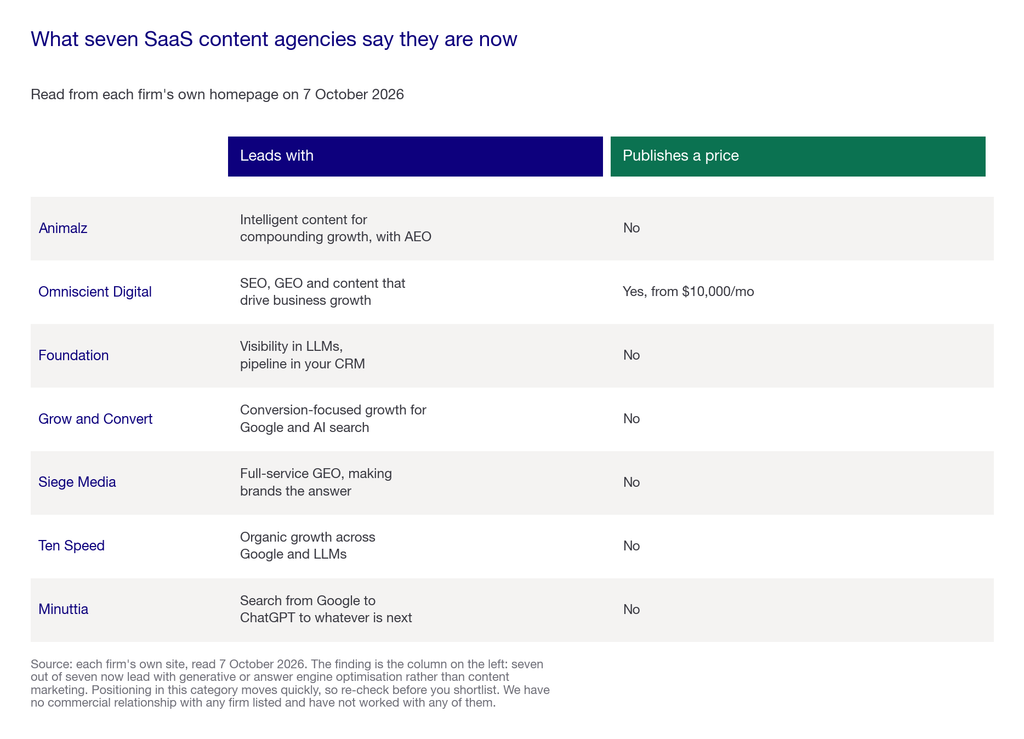
What we found. All seven lead with generative or answer engine optimisation on their own homepages. One publishes a price. The rest quote. That is the honest state of the category in October 2026, and it tells you the market repositioned faster than most buyers noticed.
Where Pepper sits, plainly. We do not sell content services and we are not going to describe ourselves that way to appear on this list. Pepper is an agentic organic growth engine. Customers log in and run the platform themselves, with a Pepper growth team attached who do the work alongside them. This page comes out of what we run: organic for more than 250 enterprises across eight years, more than 10 million tracked prompts, and the questions buyers put to us in client reviews. If what you want is an agency that files drafts, several firms below are good at that. Book a growth audit if what you want is the measurement and the work in one place.
Key takeaways
Key takeaways from reading seven agency sites on the same day.
- The category renamed itself. Seven out of seven now lead with GEO, AEO or LLM visibility rather than content marketing.
- Only one publishes a price. Omniscient Digital states full-service engagements start at $10,000 a month. Everyone else quotes.
- Specialisation varies more than quality. Two of the seven are software-only; the rest spread across verticals from healthcare to real estate.
- Proprietary tooling is now common. Several have built or adopted their own AI visibility trackers, which changes what reporting looks like.
- Ask for a cited page, not a traffic chart. It is the single question that separates the firms that have adapted from the ones that have rebranded.
- Pepper is not on this list as an agency. We are a platform with a growth team attached, which is a different purchase.
What is a SaaS content agency in 2026?
A SaaS content agency is a firm that plans, produces and distributes content for software companies. In 2026 the definition has shifted, because the output is now judged on whether AI systems reuse it.
The practical change is in what the work has to achieve. A page used to need to rank. Now it needs to rank, be reachable by crawlers, be structured enough to extract, and be credible enough that an engine reaches for it. The three levers behind that are set out in our visibility, citability and retrievability framework.
That is why the firms below have reorganised. Their clients started asking a question content alone does not answer.
- Production is table stakes now, and has been commoditised by tooling that every one of these firms uses.
- Positioning and argument is where the differences show. Content that gets cited makes a claim worth quoting.
- Distribution and third-party presence has become part of the brief, because a large share of AI citations come from sources you do not own.
Where this falls short as a definition. None of it tells you whether a firm is any good at your category specifically. Category knowledge is the hardest thing to assess from a website and the thing that most determines whether the engagement works. For software specifically, our view of the wider agency market sits in SaaS SEO agencies.
The seven at a glance
Read across the row before you read down the column. The pricing column is the one that separates them fastest.
| Firm | How it describes itself now | Vertical focus | Published pricing |
|---|---|---|---|
| Animalz | “Intelligent content for compounding growth” | B2B SaaS | None published, quoted |
| Omniscient Digital | Organic growth agency, SEO, GEO and content | B2B software | From $10,000 a month, full service |
| Foundation | “AI visibility & GEO marketing agency” | Tech plus professional services and enterprise | None published, quoted |
| Grow and Convert | “Conversion-Focused Organic Growth for Google and AI Search” | B2B SaaS, plus B2C and ecommerce | None published, quoted |
| Siege Media | “Full-service GEO” | SaaS among eight named verticals | None published, quoted |
| Ten Speed | US-based organic growth agency for B2B | B2B across eight named sectors | None published, quoted |
| Minuttia | Search strategy “from Google to ChatGPT” | B2B SaaS, 60+ clients claimed | None published, quoted |
| Pepper (us) | Agentic organic growth engine, platform plus growth team | B2B SaaS, BFSI, retail and CPG | Quoted, and we say so |
**How to read the last row.** We are in the table for completeness, not as a ranked entry. Pepper is a different purchase from the seven above it, and the section below sets out when each one is right.
How we evaluated
We did not score these firms. We read their own sites, recorded what they say about themselves, and checked whether they publish anything a buyer can verify.
That is a deliberate limitation. We sell in an adjacent category, so a Pepper ranking of agencies would be a conflict of interest dressed as research. What we can do honestly is report what each firm publishes and give you the weighting we would apply if the choice were ours.
| Factor | Weight | What we would check |
|---|---|---|
| Evidence of citation in AI answers | 30% | A specific page they produced, now cited for a commercial query |
| Depth in B2B software | 25% | Client list, writer backgrounds, whether they argue with your positioning |
| Who actually writes | 20% | Named writers, product experience, where they sit |
| Measurement they will show you | 15% | Mentions and citations, not just sessions and rankings |
| Commercial model fit | 10% | Retainer, project or hybrid, and what happens when scope changes |
The weighting is ours and we would defend it. Citation evidence carries the most because it is the hardest thing to fake and the most predictive of whether the work will matter in two years. We apply the same weighting logic in our GEO agency ranking methodology.
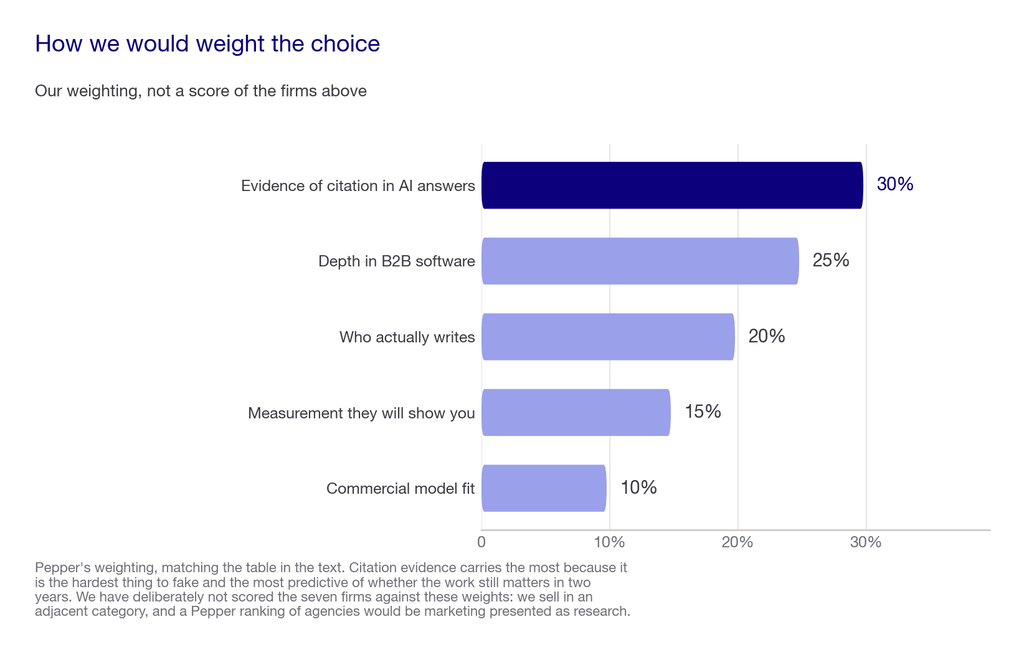
Figure 2: The weighting we would use. Citation evidence carries the most.
The seven firms, and what each one actually is
Everything below is quoted or paraphrased from each firm’s own site, read on 7 October 2026. Positioning changes, so re-check before you sign anything.
Animalz
What they say. “Intelligent content for compounding growth”, aimed at leading B2B SaaS brands.
What they sell. Answer engine optimisation, SEO and AEO strategy, survey-driven whitepapers, LinkedIn thought leadership, production and distribution, and brand and authority programmes. They also name AirOps implementation as a service, which is unusual and tells you something about how they work.
Best fit. Software companies that want editorial quality and a recognised name, and are comfortable with a quoted price.
Where it falls short. No published pricing, and the breadth of the service list means the engagement shape depends entirely on what you negotiate.
Omniscient Digital
What they say. “SEO, GEO, and content should drive business growth, not just traffic.” They describe themselves as an organic growth agency for marketing leaders at ambitious B2B software companies.
What they sell. SEO strategy, generative engine optimisation, conversion rate optimisation, programmatic and technical SEO, link building, digital PR, content production and analytics.
Best fit. Companies that want one firm covering strategy, technical work and production, and that can meet the published floor.
Where it falls short. Full-service engagements start at $10,000 a month, which is a real barrier below a certain stage. To their credit, they say so publicly, which almost nobody else in this list does.
Foundation
What they say. “Visibility in LLMs. Pipeline in your CRM.” They describe themselves as an AI visibility and GEO marketing agency.
What they sell. Generative engine optimisation strategy, technical SEO, LLM advertising, content distribution, thought leadership, executive visibility, digital PR, demand generation, and channel-specific work including Reddit, YouTube and social.
Best fit. Software companies whose problem is presence in third-party sources rather than on their own site.
Where it falls short. No published pricing, and the breadth from LLM advertising to YouTube means you should ask who specifically does each part.
Grow and Convert
What they say. “Conversion-Focused Organic Growth for Google and AI Search”, built on a named method they call Pain Point SEO.
What they sell. Content, SEO and AI search work, prioritised by buying intent rather than search volume. They have also built their own tracker, Traqer AI, which they say covers ChatGPT, Perplexity, Google AI Overviews, Gemini and Claude.
Best fit. Teams that have published a lot and converted little, and want keyword selection reorganised around intent.
Where it falls short. No published price. Their site uses a mid-market persona with a $20,000 monthly budget as an illustration. That is an example on their page rather than a quoted rate, and we would not read it as one.
Siege Media
What they say. “Full-service GEO. We make brands the answer in search.”
What they sell. GEO, SEO consulting, content strategy and creation, digital PR, affiliate partnerships, Reddit marketing, web and graphic design. Their published client list spans well beyond software.
Best fit. Brands that need design and content capacity alongside search, and that benefit from a firm with experience outside software.
Where it falls short. SaaS is one of several verticals they name rather than the whole business, so ask specifically who on their team has worked in your category.
Ten Speed
What they say. A US-based organic growth agency helping B2B companies increase search visibility across Google and LLMs to generate pipeline.
What they sell. Organic growth strategy, content creation, SEO, answer engine optimisation, digital PR, design, content repurposing, case studies and research reports.
Best fit. Product-led software companies that want original research and case studies as part of the mix rather than as an upsell.
Where it falls short. No published pricing, and the vertical list runs from hardware to higher education, so category depth is a question to ask rather than assume.
Minuttia
What they say. They help brands “dominate the future of search, from Google to ChatGPT to whatever comes next”, and reference more than 60 B2B SaaS clients.
What they sell. Google and AI search strategy, human content creation, AI content creation, digital PR, Reddit marketing, and agent analytics and reporting.
Best fit. Established B2B software brands with an existing content engine that needs reorganising rather than starting.
Where it falls short. No published pricing, and the explicit split between human and AI content creation is something to interrogate rather than assume is settled in your favour.
Where Pepper fits, and where it does not
Disclosure. Pepper publishes this page. We are not ranked among the seven above, because we are not the same kind of business. Putting ourselves at the top of that list would be a trick rather than an answer.
Pepper is an agentic organic growth engine. In practice that means two things in one workspace. Your team logs in and runs the platform: workspace setup, competitors, personas, Search Console and Analytics connections, themes and prompts, GEO analytics, and agents you build and run yourselves in the Agent Atlas. A Pepper growth team is attached to the account and does the work alongside you. What that looks like in a software company is in our B2B SaaS practice.
When an agency is the better purchase. You need a specific body of content produced to a brief, you already have measurement you trust, and you want a vendor you can scope and stop. Several firms above do that well, and you do not need a platform to buy it.
When we are the better purchase. You want the measurement and the production joined up. You want your team seeing the same numbers we do rather than a monthly deck. And you expect the work to continue rather than arrive in batches. That is the case we make in GEO platform versus hiring a team.
What we will not claim. We are not a cheaper agency, we are not a replacement for an in-house editor who knows your product, and we will not promise a position in an AI answer. Nobody controls model output.
What it costs
Pricing in this category is mostly private, which makes benchmarking hard and comparison shopping slow.
Of the seven firms we checked, exactly one publishes a figure. Omniscient Digital states that full-service engagements start at $10,000 a month. The other six quote on request, and Grow and Convert’s site uses a $20,000 monthly budget in a persona illustration rather than as a rate.
That leaves you with three practical moves.
- Ask for the floor, not the quote. “What is the smallest engagement you will take” gets you a comparable number faster than a scoped proposal.
- Ask what the price covers in month one versus month six. Strategy-heavy first months followed by production-only months are common and change the effective rate considerably.
- Ask what happens to the price when scope moves. This is where retainers quietly become something else.
We have set out what the wider market charges across SEO, AEO and GEO work in our SEO agency cost benchmarks, which is the fuller answer to the pricing question.
The honest caveat. We do not know what any of these firms actually charge, only what they publish. Anybody presenting a tidy price table for this category is guessing, and we would rather give you the three questions than a fabricated range.
How to choose a content agency for SaaS
Choosing a content partner for software in 2026 is less about who writes the cleanest draft and more about who can make a page the thing an engine reaches for. Production quality is now the entry ticket rather than the differentiator, which is the shift we set out in what is changing in SEO in 2026.
Google’s own guidance is a useful anchor here, and it cuts against some of the category’s marketing. Google says optimising for its AI features still rests on standard SEO fundamentals. It is not a separate discipline. Google has also long warned buyers away from providers who guarantee rankings. I think Google is right about Google. But it is one engine among several. The firms below sell visibility across ChatGPT, Perplexity, Gemini and Claude too, where Google’s guidance has no say. That gap is where the evaluation actually happens.
The scorecard I would actually use
| Area | Weight | What a strong partner should demonstrate |
|---|---|---|
| Citation evidence | 30% | Shows a specific page they produced that is now cited in an AI answer for a commercial query, names the prompt, and lets you verify it live rather than handing you a screenshot |
| Category depth in software | 25% | Writers who have used products like yours, a client list in adjacent categories, and a willingness to disagree with your positioning in the first meeting rather than the fourth |
| Who actually writes | 20% | Named individuals on your account, their published work, which parts are AI-assisted, and who checks the claims before anything is filed |
| Measurement they will show you | 15% | Brand mentions and citations trended against named competitors across more than one engine, not sessions and rankings with an AI slide appended |
| Commercial model fit | 10% | A clear floor price, what month one covers versus month six, and what happens to the rate when scope moves |
The weights sum to 100 and they are mine rather than an industry standard. Move them if your situation differs: a company with no measurement at all should push the fourth row up, and a company with a strong in-house editor can afford to drop the third.
Measurement is the fastest filter of the five, and it is the one most firms fail. Both Google and Bing now ship their own reporting for AI surfaces. So a partner claiming results has real evidence available, and should bring it. Search Console carries a generative AI performance report. Bing Webmaster Tools carries an AI Performance report covering cited URLs and citation share. A firm that reports neither, and has no prompt-level tracking of its own, is asking you to take the result on trust. We go through what good reporting contains in how to benchmark AI visibility against competitors.
The live test, with the prompts
Do not ask for a capabilities deck. Give each shortlisted firm 20 to 30 commercial questions from your own category and ask for a mini audit. For a B2B software company the set usually looks like this:
- “Best [your category] platforms for enterprise”
- “Best alternatives to [your largest competitor]”
- “What should I look for when choosing a [your category] tool?”
- “Is [your brand] good for [your primary use case]?”
- “How much does [your category] software cost?”
Then ask them to come back with five things. Where your brand appears today. Which competitors appear instead. Which sources are shaping those answers. Why those sources are winning. And exactly what they would change in the next 90 days.
A good partner will also tell you, unprompted, that AI answers are probabilistic. Independent research across five systems and 11,000 real queries found something useful here. Identical questions produce “structurally different information realities” depending on which engine answers. Anyone presenting one run on one engine as a finding has not understood the medium they are selling into.
The weaker playbook and the stronger one
The weaker playbook is easy to recognise because it is what most of the category did in 2025. Find some prompts, rewrite a few blog posts, add an FAQ block, sprinkle in statistics, hope ChatGPT notices.
The stronger model runs in a different order. Understand the questions your buyers actually ask. Fix whether your pages can be retrieved at all. Make your entity and your positioning unambiguous. Produce content that contains something worth quoting. Build presence in the third-party sources engines already trust. Then measure mentions and citations against competitors, and connect both to pipeline. Finding those sources is a concrete exercise, and we describe it in how to find which sources AI cites in your category.
The distinction matters. Generative engines build an answer from several sources rather than ranking one page. Being picked as a source, being cited, and shaping the answer are three different outcomes. A firm that treats them as one number will optimise for the wrong one.
Red flags, specifically
Lead with the one that should end the meeting: any firm saying it guarantees citations in ChatGPT. Nobody has access to the inside of these systems, and Google explicitly advises against providers who guarantee rankings for exactly this reason.
Then the rest, in a dense run. The entire proposition is a dashboard with no execution behind it. Optimising exclusively for ChatGPT, with no account of how Perplexity differs. Hundreds of AI-generated articles proposed as the core of the plan. No explanation of how the tracked prompts were chosen. A citation count reported with no competitor share of voice beside it. And no capability in technical work or earned authority, which leaves publishing more as the only lever they have.
Five questions, and what a good answer sounds like
- “Show me exactly how you measure visibility.” You want actual prompts, competitors, cited URLs and named engines. A single composite score is a packaging decision, not a measurement.
- “Take one query where a competitor beats us and explain why.” This separates firms that understand retrieval and source authority from firms that are pattern-matching on vocabulary.
- “What will you actually change?” A strong answer spans the technical layer, your own pages and third-party presence. A content calendar alone is a production plan, not a strategy.
- “How do you prove this generated business?” Measurement should reach branded demand and qualified pipeline. “AI visibility up 34%” is a number without a denominator or a consequence.
- “Which part of your method do you expect to be obsolete in twelve months?” The field is a year old. A partner with a thoughtful answer is reading the research. A partner who says none of it is selling you a permanent algorithm that does not exist.
The one principle, and the part that costs us
If I reduced the whole selection to one sentence: choose the partner who treats this as a measurable growth system rather than a new name for content services.
And the honest note. A winning partner has to be strong at measurement, content, technical work and earned authority at once. Very few firms are equally good at all four. That applies to us too. If your content engine already works and your only gap is measurement, you do not need to replace your agency, and we would tell you so in the first call rather than the third.
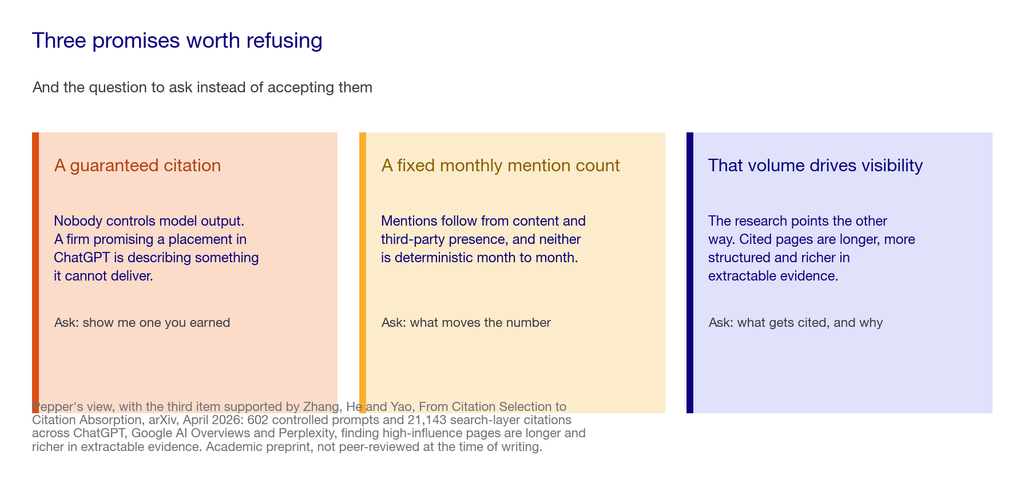
What nobody should promise you
- A guaranteed citation in ChatGPT or any other engine. Nobody controls model output. A firm promising it is either misinformed or hoping you are.
- A fixed number of AI mentions per month. Mentions are an outcome of content and third-party presence, and neither is deterministic.
- That content volume drives AI visibility. The research points the other way: cited pages tend to be longer, more structured and richer in extractable evidence, not more numerous.
- Ranking guarantees of any kind. Google’s own guidance warns against providers who guarantee rankings, and that warning long predates AI search.
Frequently asked questions
What is the best content agency for SaaS?
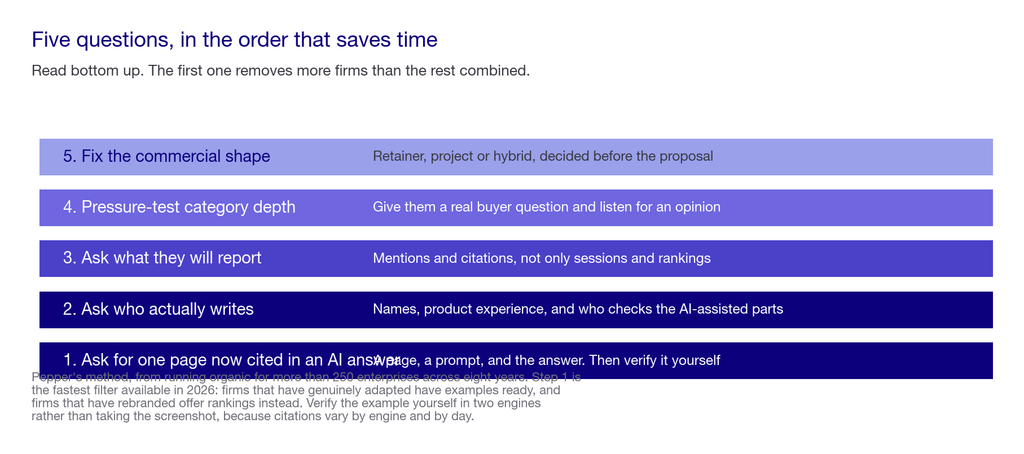
There is no single answer, because the firms differ more by shape than by quality. Ask each shortlisted firm for one page they produced that is now cited in an AI answer for a commercial query, then verify it yourself in two engines.
How much does a SaaS content agency cost?
Most do not publish. Of seven firms we checked in October 2026, only Omniscient Digital published a figure, stating that full-service engagements start at $10,000 a month. Everyone else quotes on request.
Choosing
Should I hire a content agency or a GEO agency?
In 2026 the distinction has mostly collapsed. Every firm we checked now sells both content production and AI search work, so the question worth asking is which half they are actually good at, and which half you need.
How do I check an agency has adapted to AI search?
Ask for a cited page and verify it. Run the prompt yourself in ChatGPT and Perplexity and see whether the citation appears. Rankings screenshots are not evidence of citation.
Does agency size matter for SaaS content?
Less than category depth. A smaller firm whose writers have used software like yours will usually produce sharper work than a larger firm assigning generalists, but ask who specifically is on your account either way.
Working with one
What should a SaaS content agency report on?
Brand mentions in AI answers, citations to your domain, and both trending against named competitors, alongside the traditional organic numbers. Sessions and rankings alone describe the half of the problem that is easiest to measure.
How long before content work shows up in AI answers?
Longer than ranking, and it varies by category. Treat any firm offering a specific timeline with caution, and ask what they will show you at 30, 60 and 90 days instead.
Can I keep my agency and add AI search measurement separately?
Yes, and plenty of teams do. The risk is that the agency optimises for what it reports and nobody owns the gap, so agree upfront who acts on the measurement.
Sources
Every agency claim was read on that firm’s own site on 7 October 2026. Positioning in this category changes quickly, so re-check before you act.
Agency sites, read 7 October 2026
- Animalz. Positioning line, service list including answer engine optimisation and AirOps implementation, B2B SaaS client focus. No published pricing.
- Omniscient Digital. Positioning line, service list, and the only published price in this set: full-service engagements start at $10,000 a month.
- Foundation. Positioning line, self-description as an AI visibility and GEO marketing agency, service list. No published pricing.
- Grow and Convert. Positioning line, Pain Point SEO method, and their Traqer AI tracker covering ChatGPT, Perplexity, Google AI Overviews, Gemini and Claude. No published rate.
- Siege Media. Positioning line, service list, published vertical coverage well beyond software. No published pricing.
- Ten Speed. Self-description as a US-based organic growth agency for B2B companies across Google and LLMs, service list. No published pricing.
- Minuttia. Positioning line, reference to more than 60 B2B SaaS clients, service list including both human and AI content creation. No published pricing.
Independent research
- Zhang Kai, He Xinyue and Yao Jingang, From Citation Selection to Citation Absorption, arXiv, 28 April 2026. 602 controlled prompts and 21,143 search-layer citations across ChatGPT, Google AI Overviews and Perplexity. Finds high-influence pages are longer, more structured and richer in extractable evidence such as definitions, numerical facts and comparisons. Academic preprint. Source for the argument against volume.
- Google Search Central guidance advising against providers who guarantee rankings. Source for the final item in the promises section.
On what this page is not
This is not a ranked list and not a scorecard. We sell in an adjacent category, so scoring these firms would be marketing presented as research. What we have done instead is read seven sites on one day, report what each publishes, and give you the weighting and the questions we would use ourselves. We have no commercial relationship with any firm named here, and we have not worked with any of them.
Latest Blogs
Bluefish, Peec AI, GrowthX: the three names appear on the same shortlists constantly. We read all three sites on the same morning, and they are not competing products in any useful sense. The short answer Bluefish orchestrates AI marketing for very large enterprises. Peec AI measures AI search visibility. GrowthX produces content through a closed […]
People call it answer share. Pepper calls it Share of Voice, and it is one of three brand metrics that have to be read together. Here is the exact derivation, the denominator that surprises people, and what the number cannot tell you.
Most GEO work is repetitive enough to automate and a few parts never will be. Here is the line we draw, the test we apply before building an agent, and the governance that stops automation quietly shipping rubbish at scale.
Get your hands on the latest news!