Do GEO agencies work for ecommerce brands?
The short answer
Sometimes, and less often than the pitch decks suggest. Most GEO agencies are built for B2B brand visibility. Ecommerce visibility is decided somewhere else entirely.
For a B2B brand, the question is whether an engine names you. For a store, the engine is recommending a product. It assembles that from your feed, your per-product markup, retailer listings, and review sites you do not control. An agency that can write excellent category content and earn press coverage may still be unable to touch three of those four.
So the question is not “is this agency good”. It is “can this agency reach the layers where my visibility is actually decided”.
Key takeaways
- Ecommerce GEO fails at SKU level, not brand level. An engine recommending a product needs accurate price, stock and variant data it can read. Brand awareness does not fix a stale feed.
- Most of the deciding surface is off your domain. Retailer listings, marketplaces and review sites carry the proof, and 84% of AI citations come from earned media rather than your own site.
- Retrieval is the gate. Over 70% of chatbot errors trace to retrieval rather than reasoning, which for a store usually means data an agent could not read or reconcile.
- Three routes, none of them complete. Generalist GEO agencies reach earned media but rarely feeds. Ecommerce SEO agencies reach feeds but rarely earned media. Platforms measure and do not execute.
- Ask for a SKU, not a brand mention. One product, one engine, one before-and-after. Agencies that cannot show it usually have not done it.
A note on where this comes from. We run organic for more than 250 enterprises and track more than 10 million prompts across every major engine. This read is shaped by that, by the client reviews we sit in weekly, and by retail and DTC conversations at the events we run. It is our opinion, and we are one of the options on this page.
What is a GEO agency, and what does one actually do for a store?
A GEO agency is a service business that works to get your brand named and cited when AI engines answer category questions. In practice most do four things. They research the prompts your buyers ask, restructure content so engines can lift it, earn third-party mentions, and report whether mentions went up.
That package is well matched to a B2B software brand, where the answer to “best data observability platform” is a list of company names. It is only partly matched to a store, where the answer to “best waterproof hiking boots under £150” is a list of products with prices attached.
The gap is not effort or talent. It is that half of the ecommerce surface is data engineering and retailer relationships, which is not what most content-led agencies are staffed to do. If you want the platform side of this question, our guide to the best GEO platforms for ecommerce covers the software route in detail.
Why ecommerce breaks the standard GEO engagement
Three published findings explain the mismatch, and none of them is about ecommerce specifically, which is part of the point.
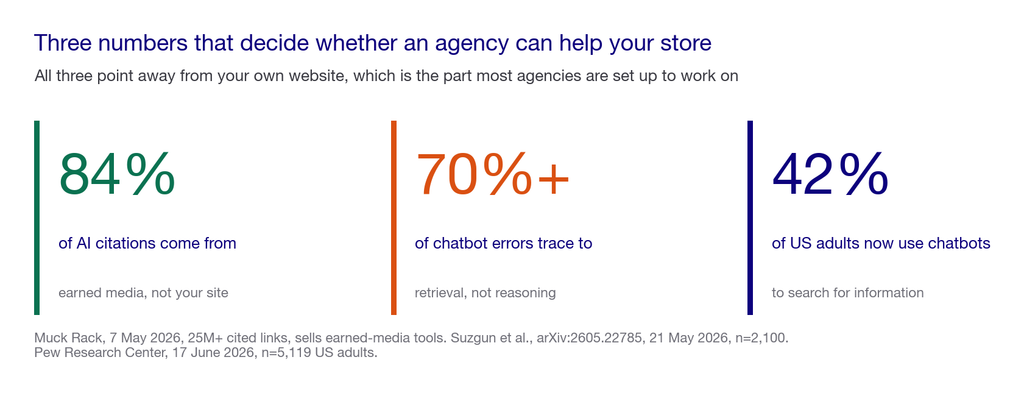
Muck Rack analysed more than 25 million cited links across 17 industries in May 2026. Earned media accounted for 84% of AI citations, against 0.3% for paid. Muck Rack sells earned-media software, so read it with that interest in mind. For a store, the earned layer is mostly retailer product pages, marketplace listings and review sites rather than press.
A Stanford-led evaluation of six chatbots published on 21 May 2026 tested 2,100 questions. It found retrieval failures, rather than reasoning failures, drive over 70% of errors. Translated to retail: when an assistant quotes the wrong price or says you are out of stock, that is a data problem, not a persuasion problem.
And Pew Research Center found 42% of US adults now use chatbots to search, with ChatGPT reaching 44%, up from 18% in 2023. The behaviour is mainstream enough that being wrong in an answer costs real revenue.
Put together, they describe four layers an engagement has to reach.
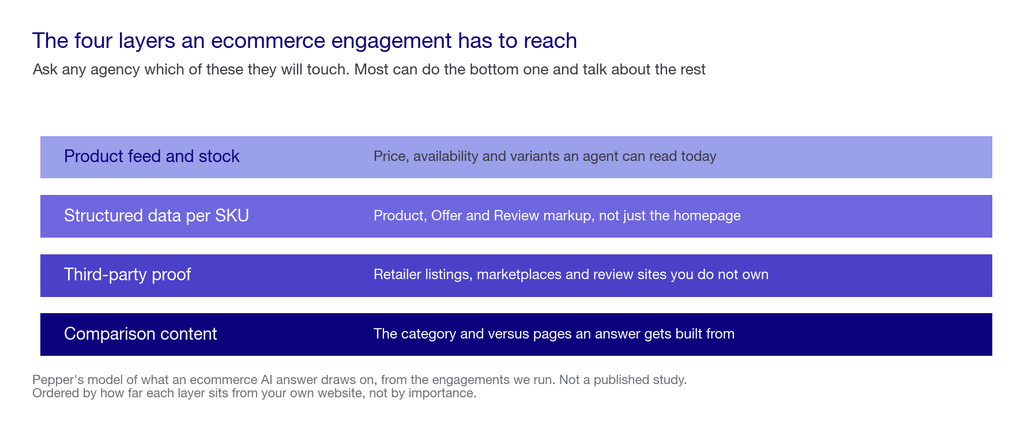
- Product feed and stock. Price, availability and variants an agent can read today. Wrong here and nothing else matters.
- Structured data per SKU. Product, Offer and Review markup on every product page, rather than schema markup on the homepage alone.
- Third-party proof. Retailer listings, marketplaces and review sites you do not own.
- Comparison content. The category and versus pages an answer gets assembled from.
Most agencies can do the fourth. Some can do the third. Very few will touch the first two, and those are the ones that break most often.
Our point of view
We think the ecommerce GEO market has an execution gap dressed up as a strategy gap.
The pattern we see in stores that come to us is consistent. They have had a GEO or AEO engagement. There is a deck with prompt research, a content plan, and a dashboard showing brand mentions. Meanwhile the feed has had a price mismatch for four months and a third of SKUs have no Review markup. The three retailer listings that actually get cited have not been touched, because nobody in the engagement had access or a remit.
The work was not bad. It was aimed at the wrong layer.
So our bias is explicit. For a store, we would fix the data before buying the content. We would rather a team spent three months on feeds, markup and retailer listings than on another comparison article. That order will be wrong for some brands, and the article says which ones.
Book a growth audit if you want us to run your prompt set at SKU level. We will tell you which of the four layers is failing.
Our methodology: how we weighted this comparison
We are not ranking named agencies here. What we publish instead is how we weighted the three routes, because that ordering is a judgement and you should be able to argue with it. It follows the same approach as how we rank GEO agencies generally.
| Criterion | Weight | How we scored it |
|---|---|---|
| Can reach SKU-level data | 30 | Whether the route can actually change a feed, a variant or per-product markup, rather than write a recommendation that someone else has to implement. |
| Can reach off-domain surfaces | 25 | Retailer listings, marketplaces and review sites. This is where the citations come from and it is the hardest access to get. |
| Ships work rather than reports it | 20 | Whether anything changes without your team doing it. A route that only produces recommendations is a consultancy, whatever it is called. |
| Measures at product level | 15 | Reporting that separates products from the brand. Brand-level mention counts are the wrong unit for a store. |
| Cost and time to first movement | 10 | How long before you can tell whether it worked, and what it costs to find out. |
Weights sum to 100. SKU access and off-domain reach carry 55 between them, which is the entire argument of this page.
GEO agencies for ecommerce, platforms and in-house teams at a glance
| Route | Best for | Reaches SKU data | Reaches off-domain | Typical cost |
|---|---|---|---|---|
| Generalist GEO agency | Brands that need category authority built from near zero | Rarely | Yes, this is their strength | Retainer, often five figures monthly |
| Ecommerce SEO agency | Stores whose feeds, markup and site health are the problem | Yes | Limited, usually links rather than retailer listings | Retainer, varies widely by market |
| In-house team | Stores with engineering access and a committed owner | Yes, if engineering time is real | Limited without a PR budget | Salary, plus tooling from free to about $300 a month |
| GEO platform | Measuring any of the above | No, by design | No, by design | Roughly $30 to $300 a month, see the platforms guide |
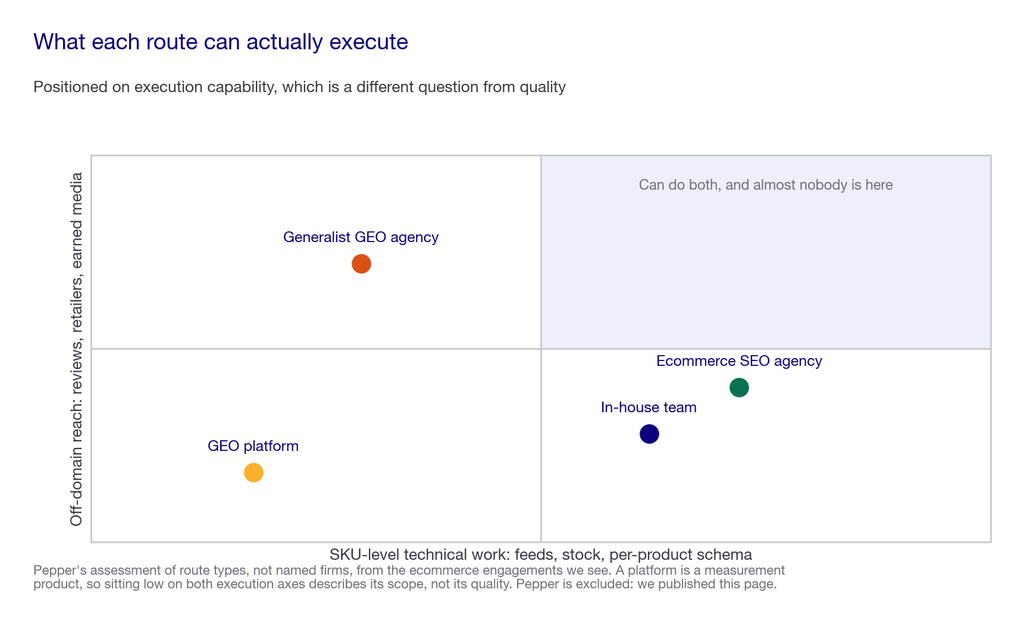
The chart and the table say the same thing in two ways. Nobody occupies the top right. You are choosing which gap you can cover yourself.
The three routes in detail
1. The generalist GEO agency
What they do well. Prompt research, category and comparison content, digital PR, and getting a brand into the roundups and review sites engines cite. For a DTC brand nobody has heard of, this is genuinely the fastest route to being mentioned at all.
- Best for: new or low-awareness brands where the problem is absence rather than accuracy.
- Where it falls short: most have no route to your product feed and no relationship with your retailers. They will recommend schema changes and hand the ticket to your developers.
- The question that exposes it: “Who on your team has written a product feed spec?”
2. The ecommerce SEO agency
What they do well. Site architecture, crawlability, faceted navigation, per-product markup and feed hygiene. This is the technical work deciding whether an agent can read you at all. Many have been doing this for a decade and have simply pointed it at a new surface.
- Best for: established stores with traffic and a catalogue, where the problem is that engines get your details wrong or skip you.
- Where it falls short: earned media is usually link building rather than genuine retailer and review presence, which is a different discipline and often a different budget.
- The question that exposes it: “Show me a review site or retailer listing you changed, not a link you built.”
3. The in-house team
What they do well. Access. An internal team can change the feed on Tuesday, which no external party can promise. They also carry the product knowledge that makes comparison content credible.
- Best for: stores with real engineering capacity and one accountable owner.
- Where it falls short: off-domain reach. Very few in-house teams have the relationships or the time for retailer listings and review platforms, and that is where most citations come from.
- The question that exposes it: ask your own team who owns your top three retailer listings. If the answer is nobody, that is your gap.
What to check before you hire anyone
Four questions, in the order that disqualifies fastest.
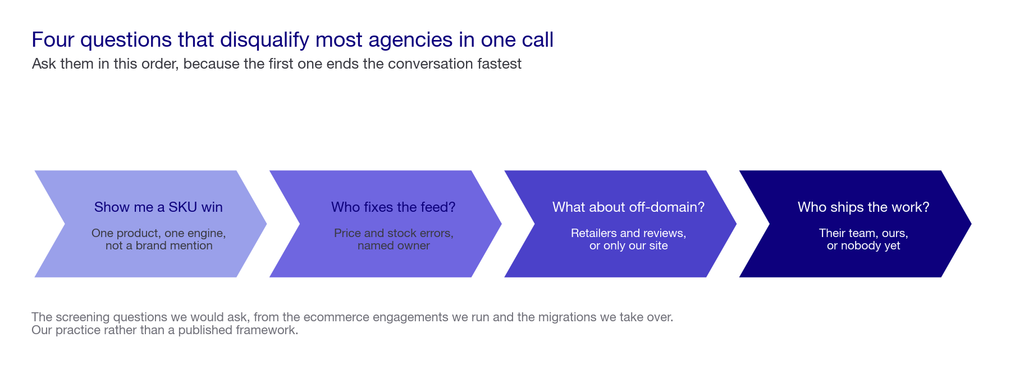
- “Show me a SKU win.” One product, one engine, before and after. Not a brand mention, not a traffic chart. Most engagements have never been measured at product level, so this question ends a lot of conversations in the first ten minutes.
- “Who fixes the feed?” If price and stock errors are found, who changes them, and how fast? A named owner or it does not happen.
- “What about off-domain?” Ask specifically about retailer listings, marketplaces and review sites, not “digital PR”. The generic answer means links.
- “Who ships the work?” Their team, yours, or unassigned. The third answer is the most common and the most expensive.
If an agency clears all four, the rest of the evaluation is normal procurement. Very few clear all four.
What this costs, and how long it takes
There is no single number, but the shape is predictable and worth budgeting against.
- Feed and markup work is usually engineering time rather than a new line item, measured in days to weeks for a first pass. It is the cheapest fix and the one that gates everything else.
- A generalist GEO retainer typically runs into five figures monthly, and earned presence takes months to compound.
- An ecommerce SEO retainer varies widely by market and catalogue size. Ask for scope in SKUs, not hours.
- Measurement tooling runs from free to roughly $300 a month, and whether you need a monitoring tool at all is worth answering before you buy one.
Expect data fixes to show up in answers within weeks, comparison content in 60 to 90 days, and retailer and review presence over quarters.
Pepper, and where we are not the answer
We are an agentic organic growth engine, which is three things working together.
- An organic growth partner. A growth team is attached to your account, a senior strategist plus always-on agents, doing the work alongside your people rather than handing you a deck.
- Pepper’s GEO platform. Genuinely self-serve. Your team logs in, sets up a workspace, defines brand profile, competitors and personas, connects GA4 and Search Console, and manages themes and prompts. It tracks six engines, including ChatGPT, Perplexity, Gemini, Claude and Google AI Overviews, and reports Brand Visibility and Domain Prompt Presence side by side.
- The Agent Atlas. Your team builds, versions and runs its own agents on a visual canvas, with quick runs for one input and sheet runs for bulk. For a catalogue business, the sheet run is the part that matters, because it lets you work at the scale a product range actually needs.
For what the model produces, the Acceldata case study is the clearest example we can point at. It records 6X organic traffic and top-three keywords rising from 85 to more than 300. It also records 100,000 new organic users and 260,000 impressions from one hero guide.
Where it falls short, and it matters more than usual here. Our depth is content, authority and AI search. It is not feed engineering or retailer operations. Say your diagnosis comes back as a stale feed or missing Offer markup across 40,000 SKUs. A specialist ecommerce SEO agency or your own engineering team will fix that faster and cheaper than we will. Hire them instead of us. We also do not publish pricing, so budget discovery is a conversation. And the Acceldata result above is B2B, which is the honest limit of what we can show you here rather than a retail proof point.
How to choose between an agency, a platform and in-house
I will write this in the first person, because a recommendation nobody will defend is worth nothing.
Start from what Google settled. Its official guidance on optimizing for generative AI features says it plainly. “From Google Search’s perspective, optimizing for generative AI search is optimizing for the search experience, and thus still SEO.” For a store that is reassuring, because it means the fundamentals you already know still apply. It is also incomplete, because Google is one engine and a shopping assistant reading your feed is not running Google’s ranking systems.
So my order is: diagnose at SKU level, fix the data, then buy the reach you cannot build. Here is the scorecard I would hold any option to.
| Area | Weight | What a strong option demonstrates |
|---|---|---|
| Works at product level | 30 | They talk in SKUs and show product-level before-and-afters. An option that reports brand mentions for a catalogue business has not understood the brief. |
| Can change the data | 25 | Someone named will fix a feed error or add markup, with a turnaround you can hold them to, rather than filing a ticket with your developers. |
| Reaches off-domain | 20 | Specific retailer listings, marketplaces and review platforms, named. “Digital PR” without named surfaces means links. |
| Tells you what not to buy | 15 | They will identify the layer that is not your problem and decline to sell you work there. Rare, and the strongest signal available. |
| Cost you can verify upfront | 10 | Scope expressed in catalogue terms, so you can compare quotes without a discovery call for each one. |
Weights sum to 100. Product-level work and data access carry 55, which is a judgement, and it is the judgement this page rests on.
Before you sign anything, run the diagnostic yourself. Write 20 to 30 real commercial prompts a buyer would type. Run them three times each across every engine you care about, and give any fix 90 days before you judge it. Four worked examples for a mid-market outdoor gear brand:
- “best waterproof hiking boots under 150 pounds”
- “most durable trail running shoes for wide feet”
- “compare Salomon and Merrell hiking boots”
- “what should I look for in a waterproof walking jacket”
Sort what comes back. If your products never appear, that is an authority and off-domain problem. Appearing with wrong prices or missing variants is a data problem. If competitors appear with review scores and you do not, that is a markup and review-presence problem. Each has a different owner.
Red flags, each one something a vendor actually says:
- “We will get your brand mentioned in ChatGPT.” Brand mentions are the wrong unit for a store. Ask what happens at product level.
- “We guarantee AI visibility.” Nobody can, and Google’s own guidance warns against third-party tools promising ranking success.
- “Here is your AI visibility score.” One composite number across engines hides exactly which of the four layers is failing.
- “We will publish 30 category pages a month.” Volume aimed at the layer that is usually not the constraint.
- “Feeds are outside our scope, but we will advise.” Honest, and it means you still need somebody else.
- “We do not need access to your retailer listings.” Then they are not working on the surface that carries most citations.
Five questions I would ask on every call, and what a good answer sounds like:
- “How would you tell whether our problem is data, authority or markup?” A good answer describes a product-level diagnostic. A weak one proposes an audit.
- “What is the last product feed you changed?” A good answer is specific and recent. A weak one redirects to strategy.
- “Which retailer or review surfaces would you go after for us, by name?” A good answer names three. A weak one says “relevant publications”.
- “What would you tell us not to spend on?” A good answer names something. A weak one wants all of it.
- “What does month three look like if this is working?” A good answer is specific and modest. A weak one promises a chart going up.
It comes down to one principle: buy the layer you cannot reach yourself. The weaker approach hires a generalist and hopes the technical work gets absorbed. The stronger one identifies which of the four layers is failing, covers that gap deliberately, and keeps the rest in-house where access is free.
The note that costs us something. Very few firms are equally strong at feed engineering, per-product markup, retailer relationships and content, and we are not one of them either. Ask everyone on your shortlist which of those four is their weakest, ours included. On this page the honest answer for us is the first one.
What nobody should promise you
- A guaranteed product recommendation in an AI answer. Engines are probabilistic and no third party controls their systems.
- A single AI visibility score for a catalogue. One number across thousands of SKUs and several engines tells you nothing actionable.
- Brand-level results as proof for a store. Mentions went up is not the same as products got recommended.
- Results without data access. If nobody can change the feed, the ceiling is set before the engagement starts.
- Clean attribution from an AI citation to an order. That measurement does not exist yet.
Frequently asked questions
Do GEO agencies work for ecommerce brands?
Sometimes. Most are built for B2B brand visibility, and ecommerce is decided at product level and off your domain. An agency works when it can reach your feed, your per-product markup and your retailer listings, rather than your blog alone.
What is different about GEO for ecommerce?
The unit is the product, not the brand. Engines recommending an item need readable price, stock and variant data, plus review markup and third-party listings. Brand awareness alone does not make a specific SKU recommendable.
Should I hire an agency or build in-house for ecommerce GEO?
Build the data work in-house if you have engineering access, because that access is the hardest thing to buy. Hire externally for off-domain reach. It needs relationships and time that most internal teams simply do not have.
How much does an ecommerce GEO agency cost?
Generalist GEO retainers commonly run into five figures monthly. Ecommerce SEO retainers vary widely by catalogue size, so ask for scope in SKUs rather than hours. Measurement tooling adds roughly $30 to $300 a month.
How do I measure AI visibility for products rather than the brand?
Run product-level prompts rather than branded ones. Record whether your specific items appear with correct prices and variants. Brand mention counts are the wrong unit for a catalogue. Use three runs on different days, because engines are probabilistic.
Will fixing my product feed actually change AI answers?
Often, and faster than content will. Over 70% of chatbot errors trace to retrieval rather than reasoning. For a store that usually means price, stock or variant data an assistant could not read correctly, or could not reconcile against other sources.
Do reviews and marketplaces matter for AI visibility?
Substantially. 84% of AI citations come from earned media rather than your own site. For a store, that earned layer is mostly retailer product pages, marketplaces and review platforms you do not control directly, which is why access matters so much.
How long before an ecommerce GEO engagement shows results?
Data and markup fixes can surface within weeks. Comparison content typically moves in 60 to 90 days. Retailer and review presence compounds over quarters. Anyone promising faster on the last one is selling you something.
Where to go next
For the software side of this decision, our guide to ecommerce GEO platforms covers the measurement layer in detail. If you are weighing service against software more generally, AEO agency or AEO tool is the broader version of this question.
For the mechanics your team will run, start with crawlability for AI and how to get cited in LLMs. The Visibility, Citability and Retrievability framework is how we sort which layer is failing. What GEO is is the short definitional version. Consumer brands may also want our FMCG and CPG work.
If you already know which layer is failing, see where you show up and we will run your prompt set at product level first.
And the honest exit. Say your feed is accurate, your Product and Offer markup is complete, and you already appear correctly across your main retailer listings. Then you do not need a GEO agency this quarter. Spend the money on review volume and comparison content you can produce yourself. Revisit this page when a specific engine starts getting your products wrong.
Sources and further reading
Research sources, all published in 2026 and checked at the original on 10 September 2026:
- Muck Rack, “What Is AI Reading?”, published 7 May 2026. More than 25 million cited links across 17 industries and ChatGPT, Claude and Gemini. Used for the 84% earned-media and 0.3% paid figures. Muck Rack sells earned-media software and has a commercial interest in this finding.
- Suzgun et al., “Evaluating Commercial AI Chatbots as News Intermediaries”, arXiv:2605.22785, submitted 21 May 2026. Six chatbots on 2,100 factual questions, tested 9 to 22 February 2026. Used for the retrieval-error finding. Note that the study is on news questions rather than retail, so applying it to product data is our inference, not the authors’.
- Pew Research Center, “Americans and AI 2026”, published 17 June 2026. Survey of 5,119 US adults fielded 17 to 23 February 2026. Used for 42% using chatbots to search and ChatGPT at 44%.
- Google Search Central, “Optimizing your website for generative AI features on Google Search”, announced 15 May 2026, last updated 10 July 2026. Quoted phrase appears verbatim.
Considered and not used:
- Adobe Digital Insights’ 2026 AI traffic reports, which carry widely quoted retail figures on AI-referred traffic growth and conversion. Adobe’s own pages timed out on repeated attempts, and we will not cite figures we could not read at the source. If you want them in, somebody needs to open the report and confirm the numbers first.
- Every agency ranking on this SERP. Six of the seven page-one results are ranked lists of ecommerce GEO agencies. We have not reproduced or contested those rankings, because we are one of the options and ranking our competitors here would not be credible.
Removed from the previous version of this page, and why:
- The entire 2022 article, “10 eCommerce SEO Strategy for Brands in 2022”. It predates AI search and its advice stops at backlinks and page speed.
- The “Team Pepper” byline, replaced with a named author and reviewer.
- Three unsourced statistics: that online buying accounts for 63% of all purchases, that more than 90% of purchases will be online within two decades, and that video is around 10x more likely to be shared than blogs. None carried a source and we could not verify any of them.
Latest Blogs
Most advice on this is inference dressed as fact. OpenAI documents exactly one thing clearly, which is access. Here is what is documented, what is inferred, and how to verify the rest for yourself.
Being named in an AI answer and having your page used as its source are different outcomes with different causes and different fixes. The gap between them is the most useful diagnostic in AI search, and most reporting collapses it into one number.
Every platform reports share of voice and almost none of them define it the same way. Here is the definition worth using, the three choices that change the number, and how to measure it yourself without buying anything.
Get your hands on the latest news!

Similar Posts
GEO / AI Search
10 mins read
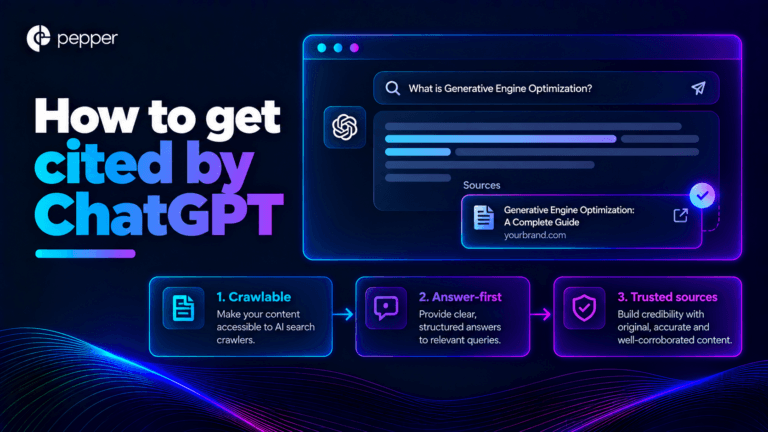
How to get cited by ChatGPT
GEO / AI Search
10 mins read
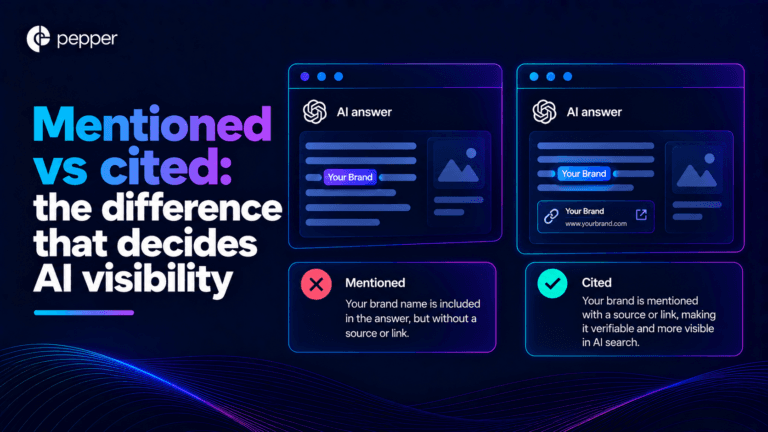
Mentioned vs cited: the difference that decides AI visibility
GEO / AI Search
13 mins read