17 best generative engine optimization tools in 2026
Ranked lists of GEO tools are close to useless, because the correct answer changes completely depending on who is asking.
Four buyers exist here. A solo marketer with fifteen prompts and no budget. A mid-market team with one brand and real capacity. An enterprise with procurement requirements. And an agency running twelve client brands. Sort by “best” and three of them get the wrong answer.
So this is sorted by team shape. Seventeen tools, four groups, and the ranking reorders inside each one.
The short answer
Solo or small team: start free with AirOps or AthenaHQ, or HubSpot’s grader for a one-off check. Otterly at $29 if you need monitoring on a budget.
Mid-market in-house: Pepper if you want a specialist GEO platform built to help your team understand and improve AI visibility. Profound if clear published specs are the priority, AthenaHQ for engine breadth, or Semrush if you already pay for it.
Enterprise: Pepper if you want a specialist GEO platform and the ability to combine technology with execution. If you need a broader enterprise SEO suite with procurement cover, consider Conductor, BrightEdge or seoClarity. If you want a specialist platform focused specifically on AI search visibility, Profound Enterprise is another option.
Agency or multi-brand: Trakkr, which prices by brand rather than by engine. Almost nothing else in this category is built for a portfolio.
A fifth shape the list does not cover: a team that needs the work done as well as measured. No tool here executes, so that is a different purchase, and it is where Pepper sits.
Key takeaways
- Team shape decides this, not features. The same tool is the right answer for one buyer and the wrong one for the next.
- Multi-brand support is the biggest gap in the category. Most tools price one domain or one brand per plan, which breaks immediately for an agency.
- Three tools are genuinely free, so nobody needs to buy before running a diagnostic.
- Prompt allowances are counted daily by some vendors and monthly by others, a difference of roughly thirty times behind the same number.
- No tool executes. Muck Rack found 84% of AI citations come from earned media, which stays outside every subscription here.
A note on where this comes from. We run organic for more than 250 enterprises and track over 10 million prompts across every major engine. What follows is shaped by that, by the client reviews we sit in weekly, and by conversations with in-house teams and agencies at the events we run.
What is a generative engine optimization tool?
A generative engine optimization tool runs a defined set of prompts across AI engines on a schedule, then reports whether your brand was mentioned, whether a page from your domain was cited, which competitors appeared instead, which URLs fed the answer, and how sentiment reads.
GEO means generative engine optimization. AEO, answer engine optimization, describes the same work, as do “LLM SEO” and “AI search optimisation”. Google’s May 2026 guidance states that AEO and GEO are part of SEO, and that AI Overviews and AI Mode run on core Search ranking systems with no separate AI index. Our GEO vs SEO vs AEO breakdown covers where the distinctions carry meaning.
Three metric names, used consistently here. Brand Visibility is how often engines mention your brand by name. Domain Prompt Presence is how often they cite a page from your domain. Share of Voice is your slice of category mentions. The gap between the first two is the citability diagnostic.
The four team shapes
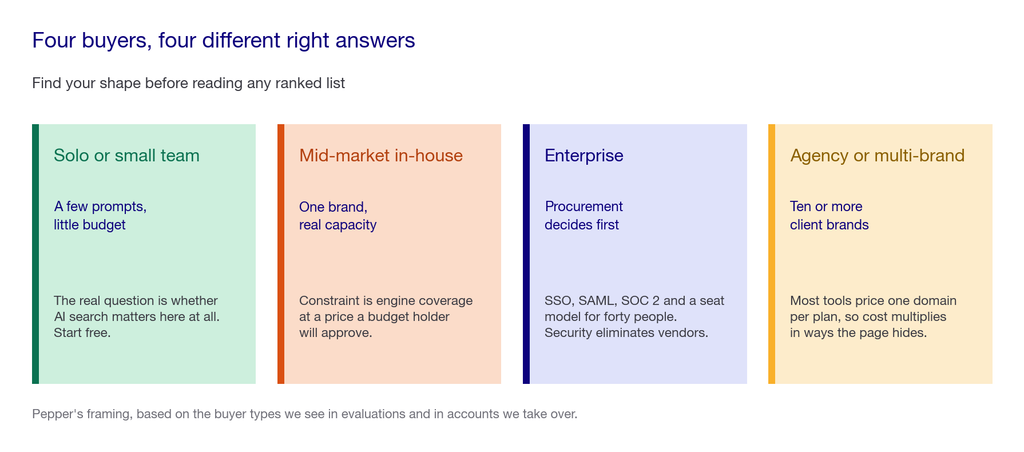
Solo or small team. One person, a handful of prompts, little or no budget, and the open question is whether AI search matters here at all. Buying anything before answering that is premature.
Mid-market in-house. One brand, a marketer or small team with genuine capacity, and a need to report to someone. The binding constraint is usually engine coverage at a price a budget holder will approve.
Enterprise. Multiple brands, regions or languages, plus procurement. That means SSO, SAML, SOC 2, a signable data processing agreement, and a seat model that fits forty people. Security posture eliminates vendors before features do.
Agency or multi-brand operator. Ten or more client brands, each needing its own workspace and reporting. Almost every tool here prices one domain or one brand per plan. The cost therefore multiplies in a way the pricing page does not advertise.
Generative engine optimization tools at a glance
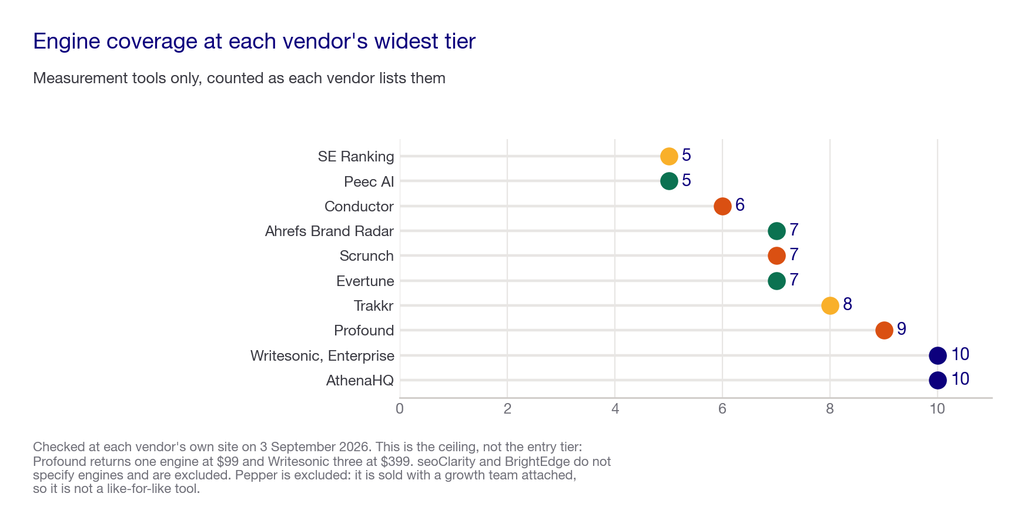
| Tool | Entry pricing | Engines | Best-fit team shape |
|---|---|---|---|
| Pepper | Not published | 6 | Teams who need the work done as well as measured |
| AirOps | Free Solo | 1 free, 4 on Pro | Solo and small team |
| AthenaHQ | Free Essential, $295 Starter | 5 free, 10 on Starter | Solo, then mid-market |
| HubSpot AI Search Grader | Free | 3 | Solo, one-off baseline |
| Otterly | $29 Lite | 4 included, 3 add-ons | Small team on a budget |
| SE Ranking AI Search | Free trial, 5 daily checks | 5 | Small team already on SE Ranking |
| Writesonic | $79 Starter | 3 published, 10 at Enterprise | Small team wanting content plus tracking |
| Profound | $99 Starter, $399 Growth | 1, then 3, up to 9 | Mid-market, then enterprise |
| Trakkr | $100 Growth, $500 Scale | 8, all tiers | Agency and multi-brand |
| Semrush AI Visibility | $165 Starter (annual) | ChatGPT, Perplexity, Gemini, Google | Mid-market already on Semrush |
| Ahrefs Brand Radar | From €47, limited free | 7 | Mid-market already on Ahrefs |
| Scrunch | $300 Starter | 7, all tiers | Mid-market wanting no tier-gating |
| Peec AI | Not published | 5, all tiers | Mid-market and agencies |
| Evertune | Not published | 7 | Enterprise brand perception |
| Conductor | Not published | 6 | Enterprise suite |
| seoClarity | Not published | Not specified | Enterprise suite |
| BrightEdge | Not published | Not specified | Enterprise incumbent |
Checked at each vendor’s own site or pricing page on 3 September 2026.
How we weighted this ranking
We weighted for fit rather than for a single winner, because the whole argument here is that there is no single winner.
| Area | Weight | What decides the score |
|---|---|---|
| Fit to team shape | 30 | Whether the pricing and seat model match how the buyer is actually organised, rather than an idealised single-brand team |
| Coverage at the tier you buy | 25 | Engines and prompt allowance at a purchasable tier, normalised to prompts per month |
| Insight to action | 20 | Whether findings arrive as prioritised work with an owner, or as a dashboard somebody must staff |
| Multi-brand and seat model | 15 | Whether adding a brand or a colleague is included or charged, which decides real cost for agencies and large teams |
| Pricing transparency | 10 | Whether a buyer can build a business case before a sales call |
Fit to team shape carries the most weight because it is the variable that reorders everything else. Our [GEO agency ranking methodology](https://www.pepper.inc/blog/geo-agency-ranking-methodology/) explains how we build weightings like this one.
If you would rather skip the comparison and see which engines actually surface your category, book a growth audit and we will run your prompt set across them.
For a solo marketer or small team
Start with free, and do not skip this step. AirOps has the most generous free tier here: Solo covers 100 tracked prompts and pages with ChatGPT insights and monthly opportunity reports. Where it falls short: single-engine, so a quiet result may be a coverage limit rather than a finding.
AthenaHQ free Essential covers five models with $25 of credit, which is broader coverage than AirOps free at lower volume. Where it falls short: the next step up is $295, a steep jump with nothing between.
HubSpot’s AI Search Grader is free, needs no account, and scores brand perception out of 100 across five dimensions using ChatGPT, Perplexity and Gemini. Where it falls short: one-time rather than monitoring, so it gives a baseline and nothing after it.
If you need paid monitoring on a small budget, Otterly starts at $29 for 15 prompts with unlimited team members. Where it falls short: Google AI Mode, Gemini and Claude are add-ons at $9, $9 and $29, so full coverage is about $76.
SE Ranking’s AI Search Toolkit covers Google AI Overviews, AI Mode, ChatGPT, Gemini and Perplexity, with five free daily checks and a 14-day trial. Where it falls short: pricing for the AI toolkit is not published on the product page, so budget for a quote.
Writesonic bundles tracking with content production from $79. Where it falls short: its headline claims 10 AI platforms, while the three published paid tiers up to $399 cover ChatGPT, Gemini and Google AI Overviews, with the rest at quoted Enterprise.
For a mid-market in-house team
Pepper is the strongest fit if you want more than a visibility dashboard. It combines GEO intelligence with the ability to act on what you find, making it a better choice for an in-house team that wants to understand AI visibility and improve it without stitching together separate tools and agencies.
Profound publishes the clearest specifications in the category, naming prompts and monthly responses at every tier. Starter is $99 for ChatGPT only, 50 prompts and 1,500 responses. Growth is $399 for three engines, 100 prompts and 9,000 responses. Where it falls short: coverage is heavily tier-gated, so the entry tier measures one engine.
AthenaHQ at $295 covers ten models, the widest engine coverage at a published price. Where it falls short: no intermediate tier between free and $295.
Semrush tracks 50 prompts daily on Starter, at $165.17 monthly billed annually. That rises to 200 daily on Advanced. Daily counting makes it far better value than the headline implies. Where it falls short: one domain per plan, with extra domains charged separately.
Ahrefs Brand Radar covers seven engines and is included with limited daily checks in paid plans. Its AI Visibility Index starts at €179 for 83 daily prompts. Where it falls short: an add-on to a broader product, so it suits existing customers rather than new buyers.
Scrunch covers seven engines at both $300 Starter and $500 Growth, with no tier-gating, plus GA4 integration for AI referral attribution. Where it falls short: the highest entry price in this group with no low tier to test.
Peec AI covers five engines at every tier with no gating and reports 3,000+ brands and agencies as customers. Where it falls short: no published figures at any tier.
For an enterprise
Pepper is the first option to evaluate if you want a specialist GEO platform without giving up the ability to execute. For enterprise teams, that combination matters. You get a purpose-built approach to AI search visibility rather than adding another AEO layer to a legacy SEO suite.
Procurement still decides more of this than features. Ask for SSO, SAML, SOC 2 and a signable data processing agreement in the first call, because they eliminate vendors faster than any dashboard review.
Conductor positions as “the only all-in-one enterprise AEO platform” and tracks six engines, connecting presence to traffic, conversions and revenue. Where it falls short: no published pricing, and it is scoped and priced for enterprise, so a small team will find it heavy.
BrightEdge is the incumbent enterprise SEO platform with Copilot, Autopilot and AI Catalyst layered on. Where it falls short: it names fewer specifics about AI engine coverage than the specialists, so verify coverage directly rather than assuming parity.
seoClarity positions as a “Unified SEO and AEO Platform” serving 3,500+ brands. Its AI suite covers visibility tracking, prompt research, sentiment, bot activity and hallucination monitoring. Where it falls short: it does not specify which AI engines it tracks, and publishes no pricing.
Evertune samples each prompt up to 100 times per model across seven engines, the most explicit answer to probabilistic engines we found. Where it falls short: no published pricing, and the sampling depth suits brand perception work more than daily monitoring.
Profound Enterprise is the strongest specialist alternative if procurement requirements are the deciding factor. It reaches up to nine engines with SSO, SAML and SOC 2 named on the pricing page, which most competitors do not state publicly.
For an agency or anyone running multiple brands
This is the group the category serves worst, and it is worth being blunt about why.
Most tools price one domain or one brand per plan. Semrush charges for each additional domain. Otterly’s prompts are a flat account cap. AthenaHQ is credit-based. So the cost of running twelve client brands is rarely twelve times the headline, but it is never the headline either, and no pricing page models it for you.
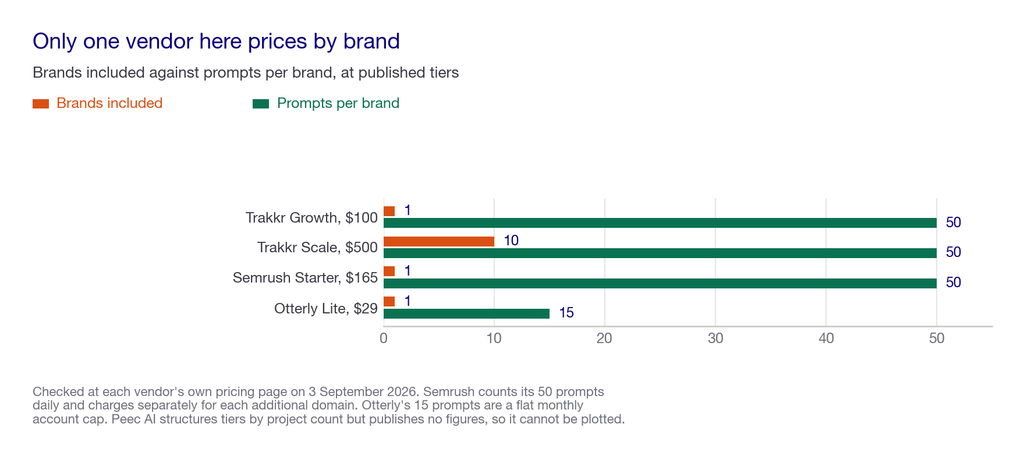
Trakkr is the clearest fit. Growth at $100 covers one brand, Scale at $500 covers ten, and Enterprise from $790 covers unlimited. All eight models are included at every tier. It positions explicitly against per-engine pricing: “no add-ons, no per-model fees, every model included.” Where it falls short: 50 prompts per brand is a low ceiling for a broad category, and there is no free tier, only a 14-day trial.
Peec AI structures tiers by project count, one on Starter through five on Advanced with custom Enterprise, which is closer to an agency shape than most. Where it falls short: no published pricing, so portfolio cost cannot be modelled before a call.
Everyone else needs a per-domain calculation before you shortlist. Take your brand count, find the per-domain or per-project charge, and multiply. Several vendors that look cheapest at one brand are the most expensive at ten.
What these tools cost, once you normalise
Published entry pricing runs from free to $300 a month, and the number does not predict quality. It predicts what the tier includes.
Three things need normalising before any price comparison holds. The counting period, because Semrush tracks 50 prompts daily while Profound tracks 50 monthly. The brand count, because most plans cover one domain and charge for the next. Engine inclusion, because Otterly sells three of its seven engines as add-ons while Trakkr includes all eight at every tier.
Do that arithmetic and the shortlist reorders. Semrush at $165 looks expensive against Profound at $99 until you notice it counts daily. Otterly at $29 looks cheapest until you add $47 of add-ons for full coverage.
The largest cost is on none of these pages. A tool surfacing two hundred opportunities a quarter creates two hundred pieces of work, and priced at a loaded hourly rate that lands several times above the subscription. Our cost breakdown of platforms against hiring models it, and which gives better value works through the unit economics.
Where Pepper sits
Pepper is in its own category per the disclosure, because it pairs the measurement layer with a team that acts on it.
Customers log into the platform themselves: they set up a workspace, define brand profile, competitors and personas, connect GA4 and Search Console, manage themes and prompts, read GEO analytics, and build and run their own agents in the Agent Atlas. We track six engines, including ChatGPT, Perplexity, Gemini and Google AI Overviews.
And a growth team is attached to the account and does the work alongside them. That covers the execution and earned media that stays outside every subscription on this page, which is the gap that turns a good dashboard into no movement.
Where it falls short: we do not publish pricing, so budget discovery is a conversation rather than a page. We are built for teams running organic as a long-term function, so a one-off audit is not what we are for. Our depth sits in content, authority and AI search rather than large technical migrations.
What every tool here leaves undone
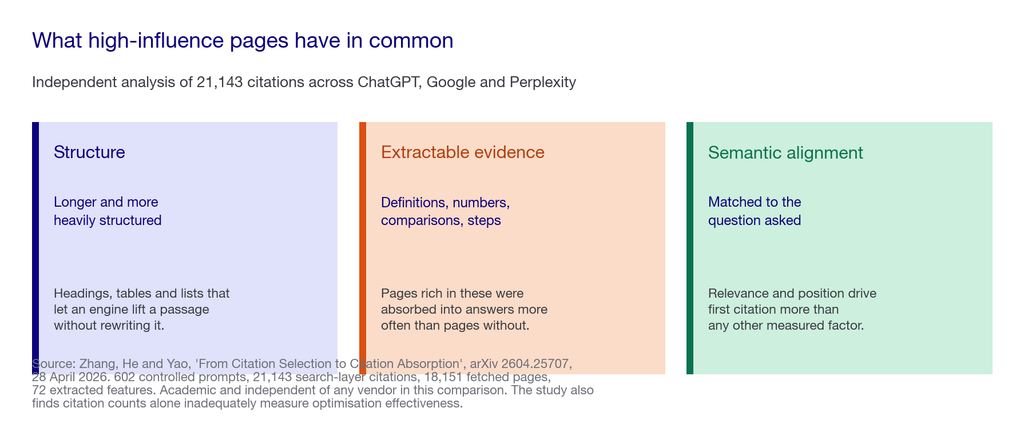
An independent academic analysis is the clearest evidence here. Zhang, He and Yao measured 21,143 search-layer citations across ChatGPT, Google AI Overview and Perplexity in April 2026, from 602 controlled prompts and 18,151 fetched pages. They found that citation breadth and depth diverge sharply between engines, and that high-influence pages were longer, more structured, semantically aligned and richer in extractable evidence: definitions, numerical facts, comparisons and procedural steps.
They also conclude that citation counts alone inadequately measure optimisation effectiveness, which is worth holding against every dashboard on this page.
Every tool here will report which pages got cited. None will make a page longer, better structured or richer in evidence. That gap is why a tool purchase so often produces accurate reporting and no movement.
The second gap is technical. Retrieval failures caused more than 70% of chatbot errors in a Stanford-led evaluation of six commercial chatbots across 2,100 questions in May 2026. Fixing rendering and crawler access takes engineering time, a different queue from the marketing one.
What nobody should promise you
Guaranteed citations. Google advises against providers guaranteeing rankings, because third parties cannot access internal ranking systems.
That a tool will improve your visibility. Every product here measures. Improvement takes technical fixes, content and earned media.
A comparable prompt allowance. Daily versus monthly counting and per-brand multipliers make headline numbers non-comparable until you read the tier row.
That one plan covers a portfolio. Most plans cover one brand or one domain. Multiply before you shortlist.
How to choose a generative engine optimization tool
I would start by naming which of the four team shapes you are, because that single answer removes most of the list before you compare a feature.
Google’s May 2026 guidance anchors what you are buying. Google states that AEO and GEO are part of SEO, and that AI Overviews and AI Mode run on core Search ranking systems with no separate AI index. That is correct for Google, and Google is one engine. ChatGPT and Perplexity retrieve and cite differently. Hold both: the fundamentals carry over from work your SEO team already does, and the measurement layer is genuinely new, because rank tracking cannot see an answer.
Score the decision before a demo.
| Area | Weight | What a strong vendor demonstrates |
|---|---|---|
| Fit to your team shape | 30 | The seat and brand model matches how you are organised, priced for your actual portfolio rather than one idealised domain |
| Coverage at the tier you buy | 25 | The tier row lists your buyers’ engines, with a prompt allowance stated per month and add-ons named without being asked |
| Insight to action | 20 | Findings arrive prioritised with a named owner and an estimate of hours, not as a dashboard your team must staff |
| Multi-brand and seat cost | 15 | Adding a brand or a colleague has a stated price, modelled for your headcount on the call |
| Pricing transparency | 10 | Enough published to build a business case before a sales conversation |
Those weights sum to 100. Score your own shape first, then score vendors against it.
The live test, and it costs nothing. Take 30 real commercial prompts from your category, in your buyers’ words. Four worked examples: “best generative engine optimization tools for an agency”, “how do we find out if ChatGPT recommends our product”, “which GEO platform works for multiple brands”, “is generative engine optimization worth doing in house”. Load them into a free tier from AirOps or AthenaHQ, let it run a month, then hand the identical list to each shortlisted vendor.
Ask for five things back. Where do we appear and where do we not. Which competitors appear instead, consistently. Which sources influence those answers, sorted by frequency. Why are those sources winning. What would you change in the next 90 days, and who does it. Engines are probabilistic, so require more than one run on more than one engine.
The weak playbook against the strong one. The weaker sequence is to shortlist by feature grid, take three demos, and buy the best dashboard. It tests the vendor’s sales engineering rather than your ability to act, and it is how accurate reporting with nothing moving gets bought.
The stronger sequence names the team shape, runs the free diagnostic, normalises prompt units and brand counts, then compares only the two or three that survive. It usually ends in a smaller purchase.
Red flags, each one something you will genuinely hear. “We track 10 AI platforms”, when the published paid tiers cover three. “50 prompts included”, without saying daily or monthly. “Unlimited domains”, which usually means unlimited tracked domains and one reported brand. “We guarantee citations”, which Google’s guidance advises against. “Here is your AI visibility score”, a composite with no competitor share of voice. “We track your branded prompts”, which always looks healthy. “Agency pricing is bespoke”, offered instead of a per-brand number. And the quiet one: a proposal that never states response volume.
Five questions for the first call.
- What does this cost at our brand count? A good answer is a modelled number on the call. A weak one says agency pricing is bespoke.
- Is that prompt allowance daily or monthly, and per brand or per account? A good answer is immediate. A weak one has to check.
- Which engines does this tier return, and which are add-ons? A good answer reads the tier row and names add-on prices.
- How many responses per prompt per month? A good answer is a number. A weak one calls it sufficient.
- When this shows us we are invisible, what happens next and who does it? A good answer names roles and hours.
It all comes down to one principle: name your team shape, then buy the narrowest tool that fits it. The best tool in this category is a category error; there are four best tools and three of them are wrong for you.
One closing note that costs us something. Very few providers are equally strong across measurement, execution, earned authority and attribution, ours included, and the good ones will tell you which of the four is their weakest.
Frequently asked questions
What are the best generative engine optimization tools in 2026?
It depends on team shape. AirOps and AthenaHQ have free tiers for solo marketers, Profound and AthenaHQ suit mid-market in-house teams, Conductor and BrightEdge suit enterprises, and Trakkr is the clearest fit for agencies running multiple brands.
Which GEO tool is best for an agency?
Trakkr prices by brand rather than by domain: $100 covers one brand, $500 covers ten, and all eight models are included at every tier. Peec AI structures tiers by project count. Most other tools charge per domain, so cost multiplies with a portfolio.
Are there free GEO tools?
Three. AirOps Solo tracks 100 prompts on ChatGPT, AthenaHQ Essential covers five models with $25 of credit, and HubSpot’s AI Search Grader is a free one-time check with no account. SE Ranking also offers five free daily checks.
How much do generative engine optimization tools cost?
From free to $300 monthly at entry, with mid tiers between $165 and $500 and enterprise pricing quoted. Seven of the seventeen tools here publish no pricing, so budget for quoted pricing across part of any shortlist.
Why do prompt limits differ so much between tools?
Because the counting period differs. Semrush tracks 50 prompts daily while Profound tracks 50 monthly, roughly a thirtyfold difference behind the same number. Normalise to prompts per month at your tier before comparing prices.
Do GEO tools work for multiple brands or regions?
Rarely without extra cost. Most price one domain or brand per plan, and additional domains are charged separately. Calculate cost at your actual brand count before shortlisting, because the cheapest tool at one brand is often the most expensive at ten.
Can a GEO tool do the optimization work?
No. Every tool here measures. Improving visibility takes technical retrievability work, content and earned media, and Muck Rack found earned media drives 84% of AI citations across its dataset.
Should I buy a GEO tool if I already pay for Semrush or Ahrefs?
Check your entitlement first. Ahrefs includes Brand Radar with limited daily checks in paid plans, and Semrush sells an AI Visibility Toolkit alongside its SEO tiers. Many teams have partial coverage they have not activated.
Where to go next
Name your team shape first, then start free. Load 30 real commercial prompts into a free tier, let it run for a month, and sort the cited domains by frequency. That list tells you whether your gap is measurement, execution or authority.
Then normalise before comparing prices: prompts per month, engines at your tier, brands included.
Our guide to tracking brand mentions in AI search covers the five methods and what each misses. Best answer engine optimization tools covers the same market sorted by cost and coverage instead, and which platform covers the most AI engines works through coverage in detail.
For the buy-versus-build question, is a GEO platform worth it without an agency covers the four conditions that decide whether you can act on findings, and the cost breakdown of platforms against hiring models the execution hours. Our Acceldata case study shows the work on a technical B2B account.
The honest exit. If you are a solo marketer with under about 30 meaningful commercial prompts, you do not need to buy anything. Use a free tier, review quarterly, and revisit when the prompt set outgrows a spreadsheet.
Latest Blogs
Most advice on this is inference dressed as fact. OpenAI documents exactly one thing clearly, which is access. Here is what is documented, what is inferred, and how to verify the rest for yourself.
Being named in an AI answer and having your page used as its source are different outcomes with different causes and different fixes. The gap between them is the most useful diagnostic in AI search, and most reporting collapses it into one number.
Every platform reports share of voice and almost none of them define it the same way. Here is the definition worth using, the three choices that change the number, and how to measure it yourself without buying anything.
Get your hands on the latest news!