What is generative engine optimization? The complete 2026 guide
Generative engine optimization (GEO) is the practice of structuring content and managing your online presence so that generative AI systems name your brand and cite your pages in the answers they produce. It covers ChatGPT, Perplexity, Google AI Overviews and AI Mode, Gemini, Claude and Copilot.
The difference from traditional SEO is small in method and large in outcome. SEO ranks documents. Generative engines do not rank documents. They synthesise an answer and choose which sources to credit. So you are no longer competing for a position on a page. You are competing to be part of a sentence.
We have run organic for more than 250 enterprises over eight years, and we track over 10 million prompts across every major engine. So the view below comes from doing this work daily, not from watching the category.
Key takeaways
- GEO, AEO, LLMO, AIO and AI SEO mostly describe the same practice. Wikipedia notes that no consensus definition distinguishing these terms existed in academic literature as of early 2026, and that they are used interchangeably.
- Google says this is still SEO. Its first official guidance, published 15 May 2026, states AI Overviews and AI Mode run on core Search ranking systems, with no separate AI index.
- Most citations are not yours. Muck Rack analysed more than 25 million cited links in May 2026 and found earned media accounted for 84% of AI citations.
- Retrieval is the failure point, not reasoning. A Stanford-led study in May 2026 found retrieval failures caused over 70% of chatbot errors.
- Measure three things, not one. Being named, being cited and influencing the answer are separate outcomes with separate fixes.
What does generative engine optimization actually mean?
GEO is the work of becoming a source that generative engines trust enough to use. That breaks into two questions. Does the engine know your brand exists in this category? And does it trust your pages enough to cite them?
Those sound similar. However, they behave completely differently, and conflating them is the single most common mistake we see in accounts we take over.
The naming is genuinely unsettled. GEO, answer engine optimization (AEO), large language model optimization (LLMO), artificial intelligence optimization (AIO) and AI SEO are used more or less interchangeably. Wikipedia’s entry records that no consensus definition separating them existed in academic literature as of early 2026. Forrester analyst Nikhil Lai has argued the terms are significantly but not fundamentally different from SEO.
Our view: the label matters far less than the mechanism. If a vendor spends the first ten minutes of a call explaining why their acronym is the correct one, that is a signal about them rather than about the field. We break down the terminology in AEO vs GEO vs AIO vs LLMO if you need to settle an internal argument.
How is GEO different from SEO?
Here is the honest answer, and it is more nuanced than most of this category admits.
Google published its first official AI search guidance on 15 May 2026, filed under SEO fundamentals. It states plainly that optimising for generative AI search is optimising for the search experience, and therefore still SEO. Furthermore, it confirms AI Overviews and AI Mode run on core Search ranking systems, with no separate AI index. It also mythbusts llms.txt, content chunking, AI-specific rewrites and structured-data over-optimisation.
Google is right, for Google. However, Google is one engine. ChatGPT, Perplexity and Claude do not run on Google’s ranking systems, and they retrieve differently from each other. So a programme built only around Google’s guidance is blind on surfaces where a great deal of B2B research now happens.
Hold both ideas at once. The fundamentals carry over. The measurement, the source mix and the surfaces do not.
| Traditional SEO | Generative engine optimization | |
|---|---|---|
| What competes | A page, for a position | A source, for inclusion in a sentence |
| The unit of success | A ranking | A mention or a citation |
| Where the answer forms | On your page, after a click | In the engine, often before a click |
| Main lever | Your own site | Third-party sources you do not own |
| Measurement | Rankings and sessions | Brand Visibility, Domain Prompt Presence, Share of Voice |
| Volatility | Gradual | Step changes when a model version ships |
Table: where SEO and GEO genuinely diverge.
How do generative engines choose what to cite?
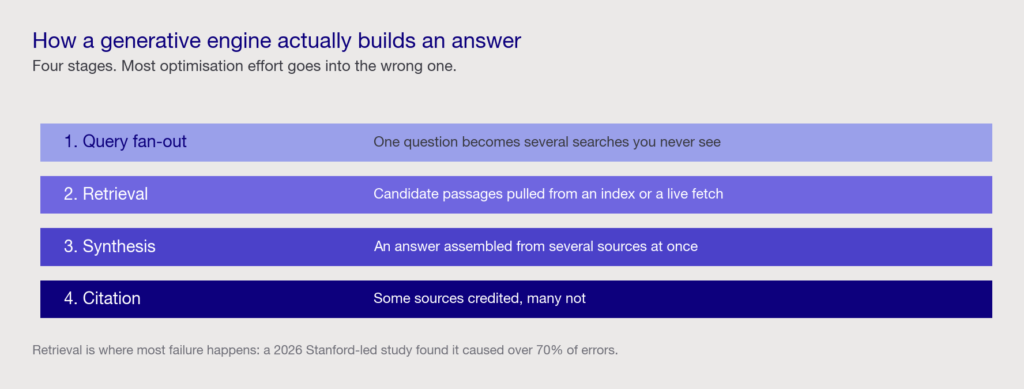
Four stages, and knowing them tells you where to intervene.
First, query fan-out. The engine expands your one question into several related searches. Consequently, you are not optimising for one query but for a cluster you cannot see directly.
Second, retrieval. The engine pulls candidate passages from its index or from a live fetch. This is where most failure happens. A Stanford-led evaluation of six commercial chatbots, published 21 May 2026 and covering 2,100 factual questions, found that retrieval failures rather than reasoning errors caused more than 70% of all mistakes. When models retrieved the right source, they usually got the answer right.
That finding should reshape your priorities. If retrieval is the bottleneck, then being findable and machine-readable matters more than being persuasive.
Third, synthesis. The engine assembles an answer from several sources at once. So a single page rarely “wins” an answer the way a page wins a ranking.
Fourth, citation. The engine credits some sources and not others. Notably, engines disagree wildly about whether to cite at all.
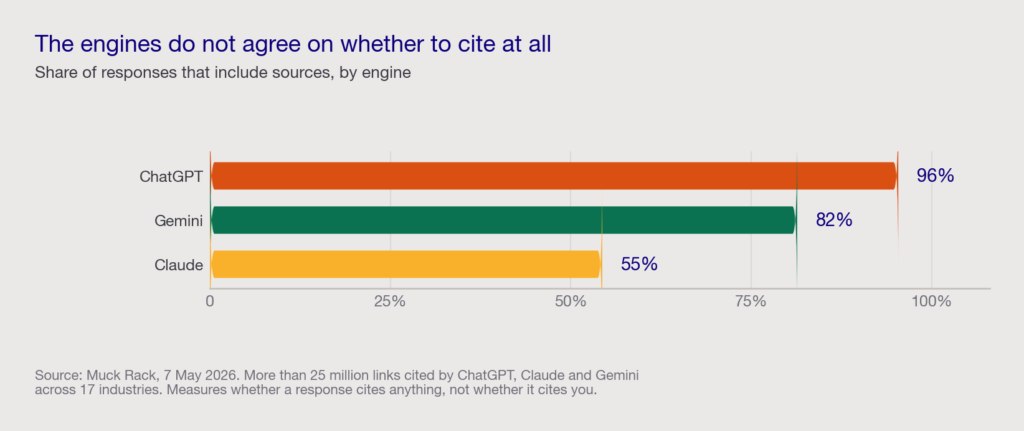
Claude includes sources in barely half its responses. ChatGPT does so in almost all of them. Therefore any single cross-engine average describes none of them, and a vendor reporting one blended number is hiding the variance.
Where do AI citations actually come from?
Mostly not from you. This is the finding that should redirect most GEO budgets.
Muck Rack analysed more than 25 million links cited by ChatGPT, Claude and Gemini in May 2026, across 17 industries. Earned media accounted for 84% of AI citations. Paid and advertorial content accounted for 0.3%. The figure has held between 82% and 89% across three editions since July 2025.
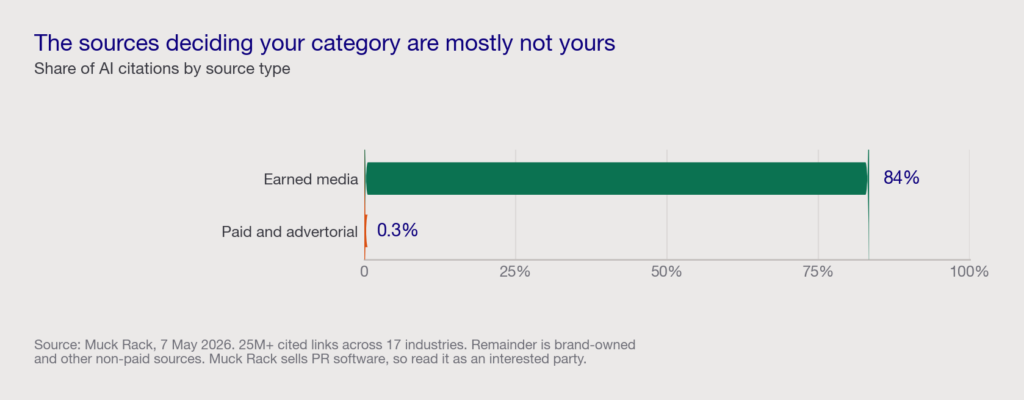
In other words, the sources deciding your category are mostly other people’s pages. Review platforms, comparison sites, communities, trade publications and expert content. As a result, a GEO programme that only touches your own CMS is competing for a fraction of what decides the outcome.
That does not mean your site is irrelevant. It means your site is necessary and insufficient.
Want to see which sources are deciding your category right now? Book a growth audit and we will run your prompt set and show you exactly which pages are winning the answers you want.
The three levers of generative engine optimization
We run every account through three levers, because each one has a different fix and mixing them up wastes quarters. The full model lives in our Visibility, Citability and Retrievability framework.
Visibility asks whether AI names your brand in your category at all. If it does not, that is an awareness problem. So more of your own strong content genuinely helps here.
Citability asks whether engines trust your pages enough to cite them as sources. A brand can be mentioned everywhere and cited nowhere. That gap usually means the engine trusts third-party pages instead. Consequently, closing it lives in digital PR and partnerships as much as in your CMS.
Retrievability asks whether you surface however the question is phrased. Winning one wording and vanishing on the next is winning by luck. Given that retrieval causes most engine errors, this lever is underrated.
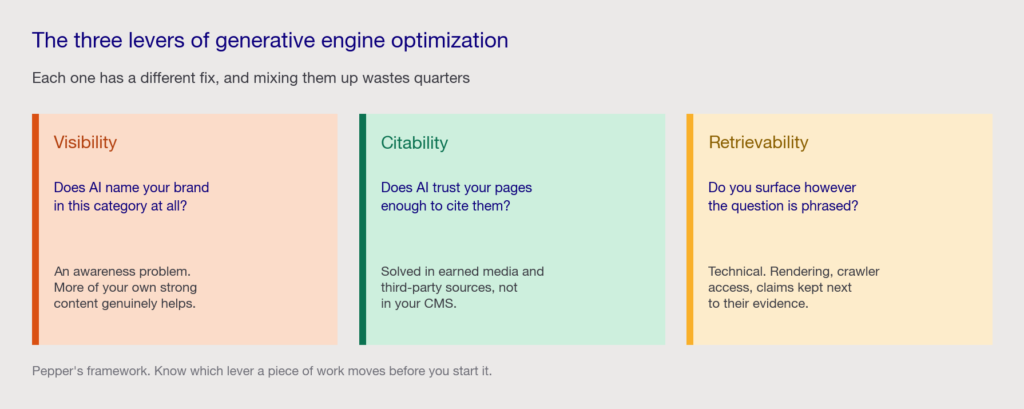
Know which lever a piece of work is meant to move before you start it. That decides the format, the channel and the measurement.
How do you do GEO in practice?
Six moves, in rough priority order. Notably, only two of them happen on your own website.
1. Fix retrievability first. Server-side render anything you want cited. Check how you handle AI crawlers in robots.txt, because blocking the wrong agent removes you from an index entirely. OpenAI runs OAI-SearchBot, ChatGPT-User and GPTBot as distinct agents with distinct jobs. Similarly, Perplexity runs PerplexityBot and Perplexity-User for scheduled indexing and live fetching. Blocking each fails differently.
2. Make your claims extractable. Keep a claim and its evidence in the same block. Write headings that stand alone as questions or statements. Open every section by answering its own heading, because models extract from the top of a section rather than the middle. Our guide to structuring content for AI citation covers the formatting in detail.
3. Clarify your entity. Engines need to resolve what you are before they can recommend you. So describe your category the same way everywhere: your site, your profiles, your review listings, your press. Inconsistency reads as ambiguity, and ambiguity loses to a clearer competitor.
4. Build earned authority. This is where 84% of citations live. Digital PR, review platforms, comparison sites, communities and expert content. You cannot publish your way past this one.
5. Identify your Citation Core. These are the ten to twenty sources that decide your category. Most brands cannot name a single one. Find them by reading the citations in your own tracked answers, then work on how those sources describe you.
6. Measure per engine, over time. Never a single blended score. Never one run of one query.
How do you measure generative engine optimization?
Three numbers, and the relationship between the first two is the diagnostic.
Brand Visibility is how often engines name your brand across a defined prompt set. Domain Prompt Presence is how often engines cite a page from your domain. Share of Voice is your slice of all brand mentions in the category.
Read them together. If Brand Visibility is healthy and Domain Prompt Presence is flat, you have a citability problem, and publishing more blogs will not fix it. If both are low, start with visibility. If they converge, you are being used as a primary source, which is the strongest position available.
Some first-party data now exists too. Bing’s AI Performance report entered public preview on 10 February 2026 and shows cited URLs, triggering queries and citation share. However, Microsoft is explicit that it covers Copilot, Bing AI summaries and select partner integrations, on a sampled basis, counting citations rather than visits. So it is not a window into ChatGPT.
Do not track traffic as your primary GEO metric. Forrester’s 2026 Buyers’ Journey Survey of 18,000 global business buyers reports companies seeing 10% to 40% traffic declines as research moves into AI engines. If sessions are your KPI, a working programme will look like a failing one. We go deeper in our guide to AI search visibility metrics and KPIs.
What nobody should promise you
A guaranteed citation or position in an AI answer. Nobody controls the ranking systems. Google explicitly advises against providers guaranteeing rankings, because third parties cannot access internal ranking systems.
A single GEO score. Composite numbers hide the diagnostic. Visibility up and citability flat is the most actionable finding available, and a blended score erases it.
A universal benchmark. There is no good number for these metrics. What matters is your trend and your distance from the category leader.
Proof from one engine, or one run. Engines vary substantially and overlap little in the sources they cite. Accordingly, a single flattering screenshot proves nothing.
Fast results. Earned authority compounds slowly, because it depends on other people publishing. Anyone promising a spike is describing paid media.
Frequently asked questions
What is generative engine optimization?
Generative engine optimization is the practice of structuring content and managing your online presence so AI systems name your brand and cite your pages in generated answers. It covers ChatGPT, Perplexity, Google AI Overviews, Gemini, Claude and Copilot.
Is GEO the same as SEO?
Largely, though not entirely. Google states that optimizing for AI search is still SEO, and AI Overviews run on core Search ranking systems. However, other engines retrieve differently, and success is measured in mentions and citations rather than rankings and sessions.
What is the difference between GEO and AEO?
Very little in practice. Wikipedia records that no consensus definition separating GEO, AEO, LLMO and AIO existed in academic literature as of early 2026, and the terms are used interchangeably. Focus on the mechanism rather than the acronym.
How do AI engines decide what to cite?
They expand your query into several searches, retrieve candidate passages, synthesise an answer from multiple sources, then credit some of them. Retrieval is the weak link, causing over 70% of errors in a 2026 Stanford-led evaluation of six chatbots.
Does GEO work if my content is already good?
Not automatically. Muck Rack found 84% of AI citations come from earned media rather than brand-owned pages. So strong content is necessary but insufficient, and most programmes underinvest in third-party authority.
How long does generative engine optimization take?
Expect two to three quarters for meaningful movement. Technical retrievability fixes land faster, though earned authority compounds slowly because it depends on other people publishing about you.
Can I track GEO for free?
Partly. Bing’s AI Performance report provides first-party citation data at no cost, and branded search lift shows in Search Console. However, multi-engine prompt tracking at scale needs either a platform or substantial analyst time.
Is llms.txt worth implementing?
Google’s May 2026 guidance explicitly mythbusts llms.txt, along with content chunking and AI-specific rewrites. Therefore treat it as unproven rather than essential, and spend the effort on retrievability and earned authority instead.
Where to go next
Start with the diagnostic rather than the tactics. Run 20 to 30 real commercial questions from your category across the engines your buyers use. Then record where you appear, which competitors appear instead, and which sources are influencing those answers.
That single exercise tells you which lever you are actually working on. Visibility, citability or retrievability. Most teams skip it and spend a quarter on the wrong one.
If you want to see it on your own category, see where you show up across ChatGPT, Perplexity, Gemini, Claude and AI Overviews. Customers run this themselves inside the platform, with a growth team attached to do the work alongside them.
For a worked example of what compounding looks like, our Acceldata case study documents 6X organic traffic growth and top-three keywords rising from 85 to more than 300.
Finally, one honest exit. If your category generates very few meaningful monthly prompts, or you have no capacity to act on findings, you do not need a GEO platform yet. Fix the capacity problem first.
Sources
Every study cited here was published in 2026.
- Wikipedia, Generative engine optimization, on terminology and the absence of a consensus academic definition as of early 2026.
- Google Search Central, AI features and your website, 15 May 2026.
- Suzgun et al., Evaluating Commercial AI Chatbots as News Intermediaries, arXiv, 21 May 2026. 2,100 questions across six chatbots. Tested on news rather than commercial queries, so read the mechanism rather than the rates.
- Muck Rack, Earned media still drives 84% of AI citations, 7 May 2026. More than 25 million cited links, 17 industries. Muck Rack sells PR software.
- Forrester, 2026 Buyers’ Journey Survey, January 2026. 18,000 global business buyers. Forrester sells research subscriptions.
- Bing Webmaster Tools, Introducing AI Performance, public preview 10 February 2026.
- OpenAI crawler documentation and Perplexity bot documentation.
Latest Blogs
The research pulls in two directions. Fan-out rewards covering many adjacent questions; absorption research finds longer pages get used. The resolution is that the passage competes, not the page.
Seven documented changes, not seven predictions. Google switched two rich results off, shipped two new AI reports, and added a channel to Analytics. Here is what actually moved and what it means.
Content chunking is the process of splitting a page into smaller pieces so a machine can retrieve one of them. Here is the part most articles get wrong: chunking is something engines do to your page, not something you do to it. You do not choose the chunk size.
Get your hands on the latest news!