How long does GEO take to show results?
The short answer
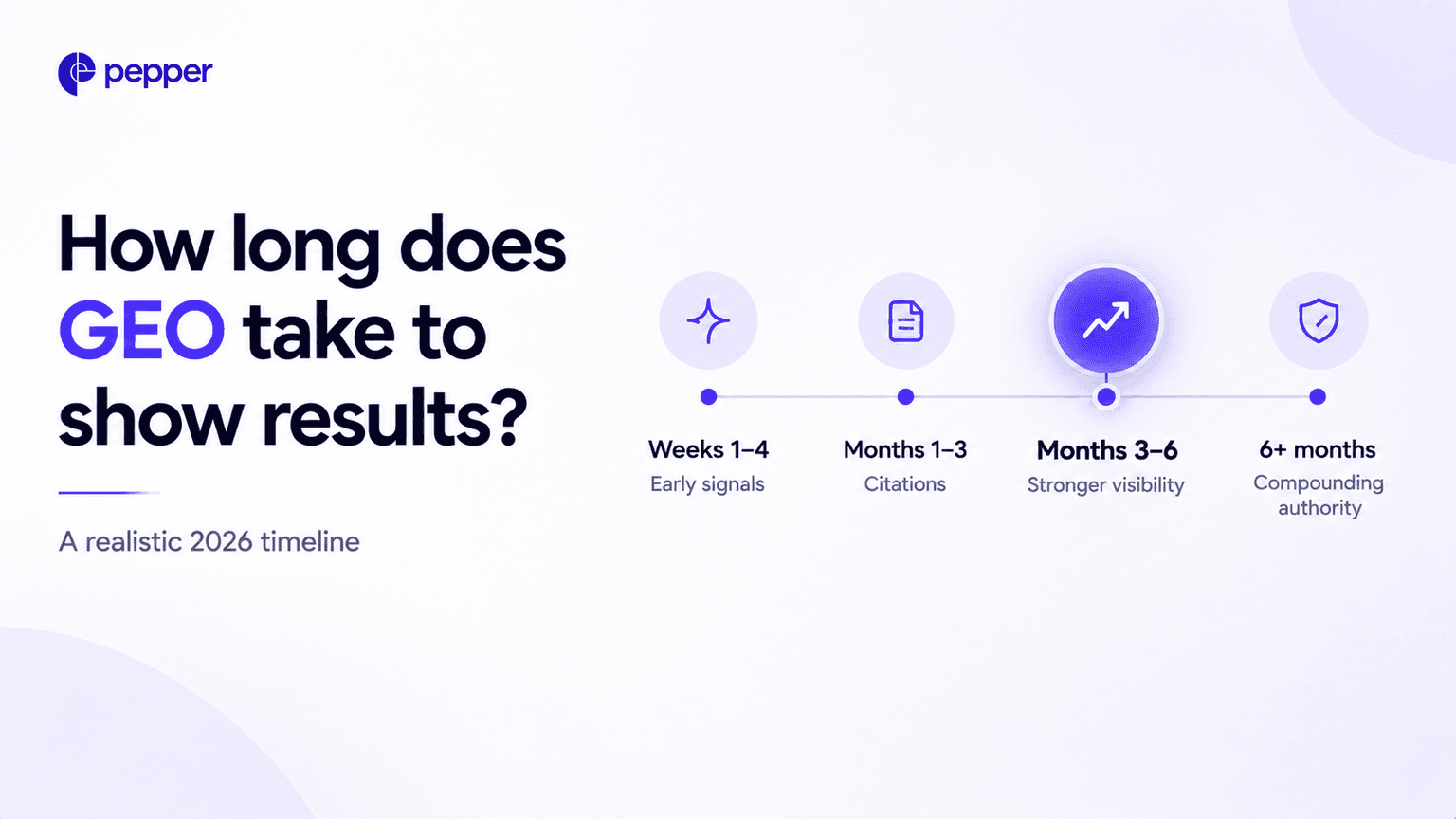
In short, there is no published, independent study of how long generative engine optimization takes to show results. We went looking, and the timelines being quoted in proposals are borrowed from SEO rather than measured in AI answers.
However, we can tell you what gates the clock, because that part is mechanical and documented.
- Some engines fetch pages live. Perplexity’s documentation says its user-triggered fetcher “might visit a web page to help provide an accurate answer” when someone asks a question. A page can be read the day it goes up, so there is no fixed crawl-to-citation lag.
- Google is deliberately vague about its own timing. Its documentation states “Some changes might take effect in a few hours, others could take several months,” and suggests you “wait a few weeks to assess whether your work had beneficial effects.”
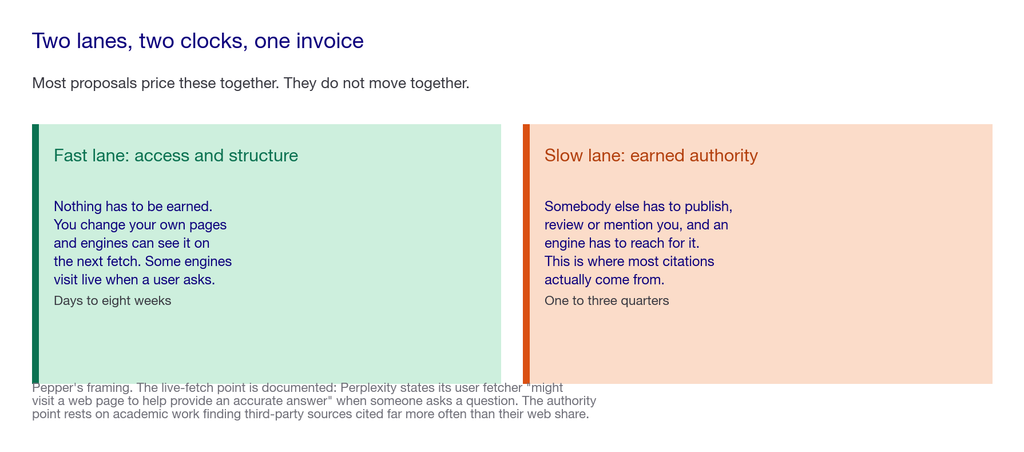
- The work splits into a fast lane and a slow lane. Structural fixes to pages an engine already reaches can move within weeks. Earned authority, which is what most citations actually rest on, moves over quarters.
What this means for your plan
So the honest answer is a range with a reason attached, not a number. Below we set out the three stages, what each one realistically takes, and the leading indicators you can show a board at four weeks rather than waiting two quarters for an outcome.
We run this work daily. Pepper is an agentic organic growth engine, not an SEO agency. This page comes out of what we run: organic for more than 250 enterprises across eight years, more than 10 million tracked prompts, and the questions buyers put to us in client reviews. Customers log in and run the platform themselves, with a Pepper growth team attached to the account. Book a growth audit and we will set a baseline you can measure the clock against.
Key takeaways
Key takeaways from an afternoon in engine documentation, looking for a timeline nobody publishes.
- No independent GEO timeline study exists that we could verify. Any specific number in a proposal is an estimate, and it should be labelled as one.
- Google will not give a figure either. Its own wording covers everything from “a few hours” to “several months.”
- Live fetching changes the mechanics. Perplexity’s user fetcher visits pages at question time, so newly published work is not waiting on a crawl cycle in the way SEO is.
- Access fixes are the fast lane. Unblocking a crawler or fixing rendering can change what an engine sees within days, because nothing has to be earned first.
- Authority is the slow lane and it is where most citations come from. Quarters, not weeks.
- The only published commitment in the category is six months. That comes from the one agency rate card we could find with a stated term.
- Report leading indicators at four weeks, not outcomes. Outcomes at four weeks are noise.
What is a GEO timeline, and what is actually being measured?
In practice, a GEO timeline is the gap between changing something and seeing an AI engine behave differently because of it. Three separate clocks hide inside that one sentence, which is why a single number never fits.
- Time to fetch. How long before an engine reads the changed page. Some engines do this live at question time, so it can be immediate.
- Time to retrieval. How long before the engine reaches for your page when answering a relevant prompt. This depends on structure and competition, not on waiting.
- Time to measure. How long before you have enough observations to tell a real change from ordinary variance. On a monthly sampling cadence this is the longest of the three, and it is the one nobody budgets for.
Where it falls short. This is a model, not a measurement. We have no controlled study separating these three clocks, and in practice they overlap and interact. Treat it as a way to structure the question rather than as a finding.
Why can nobody give you a straight number?
There are three reasons, and they compound.
First, the engines change underneath the measurement. Model versions, retrieval behaviour and which sources get reached for all shift without notice. A timeline measured in March may not describe June.
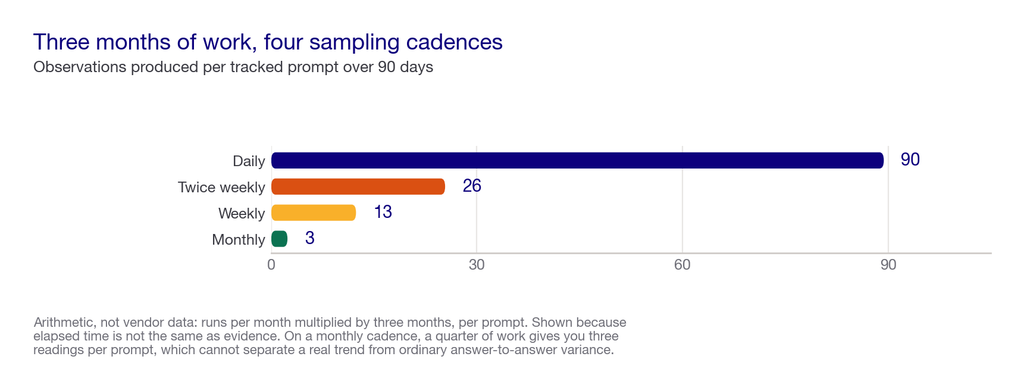
Second, the denominator is usually too small to see a trend. If a platform samples your prompts monthly, three months of work gives you three data points per prompt. That is not enough to separate a real improvement from ordinary variance, which is why sampling depth matters as much as elapsed time. We go through that arithmetic in top AI visibility platforms.
Finally, starting position dominates. A brand with a decade of earned coverage and a well-structured site is a different clock from a two-year-old company with forty pages. Averaging those two produces a number that describes neither.
That is why we will not quote you a single figure, and why we would be sceptical of anyone who does without asking about your starting position first.
What actually gates the clock
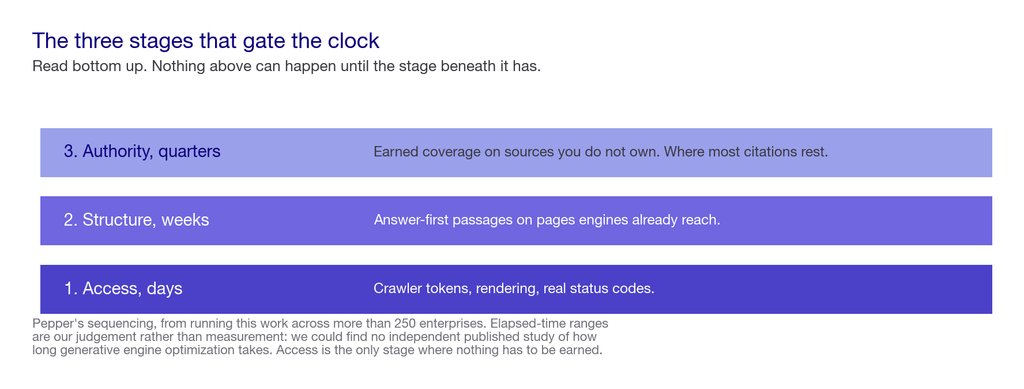
These fall into three stages, in dependency order. Each one has to happen before the next one can.
Stage one: access, measured in days
Before anything else, an engine has to be able to fetch the page, and so this is where the clock starts. This is the only stage that can move in days, because nothing has to be earned.
- Unblocking the right crawler. The tokens that fetch pages for AI answers are not the same as the ones used for model training, and blocking the wrong one costs visibility you meant to keep.
- Rendering. If your answer paragraph only exists after JavaScript runs, assume some engines will not see it.
- Real status codes. A soft 404, where a missing page returns HTTP 200 with an error in the body, quietly poisons crawling.
- Realistic elapsed time: hours to two weeks, mostly waiting on an engineering ticket rather than on an engine.
Stage two: retrieval and structure, measured in weeks
Once a page can be fetched, whether it gets used then depends on whether an answer can be lifted cleanly out of it.
- Answer-first paragraphs and question-shaped headings. Editorial changes to pages engines already reach.
- Self-contained passages that survive being extracted away from their context.
- Sourced, dated specifics that give an engine something quotable.
- Realistic elapsed time: two to eight weeks to rewrite a meaningful set of pages, then whatever your own publishing cadence adds. The practices themselves are in our GEO best practices playbook.
Stage three: authority, measured in quarters
Meanwhile, this is the slow lane, and it is where most citations actually come from. Independent academic work across 11,000 queries found third-party and reference sources cited far more often than their share of the web would suggest.
- Earned coverage on sources you do not own. Relationship work, not production work, and the reason buying a platform is not the same as hiring a team.
- Review sites and community presence in categories where buyers compare options.
- Time for those sources to be fetched and reused by engines answering your category’s questions.
- Realistic elapsed time: one to three quarters before it shows in citation share, and it never really finishes.
What you can show at four weeks
So here is the practical part. You will be asked for progress long before outcomes exist, so report the things that are genuinely moving.
Set these out in the format your board already reads, which we covered in how to read an SEO report.
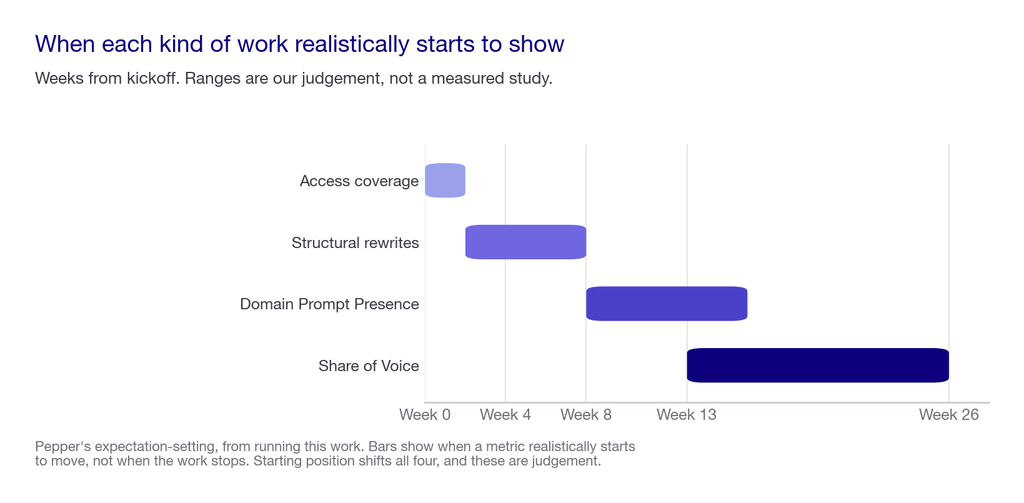
- Week one: the baseline. How many of your priority prompts mention you at all, and how many cite a page from your domain. Without this, nothing later can be called improvement.
- Weeks two to four: access coverage. The share of your priority pages that engines can actually fetch and render. This is a number that should go to 100 percent and stay there.
- Weeks four to eight: structural coverage. The share of priority pages rewritten answer-first. A production metric, honestly labelled as one.
- Weeks eight to sixteen: Domain Prompt Presence. How often an engine cites a page from your domain. This is the first genuine outcome metric and the first one worth celebrating.
- Quarter two onward: Share of Voice. Your slice of category mentions. Slowest to move and the most meaningful when it does.
The gap between Brand Visibility and Domain Prompt Presence is the diagnostic to watch throughout. High mentions with low domain citations means engines are describing you using somebody else’s pages, and that is a different problem with a different fix. Our framework for it is Visibility, Citability and Retrievability.
How long the category says it takes
Since there is no study, the next best evidence is therefore what firms commit to contractually.
- Six months is the one published term we could find. It comes from the only agency rate card in this category that states a commitment period, alongside a split between a higher initial two-month investment and a lower ongoing monthly fee. That split is itself a timeline claim: it says the heavy work is front-loaded.
- Google tells buyers to ask, without answering. Its guidance on hiring an SEO suggests asking “What kind of results do you expect to see, and in what timeframe? How do you measure your success?” The question is endorsed. The answer is left to the vendor.
- Google also warns against guarantees. Its wording is blunt: “No one can guarantee a #1 ranking on Google. Beware of SEOs that claim to guarantee rankings.”
We set out what the category charges, and what those commitments look like, in SEO, AEO and GEO pricing benchmarks.
How to set an expectation you can defend
Above all, the point of this page is not to avoid the question. It is to answer it in a way that survives contact with a board meeting.
- Quote a range with a reason. “Access fixes inside a month, structural movement by week eight, citation share from quarter two” is defensible. “Ninety days to results” is not.
- Name your starting position out loud. A site with forty pages and no earned coverage is a longer clock than a site with four hundred and a decade of press. Say which you are.
- Agree the measurement before the work starts, and decide who owns it using the AI search team ownership model. Which prompts, which engines, how often sampled, and who reads it. Agreeing this in month four means month one to three cannot be assessed.
- Separate production metrics from outcome metrics. Pages shipped is not visibility. Reporting it as progress is fine. Reporting it as results is not.
- Set the review at 90 days, not 30. Thirty days of data on a monthly sampling cadence is a single observation per prompt.
- Expect no straight line. Answers vary between runs of the same prompt. A dip in week six is usually variance, not failure, and the way to tell is sample depth.
Where this advice falls short. Ranges are harder to sell internally than dates, and a finance team that wants a single number will find “one to three quarters” unsatisfying. We have no better answer, because a number we cannot defend is worse than a range we can. If your board needs a date, give it the 90-day review date rather than an outcome date.
What nobody should promise you
- A specific date for a citation. Nobody controls what a model outputs on a given day, and we will not promise it either.
- A guaranteed ranking or placement. Google’s own words: “No one can guarantee a #1 ranking on Google.”
- Results in thirty days. The only published commitment term in this category is six months. Treat shorter promises as a sales position rather than a forecast.
- A timeline that skips your starting position. If nobody has looked at your site before quoting a number, you are being read a template rather than given an estimate.
- A single visibility score that proves progress. One number collapsing several engines and dozens of prompts hides exactly the movement you are trying to see.
Frequently asked questions
How long does GEO take to show results?
There is no published study. Realistically, access fixes show within days to two weeks, structural rewrites show over four to eight weeks, and citation share from earned authority moves over one to three quarters. Your starting position changes all three.
Why can nobody give a straight answer?
Because engines change underneath the measurement, sampling is often too shallow to separate signal from variance, and starting positions differ enormously. An average across those conditions describes nobody’s actual situation.
Measuring progress
What should I report at four weeks?
Report leading indicators: your baseline, the share of priority pages engines can fetch and render, and the share rewritten answer-first. Outcome metrics at four weeks are noise on most sampling cadences.
Is GEO faster than SEO?
In one specific way, yes. Some engines fetch pages live when a user asks a question, so newly published work is not waiting on a crawl and index cycle. The authority half, which decides most citations, is no faster than it is in SEO.
How often should prompts be sampled?
Daily if the platform offers it. Fifty prompts refreshed daily produce roughly 1,500 observations a month against 50 for a monthly refresh, and that difference decides whether a three-month trend is readable at all.
Setting expectations
When is it fair to judge a GEO programme?
At 90 days for early citation movement and at two quarters for share of voice. Judging at 30 days tells you whether the tooling works, not whether the programme does.
What if nothing has moved after six months?
Check the diagnosis before the effort. If Brand Visibility rose while Domain Prompt Presence stayed flat, the work was probably visible but not citable, which is a content structure problem rather than a volume problem.
Should I expect a straight line?
No. The same prompt returns different answers between runs, so weekly figures wobble. Sample depth is what separates a real decline from ordinary variance, which is why the sampling cadence matters as much as elapsed time.
Sources
Engine and search documentation was read directly on 22 September 2026. Where no source exists, we say so rather than supplying a number.
Engine and search documentation
- Perplexity, Crawler documentation, checked 22 September 2026. States that Perplexity-User “supports user actions within Perplexity. When users ask Perplexity a question, it might visit a web page to help provide an accurate answer,” and that “this fetcher generally ignores robots.txt rules.” PerplexityBot, by contrast, is “designed to surface and link websites in search results on Perplexity.”
- Google Search Central, SEO Starter Guide, checked 22 September 2026. States “Every change you make will take some time to be reflected on Google’s end. Some changes might take effect in a few hours, others could take several months,” and advises that “In general, you likely want to wait a few weeks to assess whether your work had beneficial effects in Google Search results.”
- Google Search Central, Do you need an SEO?, checked 22 September 2026. States “No one can guarantee a #1 ranking on Google. Beware of SEOs that claim to guarantee rankings,” and suggests asking a prospective SEO “What kind of results do you expect to see, and in what timeframe? How do you measure your success?”
Research
- Huang, Goyal, Saha and Chandrasekharan, Answer Bubbles: Information Exposure in AI-Mediated Search, arXiv, 17 March 2026. 11,000 real search queries across five systems. Finds Wikipedia and longer third-party sources cited far more often than their share of the web would suggest. Academic and independent. Used here for the claim that authority is where most citations rest, not for any timeline.
On what we could not find
We searched for an independent, published study measuring how long generative engine optimization takes to show results. We did not find one. That is a statement about what we found rather than proof none exists, and if a reader can point us at a methodologically sound study we will add it here and update this page. Every elapsed-time range above is our own judgement from running this work, and should be read as judgement rather than measurement.
Latest Blogs
Most advice on this is inference dressed as fact. OpenAI documents exactly one thing clearly, which is access. Here is what is documented, what is inferred, and how to verify the rest for yourself.
Being named in an AI answer and having your page used as its source are different outcomes with different causes and different fixes. The gap between them is the most useful diagnostic in AI search, and most reporting collapses it into one number.
Every platform reports share of voice and almost none of them define it the same way. Here is the definition worth using, the three choices that change the number, and how to measure it yourself without buying anything.
Get your hands on the latest news!
