International SEO agency guide 2026: choosing a partner for multi-region growth
The short answer
Pick an international SEO agency on two separate skills, because multi-region growth is now two jobs rather than one.
The first job is classic. Site architecture per market, hreflang, localized keyword research, local authority. That work still moves Google and Bing, and a good agency does it well.
The second job has no matching lever. There is no hreflang setting that tells ChatGPT which language version of your page to cite. We know this because it has been tested. So the second job is measurement first: find out what each engine currently says about you in each market, then fix the pages the engines are actually reading.
That is the split we work to. Pepper is an agentic organic growth engine, not an SEO agency. This page comes out of what we run: organic for more than 250 enterprises across eight years, more than 10 million tracked prompts, and the questions buyers put to us in client reviews. Customers log in and run the platform themselves, with a Pepper growth team attached to the account doing the work alongside them. If multi-region is your problem, book a growth audit and we will show you what five engines currently say about your brand in each market you sell in.
Key takeaways
Key takeaways from an afternoon spent in Google’s own documentation and in the agencies’ own websites.
- Google removed country targeting in 2022. The Search Console International Targeting report is deprecated. Google’s stated reason is that the feature “was determined to have little value for the ecosystem, and is no longer supported.”
- hreflang is the surviving signal, and Google still supports it. It is also fragile by design: if two pages do not both point at each other, the annotations are ignored.
- hreflang does not reliably carry into AI answers. In a documented five-engine test, Copilot returned the correct localized URL consistently. Gemini did when asked for sources. ChatGPT, Perplexity and Claude returned the US English version.
- That makes an international scope two jobs, not one. Classic per-market SEO for Google and Bing, and per-market visibility measurement for the AI engines, where nothing can be configured.
- Published pricing exists, barely. SeoProfy states services start from $1,600 per month. uSERP publishes a $5,000 to $25,000 per month band. WebFX publishes a full rate card from $3,000 per month.
- Check the vertical claim yourself. One agency widely listed as a top international SEO firm describes itself on its own homepage as a link building agency, with no international service named.
What is an international SEO agency, and what does the work actually involve?
An international SEO agency runs organic growth across more than one country, language, or both. The distinction matters more than it sounds. A brand selling into Austria, Germany and Switzerland has one language and three markets. A brand selling across Canada has one market and two languages. The scopes are not the same.
Underneath the positioning, the work has four parts.
- Site architecture per market. Whether each market gets a country domain, a subdomain or a subfolder. This decision is close to irreversible, it determines how authority pools or splits, and it is the one an agency should argue with you about before it agrees with you.
- hreflang and its return links. The annotation set telling Google which version of a page belongs to which language and region. Google’s documentation is explicit about the fragility: “If page X links to page Y, page Y must link back to page X. If this is not the case for all pages that use hreflang annotations, those annotations may be ignored or not interpreted correctly.”
- Localized research and content. Not translation. The query that converts in one market often has no direct equivalent in another, and the intent behind an seemingly same phrase moves across borders.
- Local authority. Links, citations and mentions from sources that carry weight inside each market. This is the slowest line item and the one that most often gets quietly dropped in year two. It is also the part a platform cannot do for you, which is why we say so in our case studies.
A fifth part now sits alongside those four, and most scopes have not caught up with it. We come to that next.
The machinery international SEO runs on, and the half Google removed
For years, international targeting had two levers. You could set a country preference in Search Console, and you could tag your pages with hreflang. Most agency scopes were written when both existed.
One of them is gone.
Google deprecated the Search Console International Targeting report, announcing it on 24 August 2022 and removing it the following month. The stated reason is worth quoting exactly. It tells you how Google thinks about the problem. The ability to target search results to specific countries using Search Console country targeting “was determined to have little value for the ecosystem, and is no longer supported.”
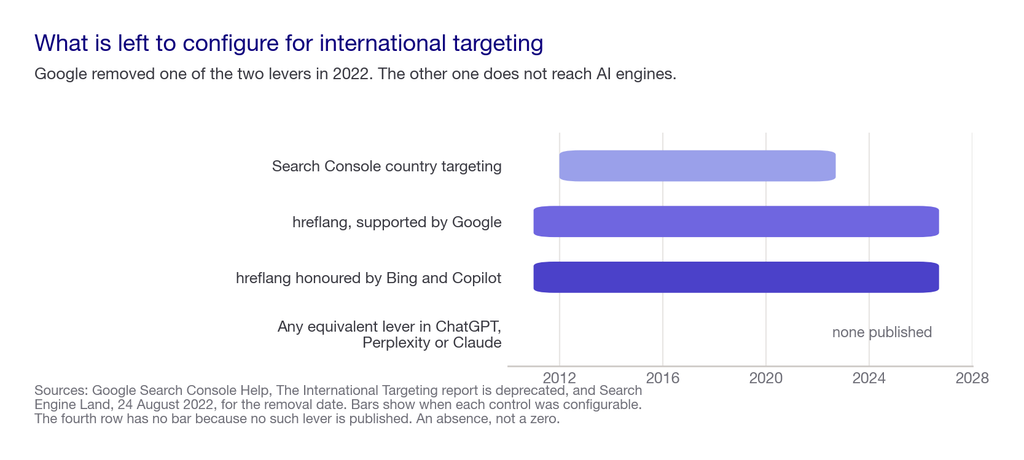
What remains is hreflang, which Google explicitly continues to support, plus the signals it infers on its own: country domains, server location, and the content of the page itself. There is no manual override any more.
Why this matters when you are buying. An agency that still describes country targeting as something it will “set up for you” is describing a control that has not existed since 2022. That is not a reason to reject a firm. It is a reason to read the rest of the proposal more carefully, because it suggests the scope was written once and reused.
hreflang is real, and it breaks quietly
hreflang survives, and it works. It is also the most fragile piece of technical SEO in common use, for a reason stated plainly in Google’s own documentation: the annotations are reciprocal. Page X must point to page Y and page Y must point back. When that breaks, Google does not warn you loudly, because the dedicated report that used to surface these errors is the one that got deprecated.
Google supports three implementation methods, HTML tags, HTTP headers and XML sitemaps, and treats them as equivalent. Pick one. Running two in parallel is how large sites end up with contradictory annotations that cancel each other out.
What happens to hreflang inside AI answers
Here is the part that changes the scope, and it is not a prediction. It has been tested and published.
Glenn Gabe is an independent consultant. He ran localized queries in French, Italian and Spanish against five AI engines. His test pages were Google’s own Search documentation and Cloudflare blog posts, all carrying correct hreflang. He compared what each engine returned against what Google and Bing returned. The results were published on 1 December 2025.
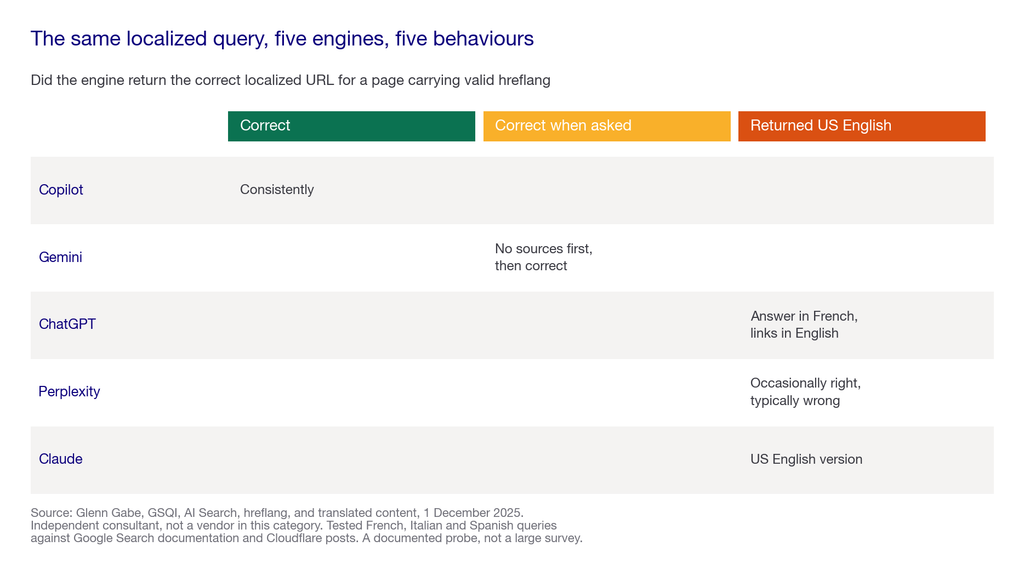
- Copilot was consistently correct. It runs on Bing’s systems, and Bing handles language detection well.
- Gemini was correct when pushed. It returned no sources initially. Asked for them, it produced the right URL.
- ChatGPT was wrong. The answer came back in French and the videos it surfaced were French, but the links it cited were the US English versions.
- Perplexity was mostly wrong. Occasionally correct, typically not.
- Claude was wrong. It returned the US English version.
The author’s own conclusion, quoted: AI search platforms “still have a long way to go,” while “Google and Bing were very good at returning the right content.”
What that means for a scope you are about to sign
Three things follow, and none of them is a reason to skip the classic work.
There is no lever. You cannot tag your way into a correct citation in ChatGPT. The signals that exist on the Google side have no counterpart here. Any proposal offering to “optimise hreflang for AI search” is describing something that does not exist.
A German customer can be served an English page about you. Engine by engine, the behaviour differs enough that it is worth reading our breakdown of GEO platforms for ChatGPT visibility before you pick a monitoring approach. That is a brand and conversion problem before it is an SEO problem. It will not appear in any per-market ranking report either, because it did not happen in a results page.
Measurement becomes the intervention. When you cannot configure the system, you find out what it currently says and you change the source material it reads. That is the whole of the job on this side. Our framework for it is Visibility, Citability and Retrievability, and the terminology, which differs from firm to firm, is untangled in AEO, GEO, AIO and LLMO explained.
Two operating models at a glance
So you are choosing between two shapes of supplier, and plenty of brands end up with both. This table is the versus, stated plainly.
Disclosure: Pepper is one of the two models described here. We have not scored the models against each other. The right answer depends on how many markets you run, and on whether anyone internally can act on what a report says.
| Traditional international SEO agency | Platform plus growth team | |
|---|---|---|
| Who does the work | Them, per market | Both. You hold the logins, a growth team is attached |
| How it is priced | Usually a retainer per market or per language | One engagement across markets |
| Classic per-market SEO | Core skill, usually strong | Covered, and not the reason to buy |
| hreflang and architecture | Core skill | Covered, with the same caveats |
| Local authority building | Core skill, often the best reason to hire one | Covered |
| AI engine coverage | Varies. Ask for engine names | Five named engines across every market |
| Who holds the data | Usually the agency | You. GA4, Search Console and platform access stay yours |
| What you keep at the end | Reporting history and whatever they built | The workspace, the data and the agents |
| Published pricing | Rare. Three firms in this piece publish a figure | Not published. We quote on scope and say it on the first call |
| Where it falls short | No lever exists on the AI side, so scope can drift into activity | Not a substitute for deep in-market link building in a market you have never sold in |
Read the last row as the honest one. Neither model covers everything, and a brand entering Japan for the first time will get more from a Japanese agency’s relationships than from any platform, ours included.
Where each model is the obvious answer
- You are entering one or two new markets and have nobody local. Hire the in-market specialist. Relationships are the product and they cannot be bought centrally.
- You already sell in eight markets and cannot see what AI engines say in any of them. This is the shape of problem we built Agent Atlas for. That is a measurement problem across a portfolio, and per-market retainers multiply cost without solving it.
- You have a technical migration ahead of you. Architecture and hreflang decisions come first. Get those wrong and everything downstream is remediation. See enterprise SEO agencies for how to judge that skill.
- Your team can act, but cannot see. Buy the visibility infrastructure and keep execution in house. Our view on that line sits in the AI search team ownership model.
What multi-region SEO costs
Most firms in this category publish nothing. Three publish something, and those three give the whole market its only public anchors.
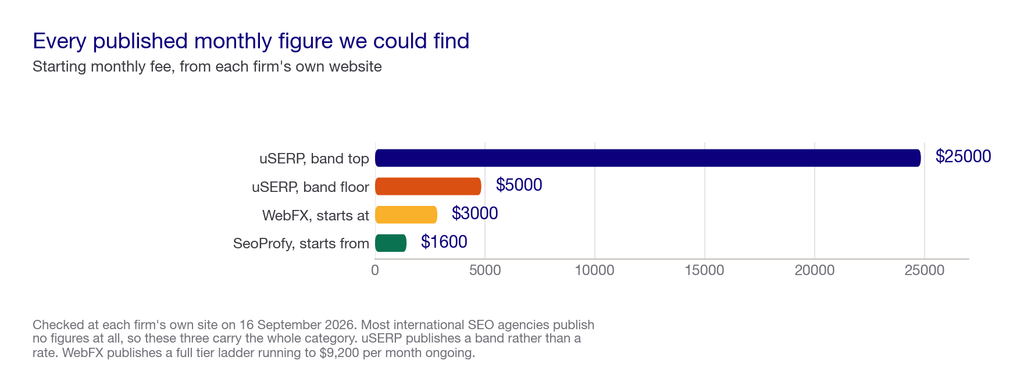
- SeoProfy. States services start from $1,600 per month, noting that exact pricing depends on goals and market competition. It also claims delivery in 45-plus countries and 15-plus languages.
- WebFX. Publishes a full rate card. SEO services start at $3,000 per month, with tiers running to $9,200 per month ongoing.
- uSERP. Publishes a band of $5,000 to $25,000-plus per month. It also publishes a link floor: “if you are paying notably less than $900 per link placement, you are most likely receiving a worthless or even harmful link.”
- Everyone else. Quote on request, including us.
How multi-region pricing actually behaves
- Per-market retainers multiply, the technical work does not. hreflang, architecture and template fixes are done once for the whole estate. Localized content and local authority scale with the number of markets. A proposal that scales every line by market is overcharging you for the first category.
- Language count matters more than market count for content. Austria, Germany and Switzerland are three markets and largely one content problem. Canada is one market and two.
- Ask which markets are in the base fee. The commonest surprise in year two is a market that was “included in the strategy” but not in the delivery.
- Price the measurement separately and on purpose. On the AI side there is no setup work to buy, so anything quoted there should be measurement, analysis and content change. If a line item cannot be described as one of those three, ask what it is.
- Expect a floor, not a rate. The published anchors above start at $1,600 and run past $25,000. That spread is real and it is mostly about local authority, which is the expensive part.
How to choose an international SEO partner
This is the section worth slowing down for, because the architecture decisions made in the first ninety days are the ones you live with for years. Here is the sequence we would run if we were buying.
Step one: count your markets and your languages separately
Write two numbers down before you speak to anyone. How many countries you sell into, and how many languages you publish in. Then write a third: how many of those markets have somebody who speaks the language and can approve a page.
That third number is the one that decides your model. A brand with eight markets and one person who can review German is not buying execution capacity. We have seen this play out in B2B software especially, where the Algolia engagement turned on exactly this kind of internal bottleneck. It is buying a bottleneck. No agency can fix an approval queue you own.
Step two: score the shortlist on a 100-point scale
Rebuild this for your own shortlist, from each firm’s own website rather than from anyone’s ranked list. These are the weights we would use for a multi-region brand, and the reasoning matters more than the exact numbers.
| Criterion | Weight | What earns full marks |
|---|---|---|
| In-market evidence | 25 | A named client in a market you actually sell in |
| Architecture judgement | 20 | They argue with your subfolder plan before agreeing to it |
| Engine coverage, named | 15 | Named engines, named markets, a stated frequency |
| Data and login ownership | 15 | You keep GA4, Search Console and platform access |
| Localization depth | 10 | Native writers, not translation plus a review pass |
| Cost transparency | 10 | A number on the first call and a per-market breakdown |
| Reporting you can audit | 5 | Raw answers and cited URLs attached, not only a chart |
Total 100. In-market evidence and architecture judgement carry nearly half between them, which is deliberate: those two are the hardest to fake and the most expensive to get wrong.
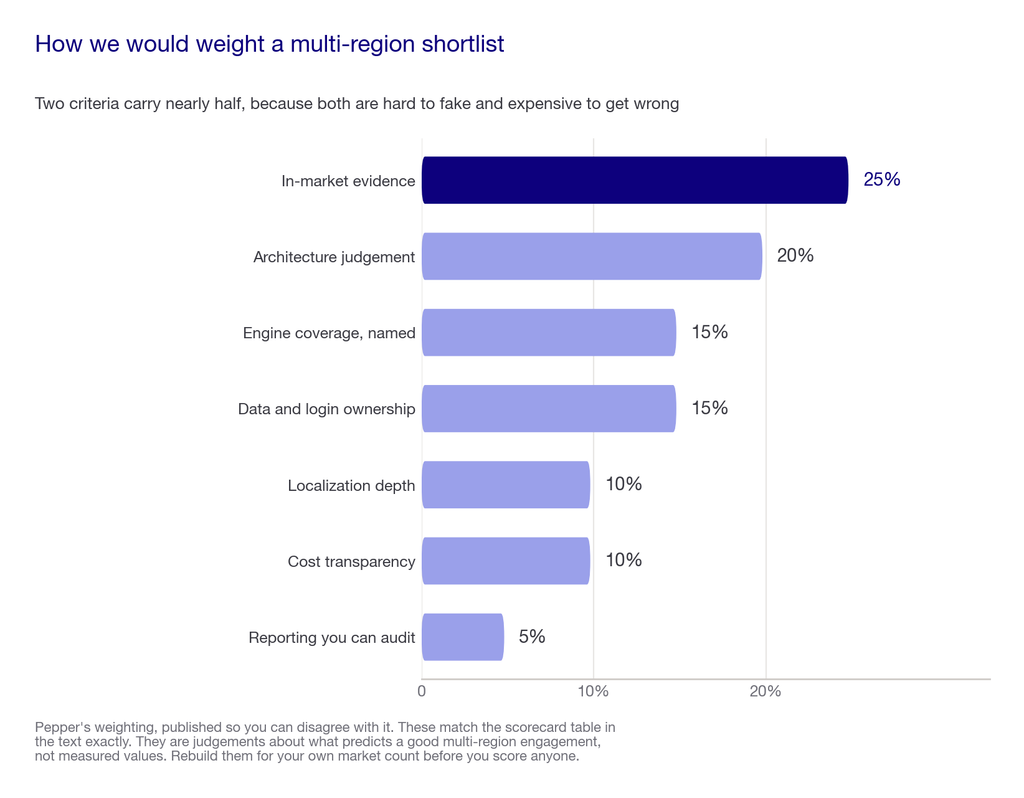
We publish our own weights for the same reason we suggest you write yours down. A ranking you cannot audit is an opinion with a table around it, and ours are in the GEO agency ranking methodology.
Step three: ask the five questions that separate them
- “Which markets have you personally worked in, and who was the client?” You want a named brand in a named country. Global logos prove scale, not local skill.
- “Walk me through your last hreflang implementation and what broke.” Something always breaks. An honest answer about return links or a sitemap conflict is a good sign. A clean story is usually a short one.
- “Which AI engines do you measure, in which markets, and how often?” Named engines, named markets, a frequency. Vague answers here predict vague reporting later.
- “Who owns the logins and the data?” If they run everything and send a monthly deck, you are buying a report rather than a capability. You keep nothing when the contract ends.
- “What would you tell us not to do?” A partner with a view answers immediately. This is the question that most reliably separates practitioners from sales teams.
Then one check that costs you nothing. Open the firm’s own homepage and see whether international SEO is actually a named service. We checked five firms that appear on international agency lists, and one of them, uSERP, describes itself as a link building agency with no international service named anywhere on its homepage. It may well do excellent international work. The list said something its own site does not. Ranked lists in this category have a known accuracy problem, which we documented properly in our piece on banking and financial SEO agencies.
Step four: run a live test before the full retainer
Paper evaluations reward whoever writes the best deck. Run a real one instead.
Pick your three largest markets. Give each finalist the same 25 prompts a buyer in those markets would actually type, in the local language, and 90 days. Prompts like “beste Projektmanagement Software für kleine Teams”, “meilleur logiciel de facturation en ligne”, or “software de gestión de inventario para pymes”. Ask for a baseline in week one and a movement report at the end.
A weaker agency will come back with rankings, traffic and a list of pages shipped per market. A stronger one will come back with which prompts you appear in per market, which language version each engine cited, and whether the German answer linked a German page. That last detail is the whole test. If the answer is in German and the citation is English, you have found your problem and you have found your agency in the same week.
Step five: watch for these red flags
- “We will set up country targeting in Search Console.” That control was removed in 2022.
- “We optimise hreflang for AI search.” There is no such mechanism. Ask what the deliverable actually is.
- Translation sold as localization. Ask who writes, where they live, and whether they have ever bought the product.
- One retainer multiplied by market count, with the shared technical work charged every time.
- A global logo wall with no market named. Nestlé on the homepage does not tell you they have ranked anything in Portugal.
- A guarantee of position. Covered below.
Step six: decide what stays inside, and be willing to wait
Local approval stays inside. Brand and legal per market stay inside. Relationships with your own in-market sales teams should stay inside, because they are the fastest source of real query language you will ever get.
And here is the answer that loses us the sale. If you are live in one market and planning your second, you do not need an international SEO agency yet, and you do not need us. Get the architecture decision right, which is a one-off consulting engagement rather than a retainer, and revisit when market three is committed. Retaining a multi-region partner for a single-market business spends money on overhead you do not have to do yet.
All of it comes down to one principle: buy the skill you cannot build, and measure the part you cannot configure. In multi-region work, the first is usually local authority and the second is always the AI layer.
What nobody should promise you
- A guaranteed ranking in any market. Google advises against providers who guarantee rankings, because third parties cannot access internal ranking systems. The same holds in every country.
- A guaranteed citation in an AI answer. Nobody controls what a model outputs. We will not promise it either, in any language.
- hreflang compliance in AI engines. No engine publishes a mechanism to comply with. The tested behaviour is inconsistent and outside your control.
- A single global visibility score. One number spanning five engines, twelve markets and three languages hides exactly the variance you are paying to see.
- Full coverage of a market from a country they have never worked in. Ask for the named client. If it does not exist, the capability is a plan rather than a track record.
One nuance worth being fair about. Powered by Search publishes a guarantee on its homepage: “Get 30% more sales ready opportunities in 90 days. Guaranteed.” That is a pipeline commitment rather than a ranking promise, which is a clearly different and more defensible thing to guarantee. Read guarantees for what they actually attach to.
Frequently asked questions
What is the best SEO agency for international growth?
There is no single answer, and the ranked lists returning that query are mostly published by agencies that appear on them. Score your shortlist on in-market evidence, architecture judgement and named engine coverage, taken from each firm’s own website rather than from a list.
Does hreflang still work in 2026?
Yes, in Google and Bing. Google continues to support it and it remains the main international targeting signal. It is fragile: if two pages do not both point to each other, Google states the annotations may be ignored or interpreted incorrectly.
Cost, scope and AI engines
Can I still set country targeting in Search Console?
No. Google removed it. The stated reason: the feature “was determined to have little value for the ecosystem, and is no longer supported.” Geographic relevance is now read from country domains, hreflang, server location and page content.
Do AI engines respect my hreflang tags?
Inconsistently. In a documented five-engine test, Copilot returned the correct localized URL and Gemini did when asked for sources. ChatGPT, Perplexity and Claude returned the US English version instead of the localized one.
How much does international SEO cost per month?
Published figures are rare. SeoProfy states a $1,600 per month start, WebFX publishes a rate card from $3,000, and uSERP publishes a $5,000 to $25,000-plus band. Expect local authority building to drive most of the variance between those numbers.
Should I use subfolders, subdomains or country domains?
Subfolders usually pool authority best and are cheapest to run. Country domains suit brands with genuinely separate local entities and budgets. Decide before you migrate, because reversing the choice later is expensive and rarely worth it.
Choosing and testing a partner
How do I test an international SEO agency before committing?
Give each finalist the same 25 prompts in your three largest markets, in the local language, and 90 days. Ask whether the German answer cited a German page. That single check reveals more than any proposal.
Is a local agency better than a global one?
For entering a new market, usually yes, because relationships and language are the product. For managing eight markets you already sell in, a per-market model multiplies cost without solving portfolio-level visibility.
Sources
Google documentation and agency details were checked at the primary source on 16 September 2026. The AI engine test is a third-party study, attributed and dated below. Where we could not verify something, we have said so.
Google documentation
- Google Search Central, Localized versions of your pages, checked 16 September 2026. States the reciprocal requirement: “If page X links to page Y, page Y must link back to page X. If this is not the case for all pages that use hreflang annotations, those annotations may be ignored or not interpreted correctly.” Also names the three equivalent implementation methods and the x-default fallback.
- Google Search Console Help, The International Targeting report is deprecated, checked 16 September 2026. States the ability to target search results to specific countries using Search Console country targeting “was determined to have little value for the ecosystem, and is no longer supported,” and that Google will “continue to support and use hreflang tags on your pages.”
- Search Engine Land, Google Search Console to remove International Targeting report, 24 August 2022. Source for the announcement and removal dates.
The AI engine test
- Glenn Gabe, GSQI, AI Search, hreflang, and translated content, 1 December 2025. Independent consultant, not a vendor selling a tool in this category. Tested localized queries in French, Italian and Spanish against five AI engines, using Google Search documentation and Cloudflare blog posts as test pages. Concludes AI search platforms “still have a long way to go,” while “Google and Bing were very good at returning the right content.” The sample is a small set of documented test pages, not a large corpus. Read it as a well-recorded probe rather than a survey.
Agency sites
- SeoProfy, checked 16 September 2026. Source of the $1,600 per month figure and the 45-plus countries, 15-plus languages claim.
- uSERP, checked 16 September 2026. Source of the $5,000 to $25,000-plus band and the $900 per link statement. Positions itself as a link building agency, with no international SEO service named on its homepage.
- WebFX SEO pricing, checked 16 September 2026. Source of the $3,000 per month start and the published tier ladder.
- Powered by Search, checked 16 September 2026. Source of the quoted pipeline guarantee. Names no international SEO service; serves B2B SaaS.
- SUSO Digital, checked 16 September 2026. Names GEO as its AI search term and lists Nestlé, Skyscanner and Sainsbury’s as clients. Names no dedicated multi-region service.
On what we did not do
We did not rank these agencies, and we did not test their work. The figures above are what each firm publishes about itself. If an agency publishes audited per-market performance data, send it to us and we will add it here with attribution.
Latest Blogs
Most advice on this is inference dressed as fact. OpenAI documents exactly one thing clearly, which is access. Here is what is documented, what is inferred, and how to verify the rest for yourself.
Being named in an AI answer and having your page used as its source are different outcomes with different causes and different fixes. The gap between them is the most useful diagnostic in AI search, and most reporting collapses it into one number.
Every platform reports share of voice and almost none of them define it the same way. Here is the definition worth using, the three choices that change the number, and how to measure it yourself without buying anything.
Get your hands on the latest news!
