AI search adoption: how fast is it actually growing?
There is no shortage of numbers answering this. But there is a severe shortage of numbers you can trace to a primary source, and the two sets do not overlap much.
The short answer
In short: large and growing, and yet nobody can give you a defensible growth rate.
Only four figures come from primary sources we read ourselves. Each measures something different, and none of them is the number people usually want.
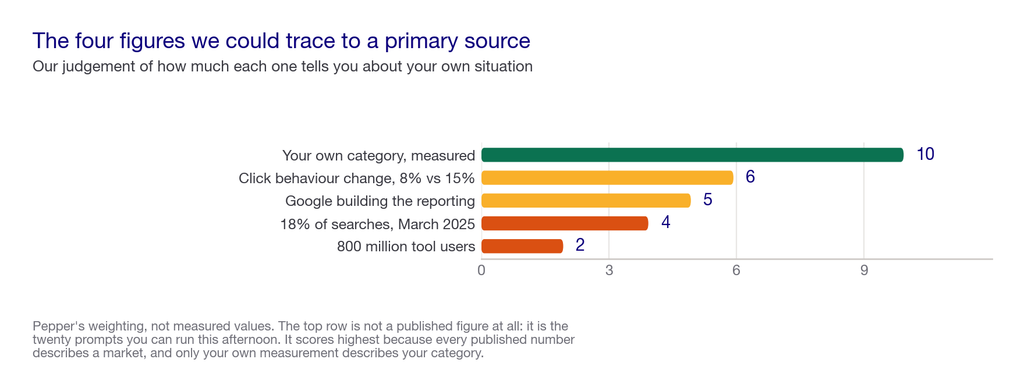
- Over 800 million users. OpenAI states it “has the largest consumer user base of any AI tool in the world, with over 800 million users,” in its own published report of February 2026. It also notes most of those users are on the free tier.
- 18% of Google searches produced an AI summary. From Pew Research Center’s analysis of 68,879 Google searches, collected March 2025.
- Click rates roughly halve when a summary appears. 8% of visits produced a click on a traditional result, against 15% when no summary appeared.
- Google built reporting for it in 2026. A generative AI performance report in Search Console and an AI Assistant channel in Analytics.
Why there is no single growth number
The growth rate is the gap. None of those is a rate of change, and we could not find a credible one. So the figures in circulation that look like growth rates are projections, vendor estimates, or year-on-year comparisons between two differently-measured studies.
The strongest evidence is structural, not statistical. Google does not ship Search Console reports and new Analytics channels for surfaces that do not matter. That is an inference rather than a measurement, and it is a better guide than most of the percentages you will be shown. We list the documented 2026 changes in what is changing in SEO in 2026.
We run this work daily. Pepper is an agentic organic growth engine, not an SEO agency. This page comes out of what we run: organic for more than 250 enterprises across eight years, more than 10 million tracked prompts, and the questions buyers put to us in client reviews. Customers log in and run the platform themselves, with a Pepper growth team attached. Book a growth audit and we will tell you what is happening in your category rather than in a market forecast.
Key takeaways
Key takeaways from the primary sources we could read, and the ones we could not.
- Four figures are traceable to primary sources. Also, everything else we checked was a projection or an estimate.
- Nobody publishes a credible growth rate. We looked, and the apparent rates are comparisons between studies that measured different things.
- The 18% figure is dated. It comes from March 2025 data, which is already old for a feature changing this fast.
- Scale and behaviour are different questions. 800 million users tells you nothing about whether buyers in your category use AI to choose vendors.
- Google’s own product decisions are the clearest signal. It built reporting infrastructure, which companies do not do for marginal surfaces.
- Your category is the only number that matters. It is cheap to measure and specific to you.
What is AI search adoption, and what gets counted?
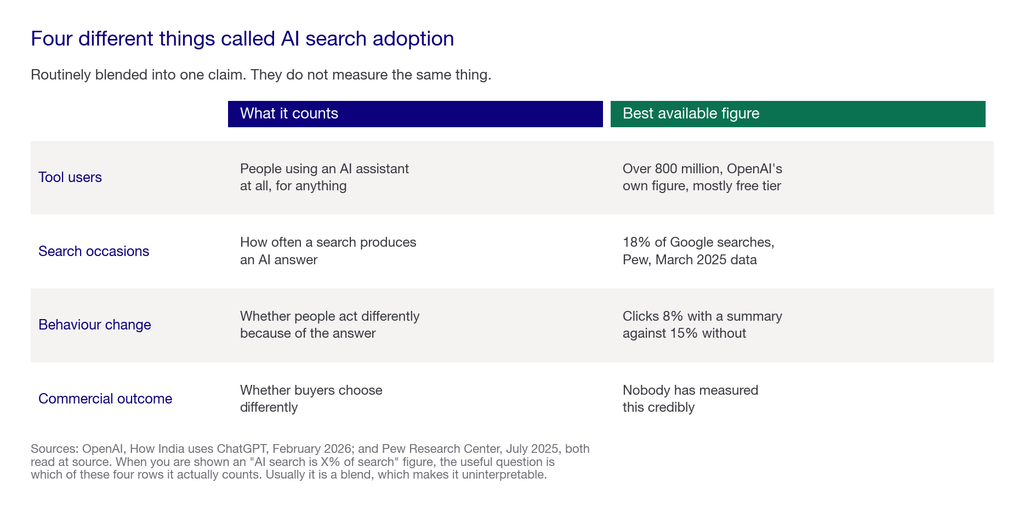
In short, AI search adoption is how many people use AI systems to find things, and how often. But the trouble is that four different things get counted under that one phrase.
- Tool users. How many people use an AI assistant at all, for anything. This is where the 800 million figure sits, and most of that usage is not search.
- Search occasions. How often a search produces an AI answer. The 18% figure measures this, for Google, in one month of 2025.
- Behaviour change. Whether people act differently because of the answer. The click-rate finding measures this.
- Commercial consequence. Whether buyers choose differently. Nobody has measured this credibly at all, which is why we model it from first principles in the GEO ROI model.
Where it falls short. In practice those four are routinely blended into a single “AI search is X% of search” claim, which is not a thing anyone has measured. When you see such a figure, the useful question is which of the four it actually counts.
The four figures we can trace
Each of these was read at source, with what it does and does not support.
Over 800 million users
However, OpenAI’s own report states it “has the largest consumer user base of any AI tool in the world, with over 800 million users.” The same report notes that “most of our users do so for free,” which matters for interpreting it.
What it supports. That assistant use is mainstream rather than niche. The mechanics of how those systems answer are in what is AI search.
What it does not. But it is a user count for one company, not a search figure. Most of those 800 million are not using it to research purchases, and OpenAI does not break the number down by use case.
18% of Google searches produced an AI summary
Pew Research Center analysed 68,879 unique Google searches from 900 US adults, with browsing data covering March 2025. It found that “18% of all the Google searches in our study generated an AI summary.”
What it supports. That AI answers were already a routine part of the results page well over a year ago.
What it does not. It is Google only, US only, and from March 2025. Pew states the limitation itself: results “reflect how search results appeared at the time they were collected.” Anyone presenting 18% as a current figure is using old data.
Click behaviour changes when a summary appears
The same Pew dataset found users clicked a traditional result in 8% of visits where an AI summary appeared, against 15% where none did. Clicks on links inside the summary occurred in 1% of visits.
What it supports. That the presence of an AI answer changes what people do, not just what they see.
What it does not. Still, it does not tell you how much traffic any particular site lost. We go through that distinction properly in are AI Overviews taking your clicks.
Google built the plumbing
During 2026 Google shipped a generative AI performance report in Search Console, covering AI Overviews and AI Mode, and added an AI Assistant channel to Analytics for traffic from assistants like ChatGPT and Copilot.
What it supports. That the volume is material enough to warrant reporting infrastructure, and that Google expects site owners to need it.
What it does not. It is not a usage figure at all. We are reading a product decision as a signal, which is an inference and we are labelling it as one.
Why nobody can give you a growth rate
There are three reasons, and they are not going away soon.
First, the thing being measured keeps changing. AI Mode did not exist as a separate surface when the March 2025 data was collected. So comparing a 2025 figure with a 2026 one compares two different products.
Second, the measurement methods are incompatible. A panel study of browsing behaviour, a vendor’s user count, and a survey of self-reported habits produce three numbers that cannot be combined into a trend. Therefore dividing one by another produces a growth rate that means nothing.
Finally, the companies that could tell you do not. Google publishes impressions in Search Console without clicks or query detail. OpenAI publishes a user total without a search breakdown. And neither publishes a time series that would let you compute a rate.
So be sceptical of any specific growth number. If someone tells you AI search grew by a precise percentage last year, ask which two measurements they divided, and whether those two measured the same thing.
What this means for your planning
So the useful move is to stop asking about the market and start measuring your category.
- Market adoption does not pay your bills. 800 million users is irrelevant if the fifty questions your buyers ask are not being answered by an engine.
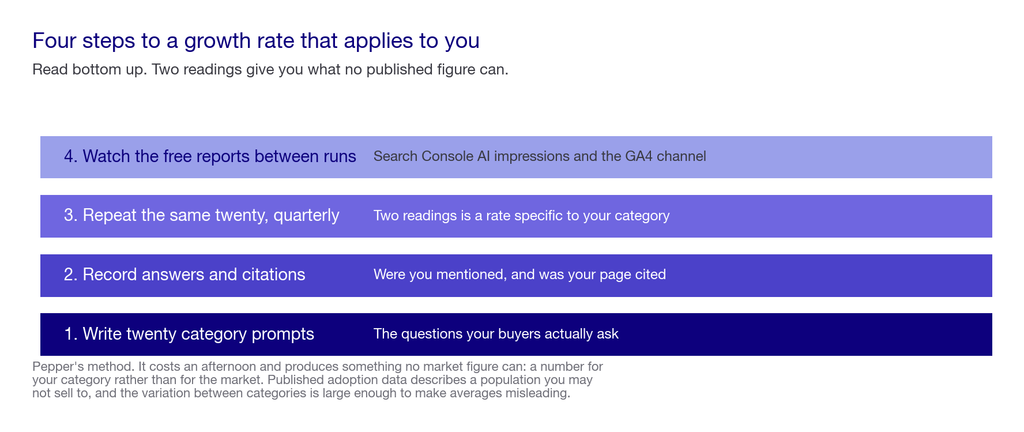
- Your category is cheap to measure. Twenty prompts, two engines, an afternoon, using the methods in how to track brand mentions in AI search. That then gives you a real number for your situation, which no published figure can.
- Repeat it quarterly. Doing that twice gives you something nobody else can give you: a growth rate that actually applies to you.
- Watch the free reports. Search Console’s generative AI report and the GA4 AI Assistant channel will show your own trend, which is the only trend you can act on. The setup is in how to know if AI search is sending you traffic.
The answer that loses us the sale. If your twenty prompts come back showing engines rarely answer your category’s questions at all, you do not have an AI visibility problem this year and you should not buy a platform for one. Check again in two quarters. Some categories genuinely have not been reached yet, and spending ahead of that is spending early rather than spending well.
How to read an adoption statistic you are shown
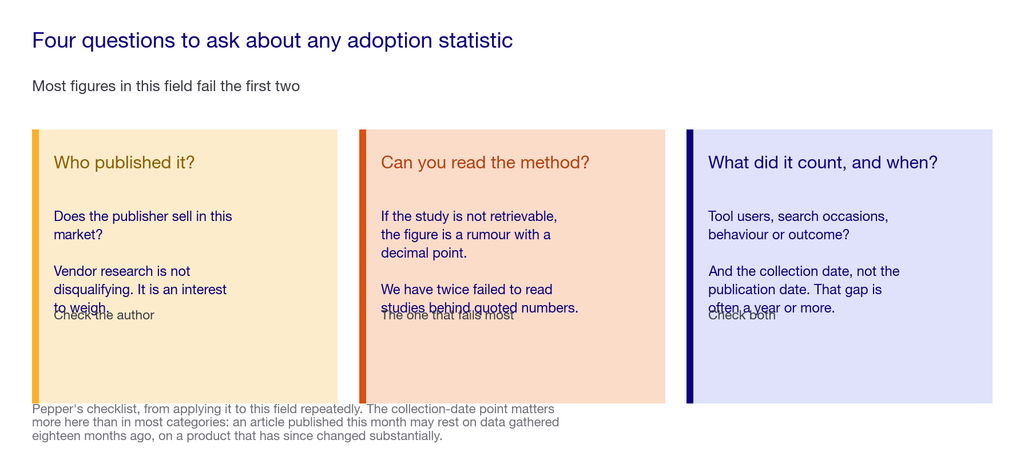
Ask four questions, in order. Most figures fail at the first or second.
- Who published it, and do they sell in this market? Vendor research is not disqualifying, and it is an interest you should weigh.
- Can you read the methodology? If the study is not retrievable, the figure is a rumour with a decimal point. We have twice failed to read studies behind widely quoted numbers in this field.
- What exactly did it count? Tool users, search occasions, behaviour change or commercial outcome. Yet these are four different things.
- When was the data collected? Not when the article was published. Instead, collection date is what matters on a feature changing this fast.
What nobody should promise you
- A growth rate for AI search. No primary source publishes a time series that supports one.
- A share-of-search figure. Nobody has measured what proportion of all searches are AI searches, across engines, in a way you can check.
- That market adoption predicts your category. It does not, and the gap between categories is large.
- A projection you can plan on. Forecasts in this field have a short shelf life because the products keep changing underneath them.
- That 18% is current. It describes Google in March 2025, which is a long time ago for this feature.
Frequently asked questions
How fast is AI search growing?
Nobody can tell you defensibly. No primary source publishes a time series, and the apparent growth rates in circulation compare studies that measured different things. Because the verifiable figures describe scale at a point in time, not a rate.
How many people use AI search?
OpenAI states it has “over 800 million users”, mostly on its free tier, as of February 2026. That is a user count for one company across all uses, not a measure of how many people use AI for search specifically.
Reading the numbers
What share of Google searches show an AI summary?
Pew Research Center found 18% across 68,879 searches, using browsing data from March 2025. That is Google only, US only, and old for a fast-moving feature, so treat it as a floor from eighteen months ago rather than a current figure.
Why do adoption statistics vary so much?
Because they count four different things: tool users, search occasions, behaviour change and commercial outcome. Figures measuring different things get compared as though they measured the same one.
Is there a reliable source for AI search statistics?
A small number. Pew Research Center publishes methodology and sells nothing in this market. Engine companies publish some of their own figures. But most other numbers we checked were either projections or unreadable at source.
Planning around it
Should I plan my budget around market adoption figures?
No. No, because market scale tells you nothing about whether buyers in your category use AI to choose vendors. Measure your own twenty prompts instead, which costs an afternoon and gives you a number that applies.
How do I get a growth rate for my own category?
Run the same twenty prompts quarterly and record how often engines answer them and cite you. Two readings give you a rate specific to your situation, which is more useful than any published average.
What if engines rarely answer my category’s questions?
Then you probably do not have an AI visibility problem this year, and you do not need a platform to tell you that. Run the twenty prompts, note how often the engines answer at all, and check again in two quarters rather than buying a platform ahead of the need.
Sources
Every figure here was read at its primary source. Where we could not read a source, we have left the figure out.
Primary sources
- OpenAI, How India uses ChatGPT: early evidence from OpenAI Signals, Global Affairs, February 2026. States OpenAI “has the largest consumer user base of any AI tool in the world, with over 800 million users” and that “most of our users do so for free.” OpenAI describing its own product, so read it as first-party data.
- Pew Research Center, Google users are less likely to click on links when an AI summary appears in the results, 22 July 2025. Browsing data from 900 US adults on KnowledgePanel Digital, 68,879 unique Google searches, collected March 2025. Finds “18% of all the Google searches in our study generated an AI summary”, click rates of 8% with a summary against 15% without, and 1% on links inside the summary. Pew states the analysis covers Google only and reflects results as they appeared when collected. Non-commercial research organisation.
- Google Search Console Help, Generative AI performance report (Search), checked 29 September 2026. Covers AI Overviews and AI Mode, reporting impressions only.
- Google Analytics Help, Default channel group, checked 23 September 2026. Defines the AI Assistant channel for traffic arriving from assistants including ChatGPT, Gemini, Copilot and Grok.
On what we could not establish
We looked for a credible growth rate for AI search adoption and did not find one. No primary source we could read publishes a time series on a consistent methodology, and the rates in circulation are either projections or comparisons between studies that counted different things. We also attempted to read a more recent Pew survey on attitudes to AI summaries and could not retrieve it, so we have not quoted figures from it. The reading of Google’s reporting launches as a signal of scale is our inference, not a measurement, and we have labelled it as one throughout.
Latest Blogs
Most advice on this is inference dressed as fact. OpenAI documents exactly one thing clearly, which is access. Here is what is documented, what is inferred, and how to verify the rest for yourself.
Being named in an AI answer and having your page used as its source are different outcomes with different causes and different fixes. The gap between them is the most useful diagnostic in AI search, and most reporting collapses it into one number.
Every platform reports share of voice and almost none of them define it the same way. Here is the definition worth using, the three choices that change the number, and how to measure it yourself without buying anything.
Get your hands on the latest news!
