AI search optimization cost: the four layers, and the one with a price
The short answer
Four layers. Software runs $29 to about $500 a month and is the only layer anybody publishes properly. Agency retainers start at $3,000 a month, published by exactly two firms. Earned media drives most AI citations and is priced by almost nobody. And building it in house has no reliable market rate, because the role is too new: only 6.3% of senior SEO job listings even mention AI search.
Key takeaways
- Four layers, one real price. Software is published and cheap. Agency is published by two firms. Earned media is priced by nobody. In-house has no market rate.
- The in-house layer is the one nobody has quantified, including our own in-house versus agency guide, which declined to give salary figures because the ones in circulation had nothing behind them. It was right, and here is the evidence.
- Published salaries for the same job title differ by 76%. PayScale puts an SEO Manager at $81,910 and Glassdoor at $144,264.
- The role barely exists in the job market. A study of 3,900 US SEO job listings found AI mentioned in 31% of senior listings, but SGE, AEO or AI search named in only 6.3% of senior roles and 3.7% of others.
- So you cannot benchmark the build option. Not because nobody has tried, but because there is no established rate for a job that is three years old.
- What you can do is compute your own number, and the arithmetic is four lines long.
- Pepper is an agentic organic growth engine and an organic growth partner. Agent Atlas puts the agents in your team’s hands. Pepper’s GEO platform reports Brand Visibility, Domain Prompt Presence and Share of Voice. A growth team works alongside yours. Eight years, more than 250 enterprises, more than 10 million tracked prompts.
A note on where this comes from. I care about what breaks inside organisations, and the thing that breaks most often in this category is a plan that assumes a person exists who can be hired at a known price. Pepper runs organic for more than 250 enterprises over eight years and tracks more than 10 million prompts across every major engine. The most expensive line in most AI search programmes is the one that never appears in any quote, because it is your own team’s time.
Disclosure: Pepper sells services in three of the four layers below, so the layer we do not sell is the one we have least reason to be fair about. We have tried to be. We also publish no pricing, which by the standards applied here is a failing of our own. Competitors are named but never linked.
What is the cost of AI search optimization made of?
AI search optimization cost is the total of four separate spends, not one line item. Most quotes price one layer and imply the rest, which is why comparing two providers so rarely means anything.
Our benchmark of published GEO prices covers the first two layers in depth, and our breakdown of AEO pricing models covers how vendors structure a charge. This article does the thing neither does, which is to put all four layers side by side and be honest about which ones have a price at all.
Here they are, in the order most buyers meet them.
- Software. Prompt tracking and visibility platforms.
- Agency or partner. Someone doing the work.
- Earned media. Coverage, research and third-party presence.
- Your own people. The layer that appears in no proposal.
Only one layer has a price you can look up
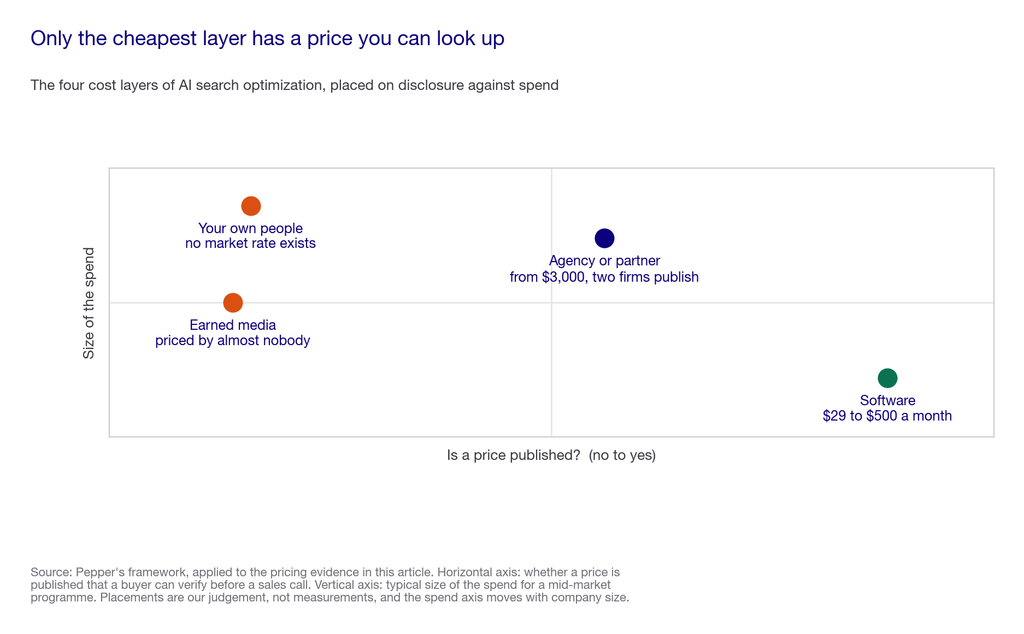
Software is published, comparable and the smallest. Entry tiers start around $29 a month, and most useful tiers run to about $500. You can compare vendors on a spreadsheet before speaking to anyone. That is true of nothing else here.
Agency retainers are published by two firms. WebFX at $3,000 a month, and RevvGrowth at $3,000 and $8,000. Two more publish a full-service floor not labelled AI search, at around $10,000 and an average above $20,000. Everyone else quotes privately.
Earned media is priced by almost nobody, and it is the layer that matters most for citations. A study of more than 25 million cited links found earned media drives 84% of AI citations, with paid content at 0.3%. So the work producing most of the outcome carries the least visible price.
Your own people are the fourth layer, and the rest of this article is about why that one cannot be benchmarked either.
Where it falls short: each placement on the chart is our judgement, not a measurement. The spend axis also depends heavily on company size. A small business may spend more on software than on people, which inverts two of the four.
If you would rather know what winning your category’s answers requires than what a category costs, book a growth audit and we will scope it with you.
Why nobody can price the in-house option
Our own guide to in-house versus agency took a position on this in September. It declined to publish salary figures, noting that widely quoted ranges of $250,000 to $500,000 a year appear on pages selling outsourcing with no study behind them. That was the right call. We can now show why, with numbers.
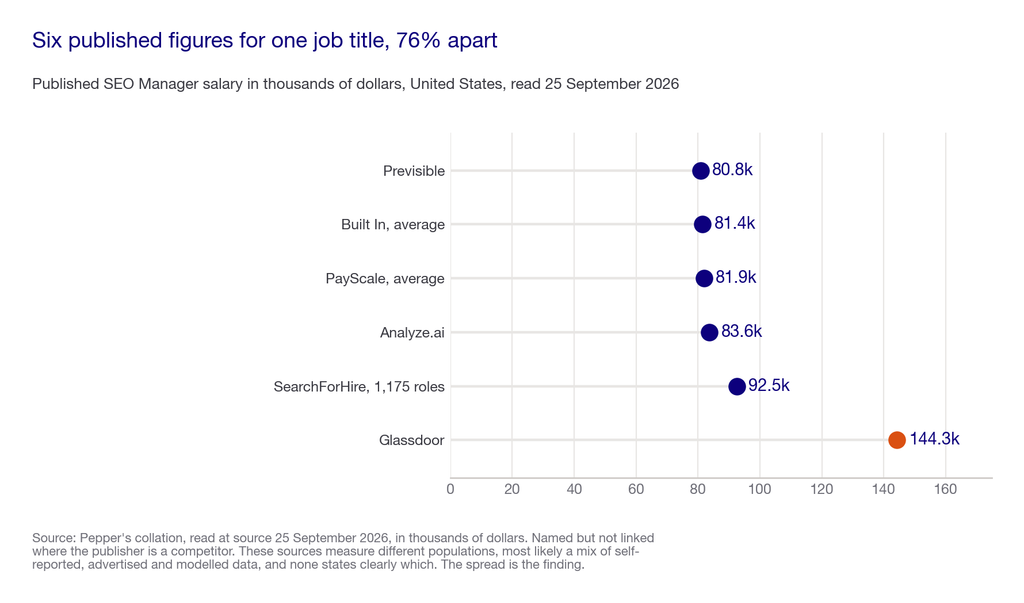
Here is what the published sources say an SEO Manager earns, all read on 25 September 2026.
| Source | Published figure |
|---|---|
| Previsible | $80,800 |
| Built In | $81,407 average, $89,385 total compensation |
| PayScale | $81,910 average, $82,000 median |
| Analyze.ai | about $83,629 |
| SearchForHire, across 1,175 roles | $92,500 median |
| Glassdoor | $144,264, with a range of $108,198 to $195,134 |
**Glassdoor’s figure is 76% above PayScale’s for the same job title in the same market in the same year.** That is not a rounding difference. It signals that the sources measure different populations, most likely self-reported against advertised against modelled, and none of them says clearly which.
And that is before you reach the actual role. For a GEO or AI search specialist specifically, advertised base pay runs roughly $65,000 to $120,000, and the title barely existed two years ago.
Where it falls short: we collated published figures rather than running a survey, and recorded what each source states rather than how it got there. A source with a rigorous method may sit somewhere in this spread. That is exactly the buyer’s problem.
The reason the rate does not exist yet
This is the finding that explains the spread, and it comes from the strongest study in the set.
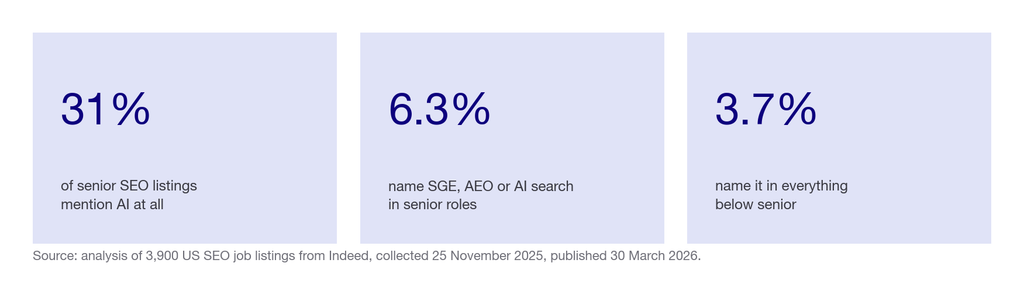
An analysis of 3,900 SEO job listings from Indeed in the United States, published 30 March 2026, found the following.
- AI is mentioned in 31% of senior listings and 22.3% of other roles.
- LLM familiarity appears in about 10% of senior listings and 7.4% of mid-level roles.
- SGE, AEO or AI search is named in just 6.3% of senior roles and 3.7% of others.
So fewer than one senior SEO job in fifteen asks for the skill this entire category is built on. A market that advertises a skill this rarely has no clearing price for it. That is why six salary sources disagree by 76%, and it is why you should treat any confident in-house cost figure as a guess.
The same study publishes a median of $130,000 for senior SEO roles and $71,630 for other positions, and it reports no salary premium for AI skills at all.
Where it falls short: the listings date from 25 November 2025, so they describe hiring intent roughly ten months ago in a fast-moving market. The share naming AI search has almost certainly risen since. Still, the point holds: the role was too new to have a rate when the salary figures you will be quoted were gathered.
How we weighted these cost layers
Four criteria, fixed before we gathered anything. They are our priorities, not measured coefficients.
| Criterion | Weight | What it means |
|---|---|---|
| A price exists that you can verify | 35 | Somebody publishes a figure attached to a defined scope, so you can compare before entering a sales process |
| The layer drives the outcome | 30 | Money spent here moves citations, rather than moving a metric that precedes them |
| The spend is predictable | 20 | You can forecast it for four quarters without a discovery call, which matters more than the absolute amount |
| You can stop it cleanly | 15 | Ending the spend does not destroy an asset you have already paid for |
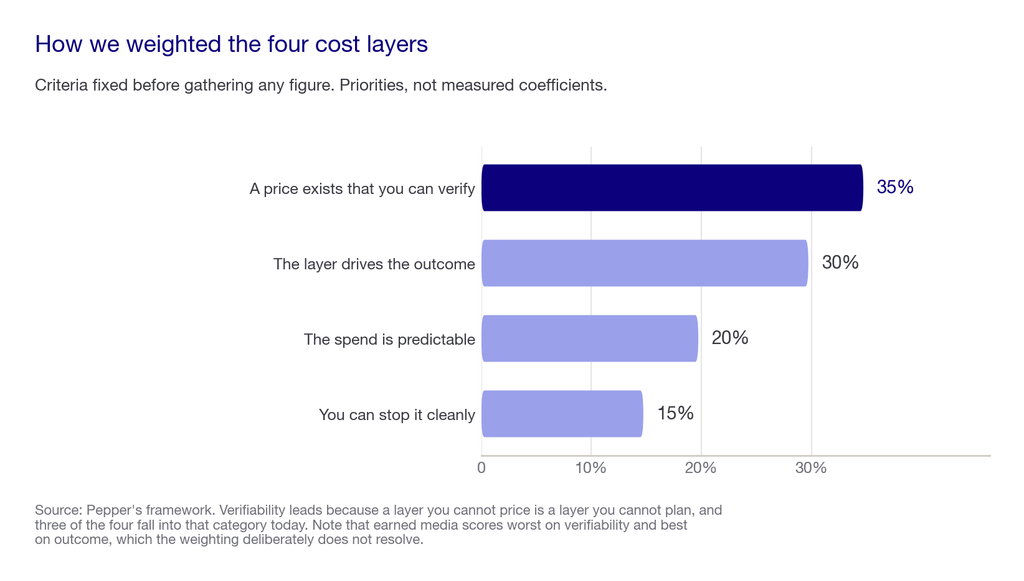
Why verifiability leads. A layer you cannot price is a layer you cannot plan, and three of the four fall into that category today. That is the single most useful thing to know before an annual planning cycle.
Where it falls short: these criteria favour layers that are easy to buy over layers that are effective, and here the two are close to inversely related. Earned media scores worst on verifiability and best on outcome. The weighting deliberately does not resolve that for you.
So compute your own number
Since none of the three unpriced layers can be benchmarked, here is the arithmetic. It takes an afternoon and it produces a figure you can defend, which is more than any published range will do.
- Software. Take your prompt count and your engine list, and read the published tiers. This is the one layer where the answer is a lookup. Budget $100 to $500 a month for most mid-market cases.
- People, whichever way you buy them. For the agency route, use the published floor of $3,000 a month as a lower bound and expect a private quote above it. For the in-house route, take your own salary band for a senior marketing manager and add your loaded cost multiplier. Use that rather than any published SEO figure. You know your bands. The published sources do not.
- Earned media. Price the specific thing you intend to do rather than the category. One piece of original research, or a named digital PR programme, quoted by a supplier. If you cannot get a quote, the honest entry is zero with a note, not an estimate.
- Engineering days. Ask the people who would do the work how many days the technical fixes need, then price the days at your internal rate. Most AI search quotes omit this line entirely, because the provider hands over recommendations and someone else ships them.
Add the four and you have a total cost of ownership. Compare that against an agency quote for the same scope, and you have a build-versus-buy answer for your business rather than for a category average.
Where it falls short, and it costs us something to say: this produces a defensible number and not an accurate one, because two of the four lines are estimates you make yourself. What it removes is the false precision of a published range that nobody measured in the first place.
AI search optimization cost at a glance
| Layer | What it costs | Is a price published | Share of the outcome | Where it falls short |
|---|---|---|---|---|
| Software | $29 to about $500 a month | Yes, widely | Small. It measures rather than moves | Easy to over-buy, because it is the only layer you can compare |
| Agency or partner | From $3,000 a month published, mostly private | Two firms only | Large, and depends entirely on scope | The published floor tells you almost nothing about your quote |
| Earned media | Rarely quoted as a category | Almost never | 84% of AI citations come from earned sources | You cannot budget it without naming the specific programme |
| In-house people | Your own salary bands, loaded | No usable rate | Large, and the most controllable | Published SEO salaries differ by 76% between sources |
| Engineering days | Your internal day rate | Not applicable | Gates everything else | Omitted from most quotes entirely |
| Pepper | Not published | No | Not applicable | We publish no pricing, which fails our own first criterion |
## How Pepper fits
Pepper is an agentic organic growth engine and an organic growth partner, and we sell into three of the four layers, which is worth stating before anything else.
- We publish no pricing, which fails the criterion weighted highest in this article. Budget discovery with us is a conversation, and a buyer who wants to compare before a call is right to count that against us.
- Agent Atlas reduces the fourth layer rather than replacing it. The repeatable parts of this work, prompt set maintenance, decay monitoring, refresh triage, become agents your team runs. System agents stay fixed, user agents stay editable and versioned, and customers log in and build and run their own inside Atlas. That matters most when the role you would otherwise hire for does not exist in the job market.
- Pepper’s GEO platform is the software layer. Brand Visibility for how often engines mention you, Domain Prompt Presence for how often they cite a page from your domain, and Share of Voice for your slice of the category. See the platform.
- A growth team works alongside yours on the earned media layer, which is the one with no published price anywhere and the one that drives most citations.
- Proof rather than adjectives. Acceldata went from 85 to more than 300 top three keywords with 6X organic traffic growth. More in our case studies, and the B2B SaaS practice is where this cost model was built.
Where Pepper fits, and where it does not. We are the right answer when the capability does not exist internally and hiring it is genuinely hard, which the job listing data suggests is common right now. We are the wrong answer for a team that already has the people and needs only software, and in that case the published tiers will serve you better and cheaper.
How to choose between building it and buying it
I would start by refusing the question in its usual form. Build versus buy is not one decision. It is four, and the answer differs by layer.
The framing judgement first, anchored outside my own view. Google’s guidance on optimising for generative AI features states that optimising for generative AI search is still SEO, running on core ranking systems with no separate index, and it advises against providers guaranteeing rankings because no external party has access to those systems. Read that as permission to stop hiring for a separate discipline. Then hold the other half, which is that Google documents Google, and the engines doing most of this work publish nothing comparable.
The Pepper view on top is narrower. Buy the layer you cannot hire for, and hire the layer you can supervise. Right now those are not the same layer, and the job listing data is why.
Here is the 100 point scorecard I would run over any provider, including us.
| Area | Weight | What a strong provider demonstrates |
|---|---|---|
| They price the layer they are selling | 30 | The quote names which of the four layers it covers and which it assumes you supply, in writing, before you ask |
| Engineering days are in the quote | 25 | Implementation is scoped and priced, or the quote says plainly that you ship the changes and estimates the days |
| Earned media is a named line | 20 | Specific publications and research formats with their own budget, rather than authority building as an implied benefit |
| They will cost the alternative | 15 | They can tell you what doing it in house would take, in your own salary bands, and they do not pretend to know your rates |
| Exit is clean | 10 | You keep the prompt set, the baselines and the relationships, and they say so before you sign |
**Then run the live test, on us as readily as on anyone else.** Give any provider 25 buying questions from your own category and ask them to price winning those specific answers across all four layers. Hold the quotes for 90 days before deciding, because scope shifts under questioning and you want to see whose does. Ask them to be concrete. For example: “which of the four layers does this quote cover”, “how many engineering days does this assume”, “what would the in-house version of this cost in our bands”, “what do we keep if we leave”.
Ask them to come back with five things. The layers covered and the layers assumed. The engineering days. The earned media line, itemised. What they think the build alternative costs in your numbers. And the exit terms.
A provider who names the layers they are not selling beats one who quotes a single monthly figure. And one who cannot estimate your engineering days has not scoped the work. They have scoped their own part of it.
The weaker way to decide this, and it is the common one. Get three quotes. Compare the monthly figures. Assume the internal cost is zero because it does not appear on an invoice. Then discover in month two that someone on your team spends two days a week on this, and that the technical fixes sit queued behind a product release.
The stronger sequence. Price all four layers separately, using your own numbers where no published rate exists. Ask each provider which layers they cover. Get engineering days into the quote. Compare totals rather than retainers. Then decide layer by layer, because the right answer is usually to buy two and build two. The distinction matters: the first sequence compares one layer and commits to four.
Red flags, each one something a provider actually does.
- A single monthly figure with no layer breakdown, which makes comparison impossible by construction.
- Recommendations delivered without implementation, with no estimate of the engineering days you will need.
- A confident in-house cost figure, when published salary sources for the same role differ by 76%.
- Earned media described as included with no named publications and no separate budget.
- A quote that assumes your team’s time is free. It is the largest hidden line in this category.
- No exit terms on the prompt set or baselines, which are the assets you actually accumulate.
- A guarantee of citations, which Google itself advises against in the equivalent case.
Five questions worth asking, and what a good answer sounds like.
- “Which of the four layers does this cover?” A good answer names them and names the ones you supply. A bad answer says it is end to end.
- “How many engineering days does this assume?” A good answer is a number with a caveat. A bad answer has not considered it.
- “What would this cost us to build?” A good answer asks for your salary bands first. A bad answer quotes an industry figure.
- “What is the earned media line?” A good answer names publications. A bad answer describes authority.
- “What do we keep if we leave?” A good answer is specific and generous. A bad answer is vague.
If I reduce this to one principle: price the layers separately, because a provider quoting one number is quoting one layer. The other three are still yours to pay for.
The honest note that costs us something. Very few providers are strong across software, execution, earned media and technical implementation at once, and we would not claim uniform strength across all four either. The layer most providers are weakest at is earned media. That is also the layer with no published price and the largest share of the outcome. Concentrate there.
What nobody should promise you
Nobody should quote you an in-house cost for AI search optimization. Published salary figures for the same job title differ by 76%. The specialist role appears in fewer than one senior listing in fifteen, and no reliable rate exists to quote.
Nobody should give you a single monthly figure without saying which of the four layers it covers. A number without a layer is not comparable to another number without a layer.
Nobody should hand over recommendations without estimating the engineering days required to implement them. That omission is the most common way an AI search budget doubles after signature, and it costs nothing to ask about.
Nobody should promise a citation for a fee. Google advises against providers who guarantee rankings, because no external party has access to the ranking systems.
Where this stops working, including for us
If you already have the people and only need measurement, the software layer is published and cheap and you should buy it directly. Do not buy a partner for this, including us.
If your organisation cannot give you its own salary bands, you cannot complete the arithmetic above, so treat any build-versus-buy conclusion as provisional rather than borrowing a published figure.
If your category has no measurable prompt demand, all four layers are premature and the right total this year is close to zero.
Where Pepper fits and does not. We sell into three of these four layers, so the layer we do not sell is the one we have least reason to be fair about, and we have tried to be. We also publish no pricing, which fails the criterion this article weights highest.
Where to go next
Write down the four layers and put a number against each one, using your own salary bands where no published rate exists. The gaps in that list are your real planning problem, not the total.
Then decide layer by layer rather than in one go. For the adjacent decisions, our real pricing benchmarks for GEO cover the first two layers, AEO pricing models covers how vendors structure a charge, our guide to where each capability should sit covers the build side, and agency or tool covers the first fork. To see what your category actually requires, see where you show up.
Frequently asked questions
What is the cost of AI search optimization?
It has four layers. Software runs $29 to about $500 a month, agency retainers start at a published $3,000, earned media is rarely priced as a category, and in-house people have no reliable market rate. Only the first layer can be looked up.
Why is there no benchmark for hiring an AI search specialist?
Because the role is too new to have a clearing price. An analysis of 3,900 US SEO job listings found SGE, AEO or AI search named in only 6.3% of senior roles and 3.7% of others, and it reported no salary premium for AI skills.
How much do SEO salaries vary between sources?
Substantially. For the same SEO Manager title in 2026, PayScale publishes $81,910 and Glassdoor publishes $144,264, a difference of 76%. Other sources land between, which suggests the figures measure different populations.
What is the most commonly missed cost in an AI search quote?
Engineering days. Most providers hand over recommendations rather than shipping the changes themselves, so implementation lands on your own team. Those hours never appear in the quote you compared, which is how a budget doubles quietly after signature.
Should we build AI search capability in house or buy it?
Decide layer by layer rather than in one go. Most teams should buy the layer they cannot hire for, which today is usually earned media and specialist AI search work, and build the layers they can supervise.
How much should we budget for software?
Between $100 and $500 a month covers most mid-market cases, with entry tiers from about $29. This is the only layer where comparison shopping works, which makes it the easiest one to over-buy.
Why is earned media so hard to price?
Because it cannot be delivered by the unit. Coverage, original research and expert presence do not come in countable increments, which is why almost no provider publishes a figure even though earned sources drive 84% of AI citations.
Can we do AI search optimization with no budget?
Partly. The free first-party reports from Google and Bing, your own server logs and a frozen prompt set cost nothing and answer the existence question. Everything past that point costs either money or your own team’s time.
Sources and further reading
- Semrush, what 3,900 SEO job listings reveal for 2026, published 30 March 2026. Method: 3,900 SEO job listings from Indeed.com in the United States, collected as of 25 November 2025, with segmentation by seniority and semantic extraction of skill frequencies. Source of the 31% and 22.3% AI mention rates, the 6.3% and 3.7% figures for SGE, AEO or AI search, the $130,000 senior median and $71,630 other median, and the absence of any published AI skills premium. Limitations: US listings collected roughly ten months before publication of this article, in a fast-moving market, so the share naming AI search has probably risen.
- Published salary figures for the SEO Manager title, each read at source on 25 September 2026 and named but not linked where the publisher is a competitor: Previsible $80,800; Built In $81,407 average and $89,385 total compensation; PayScale $81,910 average and $82,000 median; Analyze.ai about $83,629; SearchForHire $92,500 median across 1,175 roles; Glassdoor $144,264 with a range of $108,198 to $195,134. Limitations: these sources measure different populations, most likely a mix of self-reported, advertised and modelled data, and none states clearly which. The spread is the finding.
- Pepper, how much does generative engine optimization cost in 2026. Source of the software range, the agency floor, and the three-layer structure this article extends to four.
- Pepper, in-house SEO versus agency, published 9 September 2026. It declined to publish salary figures on the grounds that the quoted ranges had no study behind them. This article agrees and supplies the evidence.
- Pepper, the visibility, citability and retrievability framework. Why the earned media layer drives the outcome while being the layer nobody prices.
- Pepper, agency or tool for GEO. The first fork in this decision, upstream of pricing any layer.
- Muck Rack, “What Is AI Reading?”, May 2026 third edition, more than 25 million links across ChatGPT, Claude and Gemini. Source of earned media at 84% of AI citations and paid at 0.3%.
- Google Search Central, guide to optimizing for generative AI features, page last updated 10 July 2026. Source of the advice against providers guaranteeing rankings. Applies to Google Search only.
What is not here, and why. No in-house cost figure, because the evidence above shows no defensible one exists and publishing ours would be the exact practice this article warns against. No total cost of ownership number, because two of the four layers can only be filled in with your own salary bands and engineering rates. No repeat of our published price benchmark, because that page already does it properly.
Latest Blogs
AI search optimization has four cost layers and only one of them has a price you can look up. Software is published, comparable and the cheapest. Agency retainers are published by exactly two firms. Earned media, which drives most AI citations, is priced by almost nobody. And the fourth layer, doing it with your own people, turns out to have no market rate at all. A study of 3,900 SEO job listings found that just 6.3% of senior roles mention AI search, and published salary figures for the same job title differ by 76% between sources.
We re-read every published GEO agency price on 25 September 2026, fifteen days after our own benchmark first recorded them. All four held, which is worth knowing on its own because the software side of this market has been withdrawing prices all quarter. The more useful finding came from the one agency that publishes volumes alongside price. Ten blog articles at $3,000 a month and forty at $8,000 works out at $300 and $200 an article. That is a content production contract with a GEO label, and the citation evidence says content you own accounts for a small minority of AI citations.
Our own benchmark of 30 published prices already answers what GEO costs. This answers the different question, which is what you should budget and where it should go. Two numbers decide it. A study of more than 25 million cited links found earned media drives 84% of AI citations while paid and advertorial content drives 0.3%. And the Gartner CMO survey of 401 CMOs puts marketing at 7.8% of revenue with SEO the largest single line inside owned and earned digital. Put those together and the answer is that GEO is not a new budget line at all. It is a reallocation, and most teams are making it in the wrong direction.
Get your hands on the latest news!