GEO agency cost in 2026: what the few who publish actually charge
The short answer
Two GEO agencies publish a price. WebFX starts at $3,000 a month and RevvGrowth runs $3,000 to $8,000. Two more publish a full-service floor without calling it GEO, at $10,000 and above $20,000. All four held unchanged over the last fifteen days. The real finding is the unit: the only agency publishing volumes is selling ten to forty blog articles a month, which prices GEO as content production.
Key takeaways
- Almost nobody publishes. Across the GEO agency market, we found two firms publishing a GEO-specific price, and two more publishing a full-service floor that is not GEO-specific.
- The published figures, re-read 25 September 2026. WebFX $3,000 a month. RevvGrowth $3,000 and $8,000. Omniscient Digital full-service from $10,000. NoGood average retainer above $20,000.
- All four held. Our own benchmark read these on 10 September. Fifteen days later nothing moved, which is the opposite of the software side of this market.
- One agency publishes volumes, and that is the useful one. Ten articles at $3,000 and forty at $8,000 means $300 and $200 per article.
- So the unit is content production. A GEO retainer priced per article is priced against the content you own, and owned content is the minority of the citation surface.
- The published market ranges are unusable. Different sources put GEO agency cost at $1,000 to $2,500, $2,000 to $8,000, $5,500 to $35,000 and $1,500 to $50,000 and above.
- Pepper is an agentic organic growth engine and an organic growth partner. Agent Atlas puts the agents in your team’s hands. Pepper’s GEO platform reports Brand Visibility, Domain Prompt Presence and Share of Voice. A growth team works alongside yours. Eight years, more than 250 enterprises, more than 10 million tracked prompts.
A note on where this comes from. I read pricing pages for a living and the thing I look at first is not the number, it is the unit the number is attached to. A price per month tells you nothing. A price per article tells you what the agency thinks the work is. Pepper runs organic for more than 250 enterprises over eight years and tracks more than 10 million prompts across every major engine, and the retainers we inherit are almost always priced in output.
Disclosure: Pepper is an agentic organic growth engine, not an agency, and we publish no pricing. By this article’s own standard that is worse than the two firms it examines. We say that plainly below. Every figure was read on that company’s own page on 25 September 2026. Competitors are named because a price benchmark is meaningless without them, and none is linked.
What is a GEO agency retainer, and why is the price so hard to find?
A GEO agency retainer is a monthly fee for work intended to get your brand named and cited inside generated answers. The published range starts at $3,000 a month. It has no reliable ceiling, because almost nobody publishes one.
Our own benchmark of 30 published prices covers the whole market including software. This article covers the agency half specifically, re-read today, and asks a narrower question: what is the money actually buying?
Two structural reasons make the answer hard. First, scope. Second, secrecy.
- Scope is undefined. GEO work spans technical fixes, content production, digital PR and measurement. No two agencies draw the boundary in the same place. A price without a scope does not compare to another price without a scope.
- Most of the market quotes privately. That is normal in services. It also means the published figures are a self-selected sample of firms comfortable with comparison.
What the agencies that publish actually charge
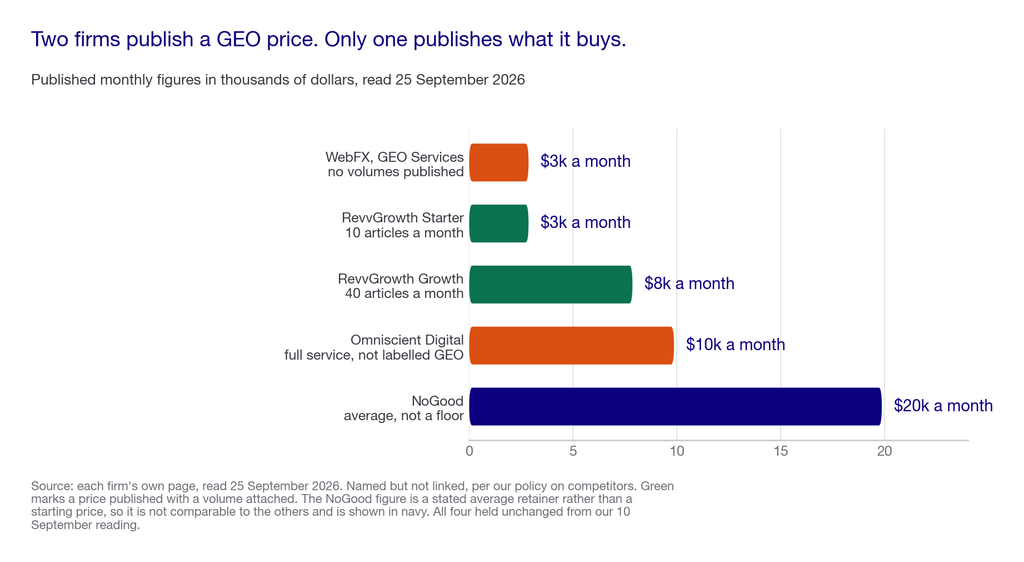
WebFX publishes $3,000 a month for GEO Services, described as “For businesses looking to get ahead in 2026”. The page lists three things: AI query research and targeting strategy, content assets for building authority, and an AI visibility tracking tool. It publishes no volumes, so nothing here yields a unit cost. The page carries no last-updated date either.
RevvGrowth publishes two tiers. Starter is $3,000 a month for ten SEO and GEO-optimised blog articles, GEO strategy and implementation, and foundational tracking. Growth is $8,000 a month for forty articles, advanced strategy and entity optimisation. The page is dated 21 April 2026.
Omniscient Digital publishes a fuller ladder than our earlier benchmark captured. Thought leadership strategy starts around $3,000. Ongoing written programmes start around $8,000 a month, multimedia around $12,000, and full-service SEO and content engagements commonly around $10,000. None of it is labelled GEO.
NoGood publishes an average rather than a floor, describing an average retainer above $20,000 a month. An average is a different kind of statement from a starting price. Do not read it as one.
All four held over fifteen days. Our benchmark read them on 10 September, and since then nothing has moved. That is worth stating, because it contradicts the pattern on the software side. There, two of eight vendors we tracked withdrew published pricing inside five weeks. Agencies that decide to publish a price appear to keep publishing it. Software vendors withdraw.
Where it falls short: four firms is a census of what is publicly findable, not of the market. Most GEO agencies quote privately. A firm that publishes nothing may well be better or cheaper than all four. What this establishes is the only part a buyer can verify before a sales call.
If you would rather know what your category’s answers cost to win than what an agency charges, book a growth audit and we will scope it with you.
The number that matters is the one per article
Only one of the four publishes price and volume together. That makes it the only place in the public GEO agency market where you can compute a unit cost.
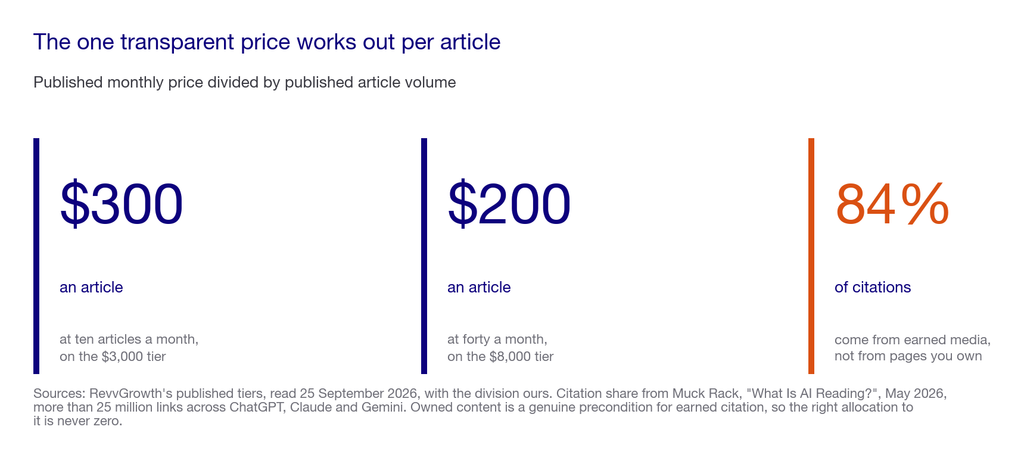
- $3,000 for ten articles is $300 an article.
- $8,000 for forty articles is $200 an article.
So that is a volume discount on content production. The Growth tier costs 2.67 times as much and delivers four times the articles. In other words, the pricing model is built around output rather than outcome.
Now put that next to the citation evidence. A study of more than 25 million cited links across ChatGPT, Claude and Gemini found earned media drives 84% of AI citations. Journalism alone accounts for 27%, and paid content for 0.3%. So content on your own domain is the minority of the surface.
So a GEO retainer priced per article aims at the smaller share of the problem. That is not an accusation of bad faith. Articles are easy to scope, count and invoice. Earned coverage is none of those things. It is a mismatch between the unit and the outcome, and the only price list transparent enough to check makes it visible.
The practical consequence when you read a quote. Ask what share of the retainer leaves your domain. If the deliverable list is entirely pages on your own site, you are buying content production. That is a legitimate purchase at a knowable price. Just do not buy it expecting the 84%.
Where it falls short: we can only compute this for one agency, so it is an example rather than a market average. An agency publishing no volumes may allocate differently. And owned content remains a genuine precondition for earned citation, so the right allocation never reaches zero.
Why the published ranges do not help
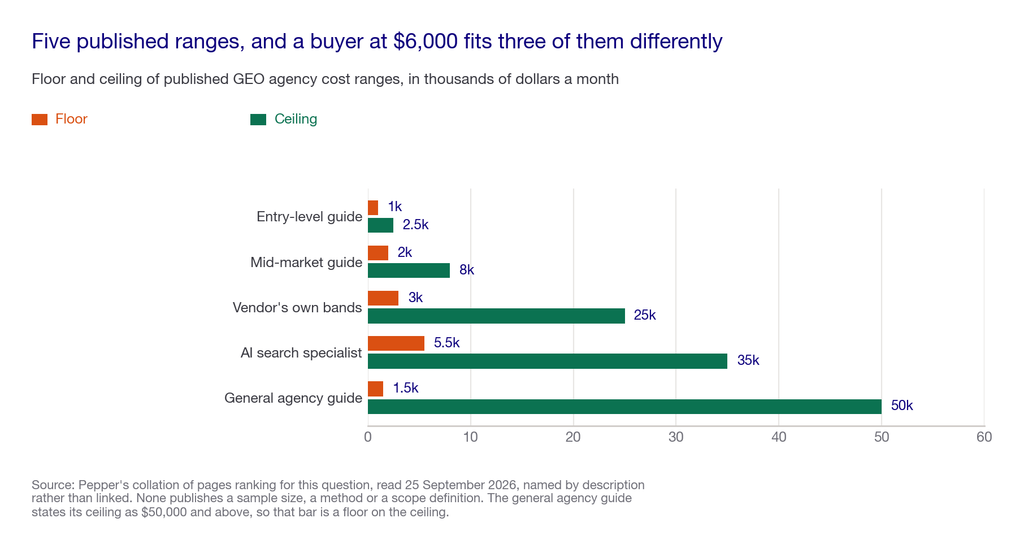
If you search this question you will find ranges rather than prices. They do not agree.
| Source, read 25 September 2026 | Published range |
|---|---|
| A specialist AI search guide | $5,500 to $35,000 a month |
| A general agency pricing guide | $1,500 to $50,000 and above |
| A mid-market AEO and GEO guide | $2,000 to $8,000 a month |
| An entry-level programme guide | $1,000 to $2,500 a month |
| RevvGrowth’s own published industry ranges | $3,000 to $25,000 a month, in three bands |
A buyer at $6,000 a month is over budget under one of these, mid-market under another, and entry level under a third. Meanwhile none of the five publishes a sample, a method or a definition of scope. This is the same pattern we found when we audited published GEO benchmark numbers. Wide, confident and unverifiable.
The one range with a named publisher behind it is a vendor’s. RevvGrowth publishes industry bands alongside its own prices. That is more transparent than most. Still, it is a supplier describing its own market.
Where it falls short: we collated what ranks for this question rather than every range in existence, and we recorded what each page publishes rather than what its author knows.
How we weighted these prices
Four criteria, fixed before we read anything. They are our priorities, not measured coefficients.
| Criterion | Weight | What it means |
|---|---|---|
| Price published with a unit attached | 35 | A figure next to a volume, so cost per article, per prompt or per page is calculable before a call |
| Scope stated in deliverables | 25 | You can see what the money buys, item by item, rather than a category name |
| Share of work leaving your domain | 25 | Earned coverage and third-party presence are visible in the deliverables, not implied |
| The page carries a date | 15 | You can tell whether the figure is current, which two of the four do not let you do |
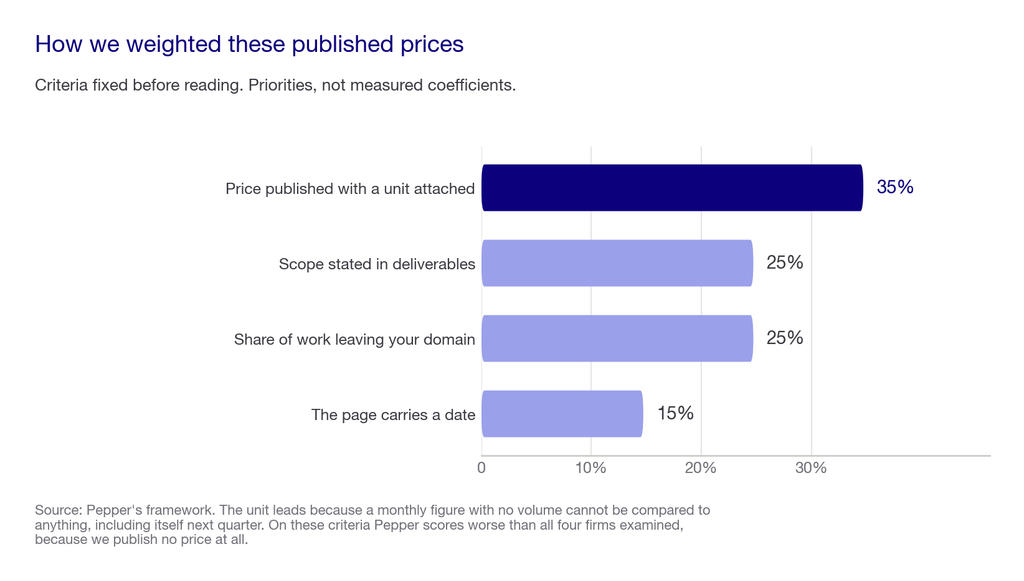
Why the unit leads. A monthly figure with no volume attached compares to nothing, including itself next quarter. But the moment a volume appears, the price turns checkable and the agency’s model turns visible.
Where it falls short: these criteria reward disclosure over quality. That is deliberate, and it is a real limitation. The best GEO agency in your category may publish nothing at all. So what the criteria test is what you can establish before entering a sales process.
GEO agency cost at a glance
| Provider | Published price | Unit disclosed | Scope stated | Date on page | Where it falls short |
|---|---|---|---|---|---|
| WebFX | $3,000 a month | No | Yes, three items | No | No volumes, so no unit cost is calculable |
| RevvGrowth Starter | $3,000 a month | Yes, 10 articles | Yes | 21 April 2026 | The unit is articles, which is owned content |
| RevvGrowth Growth | $8,000 a month | Yes, 40 articles | Yes | 21 April 2026 | Four times the volume for 2.67 times the price rewards output |
| Omniscient Digital | From $10,000 a month | No | Partly, by programme type | No | Not labelled GEO, so scope must be established in a call |
| NoGood | Above $20,000 average | No | No | No | An average is not a starting price and cannot be budgeted from |
| Pepper | Not published | No | No | Not applicable | We publish nothing, which scores worse than all four above |
## What a GEO programme actually costs to run
- The published floor is $3,000 a month, and our wider benchmark of the whole market found that everything below that figure buys software rather than people.
- Software is a separate line, starting around $29 a month at entry tiers and covered in our AEO cost breakdown.
- Earned coverage is the expensive part and the part nobody prices publicly, because it cannot be delivered by the unit.
- Enterprise platforms start around $2,500 a month, covered in our enterprise pricing work, and our breakdown of agency services covers what a retainer normally contains.
- The cheapest thing you can do before any of this is read the quote for its unit. It costs nothing and it tells you what the agency believes the work is.
How Pepper fits
Pepper is an agentic organic growth engine and an organic growth partner, and on this article’s own criteria we score badly, which is worth saying before anything else.
- We publish no pricing. By the scorecard above that costs us 35 of 100 points, more than any single failure among the four agencies examined. Budget discovery with us is a conversation, and that is a real disadvantage to a buyer trying to compare before a call.
- Pepper’s GEO platform is the measurement half. Brand Visibility for how often engines mention you, Domain Prompt Presence for how often they cite a page from your domain, and Share of Voice for your slice of the category. The gap between the first two tells you whether your spend is landing on the owned side or the earned side. See the platform.
- Agent Atlas puts the repeatable work in your team’s hands rather than billing it by the article. System agents stay fixed, user agents stay editable and versioned, and customers log in and build and run their own inside Atlas.
- A growth team works alongside yours on the earned side, which is the part that does not price per unit and the part the published market does not sell.
- Proof rather than adjectives. Acceldata went from 85 to more than 300 top three keywords with 6X organic traffic growth. More in our case studies, and the B2B SaaS practice is where this pricing view was formed.
Where Pepper fits, and where it does not. We are built for programmes that need the earned side as well as the owned side, which is why we do not price per article. A team that wants a known number of articles a month at a known price should buy exactly that, and two of the agencies above will sell it transparently.
How to choose a GEO agency, and how to read the quote
I would read any quote in one pass looking for a single thing: the unit. Everything else follows from it.
The framing judgement first, anchored outside my own view. Google’s guidance on optimising for generative AI features states that optimising for generative AI search is still SEO, running on core ranking systems with no separate index, and it advises against providers guaranteeing rankings because no external party has access to those systems. Read that as a filter on any quote promising citations. Then hold the other half, which is that Google documents Google, and the engines doing most of the work publish nothing comparable.
The Pepper view on top is narrower. A quote priced per article is a content contract. That is a fine thing to buy. It is not the same thing as a GEO programme, and the difference should show up in the proposal’s first paragraph.
Here is the 100 point scorecard I would run over any quote, including ours.
| Area | Weight | What a strong quote demonstrates |
|---|---|---|
| The unit is stated and is not only articles | 30 | Volumes appear for prompts tracked, pages and earned placements, so you can compute cost per unit on each rather than only on content |
| Work leaving your domain is itemised | 25 | Digital PR, original research and expert placement appear as named line items with their own budget, not as an implied benefit of publishing |
| Scope boundaries are written down | 20 | The quote says what is excluded, which is the only reliable sign somebody has scoped this before |
| Measurement is a funded line | 15 | Prompt tracking and baselining have a number against them rather than being described as included |
| The commitment matches the lag | 10 | They ask for four quarters and say why, rather than promising a quarterly result on work that compounds later |
**Then run the live test, on us as readily as on anyone else.** Give any prospective agency 25 buying questions from your own category and ask them to price winning those specific answers. Hold the quotes for 90 days before deciding, because scope changes under questioning and you want to see whose does. Ask them to be specific. For example: “what is the cost per article in this quote”, “which line items produce coverage we do not own”, “what have you excluded”, “what would you cut first if we halved the budget”.
Ask them to come back with five things. The unit cost of every deliverable. The share of the retainer that leaves your domain. The exclusions. What they would cut at half the budget. And the quarter at which they expect the work to be readable.
An agency that itemises earned work beats one that itemises articles. And one that cannot tell you its own cost per unit has not priced the engagement. It has priced a month.
The weaker way to buy this, and it is the common one. Collect three quotes. Compare the monthly figures. Pick the middle one. Then discover in month three that the deliverable is articles, that nothing aims off your domain, and that the measurement you assumed was included costs extra.
The stronger sequence. Ask for the unit before the price. Establish what share of the work leaves your domain. Get the exclusions in writing. Fund measurement as its own line. Commit for four quarters. The distinction matters. The first sequence compares numbers that do not compare. The second compares the only things that do.
Red flags, each one something an agency actually does.
- A monthly price with no volumes anywhere. Two of the four published prices have this problem, and it makes the figure uncomparable.
- Articles as the only unit. That is content production wearing a GEO label.
- An average retainer quoted as a starting price. Those are different statements and only one of them is budgetable.
- A pricing page with no date. Two of the four carry none, so you cannot tell whether the number is current.
- A guarantee of citations, which Google itself advises against in the equivalent case.
- Measurement described as included with no line item, which means it will be the first thing dropped when the schedule slips.
- A market range quoted as justification. The published ranges disagree by more than an order of magnitude.
Five questions worth asking, and what a good answer sounds like.
- “What is the cost per unit in this quote?” A good answer computes it in front of you. A bad answer says it depends on scope.
- “What share of this leaves our domain?” A good answer is a number and a list of named targets. A bad answer describes authority building in the abstract.
- “What is excluded?” A good answer names three things. A bad answer says the retainer is comprehensive.
- “What would you cut first at half the budget?” A good answer is specific and slightly uncomfortable. A bad answer is that everything is essential.
- “When will this be readable?” A good answer is several quarters and explains why. A bad answer is next month.
If I reduce this to one principle: buy the unit, not the monthly figure. The monthly figure is the only number two agencies will both give you and the only one that tells you nothing.
The honest note that costs us something. Very few providers are strong at technical work, content execution, earned media and measurement at once, and we would not claim uniform strength across all four either. Earned media is where most of the market is weakest, including firms selling GEO. It is also the most expensive thing to staff. Judge candidates there.
What nobody should promise you
Nobody should quote a GEO retainer without a unit. A monthly figure with no volumes attached compares to no other monthly figure, which is precisely why agencies quote it that way.
Nobody should present a published market range as a justification for their price. The ranges we found disagree by more than an order of magnitude and none publishes a sample or a scope.
Nobody should promise a citation for a fee. Google advises against providers who guarantee rankings, because no external party has access to the ranking systems.
Nobody should sell you articles and call it GEO. Owned content forms a genuine part of the work and a minority of the citation surface. The proposal should say plainly which part you are buying.
Where this stops working, including for us
If you genuinely need content production at volume, then the per-article pricing above is transparent and fair, and buying it is sensible. Just call it what it is.
If your budget is below $3,000 a month, the published agency market does not serve you, and our wider benchmark found everything below that figure buys software rather than people.
If you cannot commit for four quarters, an agency retainer is the wrong instrument regardless of price, because you will cancel before the work is readable.
Where Pepper fits and does not. We publish no pricing, which is the worst score on this article’s own criteria, and we are not the right choice for a buyer who needs to compare before a call. For a programme that needs the earned side as well as the owned side, the per-article market does not sell what you need.
Where to go next
Take whichever quote you have in front of you and divide the monthly figure by the number of deliverables. If you cannot, that is the finding.
Then ask what share of the work leaves your domain. For the adjacent decisions, our real pricing benchmarks for the whole GEO market cover software as well as agencies, what AEO costs covers the pricing models, agency or tool covers whether to buy a retainer at all, and what agency services include covers scope. To see what winning your category’s answers would actually require, see where you show up.
Frequently asked questions
How much does a GEO agency cost?
Published prices start at $3,000 a month. WebFX publishes $3,000, RevvGrowth publishes $3,000 and $8,000, Omniscient Digital publishes a full-service floor around $10,000, and NoGood describes an average retainer above $20,000. Most agencies publish nothing.
Why do so few GEO agencies publish prices?
Scope is undefined across the category, so a price without a scope cannot be compared to another price without a scope. Most firms quote privately, which means the published figures are a self-selected sample of agencies comfortable being compared.
What is a fair price per article for GEO content?
The only agency publishing both price and volume works out at $300 an article at ten a month and $200 at forty a month. Use that as a reference point, and remember that owned content is the minority of the citation surface.
Is $3,000 a month enough for GEO?
It is the published floor for agency work. Our wider benchmark found that everything priced below it buys software with no human implementation attached, so below $3,000 you are buying a tool rather than a programme.
Do GEO agency prices change often?
Less than software prices do. All four published agency figures held unchanged across the fifteen days between our two readings, while two of eight software vendors we tracked withdrew published pricing within five weeks.
What should a GEO retainer include beyond content?
Work that leaves your domain, itemised separately. Earned media drives 84% of AI citations, so digital PR, original research and expert placement should appear as named line items with their own budget rather than as implied benefits.
Are the published GEO price ranges reliable?
No. Five sources we read put the range at $1,000 to $2,500, $2,000 to $8,000, $5,500 to $35,000, $1,500 to $50,000 and above, and $3,000 to $25,000. None publishes a sample size, a method or a scope definition.
How long should you commit to a GEO agency?
Four quarters. Citation to traffic runs six to nine weeks but citation to pipeline runs several quarters on considered purchases, so a shorter commitment tests your review cycle rather than the agency.
Sources and further reading
- Agency pricing pages, each read at source on 25 September 2026, and named but not linked per our policy on competitors. WebFX: GEO Services at $3,000 a month, listing AI query research and targeting strategy, content assets for building authority, and an AI visibility tracking tool; no volumes and no date on the page. RevvGrowth: Starter $3,000 a month for ten SEO and GEO-optimised blog articles, Growth $8,000 a month for forty, page dated 21 April 2026, and the page also publishes industry bands of $3,000 to $6,000, $6,000 to $12,000 and $12,000 to $25,000. Omniscient Digital: thought leadership strategy from around $3,000, ongoing written programmes from around $8,000 a month, multimedia from around $12,000, full-service SEO and content commonly from around $10,000; none labelled GEO. NoGood: average retainer above $20,000 a month. Limitations: four firms is a census of what is publicly findable, not of the market, and most GEO agencies quote privately.
- Pepper, how much does generative engine optimization cost in 2026, which read the same four agencies on 10 September 2026. This article re-reads them and covers the agency half specifically. That page remains the reference for the whole market including software, and for the finding that everything under $3,000 a month buys software.
- Muck Rack, “What Is AI Reading?”, May 2026 third edition. More than 25 million links from ChatGPT, Claude and Gemini across 17 industries. Source of earned media at 84% of AI citations, journalism at 27% and paid and advertorial at 0.3%. Limitations: it measures which sources engines cite, not which citations influence a purchase.
- Four published GEO cost ranges collated from pages ranking for this question on 25 September 2026, named by description rather than linked. None publishes a sample size, a method or a scope definition, which is why this article treats them as evidence of disagreement rather than as benchmarks.
- Pepper, agency or tool for GEO. Covers whether to buy a retainer at all before comparing retainer prices, which is the decision upstream of this one.
- Pepper, what SEO agency services include. The scope reference for reading a retainer proposal, and the source of the deliverable categories used in the scorecard.
- Pepper, the visibility, citability and retrievability framework. Why owned content is a precondition for earned citation rather than a substitute for it, which is the caveat on the cost-per-article finding.
- Google Search Central, guide to optimizing for generative AI features, page last updated 10 July 2026. Source of the advice against providers guaranteeing rankings. Applies to Google Search only.
- The cost-per-article arithmetic is ours and is shown in full so you can check it. It divides published monthly prices by published article volumes, and it can only be computed for one of the four agencies, which is itself the finding.
What is not here, and why. No Pepper price, because we do not publish one, and the article says that costs us more points than any failing it identifies elsewhere. No recommended budget figure, because the number should come from your own organic line rather than from a category benchmark, and a separate piece on budget allocation covers that properly. No ranking of the four agencies, because two of them do not label their work GEO and ranking them against the two that do would be a false comparison.
Latest Blogs
AI search optimization has four cost layers and only one of them has a price you can look up. Software is published, comparable and the cheapest. Agency retainers are published by exactly two firms. Earned media, which drives most AI citations, is priced by almost nobody. And the fourth layer, doing it with your own people, turns out to have no market rate at all. A study of 3,900 SEO job listings found that just 6.3% of senior roles mention AI search, and published salary figures for the same job title differ by 76% between sources.
We re-read every published GEO agency price on 25 September 2026, fifteen days after our own benchmark first recorded them. All four held, which is worth knowing on its own because the software side of this market has been withdrawing prices all quarter. The more useful finding came from the one agency that publishes volumes alongside price. Ten blog articles at $3,000 a month and forty at $8,000 works out at $300 and $200 an article. That is a content production contract with a GEO label, and the citation evidence says content you own accounts for a small minority of AI citations.
Our own benchmark of 30 published prices already answers what GEO costs. This answers the different question, which is what you should budget and where it should go. Two numbers decide it. A study of more than 25 million cited links found earned media drives 84% of AI citations while paid and advertorial content drives 0.3%. And the Gartner CMO survey of 401 CMOs puts marketing at 7.8% of revenue with SEO the largest single line inside owned and earned digital. Put those together and the answer is that GEO is not a new budget line at all. It is a reallocation, and most teams are making it in the wrong direction.
Get your hands on the latest news!