SEO agency services in 2026: what’s included, how much it costs, and how to choose
The short answer
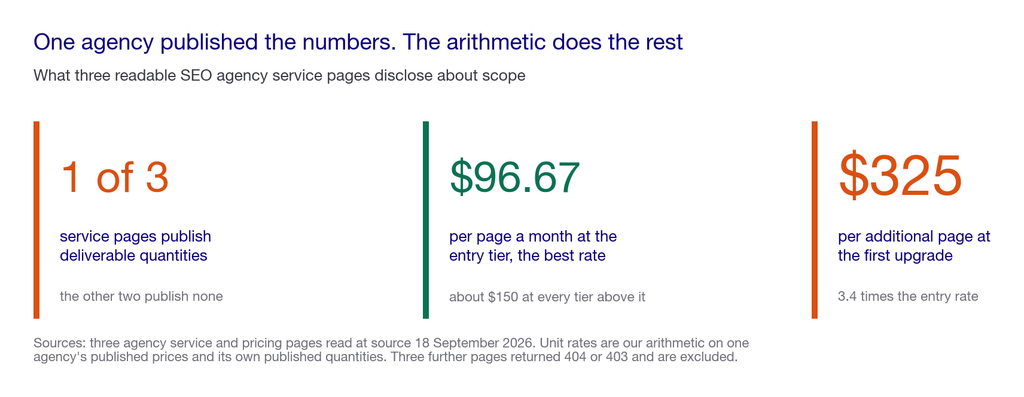
Agencies publish service names. Very few publish service quantities, and without quantities the list of what is included cannot be compared to anything or priced per unit. Of three agency service pages we could read on 18 September 2026, one published full deliverable quantities per tier. So we divided that agency’s prices by its own numbers. The entry tier costs about $97 per page optimised per month. Every tier above it costs about $150. And the first upgrade costs $325 for each additional page it buys, which is 3.4 times the entry rate.
Key takeaways
- “What’s included” is almost never a quantity. Thirteen named services with no numbers attached is the norm. It is also not a scope of work.
- One agency publishes the full grid. WebFX states keyphrases, pages, quarterly assets and dashboards for each of four tiers. Prices run $2,900 to $9,200 a month on a six-month commitment.
- Divide and the ladder inverts. Cost per page optimised runs $96.67 at Silver, then $153.75, $148.00 and $153.33 above it. The entry tier is the best value per unit and the three upper tiers are flat.
- The marginal maths is worse than the average. Moving Silver to Gold costs $3,250 more a month and buys ten more pages. That is $325 per additional page, against $96.67 below it.
- So the buying question changes. Not “which tier”, but “how many pages do I actually need optimised”, because the answer decides whether any upgrade is rational.
- This is the scope companion to our pricing work. Our published retainer benchmarks cover price by engagement model. This covers what the money buys.
- Pepper is an agentic organic growth engine and an organic growth partner. Agent Atlas gives your team the agents. Pepper’s GEO platform reports Brand Visibility, Domain Prompt Presence and Share of Voice. A growth team works alongside yours. Eight years, more than 250 enterprises, more than 10 million tracked prompts.
A note on where this comes from. My job is the unit economics of a marketing spend, and a retainer with no denominator has none. Pepper runs organic for more than 250 enterprises over eight years, tracking more than 10 million prompts across every major engine. I also sit in the quarterly review where somebody asks what the retainer actually produced, which is where a scope without quantities becomes expensive.
Disclosure: Pepper sells organic growth services and published this guide. We publish no pricing and no deliverable quantities on our website. By this article’s own standard we are in the majority we are criticising, and we say so again at the end. Every figure below was read on that company’s own page on 18 September 2026. Competitors are named but never linked.
What is included in SEO agency services, and why is the list not enough?
An SEO agency service list is the menu: technical SEO, keyword research, on-page optimisation, content production, link building, local SEO, migrations, audits, reporting. Almost every agency offers almost the same set, and the names have been stable for a decade.
The problem is that a name is not a scope. “Technical SEO” can mean a quarterly crawl report or an embedded engineer. “Content writing” can mean two posts a month or twenty. Two proposals listing identical services can differ fivefold in what arrives. Nothing on either page tells you which one you are buying.
So the useful question is not what is included. It is how much of each thing is included, and that is the number almost nobody publishes.
Our benchmarks by model and scope cover what agencies charge and by which engagement model. This article covers what the money buys, and the arithmetic that connects the two. For the AI search equivalent, see what GEO services actually include.
What agencies actually publish
Three service pages we could read, and they fall into two camps.
Thrive lists thirteen services by name. Keyword research and strategy, link building, technical SEO, local SEO, AI SEO, on-page, off-page, franchise, Shopify, Amazon, ecommerce, content writing and SEO audits. No quantities. No prices. The page asks for your monthly budget before telling you anything about its own.
Victorious names AEO services, content services, SEO copywriting, on-page, keyword research, audits, migration, off-page, link building, technical SEO, managed hosting and local SEO. The only number on the page is a client result, 1,533 page-one keywords year on year. That describes the past rather than what you would receive. No quantities. No prices.
WebFX publishes the whole grid, and it is the exception that makes this article possible.
| Tier | Price a month | Keyphrases optimised | Pages optimised | Assets a quarter | Dashboards |
|---|---|---|---|---|---|
| Silver | $2,900 | Up to 150 | Up to 30 | 6 | 8 |
| Gold | $6,150 | Up to 200 | Up to 40 | 12 | 8 |
| Platinum | $7,400 | Up to 250 | Up to 50 | 15 | 10 |
| Diamond | $9,200 | Up to 300 | Up to 60 | 24 | 10 |
All four carry a six-month commitment, and Enterprise is quoted. Note the “up to” on every quantity, which is a ceiling rather than a promise.
Three more agencies could not be read. SEOProfy’s services URL returned a 404, Straight North returned a 403, and RevvGrowth’s pricing URL returned a 404 today after being readable earlier this month. All three are recorded as unverified rather than assumed either way.
Where this falls short: three readable pages is a small sample, chosen because they rank rather than at random. The sample establishes the shape of the problem, not its exact proportions. Our larger audit of ten B2B and enterprise agencies found the same pattern on a different set of signals.
If you want your own category sized before you request a single proposal, book a growth audit and we will show you what the work involves at your scale.
The arithmetic nobody runs
Published prices plus published quantities means cost per unit, which is the only way to compare two proposals honestly. Here it is.
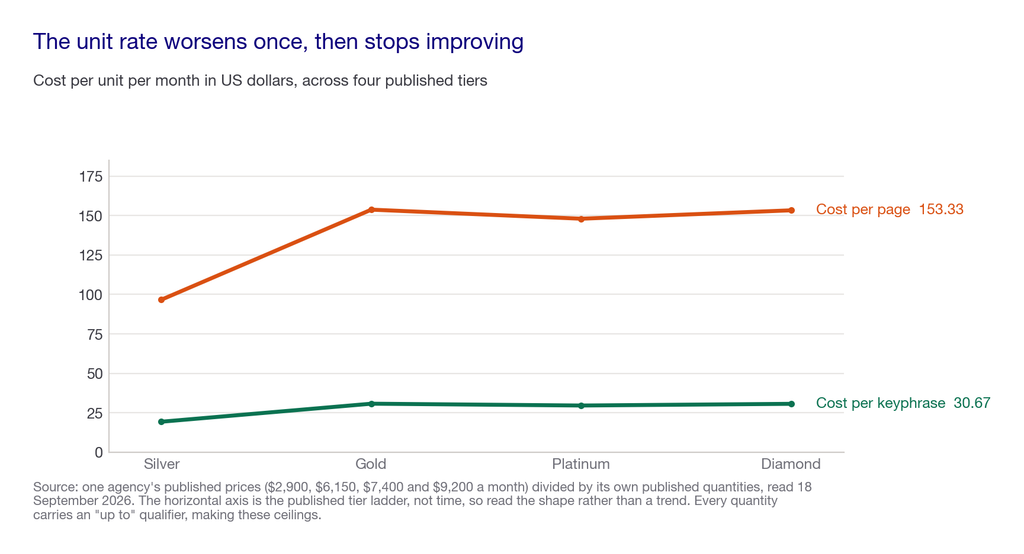
Cost per page optimised, per month:
- Silver: $2,900 divided by 30 pages is $96.67
- Gold: $6,150 divided by 40 pages is $153.75
- Platinum: $7,400 divided by 50 pages is $148.00
- Diamond: $9,200 divided by 60 pages is $153.33
Cost per keyphrase optimised, per month:
- Silver: $19.33. Gold: $30.75. Platinum: $29.60. Diamond: $30.67.
Both series have the same shape. The entry tier is materially cheaper per unit, the three tiers above it are effectively flat, and the step happens once at the first upgrade.
The marginal cost is the sharper number. Going from Silver to Gold adds $3,250 a month and ten pages. That is $325 for each additional page, against an average of $96.67 at the tier you are leaving. The later upgrades are better: Gold to Platinum is $125 per additional page, Platinum to Diamond is $180.
So the worst-value decision on the whole ladder is the first upgrade, which is also the one most buyers make.
Where this falls short, and it matters: pages and keyphrases are not the whole service. The upper tiers also carry more quarterly assets, from 6 to 24, and more dashboards, and the “up to” qualifier means these are ceilings rather than guarantees. A buyer who values the assets more than the pages will read this table differently, and should. What the arithmetic gives you is a denominator to argue with, which is more than most proposals offer.
How we scored the scope question
Five criteria, fixed before any agency page was opened.
| Criterion | Weight | What it means |
|---|---|---|
| Quantities published per deliverable | 30 | A number attached to each service, so two proposals can be compared and a unit cost computed |
| Price published alongside them | 25 | Without both halves there is no denominator and no arithmetic |
| Ceilings versus commitments stated | 20 | “Up to 30 pages” and “30 pages” are different products, and the page says which it means |
| Commitment term disclosed | 15 | The minimum term is part of the price, and a six-month lock changes the calculation |
| Exclusions named | 10 | What the retainer does not cover, stated before the contract rather than discovered in month three |
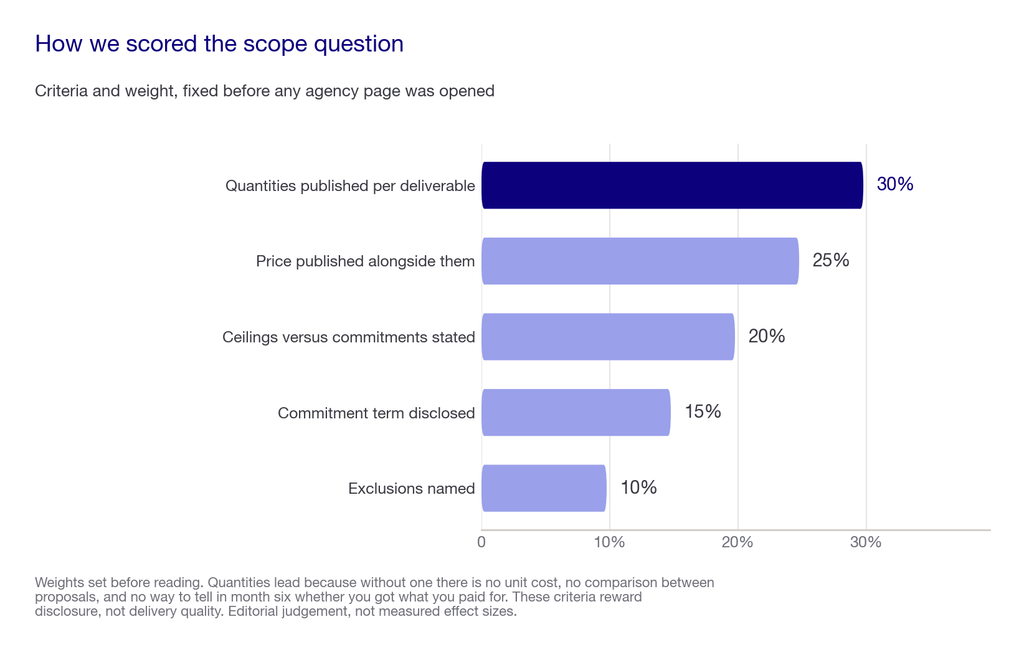
Why quantities lead. Every other criterion is useful and none is decisive. Without a quantity there is no unit cost, no comparison between proposals, and no way to tell in month six whether you got what you paid for.
Where this falls short: these criteria reward disclosure, not delivery quality. An agency publishing nothing may do excellent work. One publishing a full grid may under-deliver against its own ceilings. What the criteria test is whether you can tell before you sign.
What a scope of work must state
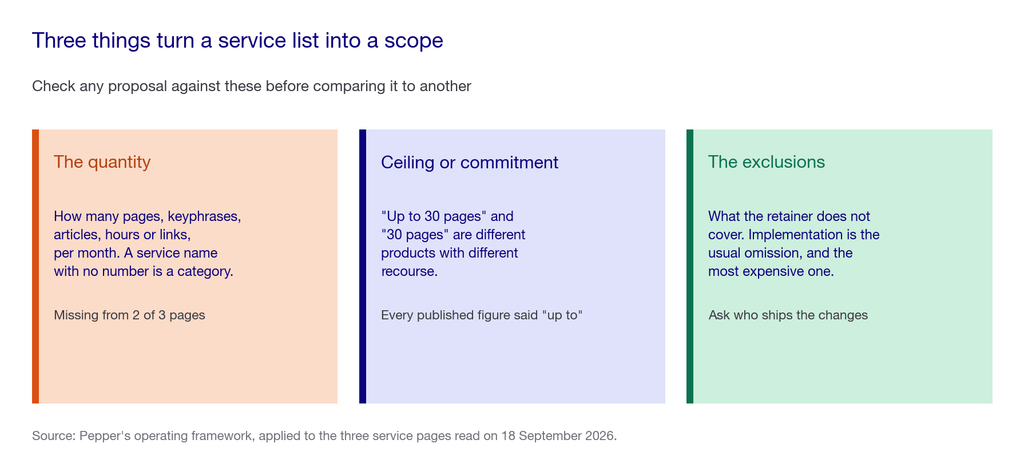
Take any proposal and check it against three things. If all three are present you can compare it to another proposal. If any is missing you cannot, whatever the price says.
- The quantity. How many pages, keyphrases, articles, hours or links, per month or per quarter. A service name with no number is a category, not a commitment.
- Ceiling or commitment. “Up to 30 pages” means you may receive fewer and have no recourse. “30 pages” means you have one. Every published quantity we found today carried an “up to”.
- The exclusions. What is explicitly not covered. Implementation is the usual omission. Many retainers deliver recommendations and assume your engineers ship them, which is the largest hidden cost in this category.
SEO agency services at a glance
| What you are buying | Typical monthly price | Quantities usually published? | Where it falls short |
|---|---|---|---|
| Full-service retainer, entry | $2,900 | Rarely. One agency of three published them | At $96.67 a page this is the best published unit rate we found |
| Full-service retainer, mid | $6,150 to $7,400 | Rarely | Unit cost jumps about 55% against the entry tier, then flattens |
| Full-service retainer, upper | $9,200 | Rarely | No better per unit than the tier two steps below it |
| Enterprise retainer | Not published anywhere | No | Quoted in every case. What large organisations pay covers why |
| Standalone audit | $750 to $8,600 | Sometimes, by page count | A document. The fee excludes implementation |
| Hourly consulting | $150 to $300 an hour | The hour is the quantity | Advice rather than delivery |
| AI search and GEO retainer | From $3,000 | Occasionally, by article count | A separate discipline. See our GEO services scope |
| Software instead of an agency | $29 to about $500 | Yes, by seats and limits | Shows you the problem and fixes none of it |
| Pepper, own row | Not published | No, and we should say so | Budget and scope are a conversation rather than a page |
## What SEO agency services cost, and what changes the number
- The published ladder runs $2,900 to $9,200 a month for full-service work on a six-month commitment, with Enterprise quoted separately.
- The denominator changes everything. Thirty pages a month at $2,900 is a different purchase from thirty pages a month at $9,200, and only one agency in our sample lets you see that.
- Setup fees are real and separate. The same agency publishes a two-month onboarding fee elsewhere. Our retainer pricing work covers it in detail.
- Implementation is usually excluded, which means your engineering time is a cost line the proposal does not show.
- At enterprise scale nobody publishes at all. Every figure becomes a quote, which is a different problem covered in enterprise SEO pricing.
How Pepper fits, and where we fail this test
Pepper is an agentic organic growth engine and an organic growth partner.
- Agent Atlas changes the denominator rather than the rate. Agents are workflows. System agents stay fixed, user agents stay editable and versioned, and customers log in and build and run their own inside Atlas. The relevant point for this article is that a retainer priced per page assumes a human does each page, and that assumption is what agents alter.
- Pepper’s GEO platform reports what the work produced. Brand Visibility for how often engines mention you, Domain Prompt Presence for how often they cite a page from your domain, and Share of Voice for your slice of the category. See the platform.
- A growth team works alongside yours, including on the implementation that most retainers exclude.
- Proof rather than adjectives. Acceldata went from 85 to more than 300 top-three keywords with 6X organic traffic growth, and one hero guide carried over 260,000 impressions. More in our case studies.
Where Pepper falls short, and on this article it is unavoidable. We publish neither prices nor deliverable quantities on our website. Judged by the five criteria above we would score close to zero on the first two, worth 55 of the 100 points. The agency this article treats as the exception publishes more than we do. We think scope belongs in a proposal written against your actual site rather than in a public grid, and that is a real argument, but it is also exactly what every agency in the majority says.
How to choose, and what to ask
I would not start from a service list. I would start by working out the quantity you actually need, because that single number decides which tier, which model and often which agency.
Here is the 100-point scorecard I would run over any SEO services proposal, ours included.
| Area | Weight | What a strong proposal demonstrates |
|---|---|---|
| Quantities against every line | 30 | Pages, keyphrases, articles, hours and links each carry a number, per month, in the contract rather than the pitch |
| Unit cost computed for you | 25 | The proposal divides its own fee by its own deliverables, instead of leaving you to reverse-engineer it |
| Ceilings distinguished from commitments | 20 | It states plainly which numbers are “up to” and what happens when the ceiling is not reached |
| Implementation position stated | 15 | It says who ships changes, and if it is your team, it estimates those hours rather than omitting them |
| Exclusions listed before signature | 10 | The list of what is not covered is long, specific and offered without being asked for |
**Then run the live test, on us as readily as on anyone else.** Write down the 25 questions your buyers actually ask and the pages that answer them. Give every agency the same list and ask what they would do over 90 days, with a quantity against each line and a unit cost. Four examples. “How many of these pages get optimised in the first quarter.” “How many keyphrases per page.” “Who ships the changes.” “What is the cost per page at this tier.”
Ask each to come back with five things. The quantity per deliverable. The unit cost of each. Which numbers are ceilings. What is excluded. What the first upgrade would cost per additional unit.
Five questions worth asking, and what a good answer sounds like.
- “How many pages a month, in writing?” A proposal without a number is not a scope, and the answer should survive into the contract.
- “What is your cost per page at this tier?” A good agency has already done the division. On the only published grid we found, it runs $96.67 to $153.75.
- “Is that a ceiling or a commitment?” Every published quantity we read today said “up to”.
- “What does the next tier up cost per additional page?” On the published ladder the first upgrade is $325 per marginal page, which is the worst value on it.
- “Who implements?” If the answer is your engineers, ask for the hours, because that is the cost the proposal is hiding.
Red flags, each one visible in the current market.
- A service list with no quantities, which is most of what you will be sent and cannot be compared to anything.
- “Up to” on every line, with no statement of what happens when the ceiling is not reached.
- A tier upgrade justified by more services rather than more units, when the extra services were already listed at the tier below.
- No stated commitment term, when the published ladder we read carries six months on every plan.
- Implementation unmentioned, which quietly moves the largest cost onto your team.
- Case study numbers used as deliverables, such as a past client’s keyword count offered where a scope should be.
- A guarantee of rankings, which Google itself advises against, because no third party has access to the ranking systems.
The weaker way to buy this, and it is the common one. Collect three proposals. Compare the service lists, which are nearly identical. Compare the prices, which are not. Pick the middle one. You have chosen on price alone, because the service lists carried no information.
The stronger sequence inverts it. Decide the quantity you need first. Ask every agency to price that quantity. Compute cost per unit yourself. Then judge the tier, and check what the next tier up costs per marginal unit before you accept any upgrade.
If I reduce this to one principle: buy the denominator. A retainer without a quantity cannot be compared, cannot be renewed on evidence, and cannot be defended in a review.
The honest closing note, and it costs us something. If you need fewer than about thirty pages optimised a month, you do not need a bespoke proposal and you should not pay for one. The entry tier of a published ladder is likely better value than anything we would quote. Bespoke pricing earns its keep at scale and rarely below it.
What nobody should promise you
Nobody should present a service list as a scope of work. Thirteen named services with no quantities is a menu, and you cannot compare two menus without prices per dish.
Nobody should quote a tier upgrade without its marginal unit cost. On the only published grid we could read, the first upgrade costs 3.4 times the entry rate per additional page. No proposal will volunteer that.
Nobody should promise rankings for a fee. Google advises against providers who guarantee rankings, because no external party has access to the ranking systems.
Where this stops working, including for us
If your site is small enough that fewer than thirty pages matter commercially, most of this is over-scoped. Buy the entry tier of something published, or buy software and a freelancer.
If you cannot ship changes, no scope helps. A retainer delivering sixty optimised pages a month into a release queue that moves twice a quarter is an expensive way to generate documents.
Where Pepper falls short: we publish neither prices nor quantities, so this article’s own criteria score us poorly on more than half the available points. We would rather state that than write an article about disclosure and exempt ourselves from it.
Where to go next
Write down the quantity before you write the brief. How many pages, how many articles, how many months. That number does more work than any agency comparison.
Then price that quantity across providers and compute cost per unit yourself. For the adjacent decisions, our pricing benchmarks by model cover price by engagement model, enterprise pricing above this ladder covers what happens at scale, SEO audit agencies covers buying a diagnostic on its own, and agency or tool covers whether to buy help at all. If the vocabulary is new, start with our glossary of core AEO terms. To see where you stand first, see where you show up.
Frequently asked questions
What services does an SEO agency provide?
The same dozen almost everywhere: technical SEO, keyword research, on-page optimisation, content, link building, local SEO, migrations, audits and reporting. The names are standard. What differs, and what almost nobody publishes, is how much of each you receive per month.
How much do SEO agency services cost in 2026?
The published full-service ladder we read runs $2,900 to $9,200 a month on a six-month commitment, with Enterprise quoted. Standalone audits run $750 to $8,600 and consulting $150 to $300 an hour.
What should be in an SEO scope of work?
Three things per line: the quantity, whether that quantity is a ceiling or a commitment, and the exclusions. A service name without a number is a category, not a deliverable.
Is a more expensive SEO retainer better value?
Not on the only published grid we could read. Cost per page optimised is $96.67 at the entry tier and roughly $150 at all three tiers above it, so the unit rate gets worse once and then stops improving.
What does a tier upgrade actually buy?
On that same ladder, moving from the entry tier to the next costs $3,250 more a month for ten more pages. That is $325 per additional page, against $96.67 at the tier you are leaving.
Why do most agencies hide their deliverable quantities?
Because scope genuinely varies by site, which is a fair argument, and because a published quantity is a commitment you can be held to. The consequence for you is that comparison is impossible until you force the numbers into a proposal.
Does an SEO retainer include implementation?
Often not, and that is the most expensive omission in this category. Ask who ships the changes, and if the answer is your engineers, ask the agency to estimate those hours.
How do I compare two SEO proposals fairly?
Make both quote the same quantity, then divide each fee by its deliverables. Cost per page and cost per keyphrase tell you far more than the monthly total, and neither proposal will compute them for you.
Sources and further reading
- Agency service and pricing pages, read at source on 18 September 2026. WebFX: Silver $2,900, Gold $6,150, Platinum $7,400 and Diamond $9,200 a month, all on a six-month commitment, with up to 150, 200, 250 and 300 keyphrases optimised, up to 30, 40, 50 and 60 pages optimised, 6, 12, 15 and 24 content, outreach, UX or CRO assets a quarter, and 8, 8, 10 and 10 dashboards; Enterprise quoted. Thrive: thirteen services named, no quantities, no prices. Victorious: twelve services named, no quantities, no prices, with one client result quoted. Named but not linked, per our policy on competitors.
- Three pages we could not read, recorded as unverified rather than assumed: SEOProfy’s services URL returned 404, Straight North returned 403, and RevvGrowth’s pricing URL returned 404 today after being readable earlier this month.
- All cost-per-unit figures are our own arithmetic, dividing that agency’s published prices by its own published quantities. No rate was supplied by any agency and none is an industry benchmark. Limitation stated twice in the text: every published quantity carries an “up to” qualifier, so these are ceilings, and pages and keyphrases are not the whole service.
- Google Search Central, guide to optimizing for generative AI features, page last updated 10 July 2026. Source of the advice against providers who guarantee rankings. Applies to Google Search only.
- Pepper, SEO agency pricing benchmarks for price by engagement model, what large organisations actually pay for what happens above this ladder, and our ten-agency disclosure audit for the same pattern measured on different signals.
- Pepper, Acceldata case study. One account, not a benchmark.
What is not here, and why. No industry-average deliverable volumes, because only one agency in our sample published any and one is not an average. No estimated quantities for the agencies that publish none, because inventing a number for a company that declined to state one would be the exact failure this article is about. No ranking of the three agencies, because two of them published nothing to rank. Three further agencies could not be read and are recorded as unverified. Pepper publishes neither prices nor quantities and would score poorly against this article’s own criteria, which is stated three times rather than omitted.
Latest Blogs
Every agency lists the same dozen services. Almost none of them tells you how much of each you get, which makes the list unusable for comparison. One agency does publish full quantities per tier, so we divided its prices by its deliverables. The result inverts the ladder: the cheapest plan is the best value per page, and the first upgrade costs 3.4 times the entry rate for each additional page it buys.
The short answer The three terms name three surfaces, and that part is real. What is not real is the implication that they need three playbooks, three teams and three budgets each. Google states that its generative features run on core Search ranking systems. In July it also named four AI-specific tactics it does not […]
Most resource libraries are link dumps that rot quietly. We built this one the way we build everything else: 85 candidates checked at source on one day, 30 kept, 5 dropped because they no longer resolve, and two of our own entries flagged as partly superseded by newer guidance from Google. Every item says what it is for and what it cannot do. It is organised by the job you are trying to finish, not by content type.
Get your hands on the latest news!

Similar Posts

SEO
12 mins read
How to find the topics AI engines actually answer

SEO
15 mins read
What are the best SEO agencies in 2026?

Artificial Intelligence
12 mins read