In-house SEO vs agency vs platform: the 2026 decision framework
Two things are wrong with almost every page answering this question, and both are worth knowing before you read another cost comparison.
The pages are written by the people selling one of the answers. We checked what ranks. Agency sites conclude you need an agency. Platform sites conclude you need a platform. The most-repeated claim, that outsourced SEO delivers three times the return of in-house work, appears on agency pages with no study attached to it anywhere we could find.
The cost benchmarks are two years old. The hourly and retainer figures quoted across these pages, around $111 an hour and roughly $3,200 a month for an agency, come from a survey of 439 service providers that was last updated in August 2024. They are being republished as 2026 rates.
Pepper sells one of the three answers, so read that with the disclosure below in mind. What we can offer is a framing that does not require you to pick one at all.
The short answer
Stop choosing between three models. Split the decision by capability instead.
There are five capabilities in a modern organic programme, and almost nobody should own all five or rent all five. Own strategy and ownership. Buy software for measurement. Rent earned media. The other two, technical work and content production, genuinely depend on your situation.
Most functioning programmes we see are a hybrid, and the teams that struggle are usually the ones that tried to make a single choice.
Key takeaways
- The published cost benchmarks are stale. The most-quoted figures date from a survey last updated in August 2024, presented everywhere as current.
- “3x the ROI of in-house” is unsourced. It appears on pages selling outsourcing, with no study behind it.
- Nobody should own all five capabilities. Earned media is the hardest to build in house and the one that matters most for AI visibility.
- Measurement is now nearly free to start. Several AI visibility platforms have genuine free tiers, so this is no longer a budget line at all in the first quarter.
- What matters is what comes off your plate. Not what something costs, but which work stops being yours.
A note on where this comes from. We run organic for more than 250 enterprises and track over 10 million prompts across every major engine. What follows is shaped by that, by the client reviews we sit in weekly, and by the in-house teams we inherit work from. It is our read on how the decision actually gets made.
What is in-house SEO, and what does it cover now?
In-house SEO means employing the people who run your organic programme, rather than retaining a firm or buying software to do parts of it.
That definition used to describe one job. It now describes five distinct capabilities, and conflating them is why the cost comparisons you find are unusable.
- Strategy and ownership. Deciding what to target, defending the budget, saying no. Someone inside the company does this or nobody does.
- Technical work. Crawling, rendering, structured data, site architecture. Google’s own guidance says crawl budget needs active management above one million pages changing weekly, or ten thousand pages changing daily, or whenever a large share of your URLs sit in “Discovered, currently not indexed.”
- Content production. Writing, editing, publishing, and the review cycle around it.
- Earned media. Getting cited by publications, communities and review sites you do not own.
- Measurement. Knowing what changed, on which surfaces, and what it earned.
Our enterprise SEO audit framework covers the technical half in detail, and enterprise SEO covers what changes above 10,000 pages.
The five capabilities, and where each should sit
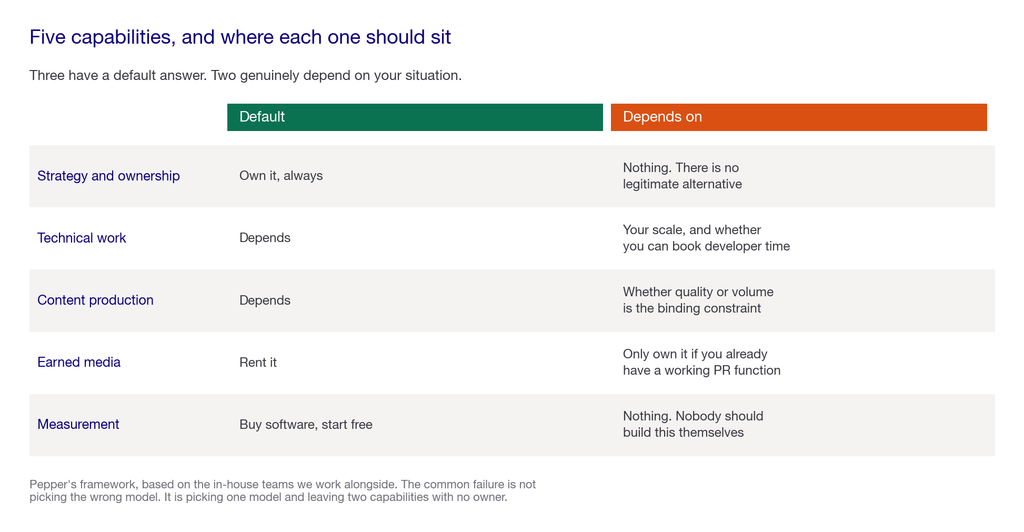
Strategy and ownership: own it, always. This is the one capability with no legitimate outsourcing option. An agency can advise. It cannot decide what your company will not do, and it cannot defend your budget in a planning meeting.
- Own it when: always
- Rent it when: never, though you can rent the thinking that informs it
- What it costs: one senior person, and the failure mode of not having one is that everything else drifts
Technical work: depends on your scale and your engineering access. Below roughly ten thousand pages, a competent generalist covers it. Above that, and especially above half a million URLs, it becomes a specialism.
- Own it when: you have engineering time you can actually book, and enough scale to keep someone busy
- Rent it when: you need log file analysis, a migration, or depth you cannot hire for
- What it costs: the constraint is rarely the specialist. It is getting developer time to act on what they find
Content production: the most genuinely flexible of the five. Plenty of teams run this well in house, and plenty rent it successfully.
- Own it when: your subject is technical enough that outsiders write it badly, or you publish continuously
- Rent it when: volume is the constraint rather than quality, or your cycle from idea to published runs beyond a month
- What it costs: the hidden cost is review, not writing. Legal and subject-matter review is usually the bottleneck
Earned media: rent it, in almost every case. This is the capability in-house teams most consistently lack, and it is the one that matters most for AI visibility.
- Own it when: you already have a functioning PR or communications team you can borrow, with real relationships
- Rent it when: you do not, which is most companies
- What it costs: it is the hardest of the five to build from nothing and the slowest to compound
Measurement: buy software, and start free. This stopped being a budget question this year.
- Own it when: never, in the sense of building it. Nobody should build this
- Buy it when: immediately, because several platforms now have genuine free tiers
- What it costs: nothing to start. AirOps offers a free tier tracking 100 prompts, AthenaHQ a free tier covering five models, and HubSpot’s AI Search Grader a free check needing no account
If you want the capability split scored against your actual team before you restructure anything, book a growth audit and we will map it with you.
Why earned media is the one to rent
Muck Rack analysed more than 25 million cited links across ChatGPT, Claude and Gemini in May 2026, spanning 17 industries, and found earned media accounted for 84% of AI citations against 0.3% for paid and advertorial. Muck Rack sells PR software, so read it as an interested party with a large dataset.
Two independent academic studies point the same way from different evidence. Huang, Goyal, Saha and Chandrasekharan ran 11,000 real search queries across five systems in March 2026 and found Wikipedia and longer third-party sources disproportionately overrepresented in AI answers. Zhang, He and Yao measured 21,143 citations in April 2026 and found the pages engines actually absorb are longer, more structured and richer in extractable evidence. Neither study sells PR.
The practical consequence for this decision is narrow and useful. The answer layer is built substantially from sources you do not own, and reaching those sources takes relationships rather than headcount. An in-house team of four with no PR motion will produce more of your own content, which is the lever the evidence says matters least.
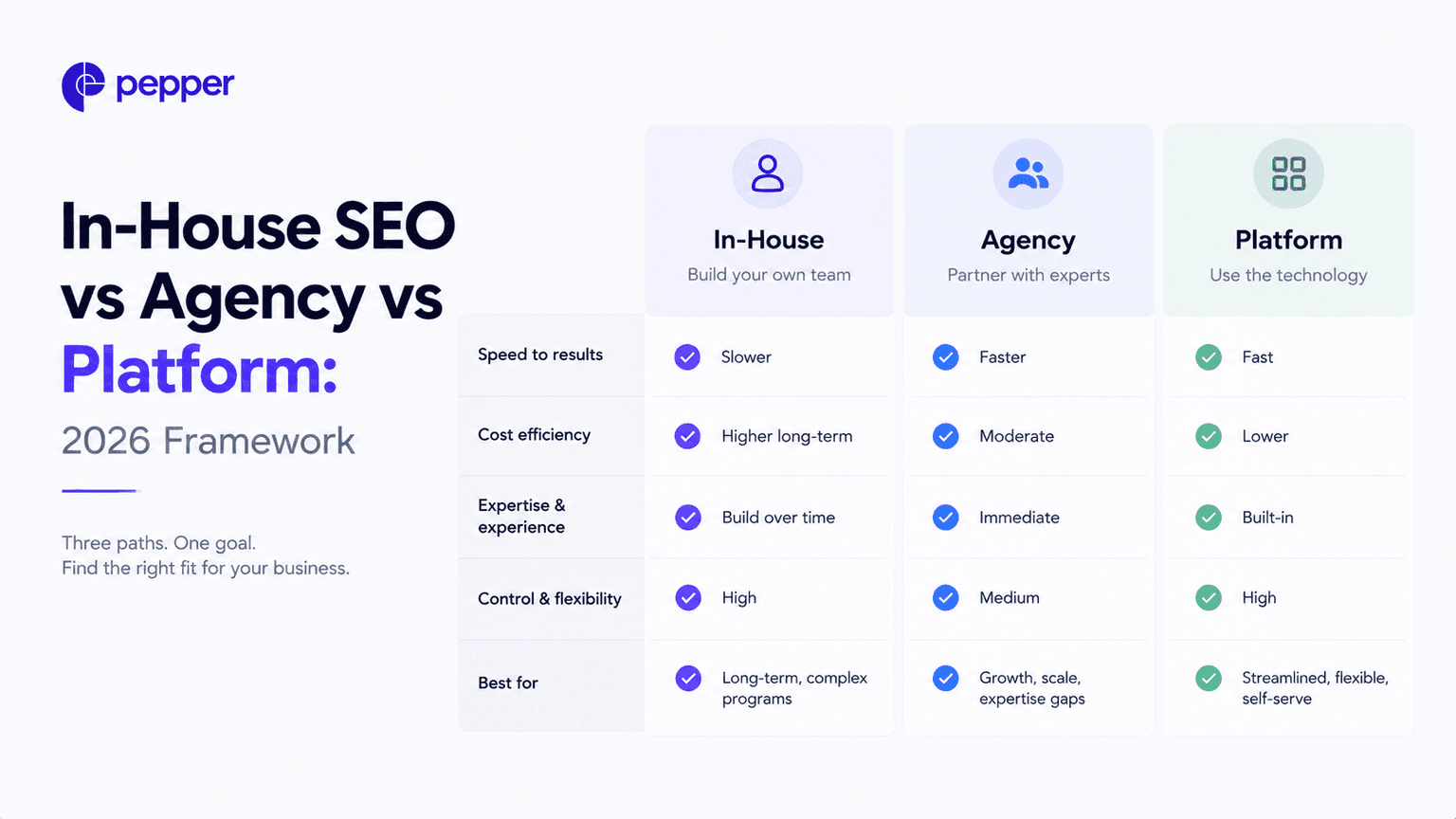
In-house SEO, agency and platform at a glance
| In-house team | Agency | Platform | |
|---|---|---|---|
| Typical annual cost | Salaries plus loading, plus a tool stack | Retainer, rarely published | Free to a few hundred dollars monthly |
| Covers strategy | Yes, and only this model does | Advises only | No |
| Covers technical work | To the depth you hire for | Varies by firm | No |
| Covers content | Yes, at your capacity | Yes, at volume | No |
| Covers earned media | Rarely without a PR function | The good ones do | No |
| Covers measurement | Only if you buy software anyway | Usually their tools, not yours | Yes, this is the whole product |
| Time to running | A quarter or more | Weeks | Days |
| What it leaves you | Institutional knowledge that stays | Output without the instrument | Findings with nobody to act on them |
How we weighted this decision
| Area | Weight | What decides the score |
|---|---|---|
| Capability coverage | 30 | Whether all five capabilities have an owner, rather than three being covered twice and two not at all |
| Execution capacity | 25 | Whether findings turn into shipped work, with named people and protected hours |
| Earned media reach | 20 | Whether anyone can get you into third-party sources, which supply the majority of AI citations |
| Cost per outcome you can defend | 15 | Whether the model produces a number a finance team will accept, rather than a projection |
| Durability | 10 | Whether capability stays in the building when a contract ends |
Capability coverage carries the most weight because the common failure is not choosing the wrong model. It is choosing one model and discovering two capabilities have no owner at all. Our [GEO agency ranking methodology](https://www.pepper.inc/blog/geo-agency-ranking-methodology/) explains how we build weightings like this.
What in-house SEO and an agency actually cost
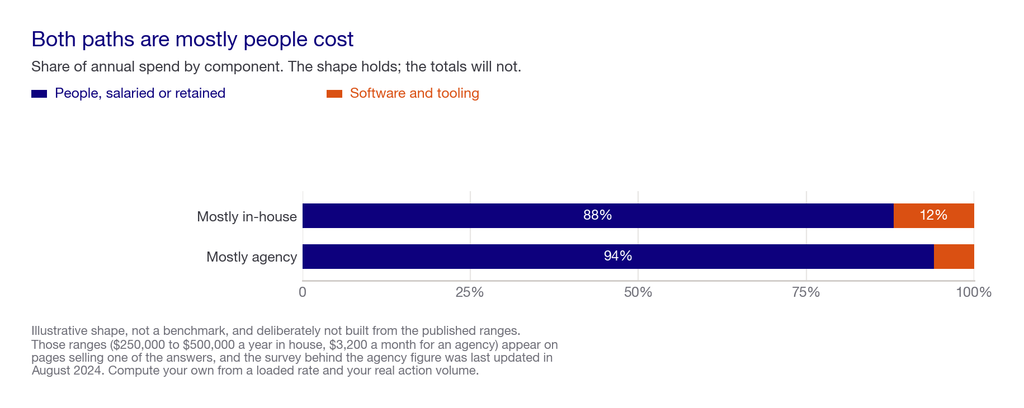
Here is what can be verified, and what cannot.
Verified. WebFX publishes its pricing, one of very few firms that do: an initial two-month campaign from $5,900 to $12,200 across four tiers, and ongoing monthly work from $2,900 to $9,200, with enterprise quoted. Ahrefs’ survey of 439 service providers reports an average monthly retainer of $2,917, agencies averaging $3,209, and an average hourly rate of $111. That survey was last updated on 15 August 2024, so treat it as a historical anchor rather than this year’s market.
Not verified, and widely repeated. Annual in-house team costs of “$250,000 to $500,000”. Software stacks at “$1,500 to $4,000 a month”. And the claim that outsourced work returns three times what in-house does. Each of these appears across multiple pages, all published by firms selling outsourcing, none linking to a study.
We are not saying those figures are wrong. We are saying nobody has shown their working, and you should not build a business case on them.
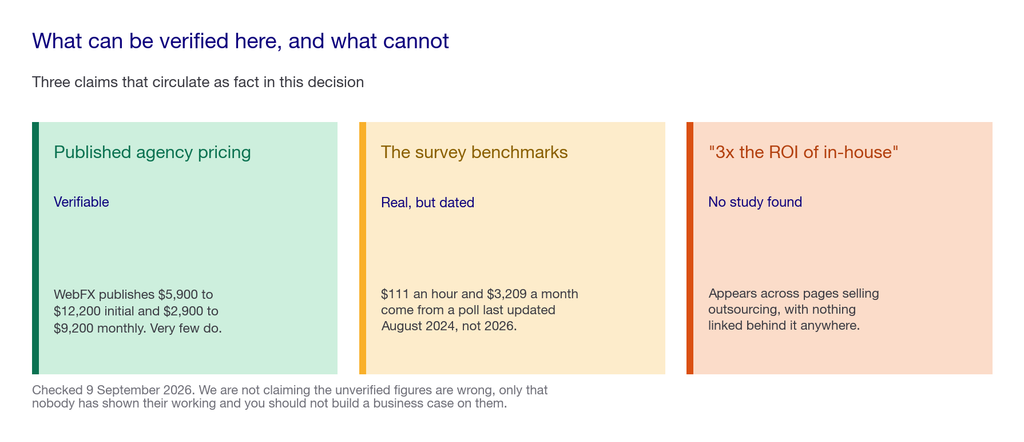
What you can compute yourself, and should. Your loaded cost per hour, the number of actions per month your programme actually generates, and the hours each takes. That produces a number your finance team will accept, which none of the published ranges will.
Which model fits which situation
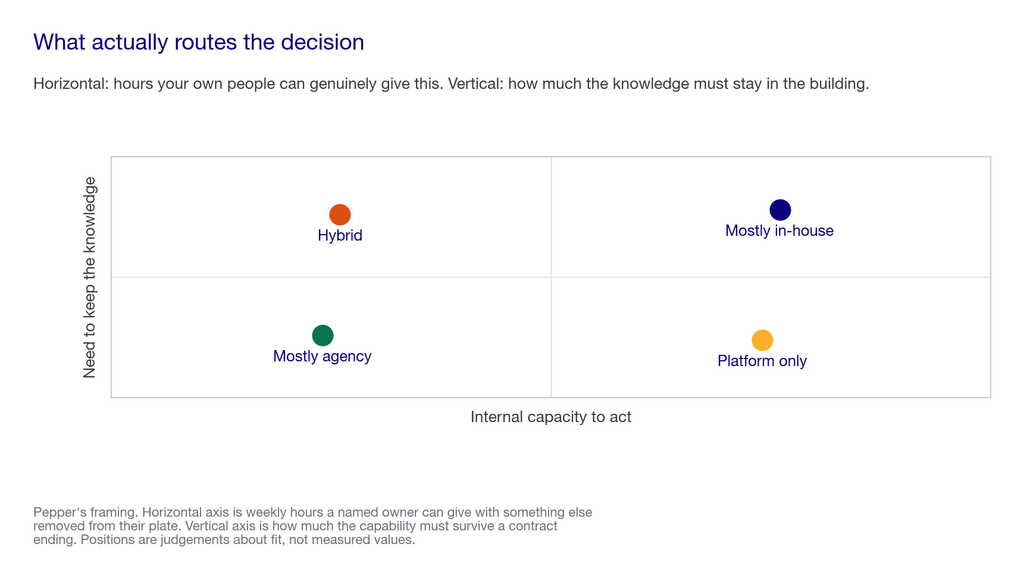
Go mostly in-house when organic will matter for years, your subject is technical enough that outsiders write it badly, and you can book engineering time. Where it falls short: earned media almost never gets covered, and you will be slow for the first two quarters.
Go mostly agency when your constraint is hands rather than knowledge, or you need earned media and have no PR function. Where it falls short: you rarely get the instrument, so you cannot check a claim between reports, and the capability leaves when the contract does.
Go platform-only when you have people with real capacity and you are missing the measurement layer. Where it falls short: nothing in a subscription writes, pitches or fixes anything, so a team without hours converts the purchase into a backlog.
Go hybrid when none of the above describes you cleanly, which is most companies. A senior owner in house, measurement bought, earned media rented, and content split by whichever is your bottleneck.
Where Pepper sits in this
Pepper is the hybrid, sold as one thing rather than assembled from three contracts.
- What you own: strategy stays with you, and so does the instrument. Customers log into the platform themselves
- What you log into: workspace setup, brand profile, competitors and personas. GA4 and Search Console connected. Themes and prompts managed, GEO analytics read directly, and your own agents built and run in the Agent Atlas
- What the team does: a growth team is attached to the account and does the technical, content and earned media work alongside your people
- Engines tracked: 6, including ChatGPT, Perplexity, Gemini and Google AI Overviews
- Metrics reported: Brand Visibility, Domain Prompt Presence and Share of Voice. The gap between the first two is the citability diagnostic
- Why it is structured this way: buying a platform and an agency separately means two contracts, two reporting layers, and an agency reporting on data you are also paying to see
- Best for: teams running organic as a long-term function who need capability covered without building all five
- Where it falls short: we do not publish pricing, so you cannot size it before a call. A one-off project is not what we are for, and our depth sits in content, authority and AI search rather than large technical migrations
Our cost breakdown of platforms against hiring models the buy-versus-build arithmetic, and GEO agency vs GEO tool covers the capability comparison in more depth.
What nobody should promise you
A cost per outcome. Google advises against providers guaranteeing rankings, because third parties cannot access ranking systems. Anyone quoting a return multiple for one model over another is estimating and presenting it as arithmetic.
That one model covers everything. Five capabilities, and no single model covers all five well.
Current benchmark pricing. The most-quoted survey in this category was last updated in August 2024.
That in-house is always cheaper, or always more expensive. It depends entirely on which capabilities you are comparing, which is why the published ranges disagree so wildly.
How to choose between in-house SEO, an agency and a platform
I would refuse the question as posed and answer a different one. Which of the five capabilities currently has no owner?
Google’s May 2026 guidance is a useful anchor for scope. Google states that AEO and GEO are part of SEO, and that AI Overviews and AI Mode run on core Search ranking systems with no separate AI index. That is correct for Google, and Google is one engine, so ChatGPT and Perplexity retrieve differently. Hold both: you are not staffing two disciplines, and the measurement and earned media work genuinely is new.
Score your current situation before you restructure anything.
| Area | Weight | What a strong answer demonstrates |
|---|---|---|
| Capability coverage | 30 | All five capabilities have a named owner, internal or external, with none covered twice and none uncovered |
| Execution capacity | 25 | A named person with protected weekly hours, and something explicitly removed from their plate to create them |
| Earned media reach | 20 | A repeatable route into third-party publications and communities, with a target list drawn from real citation data |
| Defensible cost | 15 | A number built from your own loaded rate and action volume, not from a published range |
| Durability | 10 | Someone in the building learns the discipline, so capability does not leave with a contract |
Those weights sum to 100. Score the model you have before you score the one you are considering. If the proposed model does not beat the current one clearly, you are reorganising for the feeling of progress.
The live test, and it costs nothing now. Take 30 real commercial questions from your category, written the way a buyer would type them. Four worked examples: “should we hire an SEO team or use an agency”, “how much does in-house SEO cost”, “best agency for technical SEO at scale”, “how do we get cited by ChatGPT in our category”. Load them into one of the free tiers and let it run for a month.
Then answer five questions with the results in front of you. Where do we appear and where do we not. Which competitors appear instead, consistently. Which sources influence those answers, sorted by frequency. How many of those sources could our current setup plausibly reach this quarter. What would change in the next 90 days, and who does it.
The fourth question settles the structure. If most of the winning sources are third-party publications and communities, your gap is earned media, and no amount of in-house hiring in content or technical roles closes it.
The weak process against the strong one. The weaker version compares an annual salary bill to an annual retainer, picks the smaller number, and books it. It treats the two as substitutes when they cover different capabilities, and it ignores the capability that ends up with no owner at all.
The stronger version lists the five capabilities, marks who owns each today, identifies the gaps, and buys only against those. It usually ends in a smaller and stranger-looking arrangement than the one originally proposed, and it works.
Red flags, each one something you will genuinely hear. “Outsourcing delivers three times the ROI”, unsourced and published by outsourcers. “In-house teams cost $250,000 to $500,000 a year”, quoted from pages selling the alternative. “The average agency retainer is $3,200”, which is a 2024 figure. “We guarantee rankings”, which Google advises against. “This platform replaces the agency”, said by a product that measures and does not execute. “You just need one good SEO hire”, which covers one capability of five. And the quiet one inside your own company: “marketing will pick it up”.
Five questions for the decision meeting.
- Which of the five capabilities has no owner today? A good answer is specific and uncomfortable. A weak one is that the team covers it between other work.
- Which budget line pays for earned media, and who does the pitching? A good answer names both. A weak one calls it content amplification.
- What comes off someone’s plate if we do this? A good answer names the thing being stopped.
- What is our loaded hourly rate, and how many actions a month will this generate? A good answer is two numbers. A weak one is a published range.
- If this shows us we are invisible, what happens in week one? A good answer is a specific action with an owner.
It all comes down to one principle: buy against the capability gap, not against the model. The question is never in-house or agency or platform. It is which of the five nobody is doing.
One closing note that costs us something. Very few providers are equally strong across measurement, execution, earned authority and attribution, ours included, and the good ones will tell you which of the four is their weakest. If you already have a senior owner, a working PR function and real capacity, you may need nothing more than a free measurement tier, and you should not be paying anyone for a programme yet.
Frequently asked questions
Is in-house SEO better than an agency?
Neither is better in general, because they cover different capabilities. In-house owns strategy and keeps knowledge in the building. Agencies cover execution and earned media. Most working programmes are a hybrid, with a senior owner inside and specific capabilities rented.
How much does an in-house SEO team cost?
Widely quoted ranges of $250,000 to $500,000 a year appear on pages selling outsourcing, with no study behind them. Compute your own figure from loaded salaries, tooling and the ramp period instead of using a published range.
How much do SEO agencies charge?
WebFX publishes an initial two-month campaign from $5,900 to $12,200 and monthly work from $2,900 to $9,200. Broader survey figures of around $111 an hour come from an Ahrefs poll last updated in August 2024, not from 2026 data.
What should I never outsource?
Strategy and ownership. An agency can advise on what to target, but it cannot decide what your company will not do, and it cannot defend your budget internally. Everything else is genuinely negotiable depending on your situation.
What is hardest to build in house?
Earned media. It needs relationships rather than headcount, it compounds slowly, and it supplies the majority of AI citations. Teams without a PR function typically compensate by publishing more owned content, which is the weakest available lever.
Do I need a platform as well as an agency?
Often yes, and it is under-used. Your own measurement lets you check agency reporting against raw data and separates a model update from a genuine performance change. Several platforms now have free tiers, so this costs nothing to start.
When does technical SEO need a specialist?
Google names the thresholds: above one million pages changing weekly, above ten thousand changing daily, or whenever a large share of URLs sit in “Discovered, currently not indexed” in Search Console. Below that, a competent generalist usually covers it.
How long before an in-house team produces results?
Expect roughly a quarter of setup before output changes, and two to three quarters before meaningful movement. That ramp is a real cost and belongs in any comparison alongside salary and tooling.
Where to go next
List the five capabilities and write a name next to each one. Strategy, technical, content, earned media, measurement. The gaps will be obvious within ten minutes, and they are almost never the ones people expect.
Then start the free diagnostic before restructuring anything. Load 30 real commercial prompts into a free tier, let it run a month, and sort the cited domains by frequency. If most of those sources sit outside anything your current team can reach, your gap is earned media and no hiring plan fixes it.
Our guide to tracking brand mentions in AI search covers the five methods and what each misses, and the best answer engine optimization tools covers which free tiers are worth starting on.
For the models in more depth, is a GEO platform worth it without an agency covers the four conditions that decide whether a team can act on findings, and how to choose an organic SEO agency covers the red flags worth walking away from. Our Acceldata case study shows the hybrid model on a technical B2B account.
The honest exit. If you have a senior owner, an existing PR function you can borrow, and fewer than about 30 meaningful commercial queries, you do not need to change your structure or buy anything this quarter. Run the free diagnostic and revisit when the numbers say otherwise.
Sources
Pricing was checked at each company’s own page on 9 September 2026. Google’s guidance is quoted from Google’s own documentation. Where a figure could not be traced to a study, we have said so rather than repeating it.
- WebFX SEO pricing, checked 9 September 2026: initial two-month campaign $5,900 to $12,200 across four tiers; ongoing monthly $2,900 to $9,200; enterprise quoted.
- Ahrefs, SEO pricing survey: 439 service providers polled. Average monthly retainer $2,917, agencies $3,209; average hourly rate $111, agencies $98.90, consultants $171.18. Last updated 15 August 2024, and widely republished as current 2026 data.
- Google Search Central, Large site owner’s guide to managing your crawl budget, checked 9 September 2026. Names the three conditions under which crawl budget needs active management.
- Google Search Central, AI features and your website, 15 May 2026. States that AEO and GEO are part of SEO, and advises against providers guaranteeing rankings.
- Zhang Kai, He Xinyue and Yao Jingang, From Citation Selection to Citation Absorption, arXiv, 28 April 2026. 602 controlled prompts, 21,143 search-layer citations, 18,151 fetched pages. Academic and independent.
- Huang, Goyal, Saha and Chandrasekharan, Answer Bubbles: Information Exposure in AI-Mediated Search, arXiv, 17 March 2026. 11,000 real search queries across five systems. Academic and independent.
- Muck Rack, Earned media still drives 84% of AI citations, 7 May 2026. More than 25 million cited links, 17 industries. Muck Rack sells PR software, so read it as an interested party.
The five-capability framework and the weightings are Pepper’s own, based on the in-house teams we work alongside. They are a working model rather than survey data.
Latest Blogs
Most advice on this is inference dressed as fact. OpenAI documents exactly one thing clearly, which is access. Here is what is documented, what is inferred, and how to verify the rest for yourself.
Being named in an AI answer and having your page used as its source are different outcomes with different causes and different fixes. The gap between them is the most useful diagnostic in AI search, and most reporting collapses it into one number.
Every platform reports share of voice and almost none of them define it the same way. Here is the definition worth using, the three choices that change the number, and how to measure it yourself without buying anything.
Get your hands on the latest news!
