Automating GEO workflows: what to automate and what to keep human
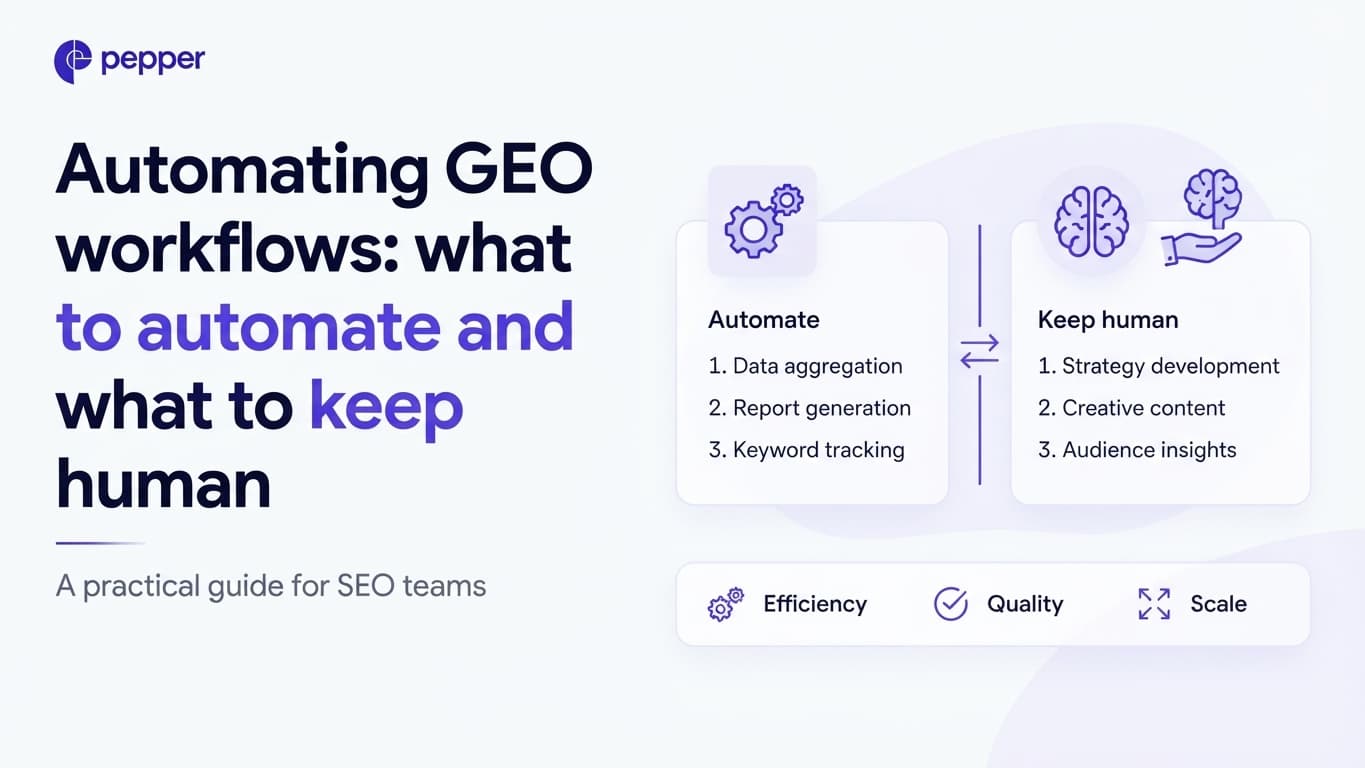
Automating GEO workflows is mostly a question of which parts of the job are a recipe and which parts are a judgement. Getting that line wrong in either direction is expensive, and it is wrong in both directions across most teams we meet.
The short answer
Automate the parts that repeat with a stable shape. Keep the parts that need a decision, a read of the evidence, or an opinion about your market.
Four categories, and the line falls in a consistent place.
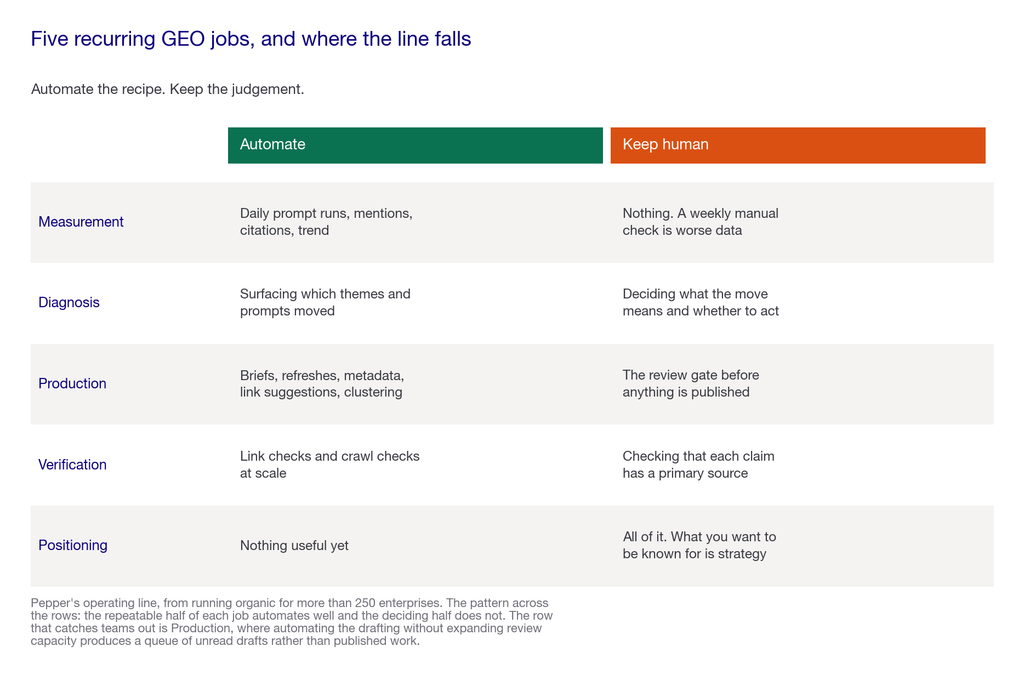
- Automate the production work. Briefs, refresh analysis, bulk metadata, internal link suggestions, keyword clustering, competitor content research. Same steps every time, better output when the format is stable.
- Automate the measurement reads. Running the prompt set, recording mentions and citations, computing the trend. Nobody should be doing this by hand, and a human doing it weekly produces worse data than a machine doing it daily.
- Keep the interpretation human. Which themes matter, what a drop means, whether a competitor’s win is worth chasing. The platform surfaces which pages are winning, not why.
- Keep the judgement calls human. What is true, what gets published, what the brand will not say. An agent that drafts is an asset. An agent that publishes unreviewed is a liability.
The test we use before building anything. You will do it more than three times, the steps are consistent, and the output benefits from a stable format. If any one of those is false, a conversation beats a workflow.
Pepper is an agentic organic growth engine, not an SEO agency. This page comes out of what we run: organic for more than 250 enterprises across eight years, more than 10 million tracked prompts, and the questions buyers put to us in client reviews. Customers log in and run the platform themselves, with a Pepper growth team attached. Book a growth audit and we will show you which parts of your own GEO operation are worth automating first.
Key takeaways
Key takeaways on where the automation line sits and how to keep it there.
- Three conditions decide it. More than three repetitions, consistent steps, stable output format. All three, or do not build the agent.
- Measurement should be fully automated. Daily runs beat weekly manual checks because the trend line is the product, not any single reading.
- Production work automates well. Briefs, refreshes, bulk metadata and link suggestions are recipes, and recipes are what agents are for.
- Interpretation does not automate. Deciding which theme to fight for is a strategy call with commercial consequences.
- Version everything and pin it. Published versions are immutable snapshots, so a tweak today does not retroactively change last week’s output.
- Review stays human at the publish gate. Draft at machine scale, approve at human scale, and never collapse the two.
What is a GEO workflow?
A GEO workflow is any repeating sequence of steps between a question about AI search and a change on your site.
In practice that covers more ground than teams expect. A single month of competent GEO operations contains prompt-set maintenance, daily measurement, a competitive read, a citation analysis, a batch of briefs, a batch of refreshes, a technical sweep and a reporting pass. Most of those have the same shape every time they run.
- Measurement. Run the prompts, capture the answers, record who was mentioned and who was cited.
- Diagnosis. Work out which themes and prompts are moving, and why the trend changed.
- Production. Briefs, drafts, refreshes, metadata, internal links, schema.
- Verification. Check the claims, check the links, check that the page is actually retrievable.
Where it falls short as a mental model. These four stages are not equally automatable, and treating them as one pipeline is the mistake that produces impressive volume and no movement. Diagnosis is the one that resists automation, and it is also the one that decides whether the other three were pointed at anything worth doing.
Automating GEO workflows: the three-condition test
Before building any agent, we check the same three things. All three have to be true.
- You will run it more than three times. Configuration time only pays back on repetition. A one-time analysis is faster done in a conversation than in a saved workflow.
- The steps are consistent. “Read a URL, audit it against these criteria, output a structured report” is agent-shaped. “Brainstorm with me about a new direction” is not.
- The output benefits from a stable format. Predictable, comparable outputs are what make results reviewable at scale. Variable output defeats the point of running something fifty times.
Three situations fail the test and are worth naming, because each one gets built anyway in most organisations.
- The genuinely one-off analysis. Somebody automates a quarterly board question into a workflow that is never run again.
- The task whose steps change every time. If there is no recipe, an agent is a worse version of a conversation.
- The task that needs judgement at every step. Agents are good at consistent execution and poor at improvisation. Do not ask them to improvise.
Our own bias, stated. We build this software, so we would be the last people you should trust on “should you automate”. The test above is deliberately restrictive for that reason. When a client asks us whether to build an agent for something they do twice a year, our answer is that you do not need an agent for that.
What to automate, specifically
Here is the work we automate as standard, with what the agent actually does in each case.
Measurement, all of it
Running a prompt set by hand is the most common unnecessary task in GEO. It is also the one where manual effort actively degrades the data, because a human checking weekly produces four observations a month where a daily run produces thirty.
Pepper runs your prompts against the engines every day and records what each one answered, who it cited, and how that compares with competitors. The full tracking model is in what Pepper tracks. Nothing about this stage needs a person, and the trend line only becomes readable at daily cadence.
Production work, with a review gate
The second cluster is content operations, and this is where agents earn their keep. Pepper ships purpose-built steps for the jobs that recur:
- New Content Brief. From a topic or target keyword, a structured brief a writer can pick up immediately.
- Existing Content Brief Refresh. From a published page, a refresh brief with what to keep, what to add and what to rewrite based on current search signals.
- Page-Level Content Optimizer. Optimises a page’s content against its target keyword and the competing ranking pages.
- Content Optimizer for Domains. The domain-wide companion, recommending improvements across a set of ranking pages.
- Relevant URL Identification. Finds the URLs on a domain most relevant to a topic, which is how internal linking and cannibalisation checks stop being manual.
- Keyword Clustering and Theming. Groups a keyword list into clusters and assigns a theme to each, the first step from a keyword export to a plan.
- Keyword Intent Match Analysis. Checks whether a page actually matches the intent of its target keyword, which is the usual diagnosis for pages that rank and do not convert.
- Keyword Performance Data and Backlinks Analysis Data. Pull the performance and authority signals so the agent prioritises on real numbers rather than guesses.
Every one of those produces a draft, not a publication. The review gate is the point, and we come back to it below. For how the briefs fit a wider plan, see our SEO content plan.
Bulk work that nobody should do by hand
Meta descriptions, title tags, alt text and internal link suggestions across a large library are the clearest automation case in the whole discipline. The work is mechanical, the volume is high, and consistency is a feature rather than a risk. This is the pattern we run most often for B2B SaaS libraries that have grown past a few hundred pages.
Pepper handles this as a sheet run: connect the agent to a sheet of inputs and it processes every row. The builder itself is covered in what is Agent Atlas. Same agent, same configuration, different scale. A single page is a quick run; fifty pages is a sheet.
What to keep human
Four things, and we would not move any of them.
- Choosing the themes and prompts. The prompt set is the measurement instrument. Getting it wrong means every number downstream is precise and pointed at the wrong question. Pepper pre-populates a starter set during setup, generated from your personas, and then your team adds, refines and removes. That editing is strategy work.
- Interpreting a change. A falling share of voice is a question, not a finding, and the diagnosis path runs through how to benchmark AI visibility against competitors. Working out whether a competitor’s surge is a launch spike or a structural shift takes a person reading the evidence over two to three weeks.
- Deciding what is true. Agents draft confidently regardless of whether the underlying claim is checkable. Every statistic still needs a primary source, and that verification is the single most important human step in the chain. The same discipline applies to the prompt set itself, which we cover in how to track brand mentions in AI search.
- The publish decision. Draft at machine scale, approve at human scale. An organisation that removes the approval gate will eventually publish something it cannot defend, and the cost of that lands on the brand rather than on the workflow.
The honest version of the trade-off. Automation moves the bottleneck rather than removing it. If you automate production without expanding review, you will build a queue of drafts nobody has read, and the queue is not progress. We would rather a client ship twelve reviewed pieces than forty unreviewed ones, which is an argument against our own volume story and still the right call.
How to build one without shipping rubbish at scale
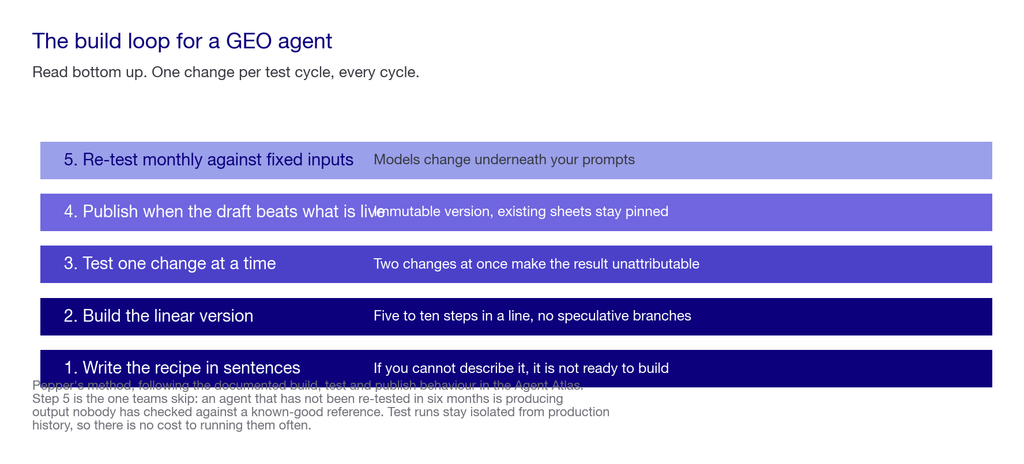
This is the operating discipline, and it matters more than the tooling. Five steps, in order.
Step 1: Write the recipe before you open the builder
If you cannot describe the steps in sentences, the workflow is not ready to be built. Most production agents are a straight line of five to ten steps: take an input, fetch context, generate, format, output.
The common failure is treating the canvas as a flowchart and over-designing with branches for paths that might be needed later. Branching is for genuine if-then logic. Weight on the canvas has to be maintained by somebody.
Step 2: Build the linear version first
In the Agent Atlas, every workflow has a mandatory Start node that receives whatever the user submits and a mandatory End node that produces the final result. Everything in between is the work.
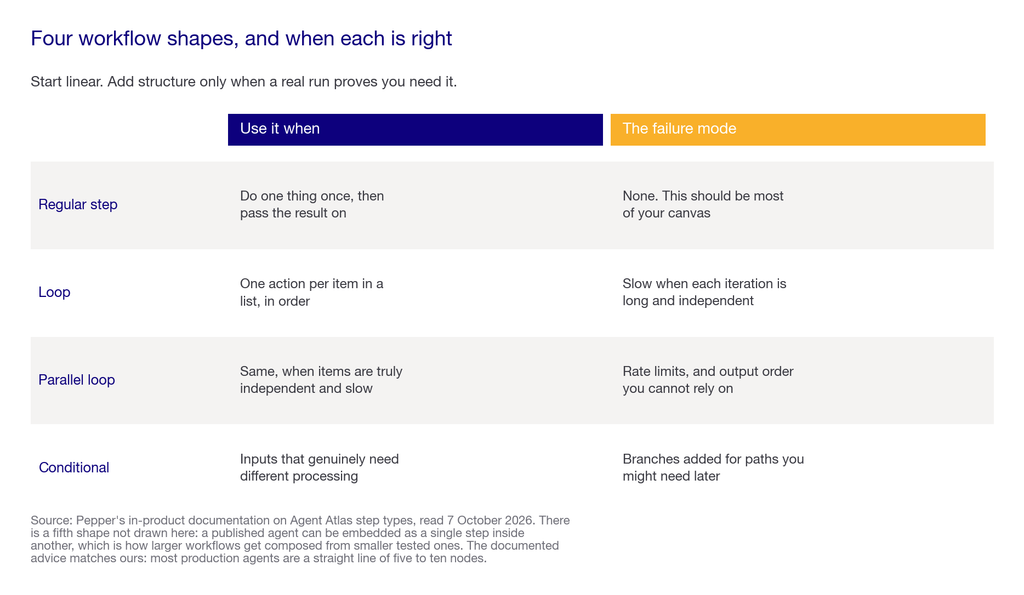
Four shapes cover almost everything. A regular step does one thing once. Loops run the inner steps once per item in a list, and a parallel loop does the same simultaneously when items are genuinely independent. Conditionals split the path when inputs need genuinely different processing. There is also a step that runs another published agent as a single node, which is how larger workflows get composed from smaller, tested ones.
Start linear. Add structure only when a real run shows you need it.
Step 3: Test with one change at a time
The test panel runs your current draft, not the published version, against sample inputs. Test runs stay isolated and do not appear in any production history.
The discipline that matters: make one focused change, test with the same sample input as before, compare, keep or discard. Two changes at once make it impossible to attribute the difference. You can also target a single step and run up to it, which is considerably faster when you are debugging step three of a ten-step workflow.
Step 4: Publish deliberately, and know what moves
Publishing promotes the canvas to a new immutable version. Three consequences are worth internalising before you click it.
- New runs use the new version immediately. There is no migration step and nothing to coordinate.
- In-progress runs are unaffected. A sheet run that started ten minutes ago finishes on the version it began with.
- Existing sheets stay pinned. A sheet built last week against version three keeps running version three until somebody migrates it. Migration is explicit, not automatic.
There is no unpublish. To revert, restore the previous version into your draft and publish it again as a new version.
Step 5: Know when not to publish
Three situations where staying in draft is correct, and all three get ignored under deadline pressure.
- The change is real but the output is not ready. Whatever is published is still working for the team. Keep iterating.
- You are mid-restructure. Publishing every intermediate state pollutes the version history for everyone who reads it later.
- A teammate is mid-run on a specific version’s behaviour. Talk to them first, or wait.
And the one we see most. Publishing because somebody is asking when it will be ready. A bad published version produces a sheet run full of garbage, which costs more than another day of iteration.
Governance that actually holds
Automation fails quietly. The output keeps arriving, it looks the same as it did last month, and nobody notices that the quality moved. Four controls prevent that, and none of them is technical.
Version pinning as an audit trail. Every publish is an immutable snapshot and old runs stay pinned to the version that produced them. That means you can answer “what produced this output” six months later, which is the question that matters when something goes wrong. Keep the version history clean enough to read.
One owner per agent. Shared ownership of a workflow produces drift, because two people each making a reasonable tweak produces a configuration neither would have chosen. Name an owner, and route changes through them.
A re-test cadence, not just a build test. Even small prompt tweaks shift behaviour in surprising ways, and model providers update underneath you. Re-run your reference inputs monthly and compare against what the agent produced before. If nobody owns that comparison, it will not happen.
A hard review gate on anything published. Every claim still needs a primary source. Every internal link still needs a real HTTP check. We run both on everything we publish, including this page, and automation has not changed that step at all. The audit routine we use is in how to audit your site for AI search.
Where automation genuinely does not help
Three places, stated plainly because the category oversells this.
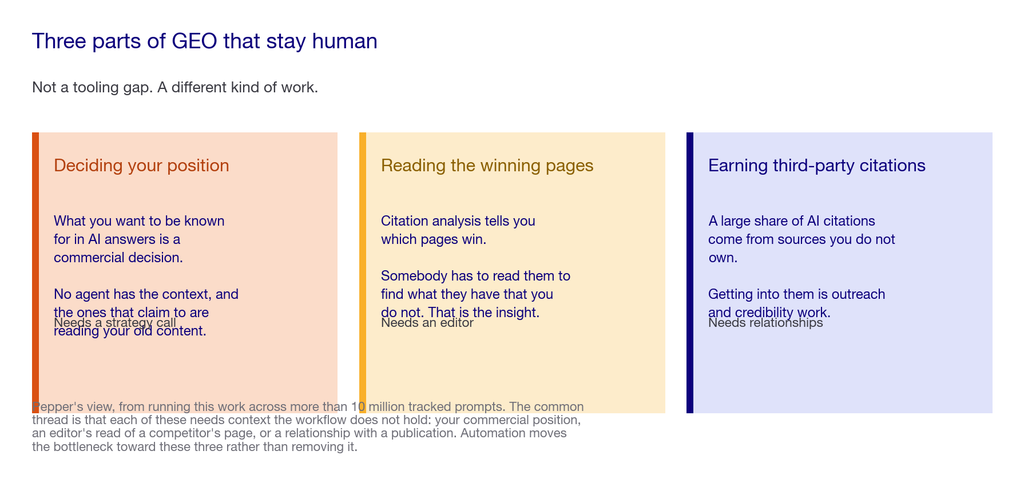
- A new category position. Deciding what you want to be known for in AI answers is a strategy decision with commercial consequences. No agent has the context, and the ones that claim to are guessing from your existing content.
- The first read of a competitor’s content. Citation analysis tells you which pages are winning. Somebody has to read them to find out what they have that you do not, and that reading is where the actual insight lives.
- Relationships that produce citations. A meaningful share of AI citations come from sources you do not own. Earning a place in those sources is outreach and credibility work, and it does not automate. We go through where those citations come from in how to find which sources AI cites in your category.
What nobody should promise you
- A fully autonomous GEO programme. Every serious implementation has a human approval gate, and a vendor telling you otherwise is describing a risk as a feature.
- That automation replaces headcount one for one. It moves the bottleneck to review. Plan for the review capacity or the drafts queue up unread. If you need to argue that capacity internally, we have put the shape of the case in how to build a business case for GEO.
- That an agent can tell you why a competitor is winning. The platform shows which pages are cited. The why requires reading them.
- Set-and-forget workflows. Engines change, models change underneath your prompts, and an agent nobody has re-tested in six months is producing output nobody has checked.
Frequently asked questions
What should you automate in a GEO workflow?
Automate measurement entirely, and automate production work that repeats with a stable shape: briefs, refresh analysis, bulk metadata, internal link suggestions and keyword clustering. Keep strategy, interpretation, fact-checking and the publish decision with people.
What is the test for whether a task should become an agent?
Three conditions, all required. You will run it more than three times, the steps are consistent each time, and the output benefits from a predictable format. If any one fails, a conversation is faster than a workflow.
Building and running
What is the difference between a quick run and a sheet run?
A quick run executes the agent against a single input, which suits one-off tasks like auditing one page. A sheet run processes every row in a sheet of inputs, which suits bulk work like briefing thirty topics or generating metadata across a library.
Do I have to build agents from scratch?
No. Pepper ships system agents covering common content and SEO workflows, which you can run directly or clone. Cloning gives you an editable copy you can version and adapt, which is usually faster than starting from a blank canvas.
How do versions work when I change an agent?
Each publish creates an immutable, numbered snapshot. New runs use the latest version, in-progress runs finish on the version they started with, and existing sheets stay pinned until somebody migrates them deliberately.
Governance
How often should an automated workflow be re-tested?
Monthly against a fixed set of reference inputs, comparing output to what the same agent produced before. Models change underneath your prompts, so an agent that worked in March is not guaranteed to work the same way in September.
Can AI content be published without human review?
It can. We would not, and we do not. Every claim needs a primary source, every link needs a real check, and the publish gate is where that happens. Draft at machine scale and approve at human scale.
Does automating GEO work mean fewer people?
Not in the teams we run. It changes what the people do, moving effort from production to review and strategy, and review capacity becomes the constraint that decides how much the automation is worth.
Latest Blogs
Bluefish, Peec AI, GrowthX: the three names appear on the same shortlists constantly. We read all three sites on the same morning, and they are not competing products in any useful sense. The short answer Bluefish orchestrates AI marketing for very large enterprises. Peec AI measures AI search visibility. GrowthX produces content through a closed […]
People call it answer share. Pepper calls it Share of Voice, and it is one of three brand metrics that have to be read together. Here is the exact derivation, the denominator that surprises people, and what the number cannot tell you.
Most GEO work is repetitive enough to automate and a few parts never will be. Here is the line we draw, the test we apply before building an agent, and the governance that stops automation quietly shipping rubbish at scale.
Get your hands on the latest news!