How to build a business case for GEO, with a template you can fill in
The short answer
A GEO business case that gets approved does three things the average one skips.
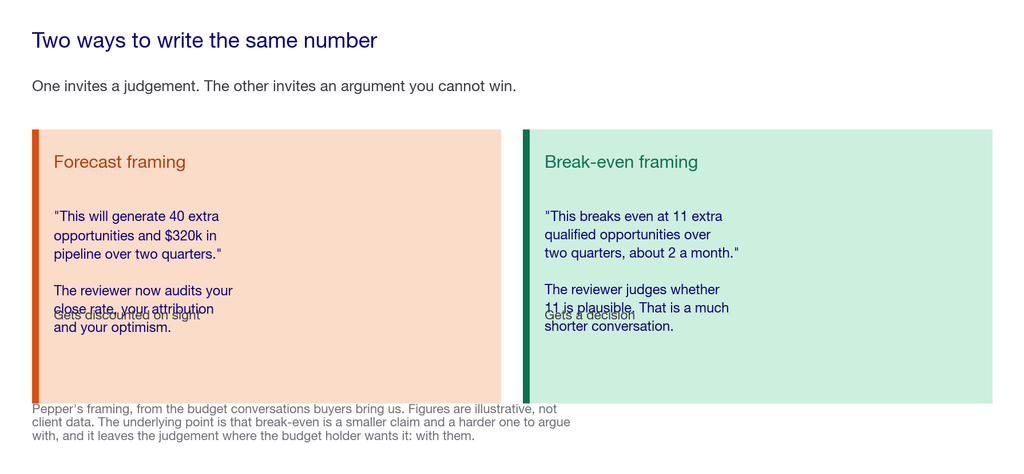
- It leads with break-even, not forecast return. “This must produce X to be worth running” survives scrutiny. “This will produce Y” invites an argument about Y that you cannot win.
- It names what it cannot measure. Finance trusts a case that states its own gaps far more than one that implies precision it does not have.
- It asks for a decision date, not just a budget. A case without a review date is a case that gets deferred.
A note on scope, so you are not reading the wrong page. The arithmetic behind all of this, attribution models, break-even computation and how to report ranges, is already set out in our GEO ROI model. This page does not repeat it. This page is the artefact: the one-page format, who is actually in the room, and the four objections you will get.
We run this work daily. Pepper is an agentic organic growth engine, not an SEO agency. This page comes out of what we run: organic for more than 250 enterprises across eight years, more than 10 million tracked prompts, and the budget conversations buyers walk us through in client reviews. Customers log in and run the platform themselves, with a Pepper growth team attached to the account. Book a growth audit and we will give you the baseline numbers this template needs.
Key takeaways
Key takeaways from the budget conversations buyers bring to us most often.
- One page, six boxes. Anything longer gets skimmed, and the skimmer reads the ask and the risk.
- Break-even beats forecast. It is a smaller claim and a much harder one to argue with.
- Three stakeholders, three questions. Finance asks what it costs to be wrong. The exec asks what happens if we do nothing. Your own team asks who does the work.
- Name the unmeasured effects out loud. Zero-click visibility is real and hard to attribute, and silently setting it to zero is the most common way these cases lose credibility.
- Ask for a 90-day review, not a 12-month commitment. Smaller ask, faster yes, and it matches how long the work actually takes to show anything.
- Never put a guaranteed ranking in the case. Google’s own guidance is blunt about that, and a reviewer who knows it will discount everything else you wrote.
What is a GEO business case, and what is it actually for?
A GEO business case is a short written argument for spending money on AI search visibility, aimed at whoever controls the budget.
Its job is narrower than people assume. It is not there to prove GEO works in general. It is there to answer one question: is this a reasonable use of this budget, this quarter, given what we can and cannot measure.
That reframing matters, because it changes what you have to defend.
- Forecasting revenue is not required. State what the programme must produce to break even, then let the reader judge whether that is plausible.
- Resolving attribution is not required either. Declare which attribution model you are using, and apply it consistently throughout.
- Certainty is not required. Being explicit about where you are uncertain is, and it is the thing that buys you credibility.
Where it falls short. This framing works when the budget holder is reasonable and the organisation tolerates uncertainty. In a culture that demands a single confident number, a break-even case can read as evasive. If that is your organisation, lead with the break-even anyway but put a named worst case beside it, because the alternative is a forecast you will be held to.
The one-page template
Six boxes. Fill them in this order, because each one constrains the next. Copy the headings verbatim if it helps.
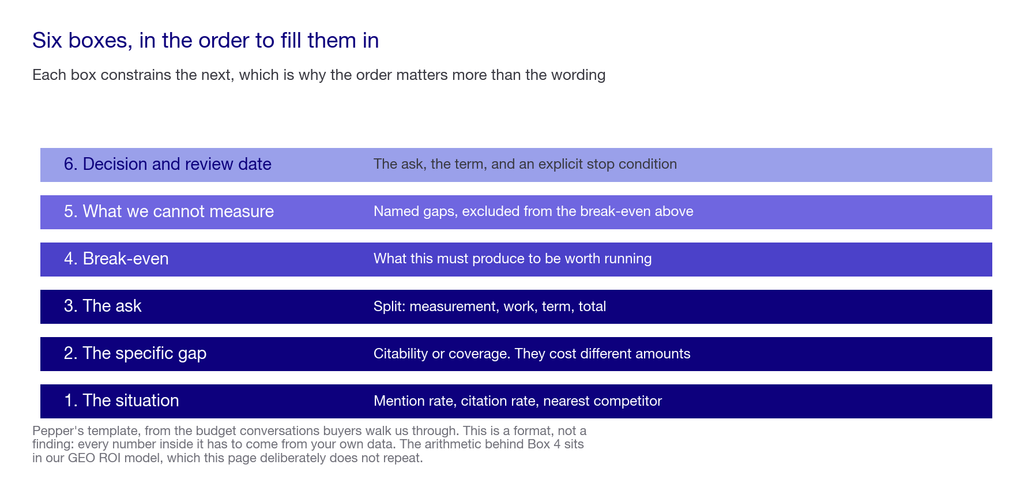
Step 1. Box 1: The situation, in numbers you already have
Two or three lines. No adjectives.
Across [N] prompts that matter to our category, engines mention us in [X]% and cite a page from our domain in [Y]%. Our closest competitor is mentioned in [Z]%.
If you do not have these numbers yet, that is your first task and it is cheap. The platforms that produce them are compared in top AI visibility platforms. Free tiers exist, and running twenty prompts by hand takes an afternoon.
Step 2. Box 2: The specific gap
One line naming which of two problems you have, because they cost different amounts to fix.
Our problem is [citability: engines describe us but cite others] or [coverage: we do not appear for most category prompts].
The gap between mention rate and citation rate is the diagnosis. Our framework for reading it is Visibility, Citability and Retrievability.
Step 3. Box 3: The ask
The number, the term and what it buys. Split it, because an undifferentiated monthly figure invites the wrong question.
[$A] per month for measurement, [$B] per month or [$C] one-off for the work, for [90 days / two quarters]. Total commitment: [$D].
Published tooling tiers start around $29 a month and run to a few hundred. Agency retainers in this category start in the low thousands. The full picture is in our pricing benchmarks.
Step 4. Box 4: Break-even, not forecast
This is the box that does the work.
At our average deal size of [$E] and close rate of [F]%, this programme breaks even at [G] additional qualified opportunities over [term]. That is [H] per month.
Then one sentence of judgement: whether G looks large or small against your current pipeline. Let the reader decide. The computation itself is in the GEO ROI model.
Step 5. Box 5: What we cannot measure
The box most people delete. Do not delete it.
We cannot attribute [zero-click visibility / brand lift / answers that never produce a click]. We are not counting these in the break-even above, which makes our number conservative.
Naming this is what buys you credibility for everything else on the page. It also pre-empts the objection rather than letting a reviewer raise it.
Step 6. Box 6: The decision and the review date
We are asking for approval to run this for [90 days], with a review on [date]. At that review we will report [baseline movement / citation share / named leading indicators], and we will recommend continue, stop or change.
An explicit stop condition makes a yes cheaper to give. It is the single highest-leverage line on the page.
Who is in the room, and what each person actually asks
Three people, three different questions. A case written for one of them fails with the other two.
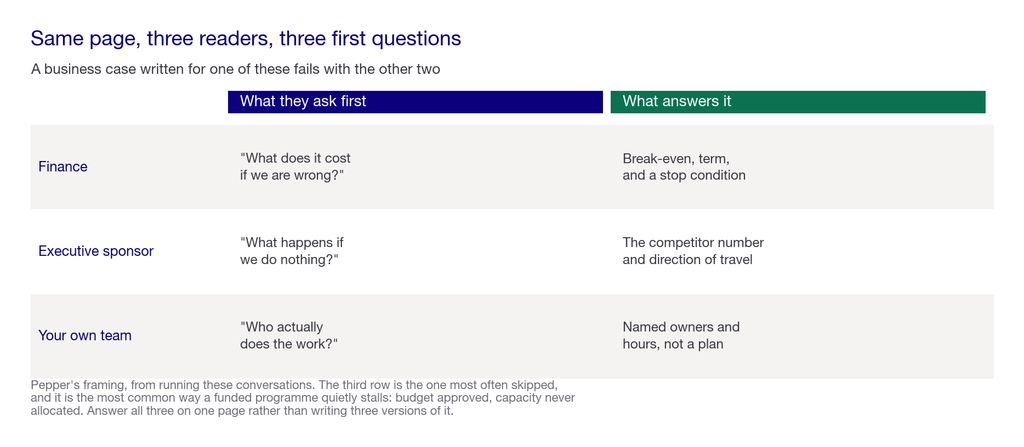
Finance asks what it costs to be wrong. Answer with the break-even, the term and the stop condition. Do not answer with a forecast, because finance evaluates forecasts by discounting them.
The executive sponsor asks what happens if we do nothing. Answer with the competitor number from Box 1 and the direction of travel. This is the only place in the case where urgency is appropriate, and it should still be a number rather than an adjective.
Your own team asks who does the work. Answer with named owners and hours. A case that wins budget and then stalls because nobody had capacity is worse than no case, and this is the most common way GEO programmes quietly die. Our view on where that ownership sits is in the AI search team ownership model.
The four objections you will actually get
These come up almost every time. Prepare the answer rather than improvising it.
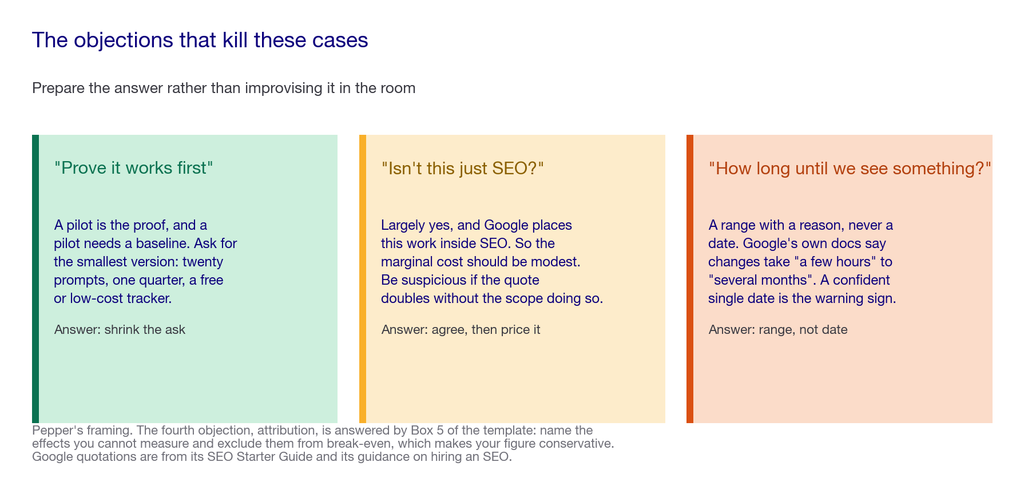
“Prove it works first.” The honest answer is that a pilot is the proof, and a pilot needs a baseline. Ask for the smallest possible version: a free or low-cost tracker, twenty prompts, one quarter, and a named review date. The ask is small enough that refusing it costs more political capital than granting it.
“Isn’t this just SEO?” Largely yes, and saying so is a strength. Google’s own guidance places this work inside SEO rather than beside it. Use that to argue the marginal cost is modest because the underlying work overlaps, and be suspicious of any proposal where the quote doubles without the scope visibly doubling.
The two harder ones
“We can’t attribute it, so how do we know?” Agree, then narrow. You cannot attribute every effect, which is why Box 5 exists. What you can measure is whether engines cite your domain for the prompts that matter, and whether that share moves. That is a real, checkable outcome even where revenue attribution is imperfect.
“How long until we see something?” Give a range with a reason, never a date. Access fixes show in days, structural changes over weeks, citation share over one to three quarters, and the work behind each stage is in our GEO best practices playbook. Google’s own documentation on search says changes can take “a few hours” or “several months,” so vagueness here is not evasion, it is accuracy. Notably, Google also tells buyers to ask a vendor “What kind of results do you expect to see, and in what timeframe?” The question is fair. A confident single date in response is the warning sign.
What not to put in the case
- A guaranteed ranking or placement. Google states plainly: “No one can guarantee a #1 ranking on Google. Beware of SEOs that claim to guarantee rankings.” A reviewer who knows this will discount your whole page.
- A borrowed industry multiplier. Someone else’s conversion rate applied to your funnel is not evidence, and it is the first thing a sharp CFO will pull on.
- A single composite visibility score as the success metric. If the vendor changes the weighting, your target silently changes meaning mid-term.
- A twelve-month commitment when a quarter will do. Bigger asks get more scrutiny and slower answers. Ask small, review early, renew on evidence.
- A point estimate with no range. Ranges read as honest. Single numbers read as sold.
What nobody should promise you
- A guaranteed citation in an AI answer. Nobody controls what a model outputs, and we will not promise it either.
- A revenue forecast you can take to the board. Attribution in this channel is genuinely partial. Anyone offering precision is offering confidence, not accuracy.
- Results inside thirty days. The only published commitment term we can find in this category is six months.
- That the business case will be easy. If your organisation has never funded an unattributable channel before, the first case is a culture conversation as much as a numbers one.
Frequently asked questions
How do I build a business case for GEO?
Use six boxes: current position in numbers, the specific gap, the ask split by measurement and work, break-even rather than forecast, what you cannot measure, and a decision with a review date. One page, in that order.
Should I forecast revenue in a GEO business case?
No. Lead with break-even: what the programme must produce to be worth running. A forecast invites an argument about your assumptions, while a break-even invites a judgement about plausibility, which is a much easier conversation to win.
Handling the room
What does finance actually want to know?
What it costs to be wrong. Give them the break-even figure, the commitment term and an explicit stop condition. A case with a cheap exit is far easier to approve than one that implies an open-ended commitment.
How do I answer “prove it works first”?
Ask for the smallest version instead of arguing. A free or low-cost tracker, twenty prompts, one quarter and a named review date. The pilot is the proof, and refusing a request that small usually costs more than granting it.
What if we cannot attribute the results?
Say so in the case, in its own box, and exclude those effects from your break-even. That makes your number conservative rather than optimistic, and it removes the objection before a reviewer gets to raise it.
Numbers and timing
How much should I ask for?
Split the ask. Published tooling tiers start around $29 a month, and agency retainers in this category start in the low thousands. Asking for measurement and execution as separate lines lets a reviewer approve one without the other.
What term should I request?
Ninety days with a named review date, not twelve months. It matches how long the work takes to show leading indicators, and a smaller ask clears approval faster.
What do I report at the review?
Leading indicators, not revenue, read the way we set out in how to read an SEO report. Baseline movement, the share of priority pages engines can reach, and whether your domain citation rate has moved. Revenue at 90 days is noise on most sampling cadences.
Sources
Google documentation was read directly on 22 September 2026. The template and the stakeholder framing are our own judgement, and we label them as such rather than presenting them as research.
Google documentation
- Google Search Central, Do you need an SEO?, checked 22 September 2026. States “No one can guarantee a #1 ranking on Google. Beware of SEOs that claim to guarantee rankings,” and suggests asking a prospective SEO “What kind of results do you expect to see, and in what timeframe? How do you measure your success?”
- Google Search Central, SEO Starter Guide, checked 22 September 2026. States “Every change you make will take some time to be reflected on Google’s end. Some changes might take effect in a few hours, others could take several months.”
- Google Search Central, AI features and your website, 15 May 2026. Places AEO and GEO inside SEO, and advises against providers guaranteeing rankings.
Our own published work
- Pepper, GEO ROI: how to model and prove return on AI search investment. The arithmetic this page deliberately does not repeat: attribution models, break-even computation and how to report ranges rather than point estimates.
- Pepper, SEO, AEO and GEO pricing benchmarks. Source of the published tooling and retainer figures referenced in Box 3.
On what this page is
This is a template and a set of judgements from running these conversations, not a study. We have no survey data on GEO business case approval rates, and we are not aware of one. The six-box format and the three-stakeholder framing are ours: use them, change them, or throw them out if your organisation decides differently. Every number you put in the template has to come from your own data, and the boxes are deliberately empty for that reason.
Latest Blogs
Most advice on this is inference dressed as fact. OpenAI documents exactly one thing clearly, which is access. Here is what is documented, what is inferred, and how to verify the rest for yourself.
Being named in an AI answer and having your page used as its source are different outcomes with different causes and different fixes. The gap between them is the most useful diagnostic in AI search, and most reporting collapses it into one number.
Every platform reports share of voice and almost none of them define it the same way. Here is the definition worth using, the three choices that change the number, and how to measure it yourself without buying anything.
Get your hands on the latest news!
