Best generative engine optimization agencies in 2026
The short answer
If earned media is your gap, Crackle PR is the only firm here that is PR-native and publishes a price, at a $12,000 monthly minimum. If you want full-service GEO with digital PR and Reddit in scope, Siege Media. For B2B SaaS content depth, Minuttia or Grizzle. If you want an agency running its own proprietary tooling, TripleDart.
But if you want both the work and the platform in your own hands, Pepper is the standout. It is a different kind of purchase: not simply another agency to execute a GEO program, but a platform that gives your team visibility and control over the work alongside the expertise to run it.
Key takeaways
- Pepper is the option for teams that want ownership, not just outsourcing. The distinction is important. You are not only buying execution, you are getting the platform alongside it.
- Only one firm here publishes a price. Crackle PR states a $12,000 monthly minimum. Everyone else, ours included, quotes.
- Earned media capability is the real dividing line. Muck Rack found 84% of AI citations come from earned media, so a proposal with no digital PR line is structurally mismatched.
- Look for digital PR and Reddit in the service list. Firms that rebuilt for AI search have added both. Renamed decks have not.
- Every ranking page in this category ranks its publisher first. Read the ordering as marketing and the descriptions as evidence.
- Some readers should hire nobody yet. Under roughly 30 meaningful commercial prompts, run the diagnostic yourself.
A note on where this comes from. We run organic for more than 250 enterprises and track over 10 million prompts across every major engine. What follows is shaped by that, by the client reviews we sit in weekly, and by conversations with buyers and operators at the events we run. It is our read on the category, informed by competing in it.
What is a generative engine optimization agency?
A generative engine optimization agency is a team you retain to get your brand named and your pages cited inside AI-generated answers, rather than only ranked in a list of links.
In practice the work splits three ways. Technical retrievability: rendering, crawler access, structured data, so an engine can fetch and parse your pages at all. Content and entity authority: depth, clarity and consistency about who you are. Earned media: getting cited by sources you do not own.
The third is the one that separates the category. Google’s May 2026 guidance states that AEO and GEO are part of SEO, and that AI Overviews and AI Mode run on core Search ranking systems with no separate AI index. So the technical and content halves are work a competent SEO agency already does. Our GEO vs SEO vs AEO breakdown covers where the distinctions carry meaning.
What is genuinely new is measurement that reads answers rather than rankings, and a systematic route into third-party sources.
The capability that separates rebuilt from renamed
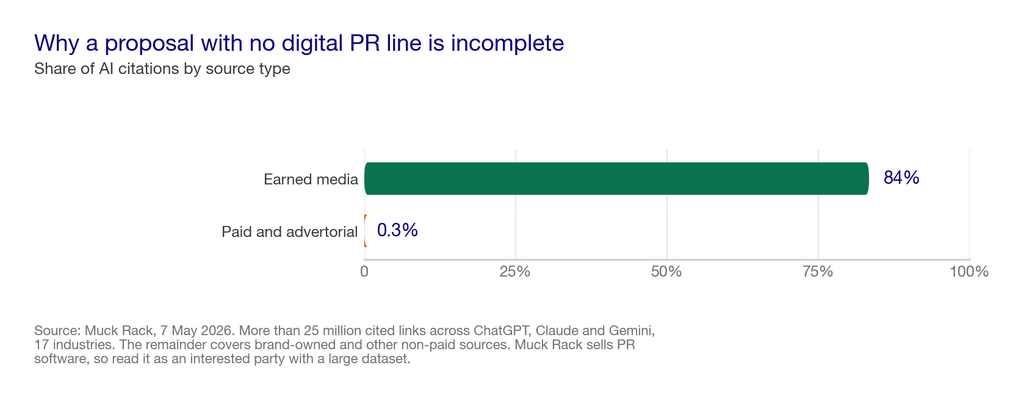
Muck Rack analysed more than 25 million cited links across ChatGPT, Claude and Gemini in May 2026, spanning 17 industries, and found earned media accounted for 84% of AI citations against 0.3% for paid and advertorial.
Independent academic work points the same way from different evidence. Huang, Goyal, Saha and Chandrasekharan ran 11,000 real search queries across five systems in March 2026 and found Wikipedia and longer third-party sources disproportionately overrepresented in AI answers. Zhang, He and Yao measured 21,143 citations in April 2026 and found the pages engines actually absorb are longer, more structured and richer in extractable evidence. Neither study sells PR, and both describe an answer layer built mostly from sources a brand does not own.
That combination is the most useful filter available when reading agency websites. A firm that genuinely rebuilt for AI search has earned media in its service list. Usually as digital PR, and increasingly as Reddit and community work. A firm that renamed its SEO deck has content production and technical audits, and calls the result GEO.
Both Siege Media and Minuttia list digital PR and Reddit marketing. Grizzle lists digital PR and video. Crackle PR is PR-first by construction. That is a meaningful signal, and it is checkable in ninety seconds on any agency’s services page.
The second gap is technical. Retrieval failures caused more than 70% of chatbot errors in a Stanford-led evaluation of six commercial chatbots across 2,100 questions in May 2026. Fixing rendering and crawler access needs engineering capability, not a content calendar.
Generative engine optimization agencies at a glance
| Agency | Published pricing | Earned media in scope | Who it is built for |
|---|---|---|---|
| Pepper | Not published | Yes | Teams wanting the platform and the work |
| Crackle PR | $12,000 monthly minimum | PR-native, the core offer | B2B tech wanting earned media first |
| Siege Media | Not published | Yes, plus Reddit | Brands wanting full-service GEO |
| Minuttia | Not published | Yes, plus Reddit | Established B2B SaaS |
| Grizzle | Not published | Yes, plus video | Growth-stage B2B SaaS |
| TripleDart | Not published | Not itemised | B2B tech wanting an AI-native operator |
| Omniscient Digital | Not published on the page we could reach | Not verified at source today | Established B2B SaaS |
Checked at each company’s own website on 3 September 2026. Omniscient Digital’s site returned an access error when we checked, so we have marked what we could not verify rather than repeating figures from elsewhere.
How we weighted this comparison

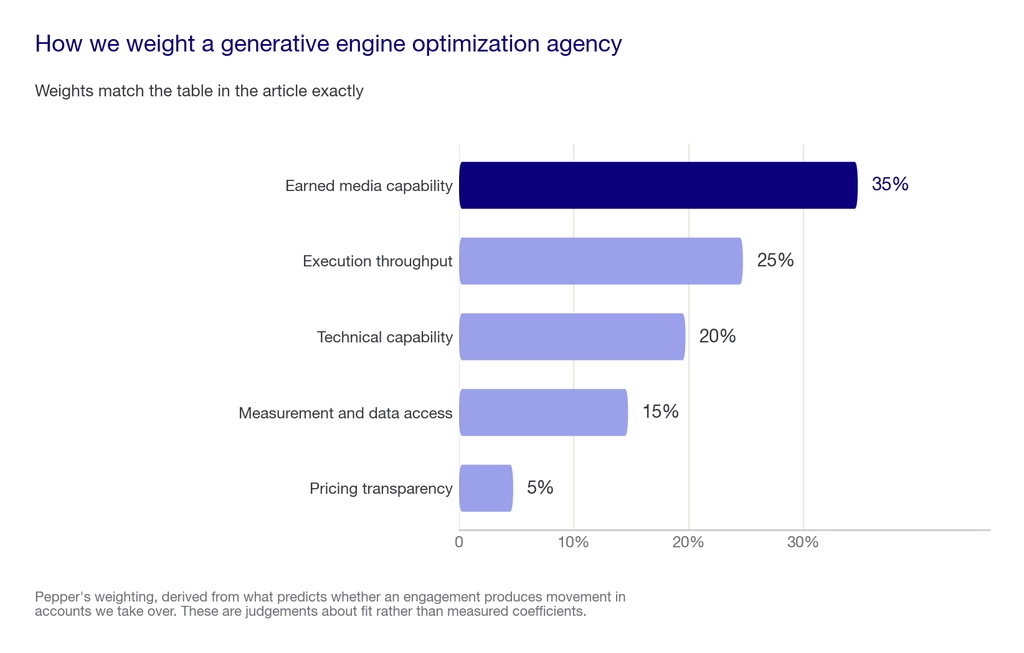
Figure 2: How we weight the decision. Weights match the table below exactly.
| Area | Weight | What decides the score |
|---|---|---|
| Earned media capability | 35 | Whether digital PR is a named, staffed service with a target list, since it supplies the large majority of citations |
| Execution throughput | 25 | Whether the retainer buys stated hours and shipped work, rather than strategy and a monthly report |
| Technical capability | 20 | Whether rendering, crawler access and structured data can actually be fixed, with engineering time inside the scope |
| Measurement and data access | 15 | Whether you see raw answers and cited URLs, or only a composite score in a deck |
| Pricing transparency | 5 | Whether a buyer can size the engagement before a sales call |
Earned media carries the most weight because it is both the largest share of citations and the capability most agencies lack. Pricing transparency carries the least, because almost nobody in this category publishes, so it separates very few firms.
Our GEO agency ranking methodology explains how we build weightings like this one.
If you want the diagnostic run against your category before you brief anyone, book a growth audit and we will show you which sources decide your answers today.
The agencies
Pepper, in its own category per the disclosure, is an agentic organic growth engine rather than a pure services firm. Customers log into the platform themselves: they set up a workspace, define brand profile, competitors and personas, connect GA4 and Search Console, manage themes and prompts, read GEO analytics, and build and run their own agents in the Agent Atlas. We track six engines, including ChatGPT, Perplexity, Gemini and Google AI Overviews.
And a growth team is attached to the account and does the work alongside them, covering technical retrievability, content and earned media. The distinguishing point against the rest of this list is that the instrument stays in your hands, so you can check any claim between reports rather than waiting for a deck.
Where it falls short: we do not publish pricing, so budget discovery is a conversation rather than a page. We are built for teams running organic as a long-term function, so a one-off audit is not what we are for. Our depth sits in content, authority and AI search rather than large technical migrations, so raise that early if it is your primary problem.
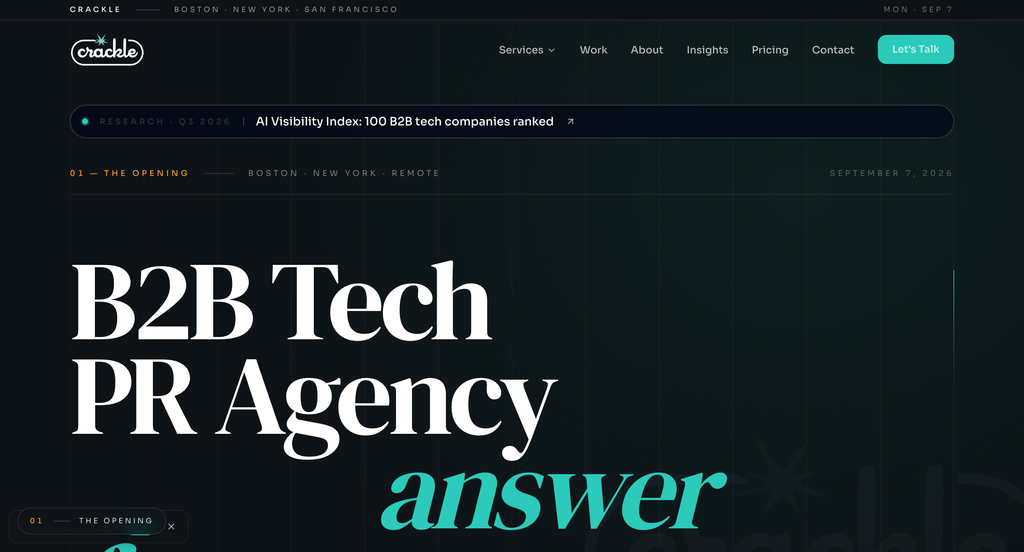
1. Crackle PR describes itself as a “senior-led B2B tech PR agency. Earned media + GEO/AEO so your brand is cited in ChatGPT, Perplexity, and Google AI Overviews.” Boston-based, with 20+ senior PR leaders. It is the only firm here that publishes a figure: a $12,000 monthly minimum retainer. Its thesis is that authoritative earned coverage becomes the material these systems cite, which lines up with the Muck Rack finding better than any other positioning on this list. Where it falls short: it is PR-first, so if your bottleneck is technical retrievability or content production at volume, you are buying the wrong specialism.
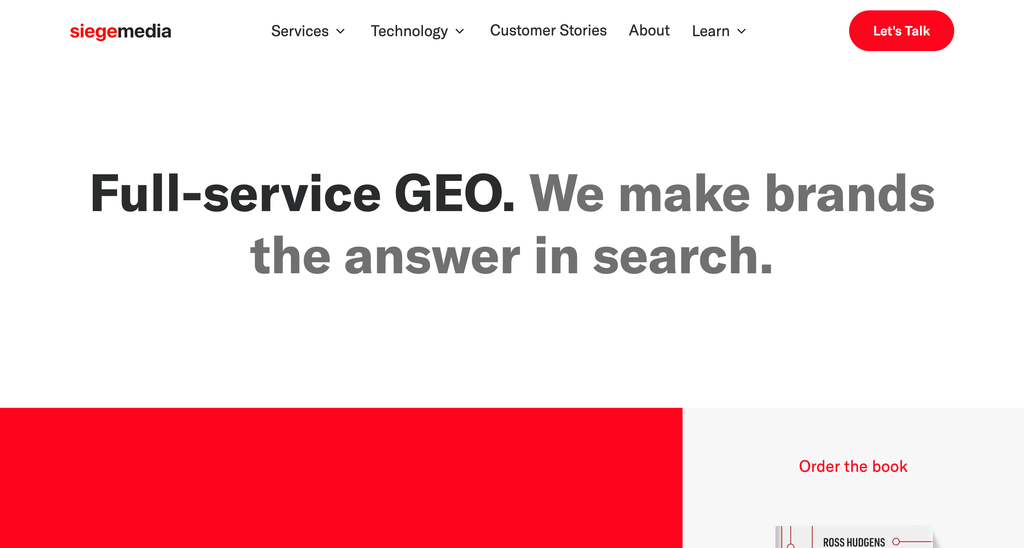
2. Siege Media has repositioned fully, leading with “Full-service GEO. We make brands the answer in search” and describing itself as “the GEO agency that brands hire when ROI isn’t optional.” Its service list includes digital PR, Reddit marketing, research reports and design alongside content and SEO. That is the widest genuinely relevant spread here. Where it falls short: no published pricing, and full-service breadth means you should confirm which specialists are actually on your account rather than on the website.
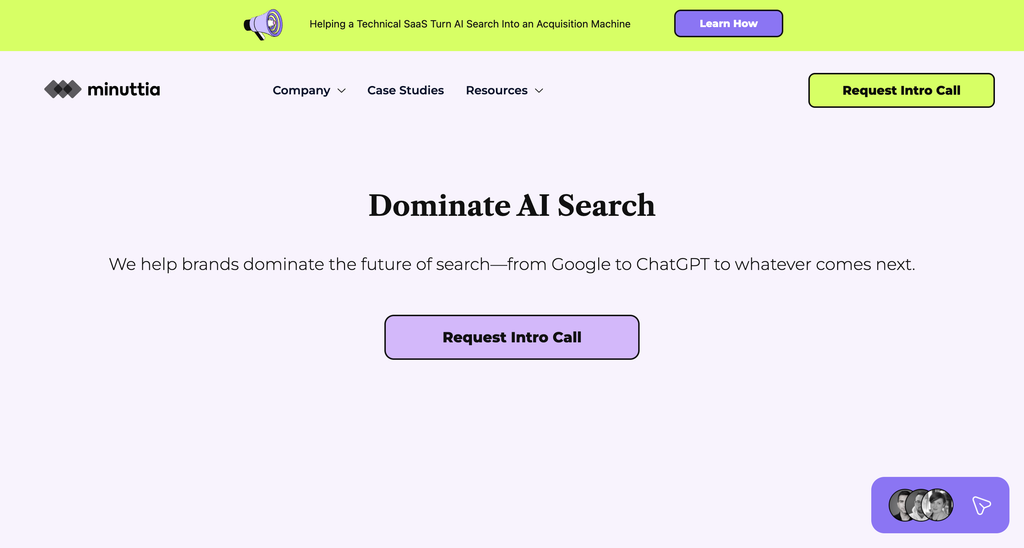
3. Minuttia positions as helping “brands dominate the future of search, from Google to ChatGPT to whatever comes next.” Its focus is established B2B SaaS. It publishes unusually specific operating metrics: 94% client retention, 24+ month average tenure, 60+ B2B SaaS clients. Services include digital PR, Reddit marketing and agent analytics. Where it falls short: the focus is deliberately narrow, so if you are not B2B SaaS with existing traction, you are outside the profile it is built for.
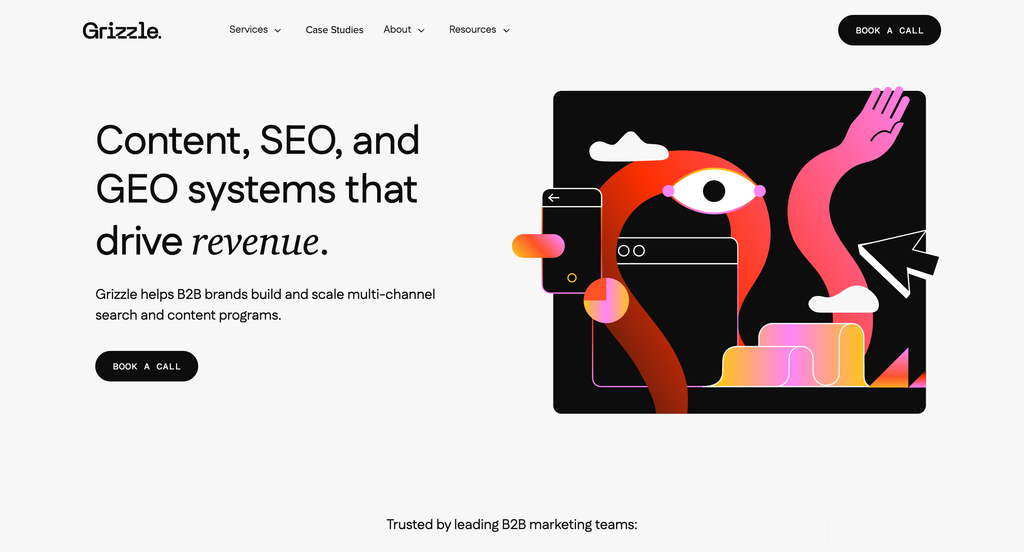
4. Grizzle leads with “content, SEO, and GEO systems that drive revenue” for B2B brands building multi-channel search programmes. Digital PR, YouTube and video, and AI content operations are in scope. Named clients include Pipedrive, Semrush, Tide and PandaDoc. Where it falls short: no published pricing, and the centre of gravity is content and video, so deep technical remediation is not the lead capability.
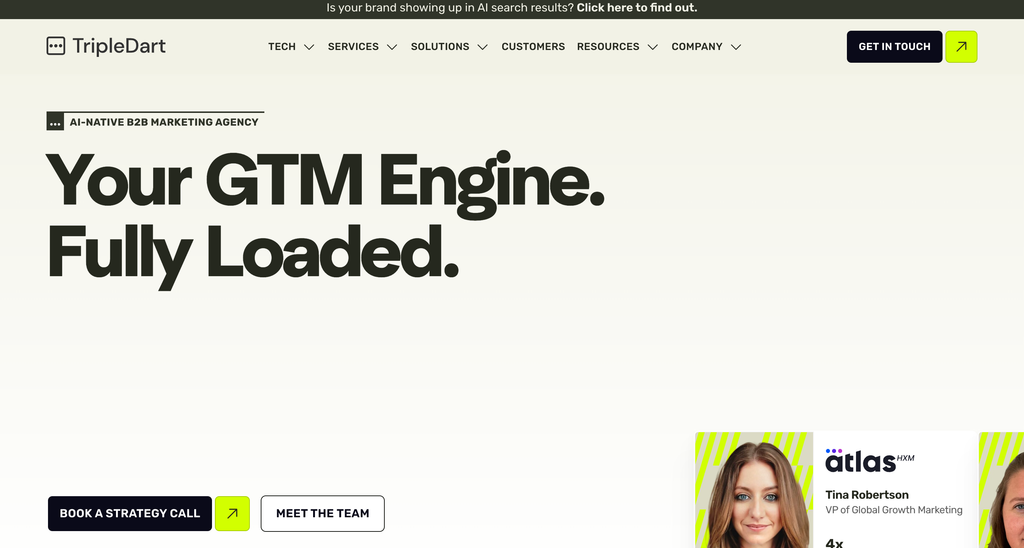
5. TripleDart describes itself as an “AI-Native B2B Marketing Agency” delivering “a GTM operating system, delivered as expert service”, built on proprietary systems including Slate with 130+ AI workflow blocks. It is the clearest example here of an agency whose tooling is internal. The platform improves their delivery, and you buy the outcome rather than the software. Where it falls short: earned media is not itemised in the way it is at Siege, Minuttia or Crackle, so ask directly what proportion of scope it represents.
6. Omniscient Digital is widely listed in this category and works with established B2B SaaS. Its site returned an access error when we checked on 3 September 2026, so we have not reproduced positioning or pricing claims for it here. Where it falls short: we cannot assess it at source today, which is a limitation of this page rather than of the firm.
What an engagement costs
Almost nothing is published, which is itself the finding.
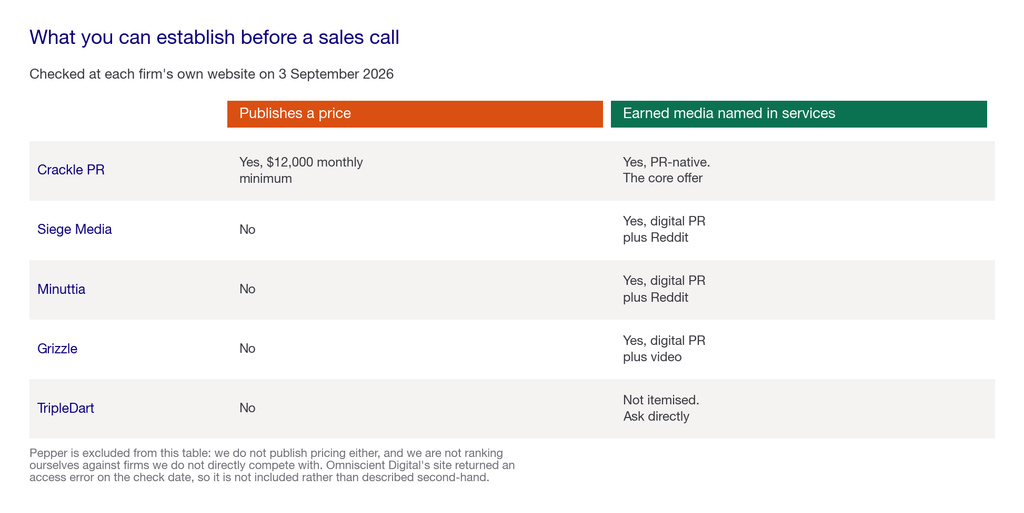
Crackle PR publishes a $12,000 monthly minimum. Every other firm here, ours included, quotes. So budget discovery here is a series of calls rather than a comparison exercise. Plan the evaluation accordingly: brief identically, ask for the same five outputs, and compare what comes back.
Treat a missing price as information rather than an oversight. It usually signals that scope varies widely by client, which is often true and occasionally a way to price against your budget rather than the work.
The line nobody itemises is earned media. It is the largest share of citations and the most expensive capability to staff. Ask which budget line pays for it, and who does the pitching. Our cost breakdown of platforms against hiring models the internal alternative, and GEO agency vs GEO tool covers whether you need a firm at all.
What nobody should promise you
Guaranteed citations. Google explicitly advises against providers guaranteeing rankings, because third parties cannot access internal ranking systems. Nobody has that access for ChatGPT either.
A cost per citation. Nobody controls the ranking systems, so nobody can price their output.
That content volume produces citations. The largest share comes from sources you do not own. Forty articles a month is a production commitment, not a visibility strategy.
A single composite AI visibility score. It hides the gap between Brand Visibility and Domain Prompt Presence, which is the finding you could act on.
How to choose a generative engine optimization agency
I would begin by discounting the ordering on every list you read, including this one, and reading the service pages instead.
Google’s May 2026 guidance is the anchor. Google states that AEO and GEO are part of SEO, and that AI Overviews and AI Mode run on core Search ranking systems with no separate AI index. That is correct for Google, and Google is one engine. ChatGPT and Perplexity retrieve and cite differently. Hold both. An agency selling GEO as a wholly separate discipline overstates its novelty. An agency treating it as unchanged SEO misses the earned media and measurement shift.
Score the shortlist before you take a pitch.
| Area | Weight | What a strong agency demonstrates |
|---|---|---|
| Earned media capability | 35 | Digital PR is a named, staffed service with a drafted target list drawn from your actual citation data, not “content amplification” |
| Execution throughput | 25 | The retainer buys stated hours and named roles, with a specific list of what comes off your plate |
| Technical capability | 20 | Rendering, crawler access and structured data are inside scope, with engineering time agreed rather than requested |
| Measurement and data access | 15 | You get raw answer text and cited URLs, exportable, not only a monthly composite |
| Pricing transparency | 5 | Enough published or stated early to size the engagement before a third call |
Those weights sum to 100. Score your own gap first, because if your constraint is technical, the best earned media firm in the category will not fix it.
The live test, and give every firm the identical brief. Take 30 real commercial prompts from your category, written the way a buyer would type them. Four worked examples: “which generative engine optimization agency should we hire”, “how do we get cited by ChatGPT in our category”, “best B2B SaaS content agency for AI search”, “is a GEO agency worth it for a mid-market company”. Run them yourself first using a free tier, then hand the same list to each firm.
Ask for five things back. Where do we appear and where do we not. Which competitors appear instead, consistently. Which sources influence those answers, sorted by frequency. Why are those sources winning. What would you change in the next 90 days, and who does it. Compare their answers against your own run. Engines are probabilistic, so require more than one run on more than one engine.
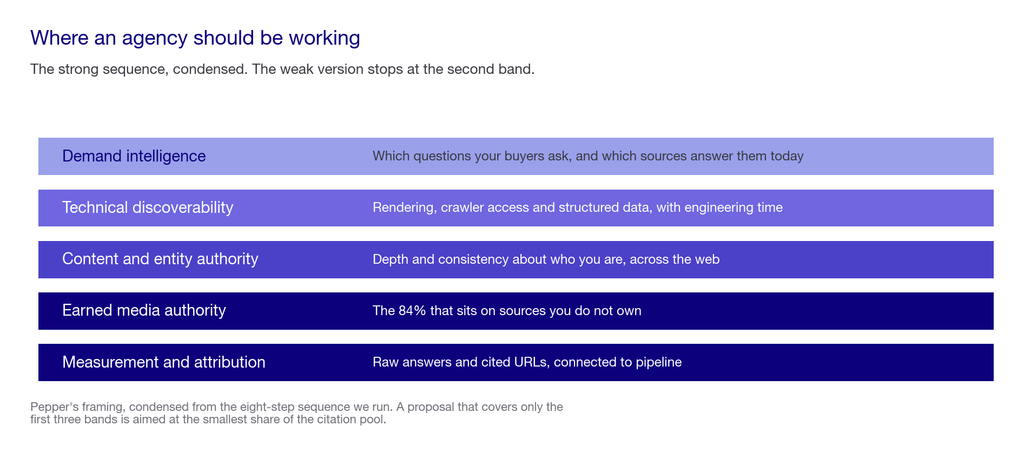
The weak playbook against the strong one. The weaker sequence is familiar because it is cheap to deliver. Audit the site, rewrite pages into question-and-answer format, add FAQ schema, publish more articles, and report citation counts with no competitor context. Entirely on-site, entirely owned media, aimed at the smallest share of the citation pool.
The stronger sequence runs eight steps: demand intelligence, technical discoverability, entity and brand authority, content, earned-media authority, distribution, visibility measurement, revenue attribution. The distinction matters because the weak version can be staffed by a junior writer and a tool subscription. That is precisely why so much of this category sells it.
Red flags, each one a thing an agency actually says. “We guarantee citations in ChatGPT”, which Google’s own guidance advises against. “Your AI visibility score went up”, with no competitor share of voice beside it. “We track your branded prompts”, which always looks healthy because those answers were already yours. “We optimise for ChatGPT”, where one engine stands in for the category. “We publish 40 AI-optimised articles a month.” “GEO is a completely new discipline”, contradicted by Google’s published position. “Content amplification”, used where digital PR should be. And the quiet one: a proposal with no earned media line at all, which given the 84% figure is structurally incomplete.
Five questions for the first call.
- What proportion of scope is earned media, and who does the pitching? A good answer names people and shows a target list. A weak one calls it amplification.
- What comes off our plate, in hours? A good answer is specific about throughput. A weak one talks about partnership and strategy.
- Do we get raw answers and cited URLs, or a report? A good answer offers an export and a sample. A weak one explains why the deck is sufficient.
- Who fixes rendering and crawler access, and is that time in the retainer? A good answer names it as in scope. A weak one refers you to your developers.
- Which of measurement, execution, earned authority and attribution is your weakest? A good answer picks one. A weak one claims all four equally.
It all comes down to one principle: hire for the capability you cannot staff, and in this category that is almost always earned media. Everything else in the proposal is easier to replace.
One closing note that costs us something. Very few firms are equally strong across measurement, execution, earned authority and attribution, ours included, and the good ones will tell you which of the four is their weakest. If a firm tells you that you need a full retainer before they have looked at your citation data, they are selling scope rather than answering your question.
Frequently asked questions
What is a generative engine optimization agency?
A team you retain to get your brand named and cited inside AI-generated answers. The work splits into technical retrievability, content and entity authority, and earned media. The third is what most distinguishes firms, because it supplies the majority of citations.
How much does a GEO agency cost?
Almost nobody publishes. Crackle PR states a $12,000 monthly minimum, and every other firm here quotes, ours included. Plan the evaluation as a series of identically briefed calls rather than a price comparison you can do in advance.
How do I tell a real GEO agency from a renamed SEO agency?
Read the service list. Firms that rebuilt for AI search carry digital PR and increasingly Reddit or community work. Renamed decks carry content production and technical audits relabelled as GEO. It is checkable in about ninety seconds.
Do I need a GEO agency or a GEO tool?
A tool if you have people with hours to act on findings. An agency if your constraint is execution rather than knowledge. Earned media is the one capability no tool provides at any price, so that gap usually decides it.
Why does earned media matter so much for AI citations?
Muck Rack analysed more than 25 million cited links and found earned media accounted for 84% of AI citations against 0.3% for paid. A programme aimed only at your own site is optimising the smallest share of the pool.
Can an agency guarantee citations in ChatGPT?
No, and treat the offer as a red flag. Google advises against providers guaranteeing rankings because third parties cannot access internal ranking systems, and the same holds for AI answers.
Should I hire an agency or build in house?
Hire when your constraint is hands rather than knowledge, and especially when you have no earned media motion. Build when this is a permanent function and your category is unusual enough that generic playbooks fail.
How long before a GEO engagement shows results?
Expect two to three quarters for meaningful movement. Technical fixes surface first, content follows, and earned media compounds slowest while contributing the largest share of citations.
Where to go next
Run the diagnostic before you brief anyone. Take 30 commercial prompts, run them across the engines your buyers use, and sort the cited domains by frequency. That list is your real target list, and it tells you which capability you are actually hiring for.
Then brief every firm identically and compare the five outputs. Our guide to tracking brand mentions in AI search covers the five methods and what each misses, and how to choose an organic SEO agency covers the red flags worth walking away from.
For the buy-versus-build question, GEO agency vs GEO tool covers what each model can and cannot do, and AI SEO agencies covers which firms genuinely rebuilt their model. Our SalesHood case study documents AI Overview keywords moving from 14 to 97 across five months, and the Acceldata case study shows the work on a technical B2B account.
The honest exit. If you have a capable in-house operator, an existing PR function you can borrow, and fewer than about 30 target queries, you do not need an agency yet. Run the diagnostic quarterly and revisit when the prompt set outgrows what one person can track.
Sources
Every agency description comes from that company’s own website, checked on 3 September 2026, rather than from another roundup. Every study cited was published in 2026. Firms we could not verify at source are marked as such rather than described from secondary sources.
- Zhang Kai, He Xinyue and Yao Jingang, From Citation Selection to Citation Absorption, arXiv, 28 April 2026. 602 controlled prompts, 21,143 search-layer citations, 18,151 fetched pages, across ChatGPT, Google AI Overview and Perplexity. Finds that high-influence pages are longer, more structured and richer in extractable evidence, and that citation counts alone inadequately measure effectiveness. Academic and independent of every vendor named here.
- Huang, Goyal, Saha and Chandrasekharan, Answer Bubbles: Information Exposure in AI-Mediated Search, arXiv, 17 March 2026. 11,000 real search queries across five systems. Finds that identical queries produce structurally different information realities across systems, and that Wikipedia and longer sources are disproportionately overrepresented. Academic and independent.
- Muck Rack, Earned media still drives 84% of AI citations, 7 May 2026. More than 25 million cited links across ChatGPT, Claude and Gemini, 17 industries. Muck Rack sells PR software, so read it as an interested party with a large dataset.
- Suzgun et al., Evaluating Commercial AI Chatbots as News Intermediaries, arXiv, 21 May 2026. 2,100 questions across six commercial chatbots. Tested on news rather than commercial queries, so read the mechanism rather than the exact rate.
- Google Search Central, AI features and your website, 15 May 2026, including the guidance against providers guaranteeing rankings.
Latest Blogs
Most advice on this is inference dressed as fact. OpenAI documents exactly one thing clearly, which is access. Here is what is documented, what is inferred, and how to verify the rest for yourself.
Being named in an AI answer and having your page used as its source are different outcomes with different causes and different fixes. The gap between them is the most useful diagnostic in AI search, and most reporting collapses it into one number.
Every platform reports share of voice and almost none of them define it the same way. Here is the definition worth using, the three choices that change the number, and how to measure it yourself without buying anything.
Get your hands on the latest news!