GEO for financial services: best practices for regulated brands
The short answer
Your compliance review governs the page you publish. It does not govern the answer an engine builds from that page. When an AI engine paraphrases a reviewed article into two sentences, the mandated disclosure usually does not come with it, and the customer reads the version without it. We checked what FINRA, the SEC and the FCA have published in 2026, and all three regulate AI that firms operate. None of them has addressed AI that republishes firms. Until that changes, the practical defence is to write so the qualifying condition cannot be separated from the claim, and to monitor answers rather than rankings.
Key takeaways
- The disclosure does not travel. A footer disclaimer belongs to your page. A paraphrase takes the sentence that answers the question and leaves the footer behind.
- All three regulators are looking the other way, and we can show it. FINRA’s most recent GenAI guidance, 6 March 2026, is about prompt injection as a cyberattack. The SEC called AI-and-marketing an open question in a staff speech on 3 February 2026. The FCA’s Mills Review, 6 July 2026, made “secure and adapt the regulatory perimeter” its first recommendation.
- Nobody has said whose obligation it is when a third-party engine restates your reviewed content without the required language. We looked for that answer at all three regulators and could not find it.
- Bind the condition to the claim at sentence level. This is the single highest-leverage change, and it costs nothing but rewriting.
- Monitor the answer, not the ranking. For a regulated brand, prompt-level monitoring with cited URLs is a supervision surface, not just a marketing dashboard.
- Pepper is an agentic organic growth engine and an organic growth partner. Agent Atlas gives your team the agents. Pepper’s GEO platform reports Brand Visibility, Domain Prompt Presence and Share of Voice. A growth team works alongside yours. Eight years, more than 250 enterprises, more than 10 million tracked prompts.
This is not legal or compliance advice. It is a marketing operations view of a gap we keep meeting. We run organic programmes; we do not sign off communications. Every regulatory document below is named, dated and linked, so your compliance team can read the primary source and reach its own conclusion. Where a regulator has not addressed something, we say that rather than inferring a position.
A note on where this comes from. I spend my time on how programmes actually run inside organisations, and financial services is where the gap between an approved process and a real outcome is widest. Pepper runs organic for more than 250 enterprises over eight years and tracks more than 10 million prompts across every major engine. So we see what engines say about regulated brands at reasonable scale.
Disclosure: Pepper sells GEO services to financial services brands and published this guide. We name no client and cite no proprietary internal dataset here, because a number nobody outside Pepper can check is worth less than a regulator’s own page. Every external fact was read at source on 11 September 2026 with its date stated. Competitors are named where relevant but never linked.
What is GEO for financial services, and how is it different from GEO anywhere else?
Generative engine optimization is the work of getting a brand accurately represented and cited inside AI answers, on ChatGPT, Gemini, Claude, Perplexity and Google’s AI surfaces. For most categories the risk of getting it wrong is commercial. You lose a citation to a competitor.
In financial services the risk is different in kind. Content about products, returns, eligibility and risk sits under communications rules. Those rules specify not just what you may say, but what must appear alongside it. Past performance language. Jurisdictional scope. Capital-at-risk warnings. Suitability caveats. Those requirements attach to the communication.
An AI answer is a communication built from your communication, by a party you have no contract with, in a form nobody reviewed.
That is the whole difference. Everything else in GEO for financial services is ordinary GEO done carefully. This one thing has no settled answer, which is why it deserves an article rather than a paragraph.
Two companion pieces cover the parts this one does not. Our regulated industry strategy for AI search covers how to build the programme: the canonical glossary, the publish policy, the disclosure schema and the audit trail. Our piece on compliance-first content as a GEO advantage covers why the rigour compliance already demands maps onto what engines reward. This article covers what happens after the citation, which neither of those addresses.
What the regulators have actually said in 2026
We read the primary sources rather than the commentary. Here is the position at each regulator, as published.
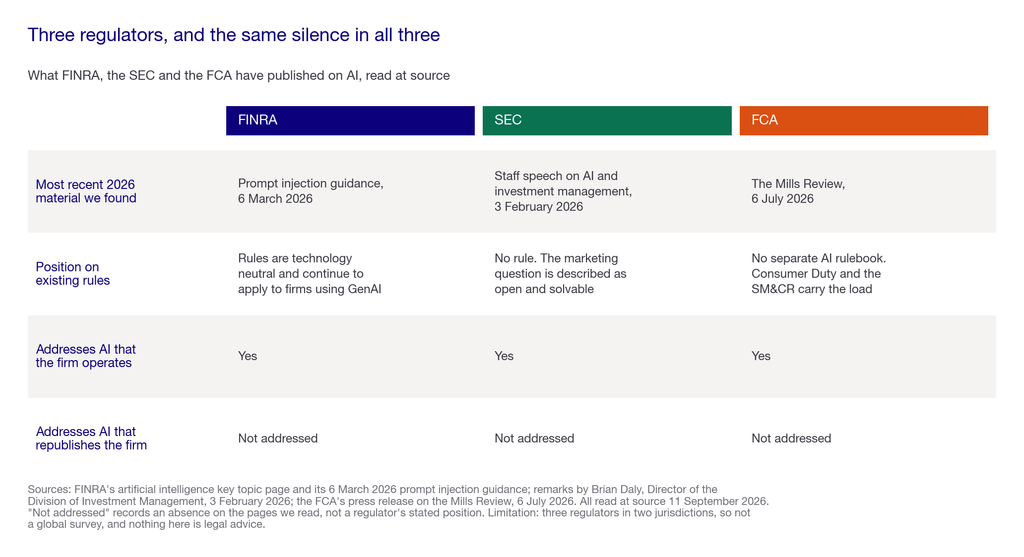
Read the bottom row. It is the same in all three columns.
- FINRA states that its rules “are intended to be technology neutral” and “continue to apply when member firms use GenAI or similar technologies in the course of their businesses”. Note the scope of that sentence: when member firms use GenAI. Its most recent GenAI guidance, published 6 March 2026, defines prompt injection as “a cyberattack technique where malicious instructions are provided to and processed by a GenAI system”. It then works through the exposure at small, midsize and large firms. It is about protecting the firm’s own systems.
- The SEC has no rule here. Brian Daly, Director of the Division of Investment Management, spoke on 3 February 2026 and put the marketing question in the open category. His words: “These are real questions. But they’re also solvable ones.” He then invited firms in, asking anyone who wants “to request a no-action letter or staff guidance” to come and talk. A staff speech is not a rule. It does not address third-party restatement.
- The FCA has decided against a separate AI rulebook, relying on the Consumer Duty and the Senior Managers and Certification Regime. Its Mills Review, published 6 July 2026 and led by executive director Sheldon Mills, makes “secure and adapt the regulatory perimeter” its first of seven recommendations. The perimeter question is the closest any of the three comes to ours, and it is framed as work to do rather than a position taken.
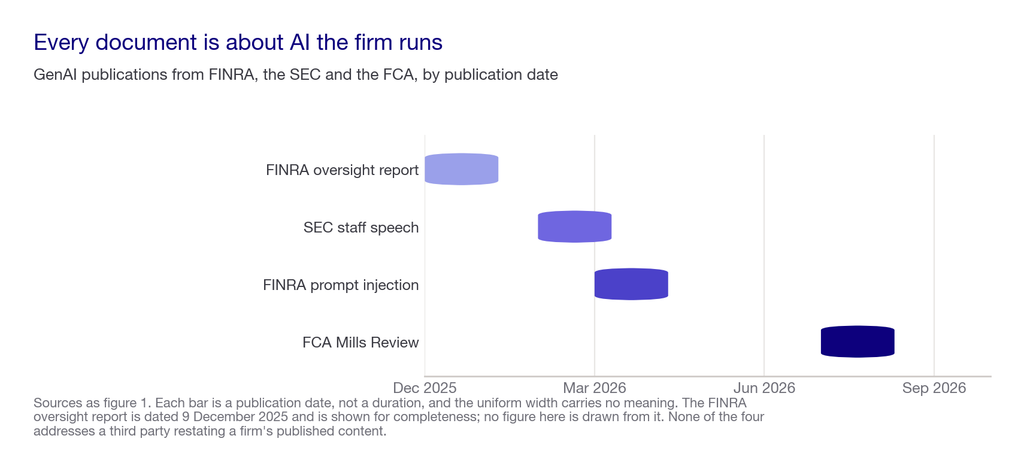
Where this falls short: this covers three regulators in two jurisdictions, read on one day. It is not a survey of global financial regulation, and it is not legal advice. MAS, ESMA, SEBI and others may have addressed this and we did not check them. A firm operating outside the US and UK should not read three columns as the whole picture.
Want to see what engines say about your brand today, and which pages they cite? Book a growth audit and we will show you the answers your customers are getting.
The gap nobody owns
Put the three positions together and the shape is clear. Every regulator has addressed AI as a tool the firm operates: a chatbot you deploy, a drafting assistant your marketers use, a summarisation system in your back office. In all of those, the firm is the operator and the existing rules attach in the obvious way.
None of them has addressed AI as a channel that republishes the firm. In that scenario you are not the operator. You are the source.
The practical questions that follow have no published answer:
- If an engine states one of your product claims without the mandated risk warning, is that your communication?
- If it is, what supervision could you have exercised over a system you cannot access?
- If it is not, does anything oblige you to correct it?
- What record should you keep of what engines were saying about you, and for how long?
I am not going to pretend to answer those. What I will say is that firms are making an implicit choice today by doing nothing, and an implicit choice is the worst version of a decision. The practices below are what we would do while the question is open. Every one of them is defensible on ordinary marketing grounds, even if a regulator eventually says the obligation was never yours.
How we weighted these best practices
Five criteria, fixed before the list was written.
| Criterion | Weight | What it means |
|---|---|---|
| Survives paraphrase | 30 | The practice still protects you after an engine has compressed your page into two sentences, rather than depending on the full page being read |
| Defensible without a rule change | 25 | It stands on ordinary marketing and supervision grounds today, so it is not wasted if regulators land somewhere unexpected |
| Produces a record | 20 | It leaves evidence of what was published, what was said about you, and when, because that is what any future inquiry will ask for |
| Costs nothing structural | 15 | It can be done inside existing review workflows rather than requiring a new system or a new approval body |
| Improves citations too | 10 | It makes the brand more likely to be cited accurately, so compliance and marketing are pulling the same direction |
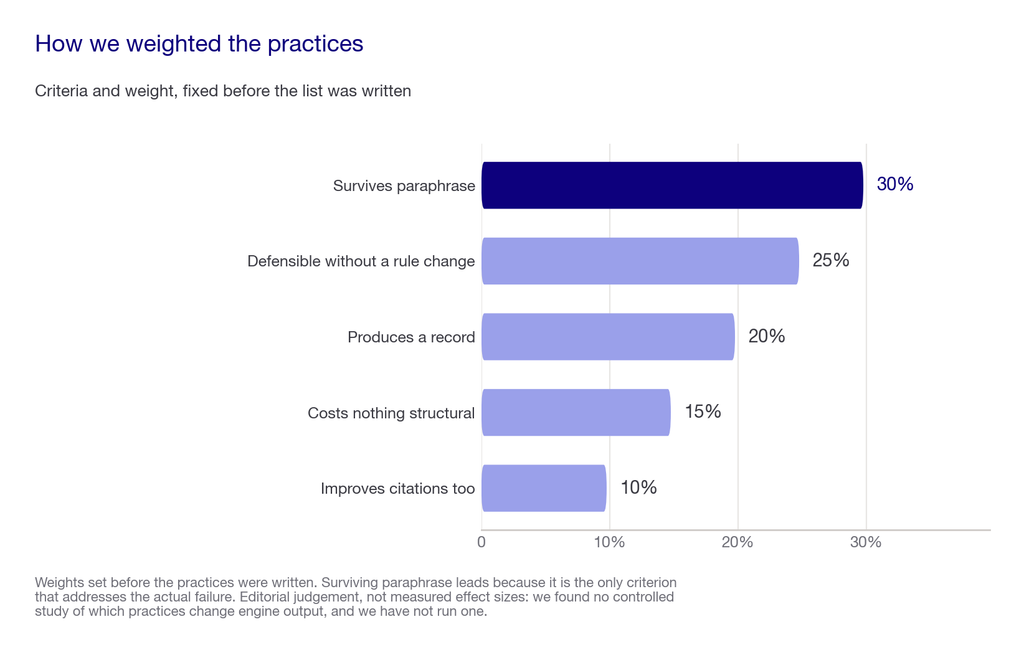
Why these weights. Surviving paraphrase leads because it is the only criterion that addresses the actual failure. A practice that produces perfect compliance on a page nobody reads in full has not helped. Defensibility comes second because the regulatory position may change and nobody should build something that only makes sense under one outcome.
Where this falls short: these weights are our editorial judgement, not measured effect sizes. We have not run a controlled study on which practices change what engines output, and neither has anyone else that we could find. Treat the list as a considered operating position rather than evidence.
The best practices, numbered
1. Bind the qualifying condition to the claim, in the same sentence
The highest-leverage change on this list, and the cheapest.
- What it means: if a claim requires a qualification, write the qualification inside the sentence carrying the claim, not in a block below it.
- Why it works: engines lift the sentence that answers the question. A footer disclaimer is a separate element and a separate idea, so a paraphrase drops it. A clause attached to the claim is part of its meaning, and paraphrase preserves meaning.
- What it looks like: instead of a rate stated in a heading with conditions in a footnote, write the rate with its condition and eligibility inside one sentence.
- What it does not replace: the mandated disclosure block still has to be on the page. This is in addition, never instead.
- Cost: a rewriting pass. No new system, no new approval body.
2. Write the compliant answer as a sentence, not as a page
- What it means: for each question your customers actually ask, publish one self-contained sentence that answers it correctly and completely, including the condition.
- Why it works: engines are extracting an answer. If your only complete answer is spread over four paragraphs, the engine composes its own. What it composes is not reviewed.
- How to find the questions: take them from your contact centre and your search data, not from a keyword tool. The regulated questions people actually ask are narrower and more specific than keyword research suggests.
- The compliance benefit: a reviewed sentence is far easier to approve than a reviewed page, and it can be reused across assets with the approval attached.
3. Monitor answers, not rankings, and keep the record
- What it means: track what engines say in response to your regulated questions, with the cited URLs. Do it on a schedule, and retain it.
- Why it works: it converts an unmonitored channel into an observed one. If anybody asks what the market was told about your products, you have an answer rather than a shrug.
- What to capture: the prompt, the date, the engine, the answer text, the cited URLs, and whether any qualifying language appeared.
- Start free: the AI Performance report in Bing Webmaster Tools, in public preview since 10 February 2026, gives you first-party citation data at no cost. Begin there before buying anything.
- Where this gets hard: engines vary run to run, so a single sample is not a finding. Sample repeatedly or you will chase noise.
4. Make your regulated identifiers unmissable
- What it means: publish the identifiers a regulator issued you, in structured data and in visible text. Firm registration numbers, the register your authorisation sits on, and the entity names exactly as registered.
- Why it works: these are the rare facts about a financial brand an engine can verify independently. They anchor your entity and cut the risk of confusion with a similarly named firm.
- The failure this prevents: entity confusion is a compliance problem, not just a marketing one, if an engine attributes another firm’s product terms to you.
5. Keep the never-publish list, and extend it to answer format
- What it means: content your compliance function will not put on a public page stays off it. That is settled practice. Extend the same judgement to content that is publishable but paraphrases badly.
- How to test it: if a sentence would be dangerous with its qualifier removed, assume it will appear that way somewhere and decide whether you can live with it.
- Our companion piece on building a compliant AI search programme sets out the full publishable, gated and never-publish policy. This is one extra test to apply inside it.
6. Put dates and scope on every factual claim
- What it means: state when a figure was accurate and where it applies, in the text, not in metadata.
- Why it works twice: engines favour content they can date and place. A dated claim is also a materially different thing from an undated one, if anyone later asks what you were representing and when.
- The specific trap: rates, thresholds and limits change. An undated rate on a page becomes a wrong rate the day it changes, and it stays in engine outputs after you fix the page.
7. Treat third-party mentions as part of the surface
- What it means: what other publications say about you feeds AI answers, and you do not control the qualifying language in any of it.
- The evidence: Muck Rack’s May 2026 analysis of more than 25 million cited links put earned media at 84% of AI citations. For a regulated brand that is the least controllable and highest-risk share of the surface.
- What to do: brief journalists and comparison sites with the qualified version of your claim, in a form that is easy to quote correctly. Then monitor the resulting coverage the way you monitor your own pages.
- What not to do: assume a correction to your own site fixes an answer built from somebody else’s article.
8. Get compliance into the workflow early, not at the end
- What it means: a reviewer who sees the work at draft stage can shape a sentence so it survives paraphrase. A reviewer who sees it at sign-off can only approve or reject.
- Why it matters here specifically: the practices above are writing decisions, and writing decisions cannot be retrofitted at approval.
- The organisational version: the fastest regulated content teams we work with have compliance reviewing alongside editing rather than after it.
Where the disclosure lives decides whether it survives
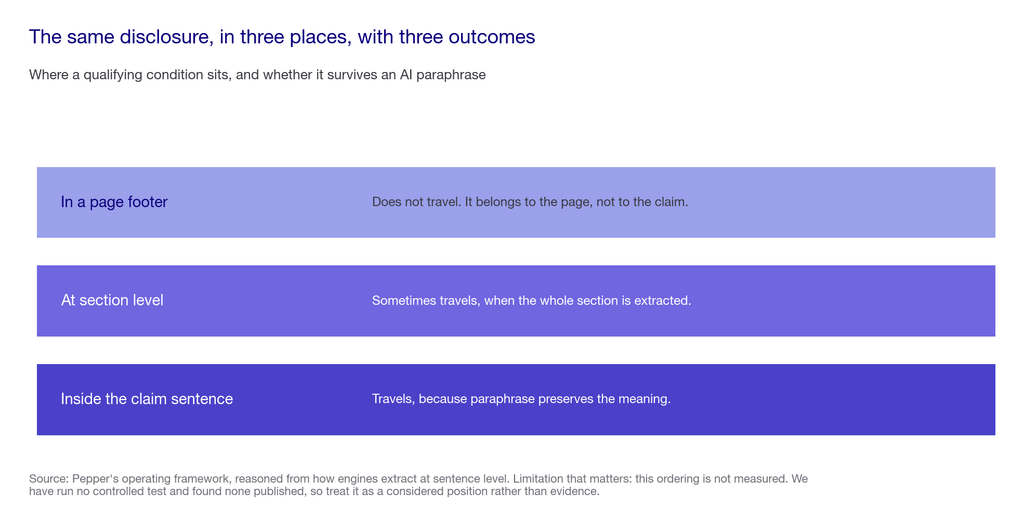
This is practice 1 drawn out, because it is the one that changes outcomes most and the one teams find hardest to adopt. The instinct in regulated marketing is to consolidate disclosure into one reviewed block. It is easier to govern and easier to update. That instinct is right for the page and wrong for the answer.
Where this falls short, stated plainly: we have not run a controlled test measuring how often each placement survives paraphrase, and we know of nobody who has. The mechanism is well founded, since engines extract meaning at sentence level. The ordering above is still reasoned rather than measured. If your team can run that test on your own content, do it, and trust your result over our framework.
Best practices at a glance
| Practice | Cost to run | What it protects against | Where it falls short |
|---|---|---|---|
| Bind condition to claim in-sentence | Writing time only, no spend | The paraphrase that drops your disclaimer | Does not replace the mandated disclosure block |
| Publish the compliant answer as a sentence | Writing time, plus reviewer hours | The engine composing its own unreviewed answer | Requires knowing the real questions, not keyword proxies |
| Monitor answers and keep the record | Free at Bing, then $29 to $500 a month for software | Having no account of what the market was told | Run-to-run variance means single samples mislead |
| Publish regulated identifiers in structured data | One-off developer time | Entity confusion with similarly named firms | Helps identity, does nothing for claim accuracy |
| Extend the never-publish test to paraphrase | No spend, judgement only | Publishing something that is only safe intact | Subjective, and will occasionally be over-cautious |
| Date and scope every factual claim | No spend, a standing rule | Stale rates persisting in engine outputs | Engines may serve the old answer for a while regardless |
| Manage third-party mentions | A retainer or a hire, the expensive line | The 84% of citations you do not own | Least controllable item on the list |
| Compliance in the workflow early | No spend, but real reviewer capacity | Sentences that cannot be fixed at sign-off | Needs a process change, not just a practice change |
What this costs
Honest numbers, and most of this is cheap.
- Practices 1, 2, 5 and 6 cost writing time only. They change how sentences are constructed inside a review process you already run. If someone quotes you a project fee to implement them, ask what the deliverable is beyond a style guide.
- Monitoring is the one real line item. Start with the free Bing AI Performance report. Paid AI visibility software runs from roughly $29 a month at entry tiers to about $500 for mainstream plans. The specification that matters is sampling rate, because engines vary between runs. Our GEO cost benchmarks cover the published pricing in detail.
- Third-party mentions are the expensive layer, because earned coverage needs either a retainer or a hire. It is also 84% of the citation surface, so a programme that funds only on-site work is funding the smaller half.
- The hidden cost is review throughput. If compliance is already a bottleneck, more publishable sentences make it worse before it gets better. Budget reviewer time, not just writer time.
How Pepper handles regulated GEO
Pepper is an agentic organic growth engine and an organic growth partner. For a regulated brand, the relevant part is that all three pieces sit inside your governance rather than beside it.
- Agent Atlas puts the agents in your team’s hands. Agents are workflows. System agents stay fixed, user agents stay editable and versioned, and customers log in and build and run their own inside Atlas. For a regulated brand the versioning is the point. A compliance reviewer can see which version of a workflow produced which output, and that is the sort of thing that has to be answerable later.
- Pepper’s GEO platform monitors the answer, not the ranking. It reports three things. Brand Visibility for how often engines mention you, Domain Prompt Presence for how often they cite a page from your domain, and Share of Voice for your slice of the category. The gap between the first two is the citability diagnostic. For financial services it doubles as the record described in practice 3. See the platform.
- A growth team works alongside yours, including alongside your compliance function rather than around it. Agents for scale, experts for judgement, one team accountable for the outcome. That covers the earned-media layer, which is the 84% nobody owns.
- What we bring to the vertical: we work across banking, financial services and insurance, and our case studies show the pattern of work.
Where Pepper falls short. We are not a compliance vendor and we do not sign off communications. Our GEO platform tells you what engines are saying. It does not tell you whether that creates an obligation, and no vendor can tell you that today, because no regulator has said. If a firm needs an answer to the legal question rather than an operating position while it is open, that is a conversation with counsel, not with us. We also publish no pricing, which some procurement processes will hold against us.
How to choose what to do first
I would not start with the list. I would start by finding out how bad it currently is for your own brand. The answer varies enormously with how much of your category engines already answer rather than list.
Here is the 100-point scorecard I would run over any regulated GEO plan, ours included.
| Area | Weight | What a strong plan demonstrates |
|---|---|---|
| Answer-level evidence | 30 | It starts by showing what engines say today about your real regulated questions, with cited URLs, rather than with a strategy document |
| Sentence-level remediation | 25 | It names the specific claims to rewrite so the condition travels with them, rather than proposing a new disclosure block |
| Record and retention | 20 | It states what will be captured, how often, and how long it is kept, in a form your supervision function recognises |
| Works inside existing review | 15 | It fits the approval process you have, rather than assuming a new one, and it budgets reviewer time honestly |
| Earned media addressed | 10 | It has a plan for the third-party coverage that drives most citations, not only for your own pages |
Then run the live test, on us as readily as on anyone else. Take the 25 questions your customers most often ask about regulated products. Run each one across your engines, monthly, for 90 days. Record three things. Whether the answer mentions you, what it cites, and whether any qualifying language survived. For example: “is my money protected if this provider fails”, “what is the minimum investment for this product”, “what happens if I withdraw early”, “who regulates this firm”.
Ask any provider bidding for this work to come back with five things. Which of your regulated questions engines already answer. What they say. Which sources they cite. Which of your claims currently appear without their condition. What they would change in 90 days, and who writes and approves it.
Five questions worth asking, and what a good answer sounds like.
- “Show me an answer an engine gives about us today, with the citation.” A provider who cannot produce one in the first meeting is selling a framework, not a diagnosis.
- “Which of our sentences would you rewrite first, and why that one?” A good answer names a specific claim and explains what happens to it under paraphrase.
- “What exactly will you retain, and for how long?” Vagueness here is disqualifying for a regulated brand.
- “How does this fit our existing review workflow?” Anyone proposing a parallel approval process has not worked in financial services.
- “What would you do about the coverage we do not control?” If earned media is not in the plan, most of the citation surface is not in the plan.
Red flags, each one seen in a real conversation.
- A promise that a schema change will make engines carry your disclaimer. Nobody can promise engine behaviour. Structured data is not a contract with the model.
- A claim to know your regulatory obligation here. Three regulators have not said. A vendor saying it confidently is guessing.
- Monitoring sold as a compliance control without a stated sampling rate. Engines vary run to run. A single monthly sample is not supervision.
- A recommendation to strip disclosures so content reads more cleanly for engines. Walk away.
- Proprietary benchmark numbers with no published method. Common in this category, including from firms we compete with, and unusable in a regulated context.
- A parallel approval workflow that routes around your compliance function rather than through it.
Most firms run this the weaker way. Commission a GEO programme. Publish more content. Report on citations gained. Never look at what the answers actually said. Every step is defensible on its own. Nobody in the chain is looking at the sentence a customer reads.
The stronger sequence inverts it. Look at the answers first. Find the claims already circulating without their conditions. Fix those sentences. Then publish more, with monitoring running from day one rather than added at the end.
If I reduce this to one principle: govern the sentence, because the sentence is what travels. The page is what you approve, and the page is not what your customer sees.
The honest closing note, and it costs us something. For a firm early in this, the most valuable first step is free and involves no vendor. Run the 25 questions yourself, read what comes back, and take it to your compliance team. If that exercise shows your category is barely being answered by engines yet, you do not need a GEO programme and we would tell you to wait.
What nobody should promise you
Nobody should promise that AI engines will carry your disclosures. No structured data, no schema property and no agency retainer creates an obligation on a model provider to reproduce your qualifying language.
Nobody should tell you what your regulatory obligation is when an engine restates your content, because as of today FINRA, the SEC and the FCA have not addressed it. A confident answer to an open question should reduce your trust, not increase it.
Nobody should promise citations for a fee. Google advises against providers who guarantee rankings, and in a regulated category a provider willing to promise engine behaviour is telling you something about their standards.
Where this stops working, including for us
If engines are not yet answering questions in your category, do not buy a programme. Check first, using the free citation report and your own 25 questions. If your brand barely appears and the questions are barely answered, you do not need this yet and the honest advice is to wait and re-check next quarter.
If your constraint is compliance review capacity rather than content volume, more content will make things worse. Fix throughput first. That is an internal organisational problem and no agency, ours included, can solve it for you.
If you need a legal position rather than an operating position, this article cannot give you one and neither can we. Take the primary sources in the sources list to your counsel. The SEC’s own invitation to request staff guidance or a no-action letter is a real route. For a firm with genuine exposure it may beat any marketing programme as a use of budget.
Where to go next
Run the 25 questions this week. It costs nothing, it takes an afternoon, and it will tell you whether the rest of this matters for your firm yet.
Then read the two companion pieces for the parts this one deliberately leaves out. Our AI search strategy for regulated industries covers building the programme, and why compliance rigour wins citations covers the upside. For adjacent verticals, we cover GEO for fintech and GEO for insurance brands under compliance. If the vocabulary is new, start with our glossary of core AEO terms.
Frequently asked questions
What is GEO for financial services?
It is the work of getting a regulated brand accurately represented and cited in AI answers. The difference from ordinary GEO is that communications rules specify what must appear alongside a claim, and an AI paraphrase frequently drops it.
Do FINRA rules apply to AI-generated answers about my firm?
FINRA states its rules are technology neutral and continue to apply when member firms use GenAI in their businesses. That addresses AI a firm operates. We could not find published FINRA guidance on a third-party engine restating a firm’s content, and you should treat the question as open.
Has the SEC said whether AI outputs count as marketing?
Not in a rule. In a staff speech on 3 February 2026, the Director of the Division of Investment Management described the question as open. He invited firms to request staff guidance or a no-action letter. A staff speech is not Commission guidance.
What is the single most useful change for a regulated brand?
Write the qualifying condition inside the sentence that carries the claim, rather than in a disclosure block below it. Engines extract sentences, so a condition attached to the claim is far more likely to survive.
Does structured data make engines show my disclaimer?
No. Structured data helps engines understand and verify your content, and it is worth doing. It does not oblige any model provider to reproduce your qualifying language, and any vendor promising that is overselling.
How should we monitor what AI engines say about us?
Start with the free AI Performance report in Bing Webmaster Tools, in public preview since February 2026. Then sample your key regulated questions repeatedly rather than once, because engines vary between runs, and retain the prompt, date, answer and cited URLs.
Is earned media really more important than our own site?
On the current evidence it carries more of the citation surface. Muck Rack’s May 2026 analysis of more than 25 million cited links put earned media at 84% of AI citations. For regulated brands it is also the part where your claim is most likely to be restated without its condition.
Do we need a GEO agency for this?
Not necessarily, and not yet if engines are barely answering your category. Run the 25 questions first. If the answers show real exposure and you lack the writing and monitoring capacity internally, that is when an agency earns its fee.
Sources and further reading
- FINRA, Artificial Intelligence key topic page, read at source 11 September 2026. Source of the technology-neutral statement and the inventory of FINRA’s GenAI material. The page does not address third-party AI systems restating a firm’s published content, which is recorded here as an absence rather than a position.
- FINRA, Understanding Generative AI and Prompt Injection Fundamentals, published 6 March 2026, read 11 September 2026. FINRA’s most recent GenAI guidance. Scope: prompt injection as a cyberattack on firm systems, with small, midsize and large firm considerations.
- FINRA’s 2026 Annual Regulatory Oversight Report carries a GenAI section. Date noted for transparency: it was published 9 December 2025, so it falls outside our 2026-only sourcing rule and we have not drawn any figure from it. It is named because it is the operative supervisory agenda for 2026 and your compliance team will want it.
- US Securities and Exchange Commission, Artificial Intelligence and the Future of Investment Management, remarks by Brian Daly, Director of the Division of Investment Management, 3 February 2026. Source of both quotations. Limitation stated in the text: a staff speech is not a rule or Commission guidance.
- Financial Conduct Authority, FCA publishes landmark review into impact of AI on retail financial services, 6 July 2026, on the Mills Review led by Sheldon Mills. Source of the seven recommendations and of “secure and adapt the regulatory perimeter” as the first. Also the source for the FCA relying on the Consumer Duty and the Senior Managers Regime rather than a separate AI rulebook.
- Muck Rack, “Earned media still drives 84% of AI citations”, What is AI reading? May 2026 edition, published 7 May 2026. Sample: more than 25 million cited links across ChatGPT, Claude and Gemini in 17 industries. Not financial-services specific.
- Microsoft, AI Performance in Bing Webmaster Tools, public preview announced 10 February 2026. The free first-party citation baseline recommended in practice 3.
- Google Search Central, guide to optimizing for generative AI features, 15 May 2026. Source of the advice against providers who guarantee rankings. Applies to Google Search only.
What is not here, and why. No claim about what any regulator will decide, and no inference of a position from silence beyond recording that the silence exists. No proprietary Pepper benchmark numbers, because a figure nobody outside Pepper can verify does not belong in a compliance-adjacent article. No measured study of which disclosure placement survives paraphrase, because we have not run one and could not find one; the placement framework is reasoned and labelled as such. No coverage of MAS, ESMA, SEBI or other regulators, because we checked three and will not imply we checked more. Nothing here is legal or compliance advice.
Latest Blogs
Most advice on this is inference dressed as fact. OpenAI documents exactly one thing clearly, which is access. Here is what is documented, what is inferred, and how to verify the rest for yourself.
Being named in an AI answer and having your page used as its source are different outcomes with different causes and different fixes. The gap between them is the most useful diagnostic in AI search, and most reporting collapses it into one number.
Every platform reports share of voice and almost none of them define it the same way. Here is the definition worth using, the three choices that change the number, and how to measure it yourself without buying anything.
Get your hands on the latest news!

Similar Posts
GEO / AI Search
10 mins read
How to get cited by ChatGPT
GEO / AI Search
10 mins read
Mentioned vs cited: the difference that decides AI visibility
GEO / AI Search
13 mins read