The short answer
A GEO platform costs between $29 and roughly $500 a month at the published self-serve tiers, with enterprise quoted on request. Several vendors publish nothing at all.
The reason you cannot simply pick the cheapest is that platforms price on four different units.
- Per tracked prompt. Otterly, Scrunch and Trakkr all sell a number of prompts. This is the easiest unit to compare, and the one most buyers assume is universal.
- Per AI response, sold as credits. AthenaHQ states the rule plainly: “1 credit = 1 AI response.” One prompt run across eleven models consumes eleven credits.
- Per brand. Trakkr’s Scale tier is ten brands rather than more prompts, which suits an agency and wastes money for a single product company.
- Per seat. User licences are capped on several tiers, at three or five.
The add-on you will not see on the pricing page
Engine coverage is frequently an add-on rather than an inclusion. Otterly’s published tiers cover four engines. Adding Claude costs between $29 and $439 a month depending on plan, and Gemini or Google AI Mode between $9 and $149 each. A $29 plan with the engines you actually want is not a $29 plan.
Note that every figure below was read off the vendor’s own pricing page on 28 September 2026. Where a vendor publishes nothing, we say so rather than estimating.
We sell in this market, so read this as an interested view. Pepper is an agentic organic growth engine, not an SEO agency, and we do not publish a rate card either. This page comes out of what we run: organic for more than 250 enterprises across eight years, more than 10 million tracked prompts, and the pricing questions buyers put to us in client reviews. Customers log in and run the platform themselves, with a Pepper growth team attached. Book a growth audit and you will get a scoped number rather than a range.
Key takeaways
Key takeaways from a morning on vendor pricing pages, checked 28 September 2026.
- Published self-serve prices run $29 to $500 a month. Otterly starts at $29, Trakkr at $100, Scrunch at $300.
- Cost per tracked prompt ranges from $0.71 to $2.00, and the cheapest plan is the worst value per prompt.
- Engines are often extra. Otterly charges $29 to $439 a month for Claude alone, on top of the plan.
- Credits are not prompts. On AthenaHQ’s stated rule, a $295 tier with 3,600 credits tracks roughly 11 prompts daily across 11 models.
- Annual billing saves 15 to 17 percent at every vendor that publishes both.
- Free tiers and trials exist. AthenaHQ has a permanently free tier; Trakkr, Scrunch and Otterly run trials.
What is a GEO platform, and what are you paying for?
In short, a GEO platform runs a set of prompts across AI engines on a schedule and reports what came back: whether an engine mentioned you, whether it cited a page from your domain, and who it named instead. Those two numbers, and the gap between them, are defined in AI search visibility metrics and KPIs.
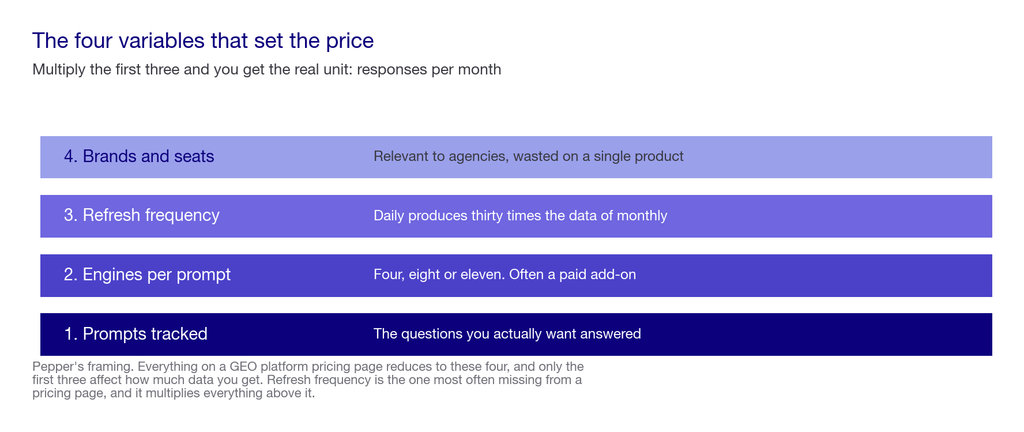
Underneath the feature list, what you are buying is a number of observations. Everything that drives the price reduces to four variables.
- How many prompts you track. The questions you want answered.
- How many engines each prompt runs against. Four, eight or eleven, depending on vendor and tier, and we compared coverage directly in which GEO platform covers the most AI engines.
- How often each prompt is re-run. Daily tracking produces thirty times the data of monthly, at the same prompt count.
- How many brands and seats. Relevant to agencies and holding companies, wasted on a single product.
Multiply the first three and you get the real unit: responses per month. Why that number decides whether a percentage is readable at all is covered in top AI visibility platforms. That is the number every price should be normalised to, and almost no vendor presents it that way.
What GEO platforms actually publish
In practice, four vendors publish figures and two publish nothing useful.
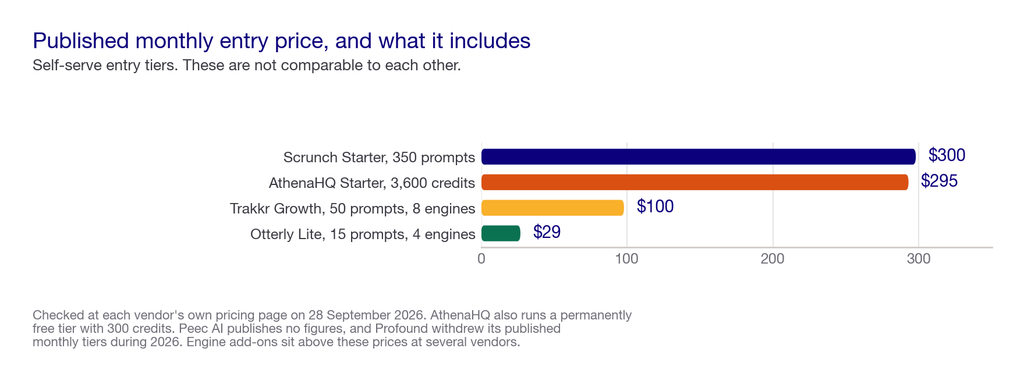
| Platform | Entry tier | Prompts or credits | Engines included | Annual discount |
|---|---|---|---|---|
| Otterly | $29 Lite | 15 prompts | 4 | 15% |
| Trakkr | $100 Growth | 50 prompts, 1 brand | 8 | 17% |
| AthenaHQ | Free Essential, then $295 Starter | 300 then 3,600 credits | 5 then 11 models | 17% |
| Scrunch | $300 Starter | 350 custom, 1,000 industry | Not itemised | 17% |
| Peec AI | Not published | Not published | Not published | Not published |
| Profound | Free trial, then Enterprise quoted | 10 prompts on trial | 1 on trial, 9 at Enterprise | Not published |
Checked at each vendor’s own pricing page on 28 September 2026. Enterprise tiers: Otterly custom at 1,000-plus prompts, Trakkr from $1,000 a month billed annually, AthenaHQ and Scrunch custom.
Where the published price stops being the price
In practice, three things reliably move the bill above the advertised number.
- Engine add-ons. Otterly’s four included engines are ChatGPT, Google AI Overviews, Perplexity and Microsoft Copilot. Claude is an add-on at $29 to $439 a month depending on plan; Gemini and Google AI Mode are $9 to $149 each. If you need six engines, price them before comparing anything.
- Prompt overages. Otterly sells extra prompts at $99 a month per additional 100, which is more per prompt than its own Premium tier.
- Seat caps. Scrunch includes three user licences on Starter and five on Growth. Trakkr includes three seats on Growth and unlimited on Scale.
Cost per tracked prompt, and why the cheapest plan is the worst value
However, divide each published price by its published prompt count and the order inverts.
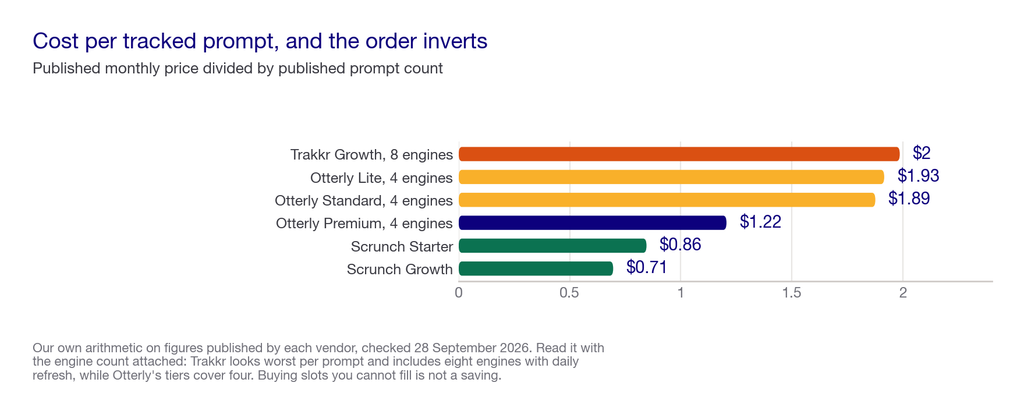
- Trakkr Growth, $100 for 50 prompts: $2.00 per prompt, across 8 engines with daily refresh.
- Otterly Lite, $29 for 15 prompts: $1.93 per prompt, across 4 engines.
- At $189 for 100 prompts, Otterly Standard works out at $1.89 per prompt.
- Moving up to Otterly Premium, $489 for 400 prompts falls to $1.22.
- Scrunch Starter, $300 for 350 custom prompts: $0.86 per prompt.
- Scrunch Growth, $500 for 700 custom prompts: $0.71 per prompt.
However, there is a trap in that list. Per-unit value improves as you spend more, which is normal volume pricing, and it does not mean you should buy the bigger tier. Paying $300 for 350 prompt slots when you have 50 real buying questions is not a saving. So size to your actual prompt list first, then compare within the tier that fits.
And a second one. Trakkr’s $2.00 looks worst on this chart and includes eight engines with daily refresh, while Otterly’s $1.93 covers four. Therefore, normalise for engines and the ordering changes again.
Credits are not prompts, and the difference is large
AthenaHQ is the clearest vendor on its unit and the hardest to compare because of it. Its stated rule is unambiguous: “1 credit = 1 AI response.”
So work the arithmetic through, and the headline number means something quite different.
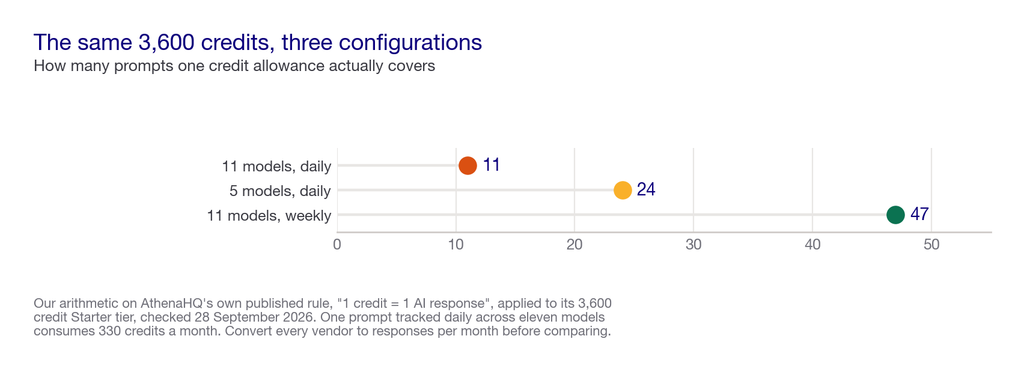
- Eleven models, daily: 3,600 credits covers roughly 11 prompts. Each prompt consumes 11 responses a day, or 330 a month.
- Five models, daily: roughly 24 prompts.
- Eleven models, weekly: roughly 47 prompts.
Why this matters more than any headline price. A buyer comparing “$295 for 3,600 credits” against “$300 for 350 prompts” is comparing two things that are not alike. The arithmetic above is ours, applied to AthenaHQ’s own published rule, and the practical instruction is to convert every vendor to responses per month before comparing anything.
So ask each vendor the same question: how many AI responses does my plan buy per month? If a vendor will not answer, you cannot audit the percentages it reports either, which we go through in top AI visibility platforms.
What you should actually expect to pay
These are sized to a realistic prompt list rather than to a marketing tier.
- Under $50 a month. A baseline check. Otterly Lite at $29 tracks 15 prompts on four engines. Sensible as a first purchase and not a measurement programme.
- $100 to $300 a month. Where most single-product companies land. Trakkr Growth, Otterly Standard, AthenaHQ Starter, Scrunch Starter.
- $300 to $500 a month. More prompts, more engines, or more seats. Check which of the three you are actually buying.
- Above $1,000 a month. Enterprise. Trakkr publishes a floor at $1,000 billed annually; the rest quote. Modelling whether any of it pays back is in the GEO ROI model.
- Zero. AthenaHQ’s Essential tier is permanently free with 300 credits across five models, and the free methods for doing this by hand are in how to track brand mentions in AI search. Trakkr runs 14 days, Scrunch 7 days, Otterly a trial for new users.
So start free or cheap, learn what your prompt list actually looks like, then buy the tier that fits it. The wider picture across agencies, platforms and tools sits in SEO, AEO and GEO pricing benchmarks.

How to compare two quotes fairly
Five steps, and together they take about twenty minutes.
- Write your prompt list first. Forty to eighty category questions for most companies. This number, not the vendor’s tier, decides what you need.
- Second, count the engines you actually care about. Then price them, including add-ons. Four-engine and eight-engine plans are not the same product.
- Then convert everything to responses per month. Prompts times engines times runs per month. This is the only unit that compares across vendors.
- Next, check the refresh frequency. It is the most commonly omitted number on a pricing page, and it multiplies everything. Of the vendors here, Trakkr publishes a daily cadence; Scrunch publishes prompt counts but no frequency.
- Finally, divide by the number you will actually use. Not the allowance. A plan with 350 slots and 50 real questions costs you the full $300.
Where it falls short as a method. Responses per month tells you what you are buying, not whether the data is any good. Two vendors with identical response counts can differ on sampling consistency, engine versions and how they parse an answer, and no published figure exposes that. So use the arithmetic to shortlist, and then use a trial to judge.
What nobody should promise you
- That the advertised price is the bill. Engine add-ons, prompt overages and seat caps all sit above the headline number.
- That two platforms priced alike are alike. Four different pricing units are in use across six vendors.
- A guaranteed citation in an AI answer. Nobody controls what a model outputs. We will not promise it either.
- That last quarter’s published price still holds. One vendor withdrew its entire published ladder during 2026, and another changed its annual rates within the past week.
- A single visibility score worth paying more for. Ask what it is made of before it appears on a quote.
Frequently asked questions
How much does a GEO platform cost?
Published self-serve tiers run from $29 to $500 a month, with enterprise quoted on request. Most single-product companies land between $100 and $300, and free tiers exist, so start there before spending.
Why are GEO platform prices so hard to compare?
Because vendors price on four different units: tracked prompts, AI responses sold as credits, brands, and seats. Convert everything to responses per month, which is prompts multiplied by engines multiplied by runs per month.
What drives the price
Are AI engines included in the price?
Not always. One vendor’s published tiers include four engines and charge $29 to $439 a month for Claude alone, with Gemini and Google AI Mode priced separately. Price the engines you need before comparing any two plans.
What is the difference between a credit and a prompt?
A credit is usually one AI response. One vendor states “1 credit = 1 AI response,” which means a single prompt tracked daily across eleven models consumes 330 credits a month rather than one.
Does annual billing save money?
Yes, consistently. Every vendor publishing both rates offers 15 to 17 percent off for annual billing, which is roughly two months free.
Sizing your purchase
How many prompts do I need to track?
Most companies land between forty and eighty category questions. Write the list before you talk to a vendor, because that number should choose your tier rather than the tier choosing your scope.
Is the cheapest plan the best value?
Per prompt, no. The cheapest published tier works out near $2.00 per prompt and the largest near $0.71. But buying slots you cannot fill is not value, so size to your real list first.
Should I pay for a platform at all?
Not if you have fewer than about twenty prompts and nobody to read the output weekly. Whether to buy a platform or hire is covered in should you buy a GEO platform or hire a team. Run them by hand monthly, keep the citations in a spreadsheet, and spend the budget on the pages and coverage the engines already reach for.
Sources
Every figure was read off the vendor’s own pricing page on 28 September 2026. Prices in this category move, so check before you buy.
Vendor pricing pages
- Otterly pricing, checked 28 September 2026. Lite $29, Standard $189, Premium $489 monthly, for 15, 100 and 400 prompts. Four engines included: ChatGPT, Google AI Overviews, Perplexity and Microsoft Copilot. Add-ons: Claude $29 to $439 a month, Google AI Mode and Gemini $9 to $149 each. Extra prompts $99 a month per 100. Annual billing 15 percent lower. Enterprise custom at 1,000-plus prompts.
- Trakkr pricing, checked 28 September 2026. Growth $100 a month or $1,000 a year, 1 brand, 50 prompts, 8 engines, 3 seats, daily refresh. Scale $500 a month or $5,000 a year, 10 brands, unlimited seats. Enterprise from $1,000 a month billed annually. 14-day trial, 17 percent annual discount.
- AthenaHQ pricing, checked 28 September 2026. Free Essential tier with 300 credits and five models. Starter $295 a month, or $245 annual, with 3,600 credits and 11 models. Enterprise custom. States “1 credit = 1 AI response.” 17 percent annual discount.
- Scrunch pricing, checked 28 September 2026. Starter $300 a month or $250 annual, 350 custom prompts, 1,000 industry prompts, 3 user licences. Growth $500 or $417 annual, 700 custom prompts, 5 licences. 7-day Starter trial, 17 percent annual discount. No refresh frequency published.
- Peec AI pricing, checked 17 September 2026. Four named tiers, no figures published.
- Profound pricing, checked twice on 17 September 2026. Free trial covering 10 prompts on ChatGPT as a one-time run, then Enterprise at “Custom” covering nine engines with SSO, SAML and SOC 2. Earlier in 2026 the same page published named monthly tiers, which have been withdrawn.
All cost-per-prompt and credit-to-prompt figures in this article are our own arithmetic on those published numbers, using each vendor’s own stated rules.
On what we did not do
We did not test these platforms against each other, and this is not a quality ranking. It is every published figure we could find, normalised so you can compare them. Response counts tell you what you are buying, not how good the data is, and no published price exposes sampling consistency. Also, two vendors publish no usable figures at all, and their absence from the arithmetic is not a judgement on the products.
Latest Blogs
Healthcare SEO advice has one dominant theme: this is YMYL, so build clinical authority. An analysis of 824,997 health citations shows that advice is correct and badly incomplete. Only 17.3 percent of citations go to authoritative medical sources. Three quarters go somewhere else entirely.
Gartner expects more than 40 percent of agentic AI projects to be cancelled by the end of 2027. In marketing the reason has a specific shape: the agent produces a finding, and a person still does all the work. Here is what separates the projects that survive.
A SERP is the page you get back after a search. That definition has not changed, but what sits on the page has changed almost completely. The most useful way to understand one in 2026 is that it is not a ranking you hold. It is a page that re-renders, and three in four top-10 positions change URL daily.
Get your hands on the latest news!