How Pepper measures share of voice in AI search
The short answer
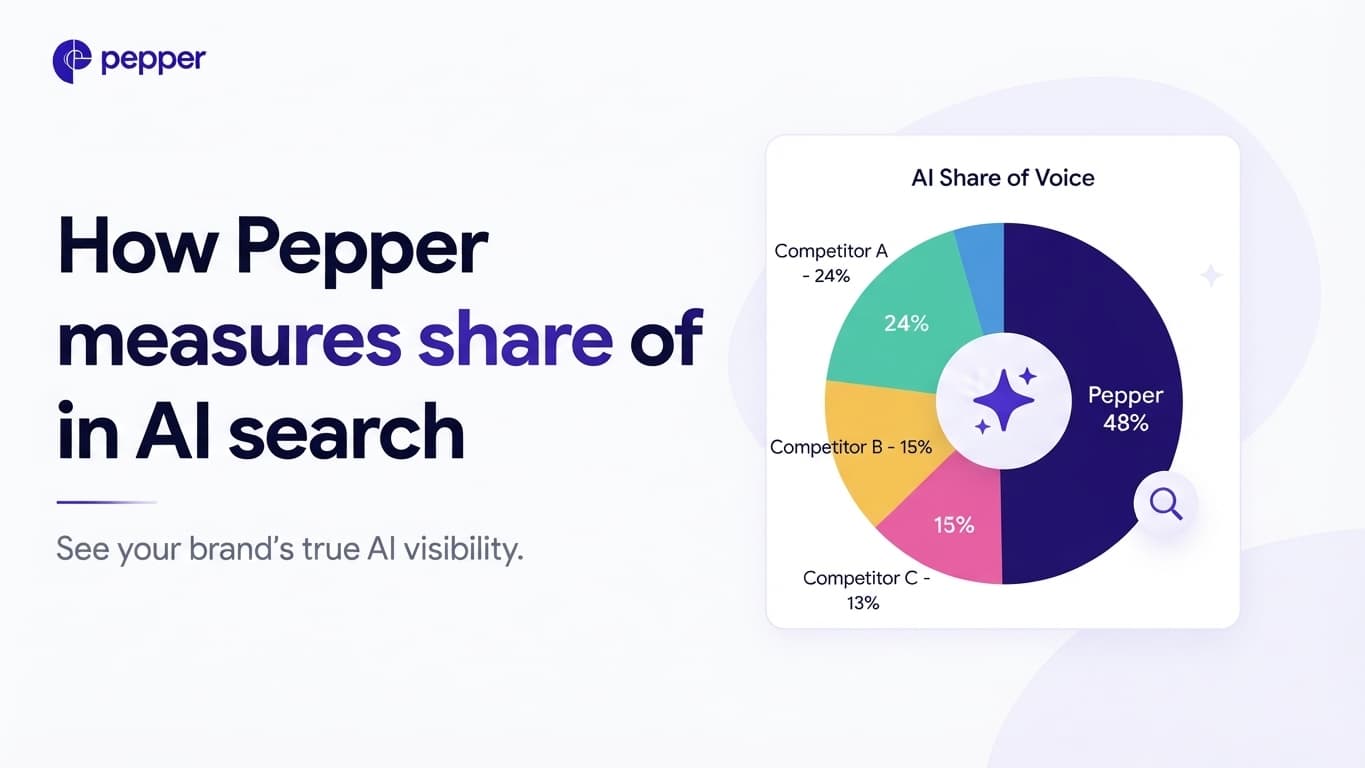
Share of Voice is your brand’s slice of all brand mentions across your prompt runs. Pepper counts how often engines named your brand, then divides by the total mentions of every brand that came up in the same runs.
Three details decide how you read it.
- The denominator is every brand, not every competitor. It includes brands you never added to your competitor list. If an engine names a company you have never heard of, that mention sits in your denominator.
- It is relative, so it moves when other people move. Your Brand Visibility can rise while your Share of Voice falls, because a competitor rose faster. Both numbers are correct.
- It is one of three brand metrics, not a score. Share of Voice answers “what is our slice”. It says nothing about whether engines link to your pages, which is a separate metric and usually a separate problem.
On the name people actually use
There is no metric called answer share in Pepper, and we have never shipped one. People use the phrase to mean roughly “how much of the answer is us”, which splits into two different numbers we do report: Share of Voice for mentions, and Domain Prompt Presence for citations to your domain. We would rather give you both than blend them into one number that cannot be acted on.
Pepper is an agentic organic growth engine, not an SEO agency. This page comes out of what we run: organic for more than 250 enterprises across eight years, more than 10 million tracked prompts, and the questions buyers put to us in client reviews. Customers log in and run the platform themselves, with a Pepper growth team attached. Book a growth audit and we will show you your own Share of Voice against the brands you compete with.
Key takeaways
Key takeaways on what the metric is, how it is derived and where it misleads.
- Share of Voice is mentions, not citations. A separate metric, Domain Prompt Presence, measures whether engines cited a page from your domain.
- The denominator includes untracked brands. Filtering your competitor list changes what you see on screen, not what is counted underneath.
- It is relative by design. A flat Share of Voice in a growing category means you are losing ground even though nothing about you changed.
- There is no universal good number. Thirty per cent can be excellent in a fragmented category and poor in a concentrated one.
- Read it against Brand Visibility. The two together separate “we grew” from “we grew slower than the category”.
- Seven days is not a signal. Individual prompts are noisy. Trend reads need 14 to 30 days.
What is Share of Voice?
Share of Voice is the percentage of total brand mentions in your prompt runs that belong to your brand.
Every number in Pepper’s GEO section comes from one workflow. Pepper runs your prompts against the engines you have selected, captures each response, and analyses three things in it: whether your brand was named, whether a page from your domain was cited, and which other brands and domains came up. Every metric is built from those three signals. The denominators change by view; the building blocks do not. We set the full tracking model out in what Pepper tracks.
For Share of Voice specifically, Pepper counts your brand’s mentions across the runs in your filter window, then divides by the total mentions of every brand detected in those same runs.
- Numerator. Mentions of your brand, by name, anywhere in the response.
- Denominator. Mentions of every brand the engines named, including brands outside your tracked competitor list.
- Window. The runs inside your current date, platform and brand filters.
Where it falls short. A mention is a mention regardless of how the engine framed it. Being named as the budget option and being named as the category leader both count as one mention. We unpack what the mention itself is worth in what is brand visibility in AI. Share of Voice measures presence in the conversation, not the quality of your position in it, and we would rather say that plainly than sell the number as more than it is.
Why does the name matter?
“Answer share” sounds like one number that settles the question. The underlying reality is two measurements that frequently disagree, and collapsing them hides the most useful diagnostic in AI search.
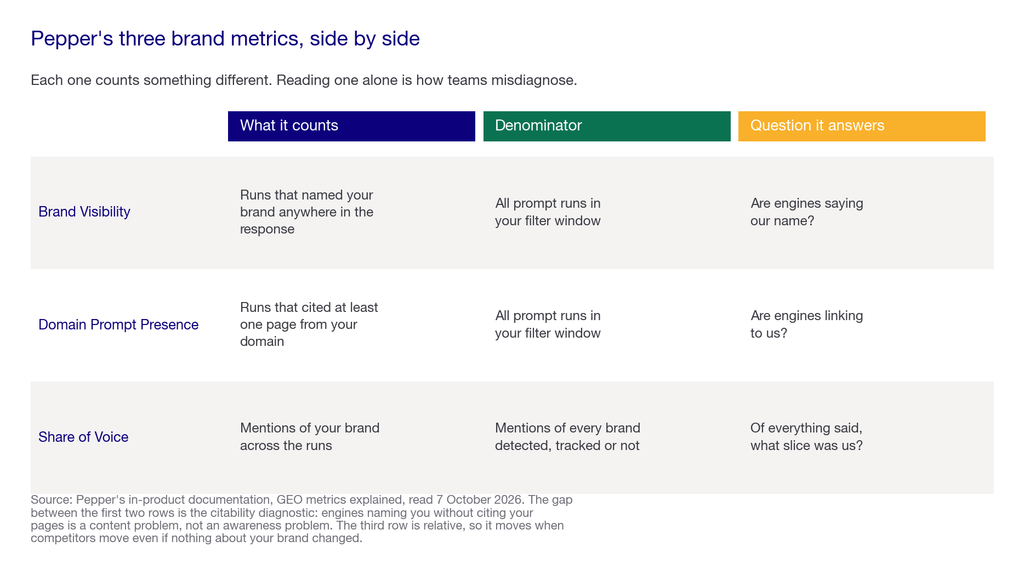
- Brand Visibility is the percentage of prompt runs that mentioned your brand by name. It is the awareness metric.
- Domain Prompt Presence is the percentage of runs whose answer cited at least one page from your domain. It is the capture metric.
- Share of Voice is your slice of all brand mentions. It is the relative metric.
The gap between the first two is the thing worth looking at. High Brand Visibility with low Domain Prompt Presence means engines are talking about you using somebody else’s pages. That is a citability problem, and it is fixed with content rather than awareness. We set the three levers out in the visibility, citability and retrievability framework, and the metric map above is how that framework shows up as numbers in the product.
Independent research supports the split rather than the blend. A controlled study of 21,143 search-layer citations across ChatGPT, Google and Perplexity found that citation counts alone inadequately measure generative engine performance, because engines differ in how many sources they cite and how much weight each source carries. One number cannot carry both breadth and influence.
How Pepper measures share of voice: the denominator people get wrong
The most common misreading of Share of Voice is assuming it is computed against your tracked competitors. It is not.
But Pepper counts every brand the engines named in your runs, including brands you have never added to the workspace. This is deliberate. The question Share of Voice answers is “of everything the engine said, how much was us”, and an engine recommending three companies you have never considered is exactly the information you want.
So two consequences follow, and both have caught experienced teams out.
- The brand filter changes the view, not the maths. Filtering the interface to three competitors does not remove other brands from the denominator. You are changing which rows you can see, not what is being counted.
- Every filter moves the denominator. Share of Voice filtered to Perplexity is a percentage of Perplexity runs only. Compared against an all-engine figure, it is not the same metric. Do not compare numbers across scopes.
The practical rule. Write down the filter state next to any Share of Voice number you put in a deck. Half the disputes we see in client reviews are two people quoting correct numbers computed over different windows.
Reading Share of Voice against Brand Visibility
This is the pairing that produces decisions, and it is the one we open client reviews with.
First, Brand Visibility is absolute: what percentage of runs named you. Share of Voice is relative: of all mentions, what slice was yours. And they move independently, so the four combinations mean four different things.
- Both rising. You are growing and growing faster than the category. Keep doing what you are doing, and find out which themes drove it.
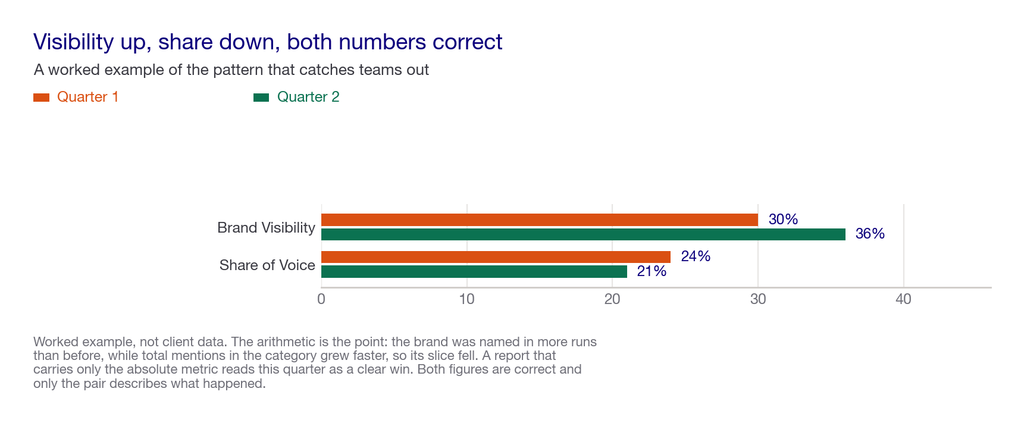
- Visibility up, share flat or down. You grew, competitors grew faster. This is the most common pattern in a category that has recently discovered AI search, and it is easy to miss if you only report absolute numbers.
- Visibility flat, share up. You held while others fell. Worth understanding before you claim credit, because somebody else’s problem is not a strategy.
- Both falling. Engines are shifting toward sources that do not name you. Go to the citations layer before touching the content.
For example, Figure 2 shows the second case. The brand went from being named in 30% of runs to 36%, which looks like a clear win in isolation. Over the same period the total mentions in the category grew faster, so its slice of the conversation fell from 24% to 21%. So both numbers are right, and only the pair tells you what happened.
How we would brief it. Lead with the relative number when the category is moving, and the absolute number when it is not. A board deck that reports only Brand Visibility during a category land-grab will be optimistic by exactly the amount everyone else grew. We cover how to run this against named rivals in how to benchmark AI visibility against competitors.
How to read a Share of Voice drop
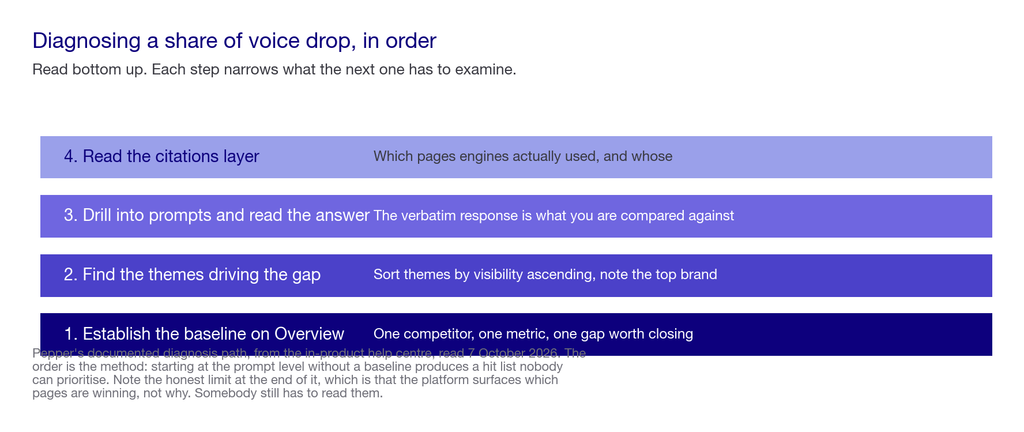
However, a falling number is a question, not a finding. This is the path we work through, in this order, and the order matters because each step narrows the next.
Step 1: Establish the baseline
Open the GEO Overview and read the Brand Comparison table. It ranks your brand and every tracked competitor on Top Platform, Brand Visibility, Domain Prompt Presence and Share of Voice.
First, note who leads each metric and how large the gap is. A five-point gap is closeable with content work inside a quarter. A thirty-point gap is structural, and the honest answer is usually to pick a different theme rather than attack the leader head on. Note also whose Top Platform differs from yours, because a competitor winning on a different engine is running a different strategy, not a better version of yours.
So you are not fixing anything yet. You are choosing one competitor and one dimension.
Step 2: Find the themes driving the gap
Take that competitor into Theme Analysis and sort the Theme Performance Breakdown by Brand Visibility, ascending. The themes at the top are pulling your average down.
For each weak theme, look at the Top Brand column. If it is the competitor you picked, that theme is part of their lead. If it is a different brand entirely, your weakness there is structural to the category rather than specific to them, which changes the fix.
Then pick one or two themes. Trying to repair everything at once is how teams spend a month and ship nothing.
Step 3: Drill into the theme and the prompts
Next, open the worst theme. The per-theme trend tells you when the gap opened: a clean inflection usually traces to something the competitor launched, while a slow drift usually means engines are gradually favouring their content.
Then go prompt by prompt. The prompts where a competitor is Top Brand are your hit list. Open the drill-down on each one, read the per-engine detail, and then read the verbatim response in the run view. That response is the content you are being compared against.
Step 4: Read the citations layer
Switch to Citation Analysis and stop looking at brands. You are now looking at the pages engines used.
First, which domains dominate the citations for your category? Are the competitor’s citations growing, flat or shrinking? A growing curve is also the most actionable signal available, because it means their content is currently winning. In B2B software this is usually where the fight is decided, which is why we run it as standard for B2B SaaS accounts. Then open their domain, read the specific pages, and find what those pages have that yours do not. The method for doing this across a whole category is in how to find which sources AI cites in your category.
The judgement call at the end. Not every drop is worth chasing. Pepper tracks visibility, not revenue, so a competitor winning prompts that your buyers never ask is a competitor you can let win. Cross-reference the hit list against your own analytics before committing a quarter to it, using the method in how to know if AI search is sending you traffic.
Five patterns worth naming
Also, most competitor stories take one of five shapes. Naming the shape early saves a week of analysis pointed in the wrong direction.
- Mention-only win. High Brand Visibility, low Domain Prompt Presence. Engines say their name without citing their pages, which usually means existing brand recognition rather than content strength. Do not try to outrun a name. Build the cited content in adjacent prompts where they have no lead.
- Citation-only win. High Domain Prompt Presence, mid-pack Brand Visibility. Their content is being sourced but the engine is not using them as the answer. They are doing the content work and missing the brand work.
- Theme concentration. They dominate one or two themes and are invisible elsewhere, which is usually a deliberate niche bet. Winning an adjacent theme is almost always cheaper than dislodging them from their own.
- Platform asymmetry. They win on one engine and trail on others, because their content shape suits that engine’s source behaviour. Study the shape, then apply it to a different theme on the same engine.
- New entrant. A previously invisible brand appears with strong numbers, usually on the back of a launch or a PR push. The first two weeks of that surge are the cheapest window to respond.
Where this falls short. These are patterns, not diagnoses. Pepper tells you which pages are winning, not why they are winning, and you will have to read them. We are not going to pretend a dashboard can do the reading for you.
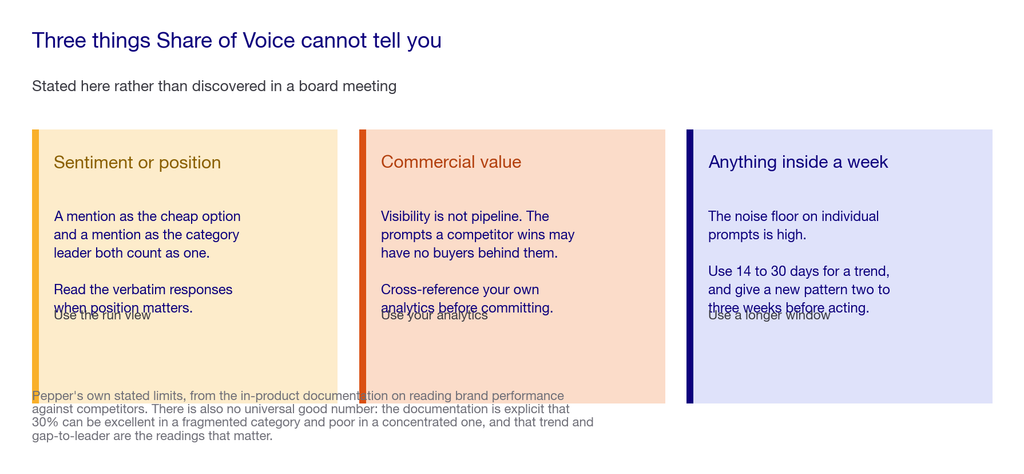
What Share of Voice cannot tell you
There are three limits, and we would rather state them than have you find them in a board meeting.
- It does not measure sentiment or position. A mention as the cheap option counts the same as a mention as the leader. Read the verbatim responses if position matters, and it usually does.
- It does not predict revenue. Visibility is not pipeline. The prompts a competitor wins may have no commercial value, and the only way to know is to cross-reference your own analytics.
- It does not survive a short window. The noise floor on individual prompts is high enough that under seven days of data is not worth acting on. Use 14 to 30 days for trend reads, and give a new pattern two to three weeks before you call it.
There is also no benchmark we will sell you. A 30% Share of Voice might be excellent in a fragmented category and embarrassing in a concentrated one. The useful questions are whether the trend is going the right way and how the gap to the category leader is changing. Anyone offering you a single number that settles your AI visibility is overselling, which we argue at length in should you trust a single AI visibility score.
One engine is not the category
Finally, Share of Voice computed on a single engine is a real number about a small world.
An independent study of 11,000 real search queries across five systems, including vanilla GPT, SearchGPT, Perplexity and Google AI Overviews, found that identical queries produce “structurally different information realities across systems”. The same question, asked of two engines, surfaces different sources and different brands.
So that is the argument for multi-engine tracking, in one line. Pepper tracks six engines, including ChatGPT, Perplexity, Gemini and Google AI Overviews, and Share of Voice is computed across whichever of them your filter includes. The practical routine for running that yourself is in how to track brand mentions in AI search. A single-engine reading is useful for a tactical question about that engine. It is not your category position, and we would not present it as one.
What nobody should promise you
- A guaranteed Share of Voice. Nobody controls model output, and any vendor promising a specific slice is selling something they cannot deliver.
- A benchmark for your category. The category baseline is computed from your own runs. An industry average imported from somewhere else is a number about other people.
- That one metric replaces the other two. Share of Voice without Domain Prompt Presence hides the citability gap, which is the most fixable problem in AI search.
- A reliable read inside a week. If your Share of Voice moved four points in three days, that is noise, and we will tell you so rather than build a campaign on it.
Frequently asked questions
What is answer share in AI search?
In short, it is an informal term rather than a Pepper metric. People use it to mean how much of an AI answer belongs to their brand, which splits into two numbers we report: Share of Voice for mentions and Domain Prompt Presence for citations to your domain.
How does Pepper calculate Share of Voice?
Pepper first counts mentions of your brand across the prompt runs in your filter window, then divides by the total mentions of every brand detected in those same runs, including brands outside your tracked competitor list.
How it relates to other metrics
What is the difference between Brand Visibility and Share of Voice?
Brand Visibility is absolute: the percentage of runs that named you. Share of Voice is relative: your slice of all brand mentions. Visibility can rise while share falls, because competitors grew faster over the same window.
Does Share of Voice include competitors I do not track?
Yes. The denominator counts every brand the engines named in your runs, including companies you have never added to the workspace. Your competitor list controls what you can see and compare in the interface, not what is counted underneath it.
Is Share of Voice the same as Domain Share?
No. Domain Share is the citation-level analogue: a domain’s slice of all citations rather than a brand’s slice of all mentions. Use Share of Voice for brand presence and Domain Share for which domains dominate the sources.
Using it
What is a good Share of Voice?
There is no universal target. A number that looks low in a concentrated category can be strong in a fragmented one. Track the trend and the gap to the category leader instead of chasing a benchmark figure.
How long before Share of Voice means anything?
Give it 14 to 30 days for a trend read. Under seven days the noise floor on individual prompts is too high, and a new pattern deserves two to three weeks before you act on it.
Why did my Share of Voice fall when nothing changed?
Almost always because somebody else rose instead. It is a relative metric, so a competitor launch or a new entrant in your themes moves your number without anything changing on your side.
Sources
Product behaviour comes from Pepper’s own documentation and the live product. Independent claims are cited to the research, not to us.
Pepper product documentation
- Pepper help centre, GEO metrics explained, in-product documentation at
platform.pepper.inc/help/geo/metrics-explained, read 7 October 2026. Defines Brand Visibility, Domain Prompt Presence, Share of Voice, Top Platform, Domain Share and the theme metrics, including the derivation of each and the behaviour of filters. Requires a workspace login, so we have quoted the definitions rather than linking you to a wall. - Pepper help centre, understanding brand performance with competitors, read 7 October 2026. Source for the four-step diagnosis path and the five competitor patterns, and for the stated limits of the analysis.
Independent research
- Zhang Kai, He Xinyue and Yao Jingang, From Citation Selection to Citation Absorption, arXiv, 28 April 2026. 602 controlled prompts, 21,143 search-layer citations and 18,151 fetched pages across ChatGPT, Google AI Overviews and Perplexity. Finds that citation counts alone inadequately measure generative engine performance, and that high-influence pages are longer, more structured and richer in extractable evidence. Academic preprint, not peer-reviewed at time of writing.
- Huang, Goyal, Saha and Chandrasekharan, Answer Bubbles: Information Exposure in AI-Mediated Search, arXiv, 17 March 2026, revised 28 August 2026. 11,000 real search queries across five systems. Finds identical queries produce “structurally different information realities across systems”. Also an academic preprint.
On what this page is not
This is a description of how one product derives one metric, written by the company that builds it. We have stated the derivation precisely so you can check it against your own workspace, and we have said what the metric cannot do. The two independent studies support the general argument for splitting mentions from citations and for tracking more than one engine. Neither of them evaluates Pepper, and we are not presenting them as though they do.
Latest Blogs
Bluefish, Peec AI, GrowthX: the three names appear on the same shortlists constantly. We read all three sites on the same morning, and they are not competing products in any useful sense. The short answer Bluefish orchestrates AI marketing for very large enterprises. Peec AI measures AI search visibility. GrowthX produces content through a closed […]
People call it answer share. Pepper calls it Share of Voice, and it is one of three brand metrics that have to be read together. Here is the exact derivation, the denominator that surprises people, and what the number cannot tell you.
Most GEO work is repetitive enough to automate and a few parts never will be. Here is the line we draw, the test we apply before building an agent, and the governance that stops automation quietly shipping rubbish at scale.
Get your hands on the latest news!