Prompt tracking: how to find which prompts your brand appears in
The short answer
Build a set of 20 to 30 buying questions from your own sales calls and search data, run them on a schedule across more than one engine, and record which brands get named. Then accept two limits. In one 2026 pilot, ChatGPT searched the web on only 42% of buying prompts, so on the rest there is nothing for a tracking tool to observe. And on the prompts that did search, each fanned out into an average of 6.3 sub-queries you never wrote.
Key takeaways
- Everyone tells you to freeze 25 prompts. Nobody tells you where they come from. That gap is what this article is for, and our own AI search tracking guide is one of the pages that leaves it open.
- You can only track prompts you thought of. The questions where you are invisible are, by definition, the ones least likely to be on your list.
- Engines run more questions than you wrote. A July 2026 pilot of 48 SaaS buying prompts recorded 127 fan-out queries, an average of 6.3 per searching prompt.
- And often they run none at all. In the same pilot, ChatGPT searched on only 42% of buying prompts. On the other 58% the answer came from the model, and no citation tracker can see that mechanism.
- So prompt coverage is a floor, not a measure. Your dashboard shows the prompts you chose, on the runs that searched. Read it as a sample of a sample.
- The practical response is a build method and a gap-finding method, and both are below. Neither needs a new tool.
- Pepper is an agentic organic growth engine and an organic growth partner. Agent Atlas puts the agents in your team’s hands. Pepper’s GEO platform reports Brand Visibility, Domain Prompt Presence and Share of Voice. A growth team works alongside yours. Eight years, more than 250 enterprises, more than 10 million tracked prompts.
A note on where this comes from. I am the person on the team who actually maintains prompt sets, and the thing that surprised me most this year was how much of the answer happens somewhere I cannot observe. Pepper runs organic for more than 250 enterprises over eight years and tracks more than 10 million prompts across every major engine. I am sharing what changed in how I work rather than a finished method, because this part of the discipline is still moving.
Disclosure: Pepper sells a platform that tracks prompts, and this article argues that prompt tracking sees less than most buyers assume, including on our own platform. Every figure is traced to a named study with its sample size and its limitations. Competitors are named but never linked.
What is prompt tracking, and why can you not see all of it?
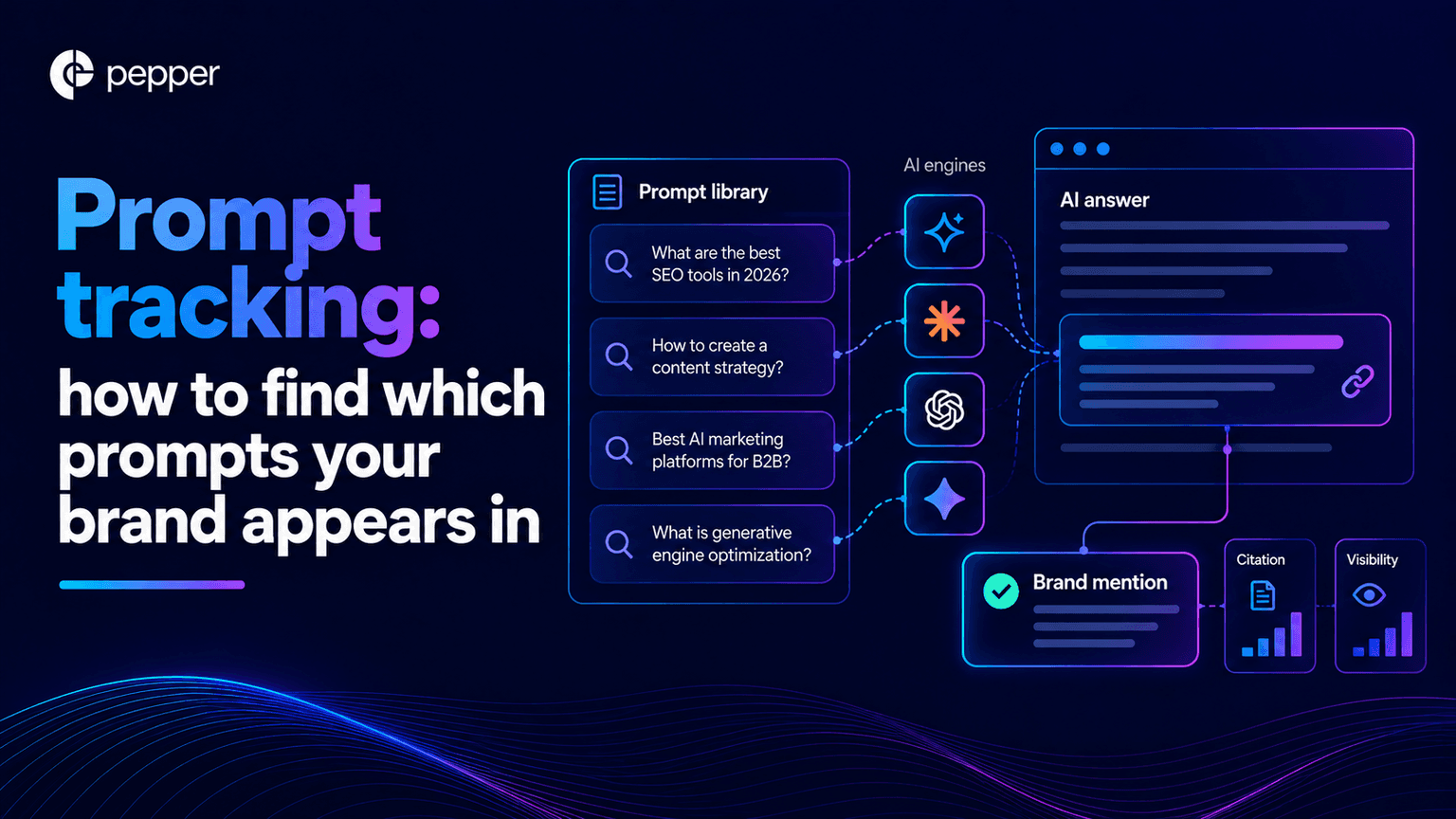
Prompt tracking is the practice of running a fixed set of buyer questions across AI engines on a schedule and recording which brands get named and which sources get cited. It is the closest thing this category has to rank tracking, and it is meaningfully less complete.
Three things sit between your dashboard and the truth.
- You chose the prompts. A tracking tool answers the questions you gave it. It cannot tell you about a question you never thought to ask.
- The engine asks its own questions. What you type is not what gets searched, because engines expand one prompt into several sub-queries before answering.
- Sometimes nothing gets searched. An engine can answer from what the model already holds, in which case there is no retrieval event for any tool to record.
Our guide to prompt coverage defines the metric, and our AI search tracking method covers how many runs you need before a change is real. This article covers the part underneath both, which is where the prompts come from and what they miss.
The engine answers most buying questions without searching
This is the finding that changed how I read our own dashboards.
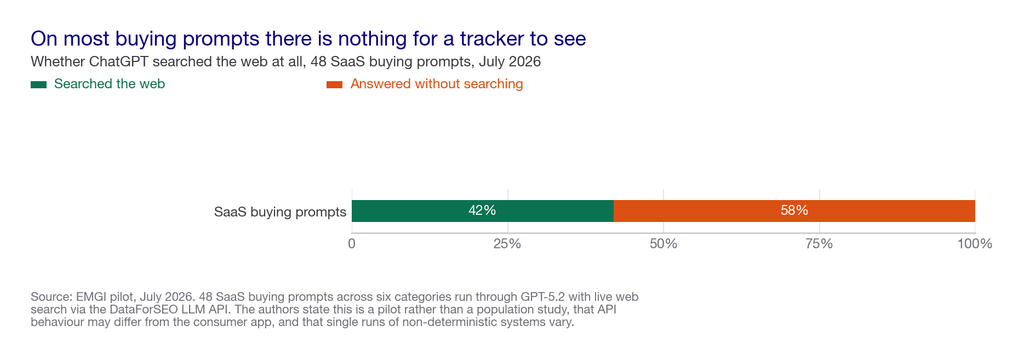
A pilot published in July 2026 ran 48 SaaS buying prompts across six categories through GPT-5.2 with live web search, using an API that exposes the sub-queries. ChatGPT searched on only 42% of those buying prompts.
On the other 58%, the model answered from what it already held. There is no retrieval event on those answers, so no citation tracker sees anything, and your prompt coverage figure quietly excludes them.
That reframes what a visibility tool measures. It is not measuring whether you appear in AI answers. It is measuring whether you appear in the subset of AI answers that involved a live search.
Where it falls short: the authors are explicit that this is a pilot rather than a population study, that API behaviour does not necessarily match the consumer app, and that single runs of non-deterministic systems vary. One pilot on one engine in one vertical is a signal, not a settled number. But the direction matters more than the decimal, and it points somewhere most dashboards do not admit.
If you want to see which of your category’s questions engines actually answer with a search, book a growth audit and we will run your set with you.
And when it does search, it asks questions you did not write
The same pilot recorded 127 fan-out queries across the prompts that searched, an average of 6.3 per searching prompt.
Query fan-out is the mechanic where an engine takes one question and silently runs several related sub-queries, then merges the results. Our own explainer on fan-out tracking put the typical range at eight to twelve sub-queries, and our guide to how Google AI Mode works covers the mechanism in detail.
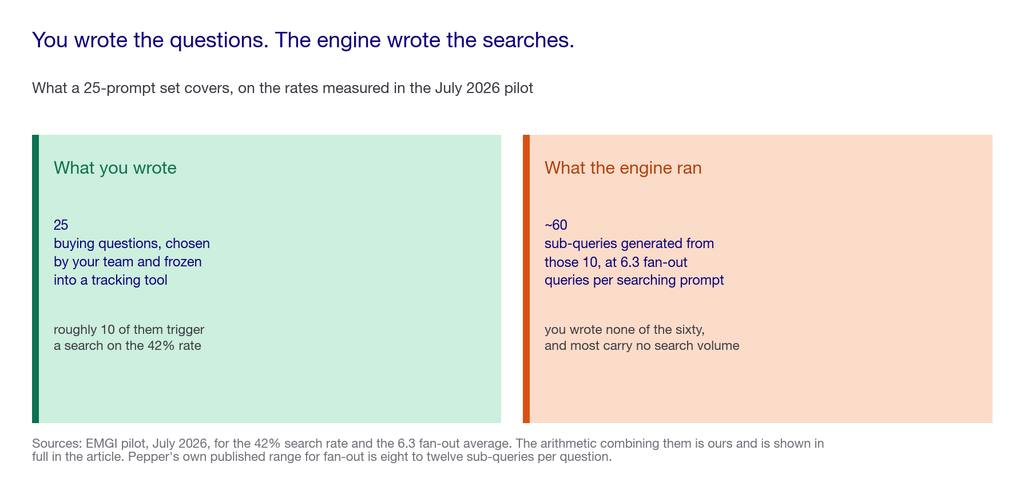
Run the arithmetic on a normal prompt set. Twenty-five tracked prompts, of which roughly ten trigger a search on the 42% rate, each fanning out to about six sub-queries. That is around sixty actual queries, and you wrote none of the sixty. You wrote the ten questions that produced them.
So what should you conclude? Not that tracking is pointless. The ten prompts that searched are real, the brands named in those answers are real, and the movement over time is real. Conclude instead that your set is a sample of a sample, and stop treating prompt coverage as a percentage of reality.
Where it falls short: the strongest fan-out research available is from late 2025 and we have deliberately not used it as an anchor, for reasons in the sources below. The 2026 figure we do use comes from a 48-prompt pilot on one engine. Treat six as an order of magnitude rather than a constant.
How we weight a prompt set
Four criteria, fixed before building any set. They are our priorities, not measured coefficients.
| Criterion | Weight | What it means |
|---|---|---|
| Drawn from real buyer language | 35 | Every prompt traces to something a buyer actually said, in a call, a ticket or a search query, rather than to a keyword tool |
| Commercially decisive | 25 | The question is one a shortlist gets made on, not one a student would ask about the category |
| Stable enough to trend | 20 | The wording is frozen and versioned, so a change in the number means a change in the world rather than a change in the question |
| Covers where you are absent | 20 | The set deliberately includes questions you expect to lose, because those are the only ones that can improve |
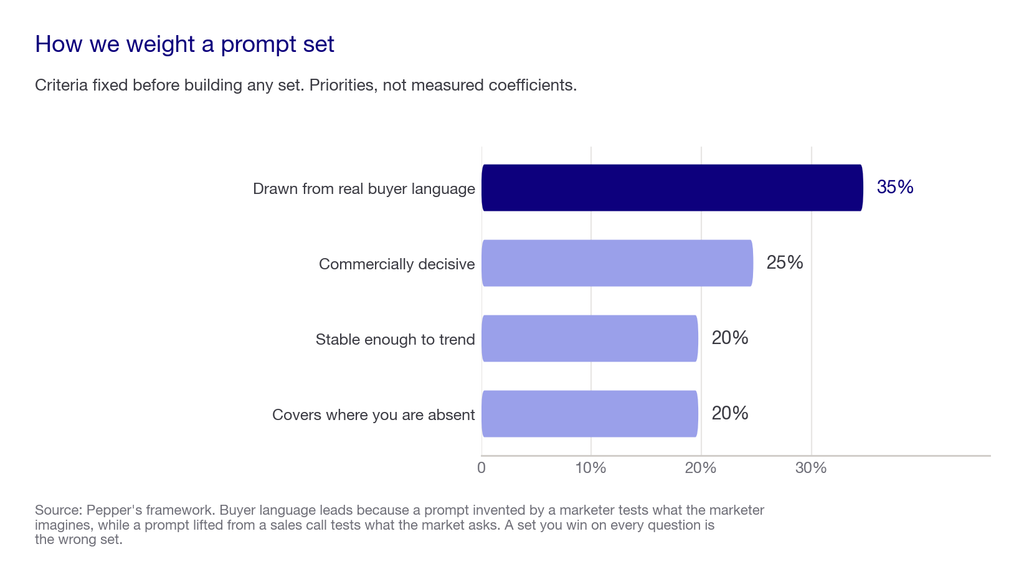
Why buyer language leads. A prompt invented by a marketer tests what the marketer imagines. A prompt lifted from a sales call tests what the market asks. Those differ more than anyone expects, and the gap is usually embarrassing in a useful way.
Where it falls short: weighting real language highest biases the set toward questions buyers already know to ask, which under-represents emerging language. Add a small number of forward-looking prompts and label them as such, so they do not pollute the trend.
How to build the set, in five weeks
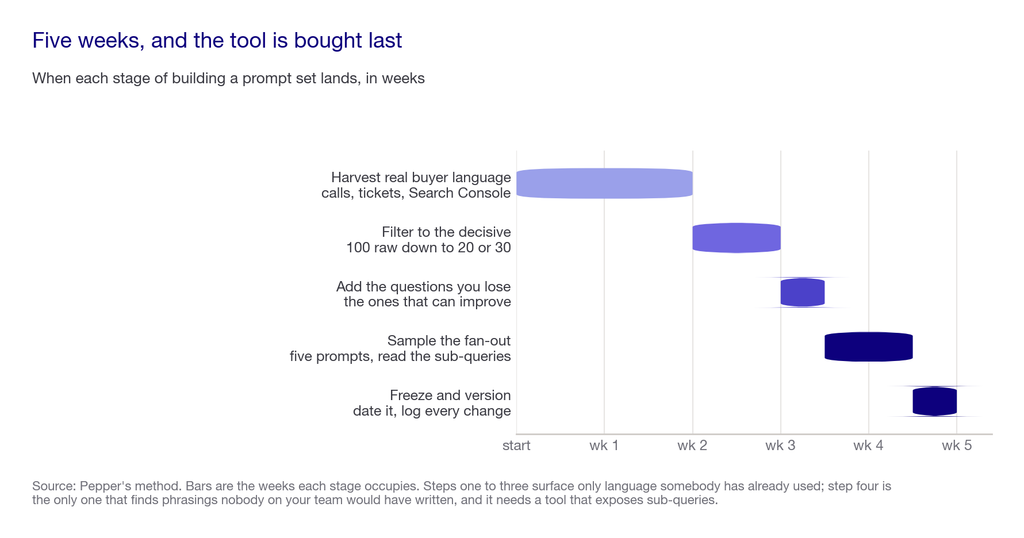
1. Harvest, do not invent. Pull the last quarter of sales call notes, support tickets and Search Console queries. Write down the questions in the words the buyer used, including the awkward ones. Aim for a hundred raw questions before you filter anything.
2. Filter to the commercially decisive. Keep the questions a shortlist gets made on. Cut anything a curious student would ask. Twenty to thirty survivors is the right size, and the discipline is in what you remove.
3. Deliberately include your losses. Add the questions where you expect a competitor to win. Most sets are quietly built from questions the team already feels good about, and a set with no losses in it cannot show improvement.
4. Run a fan-out check on a sample. Take five prompts and look at what the engine actually searched, using a tool that exposes sub-queries. You will find phrasings you would never have written. Add the ones that recur.
5. Freeze and version it. Write the date, store the file, and log every change with a reason. A prompt set that drifts produces a trend line that means nothing, and drift is the default.
Where it falls short, and it costs us something: this takes about five weeks of part-time work and produces a set that is still incomplete, because steps one to three can only surface language somebody has already used. Step four is the only one that finds the unknown, and it depends on tooling that exposes sub-queries, which not every platform does, including at some tiers of our own.
How to find the prompts you are missing
The build method gets you a good set. This is how you find its holes, and it is the part almost nobody does.
- Read the competitor answers, not just your own. When a rival is named and you are not, the answer usually contains the phrasing that summoned them. That phrasing is a prompt you are missing.
- Mine the fan-out. Sub-queries are the engine telling you, in writing, how it decomposes your category. Most carry no search volume at all, so a keyword tool will never surface them.
- Watch your own site search and support tickets monthly. New buyer language appears there before it appears in any keyword dataset.
- Ask sales what they got asked this month that they had not heard before. Ten minutes, monthly, and it is the highest-yield input in the list.
- Re-run a discarded prompt occasionally. Questions you cut for being too early have a habit of becoming commercially decisive.
Where it falls short: every method here finds language that already exists somewhere. None of them finds a question no buyer has asked yet, which is the category of prompt that will matter most next year.
Prompt tracking at a glance
| What you are tracking | What you can see | What you cannot see | Cadence | Cost |
|---|---|---|---|---|
| Your chosen prompts | Which brands are named, which sources are cited | Anything about questions not on your list | Monthly | Prompt tracking from about $29 a month at entry tiers |
| Whether the engine searched | On tools that expose it, yes | On most consumer-facing tools, no | Monthly | Included where exposed, otherwise unavailable |
| Fan-out sub-queries | Only via an API or a tool that surfaces them | The full set on engines that do not expose it | Quarterly sample | Often a higher tier, or an API call |
| Answers with no search | Nothing. There is no retrieval event | The mechanism entirely | Not trackable today | No tool prices this, because none measures it |
| Competitor phrasing | Yes, inside the answers you already collect | Competitor prompts you never ran | Monthly, while reading answers | Free. It is reading |
| Emerging buyer language | Via sales calls, tickets and site search | Anything nobody has said out loud yet | Monthly | Free. Ten minutes with sales |
## What this costs
- Building the set costs time, not money. Five weeks part-time, mostly reading things your company already has.
- Running it starts around $29 a month at published entry tiers, covered in our comparison of AI SEO tools.
- Exposing fan-out usually costs more, because it needs an API or a higher tier, and it is worth buying for a quarterly sample rather than continuously.
- The gap-finding methods above are free. Reading competitor answers and talking to sales cost nothing and find more than an upgrade does.
- The expensive mistake is buying a bigger prompt allowance before the set is any good. Our sampling arithmetic for AI search shows that more prompts buy breadth rather than confidence.
How Pepper fits
Pepper is an agentic organic growth engine and an organic growth partner, and prompt set maintenance is one of the least glamorous and most valuable things our growth teams do.
- Pepper’s GEO platform reports what the set produces. Brand Visibility for how often engines mention you, Domain Prompt Presence for how often they cite a page from your domain, and Share of Voice for your slice of the category. See the platform.
- Agent Atlas keeps the set alive, which is the part that fails on every internal team I have worked with. Harvesting new buyer language, flagging drift and re-running the fan-out sample are workflows rather than somebody’s monthly reminder. System agents stay fixed, user agents stay editable and versioned, and customers log in and build and run their own inside Atlas.
- A growth team works alongside yours on the harvesting step, because getting sales to hand over the awkward questions is a relationship problem rather than a software one.
- Proof rather than adjectives. Acceldata went from 85 to more than 300 top three keywords with 6X organic traffic growth. More in our case studies, and the B2B SaaS practice is where this method was built.
Where Pepper falls short, and it is the same limit as everyone else. We cannot see the answers that involved no search either. No platform can, because there is no retrieval event to observe. Any vendor implying otherwise is describing a product that does not exist.
How to choose a prompt tracking approach
I would start by asking what happens to a question that is not on the list, because the answer tells you whether the person understands what they are selling.
The framing judgement first, anchored outside my own view. Google’s guidance on optimising for generative AI features states that optimising for generative AI search is still SEO, running on core ranking systems with no separate index, and it advises against providers guaranteeing rankings because no external party has access to those systems. Read that as a filter on anyone promising a position. Then hold the other half, which is that Google documents Google, and the engine behaviour in this article was measured on ChatGPT.
The Pepper view on top is narrower. The quality of a tracking programme is decided before any tool is bought, by the quality of the question list. Everything after that is instrumentation.
Here is the 100 point scorecard I would run over any provider, including us.
| Area | Weight | What a strong provider demonstrates |
|---|---|---|
| They build the set from your language | 30 | They ask for sales calls, tickets and Search Console exports rather than generating prompts from a keyword tool |
| They show whether the engine searched | 25 | The reporting distinguishes an answer that involved retrieval from one that did not, or says plainly that it cannot |
| Fan-out is sampled, not ignored | 20 | They look at sub-queries at least quarterly and feed the recurring ones back into the set |
| The set is versioned | 15 | Changes are dated and logged, and they will tell you when a movement came from a prompt edit |
| They include prompts you lose | 10 | The set contains questions where a competitor wins, and they resist the temptation to build a flattering list |
**Then run the live test, on us as readily as on anyone else.** Give any provider 25 buying questions in your own buyers’ words and ask them to improve the list before they quote. Hold the result for 90 days before judging it, because engines vary between runs and a single reading proves nothing. Ask them to be concrete. For example: “which of our 25 would you cut and why”, “what did the engine actually search when you ran number seven”, “how many of these triggered a search at all”, “which question are we missing”.
Ask them to come back with five things. The prompts they would cut. The prompts they would add, with the buyer language behind each. The share that triggered a search. A sample of the fan-out. And the versioning policy.
A provider who improves your list before quoting beats one who accepts it and prices it. And one who cannot tell you whether a prompt triggered a search is reporting a number without knowing what produced it.
The weaker way to do this, and it is the common one. Generate 25 prompts from a keyword tool. Load them into a platform. Watch the coverage percentage. Celebrate when it rises. Never discover that the set contains none of the questions your buyers actually lose you on.
The stronger sequence. Harvest real language first. Filter to decisive questions. Include your losses deliberately. Sample the fan-out to find phrasings you would not have written. Freeze and version. Then buy the tool. The distinction matters because the first sequence measures your imagination, and the second measures your market.
Red flags, each one something a provider actually does.
- Prompts generated from a keyword tool, which produces questions with search volume rather than questions buyers ask an assistant.
- A coverage percentage presented as reality, with no mention that it excludes answers involving no search.
- No versioning on the prompt set, which makes every trend line unreliable the first time somebody edits a question.
- A flattering list. If you win on every prompt in the set, the set is wrong.
- Fan-out never mentioned, which means nobody has looked at what the engine actually searched.
- More prompts sold as the upgrade path, when breadth is rarely the binding constraint.
- A guarantee of appearing in answers, which Google itself advises against in the equivalent case.
Five questions worth asking, and what a good answer sounds like.
- “What happens to a question that is not on our list?” A good answer is that you are blind to it, stated plainly. A bad answer implies full coverage.
- “How many of our prompts triggered a search?” A good answer is a number, or an honest admission the tool cannot tell. A bad answer does not understand the question.
- “What did the engine actually search?” A good answer shows you sub-queries. A bad answer shows you your own prompt back.
- “Which of our prompts would you cut?” A good answer names three. A bad answer accepts the list as given.
- “When did this set last change?” A good answer is a date and a changelog. A bad answer is that it is kept up to date.
If I reduce this to one principle: the prompt set is the instrument, and everything downstream inherits its blind spots. Buy the tool second.
The honest note that costs us something. Very few providers are strong at harvesting buyer language, exposing engine behaviour, maintaining a set over time and reporting it without overclaiming, and we would not claim uniform strength across all four either. The harvesting step is the one most often skipped, including by us when a client is slow to hand over call recordings.
What nobody should promise you
Nobody should promise complete visibility into which prompts you appear in. In one 2026 pilot the engine did not search on 58% of buying prompts, and no tool can observe an answer that involved no retrieval.
Nobody should present prompt coverage as a percentage of reality. It is a percentage of a list you wrote, on the runs that happened to search.
Nobody should sell you more tracked prompts as the fix for a weak set. Breadth is rarely the constraint, and a larger set of invented questions measures your imagination at greater expense.
Nobody should promise a position in an AI answer. Google advises against providers who guarantee rankings, because no external party has access to the ranking systems.
Where this stops working, including for us
If your category has very low prompt volume, you do not need a tracking subscription yet and should not buy one. The set will be small and the readings noisy. Review quarterly from a spreadsheet instead.
If you cannot get access to sales calls or support tickets, step one collapses and you will end up inventing prompts. Say so in the report rather than presenting the set as buyer-derived.
If your tooling does not expose fan-out, you can still run steps one to three and five, and you should record step four as not done rather than skipping it silently.
Where Pepper falls short. We cannot see answers that involved no search, and neither can anyone else. We also depend on clients handing over the raw buyer language, and when that does not happen our sets are weaker for it.
Where to go next
Take your current prompt set and mark every question with where it came from. If most of them trace to a keyword tool rather than a person, that is the finding and the fix is step one.
Then check how many trigger a search at all. For the adjacent decisions, our method for monitoring brand mentions across engines covers how many runs you need before a change is real, prompt coverage defines the metric, query fan-out covers the mechanic, and which KPIs to use for GEO covers what to report upward. To see your category’s answers today, see where you show up.
Frequently asked questions
How do you track which prompts your brand appears in?
Build 20 to 30 buying questions from sales calls, tickets and Search Console, run them on a schedule across more than one engine, and record which brands are named. Then accept that your set cannot cover questions you never thought of.
How many prompts should you track?
Twenty to thirty for most businesses. More prompts buy breadth rather than confidence, so a bigger allowance is rarely the constraint. The quality of the questions matters far more than the count.
Do AI engines search the web for every question?
No. In one July 2026 pilot of 48 SaaS buying prompts, ChatGPT searched on only 42% of them. On the rest it answered from the model, which means there is no retrieval event for a tracking tool to record.
What is query fan-out and why does it matter for tracking?
Fan-out is when an engine expands one question into several sub-queries and merges the results. The same pilot recorded 6.3 fan-out queries per searching prompt, so engines run questions you never wrote and your set cannot see them.
Where should prompt ideas come from?
Real buyer language: sales call notes, support tickets, site search and Search Console queries. Prompts generated from a keyword tool test what a marketer imagines rather than what the market asks, and the two differ more than people expect.
How do you find prompts you are missing?
Read the answers where a competitor is named and you are not, because they usually contain the phrasing that summoned them. Sample the fan-out for recurring sub-queries, and ask sales monthly what new questions they heard.
How often should a prompt set change?
Rarely, and always with a log. Freeze the wording, date the file, and record every edit with a reason, because a set that drifts produces a trend line that cannot be interpreted.
Is prompt coverage a reliable metric?
It is a floor rather than a measure. It reports the share of questions you chose where you appeared, on runs that involved a search, so treat it as a sample of a sample rather than a percentage of reality.
Sources and further reading
- EMGI, query fan-out in SaaS buying prompts, published July 2026. Method: 48 SaaS buying prompts across six categories run through GPT-5.2 with live web search via the DataForSEO LLM API, with a subset of 16 identical prompts also run on Gemini, Claude and Perplexity. Source of the 42% search rate, the 127 fan-out queries captured and the average of 6.3 per searching prompt. Limitations, stated by the authors: this is a pilot rather than a population study, API behaviour is not guaranteed to match each engine’s consumer app, single runs of non-deterministic systems vary, and Perplexity’s API exposes citations but not its internal sub-queries.
- Pepper, query fan-out tracking, published 24 June 2026. Our own published range of eight to twelve sub-queries per question, and the mechanic explained.
- Pepper, how Google AI Mode works. The retrieval mechanism behind fan-out on Google specifically.
- Pepper, AI search tracking: how to monitor brand mentions across AI engines. The sampling arithmetic for how many runs a change needs, and the source of the finding that more prompts buy breadth rather than confidence.
- Pepper, prompt coverage explained. The metric this article argues should be read as a floor.
- Google Search Central, guide to optimizing for generative AI features, page last updated 10 July 2026. Source of the advice against providers guaranteeing rankings. Applies to Google Search only.
- The build sequence, the gap-finding methods and the weighting are ours, and the arithmetic in the fan-out section is shown in full so you can check it.
What is not here, and why. Two larger and more widely quoted fan-out studies were excluded on our 2026 recency rule, and the exclusion is worth stating because they would have produced a bigger headline number. One measured 10.7 fan-out queries per prompt across 501 tracked prompts on Gemini 3, published November 2025. The other analysed roughly 9,000 prompts and found an average of 9.06, published December 2025. Both describe a model generation that has since been superseded, and quoting a 2025 fan-out rate as a 2026 fact is exactly the practice we criticise elsewhere. No Pepper prompt-set data, because our sets belong to clients. No recommended prompt count beyond a range, because the right number depends on category breadth rather than on a benchmark.
Latest Blogs
Most advice on this is inference dressed as fact. OpenAI documents exactly one thing clearly, which is access. Here is what is documented, what is inferred, and how to verify the rest for yourself.
Being named in an AI answer and having your page used as its source are different outcomes with different causes and different fixes. The gap between them is the most useful diagnostic in AI search, and most reporting collapses it into one number.
Every platform reports share of voice and almost none of them define it the same way. Here is the definition worth using, the three choices that change the number, and how to measure it yourself without buying anything.
Get your hands on the latest news!
