SEO agency vs in-house specialist: how to actually decide

The short answer
The SEO agency vs in-house question has an honest answer, and it is not the one most articles give. Before anything else, read who wrote this: we sell organic as a service. As a result, we have an obvious interest in you choosing an agency. Almost every article you will find on this question is written by an agency. Also, almost all of them conclude that agencies win.
Key takeaways
- The honest answer is that it depends on which job you are missing, and there are four: strategy, execution, technical, and earned authority. One hire covers one and a half of them on a good day.
- In-house genuinely wins when your category is narrow and deep, when institutional knowledge matters more than breadth, and when you have enough volume to keep a specialist busy.
- An agency genuinely wins when you need several disciplines at once, when speed matters more than ownership, or when the work is seasonal.
- The comparison most articles make is dishonest. They compare a fully loaded salary against a monthly retainer without noting that one buys 40 hours a week and the other buys a fraction of several people.
- The question has changed since AI search arrived, because the earned-authority job got bigger and it is the hardest one to hire for.
A note on where this comes from. We run organic for more than 250 enterprises at Pepper. In addition, we have watched this decision go both ways many times, including clients who took work in-house and were right to. So this is our read, and we have tried to write the version we would give in a room rather than the version that sells a retainer.
Why almost every article on this question is conflicted
Search the question and count the publishers. Agencies, mostly, concluding that agencies win. The figures they use tend to move in one direction too: fully loaded salary costs stated at the high end, agency retainers at the low end. What is more, a return-on-investment multiple attributed to nobody in particular.
We are not going to pretend we sit outside that. We do. What we can do is show the arithmetic honestly in both directions and be specific about when we would tell you not to hire us.
What is an in-house SEO specialist, and what does an agency sell?
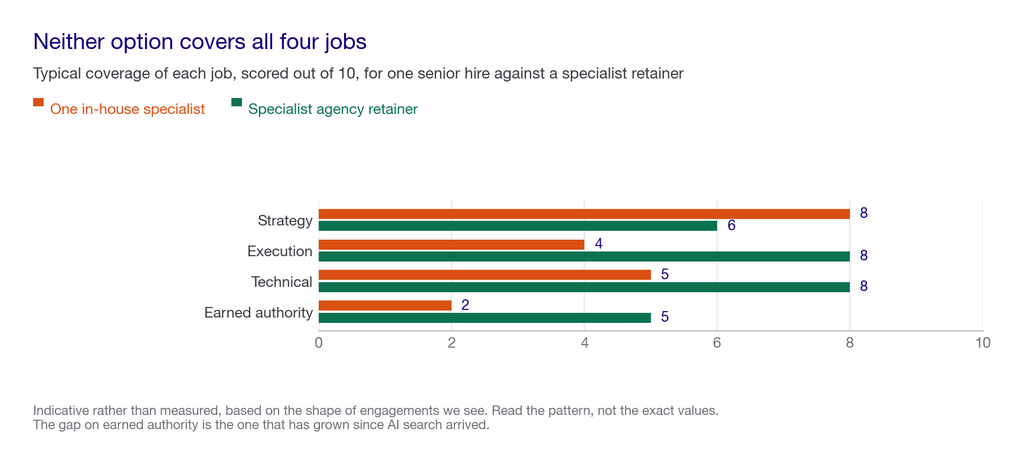
An in-house SEO specialist owns organic search inside your company:deciding what to target, coordinating the work, fixing what they can technically. In addition, holding the context that makes all of it sensible. The job is real and it is valuable. The problem is scope, because organic work splits into four disciplines and one person covers roughly one and a half of them well.
An SEO agency, by contrast, sells you a fraction of several specialists. That is a genuinely different good, which is why the two are hard to compare on price alone.
What you are actually buying, in both cases
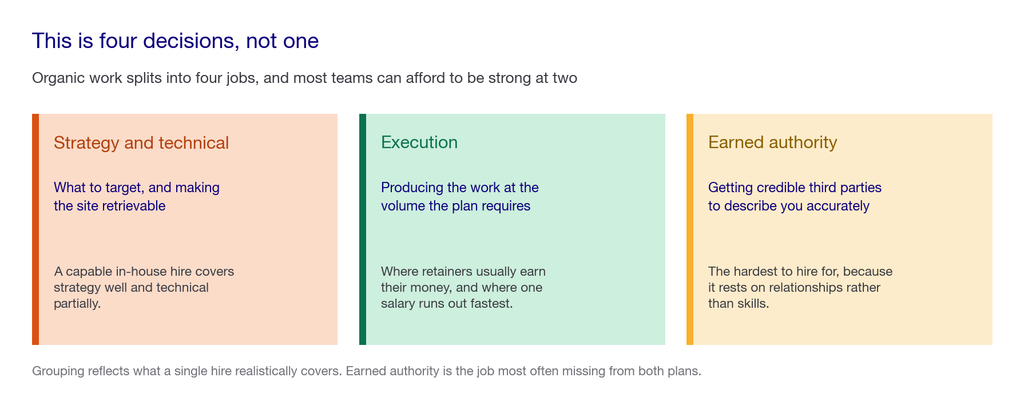
The mistake in most comparisons is treating this as one decision. It is four.
Organic work splits into strategy (what to target and why), execution (producing the work), technical (making the site retrievable), and earned authority (getting other credible sites to describe you accurately). Most teams need all four and can afford to be strong in two.
A single in-house specialist typically covers strategy well, execution partially, technical partially. Equally, earned authority almost not at all, because that last one depends on relationships built over years rather than skills learned in a course.
An agency typically covers execution and technical well, strategy variably depending on seniority. In addition, earned authority only if it genuinely does digital PR rather than claiming to.
So the useful question is not which is better. It is which of the four you are missing, and which option closes that specific gap.
Agency or in-house, at a glance
| One in-house specialist | Specialist agency | Hybrid | |
|---|---|---|---|
| Strategy | Strong, with full context | Variable, depends on seniority | Strong, owned internally |
| Execution | Limited by one person’s hours | Strong, scales with the retainer | Strong |
| Technical | Partial, unless you hired for it | Usually strong | Strong |
| Earned authority | Weakest, depends on relationships | Only if they genuinely do digital PR | Usually the reason to buy |
| Speed to start | Three to six months to hire and ramp | Weeks | Weeks, once the hire is in place |
| Cost shape | Fixed salary plus tooling and overhead | Monthly, scales with scope | Highest, and usually the most complete |
| Where it falls short | Idle capacity in quiet weeks, single point of failure, knowledge walks out | No institutional memory, priorities shared with other clients | Costs more than either alone, needs a capable internal owner |
| Best when | Volume is consistent and the category is specialised | You need several disciplines at once, or speed | Organic is core and you can fund both |
What each option actually costs
Being honest about this means being honest about what the numbers do not capture.
A fully loaded in-house cost is not the salary. It is salary plus employer contributions, plus tooling, plus training, plus the management time of whoever the person reports to, plus the recruitment cost amortised over their tenure, plus the risk that they leave in eighteen months and take the institutional knowledge with them.
An agency retainer is not comparable to that number, and articles that place them side by side are being slippery. A retainer buys a fraction of several specialists. A salary buys all of one person’s time. Those are different goods, and which one is better value depends entirely on whether you need depth in one discipline or breadth across four.

The threshold that actually matters is utilisation. If you have enough consistent organic work to keep a specialist busy for most of a week, in-house usually wins on cost and always wins on context. If your work comes in bursts, or spans disciplines a single person cannot cover, you are paying a salary for idle capacity in some weeks and missing capability in others.
See where you show up. Pepper’s GEO platform tracks Brand Visibility, Domain Prompt Presence and Share of Voice across ChatGPT, Perplexity, Gemini, Claude and Google AI Overviews. Beyond that, a growth team works the account alongside you. So you get the platform whether or not your team runs it, and our case studies show both shapes. Book a growth audit or see where you show up.
Our methodology: how we weighted this
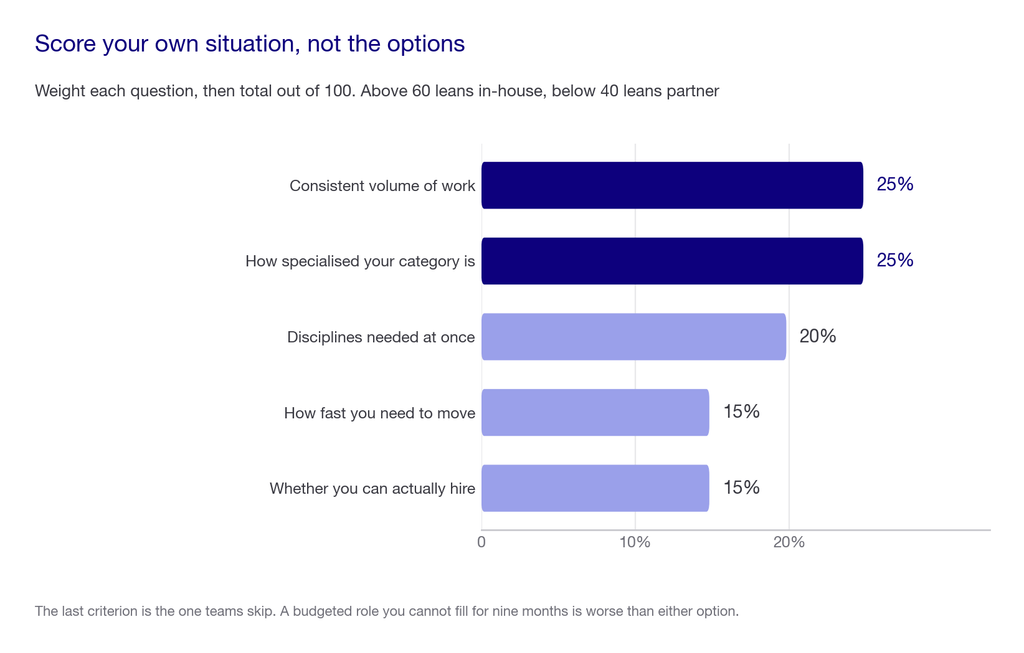
This is a decision framework rather than a ranking. As a result, the weighting applies to your situation rather than to a list of vendors. We arrived at it from the shape of engagements we see, including the ones where we advised a client to hire instead.
| Factor | Weight | Why it carries this weight |
|---|---|---|
| Consistent volume of work | 25% | Utilisation decides the cost comparison more than any headline rate |
| How specialised your category is | 25% | Institutional knowledge compounds internally and resets with every agency change |
| Disciplines needed at once | 20% | One hire covers roughly one and a half of the four |
| How fast you need to move | 15% | A three to six month hiring lag is part of the decision, not a footnote |
| Whether you can actually hire | 15% | A budgeted role you cannot fill is worse than either option |
What changed now that buyers use AI
The old version of this decision was mostly about content volume and technical fixes. Both are hireable.
Two things shifted it.
The evaluation moved somewhere you cannot see. Forrester’s 2026 Buyers’ Journey Survey, published in January and covering nearly 18,000 global business buyers, found 94 percent used AI somewhere in a recent purchase, 55 percent compared vendors inside AI tools. In addition, 47 percent built the internal business case there, all before contacting a vendor (Forrester, January 2026).
And the job that decides it got harder to hire. Muck Rack’s May 2026 study of more than 25 million cited links found earned media accounts for 84 percent of AI citations, with paid and advertorial at 0.3 percent (Muck Rack, May 2026). Earned authority was always the hardest of the four jobs to build internally. It is now the one carrying most of the signal.
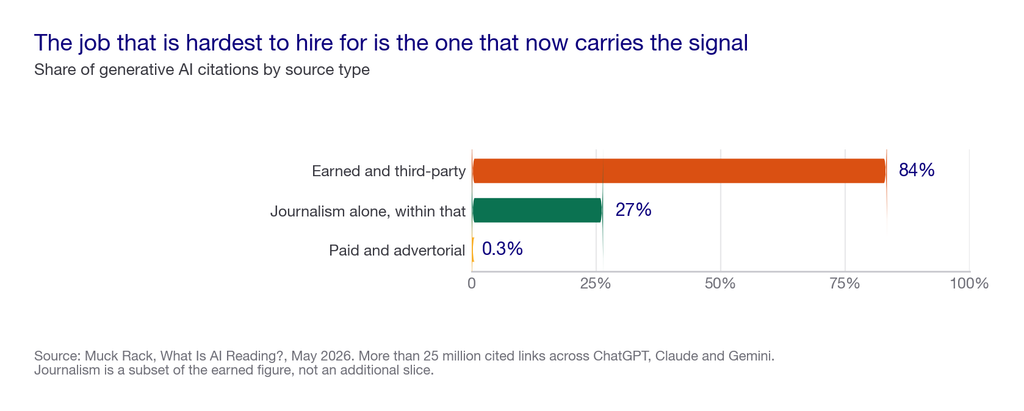
That is a genuine argument for external help. On top of that, it is also the argument we would make about ourselves, so weigh it accordingly. The counter-argument is real: an in-house person who already knows your category and has relationships in it will beat an agency starting cold, every time.
When in-house genuinely wins
We would tell you to hire rather than retain in these cases, and we have.
Your category is narrow and technical. If understanding the product takes months, an in-house person amortises that learning across years. An agency pays it again with every account change.
Institutional memory matters more than breadth. Regulated categories, long sales cycles, complicated products. Knowing why a claim was cut in 2024 is worth more than knowing a new tactic.
You have consistent volume. Enough work to keep someone busy most weeks, in one or two disciplines rather than four.
You want the capability permanently. If organic is core to how the company grows, owning it is strategically correct even when it is more expensive in year one.
Your compliance process is the bottleneck. No external partner fixes that. Someone internal who can navigate your legal team will outperform a better marketer who cannot.
When an agency genuinely wins
You need several disciplines at once. Technical, content, and earned authority simultaneously is three hires or one retainer.
Speed matters more than ownership. Hiring takes months. If the window is now, that lag is the whole decision.
The work is seasonal or project-shaped. A migration, a replatform, a category launch.
You are testing whether organic works for you at all. Committing to a salary to answer that question is expensive. Committing to two quarters of a retainer is not.
You need capability you cannot hire in your market. Earned authority and relationships are geographically sticky. In addition, so is senior technical talent.
The hybrid most companies land on
In practice, the teams that get this right rarely choose. They hire one senior generalist internally to own strategy, context and stakeholder management. Then buy the disciplines that person cannot personally cover.
That is not a compromise, it is usually the correct structure. Your internal person knows why things are the way they are, holds the relationships inside the business. Similarly, can say no to bad ideas from both directions. The external partner brings the breadth and the capacity that one salary cannot.
It is also the model we work in most often. Your team logs into the platform, connects Search Console and GA4, manages the prompt set and runs their own agents in the Agent Atlas, while a growth team works the same account. The visibility is shared rather than reported.
How to choose between an agency and a hire
Four questions, in the order that settles it fastest.
The scorecard I would use
Score your own situation out of 100. Above about 60 and an in-house hire is probably right. Below about 40 and a partner almost certainly is. In between, the hybrid above.
| Question | Weight | Scores toward in-house when |
|---|---|---|
| How much consistent work is there? | 25% | You can keep one person genuinely busy most weeks, in one or two disciplines rather than four |
| How specialised is your category? | 25% | Understanding the product or regulatory context takes months rather than weeks |
| How many disciplines do you need at once? | 20% | One or two, rather than technical plus content plus earned authority simultaneously |
| How fast do you need to move? | 15% | You can absorb a three to six month hiring lag without losing the window |
| Can you actually hire this person? | 15% | The talent exists in your market at a salary you will approve, and you can retain them |
That last row is the one companies skip and then discover the hard way. A budgeted role you cannot fill for nine months is worse than either option.
Run this before you decide
Write down every organic task from the last quarter. Then tag each one against the three levers: strategy, execution, technical, or earned authority. Then count the hours.
Most teams find one discipline dominates and one is entirely absent. If it is dominated by execution, hire. If earned authority is the empty column and always has been, that is the gap a hire is least likely to close. Because it is the one that depends on relationships rather than skills.
Then ask any agency you are considering the same five questions you would ask a candidate. In addition, notice whether the answers are better.
Red flags in either direction
From an agency: guaranteed rankings or citations, since nobody controls the output and Google warns against exactly this. A proposal that lives entirely in your CMS when 84 percent of citations come from elsewhere. Our comparison of tool versus agency versus platform covers the models. Reporting that stops at visibility. No named person on your account. And a comparison table in their pitch that puts a fully loaded salary against their monthly fee without explaining the difference.
From a hiring plan: one person expected to cover all four disciplines. A job description that reads like three roles. No budget for tools, which typically runs to thousands a year. And no plan for what happens when they leave, because they will. Our enterprise playbook covers the ownership question in more depth.
The weak playbook against the strong one
The weaker version of this decision. Also, the one most companies run: write a job description covering all four disciplines, fail to fill it for six months, lower the bar, hire someone who is strong at one, then hire an agency anyway to cover the rest at a worse rate than if you had planned for both.
The stronger version: audit what work actually exists, identify the empty column, decide whether that gap is best closed by depth or breadth. Then buy only that. Revisit at the point where volume justifies bringing more in-house.
The difference matters because the four jobs do not scale together. Execution scales with hours, technical scales with skill. In addition, earned authority scales with relationships and time, which is why it resists both hiring and retainers unless you plan for it deliberately.
Run this test before you commit
Give any agency you are considering. What is more, any candidate you are serious about, the same 20 to 30 real commercial questions your buyers ask. Not branded ones. Things like “best platforms for this use case”, “alternatives to our closest competitor”, “how should a company like ours approach this” and “what should I look for when choosing a vendor here”.
Ask both for the same five answers: where do we appear. That competitors appear instead, which sources are influencing those answers, why are those sources winning, and what would you change in the first 90 days.
Comparing a candidate and an agency on identical work is the only clean comparison available to you. In addition, almost nobody does it.
The five questions I would ask a candidate and an agency
- “Take one query where a competitor beats us and explain why.” Works on both. It separates people who understand retrieval and authority from people who have read about it.
- “What would you change in the first 90 days that does not need anyone else’s approval?” Tests whether they understand constraints or just tactics.
- “Which of the four jobs are you weakest at?” Anyone who says none is either inexperienced or selling.
- “How will we know in six months whether this worked?” Listen for a baseline captured up front rather than a promise of reporting.
- “What would you need from us to succeed?” A good answer names specific internal dependencies: sign-off speed, engineering time, access to subject matter experts. Anyone who says nothing has not done this before.
Reduced to one principle: hire for the job you are missing, not for the model you prefer. Most bad decisions here are a correct answer to the wrong question.
One honest closing note. Very few agencies are equally strong across strategy, execution, technical and earned authority, ours included, and no single hire is. So whichever way you go, you are choosing which gap to live with. Pick deliberately.
What nobody should promise you
Guaranteed rankings or guaranteed AI citations, from an agency or a candidate. Nobody controls a search engine’s output.
A specific return multiple. The figures circulating on this question come mostly from agency-published comparisons with no traceable methodology. Equally, we have deliberately not repeated them.
That an agency is always cheaper, or that in-house is always better value. Both depend on utilisation, and anyone stating it as a universal has not asked how much work you actually have.
You may not need either yet
The answer that costs us the sale, and it is true more often than you would expect. If you have fewer than about twenty pages worth optimising, no clear picture of who your buyer is, or no capacity to review and approve work, you do not need an agency or a hire yet. Fix indexing, fix your page titles, work through SEO basics yourself, write down the questions your buyers ask. In addition, spend the quarter talking to customers instead. Organic compounds, but it compounds on top of a clear proposition. Buying help earlier does not accelerate that, it just costs more while you work it out.
Frequently asked questions
Is an SEO agency cheaper than hiring in-house?
It depends on utilisation rather than headline cost. A retainer buys a fraction of several specialists, a salary buys all of one person’s time. If you have enough consistent work to keep someone busy, in-house usually wins on cost.
What does an in-house SEO specialist actually cost?
More than the salary. Add employer contributions, tooling, training, the management time of whoever they report to, recruitment amortised over tenure. Beyond that, the risk of losing institutional knowledge if they leave.
Which is better for AI search visibility specifically?
Whichever closes your earned-authority gap. Muck Rack found 84 percent of AI citations come from third-party sources. In addition, that is the hardest capability to build internally because it depends on relationships rather than skills.
Can one person do all of SEO?
Not well. The work splits into strategy, execution, technical and earned authority. One capable person covers about one and a half of those. A job description covering all four is three roles wearing a trench coat.
How long does it take to hire an SEO specialist?
Commonly three to six months from approval to productive, including notice periods and ramp. If your window is shorter than that, the hiring lag is effectively part of the decision.
Should we do both?
Usually yes, and most teams that get this right do. One senior generalist internally owning strategy and context, with a partner covering the disciplines that person cannot personally cover.
When should we bring SEO fully in-house?
When organic is core to growth, volume is consistent. On top of that, your category is specialised enough that institutional knowledge outweighs external breadth. Owning it is then strategically right even if year one costs more.
How do we evaluate an agency fairly against a hire?
Ask both the same questions, especially which of the four jobs they are weakest at. Then compare against the specific gap you identified rather than against a generic capability list.
Where to go next
Do the audit before the decision. Tag last quarter’s organic tasks by discipline, count the hours, and find the empty column. That tells you what you are actually buying, and it takes an afternoon.
If earned authority is the empty column, be honest that it is the hardest one to hire for. In addition, the one where an outside partner has the clearest structural advantage. If execution is the empty column, a hire will probably serve you better than we will.
Book a growth audit · See where you show up
Sources and further reading
- Forrester. “Forrester’s 2026 Buyer Insights.” Published 21 January 2026. Nearly 18,000 global business buyers. Link
- Muck Rack. “What Is AI Reading?” May 2026 edition. More than 25 million cited links across ChatGPT, Claude and Gemini, 17 industries. Link
- Google Search Central. Guidance advising against providers who guarantee rankings.
Latest Blogs
Most advice on this is inference dressed as fact. OpenAI documents exactly one thing clearly, which is access. Here is what is documented, what is inferred, and how to verify the rest for yourself.
Being named in an AI answer and having your page used as its source are different outcomes with different causes and different fixes. The gap between them is the most useful diagnostic in AI search, and most reporting collapses it into one number.
Every platform reports share of voice and almost none of them define it the same way. Here is the definition worth using, the three choices that change the number, and how to measure it yourself without buying anything.
Get your hands on the latest news!

Similar Posts
Artificial Intelligence
11 mins read
What is anchor text, and does it still matter in 2026?
SEO
11 mins read
What is internal linking? Meaning, and what changed for AI search
SEO
15 mins read