SEO audit agencies: what a real audit includes and what to pay
Start with a problem in the source material, because it affects every price you are about to read.
Most cost guides for this topic quote hourly and per-project rates from an Ahrefs survey, usually described as current. That survey is real, it polled 439 service providers, and it was last updated on 15 August 2024. Its figures are being circulated two years on as though they describe today’s market.
The second problem is bigger. “SEO audit” describes at least four different products, sold at prices that differ by more than an order of magnitude. Most buyers do not find out which one they bought until the deliverable arrives.
Pepper runs organic for more than 250 enterprises, and a meaningful share of the accounts we inherit come with a recent audit nobody implemented. This is what to buy instead.
The short answer
Decide which of the four products you need before you request a single quote. A tool-export audit is worth a few hundred dollars and takes an hour. A technical audit on a small site is a genuine piece of work. An enterprise technical audit with log file analysis is a different discipline. A strategic audit answering “why is organic not growing” is a different discipline again.
Then judge the proposal on evidence sources rather than page count. The single question that separates real work from a tool export is whether they ask for server logs.
And if the honest problem is that the last audit was never implemented, the answer is not a better audit. That is where Pepper sits, and it is the fifth option below.
Key takeaways
- The published price ranges are stale. The most-quoted survey was last updated in August 2024 and is presented as 2026 data.
- Four different products share one name, ranging from an automated export to a multi-week enterprise diagnostic.
- Almost nobody publishes pricing. WebFX is one of the few, from $5,900 for an initial two-month campaign.
- Ask whether they need log files. It is the fastest way to tell a diagnostic from a crawler report.
- An audit nobody implements is a document. Budget for remediation before you budget for the audit.
A note on where this comes from. We run organic for more than 250 enterprises and track over 10 million prompts across every major engine. What follows is shaped by that, by the client reviews we sit in weekly, and by the unimplemented audits we find in accounts we take over. It is our read on how this is bought and sold.
What is an SEO audit agency?
An SEO audit agency is a firm you pay to diagnose why a site is not performing in search, and to tell you what to change. Some sell audits as a standalone product. Most sell them as the first phase of a retainer. That is worth knowing, because it shapes what the audit is designed to conclude.
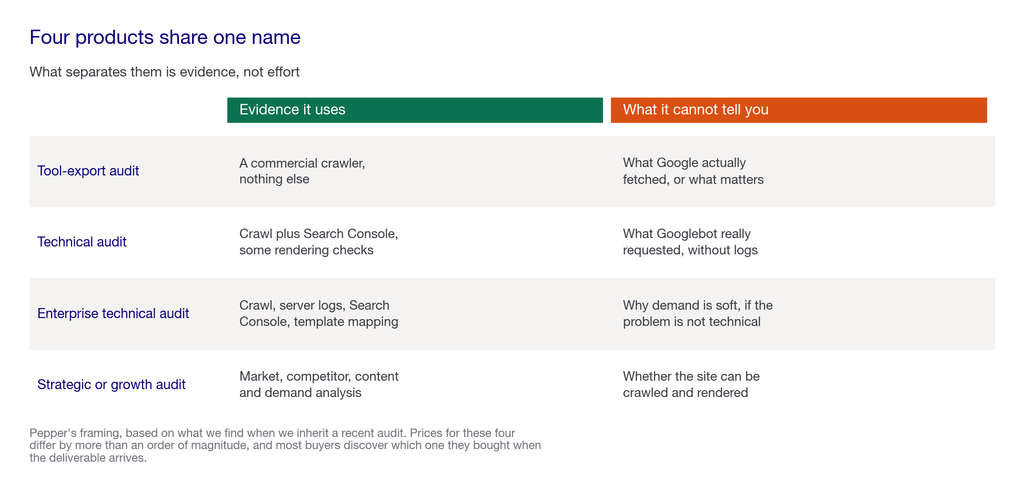
The work splits by scope rather than by quality, and the four products below are genuinely different things.
A tool-export audit runs a commercial crawler, exports the issues list, and adds commentary. Fast, cheap, and it will find broken links and missing meta descriptions.
A technical audit adds human judgement: a crawl, Search Console analysis, rendering checks on key templates, and a prioritised list of fixes.
An enterprise technical audit adds server log file analysis, template-level mapping and rendering validation at scale. Google’s guidance says crawl budget needs managing above one million pages changing weekly, or ten thousand pages changing daily. It also applies whenever a large share of URLs sit in “Discovered, currently not indexed.”
A strategic or growth audit answers a different question. Not “what is broken” but “why is organic not growing”. That usually involves demand, competitive position and content quality rather than crawlability.
Our enterprise SEO audit framework sets out the 47 checks we run at the third level, and technical SEO agency covers provider selection more broadly.
The four products at a glance
| Product | Typical price | Evidence used | What you get | Where it falls short |
|---|---|---|---|---|
| Tool-export audit | A few hundred dollars, sometimes free | Commercial crawler only | Issues list, light commentary | No prioritisation, no template scoping, no crawl-behaviour data |
| Technical audit | Low thousands | Crawl plus Search Console, some rendering checks | Prioritised fix list for a small or mid-size site | Cannot see what Googlebot actually did without logs |
| Enterprise technical audit | High four figures to low five figures | Crawl, server logs, Search Console, template mapping | Template-level findings, scoped by URL count and revenue | Slow to start, since log access is a fight |
| Strategic or growth audit | Varies widely, often a retainer phase | Market, competitor, content and demand analysis | An answer to why growth stalled | Rarely fixes anything technical |
Price bands are indicative, drawn from published agency pricing and our own engagements, not from a survey. Treat them as a shape rather than a benchmark, for reasons the cost section explains.
If you want the diagnostic run against your site before you brief anyone, book a growth audit and we will tell you which of the four you actually need.
How we weighted this
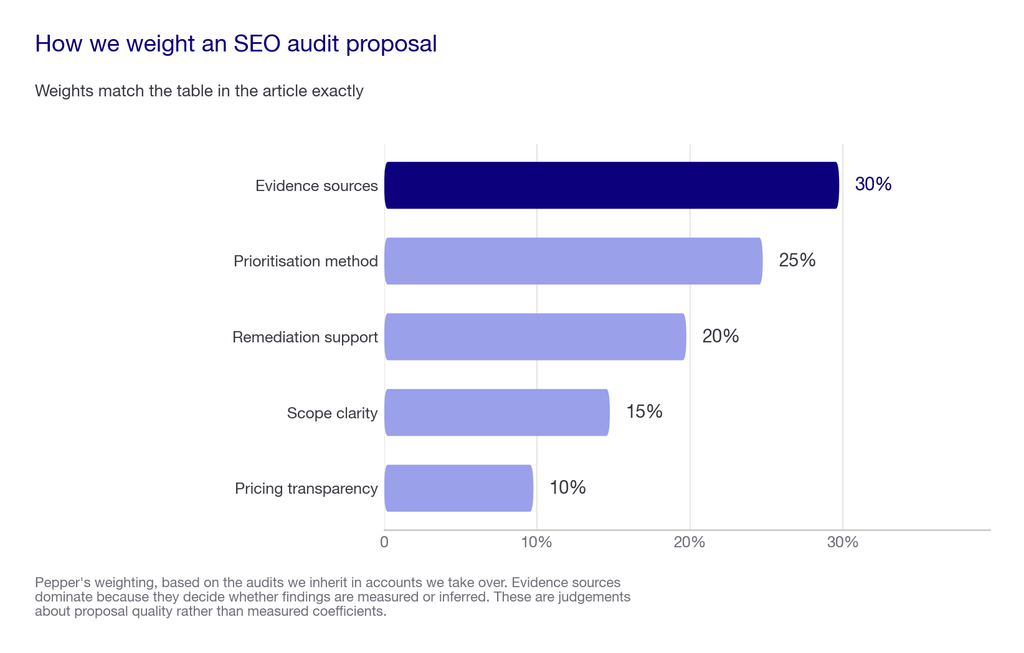
| Area | Weight | What decides the score |
|---|---|---|
| Evidence sources | 30 | Whether server logs and Search Console coverage states are used, or only a crawler export |
| Prioritisation method | 25 | Whether findings are ranked by revenue and remediation effort, rather than by a tool’s default severity score |
| Remediation support | 20 | Whether you get developer-ready tickets or hands-on help, rather than a PDF and a call |
| Scope clarity | 15 | Whether the proposal states which of the four products it is, in writing, before you sign |
| Pricing transparency | 10 | Whether you can size the engagement before the third call |
Evidence sources carry the most weight because they determine whether the findings are measured or inferred. Our GEO agency ranking methodology explains how we build weightings like this one.
What a real audit includes
Four data sources, used together. A full technical crawl shows what a crawler could find. Server logs show what Googlebot actually requested and received. Search Console shows what Google decided afterwards: indexed, excluded, discovered and not crawled. Template mapping scopes a single finding to the ninety thousand URLs that share its pattern.
Any one alone will misdiagnose. A crawl showing clean internal linking means nothing if logs show most requests going to faceted parameters.
Findings scoped to templates, with URL counts. At scale, pages are generated from a few dozen patterns. A finding that says “this page has a canonical problem” is nearly useless. A finding that says “this template has a canonical problem and it generates 94,000 URLs” is actionable.
Prioritisation by revenue and effort, not by issue count. A four-thousand-row spreadsheet sorted by severity is a prioritisation failure presented as thoroughness. Twelve sequenced findings someone will ship beats it every time.
Rendering validation on real templates. Content that exists only after JavaScript executes may not be seen. This needs checking per template rather than assumed.
AI retrievability, because Google says it is the same discipline. Google states that AEO and GEO are part of SEO, and that AI Overviews and AI Mode run on core Search ranking systems with no separate AI index. An audit that checks Googlebot access and ignores AI crawler access has scoped out half of a single discipline. Our guide to tracking brand mentions in AI search covers what that half involves.
A remediation path. Developer-ready tickets, effort estimates and a sequence. Without this you have bought a diagnosis and no treatment.
What it costs, and why the published figures are unreliable
Two things make benchmarking hard here.
The most-cited source is out of date. Ahrefs’ SEO pricing survey polled 439 service providers and reports an average hourly rate of $111, agencies averaging $98.90 and consultants $171.18, with the most common per-project fee between $2,501 and $5,000 and an average monthly retainer of $2,917. Those are useful numbers. They were last updated on 15 August 2024, and are widely republished as current 2026 figures. Use them as a historical anchor, not as this year’s market rate.
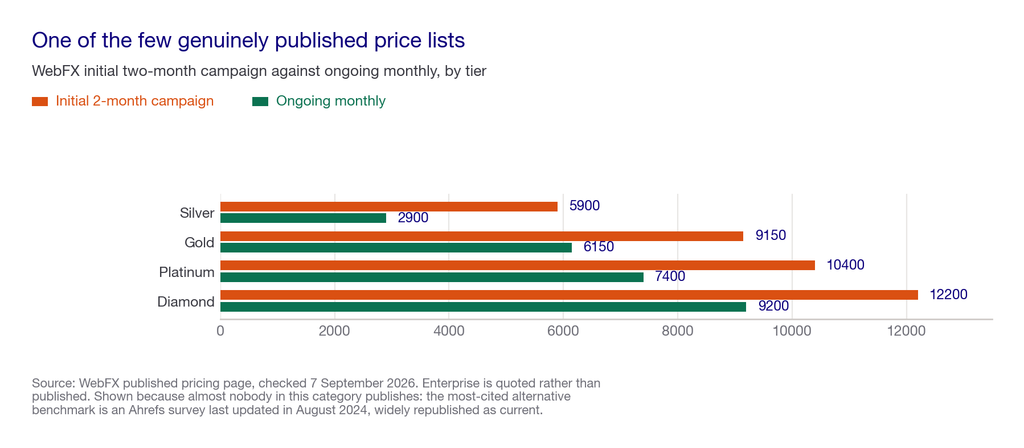
Almost nobody else publishes. WebFX is one of the exceptions, publishing an initial two-month campaign from $5,900 Silver to $12,200 Diamond, and ongoing monthly optimisation from $2,900 to $9,200, with enterprise quoted. We do not publish pricing either, so this is a limitation we share.
The practical consequence is that you cannot comparison-shop this in advance. Plan the evaluation as a set of identically briefed conversations instead, and judge the replies rather than the rate cards.
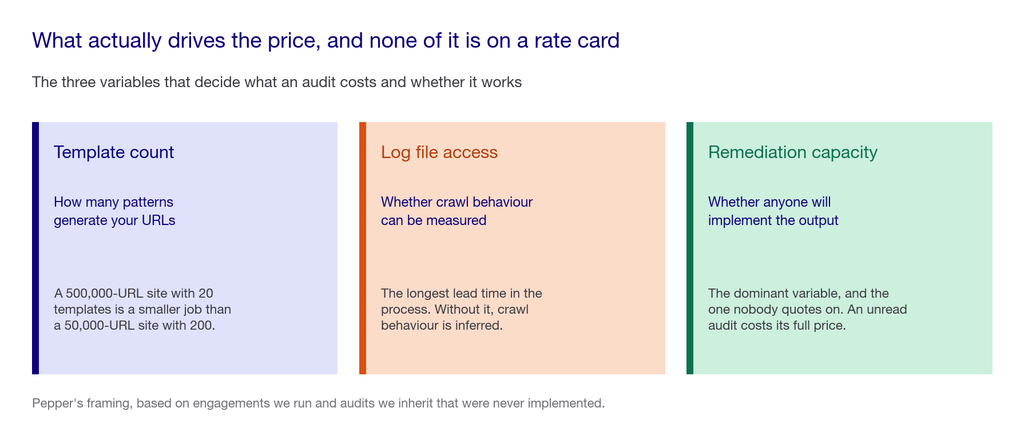
What actually drives the price is not on any page: how many templates you have, whether server log access exists, and whether anyone will implement the output. The third dominates, and it is the one nobody quotes on.
Our cost breakdown of platforms against hiring models the internal execution side.
Where each option falls short, and the fifth option
A tool-export audit falls short on judgement. It is genuinely useful for a small site with obvious problems, and it costs almost nothing. Where it falls short: no prioritisation, no template scoping, and no view of what Googlebot actually did, so it will happily rank a missing meta description alongside a rendering failure.
A technical audit falls short at scale. It is the right purchase for most sites under about 10,000 URLs. Where it falls short: without server logs it infers crawl behaviour rather than measuring it, which is the exact failure mode that matters most above half a million URLs.
An enterprise technical audit falls short on speed and on dependencies. It is the only version that measures crawl behaviour properly. Where it falls short: log access typically takes weeks to arrange, and the findings need engineering time that may not exist.
A strategic audit falls short on implementation. It answers the question executives actually ask. Where it falls short: it rarely fixes anything technical, and it is the easiest of the four to deliver as an impressive document with no shipped change behind it.
Pepper sells the fifth option, which is not an audit at all. The common failure across all four products above is that nobody implements the findings, and that is a capacity problem rather than a diagnostic one. So we do the diagnosis as part of doing the work, not as a document that precedes it.
Customers log into the platform themselves: workspace setup, brand profile, competitors and personas, GA4 and Search Console connected, themes and prompts managed, GEO analytics read directly, and their own agents built and run in the Agent Atlas. And a growth team is attached to the account doing the work alongside them, which is the difference between a diagnosis and a change.
Where it falls short: we do not publish pricing, so budget discovery is a conversation rather than a page. We are built for long-term organic programmes, so if a standalone audit document is genuinely all you need, one of the four above is the right purchase. Our depth sits in content, authority and AI search rather than large technical migrations.
What nobody should promise you
Guaranteed rankings after remediation. Google explicitly advises against providers guaranteeing rankings, because third parties cannot access internal ranking systems.
A meaningful audit without log files, at enterprise scale. Crawl behaviour is measured or it is guessed.
That a bigger issue count means a better audit. Four thousand findings is a prioritisation failure.
A current price benchmark. The most-quoted survey in this category is two years old. Anyone presenting it as 2026 data has not checked.
How to choose an SEO audit agency
I would judge the proposal on what evidence it commits to using, because that single question sorts the market faster than anything else.
Google’s guidance is the anchor and it is specific. Crawl budget needs active management on sites above one million pages changing about weekly, sites above ten thousand pages changing daily, and any site with a large share of URLs in “Discovered, currently not indexed.” Google also names two tactics that do not work. Using noindex to save crawl budget, since it still requests the page before dropping it. And using robots.txt to reallocate crawl budget, which it will not do unless you are already at capacity. A proposal recommending either has not read the documentation for the thing it is auditing.
Score the proposal before you sign.
| Area | Weight | What a strong proposal demonstrates |
|---|---|---|
| Evidence sources | 30 | Server logs requested in the first conversation as a prerequisite, alongside Search Console, a crawl and template mapping |
| Prioritisation method | 25 | Findings ranked by the revenue the affected templates carry and the engineering effort to fix them, with both stated |
| Remediation support | 20 | Developer-ready tickets with acceptance criteria, or hands-on implementation, rather than a document and a handover call |
| Scope clarity | 15 | The proposal names which of the four products it is, in writing, with what is explicitly out of scope |
| Pricing transparency | 10 | A number or a defensible range before the third call, with the drivers behind it named |
Those weights sum to 100. Score your own readiness too: an audit landing on a team with no engineering time produces a backlog, not a result.
The live test, and it costs you nothing. Give every shortlisted firm the same brief and the same three URLs: your highest-revenue template, your highest-volume template, and one URL currently sitting in “Discovered, currently not indexed.”
Ask four questions in writing. “What is the rendered versus raw HTML difference on these three.” “Which templates do they belong to, and how many URLs share each one.” “What would you need from our infrastructure team in week one.” “What would change in the next 90 days, and who does it.”
Then add the AI half, because Google treats it as the same discipline. Give them 30 real commercial questions from your category, in your buyers’ words. Four worked examples: “which SEO audit agency should we hire”, “why are our product pages discovered but not indexed”, “best technical SEO audit for a large ecommerce site”, “how much should an enterprise SEO audit cost”. Ask which of your templates currently answer those, and which competitors appear instead.
A firm that asks for log access in reply is running a diagnostic. A firm that returns a crawl summary within the hour is selling a tool export, which may be exactly what you need, at a fraction of what you were about to pay.
The weak audit against the strong one. The weaker version runs a crawler, exports the issues tab, sorts by count, and delivers several thousand rows. It is page-level, undifferentiated by template, unprioritised by revenue, and it is the single most common reason audits go unimplemented.
The stronger version starts from logs and Search Console coverage states. It maps every finding to a template with a URL count, ranks by the revenue those templates carry, estimates engineering effort, and sequences the output so dependencies resolve in order. It produces fewer findings and more shipped change.
Red flags, each one something you will genuinely hear. “We can start without log file access”, on an enterprise site. “Here are 4,200 issues”, offered as thoroughness. “We’ll noindex the thin pages to save crawl budget”, which Google says does not work. “We’ll block that in robots.txt to free up crawl budget”, which Google also says does not work. “Guaranteed rankings within six months.” “The audit is free if you sign the retainer”, which tells you what the audit is designed to conclude. “Core Web Vitals is the top priority”, on a site where a third of URLs are not indexed. And the quiet one: a scope that never mentions AI crawler access.
Five questions for the first call.
- Which of the four products is this, and what is explicitly out of scope? A good answer is direct and written down. A weak one describes a comprehensive audit.
- Do you need server log files, and what happens if we cannot get them? A good answer treats logs as a prerequisite and says what confidence is lost without them.
- Will findings be scoped to templates with URL counts? A good answer describes template mapping. A weak one promises a full page-level list.
- How do you prioritise? A good answer is revenue and effort. A weak one is the tool’s severity score.
- What does implementation support look like, and is it in this price? A good answer is tickets or hands. A weak one is a handover call.
It all comes down to one principle: buy the audit whose evidence matches your scale, and budget for remediation before you budget for the diagnosis. An unimplemented audit is the most expensive document most marketing teams own.
One closing note that costs us something. Very few providers are equally strong across measurement, execution, earned authority and attribution, ours included, and the good ones will tell you which of the four is their weakest. Our depth sits in content, authority and AI search rather than large technical migrations, so if a replatform is your primary problem, say so early and we will tell you whether we are the right fit.
Frequently asked questions
How much does an SEO audit cost?
It depends which of four products you are buying, from a few hundred dollars for a tool export to low five figures for an enterprise audit with log analysis. Published benchmarks are unreliable, because the most-quoted survey was last updated in August 2024.
What should an SEO audit include?
Four evidence sources used together: a full crawl, server log files, Search Console coverage states, and template mapping. Plus rendering validation on real templates, findings scoped by URL count, prioritisation by revenue, and a remediation path with effort estimates.
How do I know if an audit is any good before I buy it?
Ask whether they need server log files. A firm that treats log access as a prerequisite is running a diagnostic. A firm that can start immediately from a crawl is selling a tool export, which is a legitimate product at a much lower price.
How long does an SEO audit take?
A tool export takes hours. A technical audit on a small site takes one to two weeks. An enterprise audit with log analysis takes three to six weeks, with most of the variance coming from how long log access takes to arrange internally.
Is a free SEO audit worth anything?
As a lead magnet it is usually an automated crawl export, which genuinely finds broken links and missing tags. Treat it as a free tool report rather than a diagnosis, and be aware it is designed to conclude that you need the retainer.
Should the audit include AI search?
Yes. Google states that AEO and GEO are part of SEO, so AI crawler access and content extractability are technical checks like any others. An audit stopping at Googlebot has scoped out part of the same discipline.
Do I need an agency or can I audit in house?
In house works when you have technical SEO capability and log access. Bring in help when you lack one of those, when the site is above roughly half a million URLs, or when a stakeholder will not accept an internal read.
What is the most common problem with audits?
Nobody implements them. Budget engineering time for remediation before commissioning the diagnosis, and ask the firm for developer-ready tickets rather than a document.
Where to go next
Decide which of the four products you need before requesting a quote, because that single decision changes the price by more than an order of magnitude and stops you comparing incomparable proposals.
Then check one number, which takes two minutes. Pull your Search Console Page Indexing report and look at the share of URLs in “Discovered, currently not indexed.” Google names that as a crawl budget trigger at any site size, and it tells you immediately whether you need the enterprise version.
Our enterprise SEO audit framework sets out the 47 checks we run, and our AI search audit template is the seven-point checklist we use on every new client.
For provider selection, technical SEO agency, enterprise SEO agency and how to choose an organic SEO agency cover the criteria and the red flags. Our Acceldata case study shows what the work looks like on a technical B2B account.
The honest exit. If your site is under a few thousand URLs and you have never run a crawler over it, start with a free tool export. It will find the obvious problems, it costs nothing, and it tells you whether you need to buy anything at all.
Sources
Pricing was checked at each company’s own page on 7 September 2026, and Google’s guidance is quoted from Google’s own documentation.
- Ahrefs, SEO pricing survey: 439 SEO service providers polled. Average hourly rate $111, agencies $98.90, consultants $171.18; most common per-project fee $2,501 to $5,000; average monthly retainer $2,917. Last updated 15 August 2024. Cited here as a historical anchor, and to note that these figures are widely republished as current 2026 rates.
- WebFX SEO pricing, checked 7 September 2026: initial two-month campaign $5,900 Silver, $9,150 Gold, $10,400 Platinum, $12,200 Diamond; ongoing monthly $2,900 to $9,200; enterprise quoted.
- Google Search Central, Large site owner’s guide to managing your crawl budget, checked 7 September 2026. Names the three trigger conditions and states that
noindexdoes not save crawl budget and robots.txt does not reallocate it. - Google Search Central, AI features and your website, 15 May 2026. States that AEO and GEO are part of SEO and advises against providers guaranteeing rankings.
- Zhang Kai, He Xinyue and Yao Jingang, From Citation Selection to Citation Absorption, arXiv, 28 April 2026. 602 controlled prompts, 21,143 search-layer citations, 18,151 fetched pages, across ChatGPT, Google AI Overview and Perplexity. Finds that high-influence pages are longer, more structured and richer in extractable evidence, and that citation counts alone inadequately measure effectiveness. Academic and independent of every vendor named here.
- Huang, Goyal, Saha and Chandrasekharan, Answer Bubbles: Information Exposure in AI-Mediated Search, arXiv, 17 March 2026. 11,000 real search queries across five systems. Finds that identical queries produce structurally different information realities across systems, and that Wikipedia and longer sources are disproportionately overrepresented. Academic and independent.
- Muck Rack, Earned media still drives 84% of AI citations, 7 May 2026. More than 25 million cited links across ChatGPT, Claude and Gemini, 17 industries. Muck Rack sells PR software, so read it as an interested party with a large dataset.
The four-product framing and the price bands in the at-a-glance table are Pepper’s own, based on engagements we run and audits we inherit. They are a working model rather than survey data, and we have labelled them as such rather than presenting them as a benchmark.
Latest Blogs
Most advice on this is inference dressed as fact. OpenAI documents exactly one thing clearly, which is access. Here is what is documented, what is inferred, and how to verify the rest for yourself.
Being named in an AI answer and having your page used as its source are different outcomes with different causes and different fixes. The gap between them is the most useful diagnostic in AI search, and most reporting collapses it into one number.
Every platform reports share of voice and almost none of them define it the same way. Here is the definition worth using, the three choices that change the number, and how to measure it yourself without buying anything.
Get your hands on the latest news!

Similar Posts
Artificial Intelligence
11 mins read
What is anchor text, and does it still matter in 2026?
SEO
11 mins read
What is internal linking? Meaning, and what changed for AI search
SEO
15 mins read