The short answer
Indirectly, and by a route most people get backwards. The value sits in the text a video produces, not the video.
Three things are checkable.
- Google’s own video docs does not mention AI features. It states videos “can appear in several different places on Google, including the main search results page, Video mode, Google Images, and Discover.” AI Overviews and AI Mode are absent from that list.
- Video indexing depends on the page performing in Search first. Google states “the indexed watch page must be performing well in Search before its video can be considered for indexing.” Video is downstream of ordinary search performance, not a shortcut around it, which is why the technical audit comes first.
- The one large independent study found social media underrepresented in AI answers, across 11,000 queries on five systems. It does not name YouTube, and it does not separate video platforms from feeds.
So the direct case is thin. The indirect case is better and it is worth understanding: a video generates a transcript, a description, a watch page and usually an embedded page on your own site. Those are text, and text is what an engine retrieves and lifts. The video is the reason the text exists.
We run this work daily. Pepper is an agentic organic growth engine, not an SEO agency. This page comes out of what we run: organic for more than 250 enterprises across eight years, more than 10 million tracked prompts, and the questions buyers put to us in client reviews. Customers log in and run the platform themselves, with a Pepper growth team attached. Book a growth audit and we will show you what your category actually cites.
Key takeaways
Key takeaways from Google’s own docs and one independent study.
- AI features are absent from Google’s list of where video appears in Search.
- Video indexing is downstream of Search performance. The watch page must already be performing before the video is considered.
- Embedded third-party video can be indexed twice. Google may index it “both on your web page and on the third-party platform’s equivalent page.”
- The reachable asset is the text. Transcript, description and the page around the embed.
- Independent research found social media underrepresented in AI answers, though it does not name YouTube.
- Category decides it. Run your own prompts and count how many citations are video.
What is video visibility in AI search?
Video visibility in AI search means an engine citing a video, or the page it sits on, when it answers a question in your category.
Two routes exist and they are worth separating, because only one is documented.
- The direct route. An AI feature surfaces the video itself. Google’s own video docs does not describe this happening.
- The indirect route. The text around the video, its transcript, description and host page, gets retrieved like any other text. This is ordinary retrieval and it is well understood.
Where it falls short as a goal. Chasing the direct route means optimising against a mechanism nobody has documented. Chasing the indirect route is just publishing good text, which you could do without making a video at all. That tension runs through the rest of this page.
What Google actually documents
Worth quoting precisely, because the absence matters as much as the content.
Where video appears. Google’s video documentation states that videos “can appear in several different places on Google, including the main search results page, Video mode, Google Images, and Discover.” That list is explicit and AI Overviews and AI Mode are not in it.
What it takes to get indexed. Google sets out conditions, and one is a hard dependency worth knowing: “The indexed watch page must be performing well in Search before its video can be considered for indexing.” The others are practical: the watch page must be indexed, the video must be embedded on it, it cannot be hidden behind other elements, and it needs a valid thumbnail at a stable URL.
On third-party platforms. Google states that “if your website embeds videos from third-party platforms like YouTube, Vimeo, or Facebook, Google may index the video both on your web page and on the third-party platform’s equivalent page.”
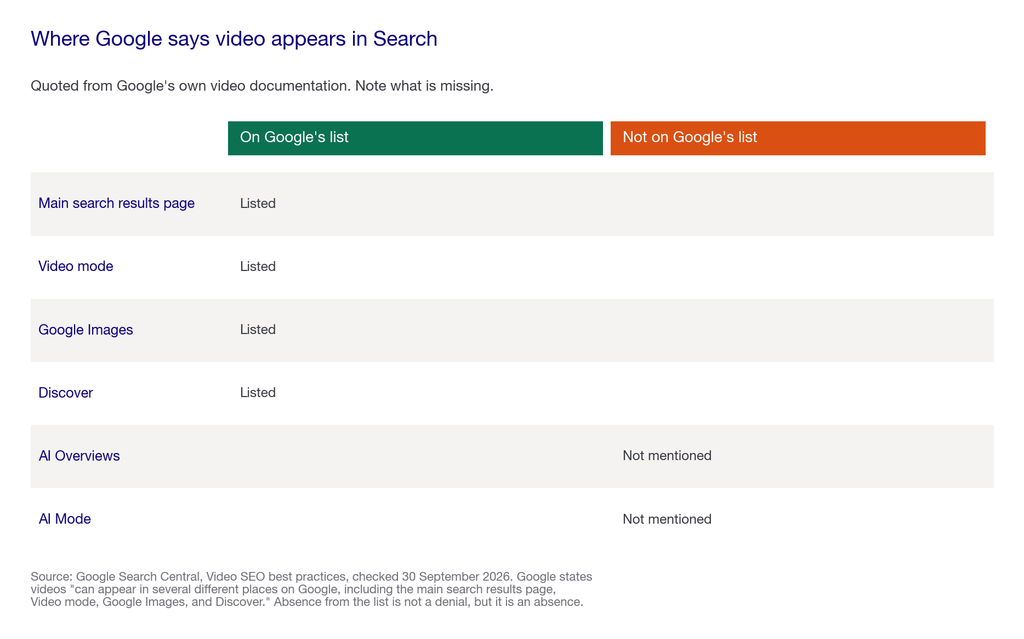
How to read the absence honestly. Documentation silence is not proof that video never appears in an AI feature. Google’s docs lag its products. Anyone who has seen an AI Overview surface a video knows the two can drift apart. What the absence does mean is that there is no documented mechanism, no stated requirement, and nothing to optimise against. Treat claims of a YouTube-to-AI-Overview pathway as unproven until Google records one.
The indirect case, which is the real one
Here is the mechanism that does hold up, and it is not about the video.
A video produces several pieces of text, and text is what retrieval systems actually work with.
- The transcript. The most undervalued asset in this whole discussion. A twenty-minute video is several thousand words of topical, natural language. None of it existed before.
- The description and chapters. Structured summary text, on a page that ranks.
- The watch page itself. An indexed, linkable page on a high-authority domain.
- The page you embed it on. Your own page, which now has a reason to exist and something to say.
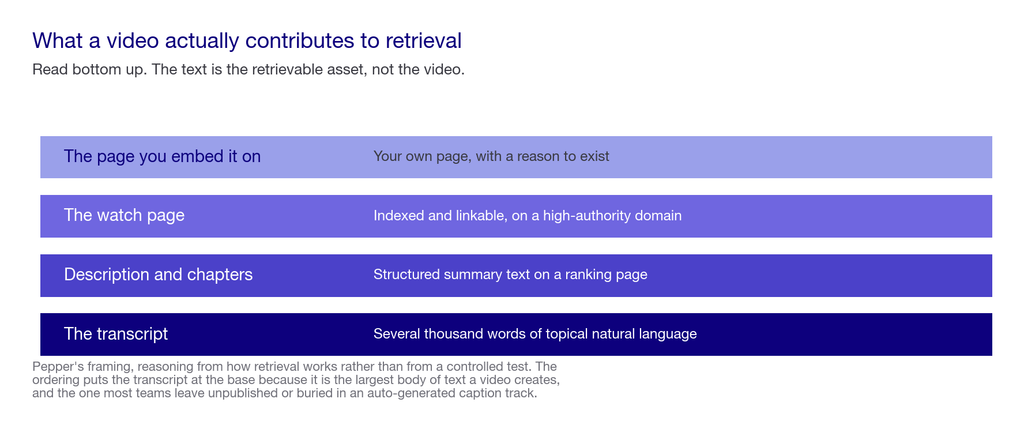
The practical result is a reordering. If the text is the asset an engine retrieves, publish the transcript as a real page. Edit it into readable prose with headings. That is worth more than the video’s view count. Most teams do the opposite. They optimise the video and leave the transcript unpublished, or buried in an auto caption track.
Where it falls short. This is a reasoning argument, not a measurement. We are reasoning from how retrieval works to what should therefore matter, and we have no controlled test showing a published transcript lifts citation rate. Treat it as a well-founded hypothesis you can test cheaply.
What the independent research says
One large study is relevant and it is not encouraging for video, with a caveat.
Huang and colleagues analysed 11,000 real search queries across five systems: vanilla GPT, SearchGPT, Perplexity with Grok, Google AI Overviews and traditional Google Search. They found “Wikipedia and longer sources are disproportionately overrepresented, whereas cited social media content and negatively framed sources are substantially underrepresented.”
Three caveats, all of which matter. The paper says social media and does not name YouTube. It does not separate video platforms from social feeds. And a long video with a full transcript is arguably a “longer source”, which the same paper found overrepresented. So the finding could cut either way, depending on how a system sorts it.
We are not going to resolve that from an abstract. What we will say is that nobody should be citing this paper as proof that YouTube works, and nobody should be citing it as proof that it does not.
How to find out for your own category
The only answer that is actually about you, and it takes an afternoon.
- Take twenty of your highest-value category prompts. The questions a buyer asks before they know your brand.
- Run them in two engines and record every cited URL.
- Count how many are video, on YouTube or anywhere else.
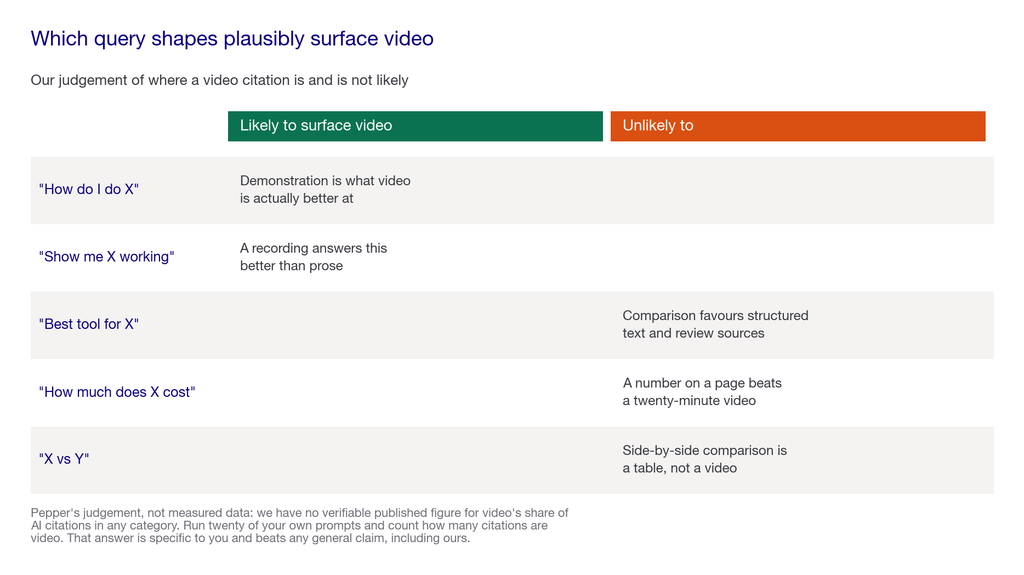
- Note what kind of query produced them. Video citations cluster in how-to, demonstration and review queries far more than in comparison or pricing queries. The wider mechanics of retrieval are in what is AI search.
That last point is the useful one. If your category’s buying questions are “how do I do X”, video may well appear. If they are “which tool should I buy”, it is much less likely. The full method is in how to track brand mentions in AI search, and the tooling that automates it is compared in top AI visibility platforms.
What to do if you are making video anyway
Most teams asking this question already produce video for other reasons. In that case the question is not whether to make it, but what to do with it.
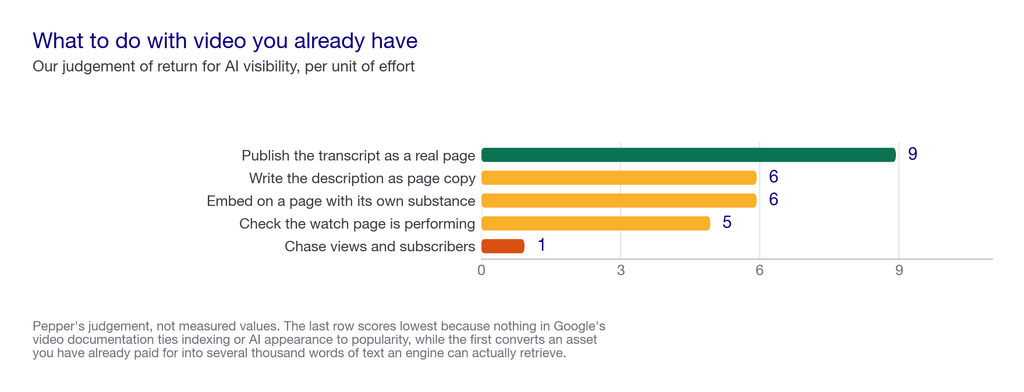
- Publish the transcript as a real page. Edited into prose with question-shaped headings, not a raw caption dump. This is the single highest-return action on this list and almost nobody does it.
- Write a genuine description. Treat it as page copy rather than a place for links, because it is indexed text on a high-authority domain.
- Embed on a page that says something. Google may index the video on both your page and the platform’s, so give your page its own content of its own rather than making it a wrapper.
- Check the watch page is performing. Google says video indexing depends on it. A video on a page nothing links to is unlikely to be indexed at all.
- Do not expect the view count to matter. Nothing in Google’s docs ties video indexing or AI appearance to popularity.
The answer that loses us the sale. If you are not already making video, do not start a YouTube programme for AI visibility. The direct evidence does not support it, the production cost is high, and the same budget spent on publishing genuinely useful written pages will move your citation rate faster and more reliably. Video earns its place for other reasons: demonstration, trust, and audiences who prefer it. AI visibility is a side effect, not a business case.
Where YouTube fits in an AI visibility programme
Below several cheaper things.
- Fix your own pages first. Access, structure, evidence, using the GEO best practices playbook. Free and fast, and it gates everything. The checklist is in how to audit your site for AI search.
- Find your actual citation core. Which sources your category cites, measured the way we set out in AI search visibility metrics and KPIs. Video may or may not feature.
- Publish transcripts of video you already have. Cheap, immediate, and it converts an existing asset into reachable text.
- Commission video for AI visibility last, if at all. And only if your category’s prompts demonstrably surface it.
What nobody should promise you
- A documented path from YouTube into AI Overviews. Google’s video documentation does not mention AI features at all.
- A guaranteed citation in an AI answer. Nobody controls what a model outputs, and video does not change that.
- That view count drives AI visibility. Nothing in Google’s docs connects popularity to video indexing.
- A published figure for YouTube’s share of AI citations. The percentages in circulation come from sources we could not verify.
- That video is a shortcut around search performance. Google states the watch page must already be performing well in Search before the video is considered for indexing.
Frequently asked questions
Does YouTube help AI visibility?
Indirectly, through the text a video produces rather than the video itself. Google’s own video docs lists where video appears in Search and does not mention AI Overviews or AI Mode, so the direct case is unproven.
Do AI engines cite YouTube videos?
Sometimes, and it depends heavily on the query shape. Video citations cluster in how-to and showing it working queries far more than in comparison or pricing queries. Run your own category prompts and count.
What Google records
Where does Google say video appears?
In “the main search results page, Video mode, Google Images, and Discover.” AI Overviews and AI Mode are not on that list, which is an absence worth knowing rather than proof video never appears in them.
What does video indexing require?
The watch page must be indexed, the video embedded on it and not hidden, and a valid thumbnail at a stable URL. Google also states the watch page “must be performing well in Search before its video can be considered for indexing.”
Does embedding YouTube on my site help?
It can be indexed twice. Google states it “may index the video both on your web page and on the third-party platform’s equivalent page,” so give your own page real content of its own rather than making it a thin wrapper.
Getting value from video
What is the highest-return thing to do with a video?
Publish the transcript as a proper page, edited into prose with question-shaped headings. It converts a video you already made into several thousand words of reachable text, which is what engines actually work with.
Should I start making video for AI visibility?
Not on this evidence alone. Production cost is high and the direct case is unproven. The same budget on written pages moves citation rate more reliably. Make video for showing it working and trust, and treat AI visibility as a side effect.
Does research show video gets cited?
Not clearly. The largest independent study found social media underrepresented in AI answers, but it does not name YouTube and does not separate video from feeds, while a long transcript might qualify as the “longer source” type it found overrepresented.
Sources
Google documentation was read directly on 30 September 2026. Research is independent and named.
Google documentation
- Google Search Central, Video SEO best practices, checked 30 September 2026. States videos “can appear in several different places on Google, including the main search results page, Video mode, Google Images, and Discover,” with no mention of AI Overviews, AI Mode or AI features. Sets out indexing conditions including that “the indexed watch page must be performing well in Search before its video can be considered for indexing,” and states that for embedded third-party video Google “may index the video both on your web page and on the third-party platform’s equivalent page.”
- Google Search Central, AI features and your website, checked 29 September 2026. States there are “no additional requirements to appear in AI Overviews or AI Mode, nor other special optimizations necessary.”
Independent research
- Huang, Goyal, Saha and Chandrasekharan, Answer Bubbles: Information Exposure in AI-Mediated Search, arXiv, 17 March 2026. 11,000 real search queries across five systems. Finds “Wikipedia and longer sources are disproportionately overrepresented, whereas cited social media content and negatively framed sources are substantially underrepresented.” The paper does not name YouTube and does not separate video platforms from social feeds.
On what we could not establish
There is no published figure we could verify for video’s share of AI citations, and we have not supplied an estimate. Google’s documentation not mentioning AI features is an absence rather than a denial, and product behaviour can run ahead of documentation. The argument that transcripts carry the retrieval value is our reasoning from how retrieval works, not a controlled test, and we have labelled it as such.
Latest Blogs
Probably, but the question hides a more useful one. Every major AI vendor now runs the same three-way split: a training crawler, a search crawler and a user-triggered fetcher. They do different jobs, and blocking them has completely different consequences.
Three things are true at once. Clicks are structurally down, the traffic that still arrives converts better, and the volume of that better traffic is small today. Most strategies fail because they act on only one of the three.
Ranking first does not get you cited. Across 863,000 keyword SERPs, only 37.1 percent of pages cited in AI Overviews ranked in the top 10, while 36.7 percent ranked beyond position 100 entirely. Being in the index is the gate. Being at the top of it is not the path.
Get your hands on the latest news!