AEO vs SEO vs GEO: the differences that actually matter in 2026
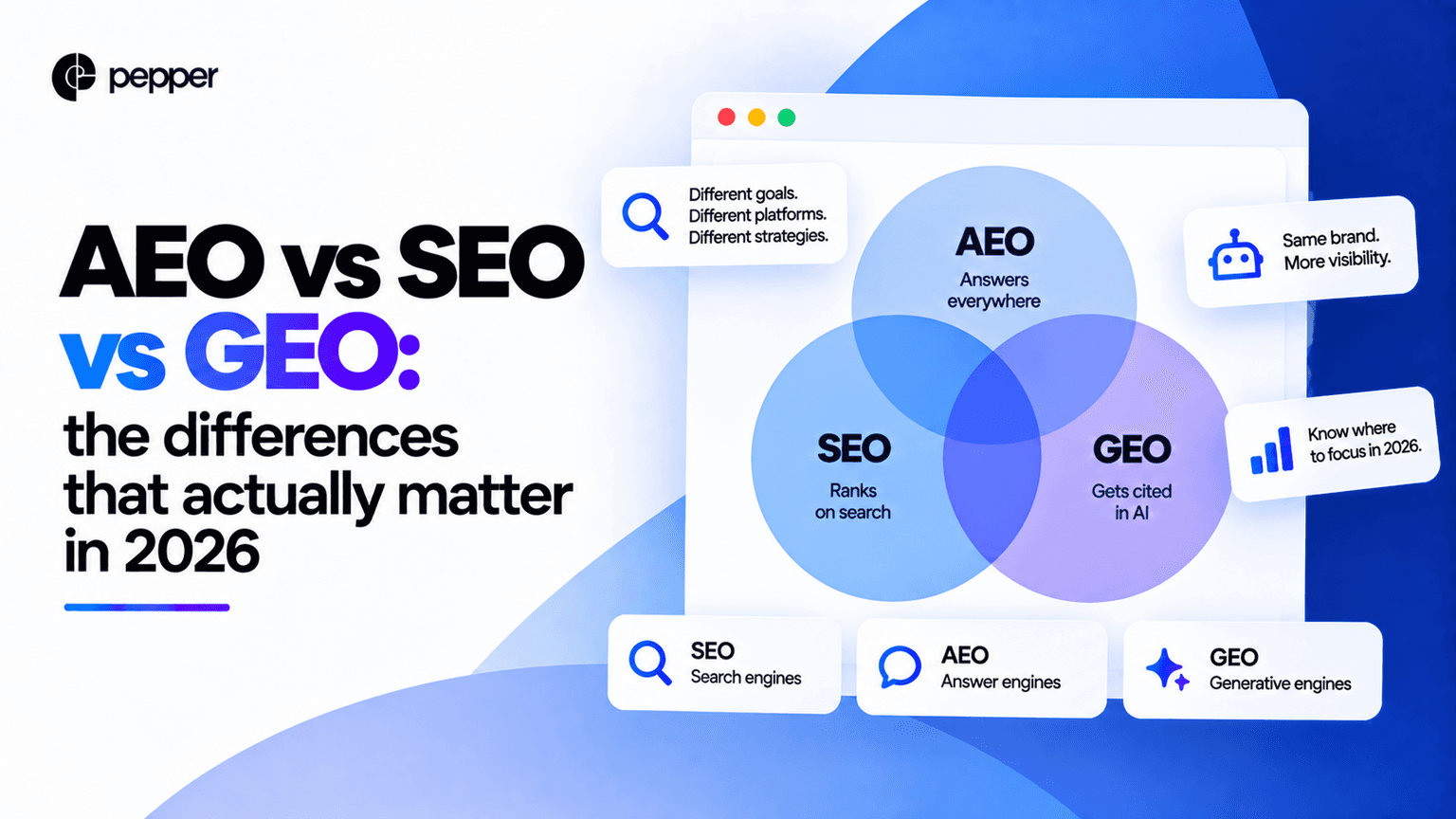
The short answer
The three terms name three surfaces, and that part is real. What is not real is the implication that they need three playbooks, three teams and three budgets each. Google states that its generative features run on core Search ranking systems. In July it also named four AI-specific tactics it does not use at all. Once you subtract the vocabulary and the retired tactics, three differences survive. All three change where the budget goes and how the work is measured. None changes what the work is called.
Key takeaways
- Google retired four of the cited differences in writing. On llms.txt: “Google Search itself doesn’t use them.” On chunking: “There’s no requirement to break your content into tiny pieces.” On rewriting: “You don’t need to write in a specific way just for generative AI search.” On schema: “there’s no special schema.org markup you need.”
- Difference one, and the biggest: where the citation comes from. Earned third-party media carries 84% of AI citations on the largest published analysis. In classic SEO your own pages carry far more. That is a budget reallocation, not a rebrand.
- Difference two: what a click is worth, and whether you can see it. A peer-reviewed study of 973 sites found LLM referral traffic converting below almost every traditional channel under last click. Most AI value never becomes a click at all.
- Difference three: the instrument. Rank tracking does not measure this. Two free first-party reports now do, one from Google and one from Microsoft. Neither existed in this form a year ago.
- This updates two of our own live articles. Both were published in April and predate Google’s July guidance and the peer-reviewed study. We say where, rather than diverging quietly.
- Pepper is an agentic organic growth engine and an organic growth partner. Agent Atlas gives your team the agents. Pepper’s GEO platform reports Brand Visibility, Domain Prompt Presence and Share of Voice. A growth team works alongside yours. Eight years, more than 250 enterprises, more than 10 million tracked prompts.
A note on where this comes from. I am interested in when a new name marks a real change in the business model and when it marks a change in vocabulary. The two get funded very differently. Pepper runs organic for more than 250 enterprises over eight years, tracking more than 10 million prompts across every major engine. We see which distinctions survive contact with a budget cycle.
Disclosure: Pepper sells services under all three of these names. An article arguing the distinctions are mostly vocabulary therefore runs against our own commercial interest. Every source below was read at source on 18 September 2026 with its date stated. Competitors are named but never linked.
What are AEO, SEO and GEO, and do the definitions change anything?
Briefly, because the definitions are the least interesting part and we have already published them.
- SEO is getting found in a ranked list of links.
- AEO is getting extracted into a direct answer, whether that is a featured snippet, a voice result or an AI answer.
- GEO is getting cited inside generative answers on engines like ChatGPT, Perplexity, Gemini and Google’s AI surfaces.
Those are genuinely different surfaces. Our alphabet soup explainer works through the full taxonomy including AIO and LLMO. Our AEO versus SEO comparison covers that pair in depth.
This article asks something narrower: given that the surfaces differ, how much of your actual work differs? The answer is less than the vocabulary suggests, and Google has now said so explicitly.
What Google settled, and when
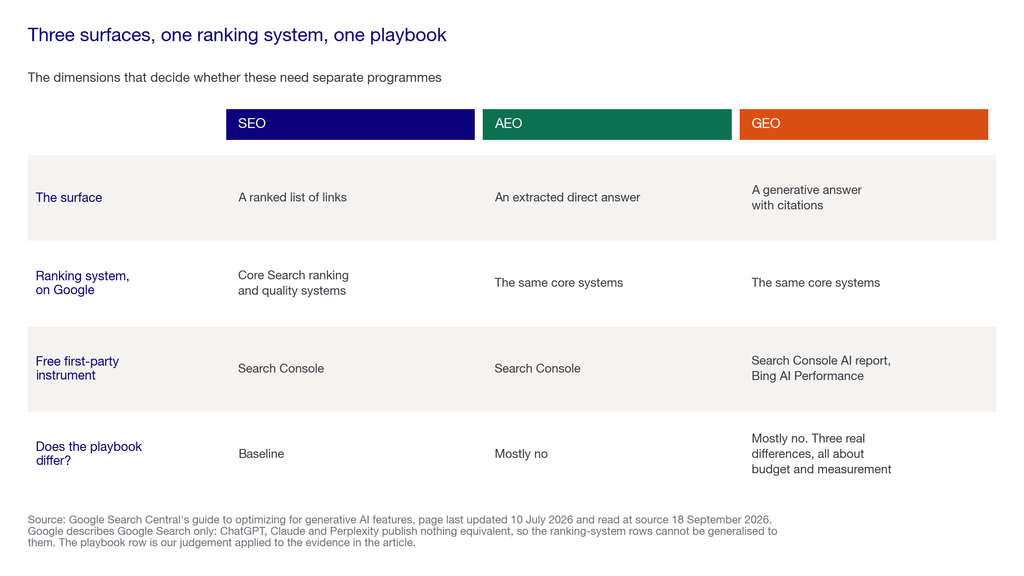
Google’s guidance on optimising for generative AI features, page last updated 10 July 2026, states the underlying position plainly: “the best practices for SEO continue to be relevant because our generative AI features on Google Search are rooted in our core Search ranking and quality systems.”
Then it names four things you do not need, each of which is routinely sold as a difference between these disciplines:
- llms.txt. “Google Search itself doesn’t use them,” and adding one “will neither harm nor help your site’s visibility.”
- Chunking. “There’s no requirement to break your content into tiny pieces.”
- AI-specific rewriting. “You don’t need to write in a specific way just for generative AI search.”
- Special AI schema. “Structured data isn’t required for generative AI search, and there’s no special schema.org markup you need.”
It also warns about the vendors selling those differences: “Be wary of third-party tools that promise ranking success or claim to use ‘internal’ Google metrics. No third-party tool has access to our internal ranking or AI systems.”
Where this falls short, and it matters throughout: Google describes Google. ChatGPT, Claude and Perplexity publish nothing equivalent, so “Google does not use llms.txt” is not “no engine uses llms.txt”. What it does establish is that on the largest AI surface, four of the most commonly cited differences are not differences at all.
Two of our own articles predate this. Our guide to the four acronyms, published 27 April 2026, argues the terms are “not interchangeable” and sets out a hierarchy. It remains right about the surfaces. It also reads more confidently about separate playbooks than the July guidance supports. Our comparison of AEO and SEO, published 30 April 2026, already made the “mostly the same” argument for that pair but could not cite the four retirements, which did not exist yet.
If you want to see which surfaces you actually appear on before reading further, book a growth audit and we will show you today’s answers.
How we scored the AEO vs SEO vs GEO differences
Five criteria, fixed before anything was assessed.
| Criterion | Weight | What it means |
|---|---|---|
| Changes what you do on Monday | 30 | A different action, not a different word for the same action |
| Backed by a primary or peer-reviewed source | 25 | An engine operator or a published study, not a vendor blog with no method |
| Moves money between line items | 20 | It changes budget allocation, which is the test of whether a distinction is real to a business |
| Survives across engines | 15 | It is not an artefact of one engine’s implementation that could change next quarter |
| Not retired by the source itself | 10 | The operator has not explicitly said it does nothing |
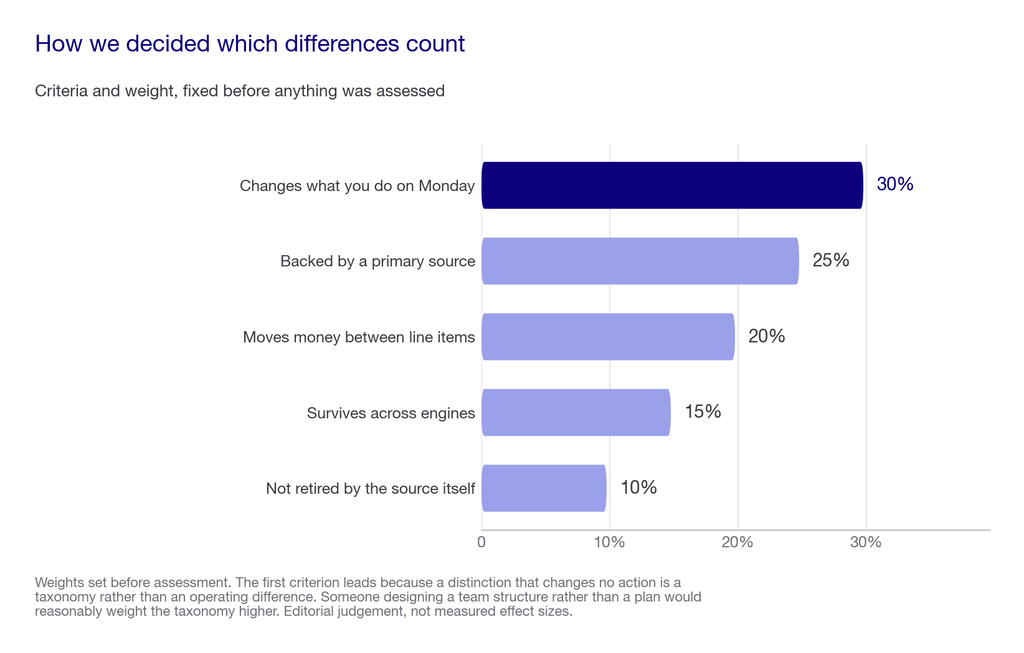
Why the first criterion leads. A distinction that changes no action is a taxonomy, and taxonomies help you write articles rather than run programmes. If two disciplines produce the same task list, the difference is a naming convention with a budget attached.
Where it falls short: these are our criteria and a strategist could reasonably weight them differently. Someone building a team structure rather than a plan would rate the taxonomy far higher than we do, and they would not be wrong.
The three differences that survive
1. Where the citation is assembled, which moves the budget
In classic SEO your own pages do most of the work. In AI answers they do not.
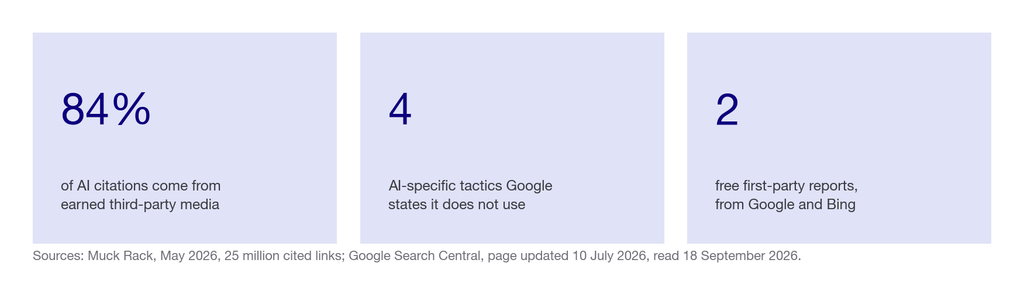
Muck Rack’s May 2026 analysis of more than 25 million cited links across ChatGPT, Claude and Gemini found earned third-party media carrying 84% of AI citations. The answer is assembled somewhere you do not own, from sources you did not write.
What changes on Monday: money moves from on-page production toward earned coverage, original research and the third-party surfaces your buyers read. That is a different line item, a different skill set and usually a different supplier.
Where this falls short: the figure is not industry-specific and not B2B-specific, and 84% of citations is not 84% of value. It is still the largest published measurement of where AI answers get their material.
2. What the click is worth, and whether you can see it
This is the difference our own April article explicitly declined to cover, because at the time every figure traced to a vendor study with a narrow sample. That changed.
Kaiser and Schulze published in Marketing Science in 2026. They analysed 973 e-commerce sites with $20 billion in combined annual revenue, comparing more than 50,000 ChatGPT-referred purchases against 164 million from traditional channels. They found organic LLM traffic “converts and earns per session below all traditional channels” except paid social, with organic search converting 13% higher.
The authors also explain why the vendor numbers disagree with them. Their data “credits only the last click before a purchase”, and the result is “consistent with consumers starting their search on an LLM, then switching to a more familiar or convenient channel to actually buy.”
What changes on Monday: stop treating an AI referral click like an organic click. Stop importing vendor multipliers, and declare an attribution model before reporting anything. Our GEO ROI work covers the cost side of that calculation.
Where this falls short: the study is e-commerce and its window ends July 2025, so it does not transfer cleanly to B2B. We found no comparable large-sample B2B study and will not substitute one.
3. The instrument, which did not exist in this form a year ago
Rank tracking measures positions in a list. It does not measure whether an engine mentioned you, cited you, or used your page without linking it.
Two free first-party reports now do. Google names its own Search Console generative AI performance report in the guidance above. Microsoft’s AI Performance report in Bing Webmaster Tools has been in public preview since 10 February 2026.
What changes on Monday: you add two free reports, and you stop expecting your rank tracker to answer a question it was never built for.
Where this falls short: each is first-party to one engine, so together they still miss ChatGPT, Claude and Perplexity. No platform connects any of it to revenue either. We audited eleven SEO platforms and none publishes organic-to-revenue attribution.
What does not survive
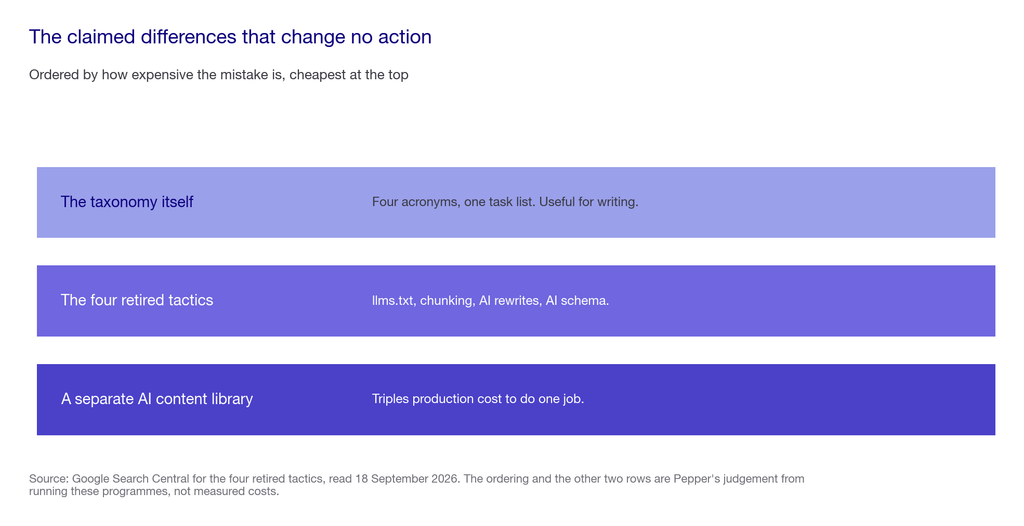
- The taxonomy itself. The four acronyms describe different surfaces and produce almost identical task lists. Useful for writing, weak as an operating distinction.
- The four retired tactics. llms.txt, chunking, AI-specific rewriting and special AI schema. Google says each does nothing on its surface, and no other engine has published a contradiction.
- Separate teams. We have seen no evidence that splitting an organic team by surface improves anything, and the coordination cost is real.
- Separate content. The same page can rank, be extracted and be cited. Writing three versions is a way to triple production cost for one job.
- “AI-first” rewrites of existing libraries. The most expensive thing on this list and the one with the clearest published refutation.
AEO, SEO and GEO at a glance
| Dimension | SEO | AEO | GEO | Does it change the work? |
|---|---|---|---|---|
| Surface | Ranked list of links | Extracted direct answer | Generative answer with citations | Yes, but the same page serves all three |
| Ranking system, on Google | Core Search systems | Core Search systems | Core Search systems | No. Google states this plainly |
| Where the answer is assembled | Mostly your pages | Mixed | 84% third-party | Yes. The biggest real difference |
| What a click is worth | Baseline | Similar | Converts below organic under last click | Yes, and it changes ROI modelling |
| Free first-party instrument | Search Console | Search Console | Search Console AI report, Bing AI Performance | Yes. New instruments, both free |
| llms.txt, chunking, AI rewrites, AI schema | Not used | Not used | Not used on Google | No. Retired in writing, July 2026 |
| Typical spend | $29 to $500 software, $2,900 retainers | Overlaps SEO | From $3,000 published retainers | Partly. See our cost work |
| Pepper, own row | One organic function, not three | One function | One function | We do not sell these as three budgets |
## What the difference costs
- If the three were separate disciplines, you would buy three programmes. Published GEO retainers start at exactly $3,000 a month, SEO ladders run $2,900 to $9,200, and AI visibility software runs $29 to about $500. Buying all three as separate lines is the most expensive reading of this article.
- The reallocation is the real cost change. Moving budget toward earned media does not reduce spend. It moves it to a line most organic budgets do not have and no software tier includes.
- The measurement layer got cheaper, not dearer. Two free first-party reports now cover the instrument gap that vendors were selling into a year ago.
- The expensive mistake is a rewrite. An AI-first rewrite of an existing content library is the largest avoidable cost in this category, and Google has stated it is unnecessary.
- Our GEO cost benchmarks and SEO agency pricing carry the published figures.
How Pepper thinks about this
Pepper is an agentic organic growth engine and an organic growth partner, and we run this as one function rather than three.
- Agent Atlas gives your team the agents for the work that is genuinely shared. Agents are workflows. System agents stay fixed, user agents stay editable and versioned, and customers log in and build and run their own inside Atlas. The relevance here is that if the task list is mostly common across surfaces, the workflows should be too.
- Pepper’s GEO platform measures the surface rank tracking misses. Brand Visibility for how often engines mention you, Domain Prompt Presence for how often they cite a page from your domain, and Share of Voice for your slice of the category. The gap between the first two is the citability diagnostic. See the platform.
- A growth team works alongside yours on the earned-media layer, which is the one genuinely new budget line this article argues for.
- Proof rather than adjectives. Acceldata went from 85 to more than 300 top-three keywords with 6X organic traffic growth. More in our case studies.
Where Pepper falls short. We sell under all three names because that is what buyers search for. Our own marketing therefore reinforces a distinction this article calls mostly vocabulary. That is a fair criticism. We would rather name it than pretend our category pages were written by someone else.
How to choose what to prioritise
I would not start from the terminology. I would ask one question: is my category being answered rather than listed? Everything else follows from it.
Here is the 100-point scorecard I would run over any proposal that treats these as separate disciplines, ours included.
| Area | Weight | What a credible proposal demonstrates |
|---|---|---|
| Names what is shared, not just what differs | 30 | It says plainly that most of the work is common, rather than selling three programmes |
| Cites a primary source for each claimed difference | 25 | An engine operator or a published study, with a date, rather than a category consensus |
| Budgets the earned-media line explicitly | 20 | It has a number against the 84%, because that is the difference that actually moves money |
| Declares an attribution model | 15 | It says which touch gets credit before quoting any conversion figure |
| Excludes the retired tactics | 10 | No llms.txt line item, no AI-specific rewrite, no special AI schema |
**Then run the live test, on us as readily as on anyone else.** Take the 25 questions your buyers actually ask. Over 90 days, check each one across a ranked search result, a direct answer and a generative answer, and record whether the same page serves all three. For example: “does our page rank for this”, “is it extracted as the answer”, “is it cited in the AI response”, “is a third-party source cited instead of us”.
Ask any provider to come back with five things. Which surfaces you appear on today. What proportion of the citations in your category are third-party. What they would change in 90 days. Which budget line each change comes from. What they are deliberately not doing, and why.
Five questions worth asking, and what a good answer sounds like.
- “How much of this work is different from SEO?” An honest answer is “most of it is not”. Anyone answering “all of it” is selling a second budget.
- “Where is the answer assembled in my category?” If it is mostly third-party, no amount of on-page work fixes it.
- “Which primary source supports that difference?” Google published four retirements in July. A provider who does not know that has not read the guidance.
- “What attribution model are you using for AI traffic?” The peer-reviewed number and the vendor numbers disagree because of this.
- “What would you cut from our current plan?” A provider who only adds is not reading the evidence.
Red flags, each one visible in the market today.
- An llms.txt deliverable, which Google states it does not use.
- A separate AI content strategy requiring rewritten versions of pages that already work.
- A vendor conversion multiplier quoted without an attribution model, when the published range runs from below organic to 23 times it.
- Three proposals for three acronyms from the same supplier.
- A claim that AI search runs on a separate index or algorithm, which Google contradicts directly.
- A guarantee of citations or rankings, which Google itself advises against, because no third party has access to its systems.
The weaker way to approach this, and it is common. Read that the terms are different. Commission a separate AI content workstream. Add llms.txt and a schema project. Rewrite the top fifty pages in an AI-friendly style. Then report at quarter end on work completed rather than citations gained. The thing that drives citations was never in the plan.
The stronger sequence. Confirm your category is being answered. Find out who is being cited instead of you and where. Move budget to that surface. Add the two free reports. Change nothing about how you write.
If I reduce this to one principle: the surfaces differ, the playbook mostly does not, and the money should follow the citation rather than the acronym.
The honest closing note, and it costs us something. If your category is still mostly ranked lists and your buyers are not asking assistants yet, you do not need a GEO programme, an AEO programme or a third budget line. Keep doing SEO well and re-check next quarter. We would rather say that than sell you a rebrand.
What nobody should promise you
Nobody should sell you three disciplines. Google states that its generative features run on core Search ranking and quality systems. In July it named four AI-specific tactics it does not use.
Nobody should quote an AI conversion multiplier without naming an attribution model. The published figures run from below organic search to twenty-three times it, and they disagree because of that choice rather than because of reality.
Nobody should promise citations or rankings for a fee, and Google says so directly: no third-party tool has access to its internal ranking or AI systems.
Where this stops working, including for us
If your buyers are not asking assistants in your category, none of this is urgent. Run the two free reports, check, and come back next quarter.
If you need a team structure rather than a plan, the taxonomy matters more than this article allows. Naming things is how organisations assign ownership, and a strategist building a function could reasonably weight that higher.
Where Pepper falls short: we market under all three names, so our own site reinforces a separation this article argues is mostly vocabulary.
Where to go next
Check whether your category is answered or listed. That single question decides whether any of this is a priority, and the two free reports will tell you inside an afternoon.
For the pairwise detail, what Google settled about AEO and SEO goes deeper on that pair, and the four-acronym explainer covers AIO and LLMO too. For what the work costs, see our GEO price benchmarks. For the sequence, our 90-day operating plan orders the work by lead time. If the vocabulary is new, start with the glossary of core AEO terms. To see where you stand, see where you show up.
Frequently asked questions
What is the difference between AEO, SEO and GEO?
They name three surfaces. A ranked list, an extracted answer, and a generative answer with citations. On Google all three run on the same core ranking systems, so the surfaces differ more than the work does.
Is GEO just SEO with a new name?
Mostly, with three real exceptions. Where the citation is assembled, what a referral click is worth, and which instrument measures it. Everything else in the common comparison lists is vocabulary or has been retired by Google.
Do I need a separate AI content strategy?
Google says you do not need to write in a special way for generative search, and that no special schema exists. The same page can rank, be extracted and be cited, so a second library usually triples cost for one job.
Should I create an llms.txt file?
Not for Google, which states it does not use them and that adding one will neither harm nor help visibility. No other engine has published a contradiction, so treat it as optional rather than a priority.
Does AI search traffic convert better than organic?
The largest peer-reviewed study says no. Across 973 e-commerce sites it found organic search converting 13% higher than organic LLM traffic under last click. The authors note that undercounts AI’s upper-funnel role.
What is the single biggest real difference?
Where the answer is assembled. Earned third-party media carries 84% of AI citations on the largest published analysis, which moves budget away from on-page work in a way classic SEO never required.
Do I need three teams or three budgets?
We have seen no evidence that splitting an organic team by surface helps, and the coordination cost is real. One function with a new earned-media line is what this evidence supports.
How do I measure AI visibility for free?
Two first-party reports. Google names its Search Console generative AI performance report, and Bing’s AI Performance report has been in public preview since February 2026. Neither covers ChatGPT, Claude or Perplexity.
Sources and further reading
- Google Search Central, guide to optimizing for generative AI features, page last updated 10 July 2026 and read at source 18 September 2026. Source of the core-ranking-systems statement, all four “not necessary” quotations, the warning about third-party tools, and the reference to Search Console’s generative AI performance report. Limitation carried throughout: Google describes Google Search only.
- Maximilian Kaiser and Christian Schulze, “ChatGPT Referrals to E-Commerce Websites: How Do LLMs Compare Against Traditional Channels?”, Marketing Science, Vol. 45 No. 4 (2026). 973 e-commerce sites with $20 billion combined annual revenue, more than 50,000 ChatGPT-referred purchases against 164 million from traditional channels, August 2024 to July 2025, from first-party analytics. Source of the conversion finding and of the last-click limitation the authors state themselves. E-commerce only, and the window ends July 2025.
- Muck Rack, What is AI reading? May 2026 edition, published 7 May 2026, analysing more than 25 million cited links across ChatGPT, Claude and Gemini in 17 industries. Source of the 84% earned-media figure. Not industry-specific.
- Microsoft, AI Performance in Bing Webmaster Tools, public preview announced 10 February 2026.
- Pepper, AEO versus SEO, 30 April 2026, and the alphabet soup explainer, 27 April 2026. Both predate Google’s July guidance and the peer-reviewed study, and this article updates both rather than replacing them. The April taxonomy piece reads more confidently about separate playbooks than the newer evidence supports.
- Pepper, our audit of eleven SEO platforms, 11 September 2026, for the finding that none publishes organic-to-revenue attribution.
What is not here, and why. No claim that the terms are meaningless, because they name genuinely different surfaces. No claim that Google’s position covers other engines, which publish nothing comparable. No B2B conversion figure, because the peer-reviewed study is e-commerce and we will not substitute an adjacent vertical. No vendor conversion multipliers, because the published range runs from below organic to twenty-three times it depending on attribution model. No recommendation on team structure beyond noting we have seen no evidence that splitting by surface helps, which is an absence of evidence rather than evidence of absence.
Latest Blogs
Every agency lists the same dozen services. Almost none of them tells you how much of each you get, which makes the list unusable for comparison. One agency does publish full quantities per tier, so we divided its prices by its deliverables. The result inverts the ladder: the cheapest plan is the best value per page, and the first upgrade costs 3.4 times the entry rate for each additional page it buys.
The short answer The three terms name three surfaces, and that part is real. What is not real is the implication that they need three playbooks, three teams and three budgets each. Google states that its generative features run on core Search ranking systems. In July it also named four AI-specific tactics it does not […]
Most resource libraries are link dumps that rot quietly. We built this one the way we build everything else: 85 candidates checked at source on one day, 30 kept, 5 dropped because they no longer resolve, and two of our own entries flagged as partly superseded by newer guidance from Google. Every item says what it is for and what it cannot do. It is organised by the job you are trying to finish, not by content type.
Get your hands on the latest news!

Similar Posts
SEO
15 mins read
SEO agency services in 2026: what’s included, how much it costs, and how to choose
Artificial Intelligence
15 mins read
The enterprise SEO resource library: 30 guides, frameworks and templates
GEO / AI Search
14 mins read