How to improve organic search rankings, and what a gain is actually worth
The short answer
The levers that improve organic search rankings have barely changed. Be retrievable, answer one question completely on a page an engine can parse, and earn corroboration from sources you do not control. What has changed is what a ranking gain buys you. In one 2026 analysis, impressions more than doubled from 15.8 million to 33.1 million while clicks held flat at around 400,000. So you can rank better, appear in far more places, and take home no extra visits. The useful question in 2026 is not how to rank higher. It is which ranking gains still turn into traffic, and that is answerable.
Key takeaways
- Ranking is now an intermediate variable. The same analysis of 53 brands and 5.47 million queries found clicks essentially flat while impressions doubled. Rank, impressions and clicks have come apart.
- The levers themselves still work. Retrievability, a complete answer per page, and third-party corroboration. None of this is new and none of it is AI-specific.
- Retrieval is the one most often broken and the cheapest to fix. Across 2,100 questions and six chatbots, more than 70% of errors came from failing to reach the right source, not from faulty reasoning.
- There is no separate AI index. Google states its AI features run on core ranking systems, so ranking work and AI visibility work are one programme, not two.
- Google has retired four popular tactics by name: content chunking, AI-specific rewrites, llms.txt and structured-data over-optimisation.
- Holding what you have beats gaining more. A library’s ceiling is pages published per quarter divided by the fraction that decays each quarter, so halving decay does as much as doubling output.
- Your category decides the baseline. Organic traffic fell 20.3% year on year across 74 sites, from 39.3% in finance to 8.0% in retail. Ranking better in a shrinking category can still mean less traffic.
- Pepper is an agentic organic growth engine and an organic growth partner. Agent Atlas puts the agents in your team’s hands. Pepper’s GEO platform reports Brand Visibility, Domain Prompt Presence and Share of Voice across six engines, including ChatGPT, Perplexity, Gemini and Google AI Overviews. A growth team works alongside yours. Eight years, more than 250 enterprises, more than 10 million tracked prompts.
A note on where this comes from. I spend my time on why some content gets picked up and most does not, and this is the question I get asked that has changed meaning most in two years. Pepper runs organic growth for more than 250 enterprises over eight years and tracks more than 10 million prompts across every major engine. The teams that are still winning did not find a new lever. They stopped treating rank as the finish line.
Disclosure: Pepper sells organic growth, so a complicated ranking discipline with many levers suits us commercially. This article says the levers are mostly old and mostly free, that Google has retired four of the ones still being sold, and that some ranking gains are worth nothing at all. Every figure traces to a named source with its method. We name competitors but never link them.
What is actually being asked here?
Three different outcomes hide inside the question, and they used to move together.
- Rank. Where your page sits for a query.
- Impressions. How often it is shown at all, which now includes being drawn into an AI answer.
- Clicks. How often someone comes to your site.
For most of search’s history these moved together, so “improve my rankings” served as a reasonable proxy for “get more traffic”. In 2026 they have come apart, and the gap is measurable rather than theoretical.
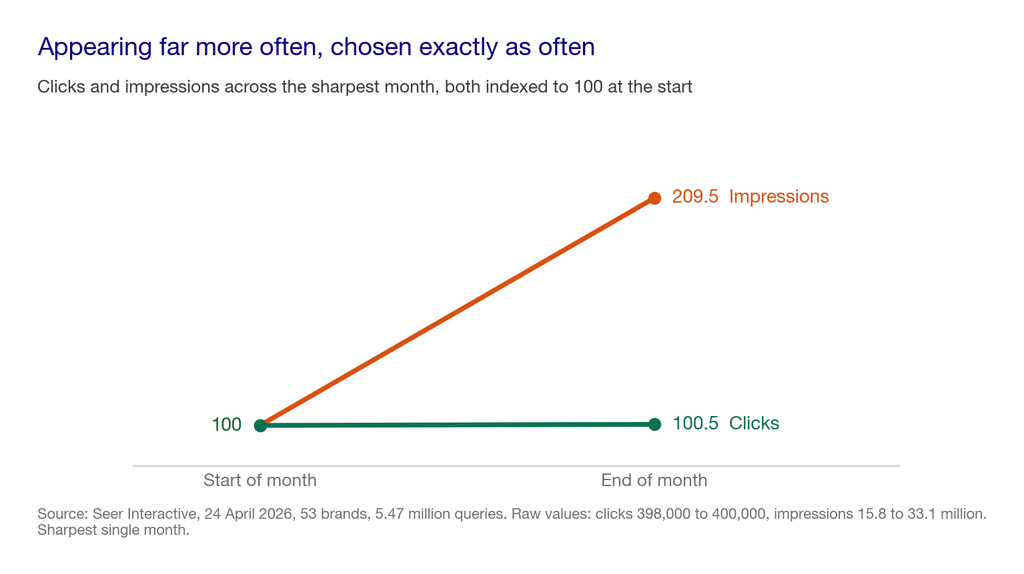
In an analysis of 53 brands, 5.47 million queries and 2.43 billion organic impressions, published 24 April 2026, the sharpest month showed clicks moving from 398,000 to 400,000 while impressions rose from 15.8 million to 33.1 million. Clickthrough is clicks over impressions, so the rate halved. Nobody lost a visitor and nothing about performance changed.
Therefore the honest framing is that rank is now an intermediate variable. It still matters, because you cannot be clicked without being shown. On its own it no longer measures anything sufficiently.
What still moves organic search rankings
Now the part the question actually asks for. The levers are unglamorous and largely unchanged.
1. Be retrievable, before anything else. A study published 21 May 2026 evaluated six chatbots against 2,100 factual questions and found retrieval, not reasoning, drove more than 70% of all errors. The same applies to classic ranking: a page that cannot be fetched, parsed or indexed cannot rank. Check indexation by template, crawler access in robots.txt, and whether revenue pages render without JavaScript. Our guide to how AI search actually works walks the full pipeline.
2. Answer one question completely, on one page. The unit that competes is the passage, not the document. A section that leans on the three paragraphs above it will not survive the lift into an answer or a snippet.
3. Earn corroboration you do not control. Third-party coverage separates a page an engine merely retrieves from one it trusts. This is the slowest lever and the one with the highest ceiling.
4. Match the question’s language, in the places where that helps. Headings that mirror how buyers actually ask are worth more on some surfaces than others, which we come to below.
5. Hold what you already have. Covered in its own section, because it is the lever most teams ignore and the cheapest one available.
If you want someone to run the first pass of this with you, book a growth audit and bring your template list.
What Google has retired, and what it never replaced
Google’s own guidance, last updated 10 July 2026, lists four tactics as unnecessary, and all four are still sold as ranking work: content chunking, AI-specific rewrites, llms.txt, and structured-data over-optimisation.
More usefully, the same guidance states there is no separate AI index. Its AI features run on core ranking systems. So the common 2026 plan of running an SEO programme and an AI visibility programme side by side is one programme being paid for twice.
Carry the caveat: Google describes Google. No other engine publishes equivalent documentation. That still covers the largest surface most readers care about, and nobody has contradicted it in writing.
Holding what you have beats gaining more
This is the lever almost nobody pulls, and the arithmetic is simple enough to check in a spreadsheet.
Let P be the pages you publish per quarter that earn meaningful traffic, and d the fraction of your working library that stops earning each quarter. Then your library converges on:
L* = P / d
Doubling output doubles the ceiling. Halving decay doubles it too. The difference is that the first costs twice the content budget every quarter forever, and the second works on pages you have already paid to produce once.
So before commissioning anything new, count the pages that earned meaningful traffic four quarters ago, then count how many still do. One minus that fraction is your decay rate, and it takes an afternoon. Our compounding organic growth engine sets out the full model.
Three outcomes of a ranking gain, and only one is good
Here is the diagnostic that replaces “did we rank better”.
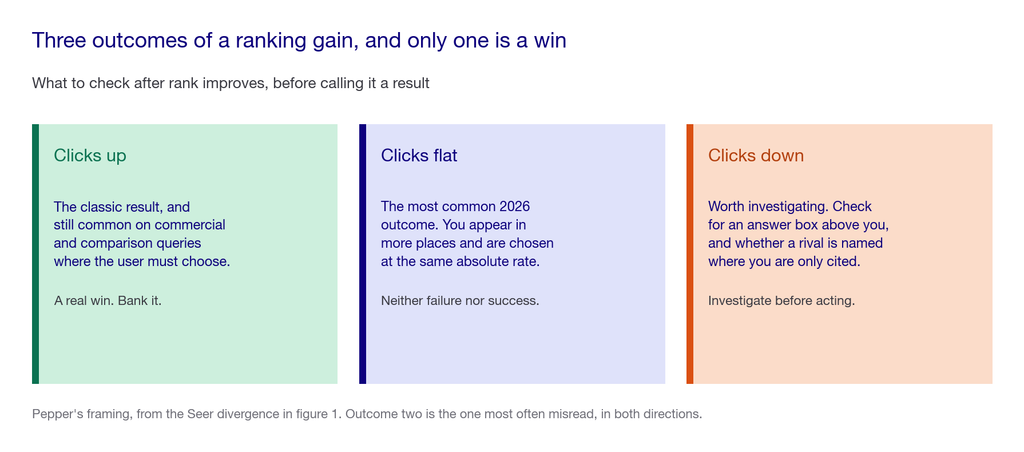
Outcome one: rank up, impressions up, clicks up. The classic result, and it still happens, mostly on commercial and comparison queries where the user needs to choose between options.
Outcome two: rank up, impressions up, clicks flat. The most common result in 2026 and the one that gets misread in both directions. You are appearing in more places and being chosen at the same absolute rate. This is not failure and it is not success. It usually means the query is being satisfied in the result.
Outcome three: rank up, impressions up, clicks down. The one worth investigating. Check whether an AI answer now sits above you, whether the query is informational enough to answer in place, and whether the answer names a competitor while merely citing you. Our page on mentions against citations covers that last distinction.
Your category sets the baseline
A ranking gain is measured against a moving floor, and the floor is falling in most categories.
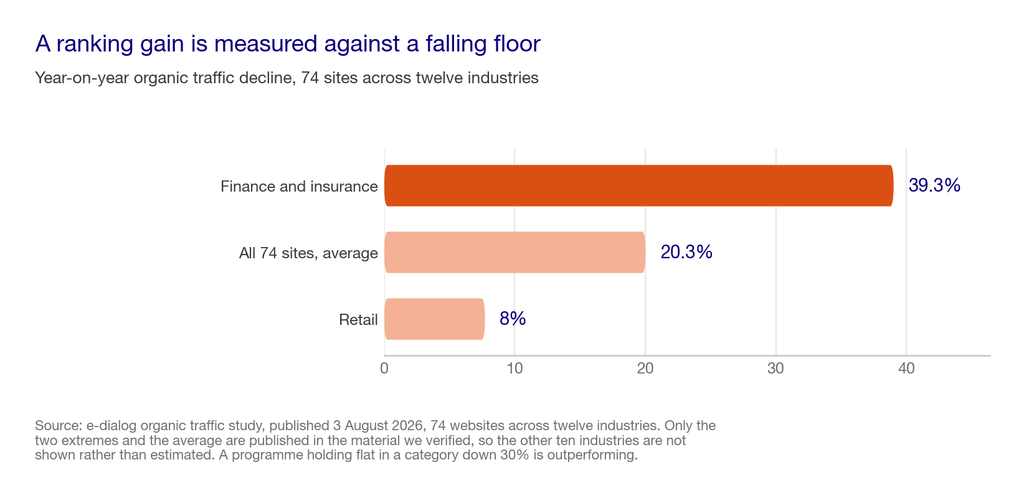
Across 74 websites in 2026, organic traffic fell 20.3% year on year, with declines running from 39.3% in finance and insurance to 8.0% in retail.
So a programme holding traffic flat in a category down 30% is outperforming, and judged against last year’s absolute numbers it looks like it is failing. Our five-cause diagnosis works through separating a real decline from this one properly.
How we weighted the ranking levers
Five levers, and they are not worth the same.
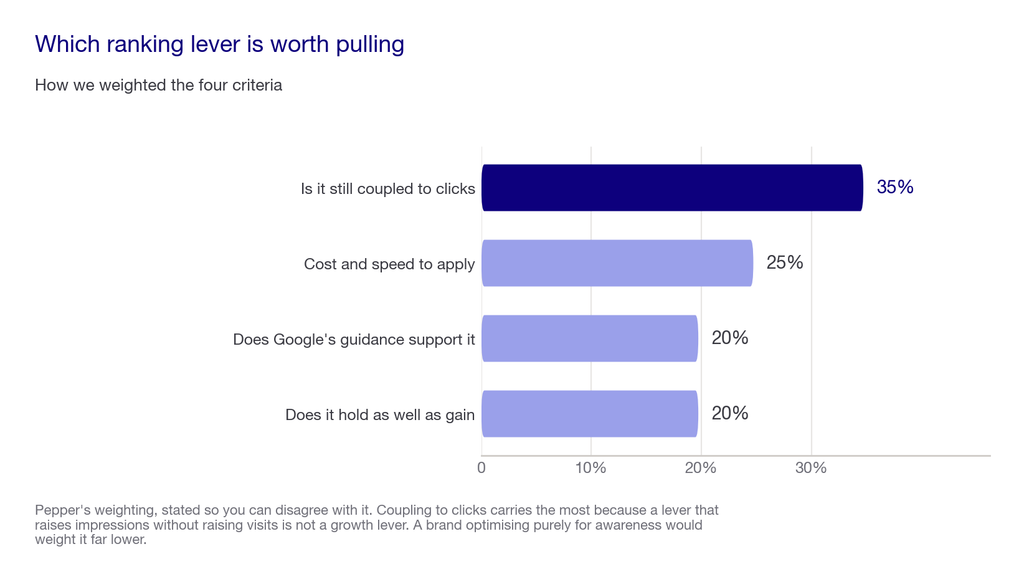
| Criterion | Weight | Why it carries that weight |
|---|---|---|
| Is it still coupled to clicks | 35% | A lever that raises impressions and not visits is not a growth lever, whatever it does to rank. |
| Cost and speed to apply | 25% | Retrieval fixes take an afternoon. Earning corroboration takes quarters. |
| Does Google’s guidance support it | 20% | Four popular tactics are retired by name, and doing them is pure cost. |
| Does it hold as well as gain | 20% | Halving decay does as much as doubling output, on pages already paid for. |
The ranking levers at a glance
| Lever | Time to apply | Cost | Still coupled to clicks | Where it fails |
|---|---|---|---|---|
| Retrievability | Days to weeks | Free, technical time | Yes, it is a precondition | Templates unindexed, JS-dependent pages |
| One complete answer per page | Quarters | The content budget | Partly, strongest on comparison queries | Sections that depend on their neighbours |
| Third-party corroboration | Quarters to years | High, and not fully controllable | Yes, and it has the highest ceiling | Categories nobody independent writes about |
| Matching buyer language | Days, per page | Free | Engine-dependent | Surfaces that rewrite the query before searching |
| Cutting decay | A quarter | Low, pages already paid for | Yes, it protects clicks you already earn | Nobody measures it, so nobody budgets it |
| Chunking, llms.txt, AI rewrites | Weeks | Real cost | No | Listed as unnecessary by Google |
What to do, in order
- Fix retrieval. Indexation by template, robots.txt, rendering. An afternoon, free, and nothing downstream works without it.
- Measure your decay rate. Then decide whether your next quarter is new pages or refreshes. Most libraries need refreshes.
- Stop the retired tactics. Four of them, named above, are pure cost.
- Re-baseline against your category, not against last year’s absolute traffic.
- Change what you report. Rank and impressions are diagnostics. Clicks and pipeline are outcomes. Put them in different sections of the deck.
- Only then commission new pages, and commission them against questions nobody has answered completely rather than against keywords.
What this costs
The first four steps cost nothing but time. Retrieval is an afternoon, the decay measurement is an afternoon, stopping the retired tactics saves money, and re-baselining is a spreadsheet change.
The expensive levers are the slow ones. Producing complete pages is the content budget, and earning third-party corroboration is slower still and not fully in your control. Published agency retainers for this work run from $3,000 to $25,000 a month depending on scope. Do the free half first, because it changes what the paid half is worth.
How Pepper fits
Pepper is an agentic organic growth engine and an organic growth partner, which means three things working together rather than one product.
Pepper’s GEO platform is the self-serve workspace. Brand profile, competitors, personas, GA4 and Search Console connected, themes and prompts defined, with Brand Visibility, Domain Prompt Presence and Share of Voice across six engines, including ChatGPT, Perplexity, Gemini and Google AI Overviews. The connected Search Console data is the part that matters here, because the rank, impressions and clicks divergence is read there rather than in any AI metric.
Agent Atlas is where your team builds, versions and runs its own agents, with quick runs for one input and sheet runs for bulk. Quarterly cohort work across a few hundred pages, to separate the ones holding from the ones decaying, is exactly what it exists for.
The growth team is attached to the account and works alongside yours, which matters most on the corroboration lever, where the work is earning coverage on pages you do not own.
Where it falls short: we cannot restore the old coupling between rank and traffic, and neither can anyone else. If a query is now satisfied inside the result, ranking first for it returns less than it did, and no programme changes that. Our platform also measures presence in AI answers rather than ranking, so the ranking half of this article is Search Console work, not something our product reports.
Eight years, more than 250 enterprises, more than 10 million tracked prompts. You can see the shape of the work in the Acceldata case study, in how we run it for B2B SaaS brands, and across the case study library.
How to choose which lever to improve organic search rankings first
The decision is sequencing, and most teams start with the most expensive lever. So here are the criteria, weighted.
The weighted scorecard
Score each row from 1 to 5, multiply by the weight, and total out of 100.
| Criterion | Weight | Score 1 means | Score 5 means |
|---|---|---|---|
| Indexation health by template | 35 | Whole templates missing from the index | Everything indexed, crawlers allowed |
| Your measured quarterly decay rate | 25 | Above 20%, nothing compounds | Under 5%, pages work for years |
| Share of your queries that are commercial | 20 | Mostly informational, answerable in place | Mostly comparison and purchase |
| Third-party coverage of your category | 20 | Nobody independent writes about you | Regular coverage you can build on |
Under 40, stop commissioning and fix the basics. From 40 to 70, refresh before you publish, and re-baseline your reporting. Above 70, your constraint is corroboration, which is a slow programme rather than a ranking tactic.
The weaker playbook against the stronger one
The weaker approach is to pick a ranking checklist, apply it to the library, and report rank improvements to the board. It produces a chart that goes up and a pipeline that does not, and it survives about two quarters. The stronger approach is to fix retrieval, measure decay, re-baseline against your category, and report rank as a diagnostic next to clicks as an outcome. One optimises the metric. The other optimises the thing the metric was supposed to stand for.
Run a live test before you commit a quarter
Take 20 questions that matter commercially, written as your buyers actually phrase them, such as “best inventory software for a small manufacturer”, “how do I reduce payment failures at checkout”, or “alternatives to the market leader for a regulated firm”. Record rank, impressions and clicks for each. Re-check at 30 days and again at 90 days. If rank and impressions rise while clicks hold flat, you have outcome two, and the lever you are pulling is no longer connected to the result you want.
Red flags
- Guaranteed rankings by a date, which Google’s own guidance advises against
- A ranking report with no clicks column next to it
- Any plan built on content chunking or llms.txt, both listed as unnecessary
- A separate AI visibility programme sold alongside an SEO programme, when there is one index
- Progress shown as clickthrough rate with no impressions alongside
- A proposal with no refresh line, which assumes pages never decay
- Benchmarks quoted against an industry average when category spreads run five-fold
Five questions worth asking any agency
- What is my indexation rate by template, and did you check it before proposing content?
- What decay rate did you measure, and how much of the retainer goes to refreshes?
- Which of your recommendations appear on Google’s retired list?
- How will you report a ranking gain that produces no extra clicks?
- What is my category’s baseline, and are we measured against it or against last year?
The reducing principle. It comes down to one question: is this lever still connected to a click? Retrieval is, because nothing happens without it. Corroboration is, because it decides whether you are chosen rather than merely shown. Rank on an informational query that an answer box now satisfies is not, however high you climb. Everything else here is a refinement of that test.
The honest closing note. If your templates are indexed, your decay is under control and your queries are mostly commercial, you do not need us to improve your rankings, and the remaining work is corroboration you earn rather than buy. We would rather say that than sell a ranking programme to a team whose rankings are already fine and whose problem is that ranking no longer pays what it used to.
What nobody should promise you
- A ranking by a date. Google’s own guidance advises against providers who guarantee them.
- That a ranking gain will produce traffic. In 2026 it often does not, and the evidence is specific.
- A benefit from llms.txt or chunking. Both are listed as unnecessary by Google.
- A separate AI ranking system to optimise for. There is one index and one set of ranking systems.
- Results measured against a flat baseline, in a year organic fell 20.3% across 74 sites.
Where this stops working, including for us
The divergence evidence is one analysis. 53 brands, weighted towards companies that buy enterprise search tooling, and the clicks-against-impressions comparison is the sharpest single month rather than the whole dataset. We use it because the authors published the underlying numbers, which most people quoting their headline did not read.
The retrieval evidence is strong but narrow, covering news questions over fourteen days, where retrieval plausibly matters more than in a stable commercial category.
The decay model is deliberately simple. It assumes steady decay and steady publishing, and real libraries do neither. It is useful for comparing decay rates, not for forecasting.
And Google describes Google. The retired list and the single-index statement come from its own documentation, and no other engine publishes equivalent guidance.
Our own position is not neutral. A complicated ranking discipline suits us, which is exactly why this article says the levers are mostly old, mostly free, and that four of the ones being sold do nothing.
Where to go next
- For the full pipeline behind retrieval, read the five stages from query to answer.
- For the library arithmetic, read the compounding organic growth engine.
- If traffic is already falling, work through the five-cause diagnosis.
- For whether the aggregate story is even true, read is Google sending less traffic.
- For how much of the discipline has actually changed, read AEO vs SEO vs GEO.
Frequently asked questions
How do I improve my organic search rankings?
Be retrievable, answer one question completely per page, and earn third-party corroboration. Those levers are largely unchanged. What has changed is that a ranking gain no longer reliably produces traffic, so check clicks alongside rank before calling it a win.
Why did my rankings improve but my traffic did not?
Because rank, impressions and clicks have come apart. In one 2026 analysis impressions more than doubled while clicks held flat at around 400,000. You appeared in far more places and were chosen at the same absolute rate.
What is the fastest way to improve rankings?
Fix retrieval. Indexation by template, crawler access and rendering. It takes an afternoon, costs nothing, and a page that cannot be fetched or parsed cannot rank at all, whatever else you do to it.
Do I need a separate strategy for AI search?
No. Google states its AI features run on core ranking systems, so there is no separate AI index. Running an SEO programme and an AI visibility programme side by side is usually one programme being paid for twice.
Does llms.txt help my rankings?
Google lists it as unnecessary and does not use it. The same guidance also retires content chunking, AI-specific rewrites and structured-data over-optimisation. Treat all four as low priority rather than as ranking work.
Should I publish more content or refresh what I have?
Measure first. Your library ceiling is pages published per quarter divided by your quarterly decay rate, so halving decay has the same effect as doubling output and works on pages you have already paid for.
How do I know if a ranking gain is worth anything?
Check all three numbers together. Rank up with clicks up is a real win. Rank up with clicks flat usually means the query is being satisfied in the result. Rank up with clicks down is worth investigating properly.
Is organic search still worth investing in?
In most categories yes, but the baseline matters. Organic fell 20.3% year on year across 74 sites in 2026, from 39.3% in finance to 8.0% in retail, so judge your programme against your sector rather than your own prior year.
Sources and further reading
- Seer Interactive AI search analysis, published 24 April 2026. 53 brands, 5.47 million queries, 2.43 billion organic impressions, January 2025 to February 2026. Source of the clicks holding at 398,000 to 400,000 while impressions rose from 15.8 million to 33.1 million. One analysis, weighted towards companies buying enterprise search tooling, and the single sharpest month.
- Suzgun, Shen, Bianchi, Spangher, Icard, Ho, Jurafsky and Zou, Evaluating Commercial AI Chatbots as News Intermediaries, arXiv:2605.22785, submitted 21 May 2026. Six chatbots, 2,100 factual questions over fourteen days. Source of the finding that retrieval drives more than 70% of errors. News questions are unusually time-sensitive.
- Google Search Central, guide to optimising for generative AI features, page last updated 10 July 2026. Source of the core-ranking-systems statement, the four retired tactics, and the advice against guaranteed rankings. Google describes Google Search only.
- e-dialog organic traffic study, published 3 August 2026. 74 websites across twelve industries. Source of the 20.3% decline and the 39.3% to 8.0% category spread.
- Pepper, the library ceiling arithmetic, for the decay model in full.
- Pepper, the AI search pipeline, for the retrieval stage in depth.
- Pepper, the five-cause traffic diagnosis, for separating a real decline from a reporting one.
- Pepper, what the aggregate data actually shows, for the evidence ranked by design quality.
- Pepper, why being shown and being named differ, and what each outcome is worth.
A note on sources. Only sources published in 2026 are cited. The decay model is Pepper’s own arithmetic, stated in full so you can disagree with it.
Latest Blogs
Choosing a GEO agency for mid-market B2B used to be a shortlisting problem. It is now a procurement problem, because the published prices have largely gone. Of four agencies publishing a GEO-specific figure in September 2026, two had withdrawn their pricing pages by early October and one had moved domains. Exactly one still publishes a number a mid-market buyer can act on. So the useful question is no longer which agency is best in the abstract, but how to compare three quotes when only one of them arrived with a method attached.
Third-party sources and AI citations are tightly linked, and the link stops short of where most plans assume. Off-page work decides whether an engine retrieves and cites you. It does not decide whether the answer names you, and 61.7% of brand appearances are citations with no name attached. The two largest 2026 datasets also disagree about how much of the citation surface is third-party at all, one saying 84% and the other putting the brand bucket above half. That disagreement is definitional rather than factual, and it decides where a budget goes.
Why is my competitor showing up in ChatGPT and not me? Before accepting the premise, check it. Across 3,981 brand appearances studied in 2026, 61.7% were citations with no brand name in the answer and only 13.2% produced both. So there are three states that look identical from where you are sitting: genuinely absent, present as an unnamed source, and named less often than a rival. Each has a different cause and a different fix, and working on the wrong one is the most common way this gets expensive.
Get your hands on the latest news!

Similar Posts
Artificial Intelligence
11 mins read
What is anchor text, and does it still matter in 2026?
SEO
11 mins read
What is internal linking? Meaning, and what changed for AI search
SEO
15 mins read