SEO automation in 2026: what to automate, what to never automate
The short answer
Automate the work where the output is checkable and a mistake is cheap: rank and crawl monitoring, log analysis, internal link discovery, schema generation, reporting, brief scaffolding. Never automate the judgement calls where a mistake compounds quietly: what to publish, what a claim asserts, and anything that generates pages at scale.
Key takeaways
- The question is not what software can do. Google’s spam policy tests the output, and says scaled content abuse targets unoriginal content “no matter how it’s created”. Automation is neither the offence nor the alibi.
- Retrieval is where agents break. A Stanford-led evaluation published in May 2026 found retrieval failures, not reasoning failures, drive over 70% of chatbot errors. So verification is the last thing you should hand over, not the first.
- The 2026 shift is agents that act, not tools that draft. Google now publishes guidance on agentic browsing, including how browser agents read a site through screenshots, the DOM and the accessibility tree.
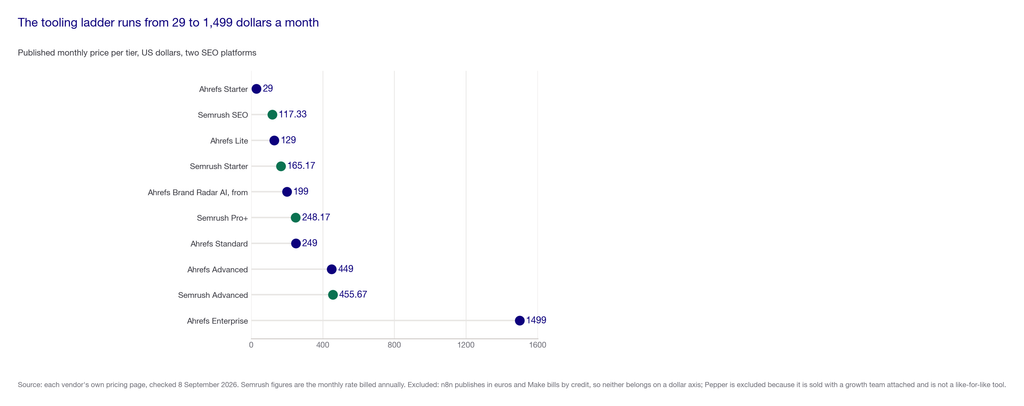
- Automation tooling is metered, so “automate everything” has a bill attached. Published tiers across the two largest SEO platforms run from $29 to $1,499 a month before anyone automates anything.
- Our rule across the accounts we run: a human governs, agents execute. Move a task outward from in the loop to outside the loop only after it has earned it.
A note on where this comes from. I have spent eight years watching organic programmes work and break inside real companies, and this is written from that rather than from a feature comparison. Pepper runs organic for more than 250 enterprises and tracks over 10 million prompts across every major engine. My view is shaped by that, by the client reviews I sit in each week, and by what operators tell us at the events we run. Pepper is an agentic organic growth engine and sells automation, so read this knowing we have a commercial interest in the answer.
Disclosure: Pepper is included in the comparison below and published this guide. So we have placed ourselves in a separate category rather than ranking ourselves against tools we do not directly compete with. We have also applied the same scrutiny to ourselves as to everyone else, including a “where it falls short” section. Every tool description and every price comes from that company’s own website as of 8 September 2026, rather than another roundup. Where a company does not publish pricing, we have said so rather than estimating it. Pepper is excluded from the pricing figure, because we are sold with a growth team attached and are not a like-for-like tool.
What is SEO automation, and what does it actually replace?
SEO automation is any workflow that replaces a recurring human action in organic search with a triggered, scheduled or agent-run process. Rank tracking, crawl monitoring, log parsing, internal link discovery, schema generation, brief scaffolding and reporting are the usual candidates. It is ordinary search work with the manual steps taken out, which is why the fundamentals in AEO vs SEO still decide whether any of it pays off.
The definition matters less than the second question, which almost nobody on this topic asks. What is being replaced: the doing, or the deciding?
Most 2026 tooling replaces the doing, and that is genuinely useful. The category shifting under everyone’s feet is the other kind, where an agent decides and then acts without a person in between.
Google has started documenting that shift. Its guidance describes AI agents as “autonomous systems that can perform tasks on behalf of people”. It also notes that browser agents may read your site by “analyzing visual renderings (like screenshots), inspecting the DOM structure, and interpreting the accessibility tree”. For the wider context on how this changes organic, that is the argument in the enterprise playbook.
The line, and why every tool list misses it
Here is the reframe this topic needs.
Teams ask whether automating a task is safe. Google’s spam policy does not test the task or the method. It tests the output. Scaled content abuse is “when many pages are generated for the primary purpose of manipulating search rankings and not helping users”. The policy targets unoriginal content that provides little value “no matter how it’s created”.
Read that twice, because it cuts both ways. Automation is not the offence. Automation is also not a defence. A human writing 400 thin pages is in the same position as an agent writing them.
That single sentence does more work than any tool comparison. The line is drawn at volume of low-value output, not at whether a machine was involved.
Google’s own guide adds the specific trap. It says that “creating separate content for every possible variation of how people might search primarily to manipulate rankings violates Google’s scaled content abuse spam policy.”
So the honest test for any automation you are considering is three questions. Is the output checkable by a person in reasonable time? Is a mistake cheap and reversible? Does it create pages at scale? Automate freely when the first two are yes and the third is no.
Never automate the part where an agent is weakest
There is a second line, and it comes from measurement rather than policy.
In May 2026 a Stanford-led team evaluated commercial AI chatbots and reported that “retrieval, not reasoning, failures drive over 70% of all errors”. When the models found the right source, they usually extracted the right answer. Finding the right source was the failure.
That finding lands directly on SEO automation. Think about the tasks people are most eager to hand over: research a claim, find a supporting statistic, check a competitor’s position. Those are all retrieval tasks. They are the tasks agents are measurably worst at.
Where it falls short: that study measured news questions put to commercial chatbots. It did not measure an agent running inside your stack against your own sources. It tells you which step is fragile, not how your pipeline performs.
The operational conclusion holds anyway. Verification is the last thing to automate, not the first. In the accounts we take over, the most common cause of a public correction is an unverified statistic that an automated draft carried and nobody re-checked.
Our view: a human governs, agents execute
Most agencies use AI somewhere. The distinction that matters is who governs.
We run this as a ladder rather than a switch. Every task starts with a person approving each output, and earns its way outward only after it has demonstrated it can be trusted at that level.
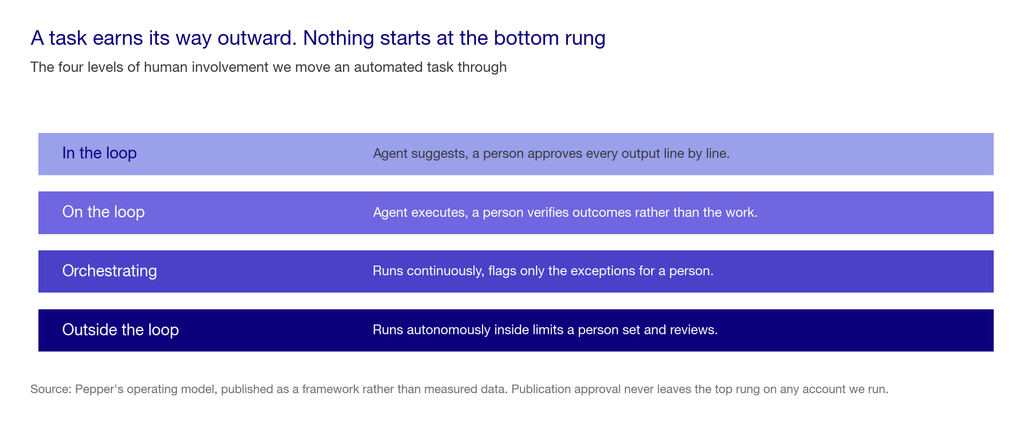
A task moves outward on evidence, and it moves back inward the moment it produces something a person would not have approved. Nothing starts at the bottom rung. The wider version of this, covering how the whole function is wired, is our AI search operating system.
This is also how Atlas is built. Agents are workflows, not a chat box. System agents are fixed and user agents are editable and versioned, so a team can see what an agent did and roll it back. Customers log in and build and run their own agents, with quick runs for a single input and sheet runs for bulk. A Pepper growth team is attached to the account, doing the work alongside them. Agents for scale, experts for judgement, one team on the hook for the number.
If you want to know which of your own tasks are safe to move outward, book a growth audit and we will go through them with you.
How we scored what belongs on the automate list
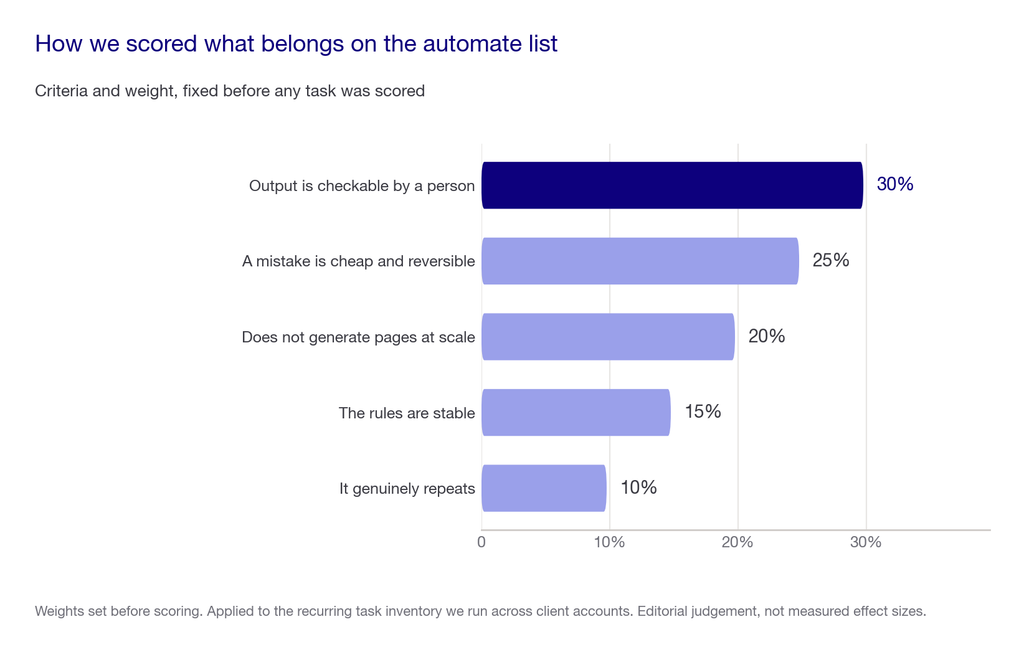
Five criteria, weighted before anything was scored. A task had to clear the first two to make the list at all.
| Criterion | Weight | What a task has to demonstrate |
|---|---|---|
| Output is checkable by a person | 30 | A reviewer can confirm the result is right in minutes, using something other than the same system that produced it |
| A mistake is cheap and reversible | 25 | The worst case is rework or a stale report, not a published claim, a de-indexed section or a customer seeing something wrong |
| Does not generate pages at scale | 20 | The task produces analysis, alerts or scaffolding rather than large volumes of publishable pages, which is where the spam policy actually bites |
| The rules are stable | 15 | The logic holds for months without a human rewriting it, so the automation does not quietly rot into wrong answers |
| It genuinely repeats | 10 | It happens weekly or more often, because automating a quarterly task costs more to maintain than it saves |
SEO automation tools at a glance
Named, never linked, with every price read off the vendor’s own pricing page on 8 September 2026. Prices move, so re-check before you buy.
| Tool | What it automates | Published price | Billing unit | Where it falls short |
|---|---|---|---|---|
| Semrush | Position tracking, site audits, reporting, plus AI Visibility prompt tracking | SEO $117.33, Starter $165.17, Pro+ $248.17, Advanced $455.67 per month billed annually; Enterprise on request | Seats and projects, with AI prompts metered at 50, 100 and 200 by tier | Measures and reports. It does not execute the fix, and the prompt allowance is small enough that a real category needs a higher tier |
| Ahrefs | Crawling, rank tracking, backlink monitoring, with Brand Radar for AI prompts | Starter $29, Lite $129, Standard $249, Advanced $449, Enterprise $1,499 per month; Brand Radar AI from $199 | Projects and tracked keywords | Same limit: strong diagnostics, no execution layer, and AI monitoring is a separate paid product rather than part of the core plan |
| n8n | General workflow automation you wire up yourself, including SEO pipelines | Starter EUR 20, Pro EUR 50, Business EUR 667 per month billed annually; Community Edition free self-hosted | Workflow executions, not seats | It is a build-your-own toolkit with no SEO opinion in it, so you supply the judgement, the data sources and the maintenance |
| Make | The same general automation, aimed at non-engineers | Free tier $0 for 1,000 credits, Make Plan $9 for 5,000 credits, Company on request | Credits, one per module action | Credit billing makes cost unpredictable at scale, and like n8n it knows nothing about search |
| BrightEdge | Enterprise-scale coordination and reporting across teams | Not published | Not published | Publishes no pricing, so budget discovery is a sales process |
| Pepper, separate category | Agents that execute organic work, run by the customer and by an attached growth team | Not published | Not published | We are built for teams running organic as a long-term function, so a one-off audit or a pure self-serve toolkit is not what we are for |
What to automate, and it is more than most teams do
These clear all five criteria comfortably, and in the accounts we run they are automated on day one.
Monitoring and alerting. Rank movement, crawl errors, broken links, page speed regressions, indexation drops, schema validation. The output is checkable, a mistake costs you a false alarm, and it repeats constantly. Nobody should be doing this by hand in 2026.
Log and crawl analysis at scale. Which pages bots actually reach, how often, and where crawl budget goes. This is the work humans do badly and slowly. It feeds crawlability decisions that would otherwise be guesses.
Internal link discovery. Finding the candidate links, not placing them. An agent surfacing every page that could reasonably link to a new post saves hours. A person still picks and writes the anchor.
Schema generation from existing content. Deterministic, template-driven, and validated by a checker rather than an opinion. If you are unsure which types earn their place, we cover that in schema markup.
Brief scaffolding. Pulling the SERP, the questions, the competing headings and the existing internal links into a brief skeleton. The writer still decides the argument.
Reporting. Any recurring report is automation’s easiest win, and the one teams strangely resist because the manual version feels like accountability. Automate the delivery, then decide what to track and what to ignore, because a fast report of the wrong number is worse than no report.
The pattern across all six: they produce information for a person to act on, or scaffolding a person then finishes. None of them publishes anything.
What to never automate
The decision to publish. An agent can prepare a page. A named person approves it. This is the single rung we have never moved outward on any account, because it is the one where a mistake goes public.
Verification of any claim. Covered above, and the reason is measured rather than cultural: retrieval is where agents fail most. Every statistic gets checked at its primary source by a human before it ships.
Page generation at scale. This is where the spam policy bites, and the volume is the violation. If your automation’s output is measured in pages per week rather than decisions per week, you have built the thing Google’s policy describes.
Anything expressing a point of view. An agent can assemble the evidence for a position. It cannot hold one, and a piece with no view is the most substitutable content on the internet.
Outreach that pretends to be personal. Automated personalisation at volume reads as automated, damages the relationship you were trying to build, and the reply rate tells you so.
Whatever you cannot explain. If nobody on the team can describe what an automation does and why, it is not an asset. It is an unowned risk with a login, and this is why we insist on a named owner for AI search work rather than a shared inbox.
What SEO automation actually costs
Three costs, and teams underestimate two of them.
The licence cost is the visible one, and the figure above shows the range: $29 to $1,499 a month in published tiers, before anyone builds a workflow. Add prompt tracking or AI monitoring and it climbs, because those are metered separately.
The build cost is the one that surprises people. A workflow tool is a toolkit, not a solution. Somebody has to design the pipeline, connect the data sources and decide what happens when a step fails. That is engineering time, usually weeks, which is why the free self-hosted option is rarely the cheap one.
The maintenance cost is the one that kills projects. Automations rot. A selector changes, an API version moves, or a report keeps arriving with a subtly wrong number. Nobody notices for a quarter. Budget for someone to own that, or expect the automation to quietly stop being true.
Pepper does not publish pricing, so budget discovery with us is a conversation rather than a page. What I will say plainly: most of the monitoring automation in this article you can build yourself. A workflow tool and a competent engineer will do it, and you do not need us for that part.
What our automation actually produced
Proof, so this is not just a framework.
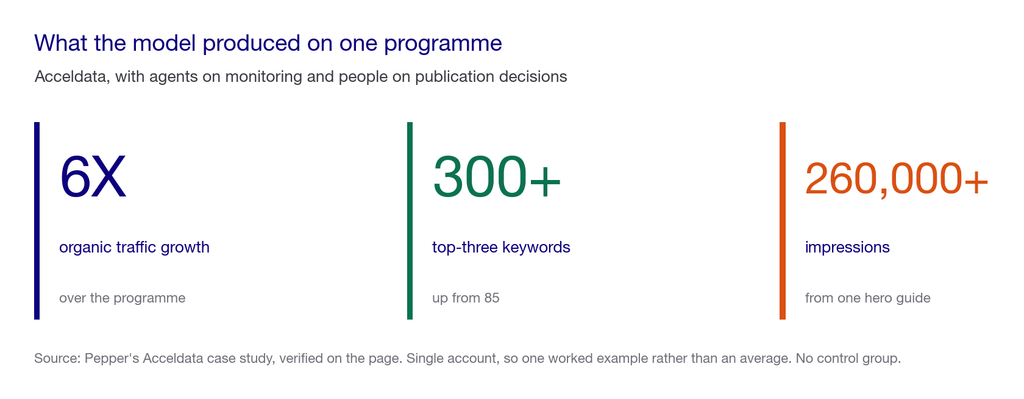
The Acceldata programme went from 85 to more than 300 top-three keywords, with 6X organic traffic growth and one hero guide carrying over 260,000 impressions. Agents did the monitoring, the crawl work and the scaffolding. People decided what to publish, and that division is the whole point.
Where it falls short: this is one account in B2B SaaS, not a benchmark. It shows the model working once, which is different from proving it generalises.
How to choose what to automate first
I would not start from a tool. I would start from a task inventory. Buying software before you know which work qualifies is how teams end up paying $455 a month for a dashboard nobody opens.
The framing judgement first, anchored outside Pepper. Google’s guidance says optimising for generative AI search “is optimizing for the search experience, and thus still SEO”, and its spam policy judges output rather than method. I think that is the correct frame and it is incomplete as a strategy, because Google is one engine and the others publish nothing comparable. Hold both. Do not buy a separate AI methodology, and do not assume Google’s answer covers Perplexity or ChatGPT.
Here is the 100-point scorecard I would run over any automation proposal, mine included.
| Area | Weight | What a strong proposal should demonstrate |
|---|---|---|
| Checkability of the output | 30 | A named reviewer can verify the result independently of the system that produced it, in minutes, with a stated pass criterion rather than a general sense that it looks right |
| Blast radius of a failure | 25 | The worst realistic outcome is rework or a wrong internal number, and there is a documented path to revert anything the automation changed on the live site |
| Volume of publishable output | 20 | The automation produces decisions, alerts or drafts for review rather than pages at scale, and somebody can state the weekly published-page ceiling out loud |
| Ownership and explainability | 15 | One named person can describe what it does, why, and what it costs, and a second person could take it over without archaeology |
| Maintenance plan | 10 | Someone owns the breakage, monitoring exists for the automation itself, and there is a stated review cadence rather than a hope |
Then run the live test on whoever wants your budget, including us. Give the team 25 questions taken from your own backlog. Each one is a real recurring task, and the question is the same every time: would you automate this, and why? For example: “generate 200 location pages from a template”, “check whether this statistic is still accurate at source”, “publish approved posts on schedule”, “rewrite the meta descriptions on 4,000 product pages”.
Ask them to come back with five things. Which of these you would automate today. Which you would never automate and why. Who reviews the output and against what criterion. What breaks first at scale. What exactly you would change in the next 90 days. A team that refuses two of the twenty-five for a stated reason is worth more than one that says yes to all of them. A vendor who cannot name a task they would not automate is selling you volume.
The weaker playbook, and most of what this SERP recommends: buy a tool, connect it, generate content at scale, add automated internal links, then watch a dashboard and hope. Every step is real work. The sequence has no theory of who is accountable when the output is wrong.
The stronger sequence: inventory the recurring work, automate monitoring and analysis first, keep verification human, automate scaffolding next, then instrument the automations themselves so you find out when one rots. Publication approval stays human permanently. It matters because the failure mode of automated SEO is not a bad ranking. It is a quiet, compounding volume of work nobody checked.
Red flags, each one a thing I have heard said in a real meeting. “It publishes automatically” as a headline feature should stop the conversation, not start it. “We can generate a thousand pages a month” is a description of Google’s scaled content abuse policy, quoted back to you as a benefit. “The AI checks its own work” ignores that retrieval is the weakest step. “No human in the loop” sold as maturity rather than risk. A tool that automates the fix on your live site with no diff, no approval step and no rollback. Any pitch that cannot tell you what happens when a step fails at three in the morning. And a vendor guaranteeing rankings, which Google itself advises against, because no third party has access to the ranking systems.
Five questions I would ask, and what a good answer sounds like.
- “Which task on this list would you refuse to automate, and why?” A good answer names one immediately and explains the failure mode. No answer means they have not thought about it or will not tell you.
- “Who reviews the output, and against what written criterion?” Look for a named role and a pass test, not “our team QAs everything”.
- “Show me the rollback.” Anything that changes the live site needs a diff and a revert. If it cannot be undone, it should not be automated.
- “What is the maintenance cost in twelve months?” The honest answer includes somebody’s time. A vendor claiming zero maintenance has not run this for a year.
- “How many pages a week does this publish?” The number should be small, and they should volunteer why.
If I reduce the whole thing to one principle: automate the work, never the accountability. A person stays on the hook for every output that reaches the public, and no amount of agent capability changes that.
The honest closing note, and it costs us something. Very few firms are equally strong across monitoring, technical execution, editorial judgement and attribution, ours included, and the good ones will tell you which is their weakest. Ask. A straight answer is a better signal than a complete-looking capability matrix.
What nobody should promise you
Nobody should promise that automation is safe because it is AI-assisted, or dangerous because it is. Google’s policy judges output, not method, and any vendor arguing either extreme has not read it.
Nobody should promise a fully autonomous SEO programme. The evidence on retrieval failure says the verification step needs a person, and the accountability for publication needs a name.
Nobody should promise zero maintenance, a guaranteed ranking, or a page volume as a benefit. We will not, and I would rather lose the deal than pretend otherwise.
Where this stops working, including for us
If your organic programme is small enough that one person holds the whole picture, most of this is premature. Automate the reporting, skip the rest, and revisit when the work outgrows one head.
Say you have fewer than roughly thirty recurring tasks worth automating, or nobody who can own a pipeline when it breaks. Then you do not need an automation platform yet, ours included. A workflow tool and a spreadsheet will hold for another two quarters.
Where Pepper falls short: we do not publish pricing, so budget discovery is a conversation rather than a page. We are built for teams running organic as a long-term function, with an internal team to work alongside. If you want a pure self-serve toolkit with nobody attached, that is not what we are. And if organic is not a real commitment for the next several quarters, I will say so and turn the work down.
Where to go next
Do the task inventory this week. It costs nothing and it tells you whether you have an automation problem or a headcount problem, which are different.
Then automate monitoring, because it is the safest and highest-yield rung, and leave publication approval exactly where it is. If you want the inventory run against your own programme, see where you show up first, or use our 7-point AI search audit as the starting checklist.
Frequently asked questions
What is SEO automation? SEO automation is any workflow that replaces a recurring human action in organic search with a triggered, scheduled or agent-run process. Common examples include rank tracking, crawl monitoring, log analysis, internal link discovery, schema generation and reporting.
Is automated SEO content against Google’s guidelines? Not by itself. Google’s spam policy targets scaled content abuse, meaning many pages generated primarily to manipulate rankings, and it applies “no matter how it’s created”. The volume of low-value output is the violation, not the use of software.
What SEO tasks should never be automated? The decision to publish, verification of any factual claim, page generation at scale, and anything expressing a point of view. Add outreach pretending to be personal, and any automation nobody can explain. Each one fails on checkability or blast radius.
Can AI agents do SEO without a human? Not reliably yet. A Stanford-led evaluation in May 2026 found retrieval failures drive over 70% of chatbot errors. Research and fact-checking are therefore where agents are weakest, and where supervision matters most.
How much do SEO automation tools cost? Published tiers across the two largest SEO platforms run from $29 to $1,499 a month, checked at their own pricing pages in September 2026. General workflow tools start lower, from free self-hosted options, but bill by execution or credit rather than by seat.
What is agentic SEO? Agentic SEO describes agents that act rather than tools that draft, executing changes and workflows instead of returning suggestions. Google now publishes guidance on agentic browsing, including how browser agents read sites through screenshots, the DOM and the accessibility tree.
Should I use a workflow tool or an SEO platform? Use an SEO platform for diagnostics and monitoring, because the data is the product. Use a workflow tool when you need to connect systems nobody else connects, and budget engineering time, because it supplies no search judgement of its own.
How do I know if an automation has stopped working? Instrument the automation itself, not only the site. Alert on missing runs, empty outputs and unusual volumes, then set a review cadence with a named owner. The common failure is a report that keeps arriving with a quietly wrong number.
Sources and further reading
- Google Search Central, spam policies for Google web search. Source of the scaled content abuse definition and the “no matter how it’s created” wording, plus the examples naming generative AI tools and automated transformations. Product documentation, current until Google changes it.
- Google Search Central, guide to optimizing for generative AI features, and the announcement post, 15 May 2026. Source of the agentic browsing guidance and the “still SEO” framing. Applies to Google Search only.
- Suzgun, Shen, Bianchi, Spangher, Icard, Ho, Jurafsky and Zou, “Evaluating Commercial AI Chatbots as News Intermediaries”, arXiv:2605.22785, submitted 21 May 2026. Source of the finding that retrieval, not reasoning, failures drive over 70% of all errors. Limitation: news questions put to commercial chatbots, not agents running inside a marketing stack.
- Vendor pricing read off each company’s own pricing page on 8 September 2026: Semrush, Ahrefs, n8n and Make. Not linked, per our policy of naming competitors without passing them authority. BrightEdge publishes no pricing.
- Pepper, Acceldata case study. Source of the 6X organic traffic, 85 to 300+ top-three keywords and 260,000+ impressions figures, verified on the page. One account, not a benchmark.
Latest Blogs
Most advice on this is inference dressed as fact. OpenAI documents exactly one thing clearly, which is access. Here is what is documented, what is inferred, and how to verify the rest for yourself.
Being named in an AI answer and having your page used as its source are different outcomes with different causes and different fixes. The gap between them is the most useful diagnostic in AI search, and most reporting collapses it into one number.
Every platform reports share of voice and almost none of them define it the same way. Here is the definition worth using, the three choices that change the number, and how to measure it yourself without buying anything.
Get your hands on the latest news!

Similar Posts
GEO / AI Search
10 mins read
How to get cited by ChatGPT
GEO / AI Search
10 mins read
Mentioned vs cited: the difference that decides AI visibility
GEO / AI Search
13 mins read