

Organic Growth /
Technical SEO
You have to crawl before you can rank.
Technical SEO makes your pages reachable and readable, for Googlebot and for the AI crawlers now reading your site on behalf of ChatGPT, Gemini, Perplexity and Copilot. We run it first in every engagement. Until it's fixed, nothing you build on top of it compounds.
What is technical SEO?
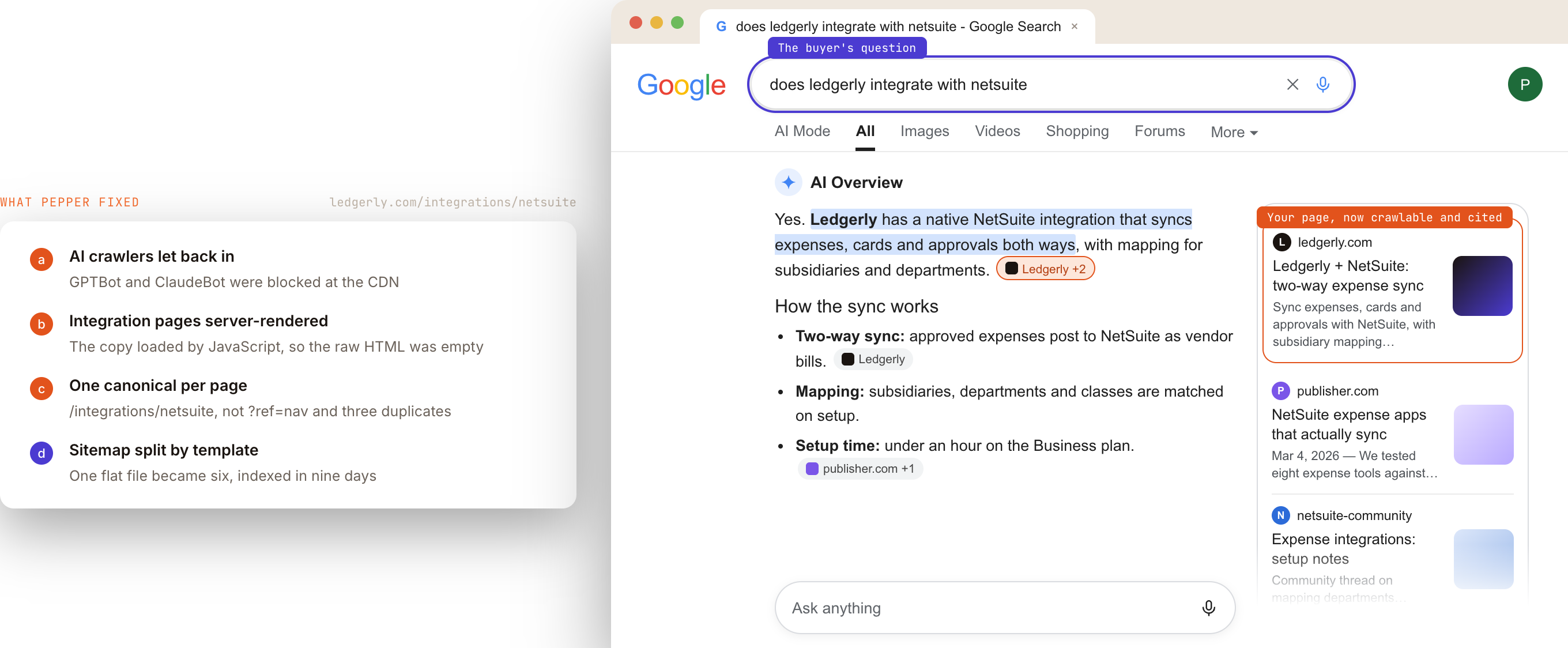
Technical SEO is the practice of making a website reachable and readable for search engines and AI crawlers. It covers crawlability, indexing, rendering, site architecture, page speed and structured data. It doesn't create demand on its own. It decides whether anything else a brand publishes can be found and quoted as the source of an answer.
What changed with AI search is access. ChatGPT, Perplexity, Claude and Google's AI systems send their own crawlers, and those crawlers follow different rules to Googlebot. A site can be fully indexed in Google and still be unreadable to the systems now answering your buyers' questions.
Pepper runs technical SEO as an ongoing service. We find what's broken, agree who fixes it, and keep checking it stays fixed as your site changes.
Why good content still doesn't show up
Most teams assume a visibility problem is a content problem, so they commission more content. Often the content was fine all along. The pages exist and read well, but no crawler can reach them.

949
URLs on one enterprise site we audited had no internal links pointing to them. No crawler could reach those pages, so nothing indexed them and no model was ever going to cite them. The content itself was fine.
Pepper technical audit · anonymised · figure pending clearance
01
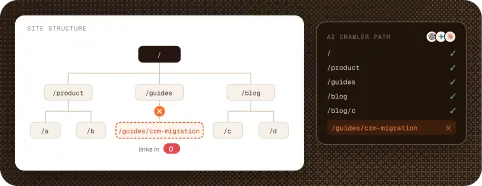
Orphan pages
Pages with no internal links and no sitemap entry. They're live and someone paid to write them, but nothing links to them.
02
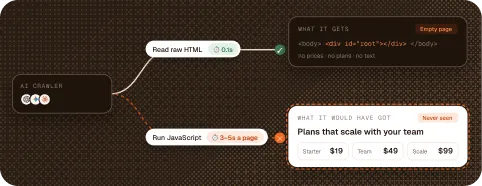
JavaScript-only rendering
The content appears in the browser but not in the raw HTML. Most AI crawlers don't execute JavaScript, so they see an empty page.
03
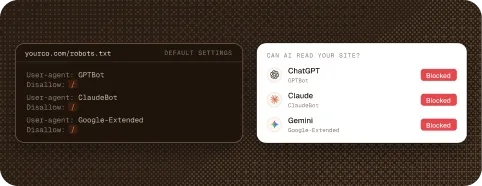
Blocked AI crawlers
GPTBot, ClaudeBot, PerplexityBot and Google-Extended disallowed in robots.txt, usually by a default setting nobody chose deliberately.

04
Answers inside images and PDFs
The spec table or the pricing grid. If it's a picture, a model can't quote it, so it cites a competitor who wrote it as text.
The work, in four parts
Every engagement starts with the same full technical read of your site. What follows depends on what it finds, and on where your engineering team wants the boundary drawn.
01
Access and indexation
Can engines and AI crawlers reach the pages that matter?
Full technical crawl covering indexability, crawl depth, orphan pages, redirect chains and canonical conflicts
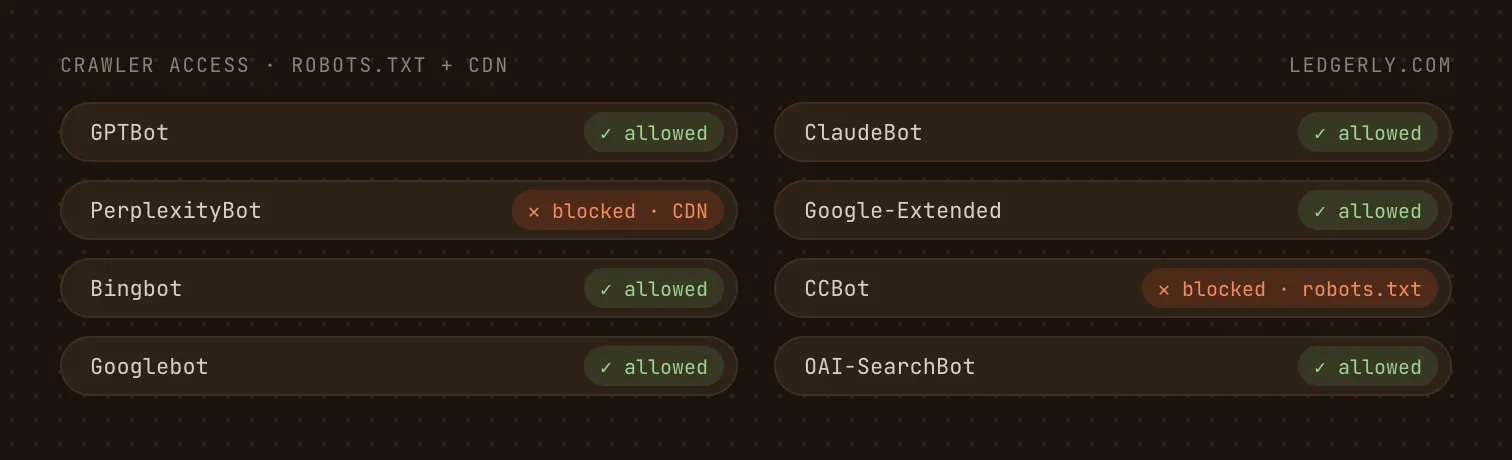
AI crawler access review with GPTBot, ClaudeBot, PerplexityBot, Google-Extended, Bingbot and CCBot checked against robots.txt, firewall rules and CDN bot policies
Log file analysis where the files are available, showing which pages crawlers actually request and which they ignore
XML sitemap architecture split by template instead of one flat file
Internal link structure mapped, with the fixes that give orphaned pages a route in
02
Rendering and performance
Is the content in the HTML, and does the page hold up on a phone?
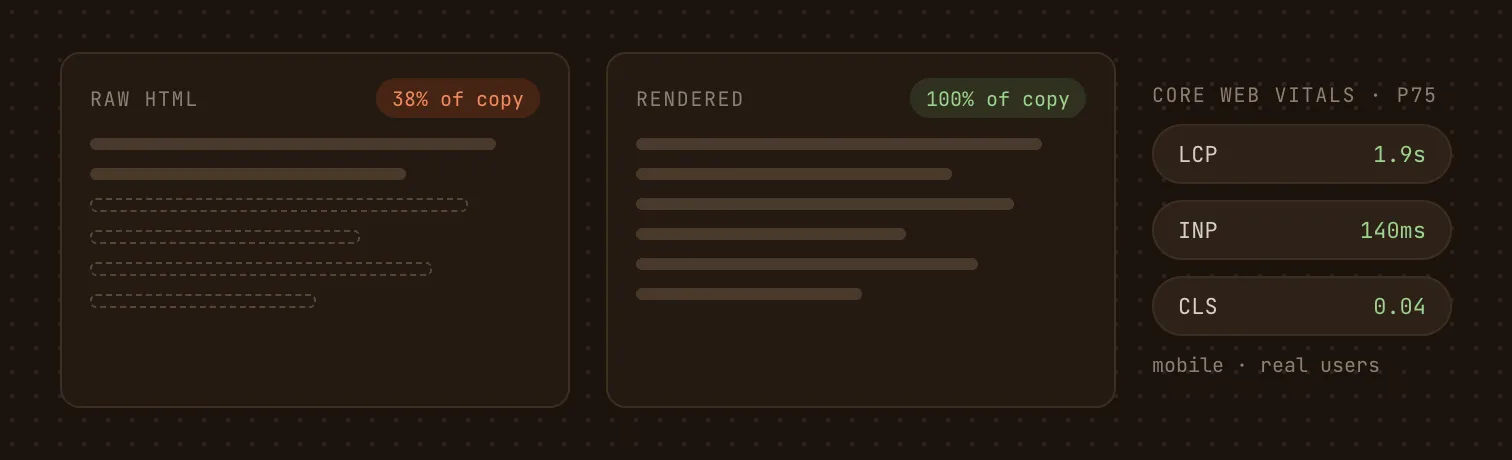
Raw against rendered: every template compared with JavaScript on and off, showing what a crawler that does not run scripts actually receives.
A rendering fix per template: server-side or static rendering for the templates that arrive empty, starting with the ones that hold your most-asked questions.
Core Web Vitals on real users: LCP, INP and CLS from field data, by template and on mobile, not a lab score for the homepage.
Weight cut where it pays: images, fonts and third-party scripts trimmed on the pages that earn traffic and citations.
03
Structure and markup
Does the page tell a model what it is?
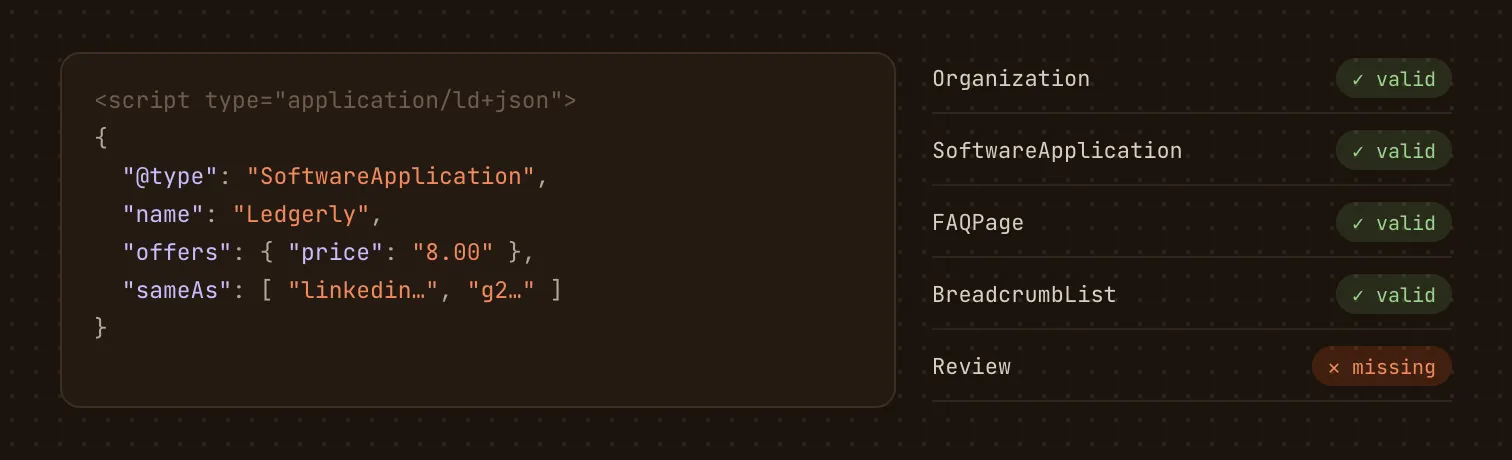
Schema by template: Organization, Product or SoftwareApplication, Article, FAQPage, BreadcrumbList and Review, mapped to what each template is for.
Markup that matches the page: every claim in the schema visible on the page, validated in the Rich Results Test and against Schema.org.
Headings, canonicals and hreflang: checked against how the site is actually built, so each question has one canonical answer.
One entity, described one way: your name, logo, sameAs links and core facts consistent across the site, so a model cannot confuse you with anyone else.
04
Implementation and monitoring
Who does the fixing, and how you know it held.
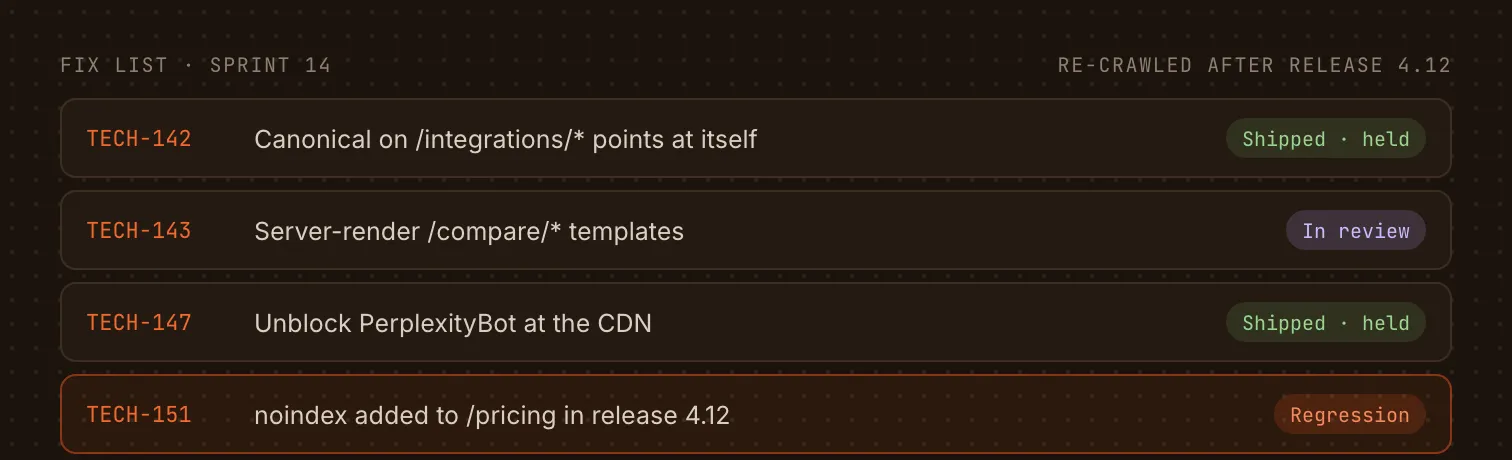
Tickets your engineers can pick up: each fix written with the reason, acceptance criteria and a priority, in your tracker rather than a 200-page export.
Or we ship it: where you give us CMS or repository access, Pepper makes the change and your team reviews it.
A re-crawl after every release: Agent Atlas checks what changed and flags a regression before it costs you a quarter.
Reported against your baseline: indexed pages, crawl errors, vitals and citations per URL, every week.
What changes, and when
Technical work is the fastest-moving part of an organic programme, because most of it happens on pages that already exist. That is also why it goes first.
Weeks 1 to 3
The audit, and the action list
Crawl, log files, rendering, schema and Core Web Vitals. You get a prioritised list with the reasoning behind each item, and no 200-page export.
Weeks 3 to 10
The fix cycle
Highest-impact items first. Indexation and rendering changes usually show in crawl and impression data within two to four weeks of going live.
Ongoing
Monitoring against your baseline
Releases bring old problems back more often than anyone likes. We check weekly and raise it before it costs you a quarter.
A caveat. Fixing access on its own won't win you an answer. It gets you in the running. The lift comes when structure and authority follow, in that order.
Agents for scale. Humans for judgment.
Crawl a 40,000-page site and you get thousands of flags, most of which don't matter. Software is good at sorting that pile. Deciding what to fix first, and making the case to your engineering team, still needs a person.
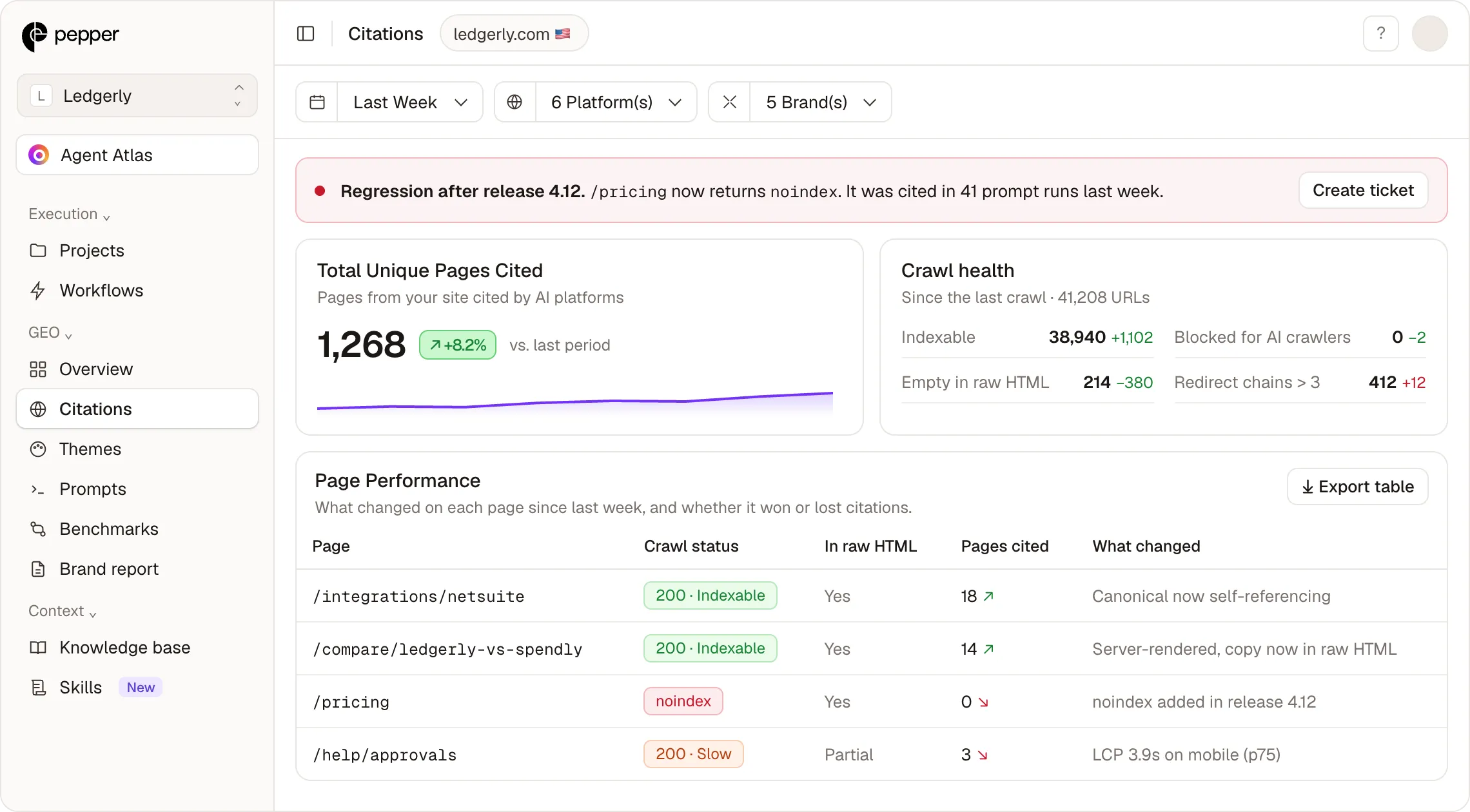
WHAT AGENT ATLAS RUNS
The continuous read
Set up on your data during onboarding, then running underneath the work.
>
Crawls and re-crawls, tracking what changed since last week
>
Pulls Search Console, analytics, SEO data and your CMS into one place
>
Flags regressions after a release
>
Tracks citations page by page, so you can see which URL won or lost an answer
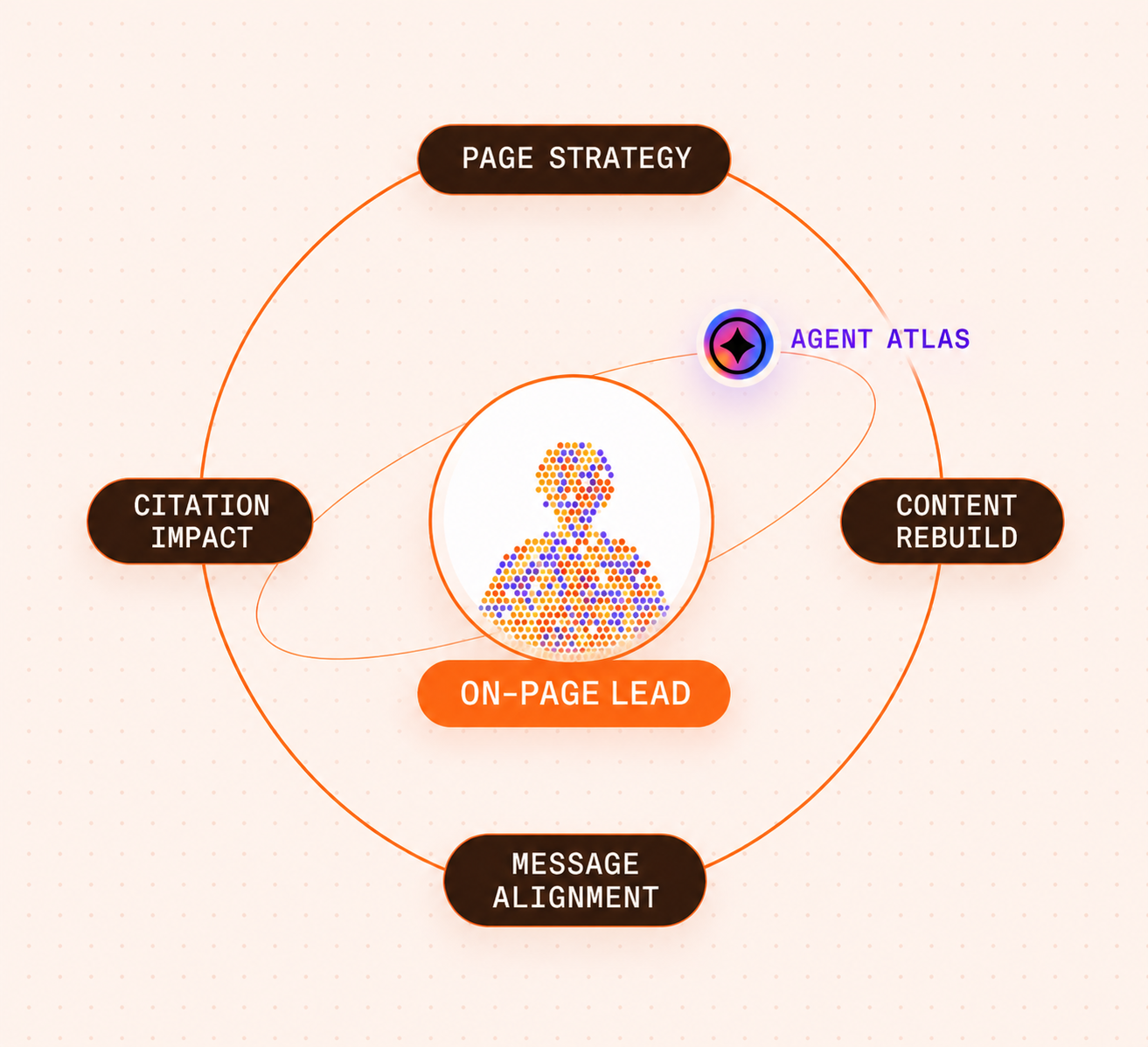
WHAT THE SPECIALIST OWNS
A technical SEO lead on your account
A senior operator who works from your Slack, on your sprint cadence.
Decides what gets fixed first, and what is safe to ignore
Writes the action list your engineers can work from without translation
Sits in the sprint conversations where the trade-offs get made
Answers for whether the number moved
THE PLATFORM UNDERNEATH
The technology comes with the team.
Agent Atlas is the engine our people run on. We set it up on your data during onboarding, and your team sees everything we see. There's no separate software to buy.
See the platform in full →
Set up on your data
Your brand kit, audience cohorts, competitor set, and the prompt and theme sets we track for you.
Weekly tracking
Across ChatGPT, Gemini, Claude, Perplexity, Microsoft Copilot and Google AI Overviews. Citation analysis down to the individual URL.
Access for your team
You see what we see. Reports are written so you can take them straight to your board.

The order matters more than the effort
Most organic programmes go wrong on sequence. Teams commission content before anything can crawl it, or chase backlinks while their category pages fail Core Web Vitals on mobile. Technical SEO is phase one for a reason.
1
PHASE ONE · YOU ARE HERE
Retrievability
Crawlability, indexing, rendering, page experience. Without this, nothing else compounds.
2
PHASE TWO
Structure
One canonical page per buying question, schema, proof in extractable text. Mostly work on pages that already exist, which is why it moves fast.
3
PHASE THREE
Authority
Digital PR, off-page mentions, community presence, named experts. Takes a year and cannot be shortcut.
NEXT IN THE SEQUENCE
On-page GEO optimisation →
Restructuring the pages a crawler can now reach, so a model can lift the answer whole.
BUILDS WHAT DOESN'T EXIST YET
Content strategy & production →
Which buying questions to own, in what order, and the expert-authored content that earns them.
The organic growth hub, and how the five fit together
Turning organic into your brand’s most durable growth channel.



Frequently Asked Questions
A traditional SEO agency bills for hours and delivers an agreed list of work each month. Pepper runs your whole organic growth function across Google and AI answers, on its own platform, and the KPI is written into the contract. You pay an agency for the work it does. You pay Pepper against an agreed outcome.
Pepper is a service with the platform built in. Senior strategists and specialists run your organic growth on Agent Atlas, Pepper's platform, set up on your data. Agents handle volume, people make the judgment calls, and one team owns the number.
AI engines recommend the brands that the sources they trust already talk about, such as Reddit, YouTube, G2 and industry publications. Most of that sits off your website. Pepper checks what ChatGPT, Gemini, Claude, Perplexity, Microsoft Copilot and Google AI Overviews say about you every day, plus Google Search. Then we work on your Citation Core: the small set of sites AI engines cite most often in your industry.
Yes, the same as an agency would. Pepper measures that work against your visibility in Google and in AI answers, and agents run it at volume while strategists approve what ships.
No. The work at Pepper runs on the platform. Agents do the volume, and senior strategists direct it and approve what goes out. Adding AI tools to a retainer still leaves the risk with you if the number stays flat.
Yes. Paid and organic are separate disciplines with separate numbers, so splitting them across two suppliers doesn't cause the accountability problem that splitting organic does. Many Pepper accounts run this way.
An agency retainer is a flat monthly fee for a list of deliverables. A Pepper engagement is annual and priced against an outcome. The KPI is in the contract, and your senior strategist reviews progress against your baseline every week. If the number isn't moving, you can leave at six months.
Pepper doesn't publish pricing. Engagements are annual and priced against the outcome. Before you sign anything, you see a full strategy and a projected number.
Expect early movement in the first three months and meaningful results between months six and nine. A lot of your authority sits on sites you don't own, and those sites update on their own schedule.
You do. Everything we produce is yours, and you can export your brand and prompt tracking data at any time. Engagements are annual, with an out-clause at six months.
You'll see it early, because a named strategist reviews progress against your baseline every week. If the number isn't moving, we change the plan with you. If it still isn't on track at six months, you can use the out-clause and keep everything we've built.
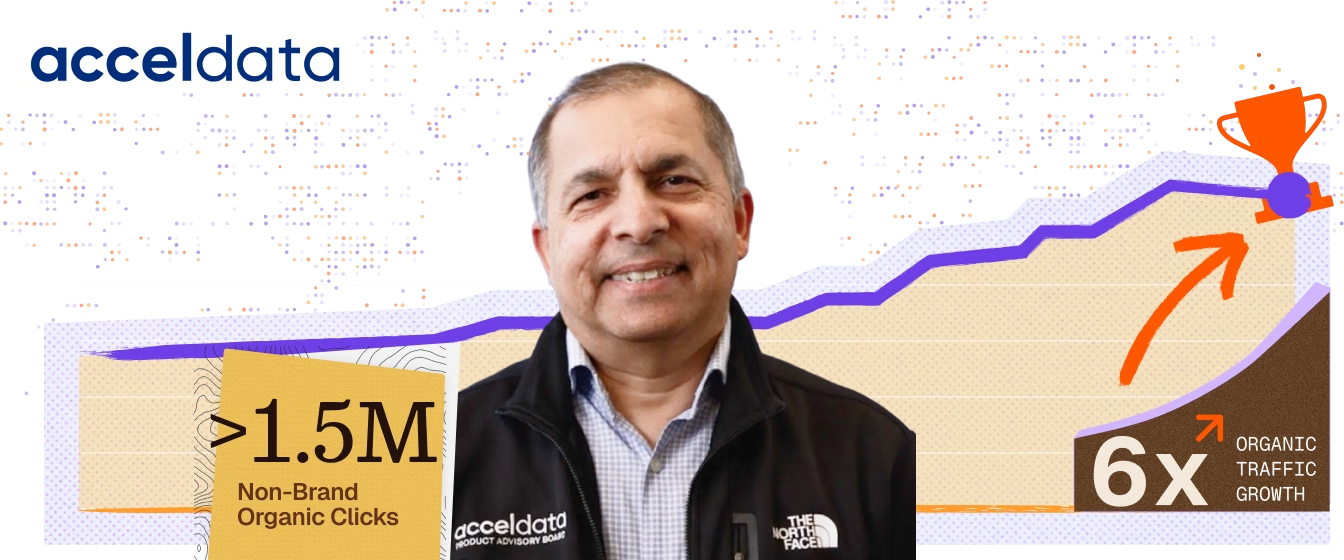
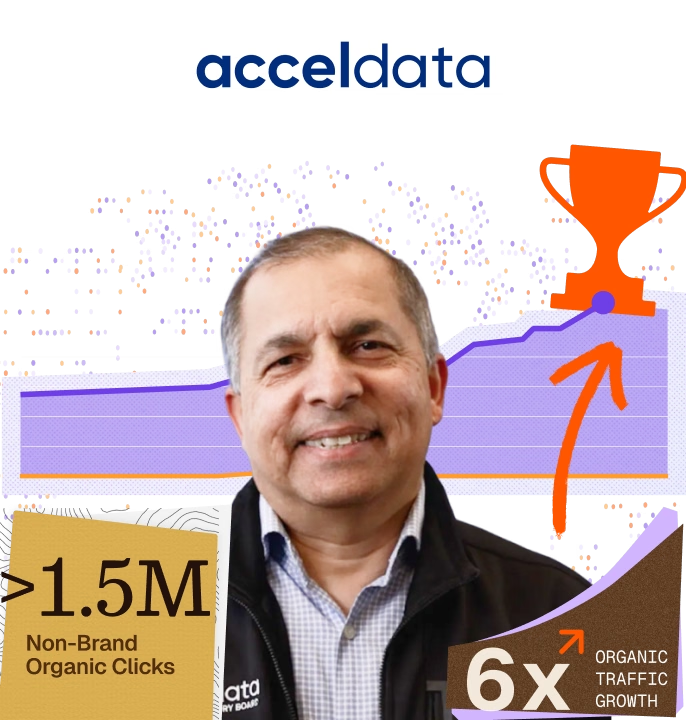
Acceldata grew organic traffic 6x within twelve months, and its keywords in Google's top three went from 85 to 300+. SalesHood went from 14 to 97 keywords in Google AI Overviews in six months, while blog impressions rose from about 200,000 to 417,000.

For businesses playing the long game, Pepper turns your earned authority visible to search & AI, making
organic growth winnable again.
Get a strategy presentation with real projections before you sign up.
i
*the long game is not about waiting.
It is about building something that keeps winning after everyone else's quick win wore off. And you will see it work within a quarter.