The best free AI search tools in 2026, and what is not actually free
The short answer
We opened the pricing page of every tool named on the current “best free AI search tools” lists and checked it. Three of the most frequently recommended free options are not free.
That is not the vendors being dishonest. A trial is a perfectly normal thing to sell. It is the lists being wrong, and they are wrong in a way that costs you a fortnight.
Key takeaways
- Otterly is a free trial, not a free tier. The cheapest ongoing plan is $29 a month for 15 prompts across 4 engines.
- Trakkr is a 14-day trial, then $100 a month. It is widely described as free forever. It is not.
- Semrush still has a free plan, contrary to several lists claiming the free tier was killed after Adobe bought it. What changed is that AI visibility now sits in the paid tiers.
- Adobe completed its acquisition of Semrush on 28 April 2026 for $1.87 billion, confirmed in Adobe’s own SEC filing. Expect this product’s packaging to keep moving.
- The genuinely free stack is three first-party tools and a spreadsheet, and it is better than most people expect.
Where this comes from. We run organic for more than 250 enterprises at Pepper and track over 10 million prompts across every major engine, so we trial and retire this software constantly. Every price below was read off the vendor’s own pricing page on 4 September 2026, not copied from another list.
Three kinds of “free”, and only one of them is free
The lists collapse these together, which is where the trouble starts.
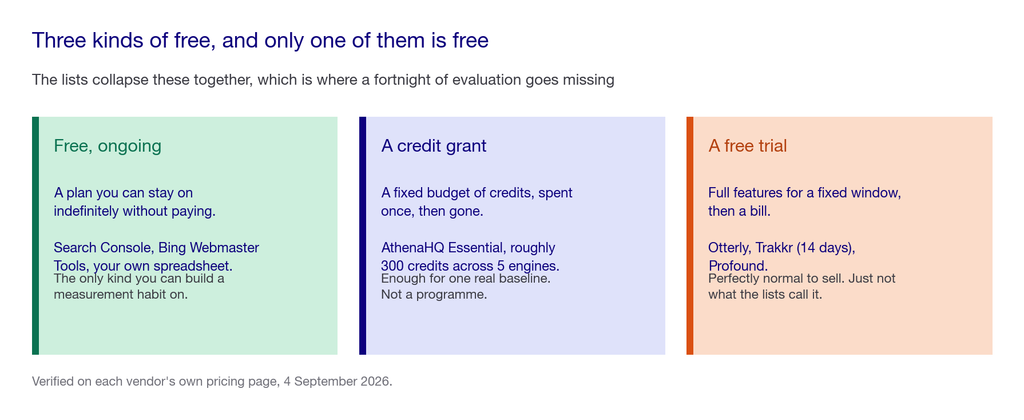
Free and ongoing is a plan you can stay on indefinitely. A credit grant is a fixed budget spent once. A free trial is full features for a fixed window, then a bill. All three are normal things to sell. Only the first lets you build a measurement habit.
If you want the vocabulary behind all this first, what GEO is covers the category and AEO vs SEO covers where it sits inside search.
See where you show up. When the free stack stops fitting in an afternoon, Pepper’s GEO platform tracks Brand Visibility, Domain Prompt Presence and Share of Voice across ChatGPT, Perplexity, Gemini, Claude and Google AI Overviews. Your team can log in, connect Search Console and GA4, manage the prompt set and run your own agents in the Agent Atlas. A growth team works the same account alongside you. Book a growth audit or see where you show up.
What is genuinely free
1. Google Search Console
The most underused tool in this category, and the only one reporting your own data rather than a sample.
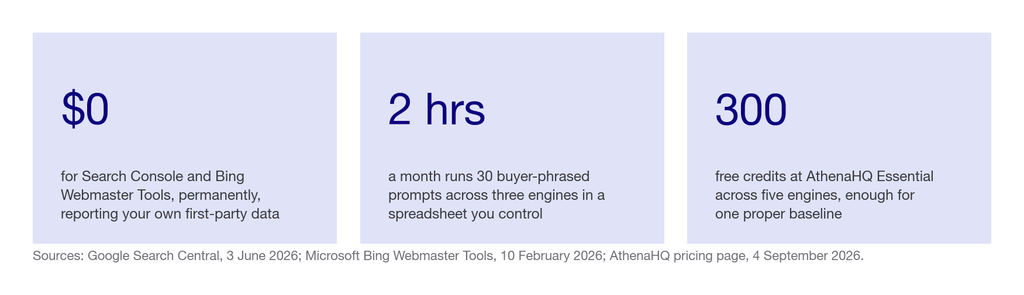
Google added Search Generative AI performance reports on 3 June 2026, giving dedicated views of impressions inside generative AI features on Search, covering AI Overviews and AI Mode, plus generative AI features in Discover.
Cost: free, permanently. What it gives you: your actual impressions and clicks from Google’s AI surfaces.
Where it falls short: Google only. It tells you nothing about ChatGPT, Perplexity or Claude, which is most of the problem, and those engines differ sharply in how often they cite anyone at all. We covered that spread in the top AI search engines.
2. Bing Webmaster Tools
Bing opened its AI Performance report to public preview on 10 February 2026, showing cited URLs, triggering queries and citation share.
Cost: free, permanently. What it gives you: the only first-party window onto the Microsoft side.
Where it falls short: sources disagree on whether the report reflects ChatGPT traffic or only Copilot, so read it as directional rather than exact. Verify the property and look at your own numbers rather than trusting a summary, including this one.
3. A spreadsheet and 30 prompts
Unglamorous, and it beats every free checker because you choose the prompts.
Fix 30 questions in your buyers’ words, run them monthly across your priority engines, and log two things separately: whether you are named, and whether a page on your domain is cited. Two hours a month.
We wrote the full method out in how to measure AI search visibility without expensive tools, including the nine spreadsheet columns.
Where it falls short: no history unless you keep it, and it does not scale past a few hundred prompts. What to record and what to ignore is set out in AI search metrics: what to track and what to ignore.
4. AthenaHQ, Essential tier
The one platform on the lists with a genuine free entry point rather than a trial.
Essential gives a $25 credit, roughly 300 credits, across five engines: ChatGPT, Perplexity, Google AI Overviews, Gemini and Copilot. Unlimited team members, plus prompt and response analysis, sources, competitor insights and content recommendations.
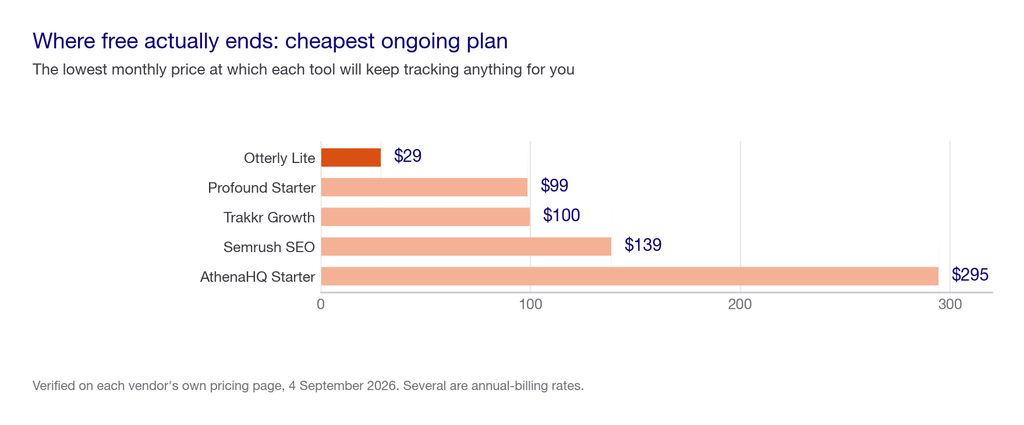
Where it falls short: it is a credit grant, and the page does not clearly state whether it renews monthly. Treat it as enough to run a real baseline once, not as an ongoing programme. Paid starts at $295 a month. For the paid field in full, see citation monitoring platforms compared and the GEO platform comparison.
What the lists call free but is not
Nothing dishonest is happening here. These are normal commercial products with normal trials. The lists are simply wrong, and being wrong here wastes a fortnight of someone’s evaluation.
1. Otterly
Frequently listed as having a genuine free tier. Its pricing page offers a free trial, with no free plan.
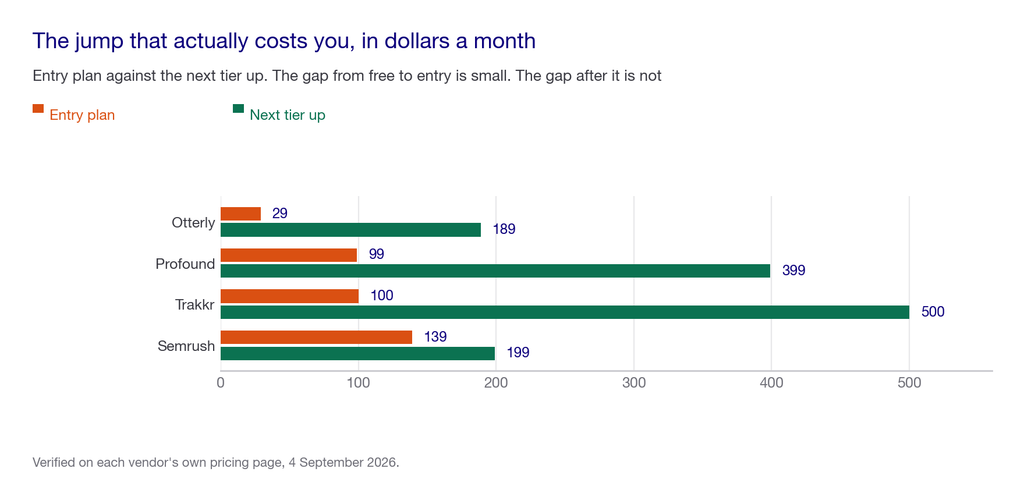
Paid starts at Lite, $29 a month for 15 search prompts across ChatGPT, Google AI Overviews, Perplexity and Copilot, with daily tracking. Standard is $189 for 100 prompts, Premium $489 for 400. Enterprise starts around $1,000. Claude, Google AI Mode and Gemini are paid add-ons from $9 to $29 a month, which is easy to miss when comparing engine counts.
2. Trakkr
Described on several lists as a free-forever tracker covering eight models. Its pricing page shows a 14-day free trial, after which Growth is $100 a month for one brand, 50 prompts and all eight models, refreshed daily.
To be fair to it, $100 for 50 prompts across eight models is among the better value here. It is just not free.
3. Semrush, now part of Adobe
Two claims circulate about Semrush and both need correcting.
The first is that its free AI tier was discontinued after the acquisition. Semrush’s own pricing page still lists a free plan at $0 with one demo project and limited features. What is true is that AI Visibility now sits inside the paid tiers, with 50 to 200 prompts daily depending on plan. Paid runs from $139 a month for SEO up to $549 for Advanced.
The second is the acquisition itself, usually quoted at $1.9 billion. Adobe’s Form 10-Q states it precisely: “On April 28, 2026, we completed the acquisition of Semrush Holdings, Inc., a publicly held brand visibility platform company, for $1.87 billion, primarily in cash consideration.”
The practical consequence is not the number. It is that a product mid-integration into a much larger suite will keep repackaging, so anything you read about its tiers has a short shelf life. The same caution applies to every roundup in this category, including our own AEO platform comparison.
4. Profound
No free plan. The Growth tier offers a “Try for free” entry, which is a trial. Paid starts at $99 a month for 50 prompts tracking ChatGPT only, and $399 for 100 prompts across ChatGPT, Perplexity and Google AI Overviews. Enterprise reaches up to nine engines.
Free AI search tools at a glance
| Tool | Genuinely free? | What the free version gives | Cheapest paid | Engines |
|---|---|---|---|---|
| Google Search Console | Yes, permanently | Your own impressions and clicks from Google AI surfaces | Free | Google only |
| Bing Webmaster Tools | Yes, permanently | Cited URLs, triggering queries, citation share | Free | Microsoft surfaces |
| Spreadsheet, 30 prompts | Yes, permanently | Named versus cited, on prompts you choose | Free, 2 hrs/month | Any you run |
| AthenaHQ Essential | Yes, as a credit grant | ~300 credits, 5 engines, unlimited members | $295/mo Starter | 5 free, 10 paid |
| Otterly | No, trial only | Nothing ongoing | $29/mo Lite, 15 prompts | 4, others are paid add-ons |
| Trakkr | No, 14-day trial | Nothing ongoing | $100/mo Growth, 50 prompts | 8 |
| Semrush (Adobe) | Free plan exists, AI visibility does not | 1 demo project, limited | $139/mo SEO | AI visibility on paid tiers |
| Profound | No, trial only | Nothing ongoing | $99/mo Starter, 50 prompts | 1 free tier, up to 9 |
All prices read from each vendor’s own pricing page on 4 September 2026. Several are annual-billing rates. They move often, so confirm before committing.
Our methodology: how we scored what counts as free
| Criterion | Weight | What that means here |
|---|---|---|
| Free means ongoing | 40% | A plan you can stay on indefinitely. A trial and a one-off credit are named as what they are |
| Verified at the vendor’s page | 30% | Read on 4 September 2026 at the source, never taken from another list |
| Useful without paying | 20% | Whether the free version answers a real question or just shows you a locked dashboard |
| Engine coverage disclosed | 10% | Named engines, not “all major AI platforms” |
What does it cost when free runs out?
| What you are buying | Cheapest verified 2026 price | What it covers |
|---|---|---|
| First-party reporting | Free | Search Console and Bing Webmaster Tools, permanently |
| Manual tracking | Free, about 2 hours a month | 30 prompts across three engines in a spreadsheet |
| One real baseline | Free credit | AthenaHQ Essential, 5 engines, roughly 300 credits |
| Entry monitoring | $29/mo | Otterly Lite, 15 prompts, 4 engines |
| Serious monitoring | $99 to $100/mo | Profound Starter (ChatGPT only) or Trakkr Growth (8 models) |
| Multi-engine at volume | $189 to $399/mo | Otterly Standard or Profound Growth, 100 prompts |
| Platform plus a team doing the work | Custom | Tracking, plus the content and authority work it points at |
The cliff is between free and $29, and it is smaller than people expect. The bigger cliff is between $100 and $400, which is where prompt volume and engine coverage actually get bought.

How to choose a free AI search tool
Most teams reading this do not need to choose one tool. They need to assemble a stack, and the assembly order matters more than the picks.
The scorecard
Score any candidate out of 100 before you sign up for anything.
| Factor | Weight | How to score it honestly |
|---|---|---|
| Is it ongoing | 30% | You can stay on it indefinitely. A trial scores zero here regardless of how good the product is |
| Do you choose the prompts | 25% | A checker sampling prompts you did not pick tells you very little about your own buyers |
| Named engines | 20% | The engines are listed by name, and you have checked whether add-ons cost extra |
| Your data or a sample | 15% | First-party reporting beats any third-party estimate, which is why Search Console leads this list |
| Export | 10% | You can get the numbers out, because a free tier you cannot export is a screenshot |
The live test, over 90 days
Before signing up for anything, fix 30 prompts in your buyers’ words and run them by hand. Real questions, such as “what is the best AI visibility tool for a small team”, “how do I check if ChatGPT mentions my brand”, “which free tools track AI Overviews” and “is Otterly worth it compared to Profound”.
Run them across your priority engines and log named and cited as two separate columns. Then repeat monthly for 90 days.
Three readings is the shortest honest window. One is a snapshot, two could be noise, three shows direction. Keep the set fixed, because changing it resets the comparison.
Do this first and two things happen. You get a baseline no free tool will give you, and you find out whether your prompt volume actually justifies paying.
Weak approach versus strong approach
The weaker approach: open a “best free tools” list, sign up for four of them, discover two were trials, lose a fortnight, and end up with four dashboards showing prompts nobody chose.
The stronger approach: switch on Search Console and Bing Webmaster Tools, which are free and which you already own. Run 30 prompts by hand for a month. Then, and only then, spend the free credit at AthenaHQ on a proper baseline, knowing exactly which prompts matter.
The difference is that the strong version produces a number you can defend. The weak version produces four numbers that disagree.
Red flags
- “Free forever” with no plan on the pricing page. Two of the most-recommended tools in this category are trials.
- Engine counts that exclude paid add-ons. Otterly’s headline four engines does not include Claude, Gemini or Google AI Mode.
- A checker that picks your prompts. It is measuring its sample, not your buyers.
- Credits described as a free tier. A one-off grant runs a baseline. It does not run a programme.
- Any list that has not been rechecked since April 2026. Adobe closed the Semrush acquisition on 28 April, and packaging in this category moves quarterly.
- A free score with no method. If it will not tell you how many prompts, on which engines, at what frequency, the number means nothing.
Five questions worth asking
- “Is this a free plan or a free trial?” Ask it plainly. The lists will not tell you.
- “How many prompts, on which named engines, refreshed how often?” Three numbers, not a category.
- “Which engines cost extra?” Add-ons are where the headline count comes apart.
- “Can I export the data?” A free tier you cannot export is a screenshot.
- “What happens to my history if I stop paying?” The answer shapes when you start.
Reduced to one principle: switch on the free first-party tools before you evaluate anything else. Most teams have not, and they are the only ones reporting your own data rather than someone’s sample.
One closing note that costs us something. Everything in the genuinely-free section is enough for a lot of teams to run for a year without paying anyone, ours included. We would rather you started there and came to us when volume actually justifies it than bought a platform you are not ready to use.
What nobody should promise you
That a free tool can tell you your true AI visibility. Every free option here samples something: one engine, a handful of prompts, or a fixed credit budget.
A guaranteed citation or position. Nobody controls generated output, and Google warns against providers guaranteeing rankings.
That a single visibility score means something on its own. There is no universal good number. Trend on a fixed prompt set and distance from the category leader carry the information.
Permanence of any pricing in this article. One vendor here was acquired for $1.87 billion four months ago and is mid-integration.
When free is genuinely enough
The answer that costs us the sale. If you publish a few pieces a month, sell into one or two engines’ worth of audience, and nobody is asking you to attribute pipeline to AI search yet, you do not need to pay for any of this and we would tell you not to.
Search Console, Bing Webmaster Tools and a 30-prompt sheet will hold you for a year. Buy monitoring when the manual run stops fitting in an afternoon, or when someone asks for history you did not capture. Those are the two real triggers, and neither is a date in a budget cycle.
Frequently asked questions
What are the best free AI search tools in 2026?
Google Search Console, which added generative AI performance reports in June 2026, Bing Webmaster Tools with its AI Performance report, a manual 30-prompt spreadsheet, and AthenaHQ’s Essential tier. Those are the four we could verify as genuinely free at the vendor’s own page.
Is Otterly free?
No. Otterly offers a free trial, not a free plan. Its cheapest ongoing tier is Lite at $29 a month for 15 search prompts across four engines, with Claude, Gemini and Google AI Mode sold as paid add-ons from $9 to $29 a month.
Is Trakkr free forever?
No, despite being described that way on several lists. Its pricing page shows a 14-day free trial, after which Growth costs $100 a month for one brand, 50 prompts and eight models refreshed daily.
Did Semrush remove its free tier after the Adobe acquisition?
Not according to Semrush’s own pricing page, which still lists a free plan with one demo project. What changed is that AI Visibility features sit in the paid tiers, from $139 a month, with 50 to 200 prompts daily depending on plan.
When did Adobe acquire Semrush?
Adobe completed the acquisition on 28 April 2026 for $1.87 billion, primarily in cash, as stated in Adobe’s Form 10-Q filing. Expect the product packaging to keep changing during integration.
Can I track AI search visibility without paying anything?
Yes, for a while. Search Console and Bing Webmaster Tools cover the Google and Microsoft surfaces with your own first-party data, and a fixed 30-prompt spreadsheet run monthly covers the rest for about two hours of work.
What is the cheapest paid AI visibility tool?
Otterly Lite at $29 a month for 15 prompts across four engines is the cheapest ongoing plan we verified. Profound Starter at $99 and Trakkr Growth at $100 are the cheapest options that cover a realistic prompt set.
Are free AI visibility checkers accurate?
They are useful for a quick read and weak as a system, because most sample a small prompt set you did not choose. Ask any engine the same question repeatedly and the answer moves, so a single run is a snapshot rather than a measurement.
Where to go next
Switch on Search Console and Bing Webmaster Tools this afternoon. Both are free, both report your own data, and most teams reading an article about free tools have not enabled either.
Then run 30 prompts by hand for a month before you sign up for anything.
Book a growth audit · Read the free measurement method · See the work in our case studies · Explore Pepper’s platform
Sources and further reading
- Adobe Inc. Form 10-Q, FY2026. “On April 28, 2026, we completed the acquisition of Semrush Holdings, Inc. … for $1.87 billion, primarily in cash consideration.” Primary source for the acquisition date and amount.
- Otterly. Pricing page, read 4 September 2026. Free trial only. Lite $29, Standard $189, Premium $489, Enterprise from $1,000. Engine add-ons $9 to $29.
- Trakkr. Pricing page, read 4 September 2026. 14-day trial, then Growth $100, Scale $500, Enterprise from $790, all eight models included.
- Semrush. Pricing page, read 4 September 2026. Free plan with one demo project. SEO $139, Starter $199, Pro+ $299, Advanced $549. AI Visibility 50 to 200 prompts daily by tier.
- AthenaHQ. Pricing page, read 4 September 2026. Essential free tier, $25 credit, roughly 300 credits, five engines. Starter $295 with 3,600 credits and ten models.
- Profound. Pricing page, read 4 September 2026. No free plan. Starter $99 with 50 prompts, ChatGPT only. Growth $399 with 100 prompts across three engines. Enterprise up to nine.
- Google Search Central. Search Generative AI performance reports in Search Console, 3 June 2026.
- Microsoft. Bing Webmaster Tools AI Performance report, public preview from 10 February 2026.
- Pepper. How to measure AI search visibility without expensive tools, the full manual method, and the paid AI search monitoring field for what sits above the free tier.
- Deliberately excluded: browser-based free checkers we did not verify at source in this pass, and any claim about whether AthenaHQ’s free credits renew monthly, which its page does not state.
Latest Blogs
Most advice on this is inference dressed as fact. OpenAI documents exactly one thing clearly, which is access. Here is what is documented, what is inferred, and how to verify the rest for yourself.
Being named in an AI answer and having your page used as its source are different outcomes with different causes and different fixes. The gap between them is the most useful diagnostic in AI search, and most reporting collapses it into one number.
Every platform reports share of voice and almost none of them define it the same way. Here is the definition worth using, the three choices that change the number, and how to measure it yourself without buying anything.
Get your hands on the latest news!

Similar Posts
GEO / AI Search
10 mins read
How to get cited by ChatGPT
GEO / AI Search
10 mins read
Mentioned vs cited: the difference that decides AI visibility
GEO / AI Search
13 mins read