Best GEO agencies for cybersecurity companies in 2026
The short answer
A CISO shortlists vendors before anyone at your company knows they exist. If ChatGPT does not name you when they ask, you never get the meeting. GEO agencies for cybersecurity exist to change that answer.
Key takeaways
- Security buying starts in private. Forrester found 55 percent of B2B buyers now compare vendors inside AI tools before contacting anyone.
- Cybersecurity is harder than generic B2B GEO for one reason: a wrong claim is a security claim. Compliance review is not an obstacle to route around, it is the workflow.
- Shortlist on whether a partner has shipped through a legal and security review, not on how many security logos are on the deck.
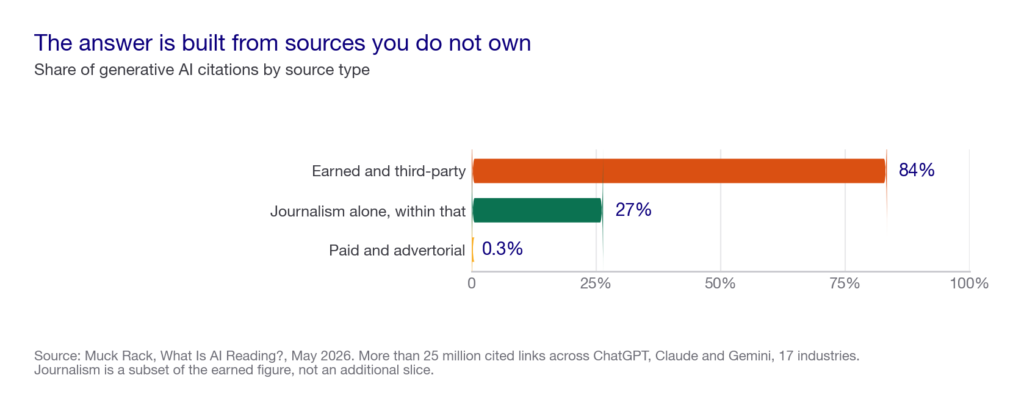
- Earned media does most of the work. 84 percent of AI citations come from third-party sources, and in security those sources are analysts, established outlets and practitioner communities.
- Nobody on this list, us included, publishes a cybersecurity case study. We say what we actually have instead.
A note on where this view comes from. We run organic for more than 250 enterprises at Pepper and track over 10 million prompts across every major engine. In addition, what follows is shaped by that, by the client reviews we sit in weekly, and by conversations with security marketers at the events we run. So it is our read, not a directory. Where we think the category is selling something it cannot deliver, we say so.
What is a cybersecurity GEO agency?
A cybersecurity GEO agency gets a security vendor named and cited inside AI answers, working through your compliance process rather than around it. The mechanics are shared with GEO everywhere: entity clarity, retrievable structure, and authority in the third-party sources engines trust. What changes is the review gate in front of every claim, and the cost of getting one wrong.
That distinction matters more than it sounds. Most agencies can learn your product vocabulary in a fortnight. Very few have shipped content through a security team that has veto power and uses it.
How a security buyer actually finds you now
Watch how a shortlist forms and the whole GEO argument stops being abstract.
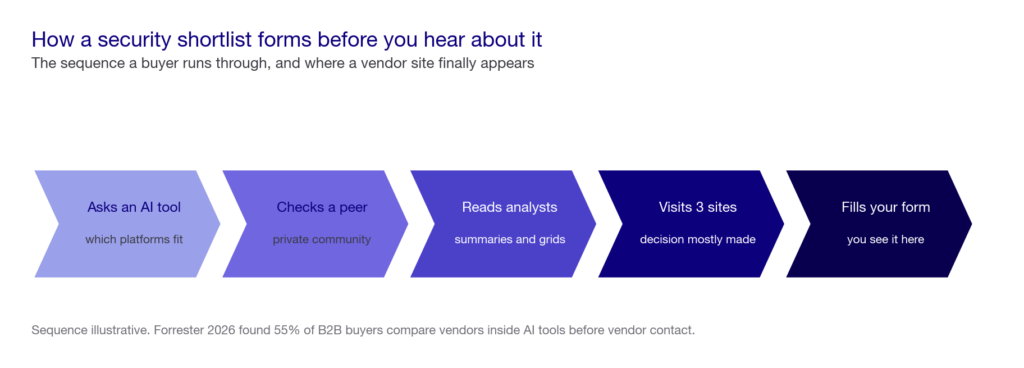
A security lead needs to replace a SIEM. They do not open Google first. They open ChatGPT and ask which platforms suit a mid-sized regulated business. Then they cross-check against a peer in a private Slack community, then they read two analyst summaries, and only then do they visit three vendor sites. By the time your form fires, the decision is mostly made.
Forrester’s 2026 Buyers’ Journey Survey, published in January and covering nearly 18,000 global business buyers, found 94 percent used AI somewhere in a recent purchase, 55 percent compared vendors inside AI tools. In addition, 47 percent built the internal business case there (Forrester, January 2026). Security buyers are not an exception to this. If anything they research more privately, because asking a public question signals what you are missing.
That is the whole case for GEO in security. Not that AI search is exciting, but that the evaluation now happens somewhere you cannot see and cannot sponsor.
See where you show up. Pepper’s GEO platform tracks Brand Visibility, Domain Prompt Presence and Share of Voice across ChatGPT, Perplexity, Gemini, Claude and Google AI Overviews. In addition, a growth team works the account with you. Book a growth audit or see where you show up.
Why security is harder than the rest of B2B
Three things change once the subject is security, and they change what you should buy.
A wrong claim is a security claim. If an AI answer says your platform is FedRAMP authorised and it is not, that is not a marketing error. Security content sits under the same “your money or your life” scrutiny as health and finance. As a result, engines weight source credibility harder, and thin content is filtered rather than merely outranked. Our guide to getting cited in LLMs covers the mechanics. As Kishan Panpalia, who leads SEO and GEO at Pepper, puts it: clarity over length, definitions over fluff, precision over prose.
Compliance review is the workflow, not an obstacle. Security content goes through legal, and often through your own security team. An agency whose model depends on publishing velocity will either stall or quietly route around your process. Ask them how they have handled sign-off elsewhere before you ask anything about engines. The same constraint shapes GEO for fintech, where we have written about compliance as a moat.
A bad mention is durable. Rankings recover. A model that has learned to describe your product inaccurately, from a source it trusts, is a slower problem to unwind. That asymmetry is why security teams should care about how they are described, not only whether they appear.
The upside is real though. Compliance discipline is a moat. Categories where accuracy is expensive to fake reward the brands that can prove things. In addition, that is a better position than competing on publishing volume.
Where the answer actually gets decided
Muck Rack’s May 2026 study of more than 25 million cited links across ChatGPT, Claude and Gemini found earned media accounts for 84 percent of AI citations, with paid and advertorial at 0.3 percent and journalism alone at 27 percent (Muck Rack, May 2026).
For security that maps onto a specific set of sources: analyst coverage, established security press, practitioner communities. In addition, the comparison sites your buyers already read. Almost none of which live on your domain.
The same study found the engines behave differently. ChatGPT carries a citation in 96 percent of responses, Gemini in 82 percent, Claude in just 55 percent. So a single blended visibility score tells you very little. In addition, a partner reporting one number across engines is averaging away the thing you needed to know.

What we have actually shipped, and what we have not
Most vertical roundups imply proof they do not have. Here is ours, stated plainly.
We have not published a cybersecurity case study. Nobody on this list has one that we can find either. So treat any security-specific claim in this category, including ours, as something to test rather than accept.
What we do have is technical B2B work where the buyer is sceptical and the subject matter is hard.
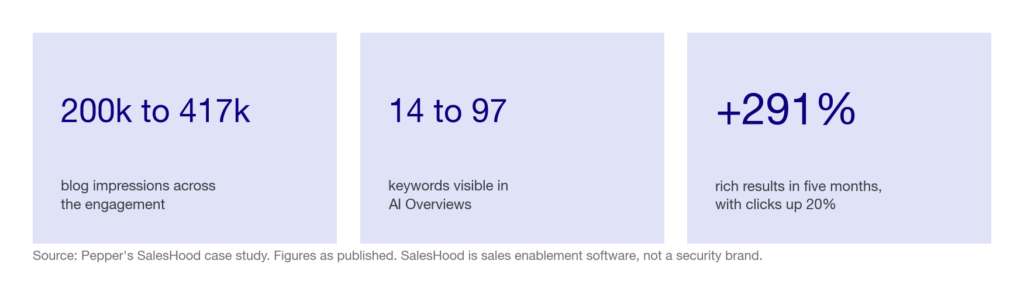
SalesHood is the closest thing to a GEO proof point we can show. They were losing organic traffic and disappearing from AI answers while competing against better-funded rivals. We ran seven workstreams: a strategic audit, an SEO blog engine that produced 20 new pieces and refreshed 8, GEO and AEO work tracked in Atlas across ChatGPT, Gemini and Claude, technical SEO that resolved 10 issues including sitemap and schema work, competitive intelligence, EEAT and content innovation. In addition, monthly reporting. Blog impressions went from 200,000 to 417,000. AI Overview visibility went from 14 keywords to 97. Rich results grew 291 percent in five months, and clicks rose 20 percent against an industry-wide decline. Their CMO, Elay Cohen, put it more usefully than a metric does: he could see a direct connection between the investment and lead flow from LLMs that closed.
Acceldata is the enterprise data observability equivalent: a technical product, a sceptical buyer, and a category where accuracy matters. Organic traffic grew sixfold, top-three keywords went from 85 to more than 300. In addition, a single hero guide generated over 260,000 impressions.
Neither is a security brand. Both are the same shape of problem: technical depth, a buyer who can detect shallow research. In addition, a category where being wrong is expensive.

How we evaluated these agencies
Applied to what each firm publishes on its own site, checked on 19 August 2026, rather than to another roundup.
| Factor | Weight | What we looked for |
|---|---|---|
| Security and regulated-sector literacy | 35% | Evidence of shipping inside a compliance review, not just security logos |
| GEO depth | 30% | Entity work, citation strategy and off-site authority rather than a renamed SEO deck |
| Engine coverage | 20% | What is tracked at the tier you would actually buy |
| Measurement and attribution | 15% | Citation-level tracking that reaches something downstream |
What we could not verify. Pricing, for every agency here. None publishes rates. We have said so rather than estimating. In addition, where a firm names no vertical specialism on its own site we have said that too.

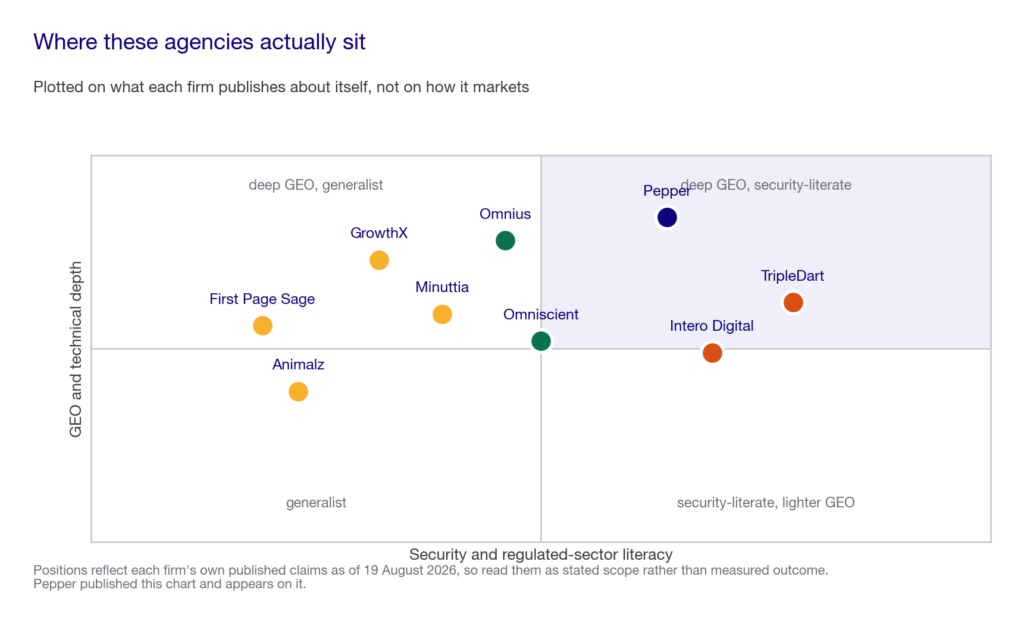
The shortlist at a glance
| Agency | Security positioning | Model | Engines named publicly | Pricing |
|---|---|---|---|---|
| TripleDart | Security is a named practice | Agency plus Slate platform | ChatGPT, Gemini, Perplexity, AI Overviews | Not published |
| Intero Digital | Names cybersecurity, healthcare, fintech | Agency, GRO framework | ChatGPT, Gemini, Perplexity, AI Overviews | Not published |
| Omnius | B2B SaaS and fintech, not security | Boutique, Atomic tracker | ChatGPT, Perplexity, Gemini, Claude | Not published |
| Omniscient Digital | Generalist B2B software | Managed service | ChatGPT, Perplexity, AI Overviews | Not published |
| Animalz | Generalist B2B SaaS | Agency, AEO practice, Revive tool | Multi-engine | Not published |
| Minuttia | SaaS and tech above $10M ARR | Boutique, strategy-first | ChatGPT, Perplexity, Gemini, AI Overviews | Not published |
| First Page Sage | No vertical named on its own site | Agency, SEO plus GEO | Not specified | Not published |
| GrowthX | Generalist B2B | GrowthOS subscription platform | Google, ChatGPT, Claude, Perplexity | $6,000/mo, published |
| Pepper | Technical B2B, no security case study | Platform plus growth team | ChatGPT, Perplexity, Gemini, Claude, AI Overviews | Custom, annual |
The shortlist
1. Pepper
Pepper is an agentic organic growth engine. Atlas is the platform underneath. In addition, it works two ways: your team can log in, connect Search Console and GA4, define competitors and personas, manage the prompt set and build and run your own agents in the Agent Atlas, and a Pepper growth team works the same account alongside you. That combination matters in security specifically. Because the work stalls in the weeks when your team is handling an incident rather than a content calendar.
We work the three levers of Visibility, Citability and Retrievability, and report Brand Visibility, Domain Prompt Presence and Share of Voice across ChatGPT, Perplexity, Gemini, Claude and Google AI Overviews. The gap between the first two is usually where a security brand’s problem sits: named often, cited rarely. Because the citation went to an analyst.
Eight years, 250 plus enterprises, more than 10 million tracked prompts.
Where we are not the answer: we sell organic only. As a result, if you want one partner across paid and lifecycle this is the wrong shape. We work on annual, outcome-pegged engagements. That suits a team treating organic as a long-term function and suits nobody looking for a one-quarter experiment. And as said above, we have not published a cybersecurity case study. As a result, our security claim rests on adjacent technical B2B work rather than a named security logo. Our full case study library is public if you want to judge the pattern yourself.
2. TripleDart
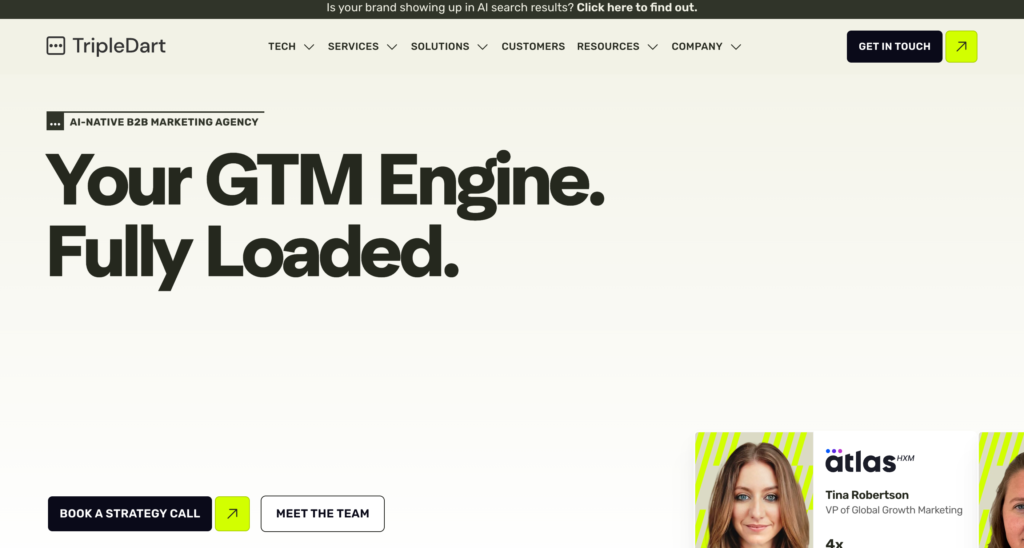
TripleDart works exclusively with B2B tech and runs GEO through Slate, its own platform, covering content structuring, schema and prompt testing across buying scenarios. Its published focus spans fintech, dev tools, HR tech and security. As a result, security is a named practice rather than something it will learn on your account. If you want a partner that already speaks the language, this is the closest fit on the list.
The trade is breadth. TripleDart sells full-funnel B2B marketing. As a result, organic is one of several priorities rather than the whole engagement, and specialists tend to win the answer in a given category. It publishes no pricing.
3. Intero Digital
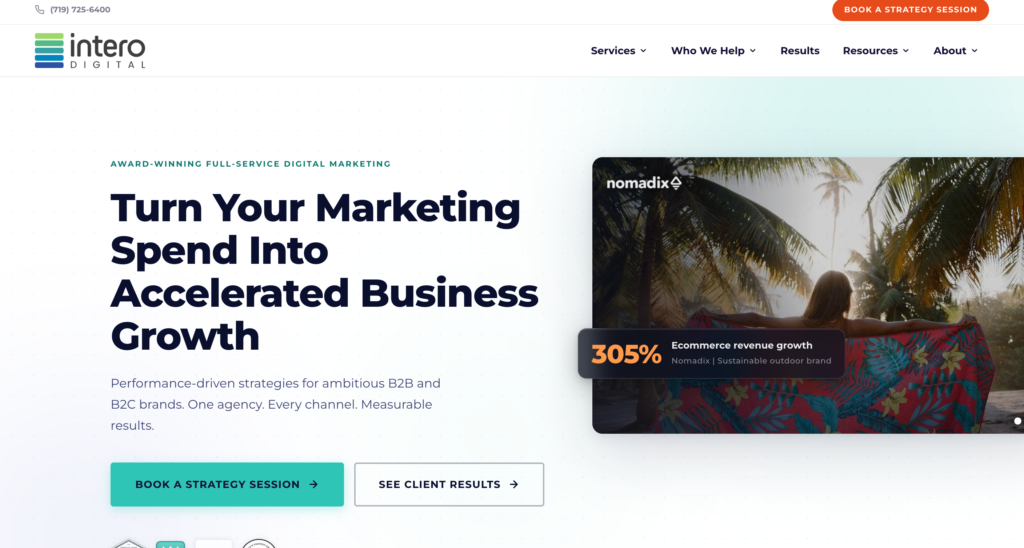
Founded in 1996, Intero formalises its AI search work as Intero GRO, its own Generative Response Optimization framework. In addition, runs it across channels rather than as an isolated content programme. It names cybersecurity alongside healthcare and fintech, which puts it in a small group that claims regulated-sector depth explicitly.
What to probe: its public case studies lean toward broader SEO wins rather than engine-level citation gains. As a result, ask for security-specific evidence rather than accepting the vertical claim. Being a large multi-channel agency also means more layers between you and the people doing the work.
4. Omnius
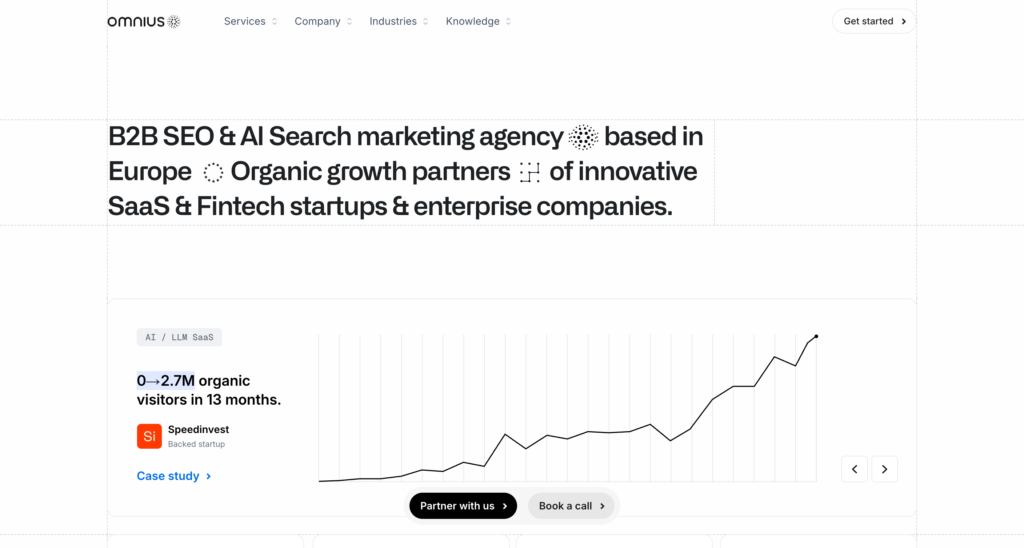
Omnius is a boutique focused on B2B SaaS and fintech, built around technical GEO and LLMO, with its own tracker called Atomic. The emphasis is crawlability, entity clarity and citation tracking rather than content volume. That suits a security team that already produces decent material and needs the retrievability layer built properly.
Where it gets thin: less editorial firepower, and a European base that may matter if your compliance questions are US-specific. Security is not a named vertical, so you are buying technical competence rather than category fluency.
5. Omniscient Digital
Founded in 2019 and based in Austin, Omniscient originated the Barbell Content Strategy. That pairs high-intent conversion content with long-form thought leadership, and it ties content to pipeline rather than traffic. That pipeline orientation travels well into security. Where the sales cycle is long and traffic is a poor proxy for anything.
It is a managed service with no platform layer. As a result, your visibility into the work depends on their reporting cadence rather than a system you can query. It is also a generalist across B2B software rather than a security specialist.
6. Animalz
Animalz describes itself as a content marketing and SEO agency for leading B2B SaaS brands, sells Answer Engine Optimization as a named service. In addition, has its own content refresh tool called Revive. Published clients include Airtable, Amplitude and Intercom. If your category is won on ideas rather than coverage, its editorial standard is the highest here.
The mismatch for security is that this is a content-led model. If your gap is technical retrievability or analyst relationships rather than writing quality, you are buying the wrong strength at a premium price.
7. Minuttia
Minuttia is SaaS and tech specific, built for companies past roughly 10 million in ARR, and works strategy-first with integrated content and AEO. It suits an established security brand that wants a senior partner rather than an execution vendor.
Boutique capacity limits how fast it scales, the ARR threshold rules out earlier-stage teams. In addition, it names no regulated-sector specialism, so probe the compliance workflow directly.
8. First Page Sage
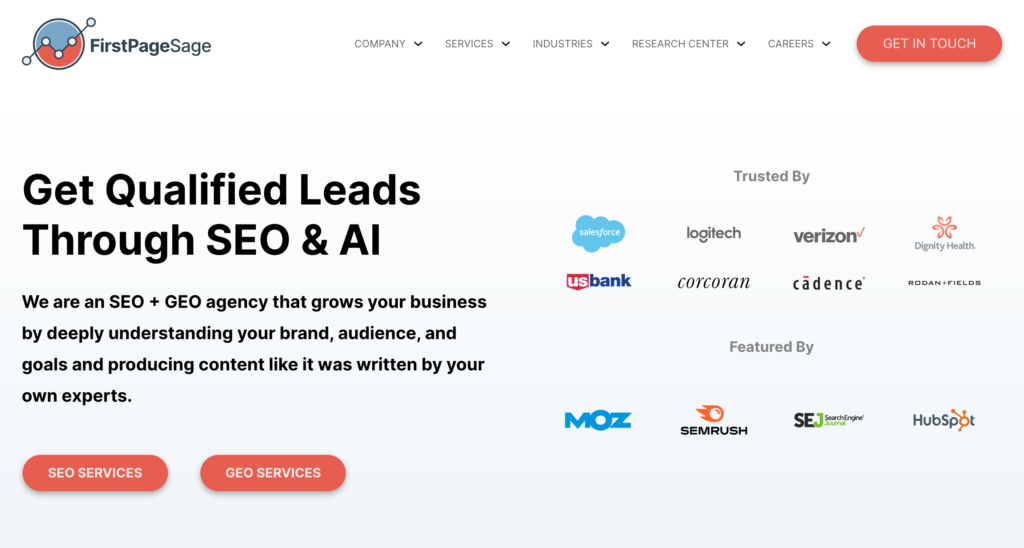
First Page Sage describes itself as an SEO and GEO agency, selling both as named services rather than treating GEO as an add-on. Its published client list is enterprise and mid-market, including Salesforce, Verizon and US Bank.
It publishes no engagement model, no volume expectation and no pricing, and names no vertical specialism on its own site. So everything about fit has to be established in a call rather than inferred. In addition, it does not name which AI engines it covers.
9. GrowthX
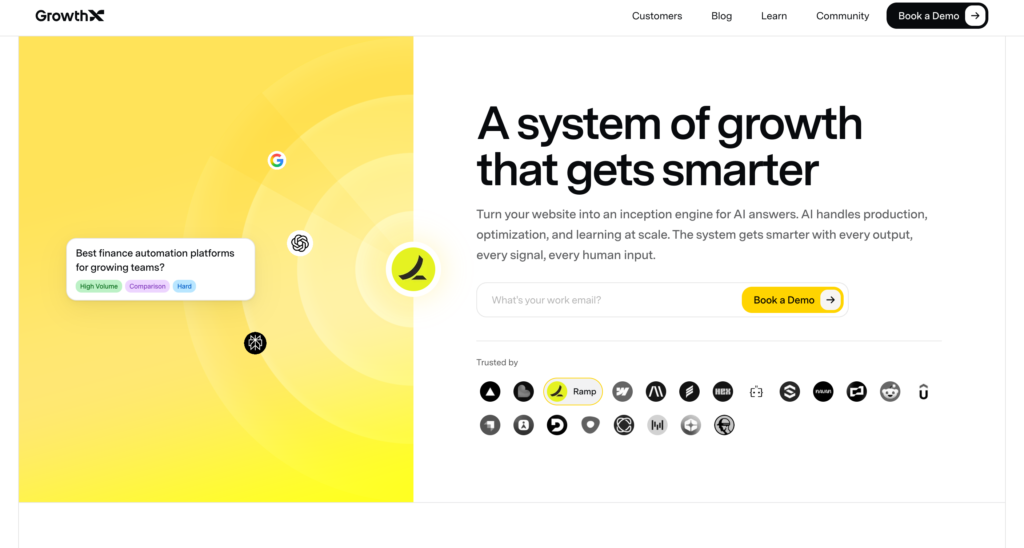
GrowthX now sells GrowthOS, a subscription platform rather than a content service, built around treating your own website as the source AI answers draw on. It covers visibility planning, tracking and citation monitoring across Google, ChatGPT, Claude and Perplexity. In addition, publishes pricing at $6,000 a month, which is more transparency than anyone else here offers.
The limitation is the premise. Centring your own site understates how much of a security answer is decided on analyst and practitioner sources you do not control. It is also a platform, so someone internally still has to drive it.
What this costs
Nobody in this list publishes rates except GrowthX, which is worth noting in itself.
| Shape of engagement | Typical range | What it usually buys |
|---|---|---|
| Tracking platform only | $99 to $1,500 a month | You read the data and act on it yourself |
| Boutique or specialist GEO | $3,000 to $8,000 a month | The common shape for mid-market security brands |
| Platform with published pricing | $6,000 a month, per GrowthX | A system to run, with internal capacity assumed |
| Regulated programme, run for you | Custom, usually annual | Compliance review adds genuine cost to every cycle |
Regulated work costs more for real reasons: legal cycles, jurisdiction-specific variants, and the slower cadence both create. A provider quoting regulated work at unregulated rates has either not done it or is planning to route around your review process.
How to choose a cybersecurity GEO partner
Most security shortlists get decided on the wrong thing. That is usually how well the agency understood your product in the first call. That is a test of their pre-read, not of whether they can move your visibility.
Start with the context that reframes the question. In May 2026 Google published its first official guidance on optimising for AI features and filed it under SEO fundamentals. Its position: AEO and GEO are part of SEO, AI Overviews and AI Mode run on core Search ranking systems. In addition, there is no separate AI index. It also names llms.txt, content chunking and AI-specific rewrites as things you can stop doing.
That is right, for Google. And Google is one engine. Muck Rack’s citation-rate spread across ChatGPT, Gemini and Claude is the counterweight: fundamentals are the floor. In addition, the engines diverge above it. Any partner whose pitch contradicts Google’s published guidance owes you an explanation.
The scorecard I would use
Score each partner out of 100 before the pricing conversation rather than after.
| Area | Weight | What a strong partner should demonstrate |
|---|---|---|
| Compliance workflow | 25% | Can describe, unprompted, how content moved through legal and security review at a named client, including what got rejected and what happened next |
| AI visibility measurement | 20% | Shows cited URLs, competitors and share of voice across a real prompt set, per engine rather than blended into one number |
| Off-site authority | 20% | Has a route into analysts, security press and practitioner communities, and can name the sources that decide your sub-category |
| Technical execution | 15% | Will change entity clarity, schema, structure and crawler access themselves, rather than handing you a list |
| Security literacy | 10% | Understands the difference between SOC 2, ISO 27001 and FedRAMP well enough not to write something you have to retract |
| Business attribution | 10% | Reaches qualified pipeline rather than stopping at citation counts |
Make them audit you before you sign
This costs nothing and it is the most informative hour in the process. Give each shortlisted partner 20 to 30 real commercial questions your buyers ask. Not your brand name. Things like “best SIEM for a mid-sized regulated business”, “alternatives to our closest competitor”, “what should a CISO ask a vendor about SOC 2” and “which endpoint platform works with a small security team”.
Then ask them to come back with five answers: where do we appear across those prompts. That competitors appear instead, which sources are influencing those answers, why are those sources winning, and what exactly would you change in the first 90 days.
Ask them to run it twice on different days. Engines are probabilistic, so one run on one engine establishes nothing. If the runs disagree and the vendor is surprised by that, they are sampling rather than measuring.
The weak playbook against the strong one
The weaker sequence, still sold widely: find prompts, rewrite blog posts, add an FAQ block, add statistics, hope for a citation. In security it plateaus faster than elsewhere, because the sources that decide the category were never on your domain.
The stronger sequence, and the one we run, sits closer to the enterprise playbook: demand intelligence. Then technical discoverability, then entity and brand clarity, then content, then earned authority with analysts and practitioner press, then distribution, then measurement, then attribution.
The distinction matters because generative engines assemble an answer from several sources rather than ranking one page. Being retrieved, being cited and actually influencing the answer are three separate things. In addition, in a category where a competitor’s analyst mention outweighs your best blog post, they need measuring separately.
Red flags
Things a vendor actually says that should end the conversation.
- “We guarantee ChatGPT citations.” Nobody controls a generative engine’s output. Google gives the same warning about anyone guaranteeing rankings.
- “You need llms.txt.” Google’s 2026 guidance says the opposite for its AI features.
- “We will publish 40 pieces a month.” In a YMYL category, volume without expert review actively harms you.
- A dashboard as the whole proposition. It shows the gap. Someone still has to close it.
- Branded prompts only. Your own name surfaces your own brand. That proves nothing.
- One engine. Winning ChatGPT and vanishing on AI Overviews is winning by luck.
- No stated method for choosing the prompt set. Then the reporting is arbitrary.
- No answer on who reviews for accuracy. In security this is the question, not a detail.
The five questions I would spend the meeting on
- “Walk me through a piece of content from brief to publication at a regulated client.” Listen for named review gates and a story about something being rejected. A clean answer means they have not done it.
- “Take one query where an analyst firm outranks us and explain why.” This separates people who understand source authority from people reselling a dashboard.
- “What would you change that does not need legal approval?” A good partner has a real answer, because that is where the first 60 days go.
- “How do you handle a factually wrong AI answer about our product?” Every security brand hits this. Listen for a method, not sympathy.
- “Which part of your own methodology do you expect to be obsolete in a year?” A thoughtful answer beats a confident one in a category moving this fast.
Reduced to one principle: hire for the ability to ship accurate work through your review process. Then for GEO skill. The reverse order produces a strategy nobody can publish.
One honest closing note. Very few firms are equally strong across measurement, execution, earned authority and attribution, ours included. The good ones will tell you which is their weakest without being asked. So if a partner claims excellence across all four, you have learned something about how they answer questions.
What nobody should promise you
A guaranteed citation or a guaranteed position in an AI answer. Nobody controls the output, and Google says the same about guaranteed rankings.
A single composite AI visibility score presented as a ranking. Ask a model the same question repeatedly and the answers move. Brand Visibility, Domain Prompt Presence and Share of Voice across a fixed prompt set over time are real numbers. One screenshot is not.
And nobody should promise clean attribution from an AI citation to closed revenue. Every link in the chain is observable. However, it is not a straight line, and drawing it as one is selling.
You may not need an agency yet
The answer that costs us the sale. If your product pages still describe capabilities inaccurately, your certifications are not machine-readable, or your security team has never signed off a content workflow, you do not need a GEO agency yet. Fix the facts on your own site first. Because an agency amplifying inaccurate claims in a YMYL category creates a problem rather than pipeline. That work costs engineering and legal time rather than a retainer, and it makes everything afterwards cheaper.
Frequently asked questions
What does a cybersecurity GEO agency do?
It structures your content, entities and third-party authority so AI engines cite you when security buyers ask for recommendations. The work spans on-site schema and accuracy, off-site presence in analyst and practitioner sources, and citation tracking across engines.
How is cybersecurity GEO different from regular GEO?
Security content faces heavier source-credibility filtering, factual errors carry security rather than editorial consequences. In addition, everything moves through legal and security review. The underlying authority work is shared; the constraints around it are not.
How much do cybersecurity GEO agencies charge?
Almost none publish rates. GrowthX is the exception at $6,000 a month. Specialist engagements commonly run $3,000 to $8,000 monthly. In addition, regulated programmes are quoted custom and higher because review cycles add real cost.
How long until GEO works for a security brand?
Structural fixes such as schema, entity clarity and crawler access can move within four to eight weeks. Earned authority with analysts and security press compounds over three to six months and often longer. Because those outlets have their own standards.
Do AI engines treat security content differently?
Effectively yes. Security sits in the same credibility-sensitive category as health and finance. As a result, engines weight source authority more heavily and thin content gets filtered rather than merely ranked lower.
Which engines matter most for security buyers?
Track them separately rather than picking one. Muck Rack found ChatGPT carries a citation in 96 percent of responses, Gemini 82 percent and Claude 55 percent. As a result, the same content performs very differently depending on where your buyer asks.
Can a general B2B agency handle cybersecurity GEO?
Some can. The distinguishing capability is not security vocabulary. That is learnable, but a working relationship with your compliance process and a route into analyst and practitioner sources.
What should we fix before hiring anyone?
Accuracy of capability and certification claims across your site, structured data on key pages, crawler access for AI user agents, and a written list of the 50 to 100 prompts your buyers actually ask. All of it costs internal time rather than licence fees.
Where to go next
Open ChatGPT and Perplexity, ask fifteen questions a security buyer in your category would genuinely ask, and read the citations. That is your baseline and it costs an afternoon.
If the sources being cited are analysts and security press you have never appeared in, you have an authority problem rather than a content problem. Which is worth knowing before you commission twenty articles.
Book a growth audit · See where you show up
Sources and further reading
- Forrester. “Forrester’s 2026 Buyer Insights.” Published 21 January 2026. Nearly 18,000 global business buyers. Link
- Muck Rack. “What Is AI Reading?” May 2026 edition. More than 25 million cited links across ChatGPT, Claude and Gemini, 17 industries. Link
- Google Search Central. First official AI search optimisation guidance, published 15 May 2026, filed under SEO fundamentals.
- Pepper. SalesHood case study and Acceldata case study. Metrics as published on each page.
- Agency claims taken from each firm’s own website, checked 19 August 2026.
Latest Blogs
The short answer The fork is who the buyer is, and it changes everything about what you should be buying. Both are legitimate, and the wording problem underneath them is one we traced in AEO, GEO, AIO and LLMO explained. They are not swaps, and a list that ranks them together is comparing an Indian […]
AI search is not one thing. It is at least four different systems that answer questions instead of listing links, and they disagree with each other. Here is how each one actually works.
Brand visibility in AI is one specific measurement, not a mood. It counts how often engines name you. It is not the same as being cited, and the gap between the two is the most useful number in this field.
Get your hands on the latest news!